Fluid Flow Measuring
Instruments
Guided by: Mr. Kartik Ayer
Prepared by: Gaurav Dave(130990136011)
Contents
 Pitot tube
 Introduction
 Working principle
 Construction and working
 Types of Pitot tube
 Applications
 Current meter
 Introduction
 Working principle
 Construction and working
Pitot Tube
• Pitot tube was invented by the French engineer Henri Pitot in the early 18th
century.
• Pitot tube is a pressure measurement instrument used to measure fluid flow
velocity.
• It is used for measuring the velocity of liquid flow at any point in a pipe or a
channel.
Working principle of Pitot tube
• “If the velocity of flow at a point becomes zero, the pressure is increased
there due to the conversion of the kinetic energy into pressure energy.”
• The point at which the velocity of flow becomes zero is called stagnant
point.
• The pressure at stagnant point is called total pressure or head or stagnation
pressure.
Construction and working
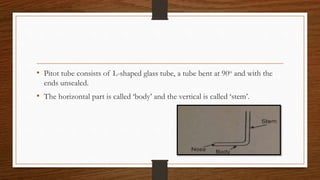
• Pitot tube consists of L-shaped glass tube, a tube bent at 90o and with the
ends unsealed.
• The horizontal part is called ‘body’ and the vertical is called ‘stem’.
Construction and working
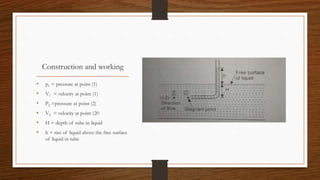
• p1 = pressure at point (1)
• V1 = velocity at point (1)
• P2 =pressure at point (2)
• V2 = velocity at point (20
• H = depth of tube in liquid
• h = rise of liquid above the free surface
of liquid in tube
Velocity measurement and Coefficient of pitot
tube
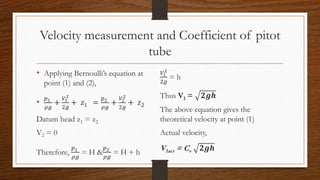
• Applying Bernoulli’s equation at
point (1) and (2),
•
𝑝1
𝜌𝑔
+
𝑉1
2
2𝑔
+ 𝑧1 =
𝑝2
𝜌𝑔
+
𝑉2
2
2𝑔
+ 𝑧2
Datum head z1 = z2
V2 = 0
Therefore,
𝑝1
𝜌𝑔
= H &
𝑝2
𝜌𝑔
= H + h
𝑉1
2
2𝑔
= h
Thus V1 = 𝟐𝒈𝒉
The above equation gives the
theoretical velocity at point (1)
Actual velocity,
V1act = Cv 𝟐𝒈𝒉
Continued…
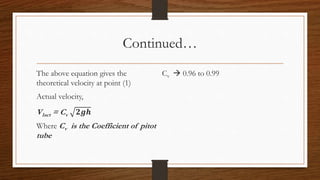
The above equation gives the
theoretical velocity at point (1)
Actual velocity,
V1act = Cv 𝟐𝒈𝒉
Where Cv is the Coefficient of pitot
tube
Cv  0.96 to 0.99
Stagnation or Total Head
It is the sum of static head and dynamic head. • Total head:
𝑝1
𝜌𝑔
+
𝑉1
2
2𝑔
=
𝑝2
𝜌𝑔
• Total pressure at point (1):
= static + dynamic pressure
p1 = p2 –
𝑉1
2
2
⍴
• Total pressure at point (2):
p2 =
𝑉1
2
2
⍴ + p1
Static pressure
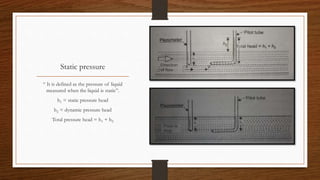
“ It is defined as the pressure of liquid
measured when the liquid is static”.
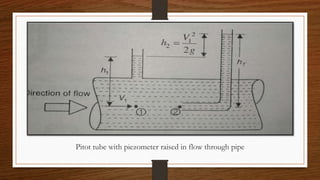
h1 = static pressure head
h2 = dynamic pressure head
Total pressure head = h1 + h2
Types of Pitot tube
Pitot tube with piezometer raised in flow through pipe
Pitot tube with differential
manometer
Here,
V1 = Cv 2𝑔ℎ
h = x[
⍴ 𝐻𝑔
⍴ 𝑝𝑖𝑝𝑒
- 1]
X = Differential manometer reading in
mm of mercury
⍴ 𝑝𝑖𝑝𝑒 = Density of liquid flow through
pipe
Pitot static tube
h = x[
⍴ 𝐻𝑔
⍴ 𝑝𝑖𝑝𝑒
- 1]
h in meter of liquid flow in channel or
through pipe
Applications
• In industry, the flow velocities being measured are often those flowing in
ducts and tubing where pitot tube is useful.
• In weather stations with high wind speeds.
Current Meter
• The Current meter is a device used to measure the velocity of water in rivers
and in open channels.
• The current meter consists of hollow hemisphere or cups mounted on
spokes so as to cause rotation about a shaft perpendicular to the direction of
flow.
Principle
 Mechanical
• Mechanical current meters are mostly
based on counting the rotations of a
propeller.
 Acoustic
• Doppler effect is used. It use a ceramic
transducer to emit a sound into the
water.
 Electromagnetic Induction
• Charged particles (the ions in seawater)
are moving with the ocean currents in
the magnetic field of the Earth which is
perpendicular to the movement.
• Using Faraday's law of induction , it is
possible to evaluate the variability of the
averaged horizontal flow by measuring
the induced electric currents.
 Tilt
• Tilt current meters operate under the
drag-tilt principle. They consist of a sub-
surface buoy that is anchored to the sea
floor with a flexible line or tether.
Construction and working
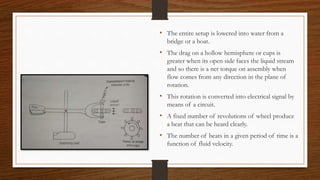
• The entire setup is lowered into water from a
bridge or a boat.
• The drag on a hollow hemisphere or cups is
greater when its open side faces the liquid stream
and so there is a net torque on assembly when
flow comes from any direction in the plane of
rotation.
• This rotation is converted into electrical signal by
means of a circuit.
• A fixed number of revolutions of wheel produce
a beat that can be heard clearly.
• The number of beats in a given period of time is a
function of fluid velocity.
References
• Fluid Mechanics: Basic Concepts & Principles, Shiv Kumar
• http://www.sciencedaily.com/releases/2010/09/100914102112.htm
• http://www.aoml.noaa.gov/phod/floridacurrent/background.php

fluid flow measuring instruments

  • 1.
    Fluid Flow Measuring Instruments Guidedby: Mr. Kartik Ayer Prepared by: Gaurav Dave(130990136011)
  • 2.
    Contents  Pitot tube Introduction  Working principle  Construction and working  Types of Pitot tube  Applications  Current meter  Introduction  Working principle  Construction and working
  • 3.
  • 4.
    • Pitot tubewas invented by the French engineer Henri Pitot in the early 18th century. • Pitot tube is a pressure measurement instrument used to measure fluid flow velocity. • It is used for measuring the velocity of liquid flow at any point in a pipe or a channel.
  • 5.
    Working principle ofPitot tube • “If the velocity of flow at a point becomes zero, the pressure is increased there due to the conversion of the kinetic energy into pressure energy.” • The point at which the velocity of flow becomes zero is called stagnant point. • The pressure at stagnant point is called total pressure or head or stagnation pressure.
  • 6.
  • 7.
    • Pitot tubeconsists of L-shaped glass tube, a tube bent at 90o and with the ends unsealed. • The horizontal part is called ‘body’ and the vertical is called ‘stem’.
  • 8.
    Construction and working •p1 = pressure at point (1) • V1 = velocity at point (1) • P2 =pressure at point (2) • V2 = velocity at point (20 • H = depth of tube in liquid • h = rise of liquid above the free surface of liquid in tube
  • 9.
    Velocity measurement andCoefficient of pitot tube • Applying Bernoulli’s equation at point (1) and (2), • 𝑝1 𝜌𝑔 + 𝑉1 2 2𝑔 + 𝑧1 = 𝑝2 𝜌𝑔 + 𝑉2 2 2𝑔 + 𝑧2 Datum head z1 = z2 V2 = 0 Therefore, 𝑝1 𝜌𝑔 = H & 𝑝2 𝜌𝑔 = H + h 𝑉1 2 2𝑔 = h Thus V1 = 𝟐𝒈𝒉 The above equation gives the theoretical velocity at point (1) Actual velocity, V1act = Cv 𝟐𝒈𝒉
  • 10.
    Continued… The above equationgives the theoretical velocity at point (1) Actual velocity, V1act = Cv 𝟐𝒈𝒉 Where Cv is the Coefficient of pitot tube Cv  0.96 to 0.99
  • 11.
    Stagnation or TotalHead It is the sum of static head and dynamic head. • Total head: 𝑝1 𝜌𝑔 + 𝑉1 2 2𝑔 = 𝑝2 𝜌𝑔 • Total pressure at point (1): = static + dynamic pressure p1 = p2 – 𝑉1 2 2 ⍴ • Total pressure at point (2): p2 = 𝑉1 2 2 ⍴ + p1
  • 12.
    Static pressure “ Itis defined as the pressure of liquid measured when the liquid is static”. h1 = static pressure head h2 = dynamic pressure head Total pressure head = h1 + h2
  • 13.
  • 14.
    Pitot tube withpiezometer raised in flow through pipe
  • 15.
    Pitot tube withdifferential manometer Here, V1 = Cv 2𝑔ℎ h = x[ ⍴ 𝐻𝑔 ⍴ 𝑝𝑖𝑝𝑒 - 1] X = Differential manometer reading in mm of mercury ⍴ 𝑝𝑖𝑝𝑒 = Density of liquid flow through pipe
  • 16.
    Pitot static tube h= x[ ⍴ 𝐻𝑔 ⍴ 𝑝𝑖𝑝𝑒 - 1] h in meter of liquid flow in channel or through pipe
  • 17.
  • 18.
    • In industry,the flow velocities being measured are often those flowing in ducts and tubing where pitot tube is useful. • In weather stations with high wind speeds.
  • 19.
  • 20.
    • The Currentmeter is a device used to measure the velocity of water in rivers and in open channels. • The current meter consists of hollow hemisphere or cups mounted on spokes so as to cause rotation about a shaft perpendicular to the direction of flow.
  • 21.
  • 22.
     Mechanical • Mechanicalcurrent meters are mostly based on counting the rotations of a propeller.  Acoustic • Doppler effect is used. It use a ceramic transducer to emit a sound into the water.  Electromagnetic Induction • Charged particles (the ions in seawater) are moving with the ocean currents in the magnetic field of the Earth which is perpendicular to the movement. • Using Faraday's law of induction , it is possible to evaluate the variability of the averaged horizontal flow by measuring the induced electric currents.  Tilt • Tilt current meters operate under the drag-tilt principle. They consist of a sub- surface buoy that is anchored to the sea floor with a flexible line or tether.
  • 23.
  • 24.
    • The entiresetup is lowered into water from a bridge or a boat. • The drag on a hollow hemisphere or cups is greater when its open side faces the liquid stream and so there is a net torque on assembly when flow comes from any direction in the plane of rotation. • This rotation is converted into electrical signal by means of a circuit. • A fixed number of revolutions of wheel produce a beat that can be heard clearly. • The number of beats in a given period of time is a function of fluid velocity.
  • 25.
    References • Fluid Mechanics:Basic Concepts & Principles, Shiv Kumar • http://www.sciencedaily.com/releases/2010/09/100914102112.htm • http://www.aoml.noaa.gov/phod/floridacurrent/background.php