Introduction to Fluid Mechanics and its
applications
Dr. Mohsin Siddique
Assistant Professor
1
Fluid Mechanics
INTRODUCTION
DR. MOHSIN SIDDIQUE
Specialization:
Coastal Engineering, Hydraulic
Engineering, Sediment transport,
hydrodynamics, Numerical modeling,
Water resources
Education:
Ph.D. (2008-2011):
The University ofTokyo
M.Sc. (2005-2007):
The University ofTokyo
B.Sc. (2000-2004):
UET Lahore
Teaching Experiences:
Asst. Prof (9/2013~): UOS
Asst. Prof (8/2012~9/2013): FAST NU
Asst. Prof (1/2012-8/2012): UET Lahore
Lecturer (12/2004~12/2011); UET
Lahore
• Contact Detail:
• Email:
2
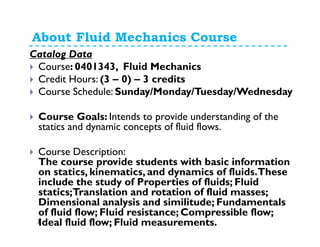
About Fluid Mechanics Course
Catalog Data
Course: 0401343, Fluid Mechanics
Credit Hours: (3 – 0) – 3 credits
Course Schedule: Sunday/Monday/Tuesday/Wednesday
Course Goals: Intends to provide understanding of the
statics and dynamic concepts of fluid flows.
Course Description:
The course provide students with basic information
on statics, kinematics, and dynamics of fluids.These
include the study of Properties of fluids; Fluid
statics;Translation and rotation of fluid masses;
Dimensional analysis and similitude; Fundamentals
of fluid flow; Fluid resistance; Compressible flow;
Ideal fluid flow; Fluid measurements.3
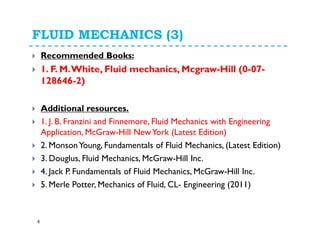
FLUID MECHANICS (3)
4
Recommended Books:
1. F. M.White, Fluid mechanics, Mcgraw-Hill (0-07-
128646-2)
Additional resources.
1. J. B. Franzini and Finnemore, Fluid Mechanics with Engineering
Application, McGraw-Hill NewYork (Latest Edition)
2. MonsonYoung, Fundamentals of Fluid Mechanics, (Latest Edition)
3. Douglus, Fluid Mechanics, McGraw-Hill Inc.
4. Jack P. Fundamentals of Fluid Mechanics, McGraw-Hill Inc.
5. Merle Potter, Mechanics of Fluid, CL- Engineering (2011)
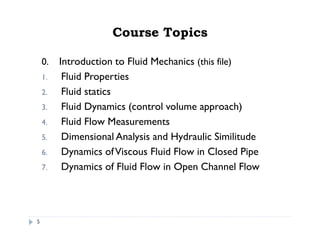
Course Topics
0. Introduction to Fluid Mechanics (this file)
1. Fluid Properties
2. Fluid statics
3. Fluid Dynamics (control volume approach)
4. Fluid Flow Measurements
5. Dimensional Analysis and Hydraulic Similitude
6. Dynamics ofViscous Fluid Flow in Closed Pipe
7. Dynamics of Fluid Flow in Open Channel Flow
5
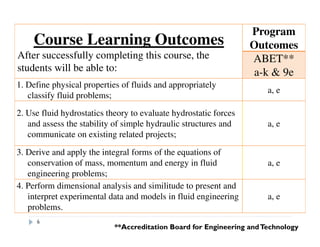
Course Learning Outcomes
After successfully completing this course, the
students will be able to:
Program
Outcomes
ABET**
a-k & 9e
1. Define physical properties of fluids and appropriately
classify fluid problems;
a, e
2. Use fluid hydrostatics theory to evaluate hydrostatic forces
and assess the stability of simple hydraulic structures and
communicate on existing related projects;
a, e
3. Derive and apply the integral forms of the equations of
conservation of mass, momentum and energy in fluid
engineering problems;
a, e
4. Perform dimensional analysis and similitude to present and
interpret experimental data and models in fluid engineering
problems.
a, e
6
**Accreditation Board for Engineering andTechnology
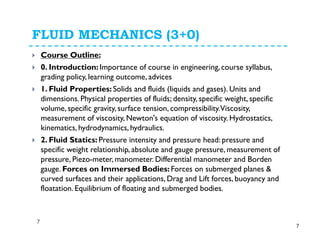
FLUID MECHANICS (3+0)
Course Outline:
0. Introduction: Importance of course in engineering, course syllabus,
grading policy, learning outcome, advices
1. Fluid Properties: Solids and fluids (liquids and gases). Units and
dimensions. Physical properties of fluids; density, specific weight, specific
volume, specific gravity, surface tension, compressibility.Viscosity,
measurement of viscosity, Newton's equation of viscosity. Hydrostatics,
kinematics, hydrodynamics, hydraulics.
2. Fluid Statics: Pressure intensity and pressure head: pressure and
specific weight relationship, absolute and gauge pressure, measurement of
pressure, Piezo-meter, manometer. Differential manometer and Borden
gauge. Forces on Immersed Bodies: Forces on submerged planes &
curved surfaces and their applications, Drag and Lift forces, buoyancy and
floatation. Equilibrium of floating and submerged bodies.
7
7
FLUID MECHANICS (3+1)
8
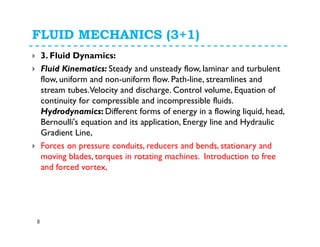
3. Fluid Dynamics:
Fluid Kinematics: Steady and unsteady flow, laminar and turbulent
flow, uniform and non-uniform flow. Path-line, streamlines and
stream tubes.Velocity and discharge. Control volume, Equation of
continuity for compressible and incompressible fluids.
Hydrodynamics: Different forms of energy in a flowing liquid, head,
Bernoulli's equation and its application, Energy line and Hydraulic
Gradient Line,
Forces on pressure conduits, reducers and bends, stationary and
moving blades, torques in rotating machines. Introduction to free
and forced vortex,
FLUID MECHANICS (3+1)
9
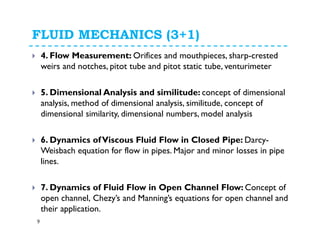
4. Flow Measurement: Orifices and mouthpieces, sharp-crested
weirs and notches, pitot tube and pitot static tube, venturimeter
5. Dimensional Analysis and similitude: concept of dimensional
analysis, method of dimensional analysis, similitude, concept of
dimensional similarity, dimensional numbers, model analysis
6. Dynamics ofViscous Fluid Flow in Closed Pipe: Darcy-
Weisbach equation for flow in pipes. Major and minor losses in pipe
lines.
7. Dynamics of Fluid Flow in Open Channel Flow: Concept of
open channel, Chezy’s and Manning’s equations for open channel and
their application.
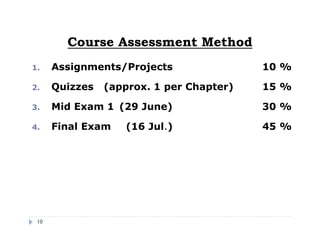
Course Assessment Method
1. Assignments/Projects 10 %
2. Quizzes (approx. 1 per Chapter) 15 %
3. Mid Exam 1 (29 June) 30 %
4. Final Exam (16 Jul.) 45 %
10
MY GLODEN ADVISESMY GLODEN ADVISES
Office Hours: A golden time to build up your skills and excel in the
course with my golden advices on the course topics and strengthen
your engineering skills in the subject.
Homework Assignments: Homework assignments are bonus points it
will only benefit you if you spend the necessary time to understand the
basics and solve the problems yourself. Keep up with the homework
assignments, as the topics in this course build upon each other.
Quizzes: Focused assessment by chapter to monitor your progress and
discover your weakness in the chapter. If you do bad in quizzes you
must rethink: (1) the way you solved your homework ,and (2)
reconsider to efficiently use the office hours.
Be Professional and watch the deadlines: In your professional life
dedication and keeping deadlines are your keys for success, No One
(neither your boss nor you client) will respect your excuses for a
delayed work. Start here and teach your self the wisdom of an
organized professional learning.
11
Examination Policy
Examinations will deal with your class work, textbook problems. Nevertheless,
due to the difficulties associated with course your textbook will be never
enough to get an A in this course. Use the additional references to be
better prepared.
Examinations are closed book and only complex Formulas will be provided.
Attendance Policy
The University of Sharjah Attendance Policy applies to this course
The classroom doors will be closed 10 minutes after the class start time.
Assignment Delay Policy
1 day of delay will reduce your assignment grade by 1.
2 days delay mean -2 and so on… if assignment is delayed by one week,
there will be not grade.
Important Note:
12
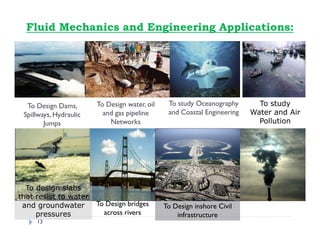
Fluid Mechanics and Engineering Applications:
To Design water, oil
and gas pipeline
Networks
To study Oceanography
and Coastal Engineering
To Design Dams,
Spillways, Hydraulic
Jumps
To study
Water and Air
Pollution
To Design bridges
across rivers
To design slabs
that resist to water
and groundwater
pressures
To Design inshore Civil
infrastructure
13
FLUID MECHANICS
14
Fluid: Fluids are substance which area capable of flowing and
conforming the shapes of container.
Fluids can be in gas or liquid states.
Mechanics: Mechanics is the branch of science that deals with
the state of rest or motion of body under the action of forces.
Fluid Mechanics: Branch of mechanic that deals with the
response or behavior of fluid either at rest or in motion.
Branches of Fluid Mechanics
15
Fluid Statics: It is the branch of fluid mechanics which deals
with the response/behavior of fluid when they are at rest.
Fluid kinematics: It deals with the response of fluid when
they are in motion without considering the energies and
forces in them.
Hydrodynamics: It deals with the behavior of fluids when
they are in motion considering energies and forces in them.
Hydraulics: It is the most important and
practical/experimental branch of fluid mechanics which
deals with the behavior of water and other fluid either at rest
or in motion.
Significance of Fluid Mechanics
16
Fluid is the most abundant available substance e.g., air,
gases, ocean, river and canal etc.
It provides basis for other subjects e.g.,
Public health/environmental engineering
Hydraulic Engineering
Irrigation Engineering
Coastal engineering
etc etc
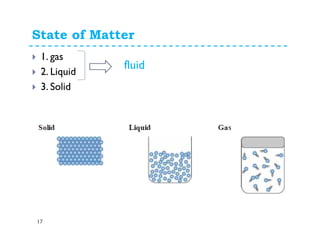
State of Matter
17
1. gas
2. Liquid
3. Solid
fluid
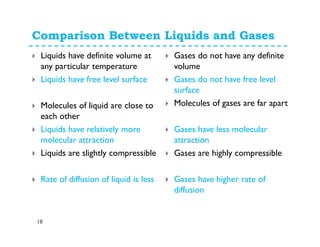
Comparison Between Liquids and Gases
18
Liquids have definite volume at
any particular temperature
Liquids have free level surface
Molecules of liquid are close to
each other
Liquids have relatively more
molecular attraction
Liquids are slightly compressible
Rate of diffusion of liquid is less
Gases do not have any definite
volume
Gases do not have free level
surface
Molecules of gases are far apart
Gases have less molecular
attraction
Gases are highly compressible
Gases have higher rate of
diffusion
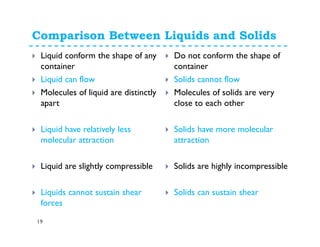
Comparison Between Liquids and Solids
19
Liquid conform the shape of any
container
Liquid can flow
Molecules of liquid are distinctly
apart
Liquid have relatively less
molecular attraction
Liquid are slightly compressible
Liquids cannot sustain shear
forces
Do not conform the shape of
container
Solids cannot flow
Molecules of solids are very
close to each other
Solids have more molecular
attraction
Solids are highly incompressible
Solids can sustain shear
Dimension and Units
20
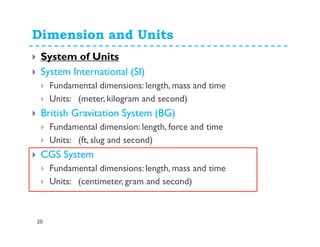
System of Units
System International (SI)
Fundamental dimensions: length, mass and time
Units: (meter, kilogram and second)
British Gravitation System (BG)
Fundamental dimension: length, force and time
Units: (ft, slug and second)
CGS System
Fundamental dimensions: length, mass and time
Units: (centimeter, gram and second)
Dimension and Units
21
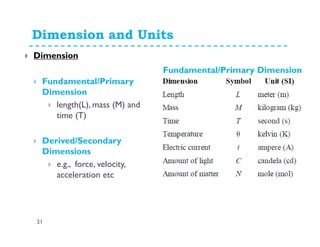
Dimension
Fundamental/Primary
Dimension
length(L), mass (M) and
time (T)
Derived/Secondary
Dimensions
e.g., force, velocity,
acceleration etc
Fundamental/Primary Dimension
Units of Some Dimensions in Different Systems
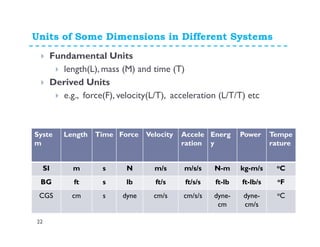
22
Syste
m
Length Time Force Velocity Accele
ration
Energ
y
Power Tempe
rature
SI m s N m/s m/s/s N-m kg-m/s oC
BG ft s lb ft/s ft/s/s ft-lb ft-lb/s oF
CGS cm s dyne cm/s cm/s/s dyne-
cm
dyne-
cm/s
oC
Fundamental Units
length(L), mass (M) and time (T)
Derived Units
e.g., force(F), velocity(L/T), acceleration (L/T/T) etc
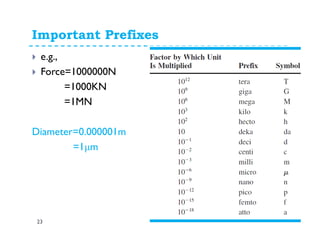
Important Prefixes
23
e.g.,
Force=1000000N
=1000KN
=1MN
Diameter=0.000001m
=1µm
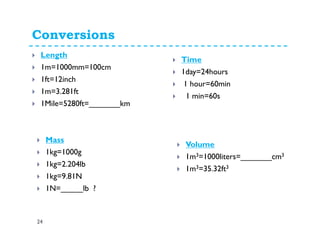
Conversions
24
Length
1m=1000mm=100cm
1ft=12inch
1m=3.281ft
1Mile=5280ft=_______km
Time
1day=24hours
1 hour=60min
1 min=60s
Mass
1kg=1000g
1kg=2.204lb
1kg=9.81N
1N=_____lb ?
Volume
1m3=1000liters=_______cm3
1m3=35.32ft3
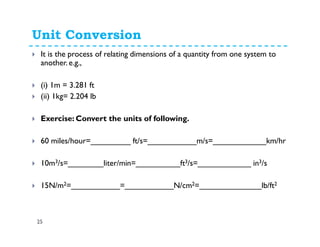
Unit Conversion
25
It is the process of relating dimensions of a quantity from one system to
another. e.g.,
(i) 1m = 3.281 ft
(ii) 1kg= 2.204 lb
Exercise: Convert the units of following.
60 miles/hour=_________ ft/s=___________m/s=____________km/hr
10m3/s=________liter/min=__________ft3/s=____________ in3/s
15N/m2=___________=___________N/cm2=______________lb/ft2
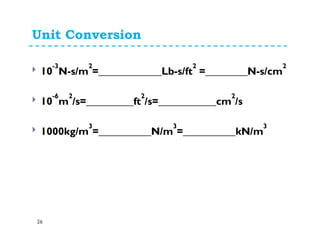
Unit Conversion
26
10
-3
N-s/m
2
=____________Lb-s/ft
2
=________N-s/cm
2
10
-6
m
2
/s=_________ft
2
/s=___________cm
2
/s
1000kg/m
3
=__________N/m
3
=__________kN/m
3
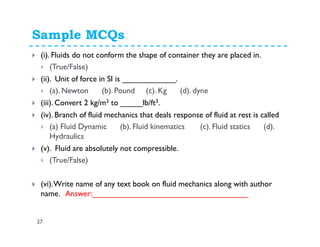
Sample MCQs
27
(i). Fluids do not conform the shape of container they are placed in.
(True/False)
(ii). Unit of force in SI is ____________.
(a). Newton (b). Pound (c). Kg (d). dyne
(iii). Convert 2 kg/m3 to _____lb/ft3.
(iv). Branch of fluid mechanics that deals response of fluid at rest is called
(a) Fluid Dynamic (b). Fluid kinematics (c). Fluid statics (d).
Hydraulics
(v). Fluid are absolutely not compressible.
(True/False)
(vi).Write name of any text book on fluid mechanics along with author
name. Answer:___________________________________
Thank you
Let’s discuss if you have any question….
Feel free to contact:
28

Introduction to fluid mechanics

  • 1.
    Introduction to FluidMechanics and its applications Dr. Mohsin Siddique Assistant Professor 1 Fluid Mechanics
  • 2.
    INTRODUCTION DR. MOHSIN SIDDIQUE Specialization: CoastalEngineering, Hydraulic Engineering, Sediment transport, hydrodynamics, Numerical modeling, Water resources Education: Ph.D. (2008-2011): The University ofTokyo M.Sc. (2005-2007): The University ofTokyo B.Sc. (2000-2004): UET Lahore Teaching Experiences: Asst. Prof (9/2013~): UOS Asst. Prof (8/2012~9/2013): FAST NU Asst. Prof (1/2012-8/2012): UET Lahore Lecturer (12/2004~12/2011); UET Lahore • Contact Detail: • Email: 2
  • 3.
    About Fluid MechanicsCourse Catalog Data Course: 0401343, Fluid Mechanics Credit Hours: (3 – 0) – 3 credits Course Schedule: Sunday/Monday/Tuesday/Wednesday Course Goals: Intends to provide understanding of the statics and dynamic concepts of fluid flows. Course Description: The course provide students with basic information on statics, kinematics, and dynamics of fluids.These include the study of Properties of fluids; Fluid statics;Translation and rotation of fluid masses; Dimensional analysis and similitude; Fundamentals of fluid flow; Fluid resistance; Compressible flow; Ideal fluid flow; Fluid measurements.3
  • 4.
    FLUID MECHANICS (3) 4 RecommendedBooks: 1. F. M.White, Fluid mechanics, Mcgraw-Hill (0-07- 128646-2) Additional resources. 1. J. B. Franzini and Finnemore, Fluid Mechanics with Engineering Application, McGraw-Hill NewYork (Latest Edition) 2. MonsonYoung, Fundamentals of Fluid Mechanics, (Latest Edition) 3. Douglus, Fluid Mechanics, McGraw-Hill Inc. 4. Jack P. Fundamentals of Fluid Mechanics, McGraw-Hill Inc. 5. Merle Potter, Mechanics of Fluid, CL- Engineering (2011)
  • 5.
    Course Topics 0. Introductionto Fluid Mechanics (this file) 1. Fluid Properties 2. Fluid statics 3. Fluid Dynamics (control volume approach) 4. Fluid Flow Measurements 5. Dimensional Analysis and Hydraulic Similitude 6. Dynamics ofViscous Fluid Flow in Closed Pipe 7. Dynamics of Fluid Flow in Open Channel Flow 5
  • 6.
    Course Learning Outcomes Aftersuccessfully completing this course, the students will be able to: Program Outcomes ABET** a-k & 9e 1. Define physical properties of fluids and appropriately classify fluid problems; a, e 2. Use fluid hydrostatics theory to evaluate hydrostatic forces and assess the stability of simple hydraulic structures and communicate on existing related projects; a, e 3. Derive and apply the integral forms of the equations of conservation of mass, momentum and energy in fluid engineering problems; a, e 4. Perform dimensional analysis and similitude to present and interpret experimental data and models in fluid engineering problems. a, e 6 **Accreditation Board for Engineering andTechnology
  • 7.
    FLUID MECHANICS (3+0) CourseOutline: 0. Introduction: Importance of course in engineering, course syllabus, grading policy, learning outcome, advices 1. Fluid Properties: Solids and fluids (liquids and gases). Units and dimensions. Physical properties of fluids; density, specific weight, specific volume, specific gravity, surface tension, compressibility.Viscosity, measurement of viscosity, Newton's equation of viscosity. Hydrostatics, kinematics, hydrodynamics, hydraulics. 2. Fluid Statics: Pressure intensity and pressure head: pressure and specific weight relationship, absolute and gauge pressure, measurement of pressure, Piezo-meter, manometer. Differential manometer and Borden gauge. Forces on Immersed Bodies: Forces on submerged planes & curved surfaces and their applications, Drag and Lift forces, buoyancy and floatation. Equilibrium of floating and submerged bodies. 7 7
  • 8.
    FLUID MECHANICS (3+1) 8 3.Fluid Dynamics: Fluid Kinematics: Steady and unsteady flow, laminar and turbulent flow, uniform and non-uniform flow. Path-line, streamlines and stream tubes.Velocity and discharge. Control volume, Equation of continuity for compressible and incompressible fluids. Hydrodynamics: Different forms of energy in a flowing liquid, head, Bernoulli's equation and its application, Energy line and Hydraulic Gradient Line, Forces on pressure conduits, reducers and bends, stationary and moving blades, torques in rotating machines. Introduction to free and forced vortex,
  • 9.
    FLUID MECHANICS (3+1) 9 4.Flow Measurement: Orifices and mouthpieces, sharp-crested weirs and notches, pitot tube and pitot static tube, venturimeter 5. Dimensional Analysis and similitude: concept of dimensional analysis, method of dimensional analysis, similitude, concept of dimensional similarity, dimensional numbers, model analysis 6. Dynamics ofViscous Fluid Flow in Closed Pipe: Darcy- Weisbach equation for flow in pipes. Major and minor losses in pipe lines. 7. Dynamics of Fluid Flow in Open Channel Flow: Concept of open channel, Chezy’s and Manning’s equations for open channel and their application.
  • 10.
    Course Assessment Method 1.Assignments/Projects 10 % 2. Quizzes (approx. 1 per Chapter) 15 % 3. Mid Exam 1 (29 June) 30 % 4. Final Exam (16 Jul.) 45 % 10
  • 11.
    MY GLODEN ADVISESMYGLODEN ADVISES Office Hours: A golden time to build up your skills and excel in the course with my golden advices on the course topics and strengthen your engineering skills in the subject. Homework Assignments: Homework assignments are bonus points it will only benefit you if you spend the necessary time to understand the basics and solve the problems yourself. Keep up with the homework assignments, as the topics in this course build upon each other. Quizzes: Focused assessment by chapter to monitor your progress and discover your weakness in the chapter. If you do bad in quizzes you must rethink: (1) the way you solved your homework ,and (2) reconsider to efficiently use the office hours. Be Professional and watch the deadlines: In your professional life dedication and keeping deadlines are your keys for success, No One (neither your boss nor you client) will respect your excuses for a delayed work. Start here and teach your self the wisdom of an organized professional learning. 11
  • 12.
    Examination Policy Examinations willdeal with your class work, textbook problems. Nevertheless, due to the difficulties associated with course your textbook will be never enough to get an A in this course. Use the additional references to be better prepared. Examinations are closed book and only complex Formulas will be provided. Attendance Policy The University of Sharjah Attendance Policy applies to this course The classroom doors will be closed 10 minutes after the class start time. Assignment Delay Policy 1 day of delay will reduce your assignment grade by 1. 2 days delay mean -2 and so on… if assignment is delayed by one week, there will be not grade. Important Note: 12
  • 13.
    Fluid Mechanics andEngineering Applications: To Design water, oil and gas pipeline Networks To study Oceanography and Coastal Engineering To Design Dams, Spillways, Hydraulic Jumps To study Water and Air Pollution To Design bridges across rivers To design slabs that resist to water and groundwater pressures To Design inshore Civil infrastructure 13
  • 14.
    FLUID MECHANICS 14 Fluid: Fluidsare substance which area capable of flowing and conforming the shapes of container. Fluids can be in gas or liquid states. Mechanics: Mechanics is the branch of science that deals with the state of rest or motion of body under the action of forces. Fluid Mechanics: Branch of mechanic that deals with the response or behavior of fluid either at rest or in motion.
  • 15.
    Branches of FluidMechanics 15 Fluid Statics: It is the branch of fluid mechanics which deals with the response/behavior of fluid when they are at rest. Fluid kinematics: It deals with the response of fluid when they are in motion without considering the energies and forces in them. Hydrodynamics: It deals with the behavior of fluids when they are in motion considering energies and forces in them. Hydraulics: It is the most important and practical/experimental branch of fluid mechanics which deals with the behavior of water and other fluid either at rest or in motion.
  • 16.
    Significance of FluidMechanics 16 Fluid is the most abundant available substance e.g., air, gases, ocean, river and canal etc. It provides basis for other subjects e.g., Public health/environmental engineering Hydraulic Engineering Irrigation Engineering Coastal engineering etc etc
  • 17.
    State of Matter 17 1.gas 2. Liquid 3. Solid fluid
  • 18.
    Comparison Between Liquidsand Gases 18 Liquids have definite volume at any particular temperature Liquids have free level surface Molecules of liquid are close to each other Liquids have relatively more molecular attraction Liquids are slightly compressible Rate of diffusion of liquid is less Gases do not have any definite volume Gases do not have free level surface Molecules of gases are far apart Gases have less molecular attraction Gases are highly compressible Gases have higher rate of diffusion
  • 19.
    Comparison Between Liquidsand Solids 19 Liquid conform the shape of any container Liquid can flow Molecules of liquid are distinctly apart Liquid have relatively less molecular attraction Liquid are slightly compressible Liquids cannot sustain shear forces Do not conform the shape of container Solids cannot flow Molecules of solids are very close to each other Solids have more molecular attraction Solids are highly incompressible Solids can sustain shear
  • 20.
    Dimension and Units 20 Systemof Units System International (SI) Fundamental dimensions: length, mass and time Units: (meter, kilogram and second) British Gravitation System (BG) Fundamental dimension: length, force and time Units: (ft, slug and second) CGS System Fundamental dimensions: length, mass and time Units: (centimeter, gram and second)
  • 21.
    Dimension and Units 21 Dimension Fundamental/Primary Dimension length(L),mass (M) and time (T) Derived/Secondary Dimensions e.g., force, velocity, acceleration etc Fundamental/Primary Dimension
  • 22.
    Units of SomeDimensions in Different Systems 22 Syste m Length Time Force Velocity Accele ration Energ y Power Tempe rature SI m s N m/s m/s/s N-m kg-m/s oC BG ft s lb ft/s ft/s/s ft-lb ft-lb/s oF CGS cm s dyne cm/s cm/s/s dyne- cm dyne- cm/s oC Fundamental Units length(L), mass (M) and time (T) Derived Units e.g., force(F), velocity(L/T), acceleration (L/T/T) etc
  • 23.
  • 24.
  • 25.
    Unit Conversion 25 It isthe process of relating dimensions of a quantity from one system to another. e.g., (i) 1m = 3.281 ft (ii) 1kg= 2.204 lb Exercise: Convert the units of following. 60 miles/hour=_________ ft/s=___________m/s=____________km/hr 10m3/s=________liter/min=__________ft3/s=____________ in3/s 15N/m2=___________=___________N/cm2=______________lb/ft2
  • 26.
  • 27.
    Sample MCQs 27 (i). Fluidsdo not conform the shape of container they are placed in. (True/False) (ii). Unit of force in SI is ____________. (a). Newton (b). Pound (c). Kg (d). dyne (iii). Convert 2 kg/m3 to _____lb/ft3. (iv). Branch of fluid mechanics that deals response of fluid at rest is called (a) Fluid Dynamic (b). Fluid kinematics (c). Fluid statics (d). Hydraulics (v). Fluid are absolutely not compressible. (True/False) (vi).Write name of any text book on fluid mechanics along with author name. Answer:___________________________________
  • 28.
    Thank you Let’s discussif you have any question…. Feel free to contact: 28