Fluid Statics and Manometers January 24 and 29, 2008
ME 390 – Fluid Mechanics 1
Introduction to Fluid StaticsIntroduction to Fluid Statics
and Manometersand Manometers
Larry Caretto
Mechanical Engineering 390
Fluid MechanicsFluid Mechanics
January 24 and 29, 2008
2
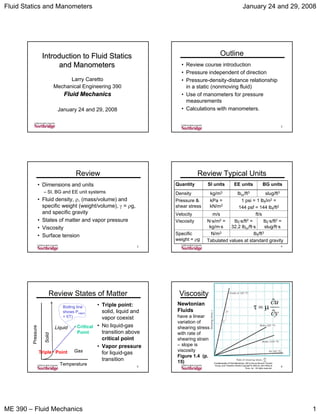
Outline
• Review course introduction
• Pressure independent of direction
• Pressure-density-distance relationship
in a static (nonmoving fluid)
• Use of manometers for pressure
measurements
• Calculations with manometers.
3
Review
• Dimensions and units
– SI, BG and EE unit systems
• Fluid density, ρ, (mass/volume) and
specific weight (weight/volume), γ = ρg,
and specific gravity
• States of matter and vapor pressure
• Viscosity
• Surface tension
4
Review Typical Units
Tabulated values at standard gravity
lbf·s/ft2 =
32.2 lbm/ft·s
lbm/ft3
EE units
lbf·s/ft2 =
slug/ft·s
N·s/m2 =
kg/m·s
Viscosity
lbf/ft3N/m3Specific
weight = ρg
ft/sm/sVelocity
1 psi = 1 lbf/in2 =
144 psf = 144 lbf/ft2
kPa =
kN/m2
Pressure &
shear stress
slug/ft3kg/m3Density
BG unitsSI unitsQuantity
5
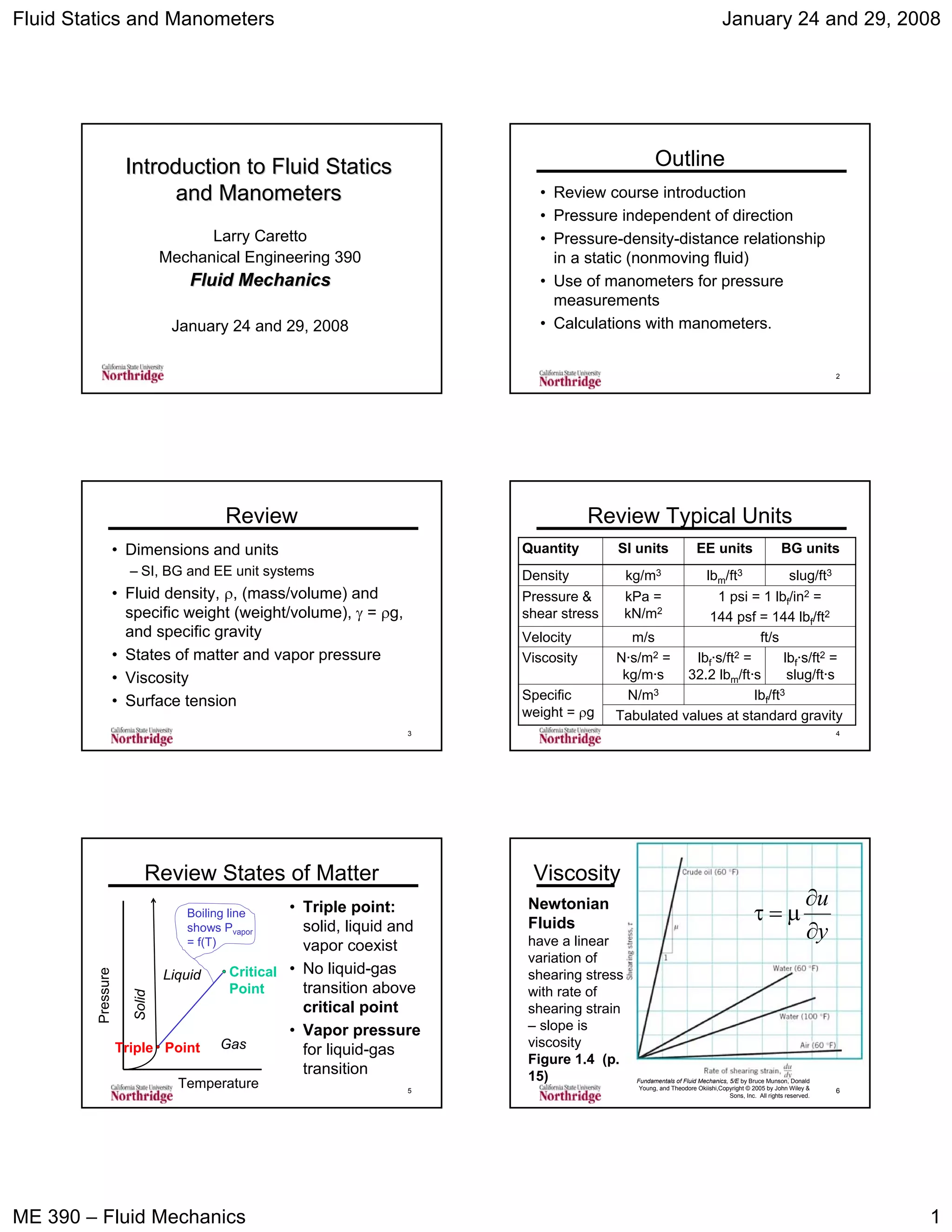
Review States of Matter
Gas
Temperature
Pressure
Liquid
Solid
Critical
Point
Triple Point
• Triple point:
solid, liquid and
vapor coexist
• No liquid-gas
transition above
critical point
• Vapor pressure
for liquid-gas
transition
Boiling line
shows Pvapor
= f(T)
6
Newtonian
Fluids
have a linear
variation of
shearing stress
with rate of
shearing strain
– slope is
viscosity
Figure 1.4 (p.
15)
Viscosity
y
u
∂
∂
μ=τ
Fundamentals of Fluid Mechanics, 5/E by Bruce Munson, Donald
Young, and Theodore Okiishi,Copyright © 2005 by John Wiley &
Sons, Inc. All rights reserved.
Fluid Statics and Manometers January 24 and 29, 2008
ME 390 – Fluid Mechanics 2
7Fundamentals of Fluid Mechanics, 5/E by Bruce Munson, Donald
Young, and Theodore Okiishi,Copyright © 2005 by John Wiley &
Sons, Inc. All rights reserved.
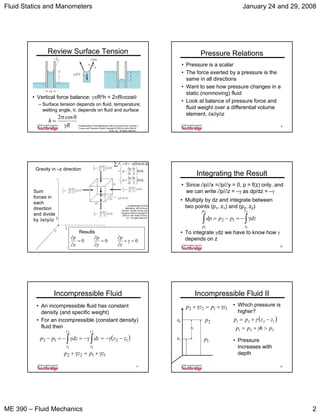
Review Surface Tension
• Vertical force balance: γπR2h = 2πRσcosθ
– Surface tension depends on fluid, temperature;
wetting angle, θ, depends on fluid and surface
R
h
γ
θσ
=
cos2
8
Pressure Relations
• Pressure is a scalar
• The force exerted by a pressure is the
same in all directions
• Want to see how pressure changes in a
static (nonmoving) fluid
• Look at balance of pressure force and
fluid weight over a differential volume
element, δxδyδz
9
Sum
forces in
each
direction
and divide
by δxδyδz
000 =γ+
∂
∂
=
∂
∂
=
∂
∂
z
p
y
p
x
p
Gravity in –z direction
Results
Fundamentals of Fluid
Mechanics, 5/E by Bruce
Munson, Donald Young, and
Theodore Okiishi,Copyright ©
2005 by John Wiley & Sons,
Inc. All rights reserved.
( )
yx
z
z
p
p
yx
z
z
p
p
gzyxFz
δδ⎟
⎠
⎞
⎜
⎝
⎛ δ
∂
∂
+−
δδ⎟
⎠
⎞
⎜
⎝
⎛ δ
∂
∂
−+
δδδρ−==∑
2
2
0
10
Integrating the Result
• Since ∂p/∂x =∂p/∂y = 0, p = f(z) only, and
we can write ∂p/∂z = –γ as dp/dz = –γ
∫∫ γ−=−=
2
1
2
1
12
z
z
p
p
dzppdp
• Multiply by dz and integrate between
two points (p1, z1) and (p2, z2)
• To integrate γdz we have to know how γ
depends on z
11
Incompressible Fluid
• An incompressible fluid has constant
density (and specific weight)
• For an incompressible (constant density)
fluid then
( )1212
2
1
2
1
zzdzdzpp
z
z
z
z
−γ−=γ−=γ−=− ∫∫
1122 zpzp γ+=γ+
12
Incompressible Fluid II
• Which pressure is
higher?
z1
z2
h
1122 zpzp γ+=γ+
2p
1p
( )
221
1221
phpp
zzpp
>+=
−+=
γ
γ
• Pressure
increases with
depth
Fluid Statics and Manometers January 24 and 29, 2008
ME 390 – Fluid Mechanics 3
13
Problem
• If the pressure at the surface of a body
of water (γ = 9789 N/m3 at 20oC) is 101
kPa, what are the pressures at depths
of 10 m and 100 m?
• Given: p1 = 101 kPa at z1 = 0
• Find: p at z2 = –10 m and z3 = –100 m
• Equation:
( )21121122 zzppzpzp −γ+=⇒γ+=γ+
14
Solution
( )
( )[ ] kPa
N
mkPa
mm
m
N
kPazzpp
9.198
1000
100
9789
101
2
3
2112
=
⋅
−−
+=−+= γ
( )
( )[ ] kPa
N
mkPa
mm
m
N
kPazzpp
1080
1000
1000
9789
101
2
3
3113
=
⋅
−−
+=−+= γ
Depth = 10 m
Depth = 100 m
15
Pressure Head
• Fluid height
equivalent to
a pressure
difference
z1
z2
h
2p
1p
( )
221
1221
phpp
zzpp
>γ+=
+γ+=
γ
−
= 12 pp
h
• h is called pressure head
• For p2 – p1 = 14.696 psia =
101.325 kPa, h = 0.76 m =
29.92 in for Hg
• What is h for water at this
Δp? 16
ΔP = 1 Atm for Water at 20oC
ft
ft
lb
ft
in
in
lb
pp
h
f
f
96.33
32.62
144696.14
3
2
2
2
12
==
γ
−
=
m
m
N
mkPa
N
kPa
pp
h 35.10
9789
1000
325.101
3
2
12
=⋅=
γ
−
=
• At 20oC, γwater = 9789 N/m3 = 62.32 lbf/ft3
(p 761, text)
17
Free Surface
• Surface of liquid open to atmosphere is
called a “free surface”
– Pressure, p0, is atmospheric pressure, p0
– Height, z0 = 0
– In the liquid, p + γz = p0 + γz0, where z < 0
– Depth h = z0 – z > 0
– p = p0 + γ(z0 – z) = p0 + γh
• Pressure, p, at depth, h, not influenced
by size or shape of container
18
Free Surface II
Figure 2.4, Fundamentals of Fluid Mechanics, 5/E by Bruce
Munson, Donald Young, and Theodore Okiishi Copyright ©
2005 by John Wiley & Sons, Inc. All rights reserved.
• Pressure, p, at depth, h, not influenced
by size or shape of container
Fluid Statics and Manometers January 24 and 29, 2008
ME 390 – Fluid Mechanics 4
19
Reference Pressure
• Free surface equation: p = p0 + γ(z0 – z)
• Apply this to two different pressures
– p1 = p0 + γ(z0 – z1)
– p2 = p0 + γ(z0 – z2)
• Find p2 – p1 from these equations
– Result: p2 – p1 = p0 + γ(z0 – z2) – [p0 + γ(z0
– z1)] = γ(z1 – z2) independent of p0 or z0
• Reference pressure cancels in taking
pressure differences
20
Gage Pressure
• For taking pressure differences, we can
use any reference pressure
• Many pressure measurement methods
measure the difference between actual
and atmospheric pressure
• We can used this measured pressure
difference, called gage pressure,
directly in Δp calculations
• pabsolute = pgage + patmosphere
21
Gage and Absolute Pressure
Figure 2.7, Fundamentals of Fluid Mechanics, 5/E by Bruce
Munson, Donald Young, and Theodore Okiishi Copyright ©
2005 by John Wiley & Sons, Inc. All rights reserved.
22
Barometric Pressure
Figure 2.8, Fundamentals of Fluid Mechanics, 5/E by Bruce
Munson, Donald Young, and Theodore Okiishi Copyright ©
2005 by John Wiley & Sons, Inc. All rights reserved.
• Mercury barometer used
to measure atmospheric
pressure
– Top is evacuated and fills
with mercury vapor
– Patm = γh + pvapor
– pvapor = 0.000023 psia =
0.1586 Pa at 68oF (20oC)
– h = 760 mm = 29.92 in
for standard atmosphere
23
What a Barometer Measures
• It actually measures the local pressure
• A barometer in a undersea submersible,
pressurized to 4 times atmospheric
pressure would measure this level
• Weather barometer readings are
corrected to mean sea level
• Standard atmosphere: 760 mm Hg,
760 torr, 29.921 in Hg, 101.325 kPa,
14.696 psia, 2116.2 psfa, 1013.25 mbar
24
Gage/Absolute Notation
• For pressure differences a specification
of gage or absolute is not required
• Traditional notation is psig (or psfg) and
psia (or psfg) for gage and absolute
pressure, respectively
• Can also use kPa(abs) or kPa(gage)
• Munson uses psi or kPa for gage
pressures and psi(abs) or kPa(abs) for
absolute pressures
Fluid Statics and Manometers January 24 and 29, 2008
ME 390 – Fluid Mechanics 5
25
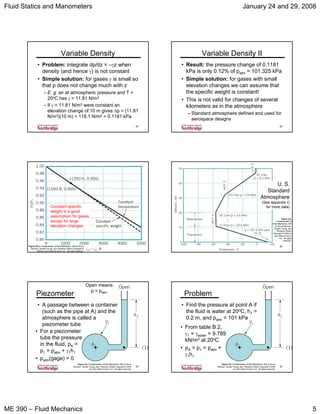
Variable Density
• Problem: integrate dp/dz = –γz when
density (and hence γ) is not constant
• Simple solution: for gases γ is small so
that p does not change much with z
– E. g. air at atmospheric pressure and T =
20oC has γ = 11.81 N/m3
– If γ = 11.81 N/m3 were constant an
elevation change of 10 m gives Δp = (11.81
N/m3)(10 m) = 118.1 N/m2 = 0.1181 kPa
26
Variable Density II
• Result: the pressure change of 0.1181
kPa is only 0.12% of patm = 101.325 kPa
• Simple solution: for gases with small
elevation changes we can assume that
the specific weight is constant!
• This is not valid for changes of several
kilometers as in the atmosphere
– Standard atmosphere defined and used for
aerospace designs
27Figure E2.2, Fundamentals of Fluid Mechanics, 5/E by Bruce
Munson, Donald Young, and Theodore Okiishi Copyright ©
2005 by John Wiley & Sons, Inc. All rights reserved.
Constant specific
weight is a good
assumption for gases
except for large
elevation changes
28
U. S.
Standard
Atmosphere
(See appendix C
for more data)
Figure 2.6,
Fundamentals of
Fluid Mechanics, 5/E
by Bruce Munson,
Donald Young, and
Theodore Okiishi
Copyright © 2005 by
John Wiley & Sons,
Inc. All rights
reserved.
29
Piezometer
• A passage between a container
(such as the pipe at A) and the
atmosphere is called a
piezometer tube
Figure 2.9, Fundamentals of Fluid Mechanics, 5/E by Bruce
Munson, Donald Young, and Theodore Okiishi Copyright © 2005
by John Wiley & Sons, Inc. All rights reserved.
• For a piezometer
tube the pressure
in the fluid, pA =
p1 = patm + γ1h1
• patm(gage) = 0
Open means
p = patm
30
Problem
• Find the pressure at point A if
the fluid is water at 20oC, h1 =
0.2 m, and patm = 101 kPa
Figure 2.9, Fundamentals of Fluid Mechanics, 5/E by Bruce
Munson, Donald Young, and Theodore Okiishi Copyright © 2005
by John Wiley & Sons, Inc. All rights reserved.
• From table B.2,
γ1 = γwater = 9.789
kN/m3 at 20oC
• pA = p1 = patm +
γ1h1
Fluid Statics and Manometers January 24 and 29, 2008
ME 390 – Fluid Mechanics 6
31
Solution
• h1 = 0.2 m, patm = 101 kPa,
and γ1 =γwater = 9.789 kN/m3
• pA = patm + γ1h1
Figure 2.9, Fundamentals of Fluid Mechanics, 5/E by Bruce Munson, Donald Young, and
Theodore Okiishi Copyright © 2005 by John Wiley & Sons, Inc. All rights reserved.
( )
kN
mkPa
m
m
kN
kPaPA
1
2.0
789.9
101
2
3
⋅
+=
• pA = 103 kPa
(absolute)
• pA = 1.96 kPa
(gage)
32
Simple U-Tube Manometer
• Manometers measure pressure
by measuring height differences
• Point A is
fluid (γ = γ1)
in a pipe
• h1 and h2 are measured
• Gage fluid has γ = γ2
• What is pressure at A?
Figure 2.10, Fundamentals of Fluid Mechanics, 5/E by Bruce Munson, Donald Young,
and Theodore Okiishi Copyright © 2005 by John Wiley & Sons, Inc. All rights reserved.
33
Simple U-Tube Manometer II
h0
p2 = p3 = p0 – γ2h0
patm
• Right side: p3 = patm + γ2h2
• Left side: p2 = pA + γ1h1
• p3 = p2 gives
patm + γ2h2 =
pA + γ1h1
• Conclusion:
pA = patm + γ2h2 – γ1h1
Figure 2.10, Fundamentals of Fluid Mechanics, 5/E by Bruce Munson, Donald Young,
and Theodore Okiishi Copyright © 2005 by John Wiley & Sons, Inc. All rights reserved.
p0 34
Simple U-Tube Manometer III
• Result for absolute pressure:
pA = patm + γ2h2 – γ1h1
• Result for gage pressure:
pA = γ2h2 – γ1h1
Figure 2.10, Fundamentals of Fluid Mechanics, 5/E by Bruce Munson, Donald Young,
and Theodore Okiishi Copyright © 2005 by John Wiley & Sons, Inc. All rights reserved.
35
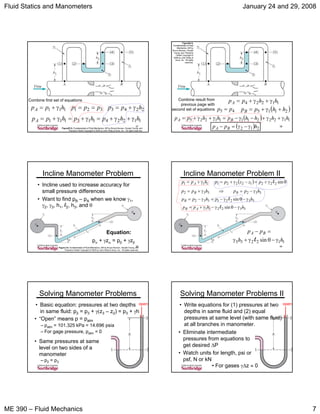
• Given: Known specific weights and
measured heights shown above
• Find: pA – pB Equation:
FigureE2.5, Fundamentals of Fluid Mechanics, 5/E by Bruce Munson, Donald Young, and
Theodore Okiishi Copyright © 2005 by John Wiley & Sons, Inc. All rights reserved.
pα + γzα = pβ + γzβ
36
111 hppA γ+= 2243 hpp γ+=
( )2115 hhppB +γ+=
321 ppp ==
45 pp =
FigureE2.5, Fundamentals of Fluid Mechanics, 5/E by Bruce Munson, Donald Young, and
Theodore Okiishi Copyright © 2005 by John Wiley & Sons, Inc. All rights reserved.
Fluid Statics and Manometers January 24 and 29, 2008
ME 390 – Fluid Mechanics 7
37
FigureE2.5, Fundamentals of Fluid Mechanics, 5/E by Bruce Munson, Donald Young, and
Theodore Okiishi Copyright © 2005 by John Wiley & Sons, Inc. All rights reserved.
11224113111 hhphphppA γ+γ+=γ+=γ+=
Combine first set of equations
111 hppA γ+= 2243 hpp γ+=321 ppp ==
38
( )2115 hhppB +γ+=45 pp =
FigureE2.5,
Fundamentals of Fluid
Mechanics, 5/E by
Bruce Munson, Donald
Young, and Theodore
Okiishi Copyright ©
2005 by John Wiley &
Sons, Inc. All rights
reserved.
11224 hhppA γ+γ+=
( ) 112221111225 hhhhphhpp BA γ+γ+−γ−=γ+γ+=
( ) 212 hpp BA γ−γ=−
Combine result from
previous page with
second set of equations
39
Incline Manometer Problem
• Incline used to increase accuracy for
small pressure differences
• Want to find pB – pA when we know γ1,
γ2, γ3, h1, l2, h3, and θ
Equation:
pα + γzα = pβ + γzβ
Figure 2.9, Fundamentals of Fluid Mechanics, 5/E by Bruce Munson, Donald Young, and
Theodore Okiishi Copyright © 2005 by John Wiley & Sons, Inc. All rights reserved.
40
Incline Manometer Problem II
111 hpp A γ+= ( ) θγ+=−γ+= sin22212221 lpzzpp
332332 hpphpp BB γ−=⇒γ+=
33221332 sin hphppB γ−θγ−=γ−= l
332211 sin hhpp AB γ−θγ−γ+= l
112233 sin hh
pp BA
γ−θγ+γ
=−
l
41
Solving Manometer Problems
• Basic equation: pressures at two depths
in same fluid: p2 = p3 + γ(z3 – z2) = p3 + γh
• “Open” means p = patm
– patm = 101.325 kPa = 14.696 psia
– For gage pressure, patm = 0
3
open
• Same pressures at same
level on two sides of a
manometer
– p2 = p3
42
Solving Manometer Problems II
3
open
• Eliminate intermediate
pressures from equations to
get desired ΔP
• Watch units for length, psi or
psf, N or kN
• For gases γΔz ≈ 0
• Write equations for (1) pressures at two
depths in same fluid and (2) equal
pressures at same level (with same fluid)
at all branches in manometer.
Fluid Statics and Manometers January 24 and 29, 2008
ME 390 – Fluid Mechanics 8
43
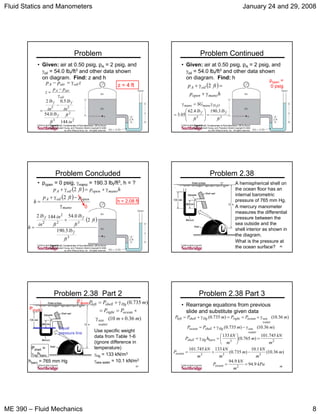
Problem
• Given: air at 0.50 psig, pA = 2 psig, and
γoil = 54.0 lbf/ft3 and other data shown
on diagram. Find: z and hand h
Figure P2.27, Fundamentals of Fluid Mechanics, 5/E by Bruce
Munson, Donald Young, and Theodore Okiishi Copyright © 2005
by John Wiley & Sons, Inc. All rights reserved.
zpp oilairA γ=−
2
2
3
22
144
0.54
5.02
in
ft
ft
lb
in
lb
in
lb
pp
z
f
ff
oil
airA
−
=
γ
−
=
z = 4 ft
44
Problem Continued
• Given: air at 0.50 psig, pA = 2 psig, and
γoil = 54.0 lbf/ft3 and other data shown
on diagram. Find: h
Figure P2.27, Fundamentals of Fluid Mechanics, 5/E by Bruce
Munson, Donald Young, and Theodore Okiishi Copyright © 2005
by John Wiley & Sons, Inc. All rights reserved.
( )
hp
ftp
manoopen
oilA
γ+
=γ+ 2
popen =
0 psig
33
3.1904.62
05.3
2
ft
lb
ft
lb
SG
ff
OHmanomano
=⎟
⎟
⎠
⎞
⎜
⎜
⎝
⎛
=
γ=γ
45
Problem Concluded
• popen = 0 psig, γmano = 190.3 lbf/ft3, h = ?
Figure P2.27, Fundamentals of Fluid Mechanics, 5/E by Bruce
Munson, Donald Young, and Theodore Okiishi Copyright © 2005
by John Wiley & Sons, Inc. All rights reserved.
( ) hpftp manoopenoilA γ+=γ+ 2
h = 2.08 ft
( )
mano
openoilA pftp
h
γ
−γ+
=
2
0
( )
3
32
2
2
3.190
2
0.541442
ft
lb
ft
ft
lb
ft
in
in
lb
h
f
ff
+
=
46
Problem 2.38
A hemispherical shell on
the ocean floor has an
internal barometric
pressure of 765 mm Hg.
A mercury manometer
measures the differential
pressure between the
sea outside and the
shell interior as shown in
the diagram.
What is the pressure at
the ocean surface?
47
Problem 2.38 Part 2
Pshell =
γHghbaro
Pshell
Pocean
Equal
pressure line
)36.010(
)735.0(
mm
PP
mPP
water
sea
oceanright
Hgshellleft
+γ
+==
γ+=
Use specific weight
data from Table 1-6
(ignore difference in
temperature)
γHg = 133 kN/m3
γsea water = 10.1 kN/m3hbaro = 765 mm Hg
48
Problem 2.38 Part 3
• Rearrange equations from previous
slide and substitute given data
)36.10()735.0( mPPmPP
water
seaoceanrightHgshellleft γ+==γ+=
23
745.101
)765.0(
133
m
kN
m
m
kN
hP baroHgshell =⎟
⎠
⎞
⎜
⎝
⎛
=γ=
)36.10()735.0( mmPP
water
seaHgshellocean γ−γ+=
)36.10(
1.10
)735.0(
133745.101
333
m
m
kN
m
m
kN
m
kN
Pocean −+=
kPa
m
kN
Pocean 9.94
9.94
2
==

01 manometers

  • 1.
    Fluid Statics andManometers January 24 and 29, 2008 ME 390 – Fluid Mechanics 1 Introduction to Fluid StaticsIntroduction to Fluid Statics and Manometersand Manometers Larry Caretto Mechanical Engineering 390 Fluid MechanicsFluid Mechanics January 24 and 29, 2008 2 Outline • Review course introduction • Pressure independent of direction • Pressure-density-distance relationship in a static (nonmoving fluid) • Use of manometers for pressure measurements • Calculations with manometers. 3 Review • Dimensions and units – SI, BG and EE unit systems • Fluid density, ρ, (mass/volume) and specific weight (weight/volume), γ = ρg, and specific gravity • States of matter and vapor pressure • Viscosity • Surface tension 4 Review Typical Units Tabulated values at standard gravity lbf·s/ft2 = 32.2 lbm/ft·s lbm/ft3 EE units lbf·s/ft2 = slug/ft·s N·s/m2 = kg/m·s Viscosity lbf/ft3N/m3Specific weight = ρg ft/sm/sVelocity 1 psi = 1 lbf/in2 = 144 psf = 144 lbf/ft2 kPa = kN/m2 Pressure & shear stress slug/ft3kg/m3Density BG unitsSI unitsQuantity 5 Review States of Matter Gas Temperature Pressure Liquid Solid Critical Point Triple Point • Triple point: solid, liquid and vapor coexist • No liquid-gas transition above critical point • Vapor pressure for liquid-gas transition Boiling line shows Pvapor = f(T) 6 Newtonian Fluids have a linear variation of shearing stress with rate of shearing strain – slope is viscosity Figure 1.4 (p. 15) Viscosity y u ∂ ∂ μ=τ Fundamentals of Fluid Mechanics, 5/E by Bruce Munson, Donald Young, and Theodore Okiishi,Copyright © 2005 by John Wiley & Sons, Inc. All rights reserved.
  • 2.
    Fluid Statics andManometers January 24 and 29, 2008 ME 390 – Fluid Mechanics 2 7Fundamentals of Fluid Mechanics, 5/E by Bruce Munson, Donald Young, and Theodore Okiishi,Copyright © 2005 by John Wiley & Sons, Inc. All rights reserved. Review Surface Tension • Vertical force balance: γπR2h = 2πRσcosθ – Surface tension depends on fluid, temperature; wetting angle, θ, depends on fluid and surface R h γ θσ = cos2 8 Pressure Relations • Pressure is a scalar • The force exerted by a pressure is the same in all directions • Want to see how pressure changes in a static (nonmoving) fluid • Look at balance of pressure force and fluid weight over a differential volume element, δxδyδz 9 Sum forces in each direction and divide by δxδyδz 000 =γ+ ∂ ∂ = ∂ ∂ = ∂ ∂ z p y p x p Gravity in –z direction Results Fundamentals of Fluid Mechanics, 5/E by Bruce Munson, Donald Young, and Theodore Okiishi,Copyright © 2005 by John Wiley & Sons, Inc. All rights reserved. ( ) yx z z p p yx z z p p gzyxFz δδ⎟ ⎠ ⎞ ⎜ ⎝ ⎛ δ ∂ ∂ +− δδ⎟ ⎠ ⎞ ⎜ ⎝ ⎛ δ ∂ ∂ −+ δδδρ−==∑ 2 2 0 10 Integrating the Result • Since ∂p/∂x =∂p/∂y = 0, p = f(z) only, and we can write ∂p/∂z = –γ as dp/dz = –γ ∫∫ γ−=−= 2 1 2 1 12 z z p p dzppdp • Multiply by dz and integrate between two points (p1, z1) and (p2, z2) • To integrate γdz we have to know how γ depends on z 11 Incompressible Fluid • An incompressible fluid has constant density (and specific weight) • For an incompressible (constant density) fluid then ( )1212 2 1 2 1 zzdzdzpp z z z z −γ−=γ−=γ−=− ∫∫ 1122 zpzp γ+=γ+ 12 Incompressible Fluid II • Which pressure is higher? z1 z2 h 1122 zpzp γ+=γ+ 2p 1p ( ) 221 1221 phpp zzpp >+= −+= γ γ • Pressure increases with depth
  • 3.
    Fluid Statics andManometers January 24 and 29, 2008 ME 390 – Fluid Mechanics 3 13 Problem • If the pressure at the surface of a body of water (γ = 9789 N/m3 at 20oC) is 101 kPa, what are the pressures at depths of 10 m and 100 m? • Given: p1 = 101 kPa at z1 = 0 • Find: p at z2 = –10 m and z3 = –100 m • Equation: ( )21121122 zzppzpzp −γ+=⇒γ+=γ+ 14 Solution ( ) ( )[ ] kPa N mkPa mm m N kPazzpp 9.198 1000 100 9789 101 2 3 2112 = ⋅ −− +=−+= γ ( ) ( )[ ] kPa N mkPa mm m N kPazzpp 1080 1000 1000 9789 101 2 3 3113 = ⋅ −− +=−+= γ Depth = 10 m Depth = 100 m 15 Pressure Head • Fluid height equivalent to a pressure difference z1 z2 h 2p 1p ( ) 221 1221 phpp zzpp >γ+= +γ+= γ − = 12 pp h • h is called pressure head • For p2 – p1 = 14.696 psia = 101.325 kPa, h = 0.76 m = 29.92 in for Hg • What is h for water at this Δp? 16 ΔP = 1 Atm for Water at 20oC ft ft lb ft in in lb pp h f f 96.33 32.62 144696.14 3 2 2 2 12 == γ − = m m N mkPa N kPa pp h 35.10 9789 1000 325.101 3 2 12 =⋅= γ − = • At 20oC, γwater = 9789 N/m3 = 62.32 lbf/ft3 (p 761, text) 17 Free Surface • Surface of liquid open to atmosphere is called a “free surface” – Pressure, p0, is atmospheric pressure, p0 – Height, z0 = 0 – In the liquid, p + γz = p0 + γz0, where z < 0 – Depth h = z0 – z > 0 – p = p0 + γ(z0 – z) = p0 + γh • Pressure, p, at depth, h, not influenced by size or shape of container 18 Free Surface II Figure 2.4, Fundamentals of Fluid Mechanics, 5/E by Bruce Munson, Donald Young, and Theodore Okiishi Copyright © 2005 by John Wiley & Sons, Inc. All rights reserved. • Pressure, p, at depth, h, not influenced by size or shape of container
  • 4.
    Fluid Statics andManometers January 24 and 29, 2008 ME 390 – Fluid Mechanics 4 19 Reference Pressure • Free surface equation: p = p0 + γ(z0 – z) • Apply this to two different pressures – p1 = p0 + γ(z0 – z1) – p2 = p0 + γ(z0 – z2) • Find p2 – p1 from these equations – Result: p2 – p1 = p0 + γ(z0 – z2) – [p0 + γ(z0 – z1)] = γ(z1 – z2) independent of p0 or z0 • Reference pressure cancels in taking pressure differences 20 Gage Pressure • For taking pressure differences, we can use any reference pressure • Many pressure measurement methods measure the difference between actual and atmospheric pressure • We can used this measured pressure difference, called gage pressure, directly in Δp calculations • pabsolute = pgage + patmosphere 21 Gage and Absolute Pressure Figure 2.7, Fundamentals of Fluid Mechanics, 5/E by Bruce Munson, Donald Young, and Theodore Okiishi Copyright © 2005 by John Wiley & Sons, Inc. All rights reserved. 22 Barometric Pressure Figure 2.8, Fundamentals of Fluid Mechanics, 5/E by Bruce Munson, Donald Young, and Theodore Okiishi Copyright © 2005 by John Wiley & Sons, Inc. All rights reserved. • Mercury barometer used to measure atmospheric pressure – Top is evacuated and fills with mercury vapor – Patm = γh + pvapor – pvapor = 0.000023 psia = 0.1586 Pa at 68oF (20oC) – h = 760 mm = 29.92 in for standard atmosphere 23 What a Barometer Measures • It actually measures the local pressure • A barometer in a undersea submersible, pressurized to 4 times atmospheric pressure would measure this level • Weather barometer readings are corrected to mean sea level • Standard atmosphere: 760 mm Hg, 760 torr, 29.921 in Hg, 101.325 kPa, 14.696 psia, 2116.2 psfa, 1013.25 mbar 24 Gage/Absolute Notation • For pressure differences a specification of gage or absolute is not required • Traditional notation is psig (or psfg) and psia (or psfg) for gage and absolute pressure, respectively • Can also use kPa(abs) or kPa(gage) • Munson uses psi or kPa for gage pressures and psi(abs) or kPa(abs) for absolute pressures
  • 5.
    Fluid Statics andManometers January 24 and 29, 2008 ME 390 – Fluid Mechanics 5 25 Variable Density • Problem: integrate dp/dz = –γz when density (and hence γ) is not constant • Simple solution: for gases γ is small so that p does not change much with z – E. g. air at atmospheric pressure and T = 20oC has γ = 11.81 N/m3 – If γ = 11.81 N/m3 were constant an elevation change of 10 m gives Δp = (11.81 N/m3)(10 m) = 118.1 N/m2 = 0.1181 kPa 26 Variable Density II • Result: the pressure change of 0.1181 kPa is only 0.12% of patm = 101.325 kPa • Simple solution: for gases with small elevation changes we can assume that the specific weight is constant! • This is not valid for changes of several kilometers as in the atmosphere – Standard atmosphere defined and used for aerospace designs 27Figure E2.2, Fundamentals of Fluid Mechanics, 5/E by Bruce Munson, Donald Young, and Theodore Okiishi Copyright © 2005 by John Wiley & Sons, Inc. All rights reserved. Constant specific weight is a good assumption for gases except for large elevation changes 28 U. S. Standard Atmosphere (See appendix C for more data) Figure 2.6, Fundamentals of Fluid Mechanics, 5/E by Bruce Munson, Donald Young, and Theodore Okiishi Copyright © 2005 by John Wiley & Sons, Inc. All rights reserved. 29 Piezometer • A passage between a container (such as the pipe at A) and the atmosphere is called a piezometer tube Figure 2.9, Fundamentals of Fluid Mechanics, 5/E by Bruce Munson, Donald Young, and Theodore Okiishi Copyright © 2005 by John Wiley & Sons, Inc. All rights reserved. • For a piezometer tube the pressure in the fluid, pA = p1 = patm + γ1h1 • patm(gage) = 0 Open means p = patm 30 Problem • Find the pressure at point A if the fluid is water at 20oC, h1 = 0.2 m, and patm = 101 kPa Figure 2.9, Fundamentals of Fluid Mechanics, 5/E by Bruce Munson, Donald Young, and Theodore Okiishi Copyright © 2005 by John Wiley & Sons, Inc. All rights reserved. • From table B.2, γ1 = γwater = 9.789 kN/m3 at 20oC • pA = p1 = patm + γ1h1
  • 6.
    Fluid Statics andManometers January 24 and 29, 2008 ME 390 – Fluid Mechanics 6 31 Solution • h1 = 0.2 m, patm = 101 kPa, and γ1 =γwater = 9.789 kN/m3 • pA = patm + γ1h1 Figure 2.9, Fundamentals of Fluid Mechanics, 5/E by Bruce Munson, Donald Young, and Theodore Okiishi Copyright © 2005 by John Wiley & Sons, Inc. All rights reserved. ( ) kN mkPa m m kN kPaPA 1 2.0 789.9 101 2 3 ⋅ += • pA = 103 kPa (absolute) • pA = 1.96 kPa (gage) 32 Simple U-Tube Manometer • Manometers measure pressure by measuring height differences • Point A is fluid (γ = γ1) in a pipe • h1 and h2 are measured • Gage fluid has γ = γ2 • What is pressure at A? Figure 2.10, Fundamentals of Fluid Mechanics, 5/E by Bruce Munson, Donald Young, and Theodore Okiishi Copyright © 2005 by John Wiley & Sons, Inc. All rights reserved. 33 Simple U-Tube Manometer II h0 p2 = p3 = p0 – γ2h0 patm • Right side: p3 = patm + γ2h2 • Left side: p2 = pA + γ1h1 • p3 = p2 gives patm + γ2h2 = pA + γ1h1 • Conclusion: pA = patm + γ2h2 – γ1h1 Figure 2.10, Fundamentals of Fluid Mechanics, 5/E by Bruce Munson, Donald Young, and Theodore Okiishi Copyright © 2005 by John Wiley & Sons, Inc. All rights reserved. p0 34 Simple U-Tube Manometer III • Result for absolute pressure: pA = patm + γ2h2 – γ1h1 • Result for gage pressure: pA = γ2h2 – γ1h1 Figure 2.10, Fundamentals of Fluid Mechanics, 5/E by Bruce Munson, Donald Young, and Theodore Okiishi Copyright © 2005 by John Wiley & Sons, Inc. All rights reserved. 35 • Given: Known specific weights and measured heights shown above • Find: pA – pB Equation: FigureE2.5, Fundamentals of Fluid Mechanics, 5/E by Bruce Munson, Donald Young, and Theodore Okiishi Copyright © 2005 by John Wiley & Sons, Inc. All rights reserved. pα + γzα = pβ + γzβ 36 111 hppA γ+= 2243 hpp γ+= ( )2115 hhppB +γ+= 321 ppp == 45 pp = FigureE2.5, Fundamentals of Fluid Mechanics, 5/E by Bruce Munson, Donald Young, and Theodore Okiishi Copyright © 2005 by John Wiley & Sons, Inc. All rights reserved.
  • 7.
    Fluid Statics andManometers January 24 and 29, 2008 ME 390 – Fluid Mechanics 7 37 FigureE2.5, Fundamentals of Fluid Mechanics, 5/E by Bruce Munson, Donald Young, and Theodore Okiishi Copyright © 2005 by John Wiley & Sons, Inc. All rights reserved. 11224113111 hhphphppA γ+γ+=γ+=γ+= Combine first set of equations 111 hppA γ+= 2243 hpp γ+=321 ppp == 38 ( )2115 hhppB +γ+=45 pp = FigureE2.5, Fundamentals of Fluid Mechanics, 5/E by Bruce Munson, Donald Young, and Theodore Okiishi Copyright © 2005 by John Wiley & Sons, Inc. All rights reserved. 11224 hhppA γ+γ+= ( ) 112221111225 hhhhphhpp BA γ+γ+−γ−=γ+γ+= ( ) 212 hpp BA γ−γ=− Combine result from previous page with second set of equations 39 Incline Manometer Problem • Incline used to increase accuracy for small pressure differences • Want to find pB – pA when we know γ1, γ2, γ3, h1, l2, h3, and θ Equation: pα + γzα = pβ + γzβ Figure 2.9, Fundamentals of Fluid Mechanics, 5/E by Bruce Munson, Donald Young, and Theodore Okiishi Copyright © 2005 by John Wiley & Sons, Inc. All rights reserved. 40 Incline Manometer Problem II 111 hpp A γ+= ( ) θγ+=−γ+= sin22212221 lpzzpp 332332 hpphpp BB γ−=⇒γ+= 33221332 sin hphppB γ−θγ−=γ−= l 332211 sin hhpp AB γ−θγ−γ+= l 112233 sin hh pp BA γ−θγ+γ =− l 41 Solving Manometer Problems • Basic equation: pressures at two depths in same fluid: p2 = p3 + γ(z3 – z2) = p3 + γh • “Open” means p = patm – patm = 101.325 kPa = 14.696 psia – For gage pressure, patm = 0 3 open • Same pressures at same level on two sides of a manometer – p2 = p3 42 Solving Manometer Problems II 3 open • Eliminate intermediate pressures from equations to get desired ΔP • Watch units for length, psi or psf, N or kN • For gases γΔz ≈ 0 • Write equations for (1) pressures at two depths in same fluid and (2) equal pressures at same level (with same fluid) at all branches in manometer.
  • 8.
    Fluid Statics andManometers January 24 and 29, 2008 ME 390 – Fluid Mechanics 8 43 Problem • Given: air at 0.50 psig, pA = 2 psig, and γoil = 54.0 lbf/ft3 and other data shown on diagram. Find: z and hand h Figure P2.27, Fundamentals of Fluid Mechanics, 5/E by Bruce Munson, Donald Young, and Theodore Okiishi Copyright © 2005 by John Wiley & Sons, Inc. All rights reserved. zpp oilairA γ=− 2 2 3 22 144 0.54 5.02 in ft ft lb in lb in lb pp z f ff oil airA − = γ − = z = 4 ft 44 Problem Continued • Given: air at 0.50 psig, pA = 2 psig, and γoil = 54.0 lbf/ft3 and other data shown on diagram. Find: h Figure P2.27, Fundamentals of Fluid Mechanics, 5/E by Bruce Munson, Donald Young, and Theodore Okiishi Copyright © 2005 by John Wiley & Sons, Inc. All rights reserved. ( ) hp ftp manoopen oilA γ+ =γ+ 2 popen = 0 psig 33 3.1904.62 05.3 2 ft lb ft lb SG ff OHmanomano =⎟ ⎟ ⎠ ⎞ ⎜ ⎜ ⎝ ⎛ = γ=γ 45 Problem Concluded • popen = 0 psig, γmano = 190.3 lbf/ft3, h = ? Figure P2.27, Fundamentals of Fluid Mechanics, 5/E by Bruce Munson, Donald Young, and Theodore Okiishi Copyright © 2005 by John Wiley & Sons, Inc. All rights reserved. ( ) hpftp manoopenoilA γ+=γ+ 2 h = 2.08 ft ( ) mano openoilA pftp h γ −γ+ = 2 0 ( ) 3 32 2 2 3.190 2 0.541442 ft lb ft ft lb ft in in lb h f ff + = 46 Problem 2.38 A hemispherical shell on the ocean floor has an internal barometric pressure of 765 mm Hg. A mercury manometer measures the differential pressure between the sea outside and the shell interior as shown in the diagram. What is the pressure at the ocean surface? 47 Problem 2.38 Part 2 Pshell = γHghbaro Pshell Pocean Equal pressure line )36.010( )735.0( mm PP mPP water sea oceanright Hgshellleft +γ +== γ+= Use specific weight data from Table 1-6 (ignore difference in temperature) γHg = 133 kN/m3 γsea water = 10.1 kN/m3hbaro = 765 mm Hg 48 Problem 2.38 Part 3 • Rearrange equations from previous slide and substitute given data )36.10()735.0( mPPmPP water seaoceanrightHgshellleft γ+==γ+= 23 745.101 )765.0( 133 m kN m m kN hP baroHgshell =⎟ ⎠ ⎞ ⎜ ⎝ ⎛ =γ= )36.10()735.0( mmPP water seaHgshellocean γ−γ+= )36.10( 1.10 )735.0( 133745.101 333 m m kN m m kN m kN Pocean −+= kPa m kN Pocean 9.94 9.94 2 ==