ACTIVE LEARNINGASSIGNMENT PRESENTATION
FLUID MECHANICS (2141906)
TOPIC
PRESSURE & HEAD (PART-1)
PREPARED BY
MECHANICAL – 4B2
DEVANSU KHORASIYA (150120119066)
GUIDED BY
PROF. SHAIVAL PARIKH
PREPARED BY : DEVANSU KHORASIYA(GIT-150120119066)
INTRODUCTION
So, Before Starting The Chapter Clear Some Doubts….
 This Chapter Deals With Forces Applied By
Fluid at Rest. When A Certain Mass of Fluid is held in
static Equilibrium by confining Within Solid Boundaries, it
exerts forces Against Boundary surfaces.
 The Forces Exerted always in The Direction
normal to The Surface in The Contact. This is So
because a fluid at Rest Cannot Sustain Shear Stress. No
Shear Force is Present as Fluid Particles do not Move
With Respect To One Another.
Let’s Start The Journey…
PREPARED BY : DEVANSU KHORASIYA(GIT-150120119066)
First Of All…
 What is Pressure ??
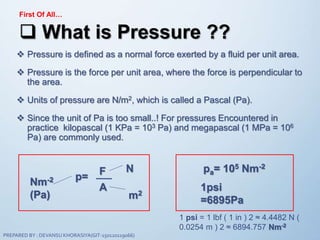
 Pressure is defined as a normal force exerted by a fluid per unit area.
 Pressure is the force per unit area, where the force is perpendicular to
the area.
 Units of pressure are N/m2, which is called a Pascal (Pa).
 Since the unit of Pa is too small..! For pressures Encountered in
practice kilopascal (1 KPa = 103 Pa) and megapascal (1 MPa = 106
Pa) are commonly used.
p=
A
m2
Nm-2
(Pa)
NF pa= 105 Nm-2
1psi
=6895Pa
1 psi = 1 lbf ( 1 in ) 2 ≈ 4.4482 N (
0.0254 m ) 2 ≈ 6894.757 Nm-2
PREPARED BY : DEVANSU KHORASIYA(GIT-150120119066)
Pressure in a fluid acts equally in all directions.
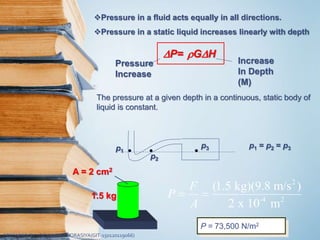
Pressure in a static liquid increases linearly with depth
P=
Increase
In Depth
(M)
Pressure
Increase
GH
The pressure at a given depth in a continuous, static body of
liquid is constant.
p1
p2
p3 p1 = p2 = p3
A = 2 cm2
1.5 kg
2
-4 2
(1.5 kg)(9.8 m/s )
2 x 10 m
F
P
A
 
P = 73,500 N/m2
PREPARED BY : DEVANSU KHORASIYA(GIT-150120119066)
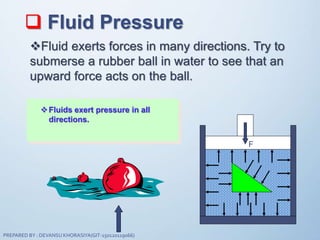
Fluid exerts forces in many directions. Try to
submerse a rubber ball in water to see that an
upward force acts on the ball.
Fluids exert pressure in all
directions.
F
 Fluid Pressure
PREPARED BY : DEVANSU KHORASIYA(GIT-150120119066)
 Properties of Fluid Pressure
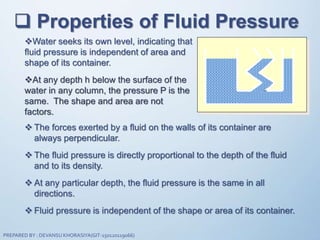
Water seeks its own level, indicating that
fluid pressure is independent of area and
shape of its container.
At any depth h below the surface of the
water in any column, the pressure P is the
same. The shape and area are not
factors.
 The forces exerted by a fluid on the walls of its container are
always perpendicular.
 The fluid pressure is directly proportional to the depth of the fluid
and to its density.
 At any particular depth, the fluid pressure is the same in all
directions.
 Fluid pressure is independent of the shape or area of its container.
PREPARED BY : DEVANSU KHORASIYA(GIT-150120119066)
 What is Pressure Head ???
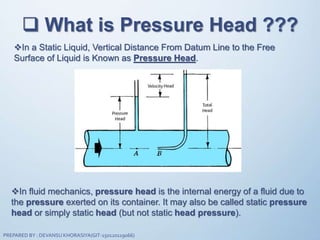
In a Static Liquid, Vertical Distance From Datum Line to the Free
Surface of Liquid is Known as Pressure Head.
In fluid mechanics, pressure head is the internal energy of a fluid due to
the pressure exerted on its container. It may also be called static pressure
head or simply static head (but not static head pressure).
PREPARED BY : DEVANSU KHORASIYA(GIT-150120119066)
 What is Pressure at a Point ?
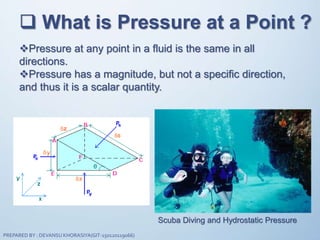
Pressure at any point in a fluid is the same in all
directions.
Pressure has a magnitude, but not a specific direction,
and thus it is a scalar quantity.
Scuba Diving and Hydrostatic Pressure
PREPARED BY : DEVANSU KHORASIYA(GIT-150120119066)
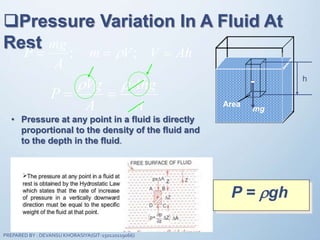
Pressure Variation In A Fluid At
Rest
; ;
mg
P m V V Ah
A
  
Vg Ahg
P
A A
 
 
h
mg
Area
P = gh
• Pressure at any point in a fluid is directly
proportional to the density of the fluid and
to the depth in the fluid.
PREPARED BY : DEVANSU KHORASIYA(GIT-150120119066)
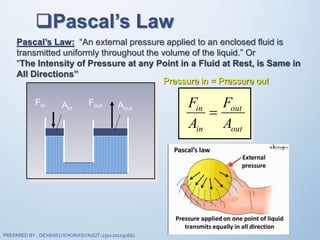
Pascal’s Law
FoutFin AoutAin
Pressure in = Pressure out
in out
in out
F F
A A

Pascal’s Law: “An external pressure applied to an enclosed fluid is
transmitted uniformly throughout the volume of the liquid.” Or
“The Intensity of Pressure at any Point in a Fluid at Rest, is Same in
All Directions”
PREPARED BY : DEVANSU KHORASIYA(GIT-150120119066)
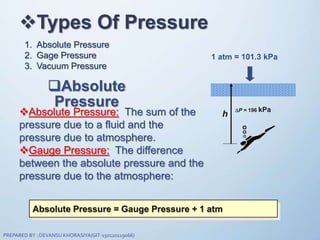
1. Absolute Pressure
2. Gage Pressure
3. Vacuum Pressure
Types Of Pressure
Absolute
Pressure
Absolute Pressure: The sum of the
pressure due to a fluid and the
pressure due to atmosphere.
Gauge Pressure: The difference
between the absolute pressure and the
pressure due to the atmosphere:
Absolute Pressure = Gauge Pressure + 1 atm
h
P = 196 kPa
1 atm = 101.3 kPa
PREPARED BY : DEVANSU KHORASIYA(GIT-150120119066)
Vacuum
Pressure
atm atm
h
Mercury
P = 0
One way to measure atmospheric
pressure is to fill a test tube with
mercury, then invert it into a bowl of
mercury.
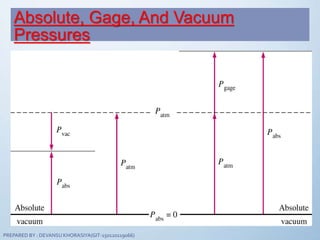
Pressure below atmospheric pressure
are called vacuum pressure, Pvac=Patm
- Pabs.
Density of Hg = 13,600 kg/m3
Patm = gh
h = 0.760 m
Patm = (13,600 kg/m3)(9.8 m/s2)(0.760 m) Patm = 101,300 Pa
Gage Pressure
Most pressure-measuring devices are calibrated to read
zero in the atmosphere, and therefore indicate gage
pressure, Pgage=Pabs - Patm.
PREPARED BY : DEVANSU KHORASIYA(GIT-150120119066)
Absolute, Gage, And Vacuum
Pressures
PREPARED BY : DEVANSU KHORASIYA(GIT-150120119066)
Pressure Measurement
 Pressure is an important variable in fluid
mechanics and many instruments have been
devised for its measurement.
 Many devices are based on hydrostatics such
as barometers and manometers, i.e.,
determine pressure through measurement of a
column (or columns) of a liquid using the
pressure variation with elevation equation for
an incompressible fluid
Enlarged LegTwo Fluid
Inclined Tube
Inverted U-Tube
U-Tube Manometer
PREPARED BY : DEVANSU KHORASIYA(GIT-150120119066)
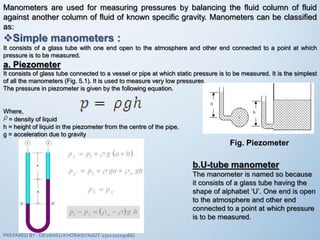
Manometers are used for measuring pressures by balancing the fluid column of fluid
against another column of fluid of known specific gravity. Manometers can be classified
as:
Simple manometers :
It consists of a glass tube with one end open to the atmosphere and other end connected to a point at which
pressure is to be measured.
a. Piezometer
It consists of glass tube connected to a vessel or pipe at which static pressure is to be measured. It is the simplest
of all the manometers (Fig. 5.1). It is used to measure very low pressures.
The pressure in piezometer is given by the following equation.
Where,
= density of liquid
h = height of liquid in the piezometer from the centre of the pipe.
g = acceleration due to gravity
Fig. Piezometer
b.U-tube manometer
The manometer is named so because
it consists of a glass tube having the
shape of alphabet ‘U’. One end is open
to the atmosphere and other end
connected to a point at which pressure
is to be measured.
PREPARED BY : DEVANSU KHORASIYA(GIT-150120119066)
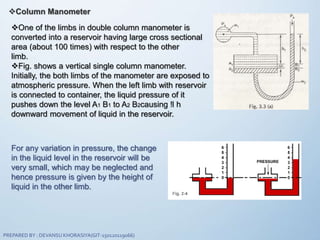
Column Manometer
One of the limbs in double column manometer is
converted into a reservoir having large cross sectional
area (about 100 times) with respect to the other
limb.
Fig. shows a vertical single column manometer.
Initially, the both limbs of the manometer are exposed to
atmospheric pressure. When the left limb with reservoir
is connected to container, the liquid pressure of it
pushes down the level A1 B1 to A2 B2causing !l h
downward movement of liquid in the reservoir.
For any variation in pressure, the change
in the liquid level in the reservoir will be
very small, which may be neglected and
hence pressure is given by the height of
liquid in the other limb.
PREPARED BY : DEVANSU KHORASIYA(GIT-150120119066)
ATTHE LAST…….
One Humble Request to all ofYOU….
Make sureYour House, School, College, Society, Road,
State, Nation, World is Neat and Clean……PREPARED BY : DEVANSU KHORASIYA(GIT-150120119066)
THANK YOU GUYS FOR LISTINING ME……
PRESENTATION & DESIGNED BY
DEVANSU KHORASIYA
(150120119066)
MYAIM IS….
CLEAN INDIA
GREEN INDIA &
MAKE IN INDIA.
PREPARED BY : DEVANSU KHORASIYA(GIT-150120119066)

PRESSURE & HEAD (PART-1)

  • 1.
    ACTIVE LEARNINGASSIGNMENT PRESENTATION FLUIDMECHANICS (2141906) TOPIC PRESSURE & HEAD (PART-1) PREPARED BY MECHANICAL – 4B2 DEVANSU KHORASIYA (150120119066) GUIDED BY PROF. SHAIVAL PARIKH PREPARED BY : DEVANSU KHORASIYA(GIT-150120119066)
  • 2.
    INTRODUCTION So, Before StartingThe Chapter Clear Some Doubts….  This Chapter Deals With Forces Applied By Fluid at Rest. When A Certain Mass of Fluid is held in static Equilibrium by confining Within Solid Boundaries, it exerts forces Against Boundary surfaces.  The Forces Exerted always in The Direction normal to The Surface in The Contact. This is So because a fluid at Rest Cannot Sustain Shear Stress. No Shear Force is Present as Fluid Particles do not Move With Respect To One Another. Let’s Start The Journey… PREPARED BY : DEVANSU KHORASIYA(GIT-150120119066)
  • 3.
    First Of All… What is Pressure ??  Pressure is defined as a normal force exerted by a fluid per unit area.  Pressure is the force per unit area, where the force is perpendicular to the area.  Units of pressure are N/m2, which is called a Pascal (Pa).  Since the unit of Pa is too small..! For pressures Encountered in practice kilopascal (1 KPa = 103 Pa) and megapascal (1 MPa = 106 Pa) are commonly used. p= A m2 Nm-2 (Pa) NF pa= 105 Nm-2 1psi =6895Pa 1 psi = 1 lbf ( 1 in ) 2 ≈ 4.4482 N ( 0.0254 m ) 2 ≈ 6894.757 Nm-2 PREPARED BY : DEVANSU KHORASIYA(GIT-150120119066)
  • 4.
    Pressure in afluid acts equally in all directions. Pressure in a static liquid increases linearly with depth P= Increase In Depth (M) Pressure Increase GH The pressure at a given depth in a continuous, static body of liquid is constant. p1 p2 p3 p1 = p2 = p3 A = 2 cm2 1.5 kg 2 -4 2 (1.5 kg)(9.8 m/s ) 2 x 10 m F P A   P = 73,500 N/m2 PREPARED BY : DEVANSU KHORASIYA(GIT-150120119066)
  • 5.
    Fluid exerts forcesin many directions. Try to submerse a rubber ball in water to see that an upward force acts on the ball. Fluids exert pressure in all directions. F  Fluid Pressure PREPARED BY : DEVANSU KHORASIYA(GIT-150120119066)
  • 6.
     Properties ofFluid Pressure Water seeks its own level, indicating that fluid pressure is independent of area and shape of its container. At any depth h below the surface of the water in any column, the pressure P is the same. The shape and area are not factors.  The forces exerted by a fluid on the walls of its container are always perpendicular.  The fluid pressure is directly proportional to the depth of the fluid and to its density.  At any particular depth, the fluid pressure is the same in all directions.  Fluid pressure is independent of the shape or area of its container. PREPARED BY : DEVANSU KHORASIYA(GIT-150120119066)
  • 7.
     What isPressure Head ??? In a Static Liquid, Vertical Distance From Datum Line to the Free Surface of Liquid is Known as Pressure Head. In fluid mechanics, pressure head is the internal energy of a fluid due to the pressure exerted on its container. It may also be called static pressure head or simply static head (but not static head pressure). PREPARED BY : DEVANSU KHORASIYA(GIT-150120119066)
  • 8.
     What isPressure at a Point ? Pressure at any point in a fluid is the same in all directions. Pressure has a magnitude, but not a specific direction, and thus it is a scalar quantity. Scuba Diving and Hydrostatic Pressure PREPARED BY : DEVANSU KHORASIYA(GIT-150120119066)
  • 9.
    Pressure Variation InA Fluid At Rest ; ; mg P m V V Ah A    Vg Ahg P A A     h mg Area P = gh • Pressure at any point in a fluid is directly proportional to the density of the fluid and to the depth in the fluid. PREPARED BY : DEVANSU KHORASIYA(GIT-150120119066)
  • 10.
    Pascal’s Law FoutFin AoutAin Pressurein = Pressure out in out in out F F A A  Pascal’s Law: “An external pressure applied to an enclosed fluid is transmitted uniformly throughout the volume of the liquid.” Or “The Intensity of Pressure at any Point in a Fluid at Rest, is Same in All Directions” PREPARED BY : DEVANSU KHORASIYA(GIT-150120119066)
  • 11.
    1. Absolute Pressure 2.Gage Pressure 3. Vacuum Pressure Types Of Pressure Absolute Pressure Absolute Pressure: The sum of the pressure due to a fluid and the pressure due to atmosphere. Gauge Pressure: The difference between the absolute pressure and the pressure due to the atmosphere: Absolute Pressure = Gauge Pressure + 1 atm h P = 196 kPa 1 atm = 101.3 kPa PREPARED BY : DEVANSU KHORASIYA(GIT-150120119066)
  • 12.
    Vacuum Pressure atm atm h Mercury P =0 One way to measure atmospheric pressure is to fill a test tube with mercury, then invert it into a bowl of mercury. Pressure below atmospheric pressure are called vacuum pressure, Pvac=Patm - Pabs. Density of Hg = 13,600 kg/m3 Patm = gh h = 0.760 m Patm = (13,600 kg/m3)(9.8 m/s2)(0.760 m) Patm = 101,300 Pa Gage Pressure Most pressure-measuring devices are calibrated to read zero in the atmosphere, and therefore indicate gage pressure, Pgage=Pabs - Patm. PREPARED BY : DEVANSU KHORASIYA(GIT-150120119066)
  • 13.
    Absolute, Gage, AndVacuum Pressures PREPARED BY : DEVANSU KHORASIYA(GIT-150120119066)
  • 14.
    Pressure Measurement  Pressureis an important variable in fluid mechanics and many instruments have been devised for its measurement.  Many devices are based on hydrostatics such as barometers and manometers, i.e., determine pressure through measurement of a column (or columns) of a liquid using the pressure variation with elevation equation for an incompressible fluid Enlarged LegTwo Fluid Inclined Tube Inverted U-Tube U-Tube Manometer PREPARED BY : DEVANSU KHORASIYA(GIT-150120119066)
  • 15.
    Manometers are usedfor measuring pressures by balancing the fluid column of fluid against another column of fluid of known specific gravity. Manometers can be classified as: Simple manometers : It consists of a glass tube with one end open to the atmosphere and other end connected to a point at which pressure is to be measured. a. Piezometer It consists of glass tube connected to a vessel or pipe at which static pressure is to be measured. It is the simplest of all the manometers (Fig. 5.1). It is used to measure very low pressures. The pressure in piezometer is given by the following equation. Where, = density of liquid h = height of liquid in the piezometer from the centre of the pipe. g = acceleration due to gravity Fig. Piezometer b.U-tube manometer The manometer is named so because it consists of a glass tube having the shape of alphabet ‘U’. One end is open to the atmosphere and other end connected to a point at which pressure is to be measured. PREPARED BY : DEVANSU KHORASIYA(GIT-150120119066)
  • 16.
    Column Manometer One ofthe limbs in double column manometer is converted into a reservoir having large cross sectional area (about 100 times) with respect to the other limb. Fig. shows a vertical single column manometer. Initially, the both limbs of the manometer are exposed to atmospheric pressure. When the left limb with reservoir is connected to container, the liquid pressure of it pushes down the level A1 B1 to A2 B2causing !l h downward movement of liquid in the reservoir. For any variation in pressure, the change in the liquid level in the reservoir will be very small, which may be neglected and hence pressure is given by the height of liquid in the other limb. PREPARED BY : DEVANSU KHORASIYA(GIT-150120119066)
  • 17.
    ATTHE LAST……. One HumbleRequest to all ofYOU…. Make sureYour House, School, College, Society, Road, State, Nation, World is Neat and Clean……PREPARED BY : DEVANSU KHORASIYA(GIT-150120119066)
  • 18.
    THANK YOU GUYSFOR LISTINING ME…… PRESENTATION & DESIGNED BY DEVANSU KHORASIYA (150120119066) MYAIM IS…. CLEAN INDIA GREEN INDIA & MAKE IN INDIA. PREPARED BY : DEVANSU KHORASIYA(GIT-150120119066)