Koya University
Faculty of Engineering
Chemical Engineering Dep.
𝑃𝑒𝑡𝑟𝑜𝑙𝑒𝑢𝑚 𝑎𝑛𝑑 𝐺𝑎𝑠 𝑃𝑟𝑜𝑝𝑟𝑖𝑡𝑒𝑠
By:
Aree Salah
Exp. NO : Six
Name of Exp.: Fire Point
Date of Exp.: 28.1.2014
Date of submission: 4.2.2014
2
Table of Content:
Aim of the experiment ………………………………………………………………. 3
Theory ……………………………………………………………………………………….. 4
Importance of Flash Point ………………………………………………………….. 5
Methods ……………………………………………………………………………………. 6
Tools and apparatus ….................................................................... 7
Description of apparatus ………………………………………………………….... 7
Procedure ………………………………………………………………………………….. 8
Discussion …………………………………………………………………………………. 9
References ………………………………………………………………………………. 10
3
The Aim of this experiment:
To determine fire point of an oil product using closed cup method
(Penesky Marten’s apparatus).
4
Theory:
Fire point can vary for a sample based on factors including pressure, the
quantity of the chemical, and the location of the ignition source in relation
to the sample. The flash point for a particular sample is, therefore,
somewhat unreliable and should be used as a general guideline, rather than
an absolute value.
There are two basic ways in which the fire point for a particular chemical can
be determined: open cup or closed cup experiments.
Both types of experiments are based on the fact that a liquid that is combustible,
such as gasoline and diesel, release vapors that are potentially ignitable.
As the temperature of the liquid increases, the amount of these vapors also
increases. This means that at a certain temperature, the vapor
concentration is high enough that it becomes ignitable.
Samples with a fairly low flash point are referred to as flammable, while chemicals
with higher flash points are usually referred to as combustible.
An open cup experiment involves a quantity of a particular sample placed in a
container that is open.
The sample is slowly heated and an ignition source, such as a small flame (spark),
is introduced above the sample at various intervals.
This process continues until a temperature is reached at which the
vapors from the sample ignite, which establishes the flash point for
that sample.
Once ignition occurs, the ignition source is removed and the vapors
should then stop burning; if they continue to burn without the
5
source, however, then the fire point for a sample has been
reached.
In a closed cup experiment, the process is similar but the container for the sample
is lidded and the ignition source is introduced through the lid.
A closed cup experiment allows for the fire point of a particular sample to be
determined when that sample is under increased pressure due to a closed
system.
Importance of flash and fire points:
• It indicates fire hazard of petroleum products and evaporation loses
under high temperature.
• It gives us the idea about the maximum temperature below which
the oil can be used (this is very important for storage and
transportation)
• Detection of contamination in the given oil product
• It classifies the petroleum (light or heavy)
6
Methods:
There are three standard methods (one open and two closed) to
determine the flash point according volatile temperature of sample:
1. Closed Abel Test
Closed cup flash point test for products and liquid petroleum mixtures
which have flash point is between -30°C and +70°C.
2. Open Cleveland Test
Opened cup flash test point for products (heavy petroleum) which have
flash point is between ambient and 400°C.
3. Closed Penesky-Martens Test
Closed cup flash point test to determine the flash point for products with
flash point above 40 0C to 3600C.
7
Tools and apparatus:
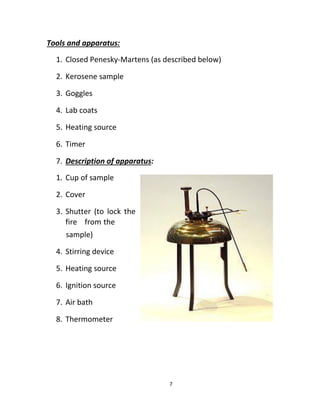
1. Closed Penesky-Martens (as described below)
2. Kerosene sample
3. Goggles
4. Lab coats
5. Heating source
6. Timer
7. Description of apparatus:
1. Cup of sample
2. Cover
3. Shutter (to lock the
fire from the
sample)
4. Stirring device
5. Heating source
6. Ignition source
7. Air bath
8. Thermometer
8
The procedure:
1. Clean and dry all parts of the apparatus with the help of suitable solvent
e.g.) ether, or benzene and dry it to remove any traces of solvent.
2.Fill the oil cup with kerosene up to the mark.
3.Fix the lids on the top through which are inserted a thermometer and a stirrer.
Ensure that the flame exposure device is fixed on the top.
4.Light the flame and adjust it to about 4 mm in diameter and start stirring the
sample.
5.Heat apparatus in a rate of 5 0
C/min until 30 0
C is reached as stirrer is
continuously rotated. (the rate of increasing temp. can be reached by adjusting
the flame source).
6.Now, At every 2 0
C rise of temp. Introduce test flame into the oil vapor. (Stop
stirring during this step)
7. When test flame causes a distinct flash in the interior of the test cup, note temp.
which represent the flash point.
8.Further heat the sample at lower rate (1 or 2 o
C) and continue applying the test
flame as before.
9. The temperature at which the vapors of the oil give a clear and distinct blue
flash for five seconds is recorded as the fire point of the oil.
9
Discussion:
1. What is the flash point and fire point you observed?
- In our experiment we got to results (45 C) & (43 C) of flash point
and (55 C) & (50 C) of fire point .
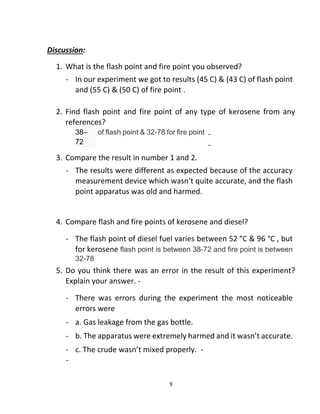
2. Find flash point and fire point of any type of kerosene from any
references?
-
-
3. Compare the result in number 1 and 2.
- The results were different as expected because of the accuracy
measurement device which wasn’t quite accurate, and the flash
point apparatus was old and harmed.
4. Compare flash and fire points of kerosene and diesel?
- The flash point of diesel fuel varies between 52 °C & 96 °C , but
for kerosene flash point is between 38-72 and fire point is between
32-78
5. Do you think there was an error in the result of this experiment?
Explain your answer. -
- There was errors during the experiment the most noticeable
errors were
- a. Gas leakage from the gas bottle.
- b. The apparatus were extremely harmed and it wasn’t accurate.
- c. The crude wasn’t mixed properly. -
-
38–
72
of flash point & 32-78 for fire point
10
References:
1. The official website of Debate Central “debate.uvm.edu”
2. The official website of art academy “www.tfa.edu”
3. http://www.ask.com/question/what-is-the-flash-point-ofdiesel
4. http://answers.yahoo.com/question/index?qid=2010031718
2632AAzv8Fv
5. http://en.wikipedia.org/wiki/Flash_point

Fire point

  • 1.
    Koya University Faculty ofEngineering Chemical Engineering Dep. 𝑃𝑒𝑡𝑟𝑜𝑙𝑒𝑢𝑚 𝑎𝑛𝑑 𝐺𝑎𝑠 𝑃𝑟𝑜𝑝𝑟𝑖𝑡𝑒𝑠 By: Aree Salah Exp. NO : Six Name of Exp.: Fire Point Date of Exp.: 28.1.2014 Date of submission: 4.2.2014
  • 2.
    2 Table of Content: Aimof the experiment ………………………………………………………………. 3 Theory ……………………………………………………………………………………….. 4 Importance of Flash Point ………………………………………………………….. 5 Methods ……………………………………………………………………………………. 6 Tools and apparatus ….................................................................... 7 Description of apparatus ………………………………………………………….... 7 Procedure ………………………………………………………………………………….. 8 Discussion …………………………………………………………………………………. 9 References ………………………………………………………………………………. 10
  • 3.
    3 The Aim ofthis experiment: To determine fire point of an oil product using closed cup method (Penesky Marten’s apparatus).
  • 4.
    4 Theory: Fire point canvary for a sample based on factors including pressure, the quantity of the chemical, and the location of the ignition source in relation to the sample. The flash point for a particular sample is, therefore, somewhat unreliable and should be used as a general guideline, rather than an absolute value. There are two basic ways in which the fire point for a particular chemical can be determined: open cup or closed cup experiments. Both types of experiments are based on the fact that a liquid that is combustible, such as gasoline and diesel, release vapors that are potentially ignitable. As the temperature of the liquid increases, the amount of these vapors also increases. This means that at a certain temperature, the vapor concentration is high enough that it becomes ignitable. Samples with a fairly low flash point are referred to as flammable, while chemicals with higher flash points are usually referred to as combustible. An open cup experiment involves a quantity of a particular sample placed in a container that is open. The sample is slowly heated and an ignition source, such as a small flame (spark), is introduced above the sample at various intervals. This process continues until a temperature is reached at which the vapors from the sample ignite, which establishes the flash point for that sample. Once ignition occurs, the ignition source is removed and the vapors should then stop burning; if they continue to burn without the
  • 5.
    5 source, however, thenthe fire point for a sample has been reached. In a closed cup experiment, the process is similar but the container for the sample is lidded and the ignition source is introduced through the lid. A closed cup experiment allows for the fire point of a particular sample to be determined when that sample is under increased pressure due to a closed system. Importance of flash and fire points: • It indicates fire hazard of petroleum products and evaporation loses under high temperature. • It gives us the idea about the maximum temperature below which the oil can be used (this is very important for storage and transportation) • Detection of contamination in the given oil product • It classifies the petroleum (light or heavy)
  • 6.
    6 Methods: There are threestandard methods (one open and two closed) to determine the flash point according volatile temperature of sample: 1. Closed Abel Test Closed cup flash point test for products and liquid petroleum mixtures which have flash point is between -30°C and +70°C. 2. Open Cleveland Test Opened cup flash test point for products (heavy petroleum) which have flash point is between ambient and 400°C. 3. Closed Penesky-Martens Test Closed cup flash point test to determine the flash point for products with flash point above 40 0C to 3600C.
  • 7.
    7 Tools and apparatus: 1.Closed Penesky-Martens (as described below) 2. Kerosene sample 3. Goggles 4. Lab coats 5. Heating source 6. Timer 7. Description of apparatus: 1. Cup of sample 2. Cover 3. Shutter (to lock the fire from the sample) 4. Stirring device 5. Heating source 6. Ignition source 7. Air bath 8. Thermometer
  • 8.
    8 The procedure: 1. Cleanand dry all parts of the apparatus with the help of suitable solvent e.g.) ether, or benzene and dry it to remove any traces of solvent. 2.Fill the oil cup with kerosene up to the mark. 3.Fix the lids on the top through which are inserted a thermometer and a stirrer. Ensure that the flame exposure device is fixed on the top. 4.Light the flame and adjust it to about 4 mm in diameter and start stirring the sample. 5.Heat apparatus in a rate of 5 0 C/min until 30 0 C is reached as stirrer is continuously rotated. (the rate of increasing temp. can be reached by adjusting the flame source). 6.Now, At every 2 0 C rise of temp. Introduce test flame into the oil vapor. (Stop stirring during this step) 7. When test flame causes a distinct flash in the interior of the test cup, note temp. which represent the flash point. 8.Further heat the sample at lower rate (1 or 2 o C) and continue applying the test flame as before. 9. The temperature at which the vapors of the oil give a clear and distinct blue flash for five seconds is recorded as the fire point of the oil.
  • 9.
    9 Discussion: 1. What isthe flash point and fire point you observed? - In our experiment we got to results (45 C) & (43 C) of flash point and (55 C) & (50 C) of fire point . 2. Find flash point and fire point of any type of kerosene from any references? - - 3. Compare the result in number 1 and 2. - The results were different as expected because of the accuracy measurement device which wasn’t quite accurate, and the flash point apparatus was old and harmed. 4. Compare flash and fire points of kerosene and diesel? - The flash point of diesel fuel varies between 52 °C & 96 °C , but for kerosene flash point is between 38-72 and fire point is between 32-78 5. Do you think there was an error in the result of this experiment? Explain your answer. - - There was errors during the experiment the most noticeable errors were - a. Gas leakage from the gas bottle. - b. The apparatus were extremely harmed and it wasn’t accurate. - c. The crude wasn’t mixed properly. - - 38– 72 of flash point & 32-78 for fire point
  • 10.
    10 References: 1. The officialwebsite of Debate Central “debate.uvm.edu” 2. The official website of art academy “www.tfa.edu” 3. http://www.ask.com/question/what-is-the-flash-point-ofdiesel 4. http://answers.yahoo.com/question/index?qid=2010031718 2632AAzv8Fv 5. http://en.wikipedia.org/wiki/Flash_point