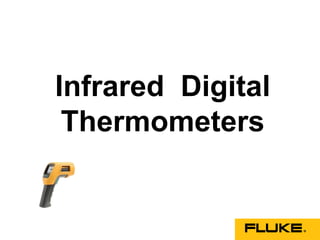
Infrared Digital
 Thermometers
Infrared thermometers are designed for applications
    requiring users to instantly measure temperature in
                    hard-to-reach areas


http://www.fluke.com/fluke/inen/products/Thermometers.htm
Temperature measurement
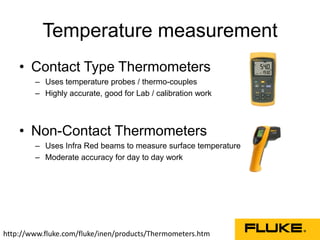
    • Contact Type Thermometers
        – Uses temperature probes / thermo-couples
        – Highly accurate, good for Lab / calibration work


    • Non-Contact Thermometers
        – Uses Infra Red beams to measure surface temperature
        – Moderate accuracy for day to day work


http://www.fluke.com/fluke/inen/products/Thermometers.htm
Why IR thermometers - 3 main reasons
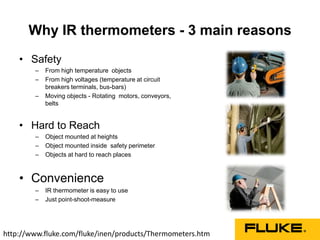
    • Safety
        –   From high temperature objects
        –   From high voltages (temperature at circuit
            breakers terminals, bus-bars)
        –   Moving objects - Rotating motors, conveyors,
            belts


    • Hard to Reach
        –   Object mounted at heights
        –   Object mounted inside safety perimeter
        –   Objects at hard to reach places


    • Convenience
        –   IR thermometer is easy to use
        –   Just point-shoot-measure


http://www.fluke.com/fluke/inen/products/Thermometers.htm
Important Parameters – IR Thermometers
    •   Emissivity

    •   A numerical value between 0 and 1 which indicates the ability of an
        object to emit infrared energy.

    •   Emissivity is determined primarily by the material from which an
        object is constructed and its surface finish.

    •   Examples:

        – Polished brass: 0.03

        – Roughly polished copper: 0.07

        – Black lacquer paint: 0.96

        – Circuit boards


http://www.fluke.com/fluke/inen/products/Thermometers.htm
Important Parameters – IR Thermometers

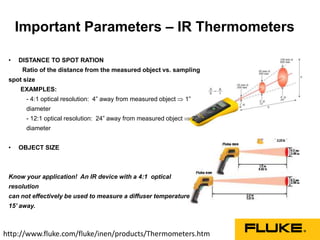
 •   DISTANCE TO SPOT RATION
      Ratio of the distance from the measured object vs. sampling
 spot size
     EXAMPLES:
       - 4:1 optical resolution: 4” away from measured object     1”
       diameter
       - 12:1 optical resolution: 24” away from measured object        2”
       diameter


 •   OBJECT SIZE


 Know your application! An IR device with a 4:1 optical
 resolution
 can not effectively be used to measure a diffuser temperature
 15’ away.


http://www.fluke.com/fluke/inen/products/Thermometers.htm
Important Parameters – IR Thermometers
     FIELD OF VIEW
     - Field of view refers to the target size relative to the IR thermometer’s spot size .
     - Ideally, the target surface to be measured should be twice the size of the spot .
     - If the spot size is larger than the surface to be measured, measurement errors are
     increased .
     - Spot size calculator www.Fluke.Com


http://www.fluke.com/fluke/inen/products/Thermometers.htm
HOW DOES IR THERMOMETER WORK

  Infrared thermometers measure the surface
  temperature of an opaque object


  The thermometer’s optics sense emitted,
  reflected, and transmitted energy, which is
  collected and focused onto a Detector


  The unit’s electronics translate the information
  into a temperature reading which the unit
  displays


http://www.fluke.com/fluke/inen/products/Thermometers.htm
IMPORTANT SPECIFICATIONS
   FOR SELECTION OF RIGHT IRTHERMOMETER

     • Temperature range

     • Measurement accuracy

     • Distance to Spot Ratio

     • Rugged & Reliable

     • Response time

     • Display resolution

     • Battery life


http://www.fluke.com/fluke/inen/products/Thermometers.htm
OPERATING THE IR THERMOMETER

  •   To measure temperature, point the thermometer at an object and pull the trigger.

  •   Laser pointer to help aim the thermometer

  •   To find a hot or cold spot, aim the thermometer outside the desired area.

  •   As the distance from the object being measured increases, the spot size of the area
      measured by the unit becomes larger

  •   For accurate measurements, make sure that the target is larger than the unit’s spot
      size

  •   The display retains its last infrared measurement for twenty seconds when the trigger
      is released, with HOLD appearing on the display

  •   The stored data can be downloaded to a personal computer (PC) via the

      included USB cable and the included Fluke View Forms Documenting Software


http://www.fluke.com/fluke/inen/products/Thermometers.htm
SAFETY PRECAUTIONS

  •   Before using the thermometer inspect the case. Do not use the thermometer if it appears
      damaged. Look for cracks or missing plastic. Pay particular attention to the insulation
      around the connectors

  •   Disconnect the thermocouple(s) from the thermometer before opening the case

  •   Replace the batteries as soon as the battery indicator appears. The possibility of false
      readings can lead to personal injury

  •   Do not use the thermometer if it operates abnormally. Protection may be impaired. When
      in doubt, have the thermometer serviced / calibrated at authorized labs.

  •   Reflective objects result in lower than actual temperature measurements. These objects
      pose a burn hazard


      Do not operate the thermometer around explosive gas, vapor, or dust


http://www.fluke.com/fluke/inen/products/Thermometers.htm
• Company Name : Fluke Corporation - India

• Website: http://www.fluke.com/fluke/inen/home/default.htm

• Address: Division of DHR Holding India Pvt. Ltd.
           10th Floor, Sigma
           Hiranandani Business Park, Powai
           Mumbai, Maharashtra 400076

• Contact Number: 1 800 209 9110


http://www.fluke.com/fluke/inen/products/Thermometers.htm
Thank You

Basics of Temperature Measurement

  • 1.
  • 2.
    Infrared thermometers aredesigned for applications requiring users to instantly measure temperature in hard-to-reach areas http://www.fluke.com/fluke/inen/products/Thermometers.htm
  • 3.
    Temperature measurement • Contact Type Thermometers – Uses temperature probes / thermo-couples – Highly accurate, good for Lab / calibration work • Non-Contact Thermometers – Uses Infra Red beams to measure surface temperature – Moderate accuracy for day to day work http://www.fluke.com/fluke/inen/products/Thermometers.htm
  • 4.
    Why IR thermometers- 3 main reasons • Safety – From high temperature objects – From high voltages (temperature at circuit breakers terminals, bus-bars) – Moving objects - Rotating motors, conveyors, belts • Hard to Reach – Object mounted at heights – Object mounted inside safety perimeter – Objects at hard to reach places • Convenience – IR thermometer is easy to use – Just point-shoot-measure http://www.fluke.com/fluke/inen/products/Thermometers.htm
  • 5.
    Important Parameters –IR Thermometers • Emissivity • A numerical value between 0 and 1 which indicates the ability of an object to emit infrared energy. • Emissivity is determined primarily by the material from which an object is constructed and its surface finish. • Examples: – Polished brass: 0.03 – Roughly polished copper: 0.07 – Black lacquer paint: 0.96 – Circuit boards http://www.fluke.com/fluke/inen/products/Thermometers.htm
  • 6.
    Important Parameters –IR Thermometers • DISTANCE TO SPOT RATION Ratio of the distance from the measured object vs. sampling spot size EXAMPLES: - 4:1 optical resolution: 4” away from measured object 1” diameter - 12:1 optical resolution: 24” away from measured object 2” diameter • OBJECT SIZE Know your application! An IR device with a 4:1 optical resolution can not effectively be used to measure a diffuser temperature 15’ away. http://www.fluke.com/fluke/inen/products/Thermometers.htm
  • 7.
    Important Parameters –IR Thermometers FIELD OF VIEW - Field of view refers to the target size relative to the IR thermometer’s spot size . - Ideally, the target surface to be measured should be twice the size of the spot . - If the spot size is larger than the surface to be measured, measurement errors are increased . - Spot size calculator www.Fluke.Com http://www.fluke.com/fluke/inen/products/Thermometers.htm
  • 8.
    HOW DOES IRTHERMOMETER WORK Infrared thermometers measure the surface temperature of an opaque object The thermometer’s optics sense emitted, reflected, and transmitted energy, which is collected and focused onto a Detector The unit’s electronics translate the information into a temperature reading which the unit displays http://www.fluke.com/fluke/inen/products/Thermometers.htm
  • 9.
    IMPORTANT SPECIFICATIONS FOR SELECTION OF RIGHT IRTHERMOMETER • Temperature range • Measurement accuracy • Distance to Spot Ratio • Rugged & Reliable • Response time • Display resolution • Battery life http://www.fluke.com/fluke/inen/products/Thermometers.htm
  • 10.
    OPERATING THE IRTHERMOMETER • To measure temperature, point the thermometer at an object and pull the trigger. • Laser pointer to help aim the thermometer • To find a hot or cold spot, aim the thermometer outside the desired area. • As the distance from the object being measured increases, the spot size of the area measured by the unit becomes larger • For accurate measurements, make sure that the target is larger than the unit’s spot size • The display retains its last infrared measurement for twenty seconds when the trigger is released, with HOLD appearing on the display • The stored data can be downloaded to a personal computer (PC) via the included USB cable and the included Fluke View Forms Documenting Software http://www.fluke.com/fluke/inen/products/Thermometers.htm
  • 11.
    SAFETY PRECAUTIONS • Before using the thermometer inspect the case. Do not use the thermometer if it appears damaged. Look for cracks or missing plastic. Pay particular attention to the insulation around the connectors • Disconnect the thermocouple(s) from the thermometer before opening the case • Replace the batteries as soon as the battery indicator appears. The possibility of false readings can lead to personal injury • Do not use the thermometer if it operates abnormally. Protection may be impaired. When in doubt, have the thermometer serviced / calibrated at authorized labs. • Reflective objects result in lower than actual temperature measurements. These objects pose a burn hazard Do not operate the thermometer around explosive gas, vapor, or dust http://www.fluke.com/fluke/inen/products/Thermometers.htm
  • 12.
    • Company Name: Fluke Corporation - India • Website: http://www.fluke.com/fluke/inen/home/default.htm • Address: Division of DHR Holding India Pvt. Ltd. 10th Floor, Sigma Hiranandani Business Park, Powai Mumbai, Maharashtra 400076 • Contact Number: 1 800 209 9110 http://www.fluke.com/fluke/inen/products/Thermometers.htm
  • 13.

Editor's Notes

  • #2 In harsh environments where fixed or <a href="http://www.fluke.com/fluke/inen/Thermometers/Food-Pro.htm?PID=56223" title="contact thermometer">contact thermometers</a> are unable to meet your requirements, an <a href="http://www.fluke.com/fluke/inen/products/Thermometers.htm" title="infrared thermometer">Infrared thermometer</a> is the better solution. Noncontact IR thermometerallows you to stay a safe distance from the object and get the most accurate readings across a wide range of temperatures.