Fire Escaping
   Systems
                       By:
                     Vinay.M
                   08011BB032


         Department of Urban and Regional Planning,
         School of Planning and Architecture,
         Jawaharlal Nehru Technological University,
         Hyderabad.
Fire escape:
     • a special kind of emergency exit.

     • provides a method of escape

     • often found on multiple-
       story residential buildings

     • they have fallen out of common use
Contents…
  •   Why…?
  •   How to escape…?
  •   Methods to escape fire …?
  •   Designs aspects…?
Economic Aspects Of Fire:
Losses & Expenditure…
                        •   suppression
        • lives
                        • prevention
        • Property
                        • protection
        • Use
                        • insurance
        • by Injury
                        • research &
                        development
Low rise…
ESCAPE ROUTES:
• There must be at least one escape route from
  a. the main entrance door of every flat or maisonette
  b. the door of every communal room
  c. from every plant room.

• An escape route must lead to a place of safety
  a. directly
  b. by way of a protected zone
  c. by way of an access deck or access balcony
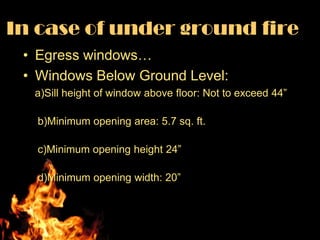
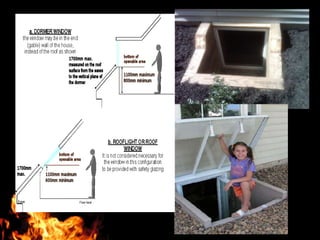
In case of under ground fire
 • Egress windows…
 • Windows Below Ground Level:
  a)Sill height of window above floor: Not to exceed 44”

   b)Minimum opening area: 5.7 sq. ft.

   c)Minimum opening height 24”

   d)Minimum opening width: 20”
HOW To ESCAPE THE
 FIRE…
• Escaping with elevators.
• Escaping through staircases.
• Rescuing people by firemen and rescue
  services.
• Rescuing with a telescopic ladder.
• Rescuing people through the windows.
• Emergency escaping with the 'rescue
  hose'
four distinct Stages:

• Stage 1 – escape from the room or area of fire origin.

• Stage 2 – escape from the compartment of origin via the
  circulation route to a protected stairway or an adjoining
  compartment offering refuge.

• Stage 3 – escape from the floor of origin to the ground
  level.

•        Stage 4 – escape at ground level away from .
•
Means of escape from fire…

 •   Time of evacuation
 •   Travel distances
 •   Number of Occupants
 •   Calculation of Exit Widths
 •   Calculation of Minimum Number of Exits
Time of evacuation:

• Class ‘A’ construction – 3 minutes

• Class ‘B’ construction – 2.5 minutes

• Class ‘C’ construction – 2 minutes
Number of Occupants

•   Number of Occupants
•   Density Factor
•   Persons who may use the building
•   Calculating the Number of Occupants
Travel Distance:
Places of Relative Safety
• A storey exit into a protected stairway or to the lobby of a
  lobby approach stairway;
• A door in a compartment wall or separating wall leading
  to an alternative exit;
• A door which leads directly to a protected stair or a final
  exit via a protected corridor.
Calculation of Exit Widths
 • U = N / (40 x T)
 Where: -
   U = number of units required;
   N = number of occupants;
   40 = standard rate of flow – constant;
   T = Flow time (i.e. 3 mins for Class ‘A’, 2.5 mins for
   Class ‘B’ and 2 mins for Class ‘C’)
Calculation of Minimum
         Number of Exits
• E=U/4+1
E = number of exits
  U = number of units of exit width (from exit width
  formula);
  4 = size of largest exit permitted.
  1 added to ensure there would always be at least one
  unit.
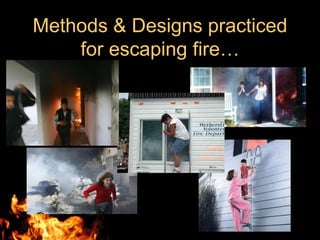
Methods & Designs practiced
    for escaping fire…
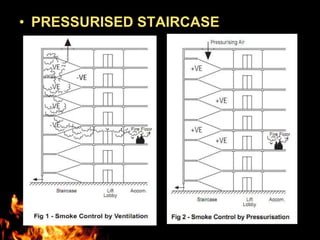
• PRESSURISED STAIRCASE
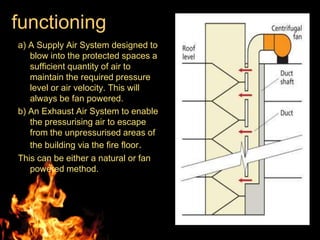
functioning
a) A Supply Air System designed to
   blow into the protected spaces a
   sufficient quantity of air to
   maintain the required pressure
   level or air velocity. This will
   always be fan powered.
b) An Exhaust Air System to enable
   the pressurising air to escape
   from the unpressurised areas of
   the building via the fire floor.
This can be either a natural or fan
   powered method.
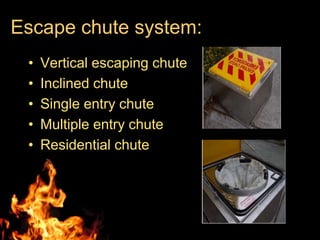
Escape chute system:
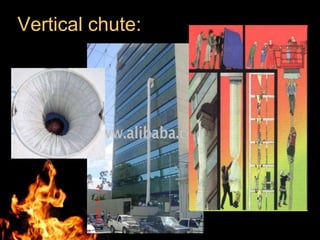
 •   Vertical escaping chute
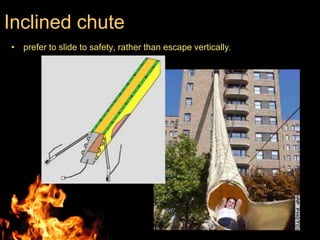
 •   Inclined chute
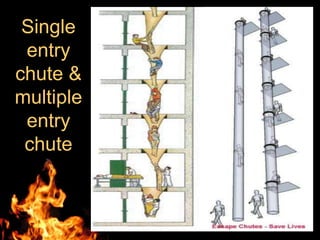
 •   Single entry chute
 •   Multiple entry chute
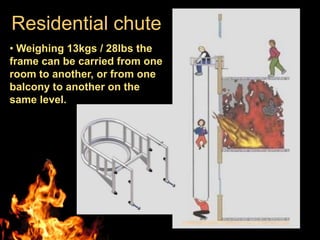
 •   Residential chute
Vertical chute:
Inclined chute
• prefer to slide to safety, rather than escape vertically.
Single
 entry
chute &
multiple
 entry
 chute
Residential chute
• Weighing 13kgs / 28lbs the
frame can be carried from one
room to another, or from one
balcony to another on the
same level.
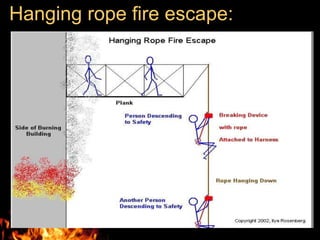
Hanging rope fire escape:
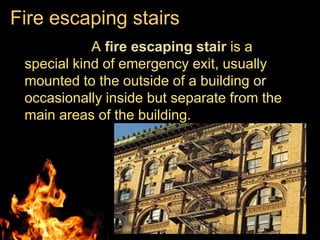
Fire escaping stairs
            A fire escaping stair is a
 special kind of emergency exit, usually
 mounted to the outside of a building or
 occasionally inside but separate from the
 main areas of the building.
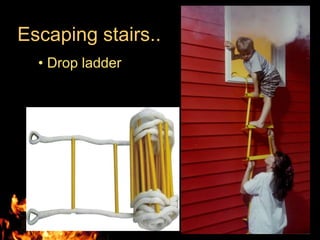
Escaping stairs..
  • Drop ladder
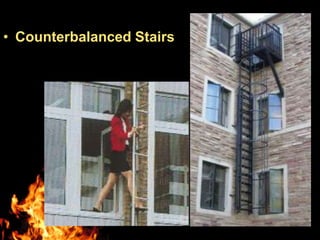
• Counterbalanced Stairs
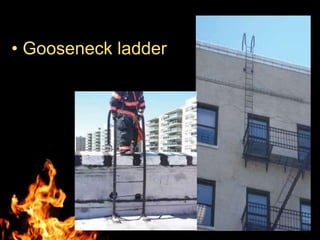
• Gooseneck ladder
THANK YOU…

fire escaping systems by vinay

  • 1.
    Fire Escaping Systems By: Vinay.M 08011BB032 Department of Urban and Regional Planning, School of Planning and Architecture, Jawaharlal Nehru Technological University, Hyderabad.
  • 2.
    Fire escape: • a special kind of emergency exit. • provides a method of escape • often found on multiple- story residential buildings • they have fallen out of common use
  • 3.
    Contents… • Why…? • How to escape…? • Methods to escape fire …? • Designs aspects…?
  • 4.
    Economic Aspects OfFire: Losses & Expenditure… • suppression • lives • prevention • Property • protection • Use • insurance • by Injury • research & development
  • 5.
  • 6.
    ESCAPE ROUTES: • Theremust be at least one escape route from a. the main entrance door of every flat or maisonette b. the door of every communal room c. from every plant room. • An escape route must lead to a place of safety a. directly b. by way of a protected zone c. by way of an access deck or access balcony
  • 7.
    In case ofunder ground fire • Egress windows… • Windows Below Ground Level: a)Sill height of window above floor: Not to exceed 44” b)Minimum opening area: 5.7 sq. ft. c)Minimum opening height 24” d)Minimum opening width: 20”
  • 9.
    HOW To ESCAPETHE FIRE…
  • 10.
    • Escaping withelevators. • Escaping through staircases. • Rescuing people by firemen and rescue services. • Rescuing with a telescopic ladder. • Rescuing people through the windows. • Emergency escaping with the 'rescue hose'
  • 11.
    four distinct Stages: •Stage 1 – escape from the room or area of fire origin. • Stage 2 – escape from the compartment of origin via the circulation route to a protected stairway or an adjoining compartment offering refuge. • Stage 3 – escape from the floor of origin to the ground level. • Stage 4 – escape at ground level away from . •
  • 12.
    Means of escapefrom fire… • Time of evacuation • Travel distances • Number of Occupants • Calculation of Exit Widths • Calculation of Minimum Number of Exits
  • 14.
    Time of evacuation: •Class ‘A’ construction – 3 minutes • Class ‘B’ construction – 2.5 minutes • Class ‘C’ construction – 2 minutes
  • 15.
    Number of Occupants • Number of Occupants • Density Factor • Persons who may use the building • Calculating the Number of Occupants
  • 16.
    Travel Distance: Places ofRelative Safety • A storey exit into a protected stairway or to the lobby of a lobby approach stairway; • A door in a compartment wall or separating wall leading to an alternative exit; • A door which leads directly to a protected stair or a final exit via a protected corridor.
  • 17.
    Calculation of ExitWidths • U = N / (40 x T) Where: - U = number of units required; N = number of occupants; 40 = standard rate of flow – constant; T = Flow time (i.e. 3 mins for Class ‘A’, 2.5 mins for Class ‘B’ and 2 mins for Class ‘C’)
  • 18.
    Calculation of Minimum Number of Exits • E=U/4+1 E = number of exits U = number of units of exit width (from exit width formula); 4 = size of largest exit permitted. 1 added to ensure there would always be at least one unit.
  • 19.
    Methods & Designspracticed for escaping fire…
  • 20.
  • 21.
    functioning a) A SupplyAir System designed to blow into the protected spaces a sufficient quantity of air to maintain the required pressure level or air velocity. This will always be fan powered. b) An Exhaust Air System to enable the pressurising air to escape from the unpressurised areas of the building via the fire floor. This can be either a natural or fan powered method.
  • 22.
    Escape chute system: • Vertical escaping chute • Inclined chute • Single entry chute • Multiple entry chute • Residential chute
  • 23.
  • 24.
    Inclined chute • preferto slide to safety, rather than escape vertically.
  • 25.
  • 26.
    Residential chute • Weighing13kgs / 28lbs the frame can be carried from one room to another, or from one balcony to another on the same level.
  • 27.
  • 28.
    Fire escaping stairs A fire escaping stair is a special kind of emergency exit, usually mounted to the outside of a building or occasionally inside but separate from the main areas of the building.
  • 29.
    Escaping stairs.. • Drop ladder
  • 30.
  • 31.
  • 32.