1
(Unit-I)
Properties of Fluids
By
Subhash Kumar
Subhash Kumar
Chapter 1: Basic ConceptsESOE 505221 Fluid Mechanics 2
Introduction
Mechanics is the oldest physical science that deals with
both stationary and moving bodies under the influence of
forces.
The branch of mechanics that deals with bodies at rest is
called statics, while the branch that deals with bodies in
motion is called dynamics. The subcategory fluid
mechanics is defined as the science that deals with the
behavior of fluids at rest (fluid statics) or in motion (fluid
dynamics), and the interaction of fluids with solids or other
fluids at the boundaries. Fluid mechanics is also referred to
as fluid dynamics by considering fluids at rest as a special
case of motion with zero velocity
3
1.1 INTRODUCTION
Fluid mechanics is that branch of science which deals
with the behavior of the fluids (liquids or gases) at rest
as well as in motion.
Thus this branch of science deals with the static,
kinematics and dynamic aspects of fluids.
The study of fluids at rest is called fluid statics.
The study of fluids in motion, where pressure forces
are not considered, is called fluid kinematics and if the
pressure forces are also considered for the fluids in
motion, that branch of science is called fluid dynamics.
Subhash Kumar
Chapter 1: Basic ConceptsESOE 505221 Fluid Mechanics 4
Introduction
Fluid mechanics itself is also divided into several categories.
The study of
Hydrodynamics: the motion of fluids that are practically
incompressible (such as liquids, especially water, and
gases at low speeds) is usually referred to as.
A subcategory of hydrodynamics is hydraulics, which
deals with liquid flows in pipes and open channels.
Gas dynamics deals with the flow of fluids that undergo
significant density changes, such as the flow of gases
through nozzles at high speeds.
Aerodynamics deals with the flow of gases (especially air)
over bodies such as aircraft, rockets, and automobiles at
high or low speeds.
Some other specialized categories such as meteorology,
oceanography, and hydrology deal with naturally
occurring flows.
Chapter 1: Basic ConceptsESOE 505221 Fluid Mechanics 5
What is a fluid?
A substance in the liquid or gas phase is referred to as a
fluid.
Distinction between a solid and a fluid is made on the
basis of the substance’s ability to resist an applied shear
(or tangential) stress that tends to change its shape.
A solid can resist an applied shear stress by deforming,
whereas a fluid deforms continuously under the influence
of shear stress, no matter how small.
In solids stress is proportional to strain, but in fluids
stress is proportional to strain rate. When a constant
shear force is applied, a solid eventually stops deforming,
at some fixed strain angle, whereas a fluid never stops
deforming and approaches a certain rate of strain.
Chapter 1: Basic ConceptsESOE 505221 Fluid Mechanics 6
What is a fluid?
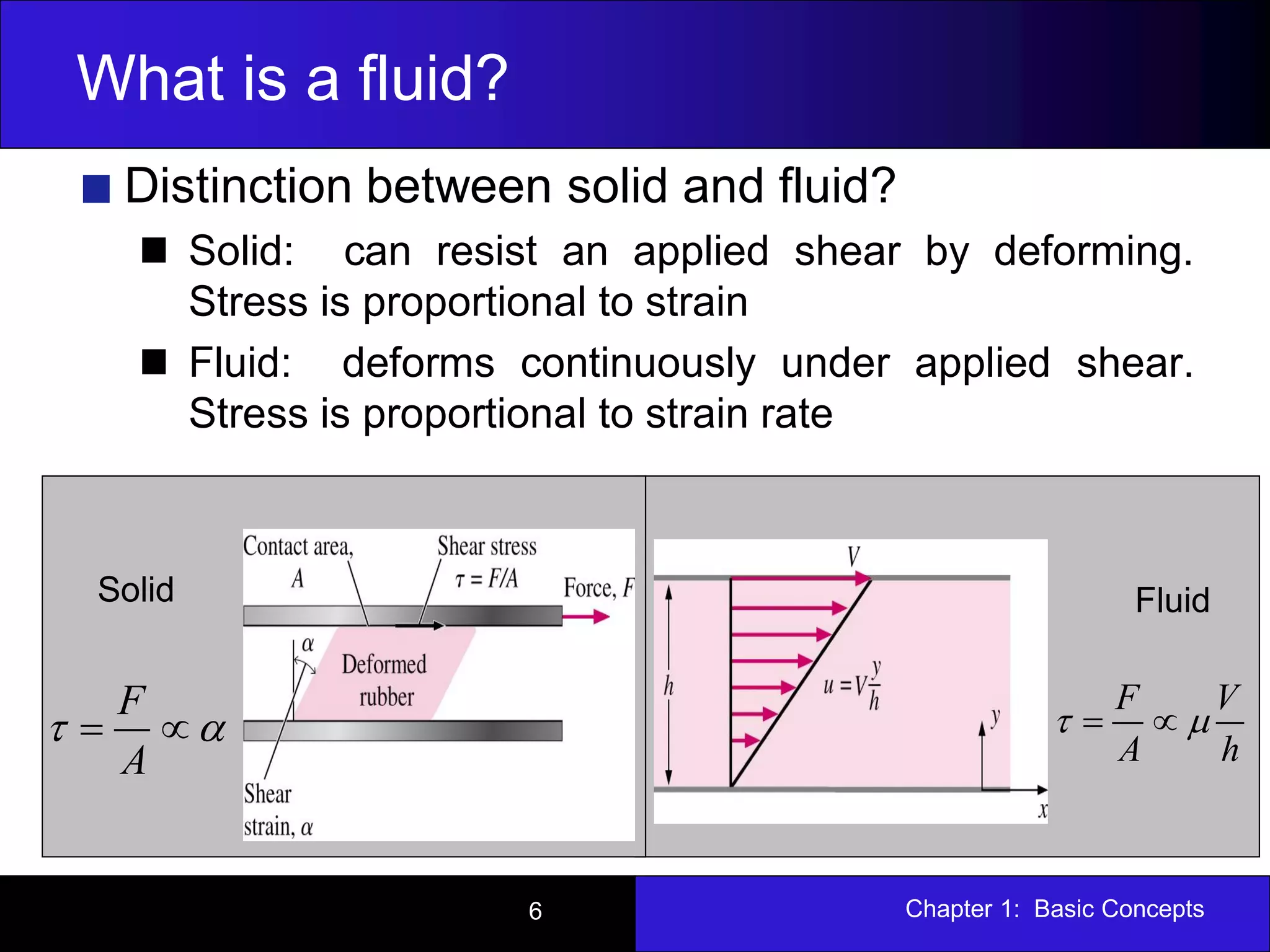
Distinction between solid and fluid?
Solid: can resist an applied shear by deforming.
Stress is proportional to strain
Fluid: deforms continuously under applied shear.
Stress is proportional to strain rate
F
A
  
F V
A h
  
Solid Fluid
Chapter 1: Basic ConceptsESOE 505221 Fluid Mechanics 7
What is a fluid?
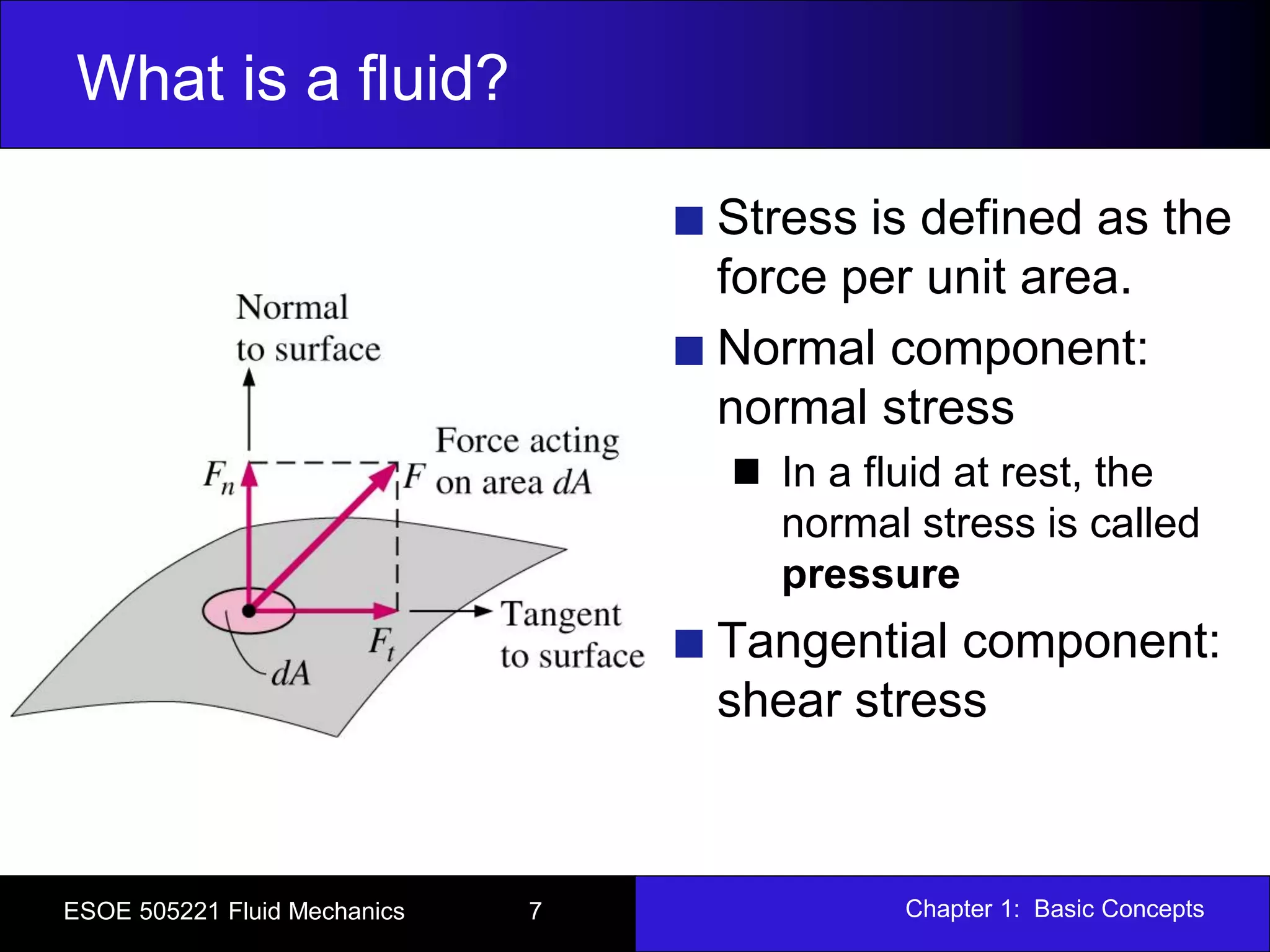
Stress is defined as the
force per unit area.
Normal component:
normal stress
In a fluid at rest, the
normal stress is called
pressure
Tangential component:
shear stress
Chapter 1: Basic ConceptsESOE 505221 Fluid Mechanics 8
What is a fluid?
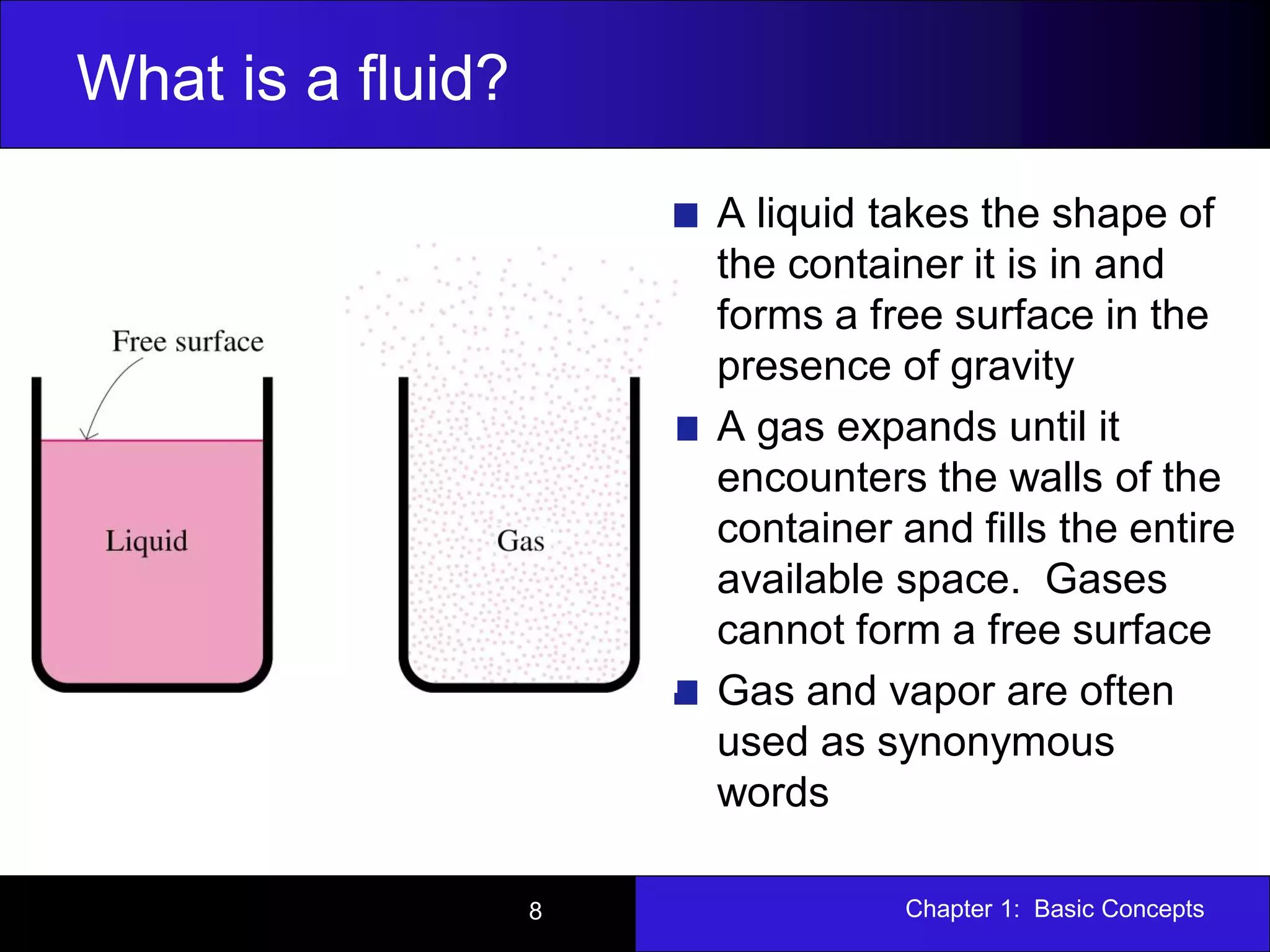
A liquid takes the shape of
the container it is in and
forms a free surface in the
presence of gravity
A gas expands until it
encounters the walls of the
container and fills the entire
available space. Gases
cannot form a free surface
Gas and vapor are often
used as synonymous
words
Chapter 1: Basic ConceptsESOE 505221 Fluid Mechanics 9
What is a fluid?
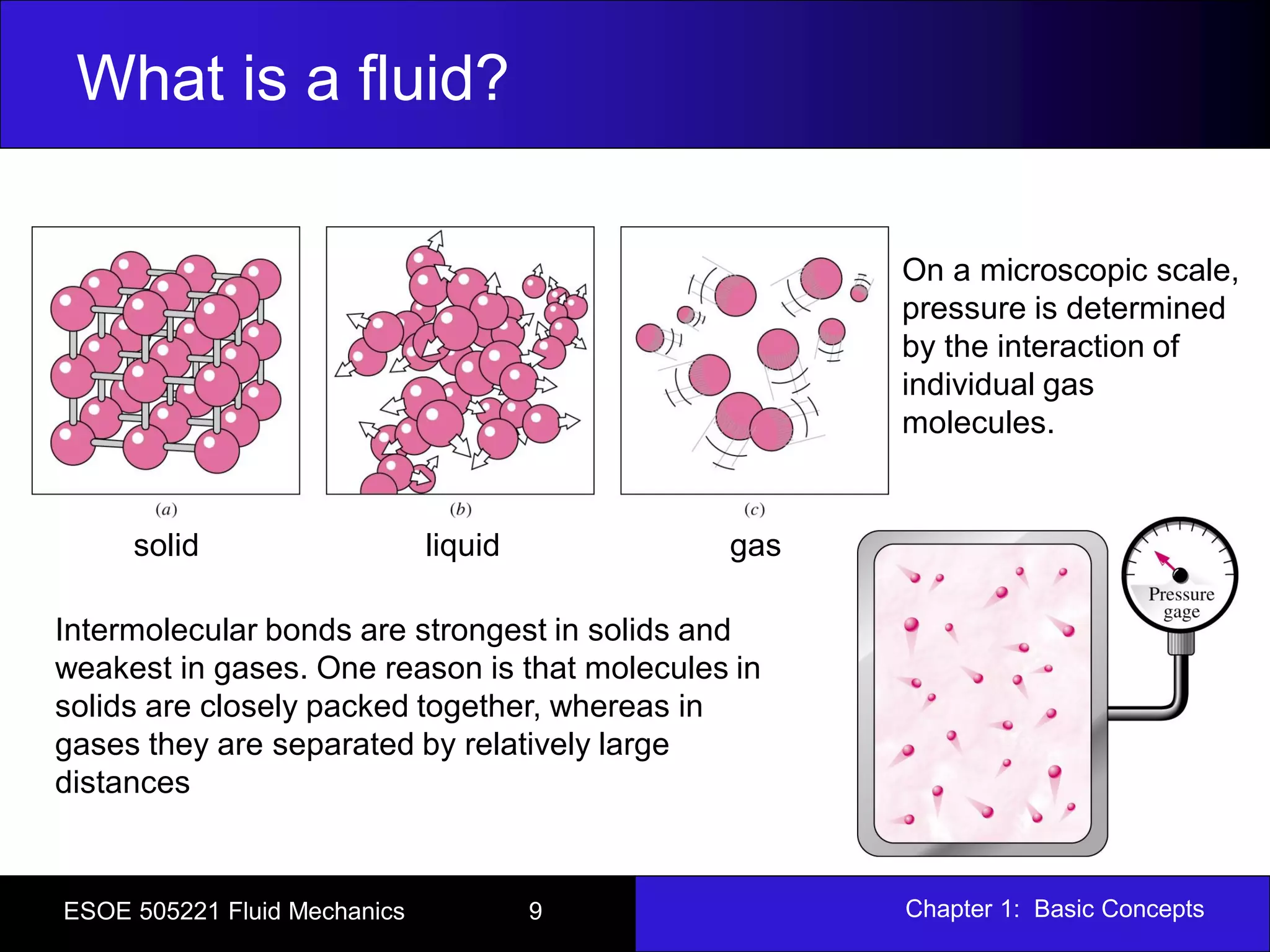
solid liquid gas
Intermolecular bonds are strongest in solids and
weakest in gases. One reason is that molecules in
solids are closely packed together, whereas in
gases they are separated by relatively large
distances
On a microscopic scale,
pressure is determined
by the interaction of
individual gas
molecules.
Chapter 1: Basic ConceptsESOE 505221 Fluid Mechanics 10
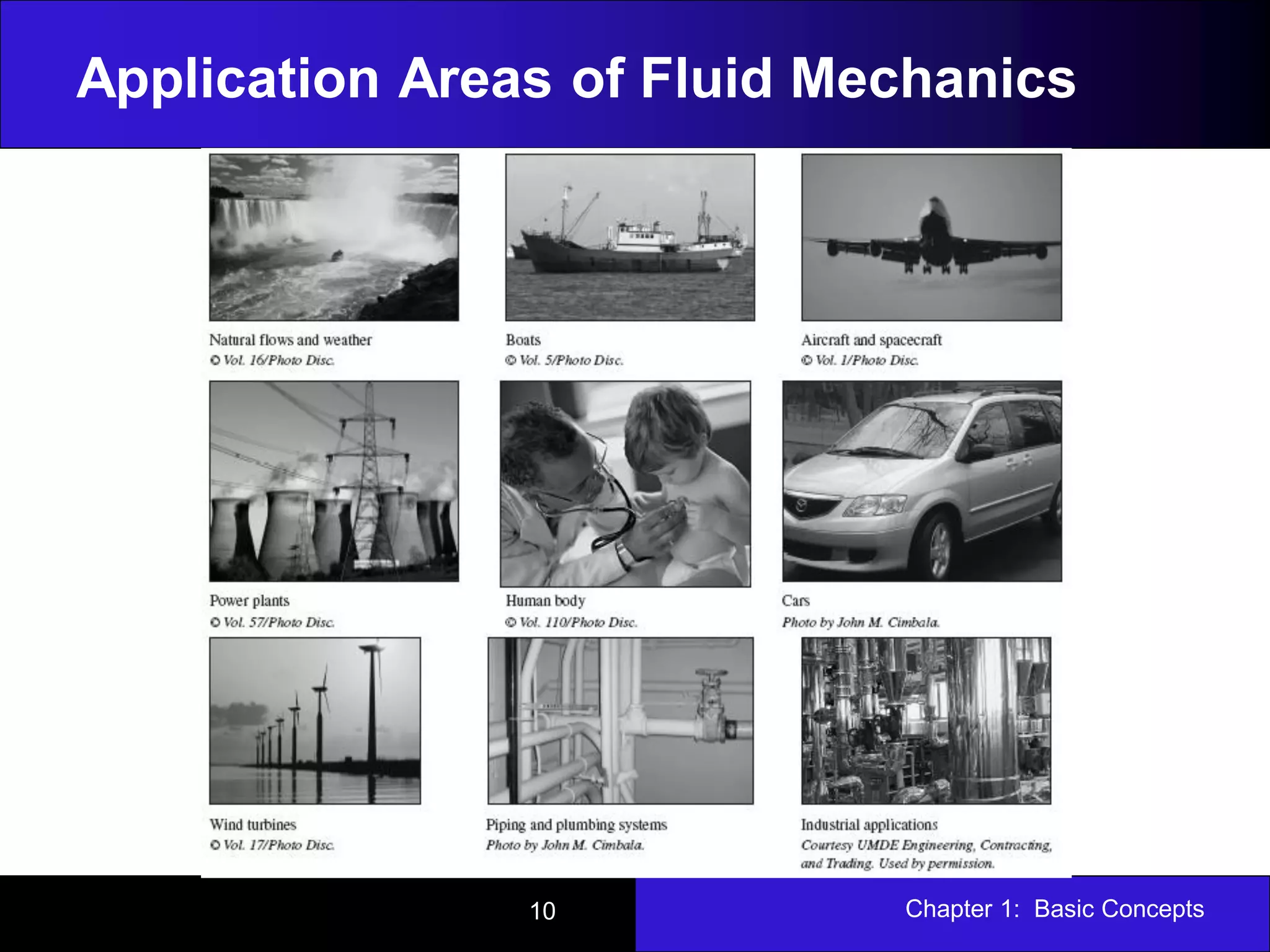
Application Areas of Fluid Mechanics
11
1.2 PROPERTIES OF FLUIDS
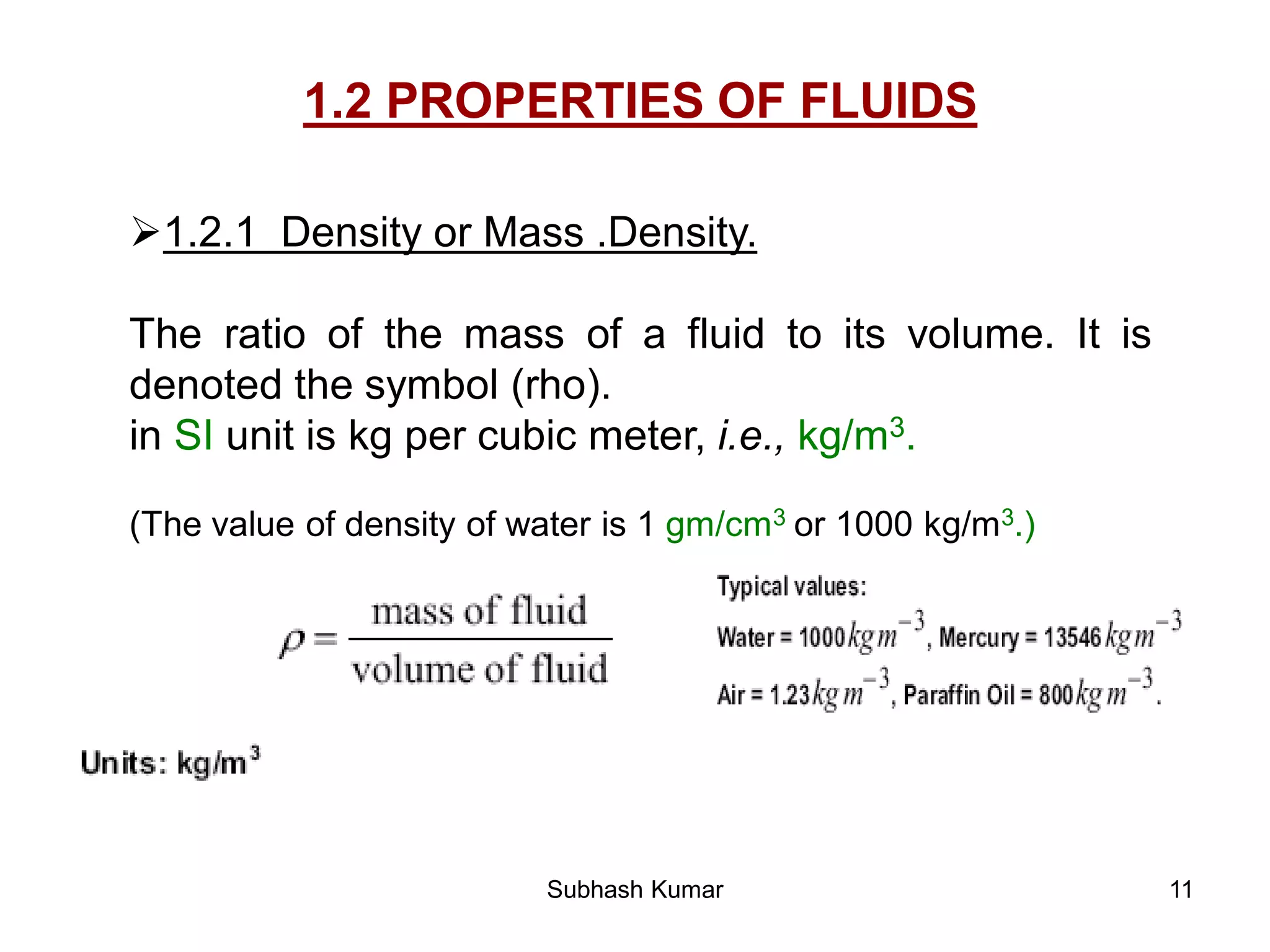
1.2.1 Density or Mass .Density.
The ratio of the mass of a fluid to its volume. It is
denoted the symbol (rho).
in SI unit is kg per cubic meter, i.e., kg/m3.
(The value of density of water is 1 gm/cm3 or 1000 kg/m3.)
Subhash Kumar
12
1.2 PROPERTIES OF FLUIDS
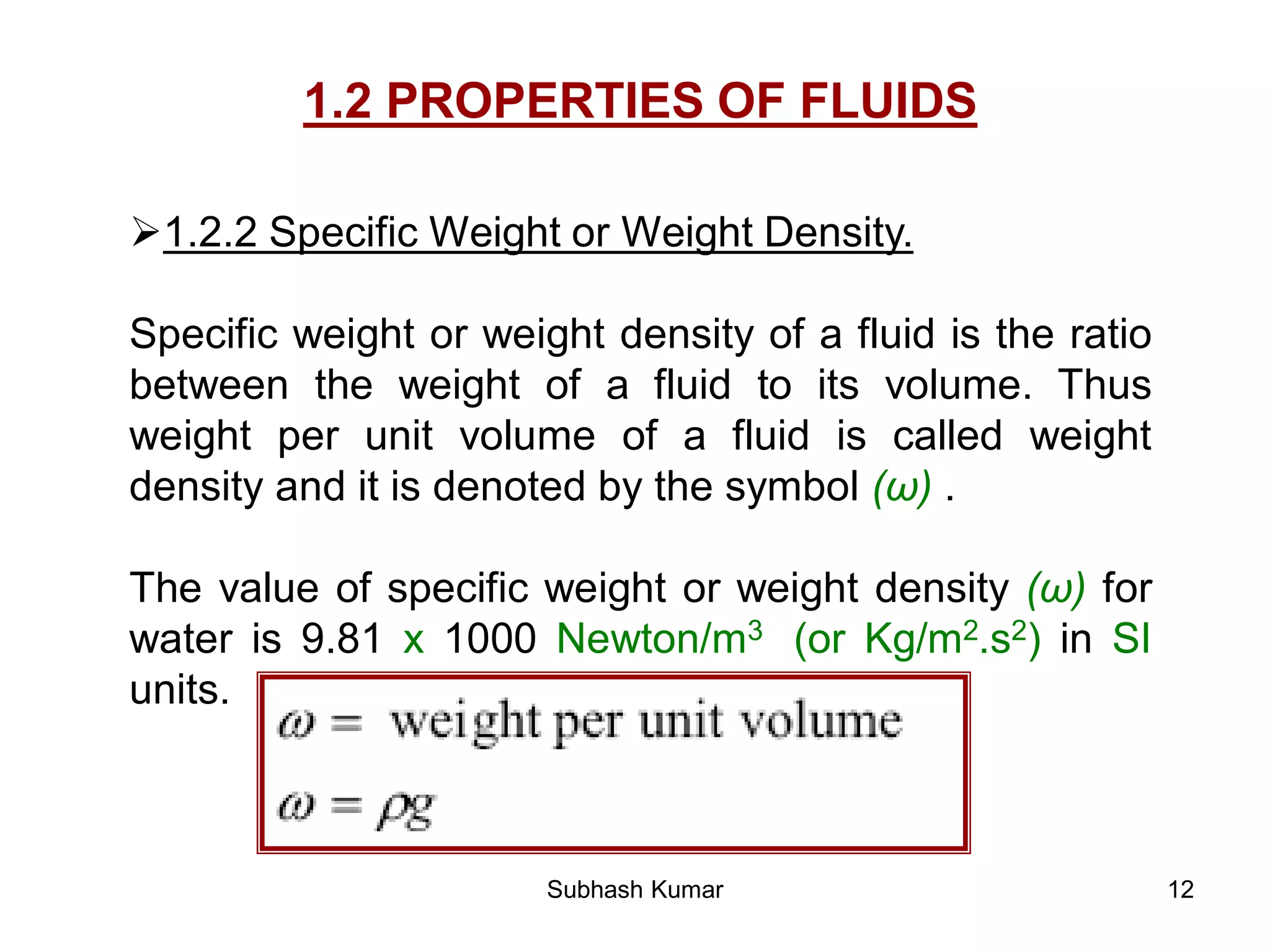
1.2.2 Specific Weight or Weight Density.
Specific weight or weight density of a fluid is the ratio
between the weight of a fluid to its volume. Thus
weight per unit volume of a fluid is called weight
density and it is denoted by the symbol (ω) .
The value of specific weight or weight density (ω) for
water is 9.81 x 1000 Newton/m3 (or Kg/m2.s2) in SI
units.
Subhash Kumar
13
1.2 PROPERTIES OF FLUIDS
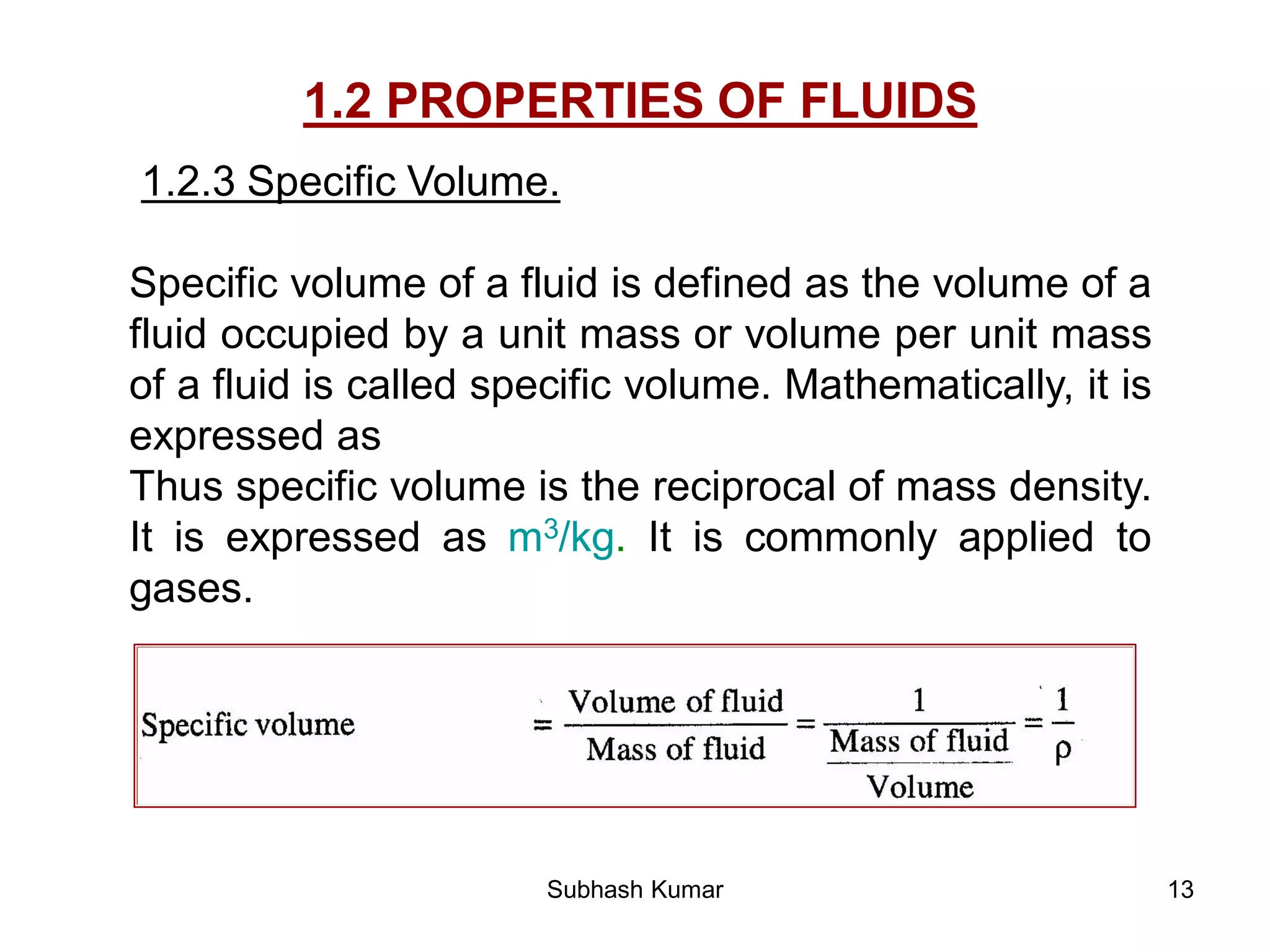
1.2.3 Specific Volume.
Specific volume of a fluid is defined as the volume of a
fluid occupied by a unit mass or volume per unit mass
of a fluid is called specific volume. Mathematically, it is
expressed as
Thus specific volume is the reciprocal of mass density.
It is expressed as m3/kg. It is commonly applied to
gases.
Subhash Kumar
14
1.2 PROPERTIES OF FLUIDS
1.2.4 Specific Gravity.
Specific gravity is defined as the ratio of the weight
density (or density) of a fluid to the weight density (or
density) of a standard fluid. For liquids, the standard
fluid is taken water and for gases, the standard fluid is
taken air. Specific gravity is also called relative
density. It is dimensionless quantity and is denoted by
the symbol S.
Subhash Kumar
15
1.2 PROPERTIES OF FLUIDS
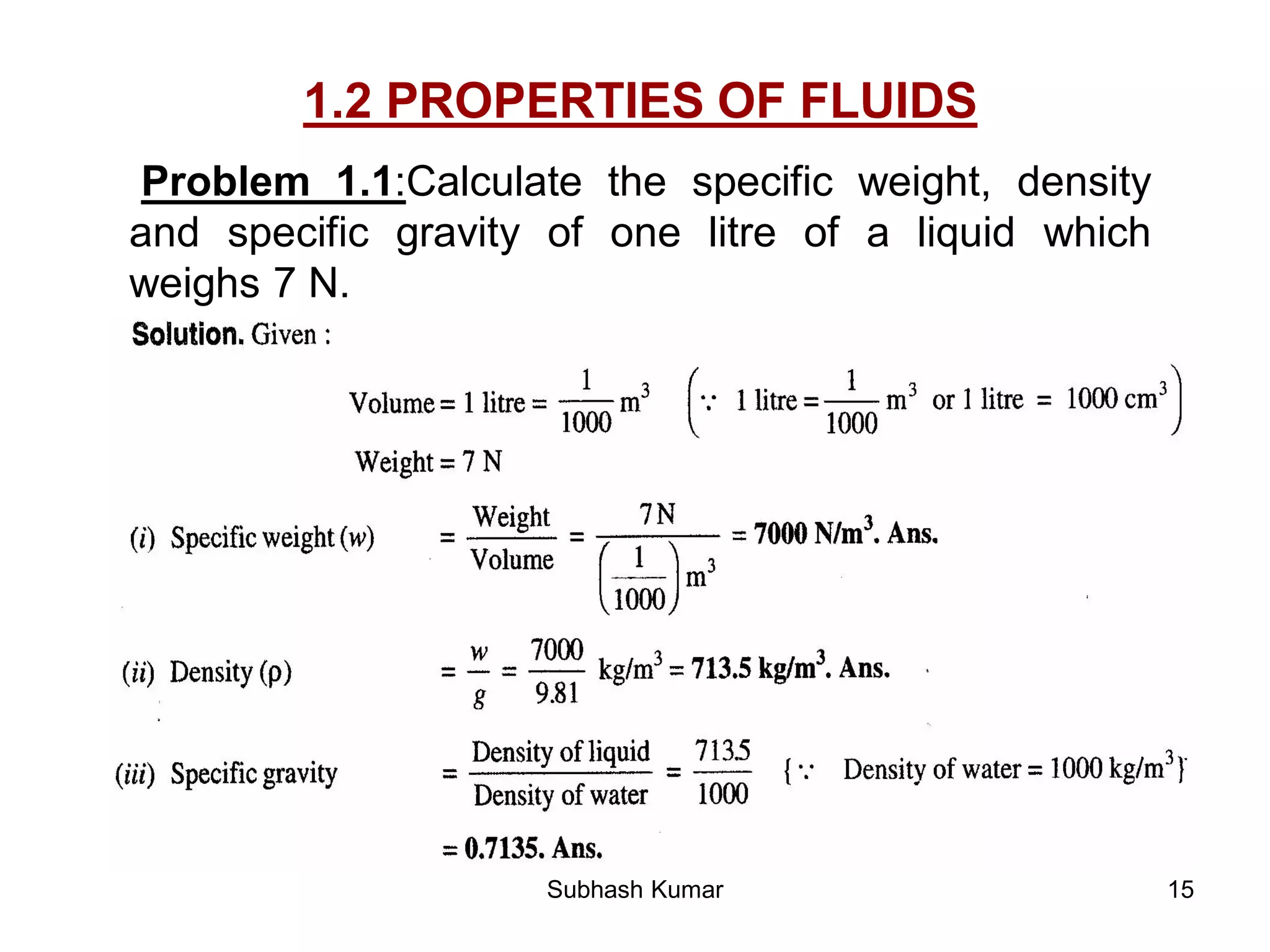
Problem 1.1:Calculate the specific weight, density
and specific gravity of one litre of a liquid which
weighs 7 N.
Subhash Kumar
16
1.2 PROPERTIES OF FLUIDS
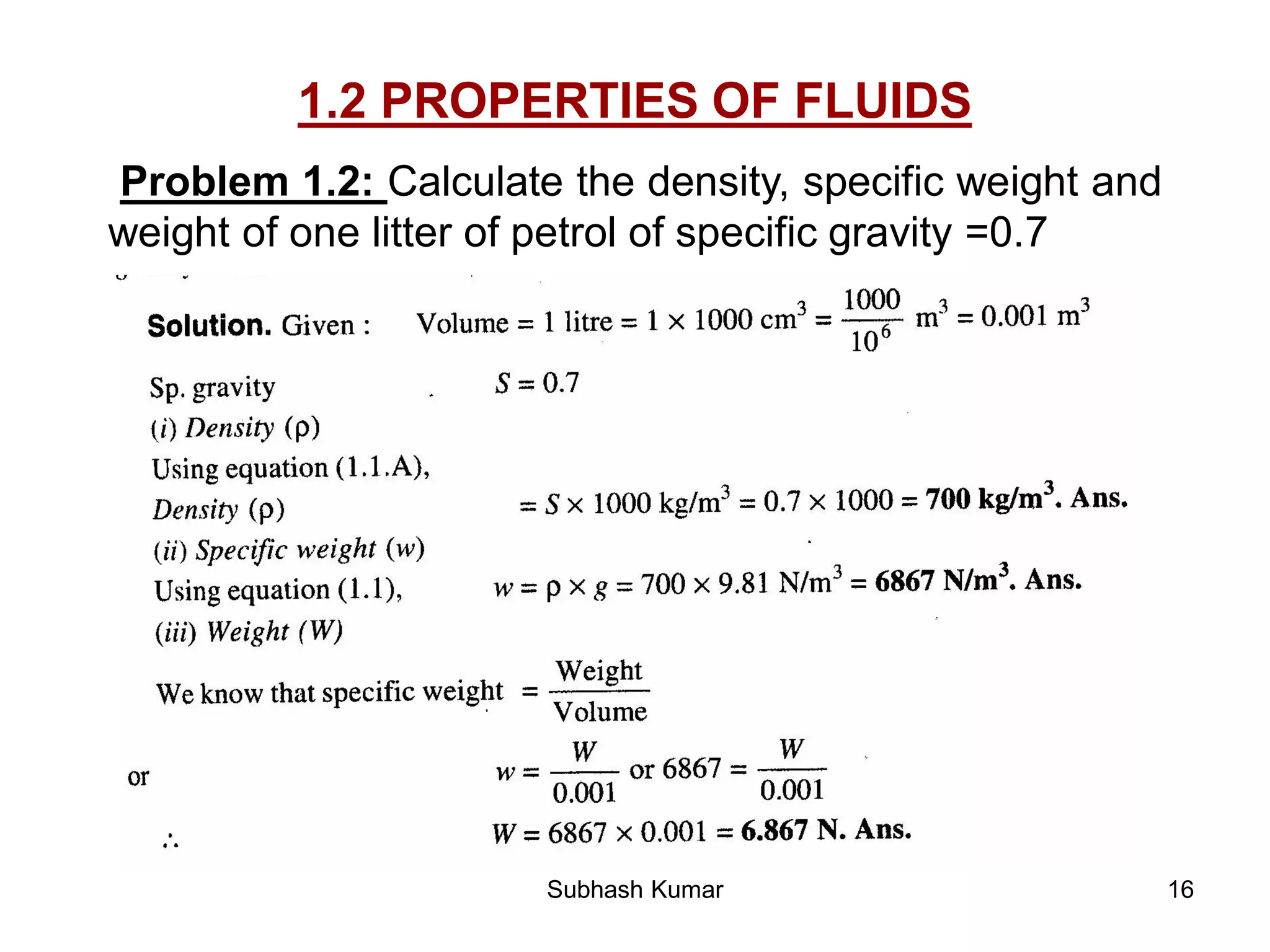
Problem 1.2: Calculate the density, specific weight and
weight of one litter of petrol of specific gravity =0.7
Subhash Kumar
17
1.3 VISCOSITY
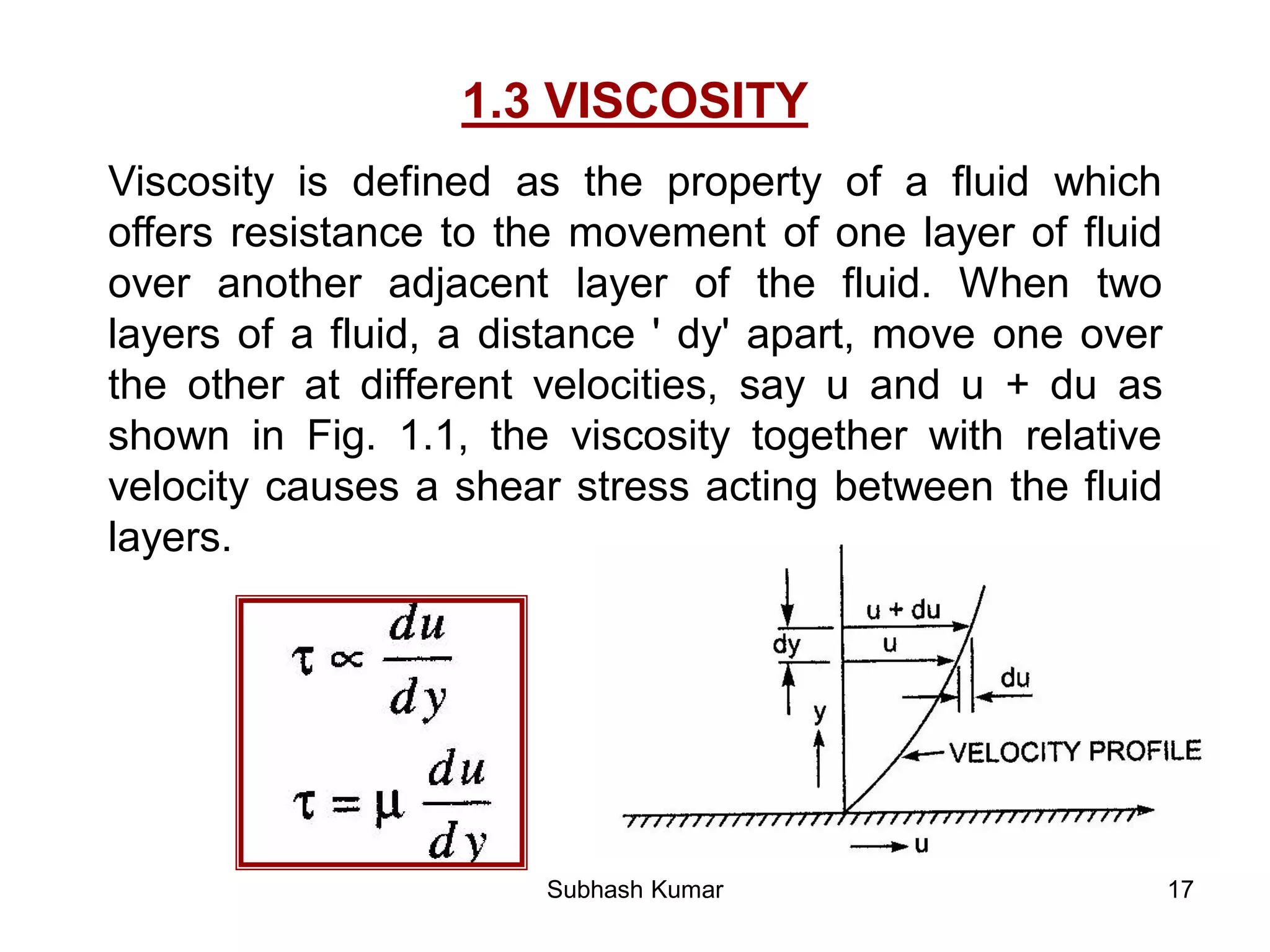
Viscosity is defined as the property of a fluid which
offers resistance to the movement of one layer of fluid
over another adjacent layer of the fluid. When two
layers of a fluid, a distance ' dy' apart, move one over
the other at different velocities, say u and u + du as
shown in Fig. 1.1, the viscosity together with relative
velocity causes a shear stress acting between the fluid
layers.
Subhash Kumar
18
1.3 VISCOSITY
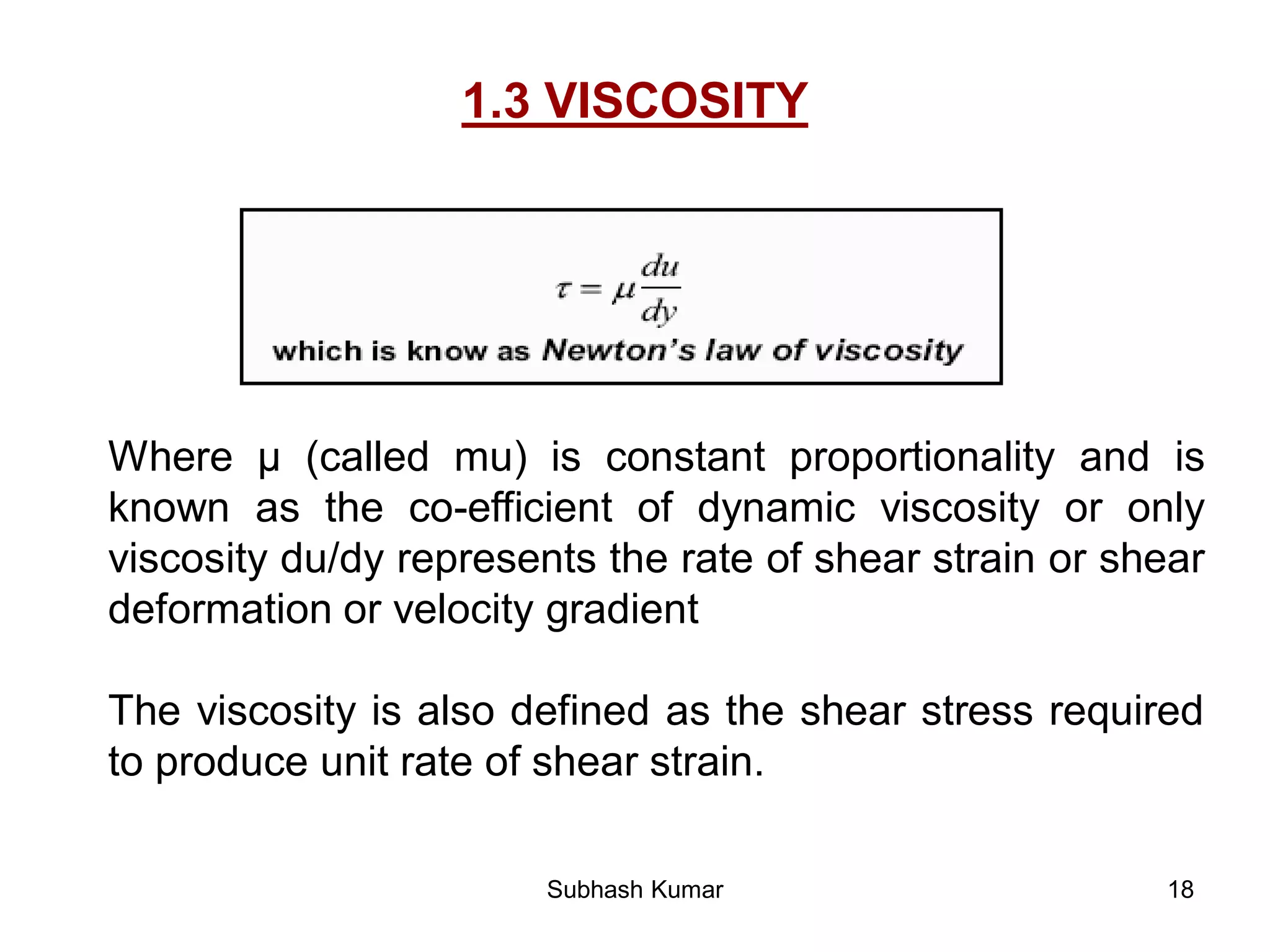
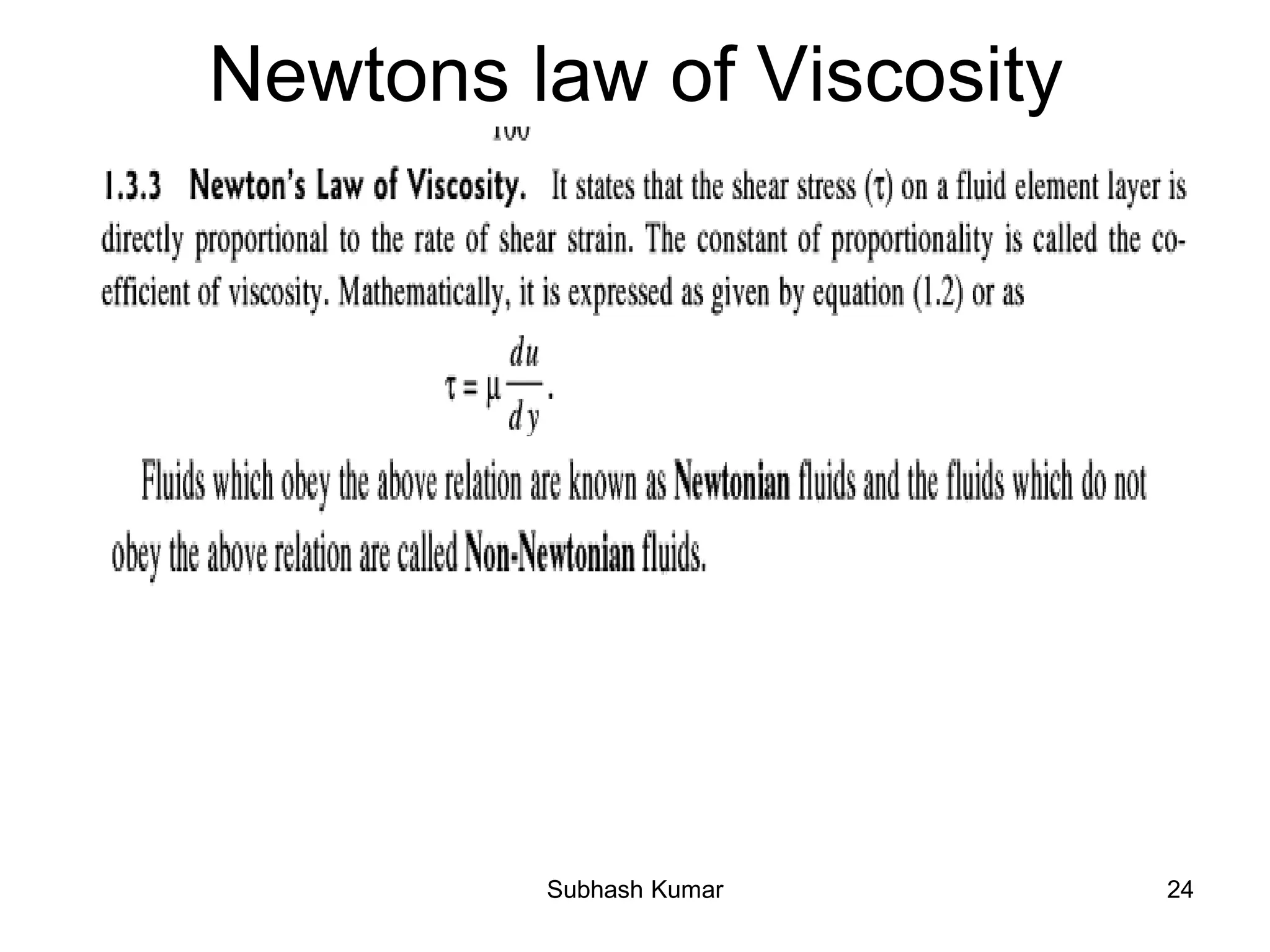
Where µ (called mu) is constant proportionality and is
known as the co-efficient of dynamic viscosity or only
viscosity du/dy represents the rate of shear strain or shear
deformation or velocity gradient
The viscosity is also defined as the shear stress required
to produce unit rate of shear strain.
Subhash Kumar
19
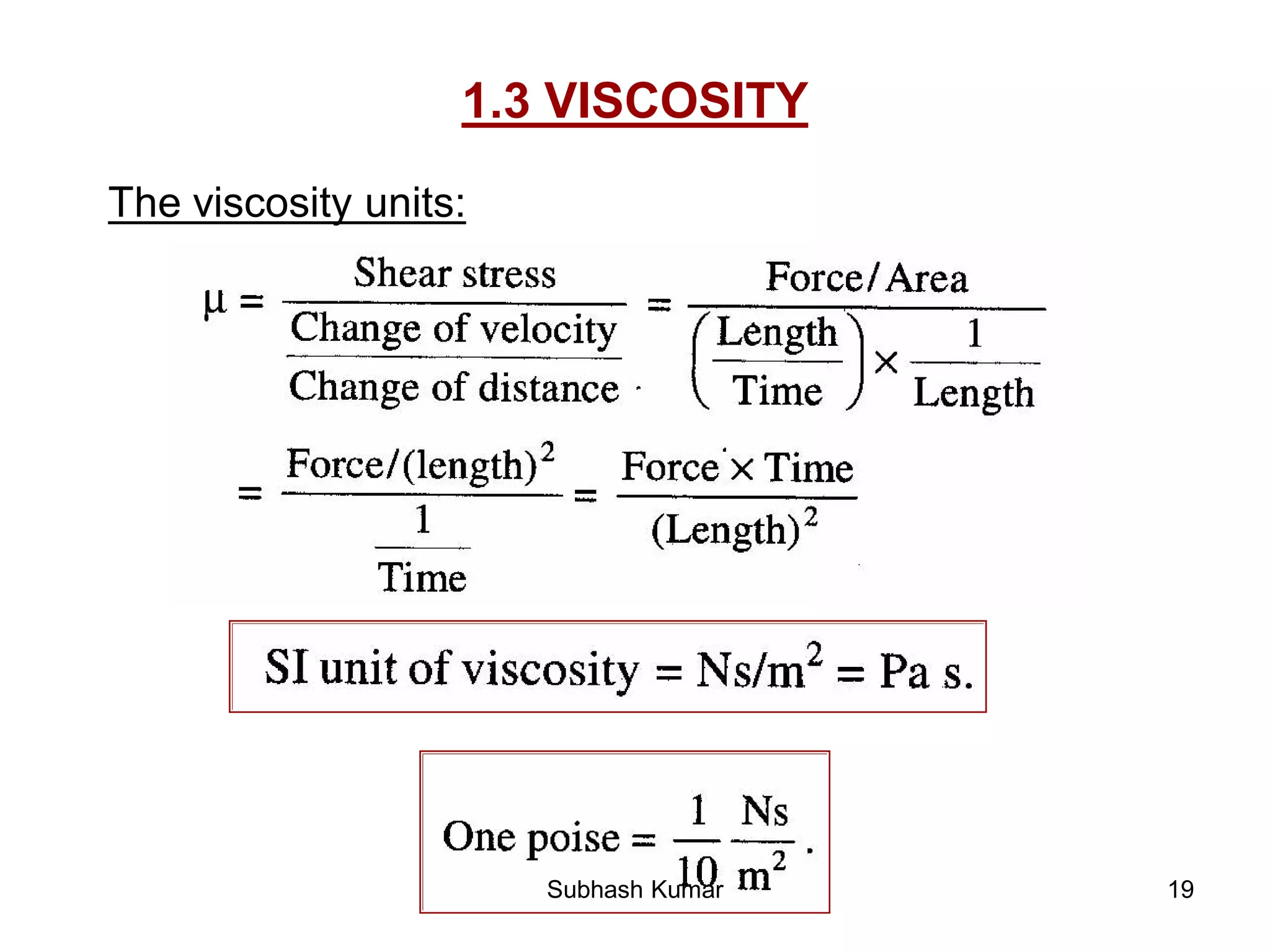
1.3 VISCOSITY
The viscosity units:
Subhash Kumar
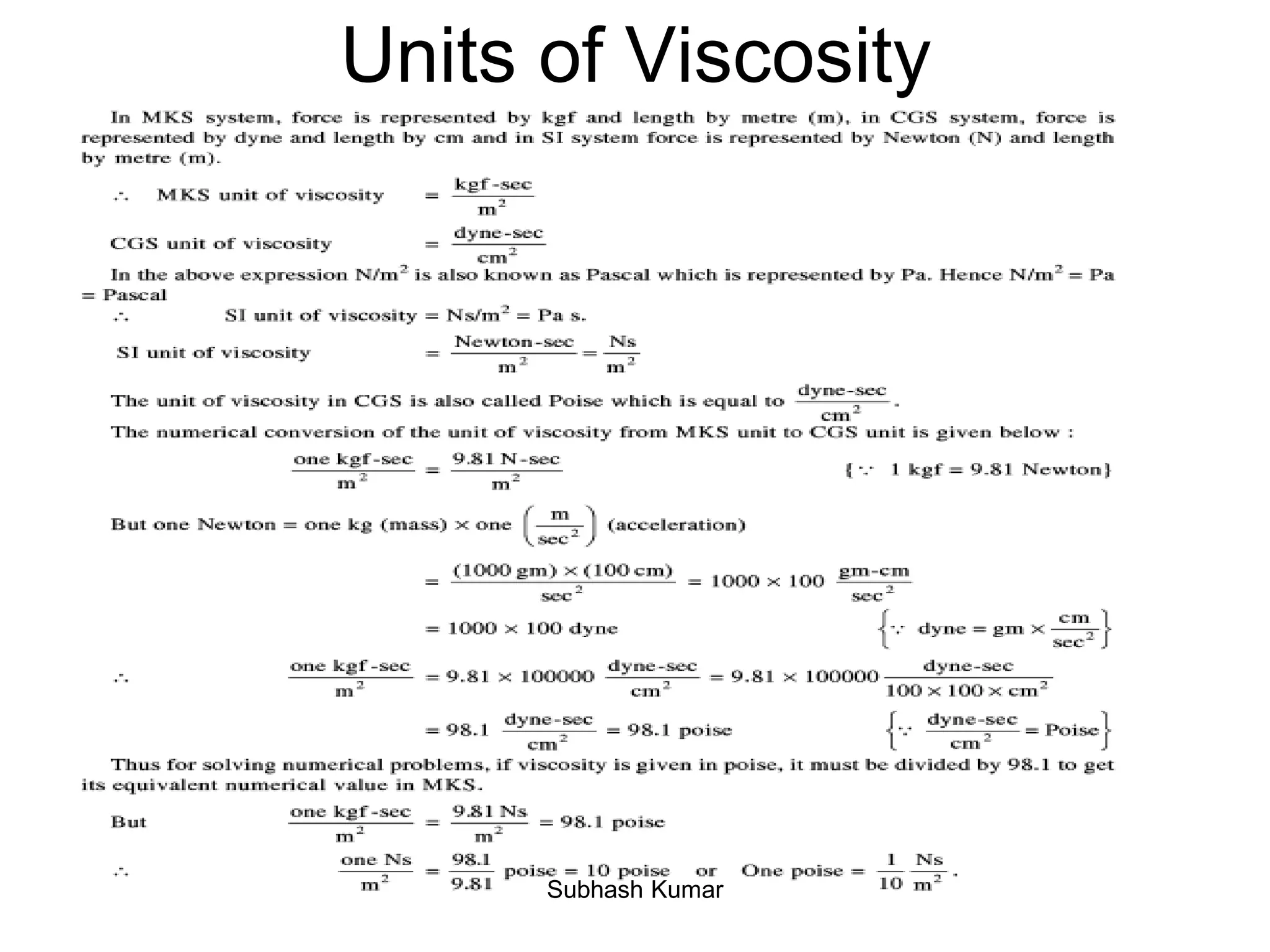
Units of Viscosity
20Subhash Kumar
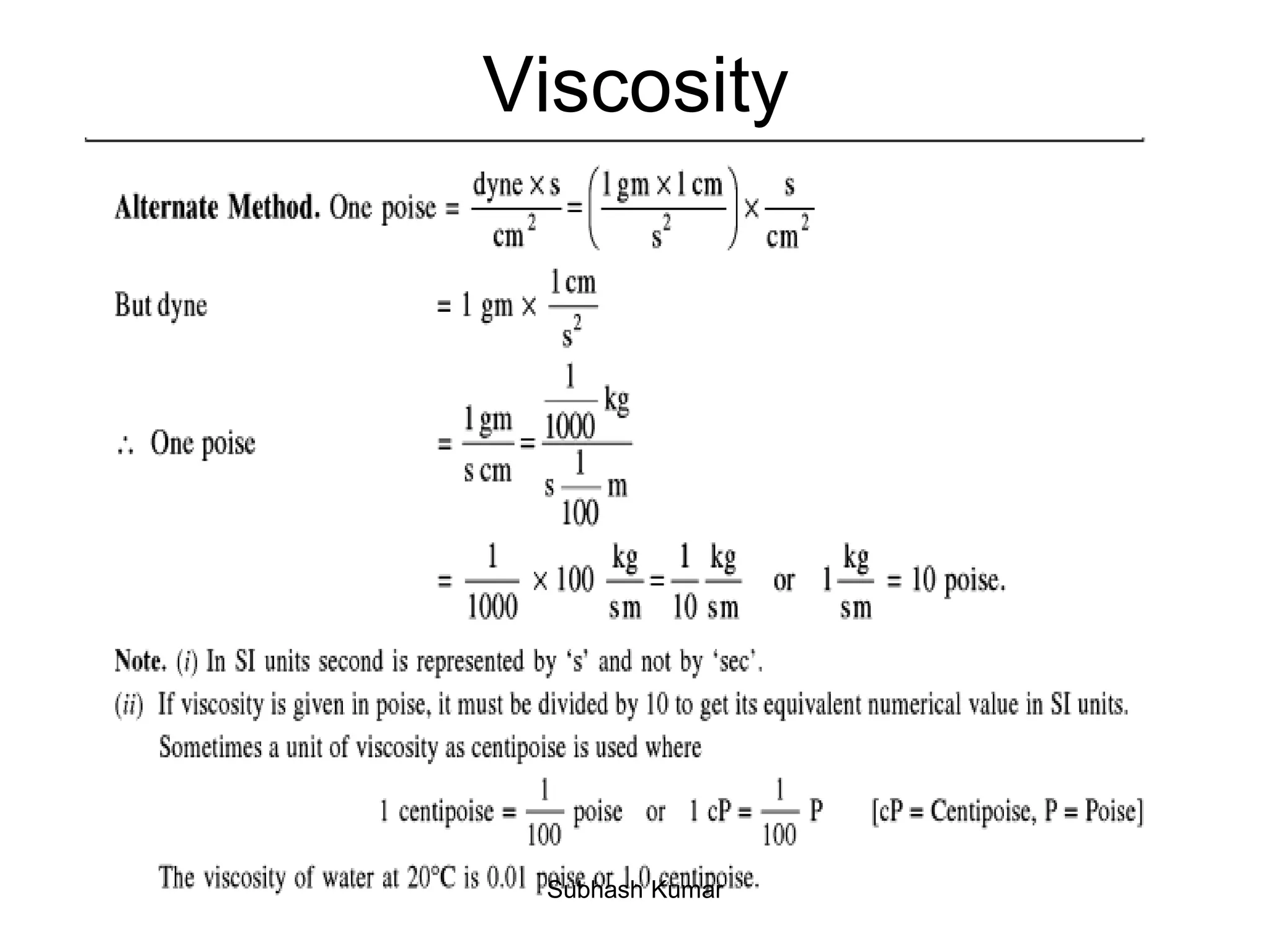
Viscosity
21Subhash Kumar
22
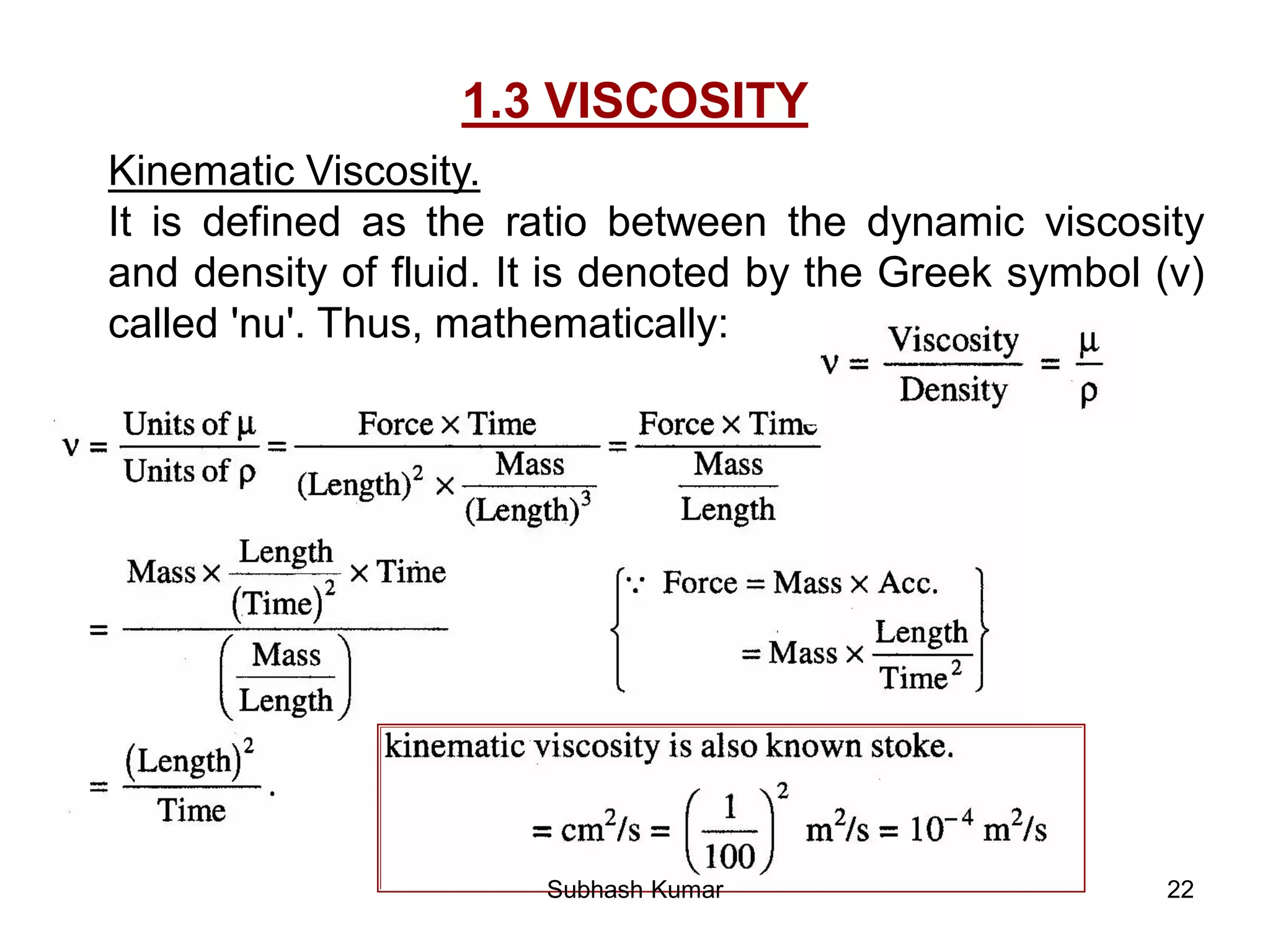
1.3 VISCOSITY
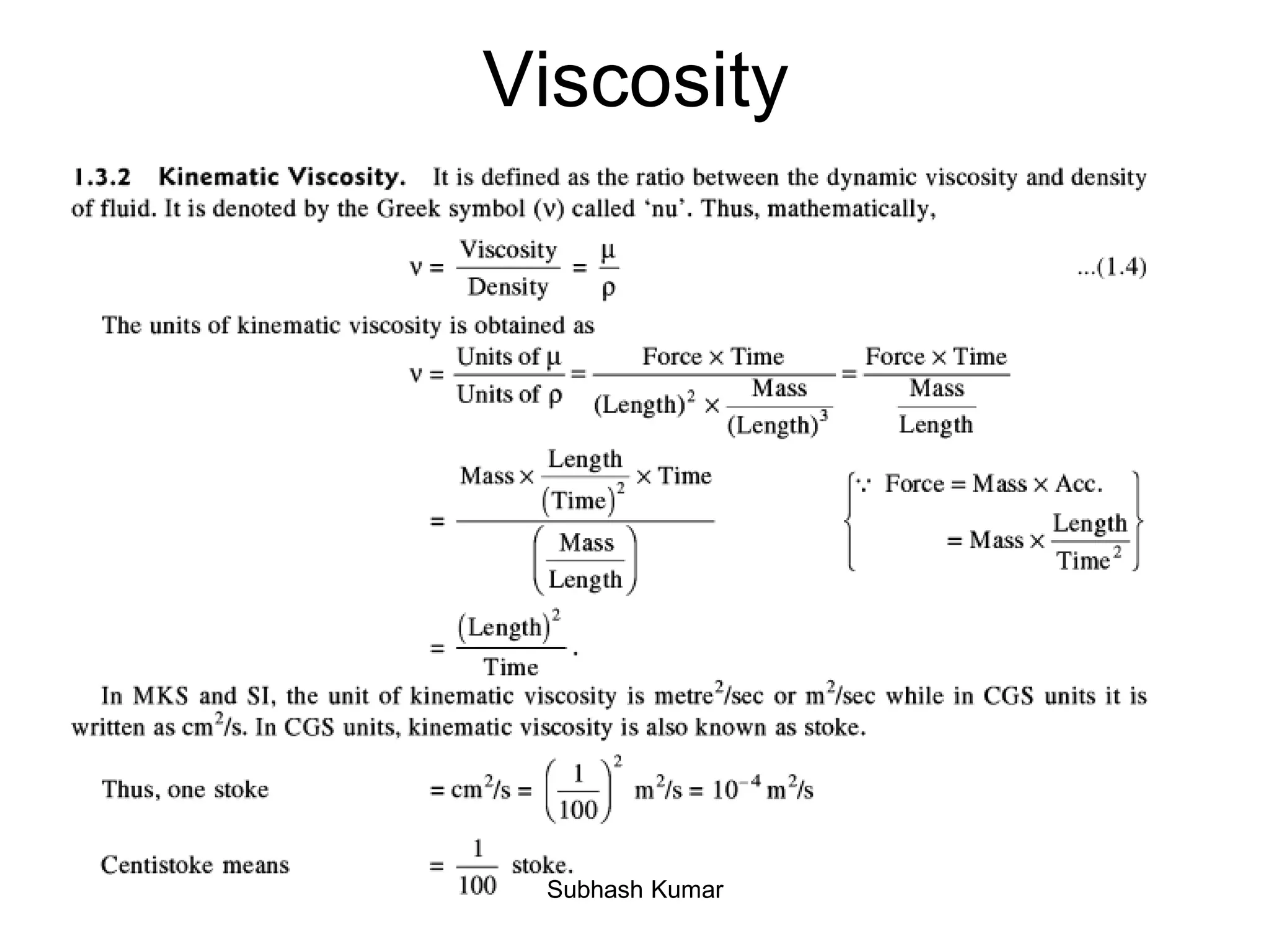
Kinematic Viscosity.
It is defined as the ratio between the dynamic viscosity
and density of fluid. It is denoted by the Greek symbol (v)
called 'nu'. Thus, mathematically:
Subhash Kumar
Viscosity
23Subhash Kumar
Newtons law of Viscosity
24Subhash Kumar
Variation of Viscosity with temperature
25Subhash Kumar
Types of Fluids
26Subhash Kumar
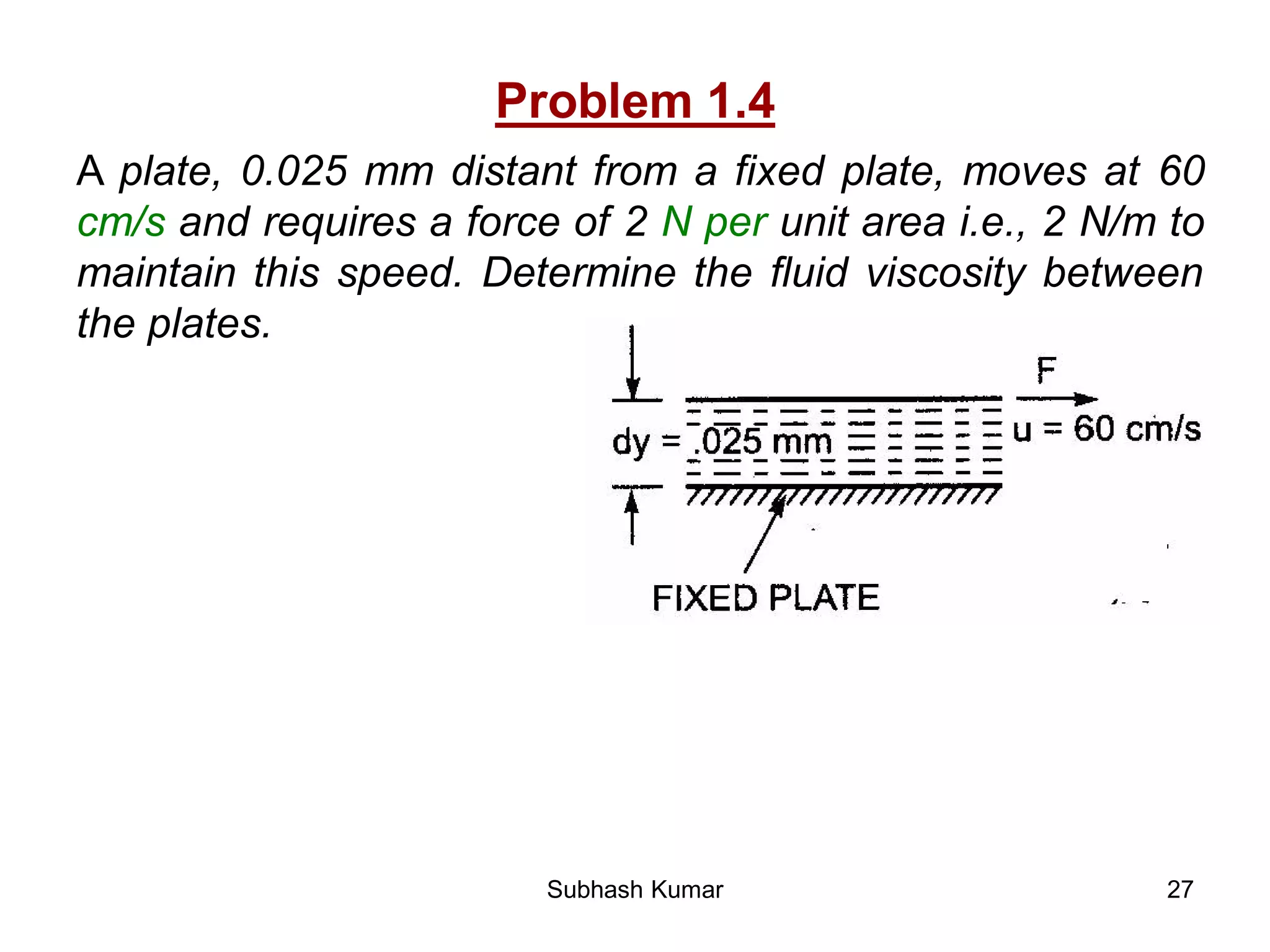
27
Problem 1.4
A plate, 0.025 mm distant from a fixed plate, moves at 60
cm/s and requires a force of 2 N per unit area i.e., 2 N/m to
maintain this speed. Determine the fluid viscosity between
the plates.
Subhash Kumar
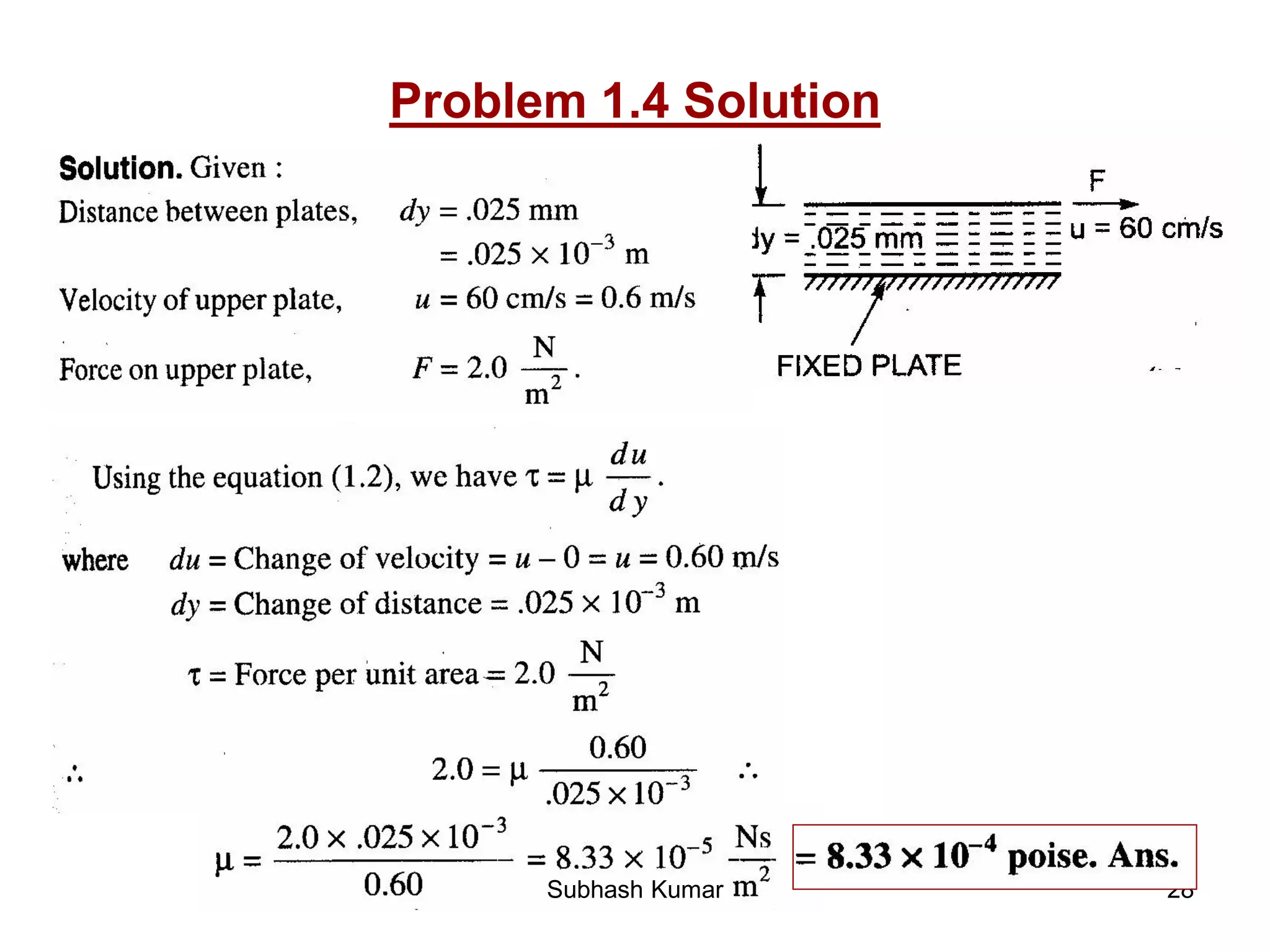
28
Problem 1.4 Solution
Subhash Kumar
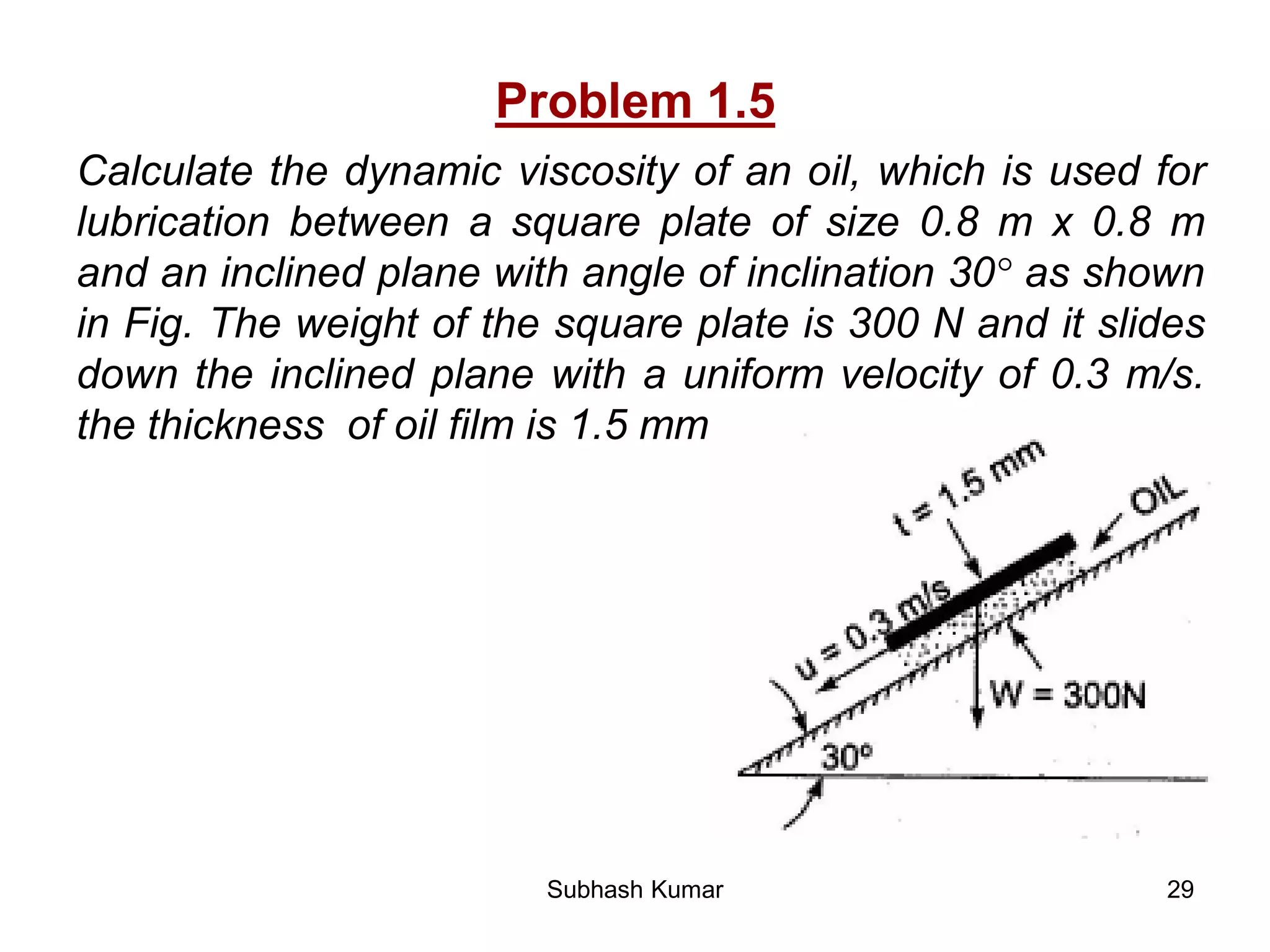
29
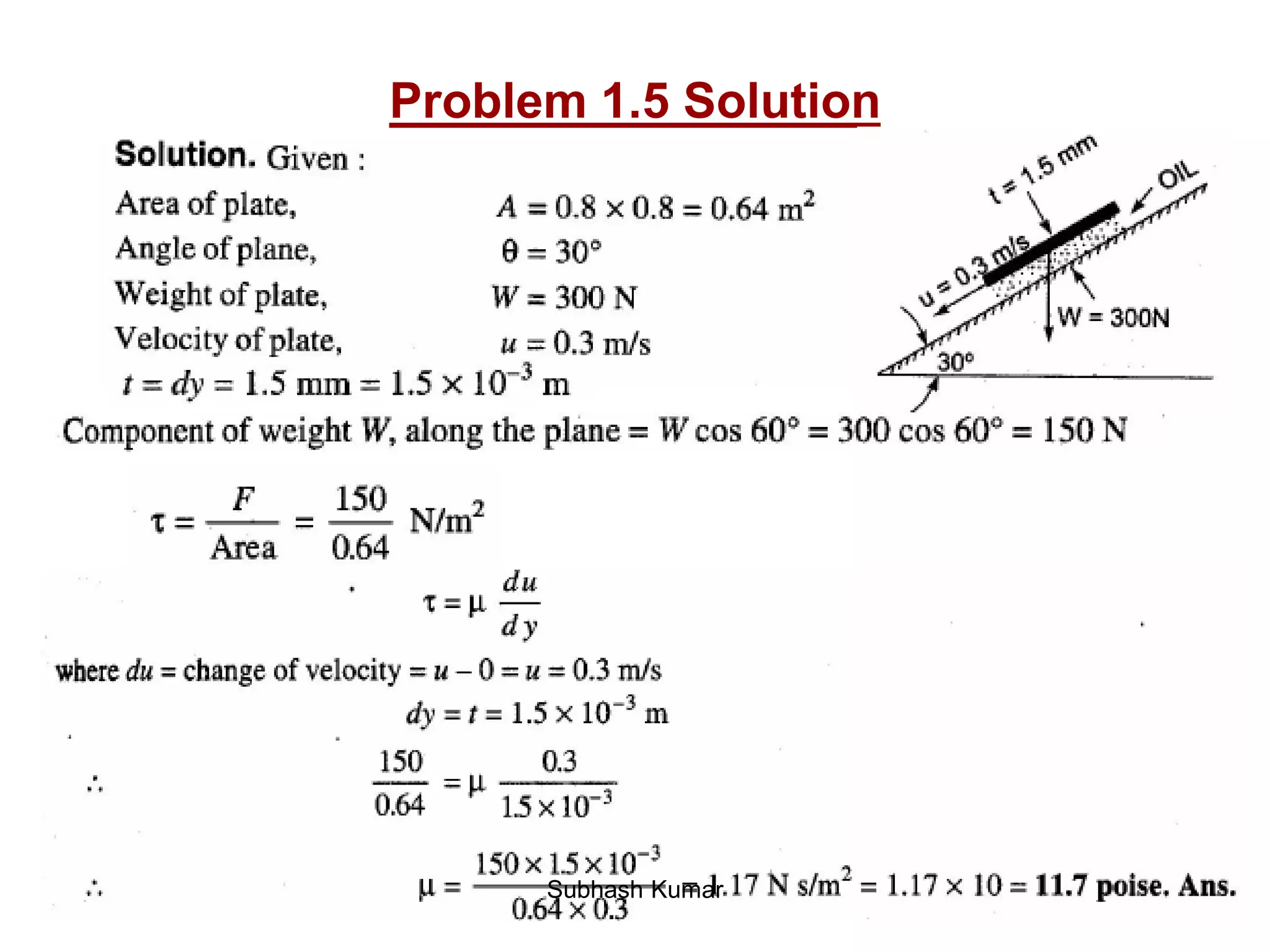
Problem 1.5
Calculate the dynamic viscosity of an oil, which is used for
lubrication between a square plate of size 0.8 m x 0.8 m
and an inclined plane with angle of inclination 30° as shown
in Fig. The weight of the square plate is 300 N and it slides
down the inclined plane with a uniform velocity of 0.3 m/s.
the thickness of oil film is 1.5 mm.
Subhash Kumar
30
Problem 1.5 Solution
Subhash Kumar
31
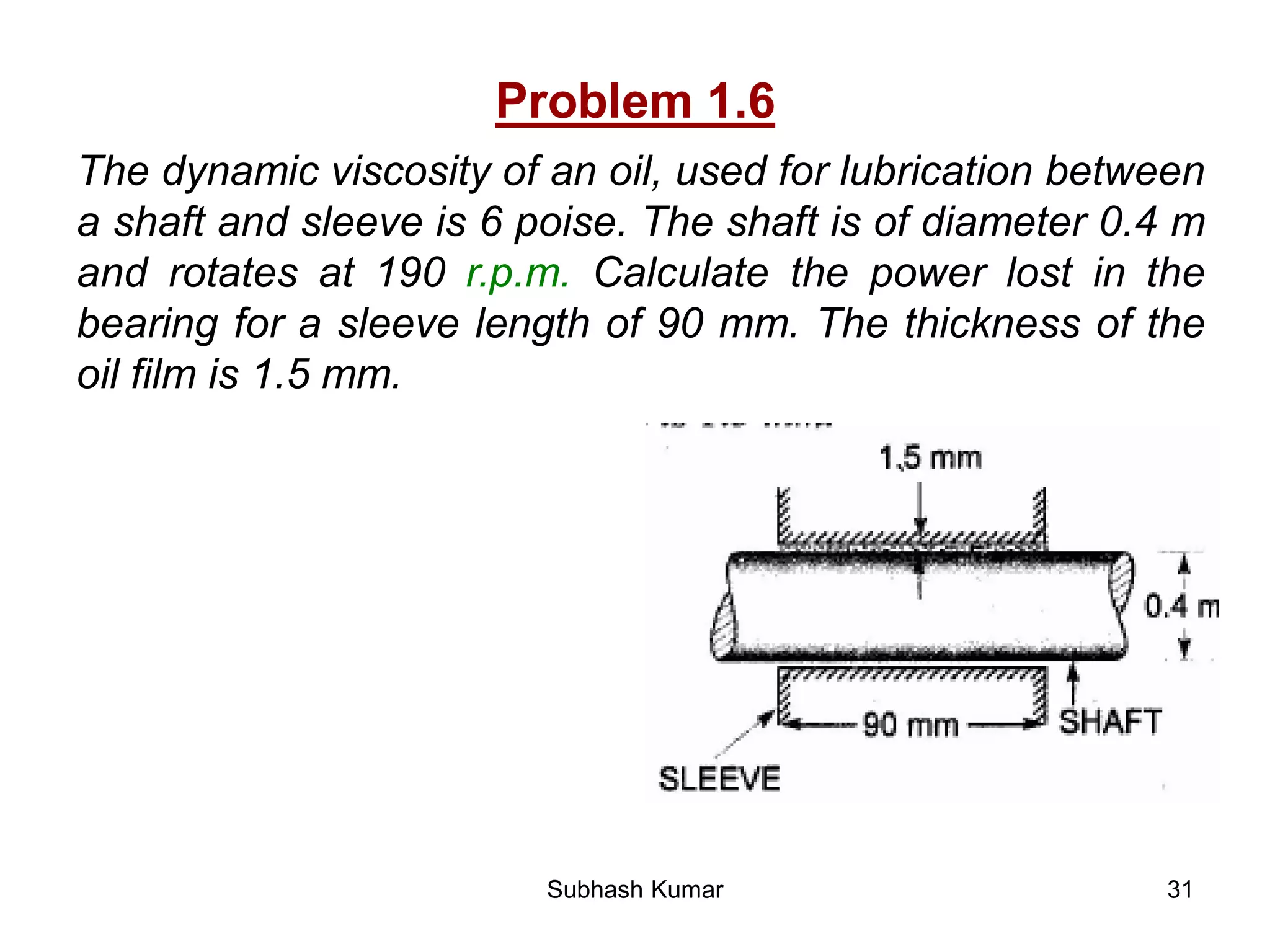
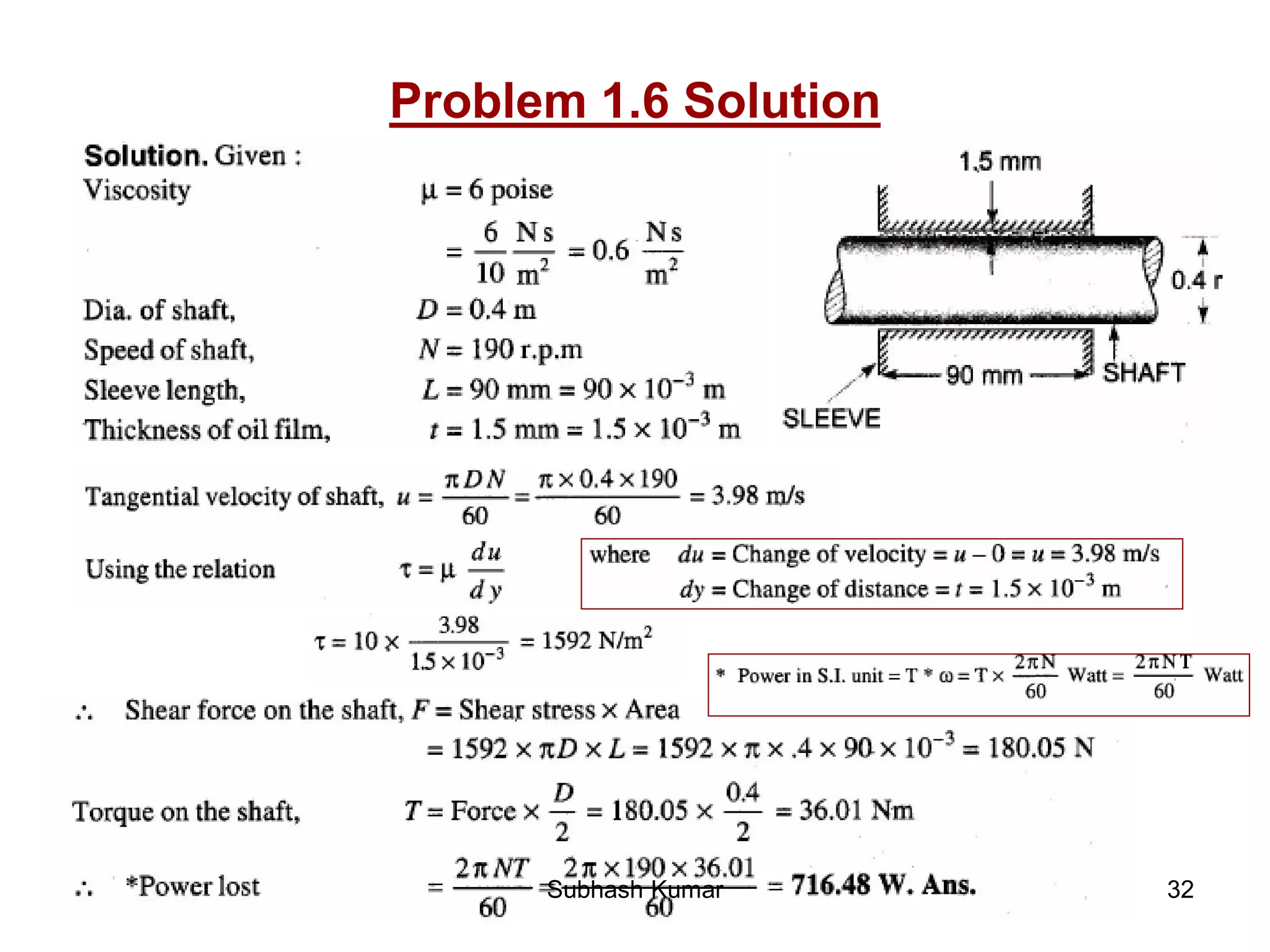
Problem 1.6
The dynamic viscosity of an oil, used for lubrication between
a shaft and sleeve is 6 poise. The shaft is of diameter 0.4 m
and rotates at 190 r.p.m. Calculate the power lost in the
bearing for a sleeve length of 90 mm. The thickness of the
oil film is 1.5 mm.
Subhash Kumar
32
Problem 1.6 Solution
Subhash Kumar
33
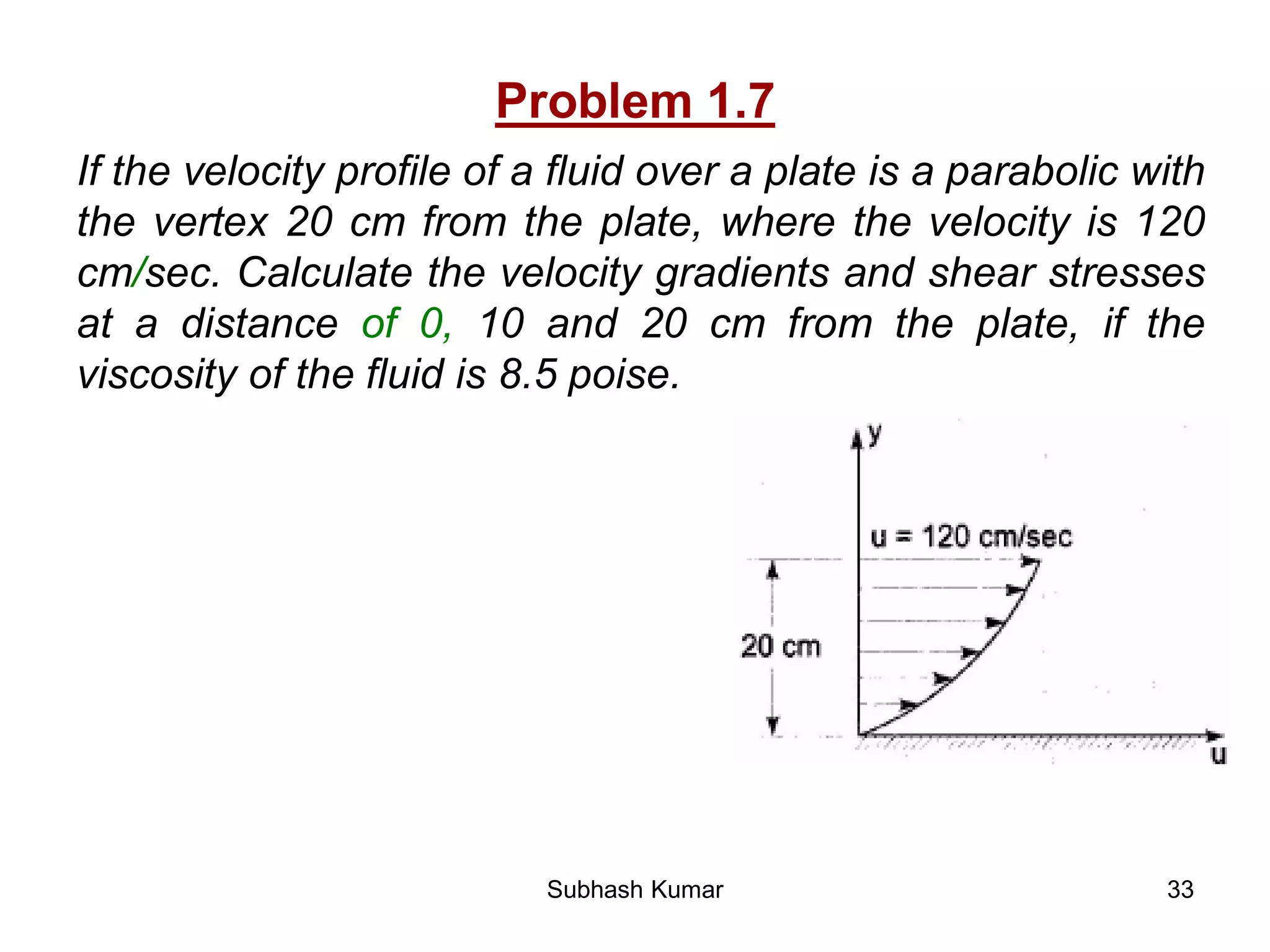
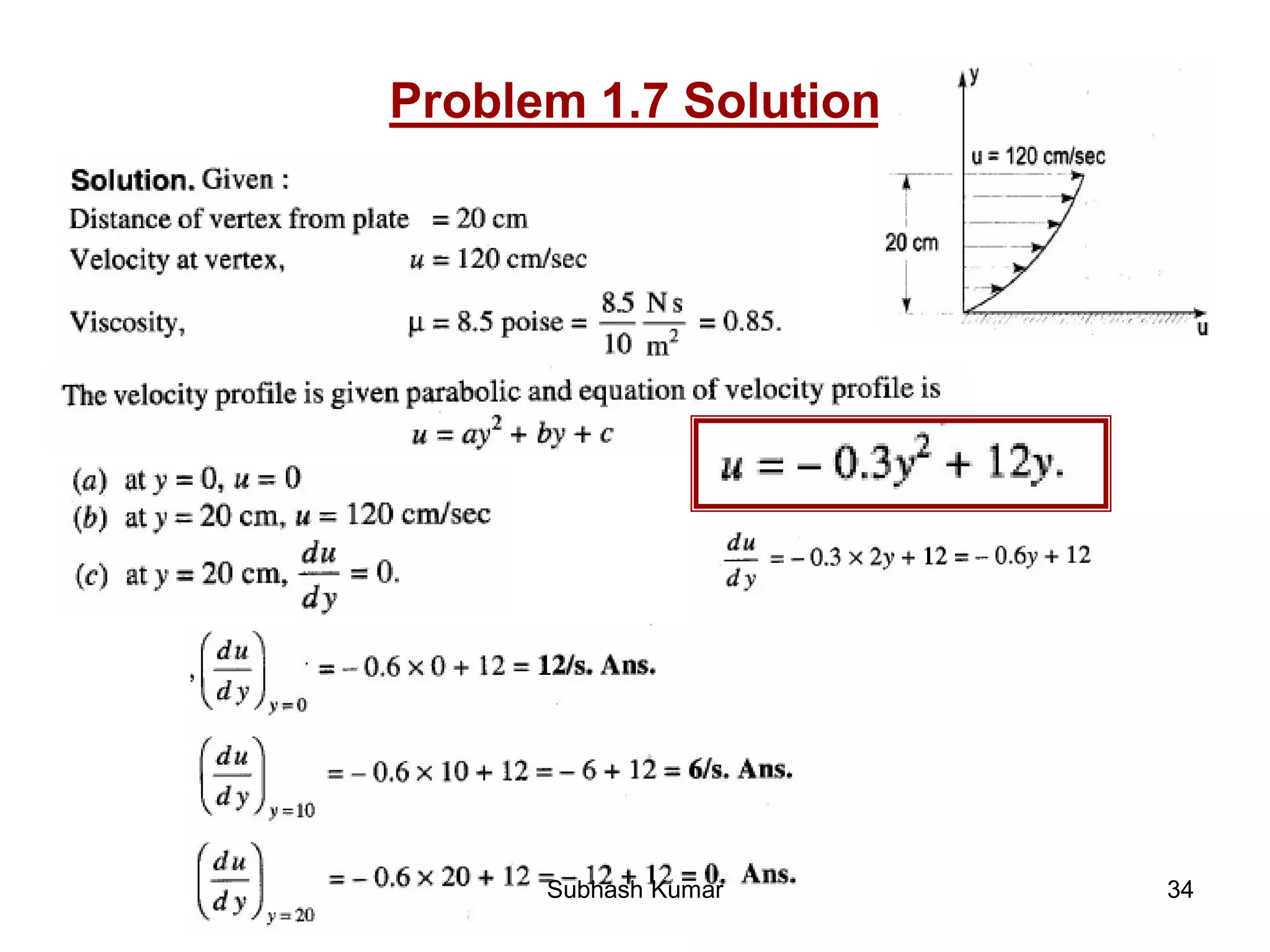
Problem 1.7
If the velocity profile of a fluid over a plate is a parabolic with
the vertex 20 cm from the plate, where the velocity is 120
cm/sec. Calculate the velocity gradients and shear stresses
at a distance of 0, 10 and 20 cm from the plate, if the
viscosity of the fluid is 8.5 poise.
Subhash Kumar
34
Problem 1.7 Solution
Subhash Kumar
35
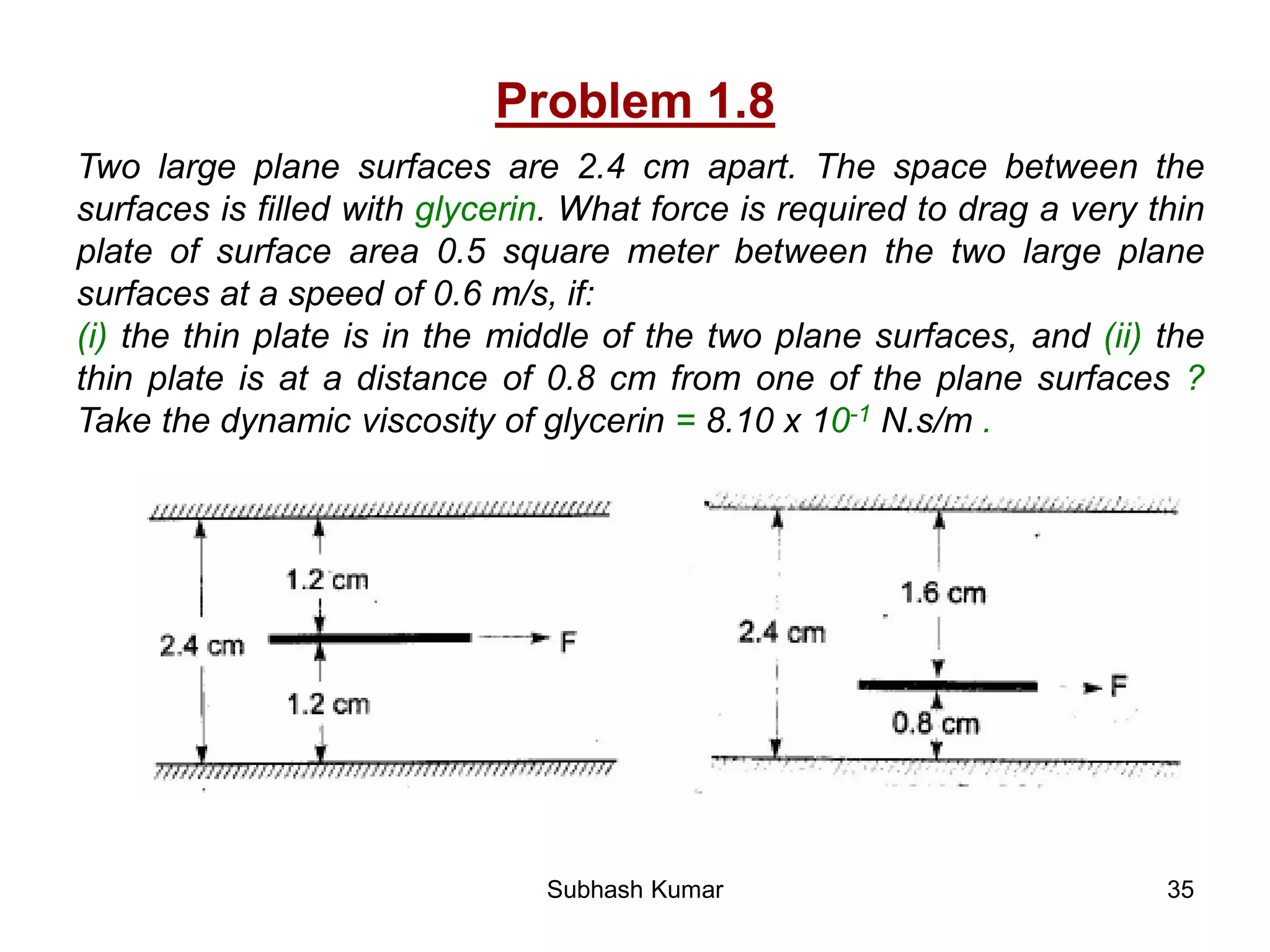
Problem 1.8
Two large plane surfaces are 2.4 cm apart. The space between the
surfaces is filled with glycerin. What force is required to drag a very thin
plate of surface area 0.5 square meter between the two large plane
surfaces at a speed of 0.6 m/s, if:
(i) the thin plate is in the middle of the two plane surfaces, and (ii) the
thin plate is at a distance of 0.8 cm from one of the plane surfaces ?
Take the dynamic viscosity of glycerin = 8.10 x 10⁻¹ N.s/m .
Subhash Kumar
36
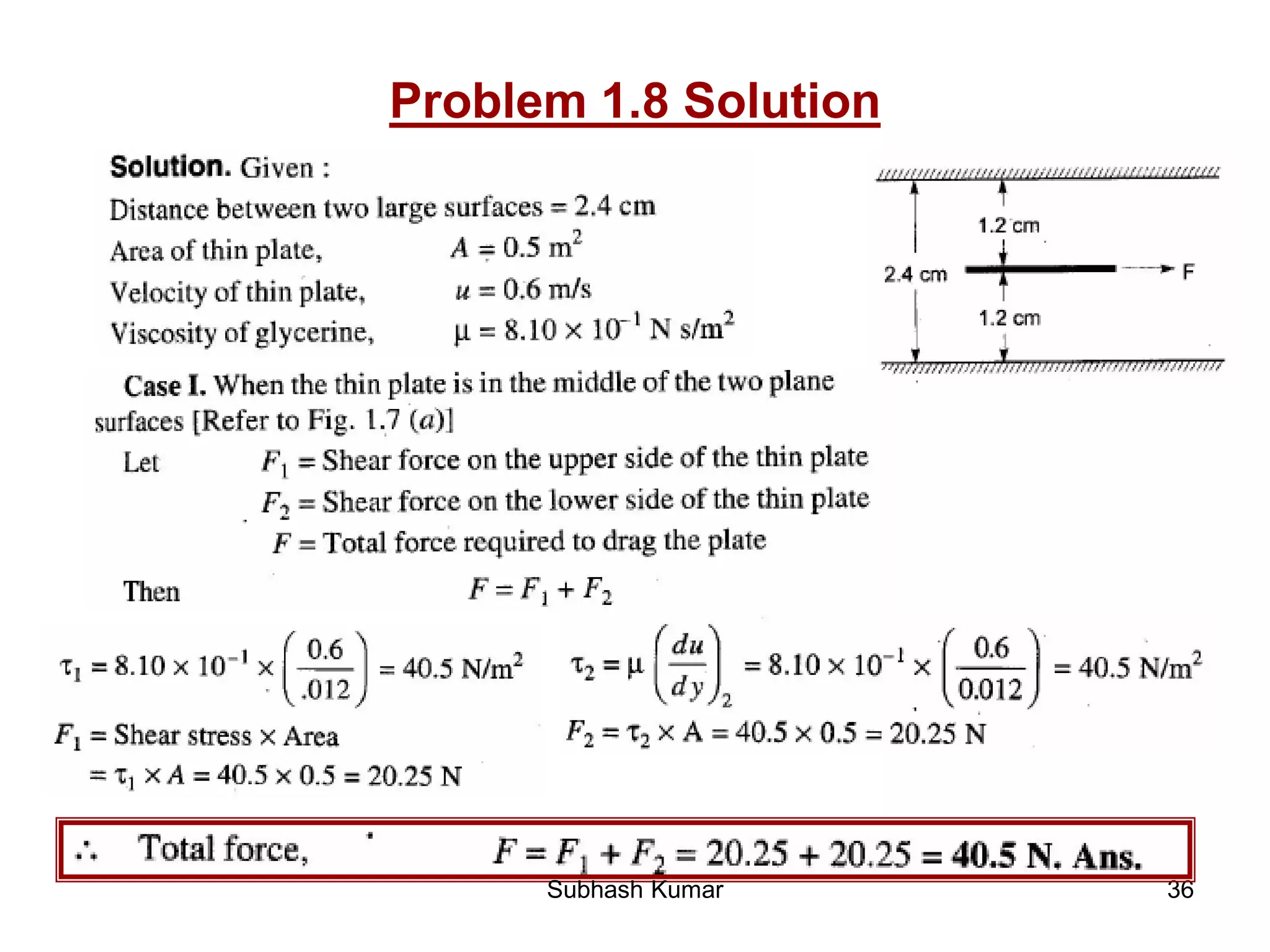
Problem 1.8 Solution
Subhash Kumar
37
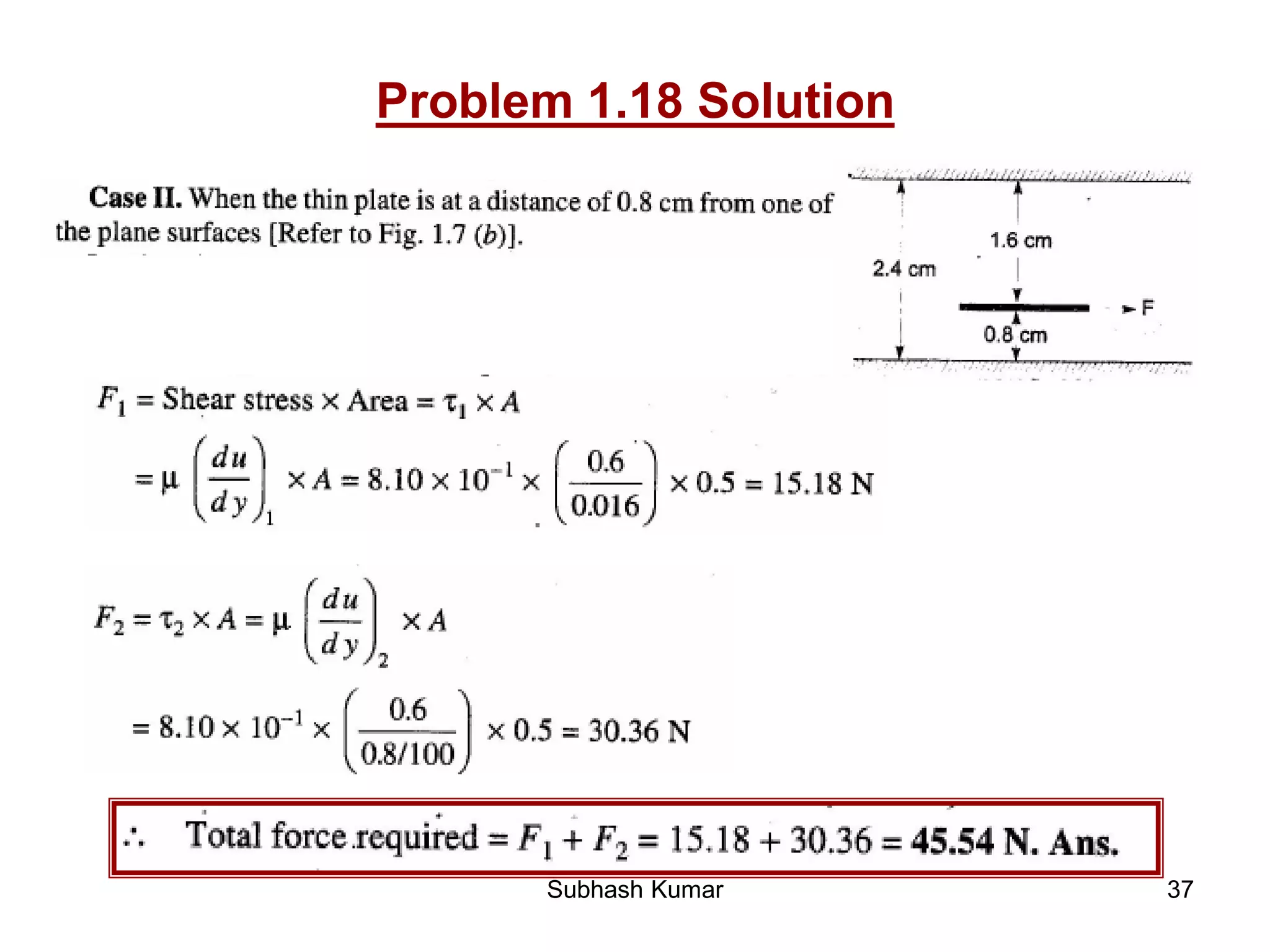
Problem 1.18 Solution
Subhash Kumar
38
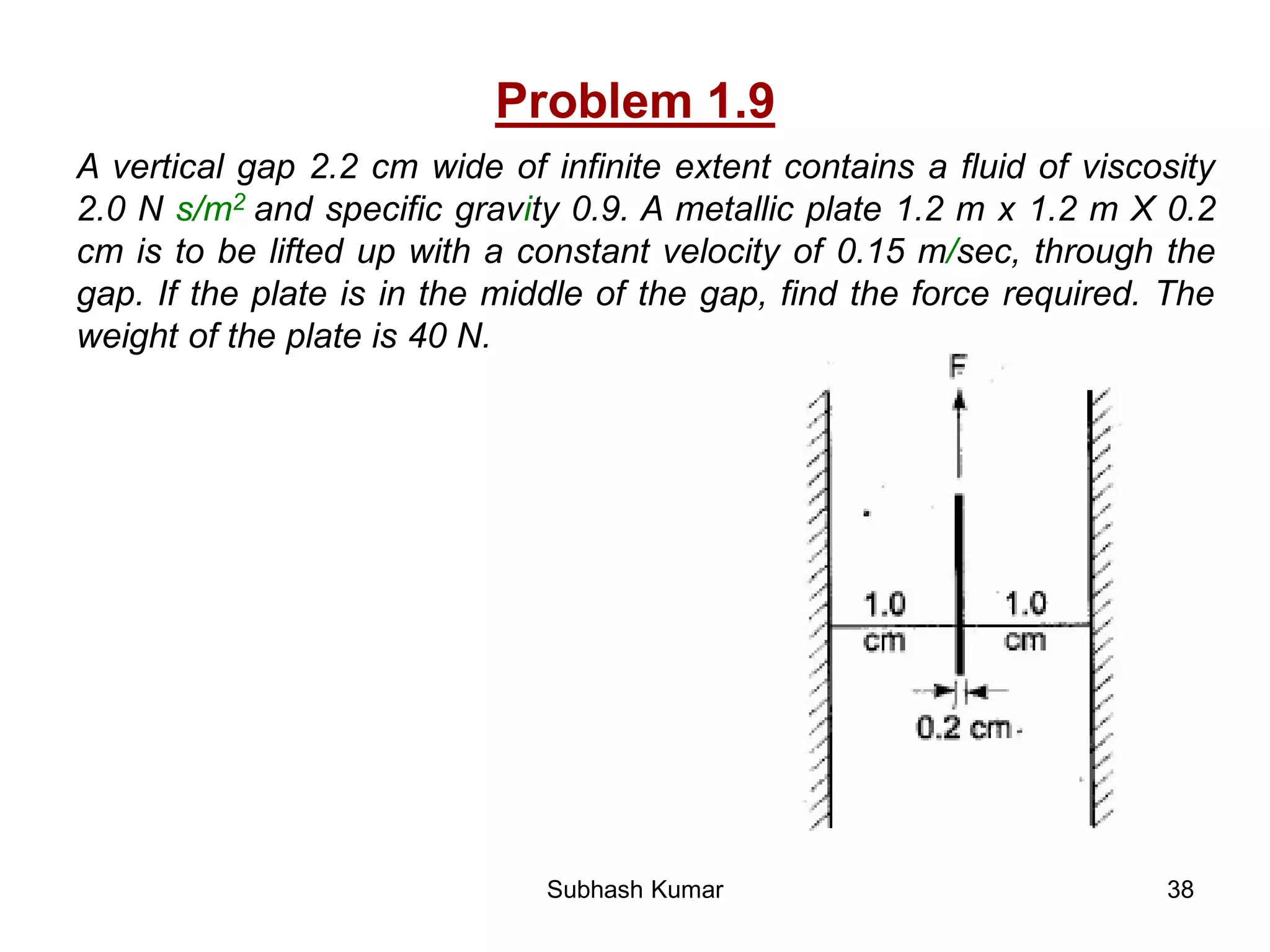
Problem 1.9
A vertical gap 2.2 cm wide of infinite extent contains a fluid of viscosity
2.0 N s/m2 and specific gravity 0.9. A metallic plate 1.2 m x 1.2 m X 0.2
cm is to be lifted up with a constant velocity of 0.15 m/sec, through the
gap. If the plate is in the middle of the gap, find the force required. The
weight of the plate is 40 N.
Subhash Kumar
39
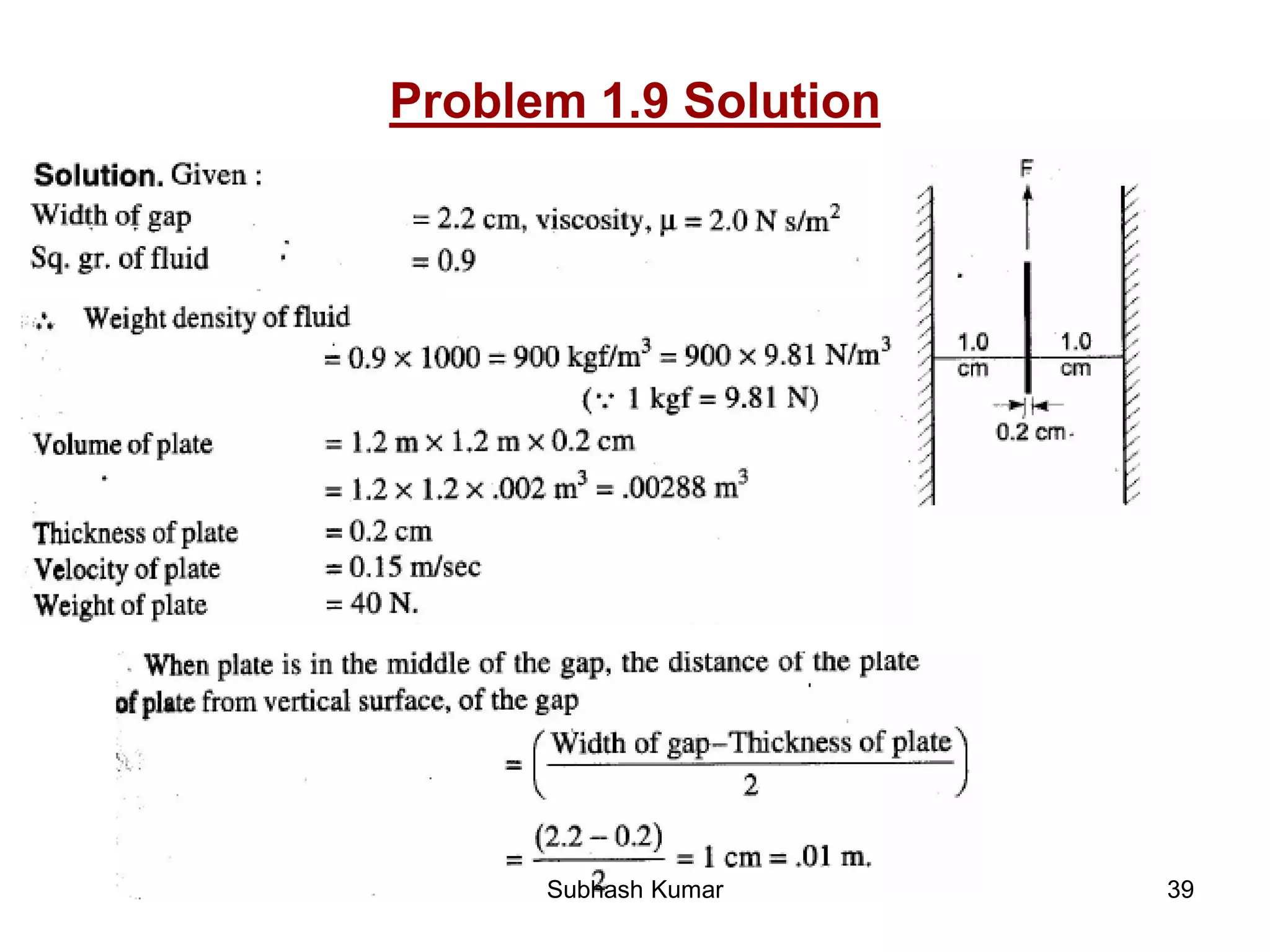
Problem 1.9 Solution
Subhash Kumar
40
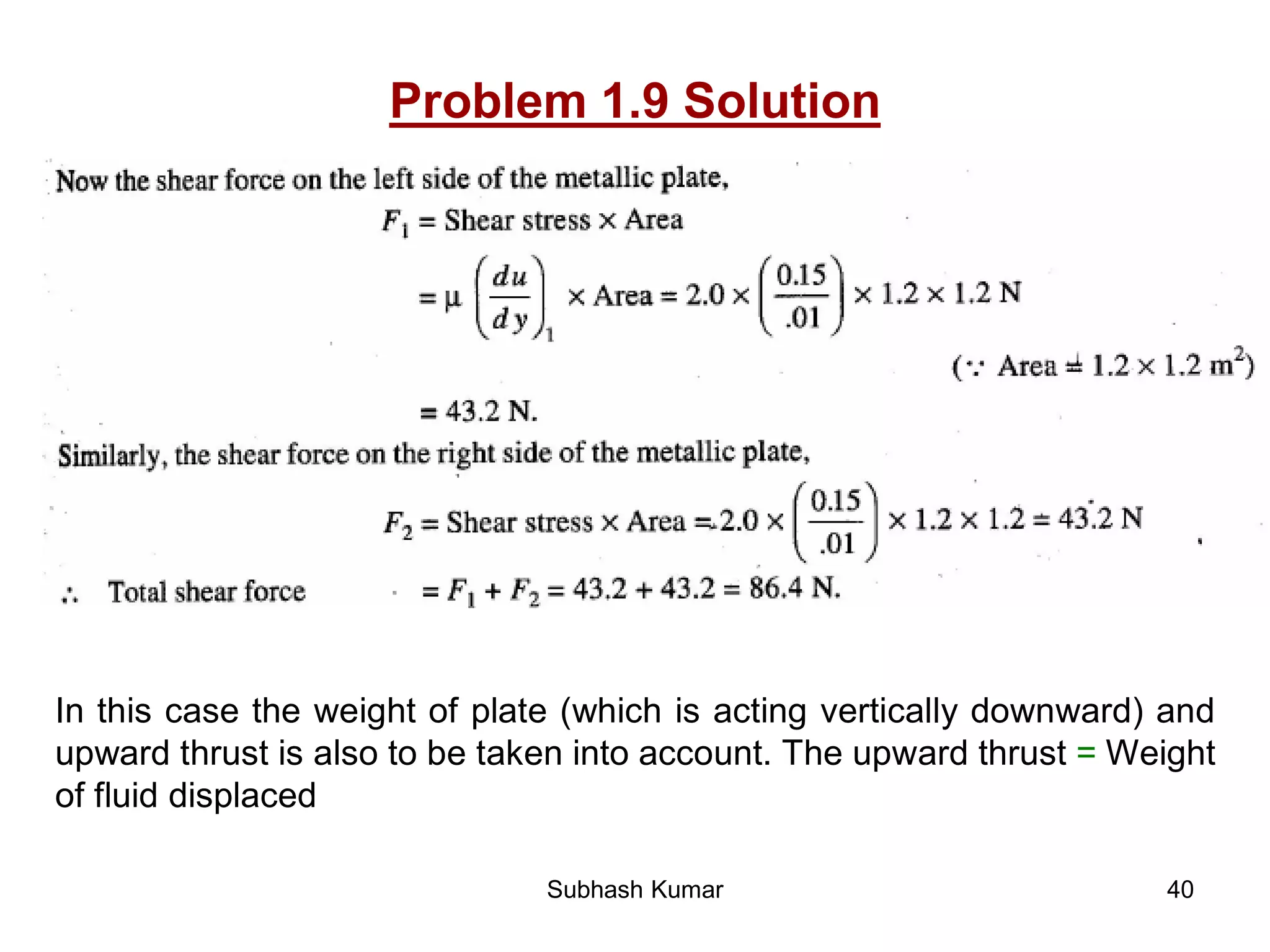
Problem 1.9 Solution
In this case the weight of plate (which is acting vertically downward) and
upward thrust is also to be taken into account. The upward thrust = Weight
of fluid displaced
Subhash Kumar
41
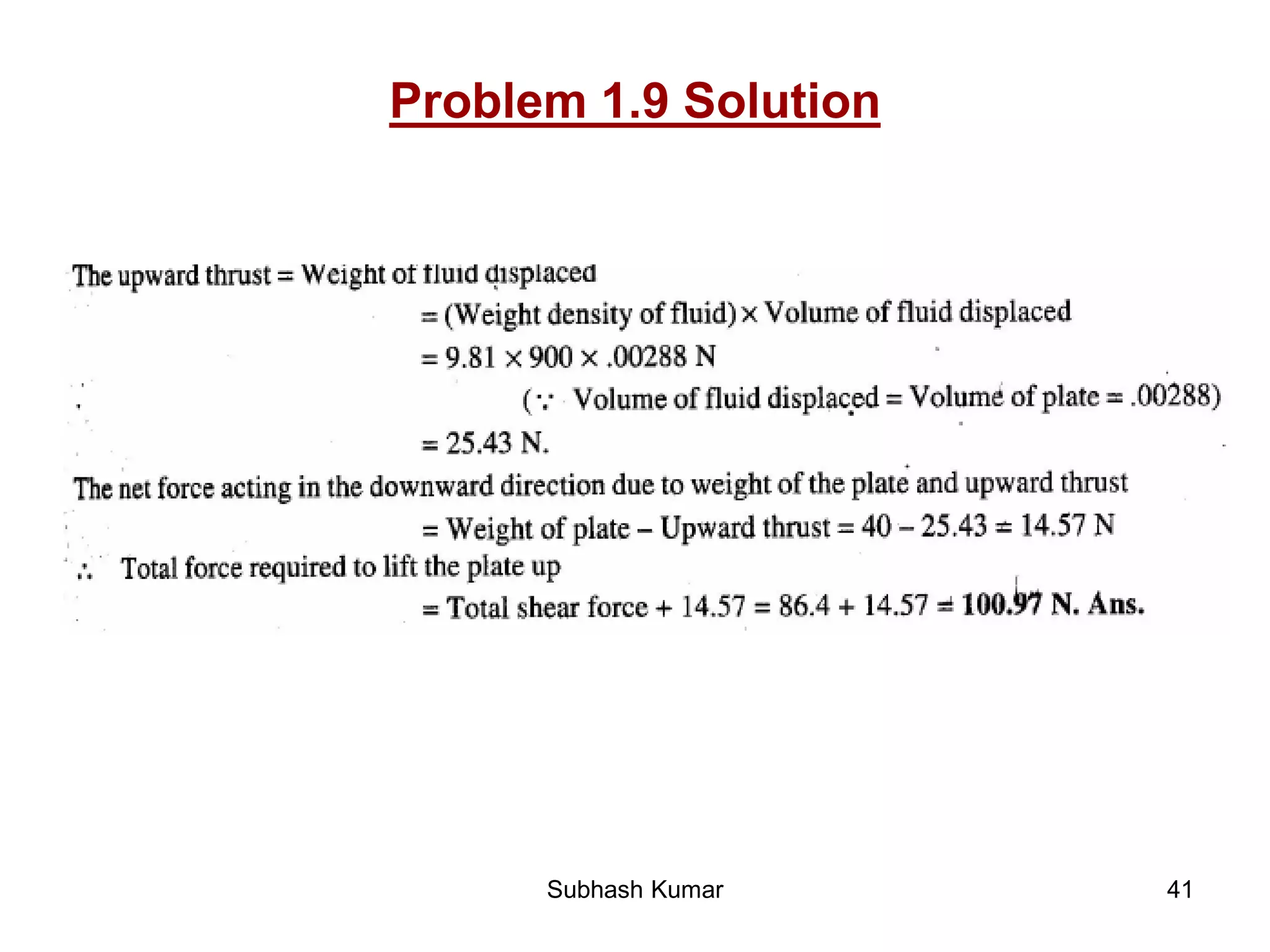
Problem 1.9 Solution
Subhash Kumar
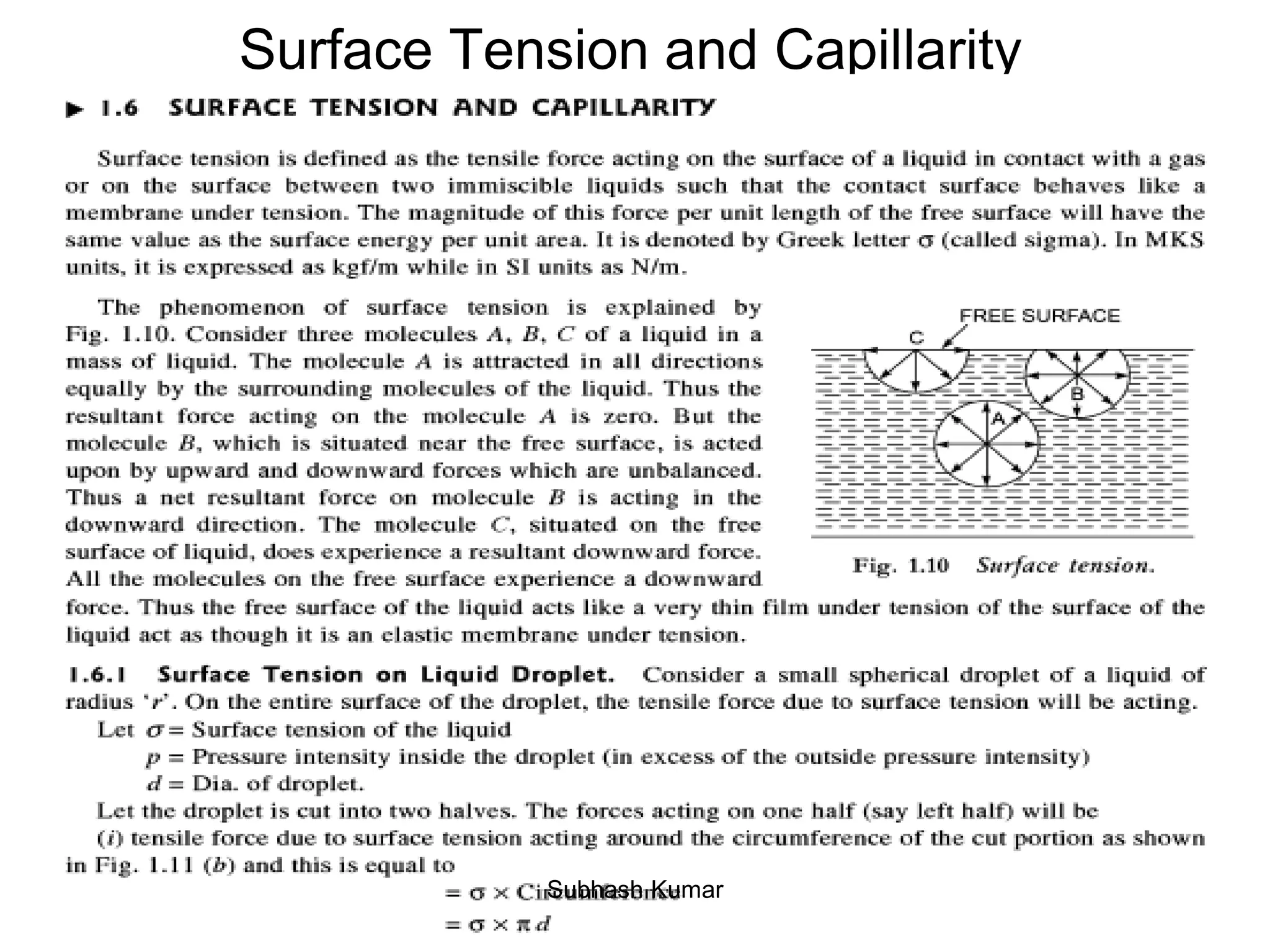
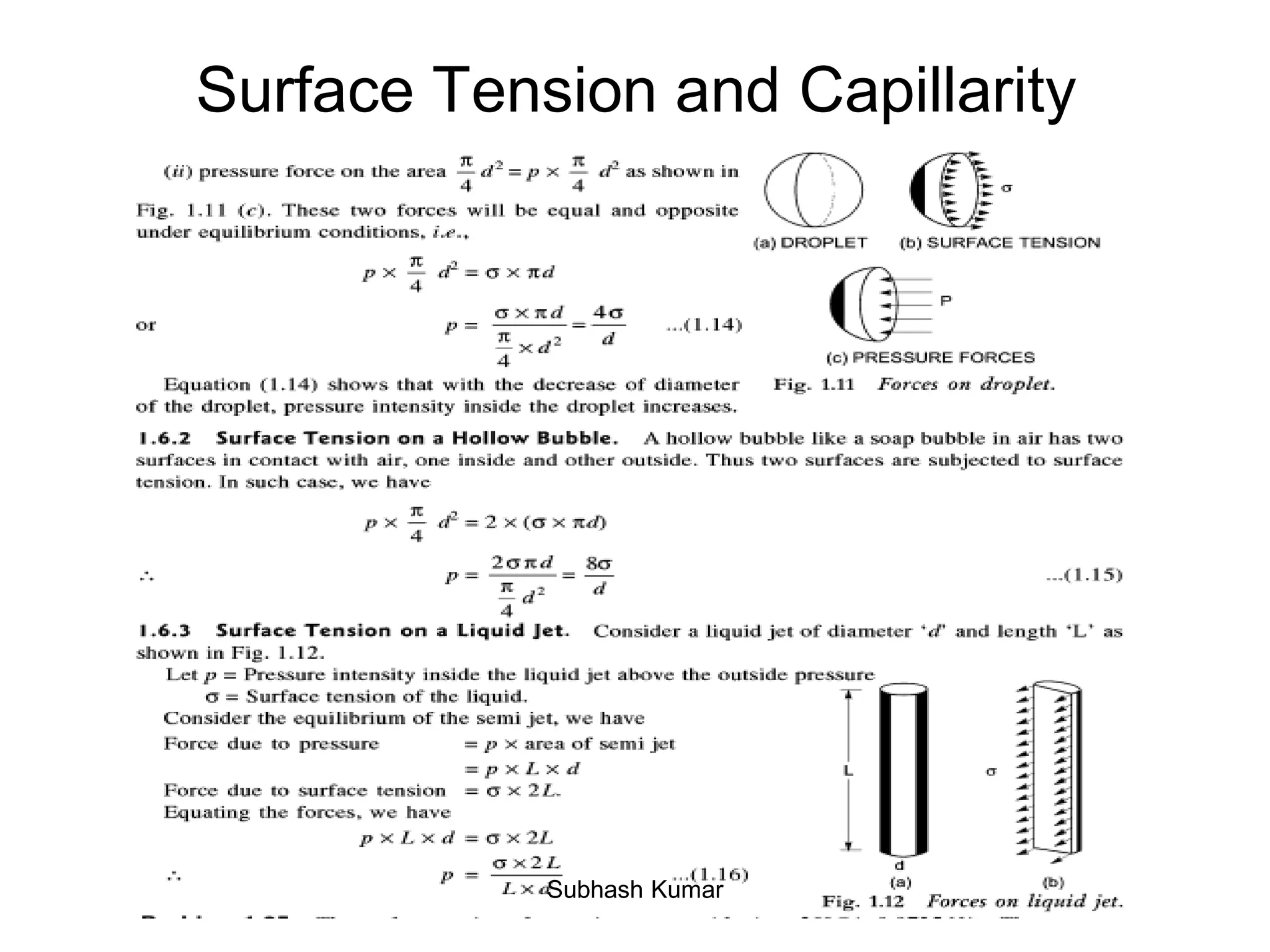
Surface Tension and Capillarity
42Subhash Kumar
Surface Tension and Capillarity
43Subhash Kumar
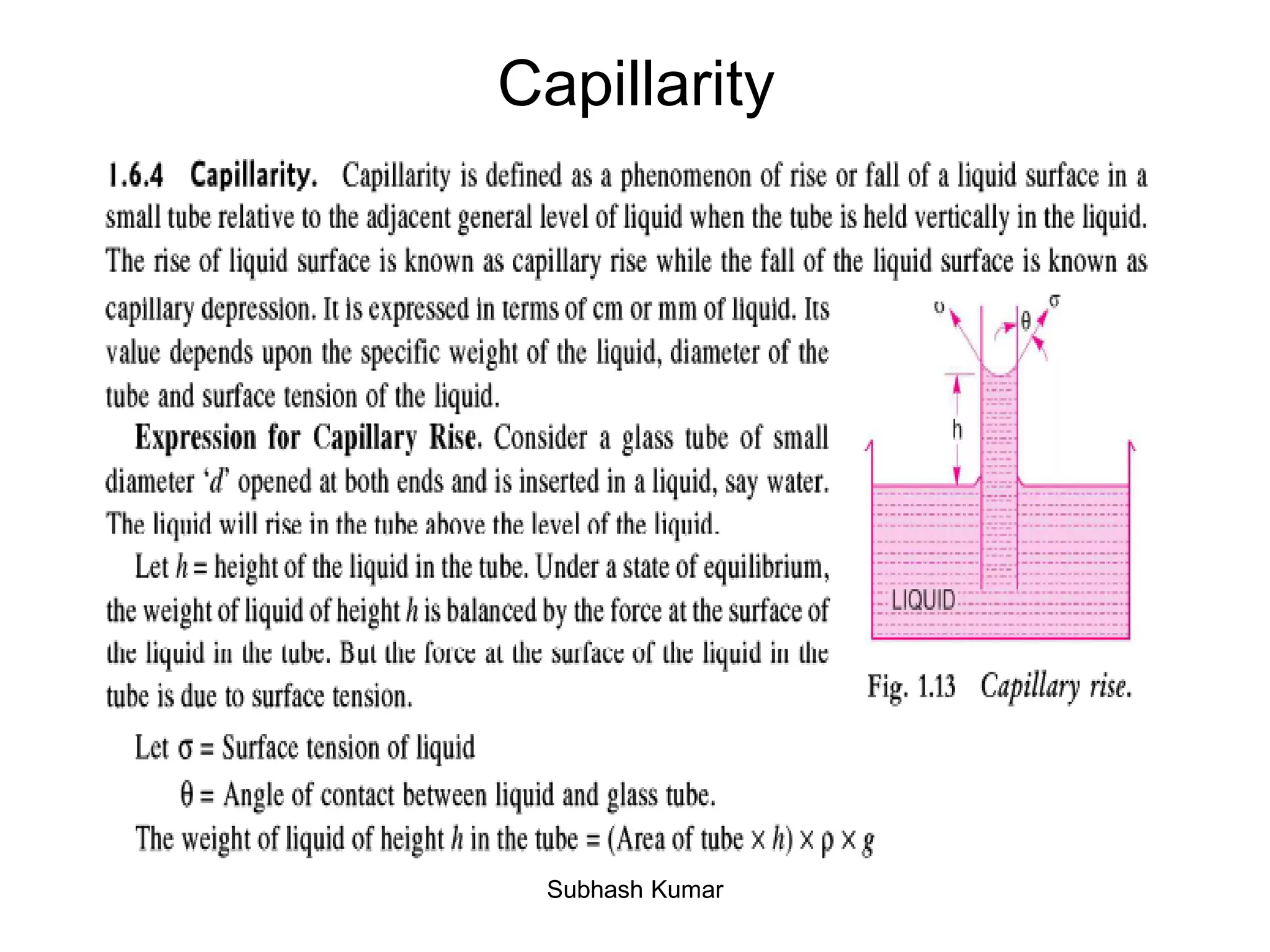
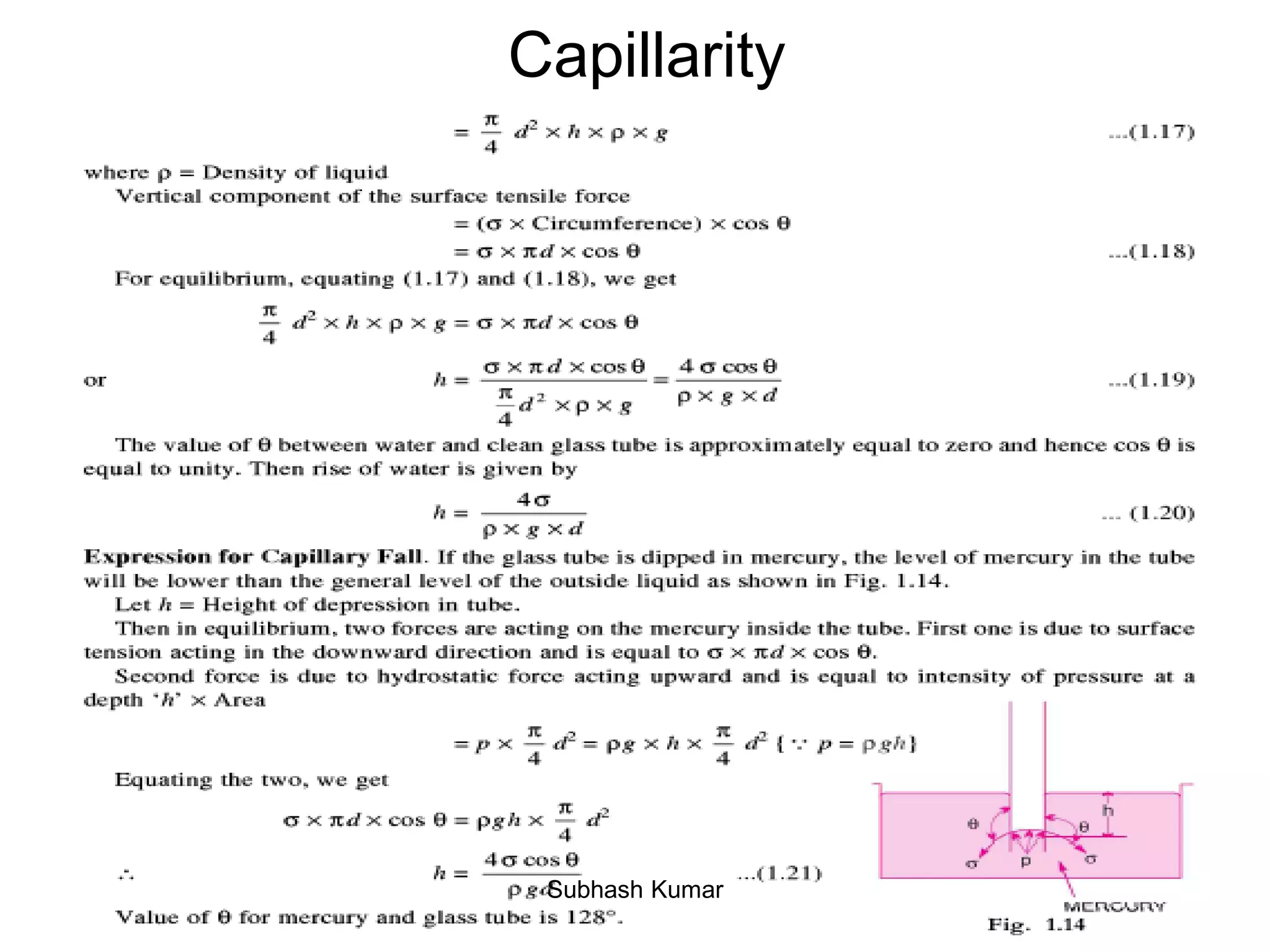
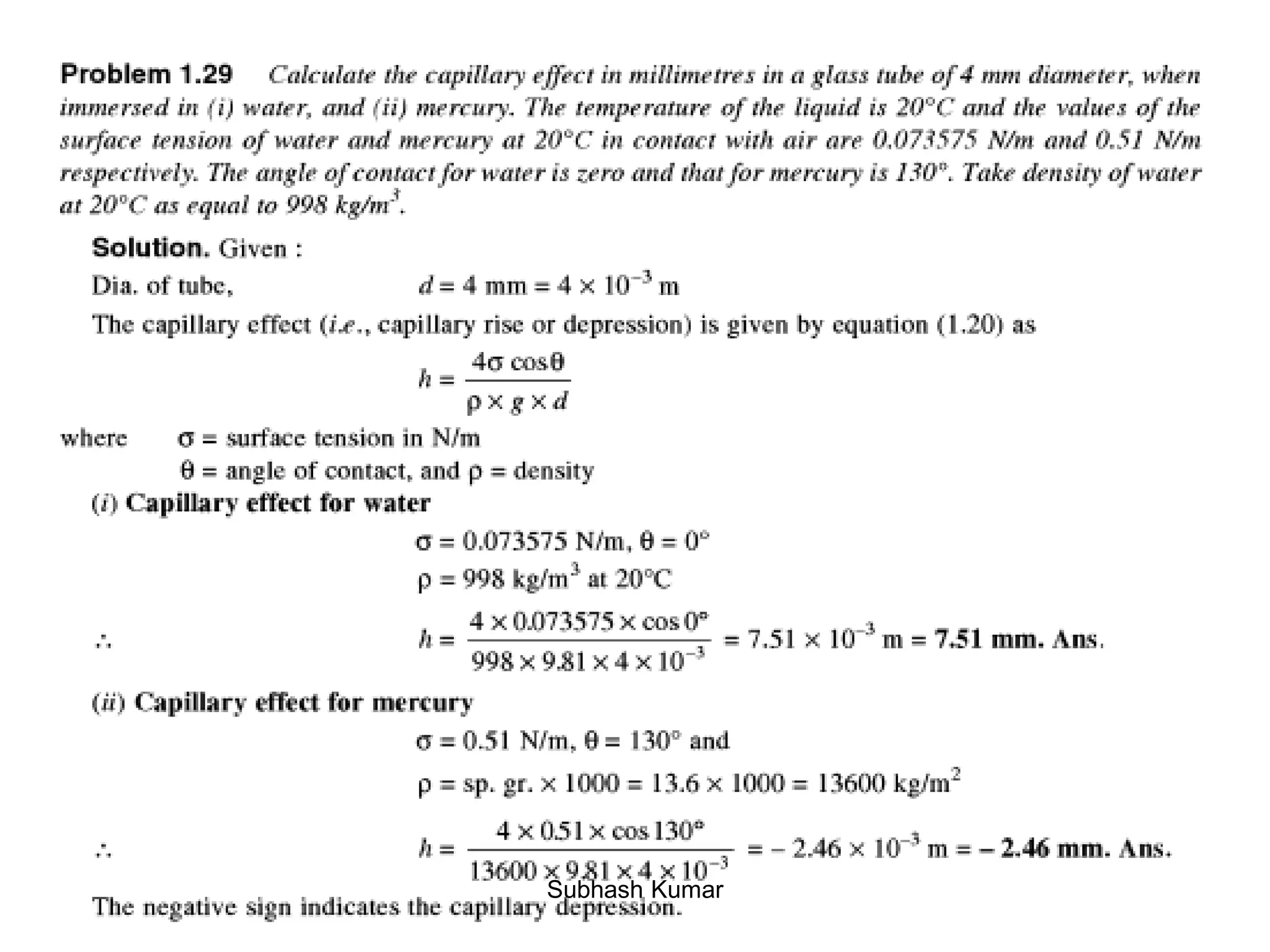
Capillarity
44Subhash Kumar
Capillarity
45Subhash Kumar
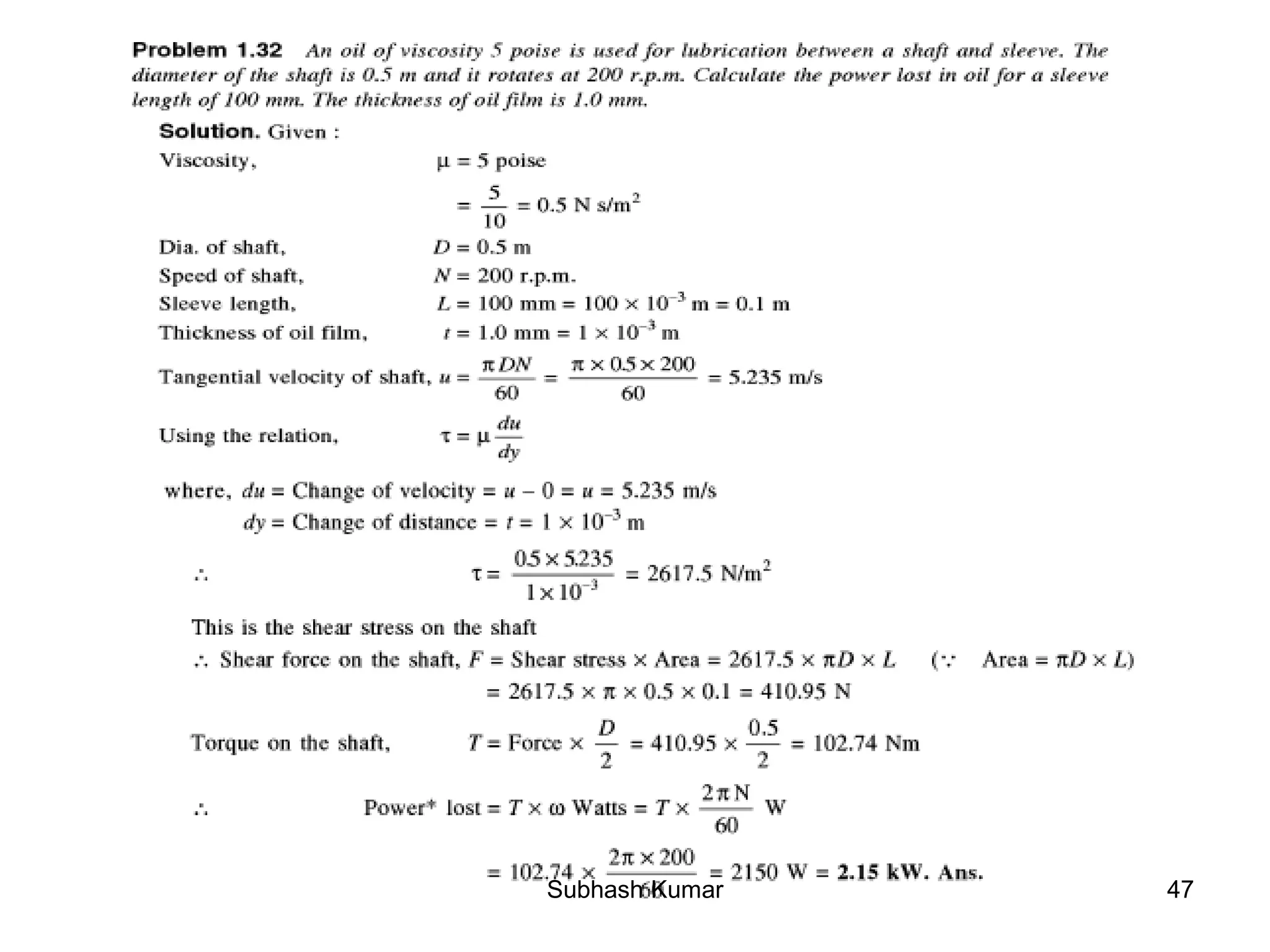
46Subhash Kumar
47Subhash Kumar
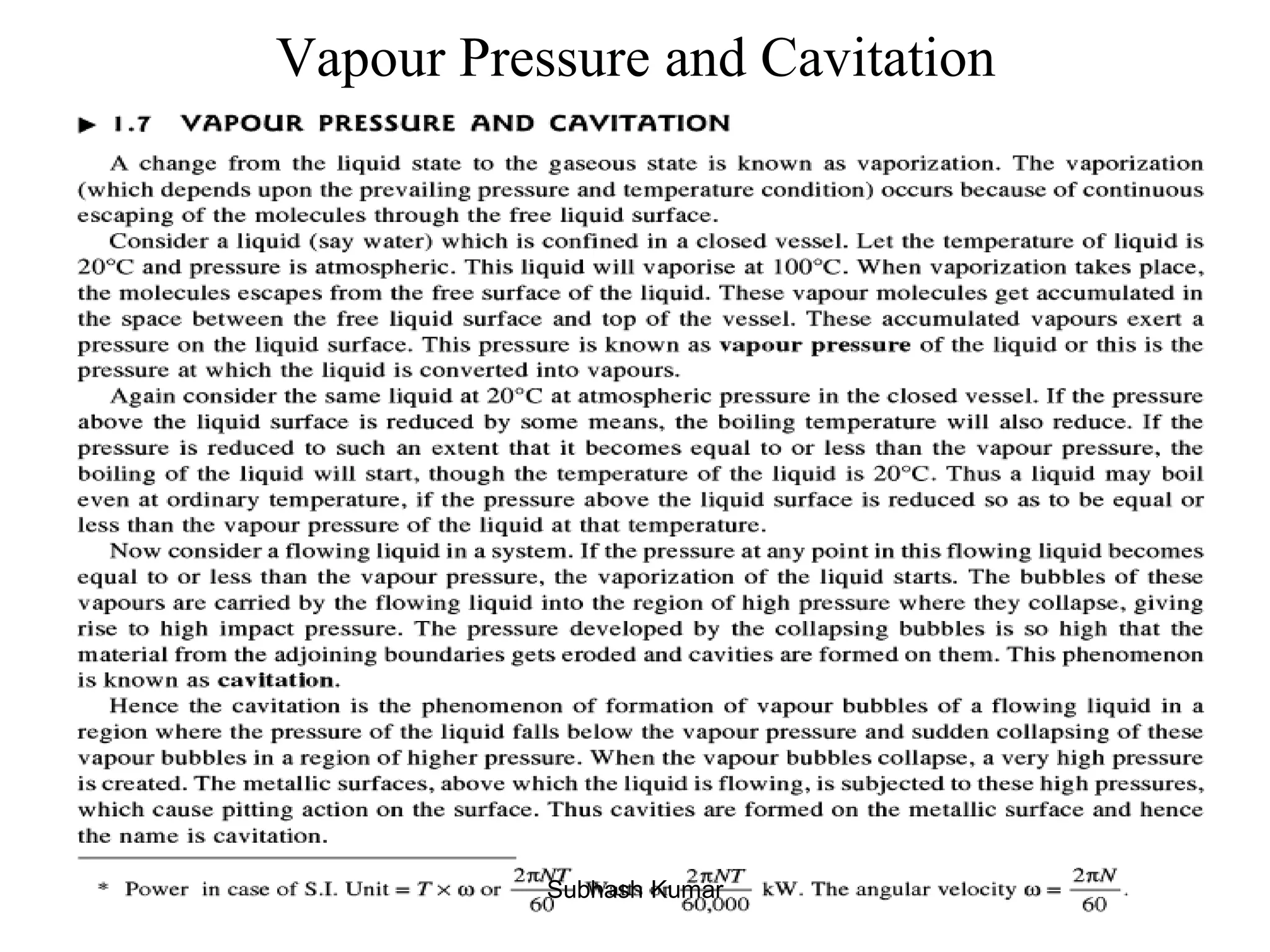
Vapour Pressure and Cavitation
48Subhash Kumar
49Subhash Kumar
50Subhash Kumar
51Subhash Kumar
52Subhash Kumar
53Subhash Kumar
54Subhash Kumar
55Subhash Kumar
56Subhash Kumar
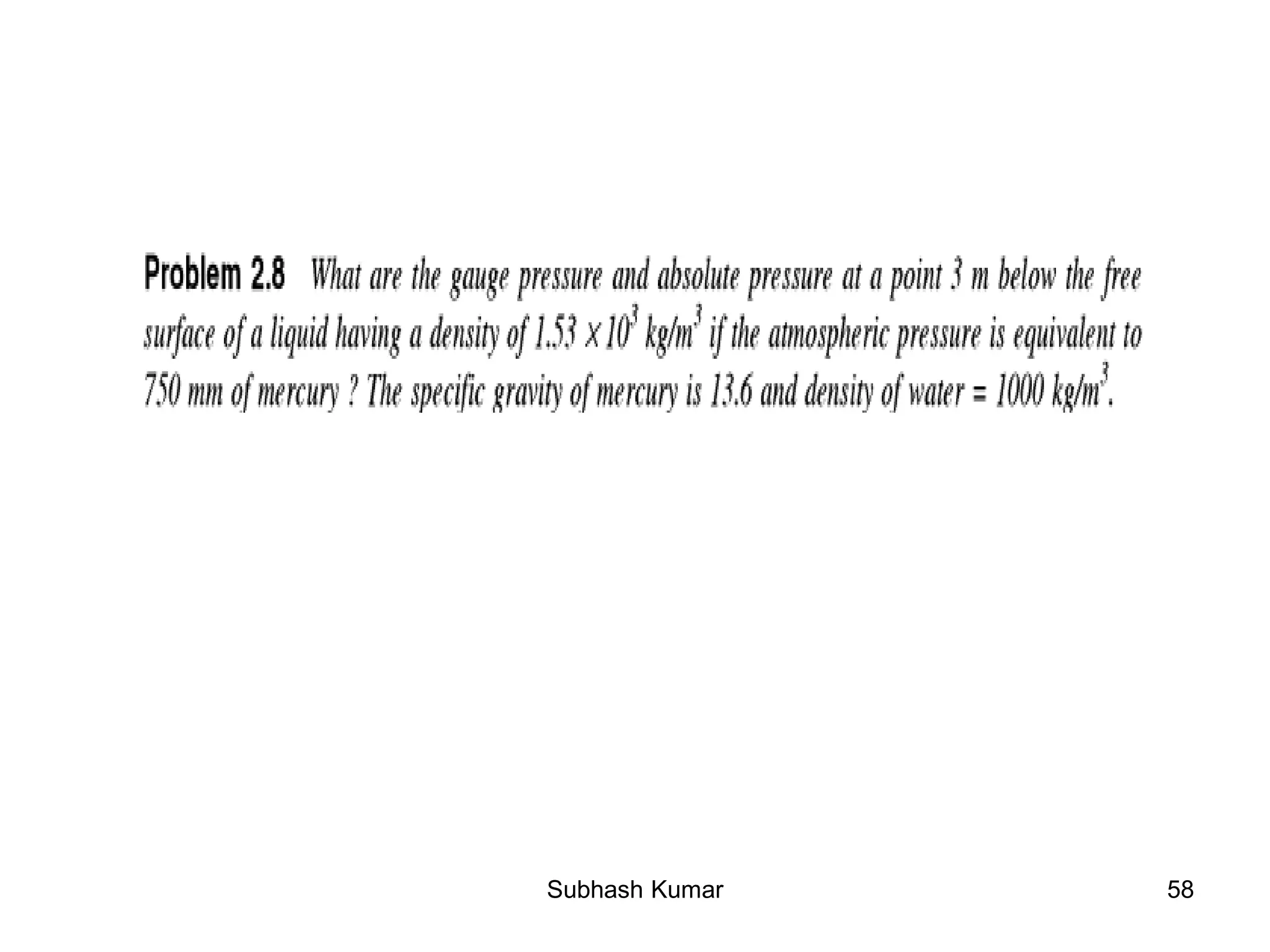
57Subhash Kumar
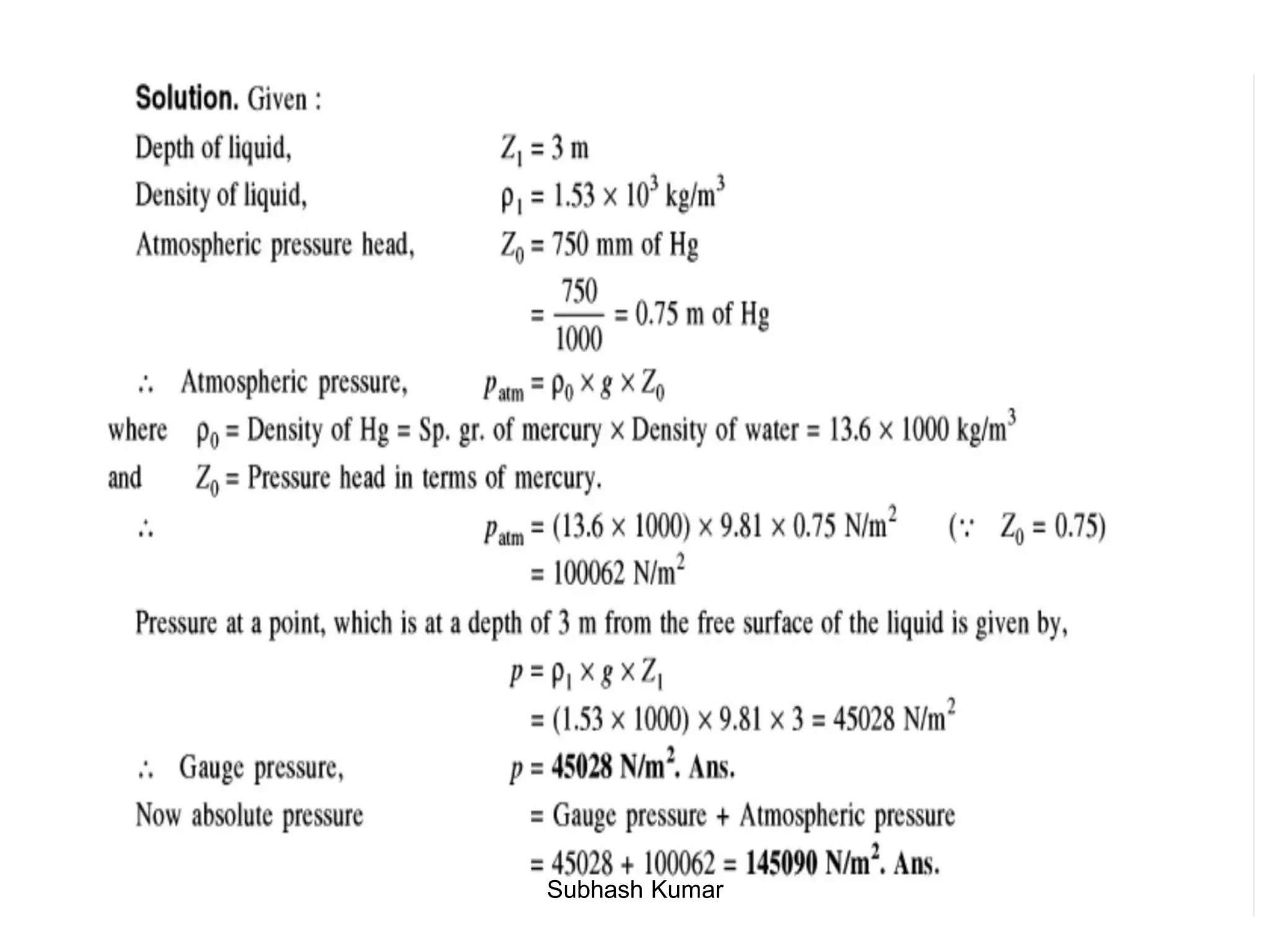
58Subhash Kumar
59Subhash Kumar
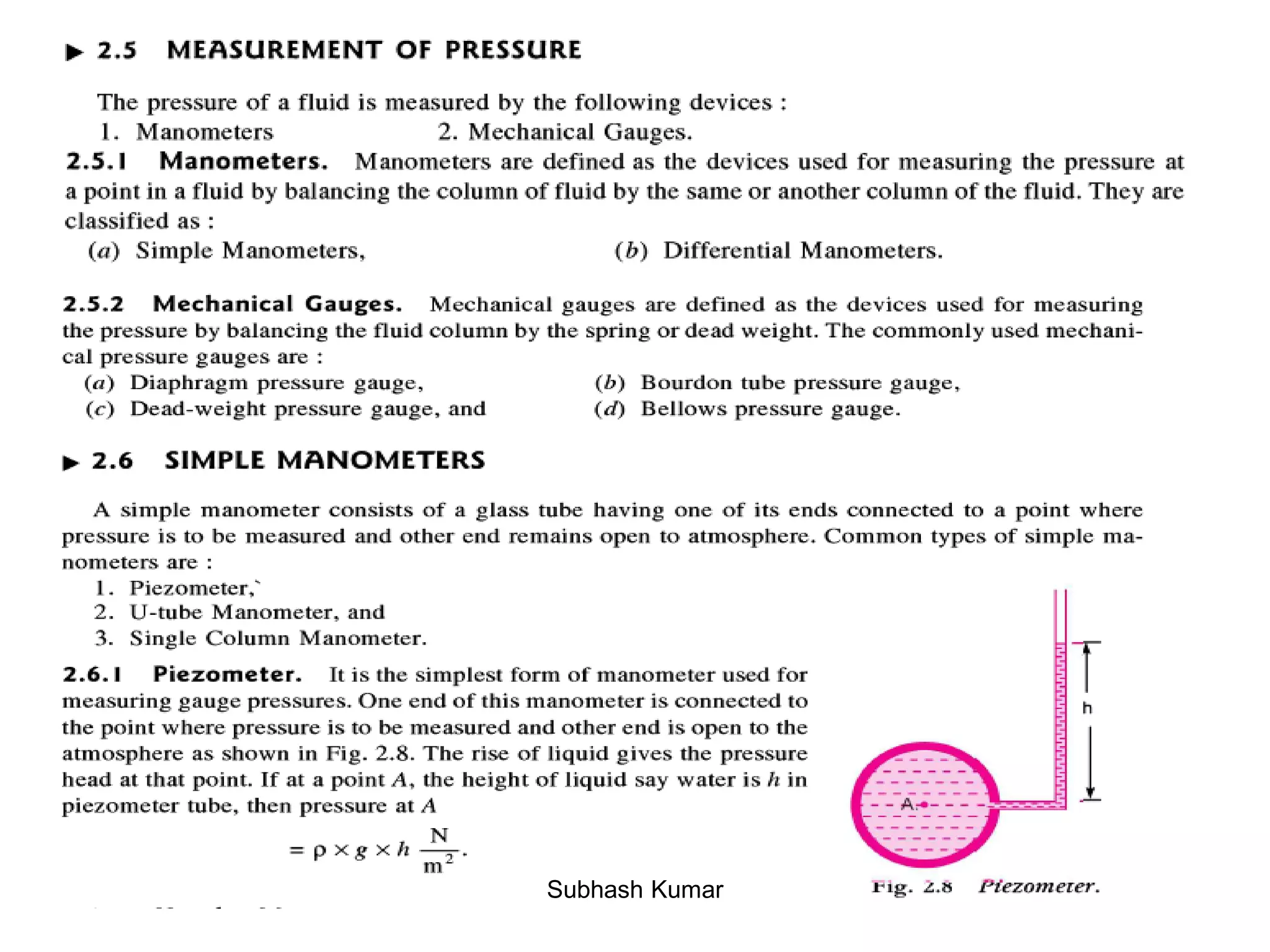
60Subhash Kumar
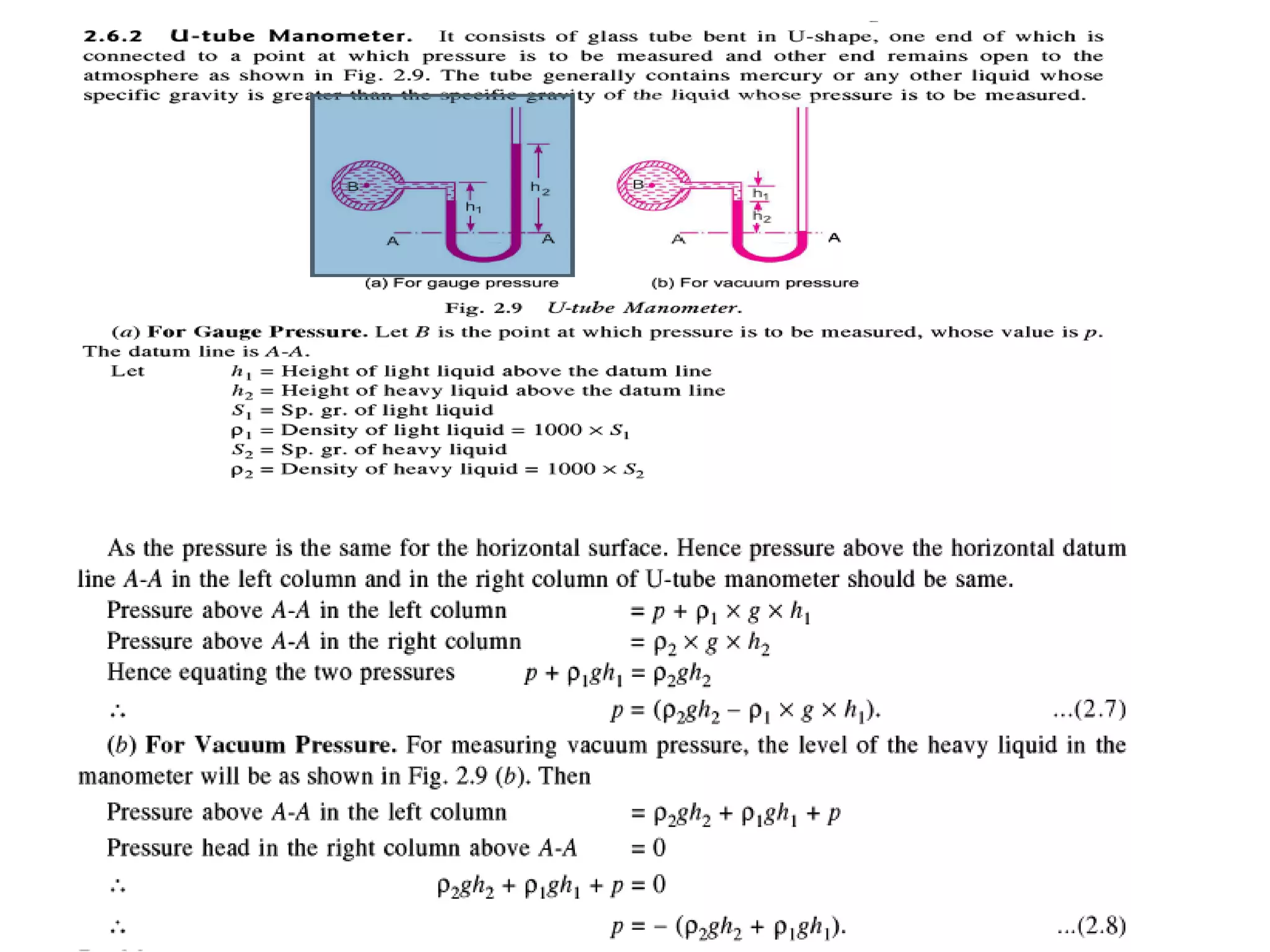
61
62Subhash Kumar
Subhash Kumar 63
64Subhash Kumar
65Subhash Kumar
66Subhash Kumar
67Subhash Kumar
68Subhash Kumar
Subhash Kumar 69
70Subhash Kumar
Subhash Kumar 71
72Subhash Kumar
73Subhash Kumar

Unit i- properties of fluid

  • 1.
  • 2.
    Chapter 1: BasicConceptsESOE 505221 Fluid Mechanics 2 Introduction Mechanics is the oldest physical science that deals with both stationary and moving bodies under the influence of forces. The branch of mechanics that deals with bodies at rest is called statics, while the branch that deals with bodies in motion is called dynamics. The subcategory fluid mechanics is defined as the science that deals with the behavior of fluids at rest (fluid statics) or in motion (fluid dynamics), and the interaction of fluids with solids or other fluids at the boundaries. Fluid mechanics is also referred to as fluid dynamics by considering fluids at rest as a special case of motion with zero velocity
  • 3.
    3 1.1 INTRODUCTION Fluid mechanicsis that branch of science which deals with the behavior of the fluids (liquids or gases) at rest as well as in motion. Thus this branch of science deals with the static, kinematics and dynamic aspects of fluids. The study of fluids at rest is called fluid statics. The study of fluids in motion, where pressure forces are not considered, is called fluid kinematics and if the pressure forces are also considered for the fluids in motion, that branch of science is called fluid dynamics. Subhash Kumar
  • 4.
    Chapter 1: BasicConceptsESOE 505221 Fluid Mechanics 4 Introduction Fluid mechanics itself is also divided into several categories. The study of Hydrodynamics: the motion of fluids that are practically incompressible (such as liquids, especially water, and gases at low speeds) is usually referred to as. A subcategory of hydrodynamics is hydraulics, which deals with liquid flows in pipes and open channels. Gas dynamics deals with the flow of fluids that undergo significant density changes, such as the flow of gases through nozzles at high speeds. Aerodynamics deals with the flow of gases (especially air) over bodies such as aircraft, rockets, and automobiles at high or low speeds. Some other specialized categories such as meteorology, oceanography, and hydrology deal with naturally occurring flows.
  • 5.
    Chapter 1: BasicConceptsESOE 505221 Fluid Mechanics 5 What is a fluid? A substance in the liquid or gas phase is referred to as a fluid. Distinction between a solid and a fluid is made on the basis of the substance’s ability to resist an applied shear (or tangential) stress that tends to change its shape. A solid can resist an applied shear stress by deforming, whereas a fluid deforms continuously under the influence of shear stress, no matter how small. In solids stress is proportional to strain, but in fluids stress is proportional to strain rate. When a constant shear force is applied, a solid eventually stops deforming, at some fixed strain angle, whereas a fluid never stops deforming and approaches a certain rate of strain.
  • 6.
    Chapter 1: BasicConceptsESOE 505221 Fluid Mechanics 6 What is a fluid? Distinction between solid and fluid? Solid: can resist an applied shear by deforming. Stress is proportional to strain Fluid: deforms continuously under applied shear. Stress is proportional to strain rate F A    F V A h    Solid Fluid
  • 7.
    Chapter 1: BasicConceptsESOE 505221 Fluid Mechanics 7 What is a fluid? Stress is defined as the force per unit area. Normal component: normal stress In a fluid at rest, the normal stress is called pressure Tangential component: shear stress
  • 8.
    Chapter 1: BasicConceptsESOE 505221 Fluid Mechanics 8 What is a fluid? A liquid takes the shape of the container it is in and forms a free surface in the presence of gravity A gas expands until it encounters the walls of the container and fills the entire available space. Gases cannot form a free surface Gas and vapor are often used as synonymous words
  • 9.
    Chapter 1: BasicConceptsESOE 505221 Fluid Mechanics 9 What is a fluid? solid liquid gas Intermolecular bonds are strongest in solids and weakest in gases. One reason is that molecules in solids are closely packed together, whereas in gases they are separated by relatively large distances On a microscopic scale, pressure is determined by the interaction of individual gas molecules.
  • 10.
    Chapter 1: BasicConceptsESOE 505221 Fluid Mechanics 10 Application Areas of Fluid Mechanics
  • 11.
    11 1.2 PROPERTIES OFFLUIDS 1.2.1 Density or Mass .Density. The ratio of the mass of a fluid to its volume. It is denoted the symbol (rho). in SI unit is kg per cubic meter, i.e., kg/m3. (The value of density of water is 1 gm/cm3 or 1000 kg/m3.) Subhash Kumar
  • 12.
    12 1.2 PROPERTIES OFFLUIDS 1.2.2 Specific Weight or Weight Density. Specific weight or weight density of a fluid is the ratio between the weight of a fluid to its volume. Thus weight per unit volume of a fluid is called weight density and it is denoted by the symbol (ω) . The value of specific weight or weight density (ω) for water is 9.81 x 1000 Newton/m3 (or Kg/m2.s2) in SI units. Subhash Kumar
  • 13.
    13 1.2 PROPERTIES OFFLUIDS 1.2.3 Specific Volume. Specific volume of a fluid is defined as the volume of a fluid occupied by a unit mass or volume per unit mass of a fluid is called specific volume. Mathematically, it is expressed as Thus specific volume is the reciprocal of mass density. It is expressed as m3/kg. It is commonly applied to gases. Subhash Kumar
  • 14.
    14 1.2 PROPERTIES OFFLUIDS 1.2.4 Specific Gravity. Specific gravity is defined as the ratio of the weight density (or density) of a fluid to the weight density (or density) of a standard fluid. For liquids, the standard fluid is taken water and for gases, the standard fluid is taken air. Specific gravity is also called relative density. It is dimensionless quantity and is denoted by the symbol S. Subhash Kumar
  • 15.
    15 1.2 PROPERTIES OFFLUIDS Problem 1.1:Calculate the specific weight, density and specific gravity of one litre of a liquid which weighs 7 N. Subhash Kumar
  • 16.
    16 1.2 PROPERTIES OFFLUIDS Problem 1.2: Calculate the density, specific weight and weight of one litter of petrol of specific gravity =0.7 Subhash Kumar
  • 17.
    17 1.3 VISCOSITY Viscosity isdefined as the property of a fluid which offers resistance to the movement of one layer of fluid over another adjacent layer of the fluid. When two layers of a fluid, a distance ' dy' apart, move one over the other at different velocities, say u and u + du as shown in Fig. 1.1, the viscosity together with relative velocity causes a shear stress acting between the fluid layers. Subhash Kumar
  • 18.
    18 1.3 VISCOSITY Where µ(called mu) is constant proportionality and is known as the co-efficient of dynamic viscosity or only viscosity du/dy represents the rate of shear strain or shear deformation or velocity gradient The viscosity is also defined as the shear stress required to produce unit rate of shear strain. Subhash Kumar
  • 19.
    19 1.3 VISCOSITY The viscosityunits: Subhash Kumar
  • 20.
  • 21.
  • 22.
    22 1.3 VISCOSITY Kinematic Viscosity. Itis defined as the ratio between the dynamic viscosity and density of fluid. It is denoted by the Greek symbol (v) called 'nu'. Thus, mathematically: Subhash Kumar
  • 23.
  • 24.
    Newtons law ofViscosity 24Subhash Kumar
  • 25.
    Variation of Viscositywith temperature 25Subhash Kumar
  • 26.
  • 27.
    27 Problem 1.4 A plate,0.025 mm distant from a fixed plate, moves at 60 cm/s and requires a force of 2 N per unit area i.e., 2 N/m to maintain this speed. Determine the fluid viscosity between the plates. Subhash Kumar
  • 28.
  • 29.
    29 Problem 1.5 Calculate thedynamic viscosity of an oil, which is used for lubrication between a square plate of size 0.8 m x 0.8 m and an inclined plane with angle of inclination 30° as shown in Fig. The weight of the square plate is 300 N and it slides down the inclined plane with a uniform velocity of 0.3 m/s. the thickness of oil film is 1.5 mm. Subhash Kumar
  • 30.
  • 31.
    31 Problem 1.6 The dynamicviscosity of an oil, used for lubrication between a shaft and sleeve is 6 poise. The shaft is of diameter 0.4 m and rotates at 190 r.p.m. Calculate the power lost in the bearing for a sleeve length of 90 mm. The thickness of the oil film is 1.5 mm. Subhash Kumar
  • 32.
  • 33.
    33 Problem 1.7 If thevelocity profile of a fluid over a plate is a parabolic with the vertex 20 cm from the plate, where the velocity is 120 cm/sec. Calculate the velocity gradients and shear stresses at a distance of 0, 10 and 20 cm from the plate, if the viscosity of the fluid is 8.5 poise. Subhash Kumar
  • 34.
  • 35.
    35 Problem 1.8 Two largeplane surfaces are 2.4 cm apart. The space between the surfaces is filled with glycerin. What force is required to drag a very thin plate of surface area 0.5 square meter between the two large plane surfaces at a speed of 0.6 m/s, if: (i) the thin plate is in the middle of the two plane surfaces, and (ii) the thin plate is at a distance of 0.8 cm from one of the plane surfaces ? Take the dynamic viscosity of glycerin = 8.10 x 10⁻¹ N.s/m . Subhash Kumar
  • 36.
  • 37.
  • 38.
    38 Problem 1.9 A verticalgap 2.2 cm wide of infinite extent contains a fluid of viscosity 2.0 N s/m2 and specific gravity 0.9. A metallic plate 1.2 m x 1.2 m X 0.2 cm is to be lifted up with a constant velocity of 0.15 m/sec, through the gap. If the plate is in the middle of the gap, find the force required. The weight of the plate is 40 N. Subhash Kumar
  • 39.
  • 40.
    40 Problem 1.9 Solution Inthis case the weight of plate (which is acting vertically downward) and upward thrust is also to be taken into account. The upward thrust = Weight of fluid displaced Subhash Kumar
  • 41.
  • 42.
    Surface Tension andCapillarity 42Subhash Kumar
  • 43.
    Surface Tension andCapillarity 43Subhash Kumar
  • 44.
  • 45.
  • 46.
  • 47.
  • 48.
    Vapour Pressure andCavitation 48Subhash Kumar
  • 49.
  • 50.
  • 51.
  • 52.
  • 53.
  • 54.
  • 55.
  • 56.
  • 57.
  • 58.
  • 59.
  • 60.
  • 61.
  • 62.
  • 63.
  • 64.
  • 65.
  • 66.
  • 67.
  • 68.
  • 69.
  • 70.
  • 71.
  • 72.
  • 73.