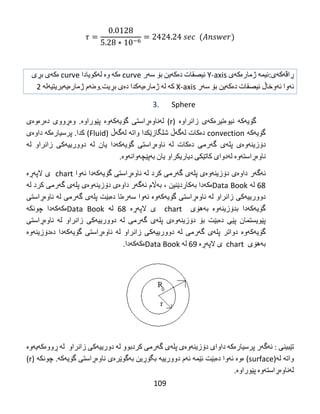
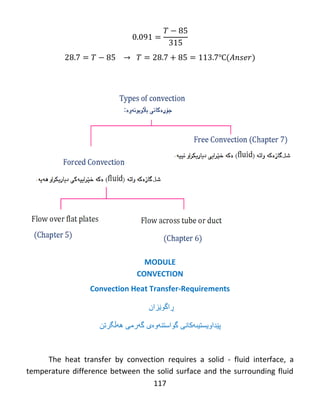
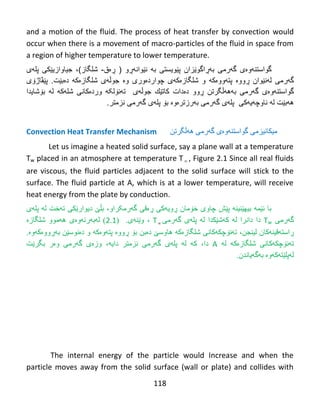
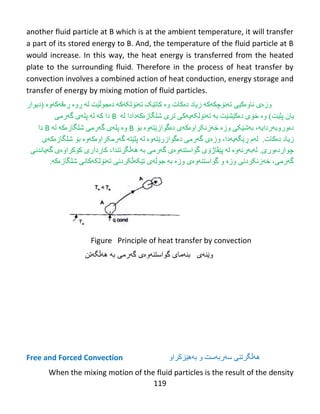
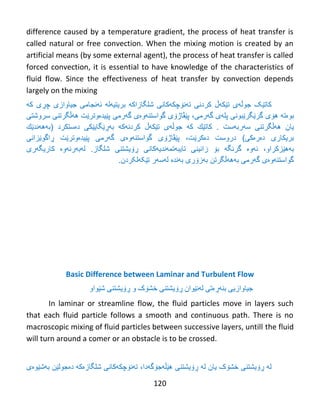
2
www.ferhang.com فهرههنگىئهندازیارى
Chapter 1
Introductionپێػەکی
Heat Energy and Heat Transfer وزەیگهرمیوگواستنهوەیگهرمی
What is Heat energy?
Heat is a form of energy in transition and it flows from one system to
another, without transfer of mass, whenever there is a temperature
difference between the systems. Heat always moves from a warmer
place to a cooler place.
وزەیگهرمیچیه؟
گهرمیشێوەیهکیوزەیهلهگواستنهوەداوەلهسیستهمێکهوەدەرواتبۆسیستهمێکیتربێئهوەیبارستای
بگواسرێتهوەههرچۆنێکبێتجیاوازیپلهیگهرمیههیهلهنێوانسیستهمهکاندا،ههمیشهگهرمی
لهشوێنێکیگهرمترەوەدەجوڵێتبۆشوێنێکیساردتر.
What is Heat transfer?
The science of how heat flows is called heat transfer.
گواستنهوەیگهرمیچیه؟
ئهوزانستهیلهچۆنێتیگواستنهوەیگهرمیدەکۆڵێتهوەپێیدەوترێتگواستنهوایگهرمی.
Importance of Heat Transfer گرنگیگواستنهوەیگهرمی
What is Importance of Heat Transfer?
3.
3
Heat transfer processesinvolve the transfer and conversion of energy
and therefore, it is essential to determine the specified rate of heat transfer at
a specified temperature difference. The design of Equationuipments like
boilers, refrigerators and other heat exchangers rEquationuire a detailed
analysis of transferring a given amount of heat energy within a specified time.
Components like gas/steam turbine blades, combustion chamber walls,
electrical machines, electronic gadgets, transformers, bearings, etc
rEquationuire continuous removal of heat energy at a rapid rate in order to
avoid their overheating.
گرنگیگواستنهوەیگهرمیچییه؟
پرۆسهکانیگواستنهوەیگهرمیبهژدارنلهگواستنهوەوپاراستنیوزەوەلهبهرئهوەبنچینهی
دۆزینهوەیبریگهرمیدیاریکراوەلهجیاوازیپلهیهکیگهرمیدیاریکراودا.دیزاینیئامێرەکهنی
وەکوبۆیلهروبهفرگروگوێزەرەوەگهرمیهکانیترپێویستیانبهشیکارێکیدرێژیگواستنهوەیبرێکی
دیاریکراویوزەیگهرمیههیهلهکاتێکیدیاریکراودا.پێکهێنارەکانیوەکپهرەیتۆرباینیههڵمیو
گازی،دیوارەکانیژوریسوتان،مهکینهکارەبییهکانئامێرەئهلکترۆنیهکانمحاویلهکانوبێرینگهکانو
ههتادوایپێویستهبهبهردەوامیگهرمیهکهیانالببرێتلهکاتێکیخێرادابۆئهوەیدوربنله
زۆرگهرمبون.
Thermal Equilibrium هاوسهنگیگهرمی
What isThermal Equilibrium?
Two bodies are in thermal Equilibrium with each other when they have
the same temperature. In nature, heat always flows from hot to cold
until thermal Equilibrium is reached. Hot objects in a cooler room will
4.
4
cool to roomtemperature. Cold objects in a warmer room will heat up to
room temperature.
هاوسهنگیگهرمیچیه؟
دوتهنلههاوسهنگیگرمیدانلهگهڵیهکتریکاتێکههردوکیانههمانپلهیگهرمیانههبێت.له
سروشدا،گهرمیههمیشهالگهرمهوەدەچێتبۆساردههتادەگهنههاوسهنگبونیگهرمی.
شتهگهرمهکانلهژورێکیسارداسارددەبنبۆپلهیگهرمیژورەکه.شتهساردەکهنلهژورێکی
گهرمداگهرمدەبنبۆپلهیگهرمیژورەکه.
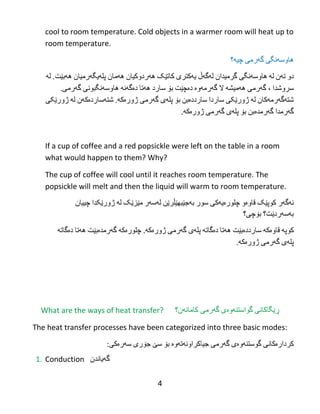
If a cup of coffee and a red popsickle were left on the table in a room
what would happen to them? Why?
The cup of coffee will cool until it reaches room temperature. The
popsickle will melt and then the liquid will warm to room temperature.
ئهگهرکوپێکقاوەوچلورەیهکیسوربهجێبهێڵرێنلهسهرمێزێکلهژورێکداچییان
بهسهردێت؟بۆچی؟
کوپهقاوەکهسارددەبێتههتادەگاتهپلهیگهرمیژورەکه.چلورەکهگهرمدەبێتههتادەگاته
پلهیگهرمیژورەکه.
What are the ways of heat transfer? ڕێگاكانیگواستنهوهیگهکامانهن؟ رمی
The heat transfer processes have been categorized into three basic modes:
کردارەکانیگوستنهوەیگهرمیجیاکراونهتهوەبۆسێجۆریسهرەکی:
1. Conduction گهیاندن
5.
5
2. Convection ههڵگرتن
3. Radiation تیشكدان
Conduction گهیاندن
1.6 Mechanism of Heat Transfer by Conduction
What is conduction?
Conduction is the transfer of heat through materials by the direct
contact of matter. Particles that are very close together can transfer
heat energy as they vibrate. This type of heat transfer is called
conduction. Dense metals like copper and aluminum are very good
thermal conductors.
میكانیزمىگهرمى گواستنهوەیبهگهیاندن
چیه؟ گهیاندن
ماددە بهناو گهرمیه گواستنهوەكهى گهیاندنکاندابهماددە ڕاستهوخۆىکان.ئهوتهنۆچكانایزۆر كه
نزیكنبگوازنهوە گهرمى وزەى دەتواننن پێكهوەکهجۆرەى ئهم .دەلهرێنهوەگهرمى گواستنهوەیپێی
دەوترێتگهیاندن.وەك پڕ كانزاىمسباش زۆر گهیێنهرى ئهلهمنیۆم ویگهرمین.
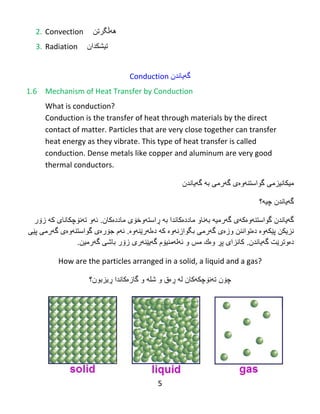
How are the particles arranged in a solid, a liquid and a gas?
تهنۆچكهك چۆنله انو ڕەقشلهگاز وڕیزبون ەکاندا؟
6.
6
Solids usually arebetter heat conductors than liquids, and liquids are
better conductors than gases.
ڕەقەکبىعبدەتەىثبغترگەرهیدەگەيەًيوەکلەغلە،کبىوغلەکبىثبغترگەرهیدەگەيەًي
وەکلەگبزەکبى.
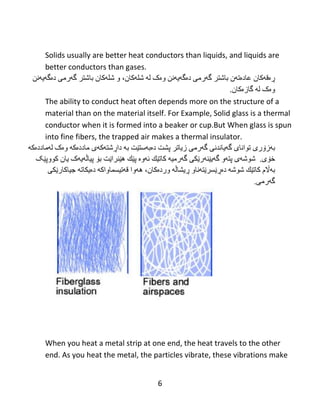
The ability to conduct heat often depends more on the structure of a
material than on the material itself. For Example, Solid glass is a thermal
conductor when it is formed into a beaker or cup.But When glass is spun
into fine fibers, the trapped air makes a thermal insulator.
ثەزۆریتىاًبیگەيًبًذیگەًرهزيبترپػتدەثەضتێتثەداڕغتەكەيهبددەکەوەکلەهبددەكە
خۆی.غىغەیپتەوگەيێٌەرێًكگەرهیەكبتێكئەوەپێكهێٌراێتثۆپیبڵەيەکيبىكىوپێک
ثەاڵمكبتێكغىغەدەڕێطرێتەًبوڕيػبڵەوردە،کبىهەواقەتیطوبواکەدەيكبتەجیبكبرێًك
گەرهی.
When you heat a metal strip at one end, the heat travels to the other
end. As you heat the metal, the particles vibrate, these vibrations make
7.
7
the adjacent particlesvibrate, and so on, the vibrations are passed along
the metal and so is the heat.
كبتێكغريتێًككبًساگەرمدەكەيتلەضەرێکییەوە،گەًرهدەڕواتثۆكۆتبيیەکەیتری.
ههروەكکه ئهوەیكانزایهكئهم ،دەلهرێنهوە تهنۆچكهكه ،دەكهیت گهرملهرانهوادەكهن
تهنۆچكهکانیدراوسێیان،بلهرێنهوەوە،ههروەهالهرەكهتێدەپهڕرنبهناوكانزاكهداوەئهوە
گهرمیهكهیه.
Metals are different, The outer electrons of metal atoms drift, and are
free to move. Whenthemetalisheated,this‘seaofelectrons’gain
kinetic energy and transfer it throughout the metal. But Insulators, such
as wood andplastic,donothavethis‘seaofelectrons’because of this
they do not conduct heat as well as metals.
كبًساکبىجیبوازى،ئهلیكترۆنهکانیدەرەوەىوە بهرەاڵن کانزاکه گهردیلهکانیبجولێت تا ئازادن.
كاتێككرا گهرم كانزاكهبئهم ،ێتدەریایئهلیكترۆنانهجووڵهدەست وزەىدەكهوێتودەیگوازێتهوە
بهناوكانزاكهدا.بهاڵمجیاكارەکان،وەكودارو،پالستیكئهمدەریاىئهلیكترۆننیه انهیانبههۆی
ئهمهوەئهوانگهرمیوەک ههر ناگهیهننكانزاکان.
8.
8
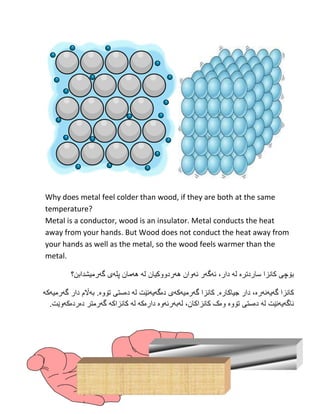
Why does metalfeel colder than wood, if they are both at the same
temperature?
Metal is a conductor, wood is an insulator. Metal conducts the heat
away from your hands. But Wood does not conduct the heat away from
your hands as well as the metal, so the wood feels warmer than the
metal.
ساردتر كانزا بۆچىەههردوو ئهوان ئهگهر ،دار لهکیانگهرم پلهى ههمان لهیشدابن؟
گهی كانزاهنهرەجیاك دار ،ارەگهرمیهكه كانزا .یدەگهیهنێتتۆ دەستى لهوە.بهاڵمگهرمیهكه دار
ناگهیهنێتتۆوە دەستى له.دەردەکهوێت گهرمتر کانزاکه له دارەکه لهبهرئهوە ،کانزاکان وەک
9.
9
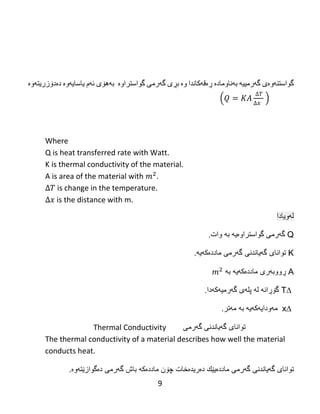
گواستنهوهىگهرمییهبهناومادهڕهقهكانداوهبڕىگهرمىگواستراوهبههۆىئهمیاسایهوهدهدۆزریتهوه
( )
Where
Q isheat transferred rate with Watt.
K is thermal conductivity of the material.
A is area of the material with .
is change in the temperature.
is the distance with m.
لهویادا
Qگواست گهرمىراوەیهبهوات.
Kتوانایگهیاندنیگهرمیماددەكهیه.
Aماددەكهیه ڕووبهرىبه
∆Tگهرمیهكه پلهى له گۆڕانهدا.
∆xمهودایهكهیهبهمهتر.
Thermal Conductivity توانایگهیاندنیگهرمی
The thermal conductivity of a material describes how well the material
conducts heat.
توانایگهیاندنیگهرمیماددەیێكدەریدەخاتماددەكه چۆنگهرمى باشدەگوازێتهوە.
10.
10
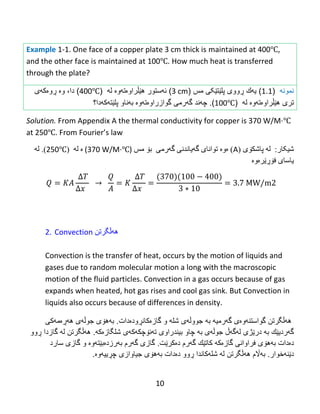
Example 1-1. Oneface of a copper plate 3 cm thick is maintained at 400℃,
and the other face is maintained at 100℃. How much heat is transferred
through the plate?
نمونه(1.1)یهكڕووىمس پلێتێکی(3 cm)ئهستورهێڵراوەتهوەله(400℃)دا،وەڕوەکهی
تریهێڵراوەتهوەله(100℃).چهندگهرمىگوازراوەتهوەبهناوپلێتهکهدا؟
Solution. From Appendix A the thermal conductivity for copper is 370 W/M·℃
at 250℃.FromFourier’slaw
:غیکبرلەپبغكۆ( یA)ەوەگەرهی گەيبًذًی تىاًبیثۆهص(370 W/M·℃)ەلە(250℃).لە
يبضبيفۆڕێرەوە
2. Convection ههڵگرتن
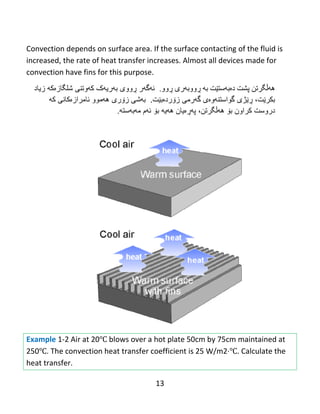
Convection is the transfer of heat, occurs by the motion of liquids and
gases due to random molecular motion a long with the macroscopic
motion of the fluid particles. Convection in a gas occurs because of gas
expands when heated, hot gas rises and cool gas sink. But Convection in
liquids also occurs because of differences in density.
ههڵگرتنگهرمیه گواستنهوەىبهجووڵگاز و شله هىەکانڕودەدات.بههۆىجوڵهىههڕەمهكى
گهردیێكبهدرێژیلهگهڵجوڵهىبهچاوبیندراوىتهنۆچكهكهىشلگازەکه.ههڵگرتنگاز لهداڕوو
دەداتبههۆیفراوانیگازەکهگهرم كاتێكدەكرێت.بهرز گهرم گازىدەبێتسارد گازى و هوە
دێنهخوار.بهاڵمههڵگرتنشله لهکاندادەد ڕوواتبههۆى.چڕییهوە جیاوازی
11.
11
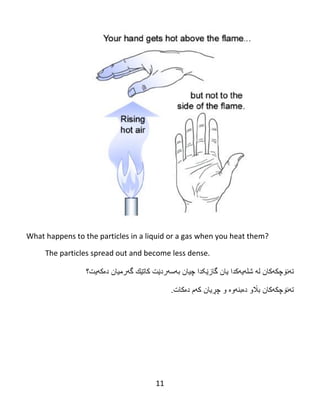
What happens tothe particles in a liquid or a gas when you heat them?
The particles spread out and become less dense.
تهنۆچكهکانلهشلهیهکدایانگازێکداچبهسهردێت یانكاتێكگهرمیاندەكهیت؟
تهنۆچكهکانباڵودەبنهوە.دەکات کهم چڕیان و
12.
12
Fluid movement:
When theflow of gas or liquid comes due to differences in density and
temperature zone, it is called natural convection. When the flow of gas
or liquid is circulated by pumps or fans it is called forced convection.
Convection depends on speed. Motion increases heat transfer by
convection in all fluids.
جوڵهشل ىگازەکان:
كاتێكلێشاویدێت شله یان گازبههۆیگهرم پلهى و چڕى له جیاوازىیدائهوە ،دەوترێت پێی
سروشتی ههڵگرتنی.ڕۆیشت كاتێكسووڕراوەتهوە شله یان گاز ىبهترومپاکانهوەیانبهههوادار
ئهودەوترێت پێی ەههڵگرتنی.بههێزکراو
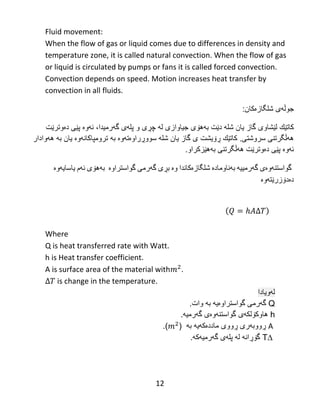
گواستنهوهیگهرمییهبهناومادهشلگازهكانداوهبڕیگهرمیگواستراوهبههۆیئهمیاسایهوه
دهدۆزرێتهوه
Where
Q is heat transferred rate with Watt.
h is Heat transfer coefficient.
A is surface area of the material with .
is change in the temperature.
لهویادا
Qگواست گهرمىراوەیهبهوات.
hهاوكۆلكهىگواستنهوەیگهرمیه.
Aماددەكهیه ڕووى ڕووبهرىبه().
∆Tگهرمیهكه پلهى له گۆڕانه.
13.
13
Convection depends onsurface area. If the surface contacting of the fluid is
increased, the rate of heat transfer increases. Almost all devices made for
convection have fins for this purpose.
هەڵگرتيثە دەثەضتێت پػتڕووثەريڕوو.ڕوو ئهگهرکهوتنی بهریهک یشلگازەکهزیاد
ڕێژى ،بكرێتگهرمى گواستنهوەیزۆردەبێت.زۆری بهشیئامراز ههمووکه ەکانی
کراون دروستبۆههڵگرتن،پهڕەیانههیهمهبهسته ئهم بۆ.
Example 1-2 Air at 20℃ blows over a hot plate 50cm by 75cm maintained at
250℃. The convection heat transfer coefficient is 25 W/m2·℃. Calculate the
heat transfer.
14.
14
نمونه(1.2)ههواله(20℃)دەدرێتلهسهرپلێتێكىگهرمی(50cm)به(75cm)
هێشتیراوەتهوەله(250℃)دا.ڕاگوێزان گهرمی گوستنهوەیهاوکۆلکهی(25 W/m2·℃)ە.
گواستنهوەكهىگهرمىبکه ههژمار.
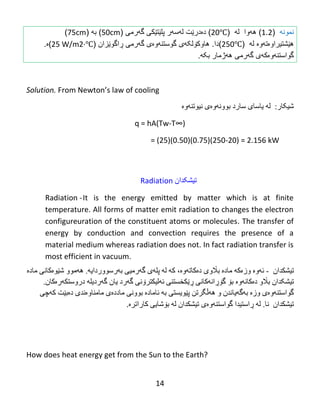
Solution. FromNewton’slawofcooling
:غیکبرلەيبضبيضبردًثىوەوەیًٌیىتەوە
q = hA(Tw-T∞)
= (25)(0.50)(0.75)(250-20) = 2.156 kW
Radiation تیشکدان
Radiation -It is the energy emitted by matter which is at finite
temperature. All forms of matter emit radiation to changes the electron
configureuration of the constituent atoms or molecules. The transfer of
energy by conduction and convection requires the presence of a
material medium whereas radiation does not. In fact radiation transfer is
most efficient in vacuum.
تیػكذاى-ئەوەوزەكەهبدەثاڵویدەكبتەوە،كەلەپلەيگەًرهیثەرضىوردايە.هەهىوغێىەکبًیهبدە
تیػکذاىثاڵودەكبًەوەثۆگۆڕًاەکبًیڕێًٌكخطتئەلیكترۆًًگەرديبىگەرديلەدروضتكەر.ەکبى
ٌگىاضتەوەيوزەثەگەيبًذىوهەڵگرتيپێىيطتثە یئبهبدەًًثىوهبددەیهبهٌبوەًذيدەثێتكەًچ
تیػكذاىًب.لەڕاضتیذاٌگىاضتەوەيتیػكذاىلەثۆًغبيكبراترە.
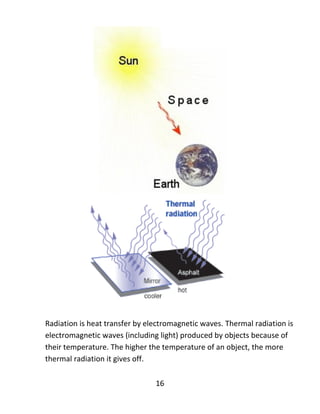
How does heat energy get from the Sun to the Earth?
15.
15
There are noparticles between the Sun and the Earth so it CAN NOT travel by
conduction or by convection.
چۆنوزەىگهرمىدەستدەكهوێتلهخۆرەوەبۆزەوى؟
هیچتهنۆچكهیهکو خۆر لهنێواننیه یدابۆیهبه ناتوانێتیان گهیاندنبهڕاگوێزان.بگات
16.
16
Radiation is heattransfer by electromagnetic waves. Thermal radiation is
electromagnetic waves (including light) produced by objects because of
their temperature. The higher the temperature of an object, the more
thermal radiation it gives off.
17.
17
تیشكدانگواستنهوەىگهرمیهبهشهپۆلىکارۆموگناتیزی.تیشكدانشهپۆلى گهرمایى ى
کارۆموگناتیزیهێنبهرههم )ڕووناكي (ههروەك هراوەبهشتهکانگهرمییان پلهى بههۆىهوە.پلهى
گهرمبهرزتری یگهرما ،شتێكزیاتر یتیشكدەدات.
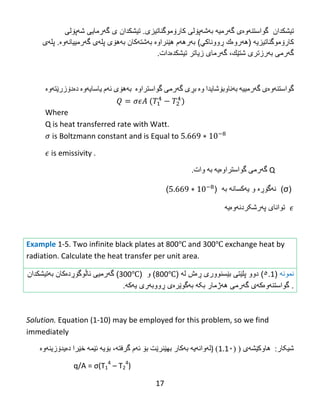
گواستنهوهیگهرمییهبهناوبۆشایداوهبڕیگهرمیگواستراوهبههۆیئهمیاسایهوهدهدۆزرێتهوه
Where
Q is heat transferred rate with Watt.
is Boltzmann constant and is Equal to
is emissivity .
Qوات ثە گىاضتراوەيە ًگەره.
(σ)یهكسانه و نهگۆڕەبه( )
پهرشکردنهوەیه توانای
Example 1-5. Two infinite black plates at 800℃ and 300℃ exchange heat by
radiation. Calculate the heat transfer per unit area.
نمونه(1.٥)دووپلێتىبێسنووریڕەشله(800℃)و(300℃)گهرمیىئاڵوگۆڕدەکانبهتیشكدان
.گواستنهوەكهىگهرمىبکه ههژماربهگوێرەیڕووبهرىیهكه.
Solution. Equation (1-10) may be employed for this problem, so we find
immediately
:غیکبرهبوكێػەی((1.1٠))لەًواەيەثەكبرثهێٌرێتثۆئەمگرفتە،ثۆيەئێوەخێرادەيذۆٌزيەوە
q/A=ς(T1
4
– T2
4
)
18.
18
= (5.66910-8
)(10734
-5734
) =69.03 kW/m3
Thermal radiation تیشکدانیگهرمی
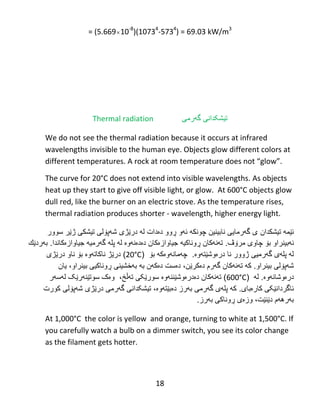
We do not see the thermal radiation because it occurs at infrared
wavelengths invisible to the human eye. Objects glow different colors at
different temperatures. Arockatroomtemperaturedoesnot“glow”.
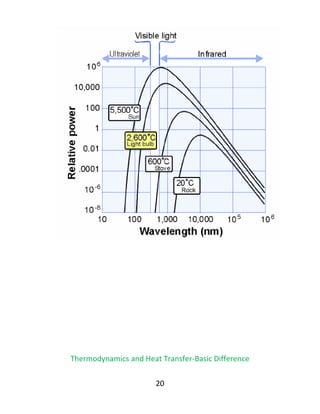
The curve for 20°C does not extend into visible wavelengths. As objects
heat up they start to give off visible light, or glow. At 600°C objects glow
dull red, like the burner on an electric stove. As the temperature rises,
thermal radiation produces shorter - wavelength, higher energy light.
ئێمهتیشكدانسوور ژێر تیشكى شهپۆلى درێژى له دەدات ڕوو ئهو چونكه نابینین گهرمایى ى
مرۆڤ چاوى بۆ نهبینراو..جیاوازەکاندا گهرمیه پله له دەدەنهوە جیاوازەکان ڕوناکیه تهنهکانبهردێك
نا ژوور گهرمیى پلهى له.درەوشێتهوەبۆ چهمانهوەكه(20°C)ناو بۆ ناكاتهوە درێژدرێژى
بینراو شهپۆلى.،دەکرێن گهرم تهنهکان کهدەكهن دەستبهبهخشینیبینراو ڕوناكیىیان ،
درەوشانهوە.له(600°Cدەدرەوشێننهوە تهنهکان )تهڵخ سورێکی،لهسهر سوتێنهرێک وەک
.کارەبای ئاگردانێکیکورت شهپۆلی درێژی گهرمی تیشکدانی ،دەبێتهوە بهرز گهرمی پلهی که
.بهرز ڕوناکی وزەی ،دێنێت بهرههم
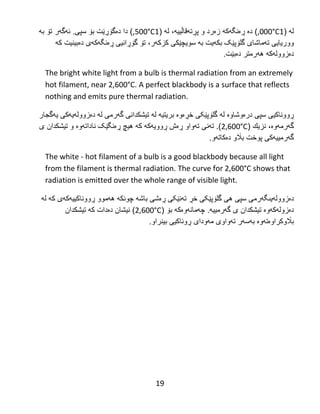
At 1,000°C the color is yellow and orange, turning to white at 1,500°C. If
you carefully watch a bulb on a dimmer switch, you see its color change
as the filament gets hotter.
19.
19
له(1,000°Cدە )ڕەنگهکه( له،پڕتهقاڵییه و زەرد1,500°C.سپی بۆ دەگۆڕێت دا )به تۆ ئهگهر
تهماشا ووریایىیگلۆپێکبكهیتبهسویچێكىکزکهرڕەنگ گۆڕانیى تۆ ،هکهیدەبینیتکه
دەزوولهكهدەبێت ههرمتر.
The bright white light from a bulb is thermal radiation from an extremely
hot filament, near 2,600°C. A perfect blackbody is a surface that reflects
nothing and emits pure thermal radiation.
ڕووناكیىسپىدرەوشاوەلهگلۆپێکیخڕله بریتیه ەوەتیشكدانىگهرمیلهدەزوولهیهکییهگجار
گهرمهوە،نزیك(2,600°C).تهنیڕوو ڕەش تهواویهڕەنگ هیچ كه كهێکناو داتهوەتیشكدانى
گهرمپوخت ییهکیدەكاتهو باڵو.
The white - hot filament of a bulb is a good blackbody because all light
from the filament is thermal radiation. The curve for 2,600°C shows that
radiation is emitted over the whole range of visible light.
دەزوولهیىهی سپی گهرمیگلۆپێکیخڕتهنێکیڕەشیباشهچونكهههمووڕووناكله که ییهکهی
دەزولهکهوەتیشكدانىگهرمییه.بۆ چهمانهوەكه(2,600°C)كه دەدات نیشانتیشكدان
باڵوکراوەتهوەبتهواوى هسهرمهودایبینراو ڕوناكیى.
21
بزاوتن گهرمیوگواستنهوەگهرمى ی-بنهڕەتىجیاوازیى
Thermodynamics is mainly concerned with the conversion of heat
energy into other useful forms of energy and IS based on (i) the concept of
thermal Equilibrium (Zeroth Law), (ii) the First Law (the principle of
conservation of energy) and (iii) the Second Law (the direction in which a
particular process can take place). Thermodynamics is silent about the heat
energy exchange mechanism.
ثەغێىەيەًكضەرەًكثساوتي گەرهیخەريكەثەگۆڕًٌيوزەيگەرهیەثۆغێىەيثەضىودي
تریوزەوەلەضەرٌثەهبي(i)چەًهكهبوضەًًگیگەًره(ٌيبضبضفر)،(ii)يبضبييەكەم
(ٌثەهبيەكەيپبراضتٌیوزە)و(iii)يبضبیدوەم(ئبڕاضتەكەكەتیبيذاكردارێًكديبريكراودەًتىاێت
ڕووثذات. )ثێذەًگەدەرثبرەيهیكبًیسهەكەي.
The transfer of heat energy between systems can only take place
whenever there is a temperature gradient and thus. Heat transfer is basically a
non-Equilibrium phenomenon. The Science of heat transfer tells us the rate at
which the heat energy can be transferred when there is a thermal non-
Equilibrium. That is, the science of heat transfer seeks to do what
thermodynamics is inherently unable to do.
پلەی کە هەرکبتێکذا لە تەًهب ڕوثذات دەتىاًێت ضیطتەهەکبًذا لەًێىاى گەرهی وزەی گىاضتٌەوەی
زاًطتی .ًیە هبوضەًگ ديبردەيەکی ثٌەڕەتذا گەرهیلە گىاضتٌەوەی کەواتە وە هەثێت پلەپلە گەرهی
گەرهی گىاضتٌەوەیًبهبوضەًگی کبتێک ثگىزرێتەوە دەتىاًرێت گەرهی ڕێژەيەکی کە دەڵێت پێوبى
گەرهی لەثٌەڕەتذا کە ثکرێت ثۆئەوەی دەريذەخبت گەرهی گىاضتٌەوەی زاًطتی ئەوە .هەثێت گەرهی
.کردًی ثۆ ثێتىاًبيە ثساوتي
22.
22
However, the subjectsof heat transfer and thermodynamics are highly
complimentary. Many heat transfer problems can be solved by applying the
principles of conservation of energy (the First Law)
لەگەڵئەوە،غذاثبثەتەكًبًگىاضتٌەوەیًگەرهوثساوتي گەرهیزۆريەکترى تەواوکەری.
زۆرًگرفتٌگىاضتەوەیگەًرهیدەًتىارێتچبرەضەرثكرێتثەجێجەجێکردًیٌثەهبیپبراضتٌی
وزە(يبضبييەكەم.)
Dimension and Unit ڕەههندویهكه
Table 1.1 Dimensions and units of various parameters
خػتە(1.1)ڕەهەًذويەكەيهۆكبريجۆراوجۆر
Parameters یهكهكانUnits هێندهكان
Mass Kilogram, kg بارستاى
Length metre, m درێژى
Time seconds, s كات
Temperature Kelvin, K, Celcius o
C پلهىگهرمى
Velocity metre/second,m/s خێراى
Density kg/m3
چڕى
Force Newton, N = 1 kg m/s2
هێز
Pressure N/m2
, Pascal, Pa پهستان
Energy N-m, = Joule, J وزه
Work N-m, = Joule, J ئیش
Power J/s, Watt, W توانا
Thermal Conductivity W/mK, W/mo
C تواناىگهیاندنىگهرمى
Heat Transfer Coefficient W/m2
K, W/m2o
C هاوكۆلكهىگواستنهوهىگهرمى
Specific Heat J/kg K, J/kgo
C گهرمىجۆرى
Heat Flux W/m2
لێشاوىگهرمى
23.
23
Viscosity N-s/m2
, Pa-sلینجى
Kinematic Viscosity m2
/s كاینهماتیكىلینجى
review پێداچونهوه
Example: A red brick wall of length 5m, height 4m and thickness 0.25m. The
inner surface 110℃ and the outer surface is 40℃ . The thermal conductivity of
the red brick, k=0.7 W/mK. Calculate the temperature at a point 20m distance
from the inner surface.
نموونه:خشتێکیسووریدیوار،درێژى(5m)،(4m)وئهستوریى(0.25m).ڕووىناوەوە
(110℃)ودەرەوە(40℃)ە.گهیاندنی توانایگهرمیخشتهسوورەکه،(k=0.7 W/mK).پلهى
گهرمیهكهبکه ههژمارلهخاڵێك(20m)دورلهڕووىناوەوە.
Given: length =L=5m, Height =h=4m, thickness = =0.25m, ℃ ,
℃ .
25
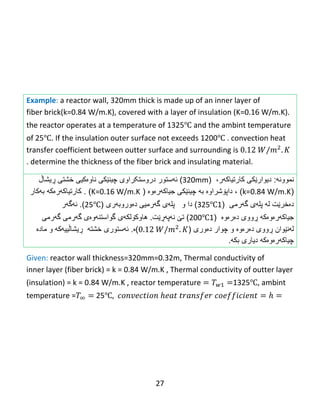
Example: Calculate theheat transfer by convection over a surface of (1.5 )
area if the surface is at 190℃ and the fluid is at 40℃ . The Value of convection
heat transfer coefficient is . Also Estimate the temperature
change with plate thickness if thermal conductivity of the plate is
نموونه:گه گواستنهوەیرمىبکه ههژماربهههڵگرتنلهسهرڕووێكىڕووبهر(1.5)ئهگهر
ڕوەكهله(190℃)وشلهكهله(40℃)بێت.نرخیهاوكۆلكهكهىههڵگرتن گهرمى گواستنهوە
()بێت.ههروەهاگۆڕانىپلهىگهرمىبخهمڵنهلهگهڵئهستورییىپلێتهکهئهگهر
گهرمی گهیاندنی توانایپلێتهکه()بێت.
Given: Area=A=1.5 ℃ , ℃ .
Solution:
26.
26
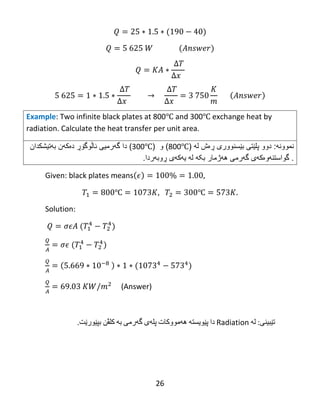
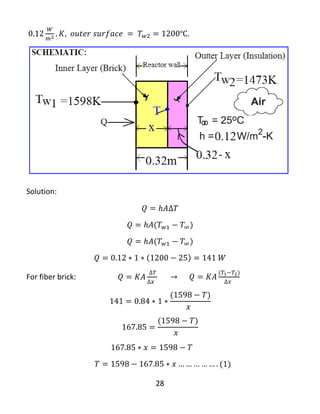
Example: Two infiniteblack plates at 800℃ and 300℃ exchange heat by
radiation. Calculate the heat transfer per unit area.
نموونه:دووپلێتىبێسنووریڕەشله(800℃)و(300℃)داگهرمیىئاڵوگۆڕدەکهنبهتیشكدان
.گواستنهوەكهىگهرمىبکه ههژمارڕوبهردا یهكهی له.
Given: black plates means
℃ ℃
Solution:
(Answer)
تێبینی:لهRadiationداپێویستهههمووكاتپلهیگهرمیبهكلڤنبپێورێت.
27.
27
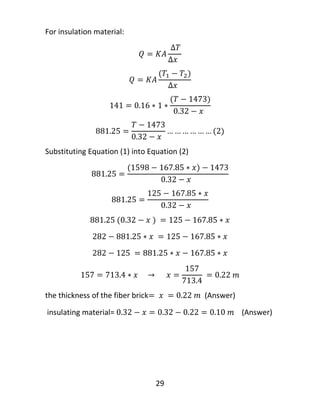
Example: a reactorwall, 320mm thick is made up of an inner layer of
fiber brick(k=0.84 W/m.K), covered with a layer of insulation (K=0.16 W/m.K).
the reactor operates at a temperature of 1325℃ and the ambint temperature
of 25℃. If the insulation outer surface not exceeds 1200℃ . convection heat
transfer coefficient between outter surface and surrounding is
. determine the thickness of the fiber brick and insulating material.
نموونه:دیوارێكىكارتیاكه،ر(320mm)ئهستوردروستکراویچینێكىناوەكیىخشتیڕیشاڵ
(k=0.84 W/m.K)،داپۆشراوەبهچینێكىجیاكهرەوە(K=0.16 W/m.K. )كارتیاكهرەكهبهكار
دەخرێتلهپلهىگهرمی(1325℃)داودەوروبهر گهرمیى پلهىی(25℃).ئهگهر
جیاكهرەوەكهڕووىدەرەوە(1200℃)تێنهپهڕێت.هاوكۆلكهىگهرمی گواستنهوەیگهرمى
لهنێوانڕووىدەرەوەوچواردەوری()ە.ئهستوریخشتهڕیشاڵمادە و ییهکه
چیاکهرەوەکهدیارىبكه.
Given: reactor wall thickness=320mm=0.32m, Thermal conductivity of
inner layer (fiber brick) = k = 0.84 W/m.K , Thermal conductivity of outter layer
(insulation) = k = 0.84 W/m.K , reactor temperature 1325℃, ambint
temperature = 25℃
32
Whyareboilersplacedbeneathhotwatertanksinpeople’shomes?
Hot water rises.Sowhen the boiler heats the water, and the hot water
rises, the water tank is filled with hot water.
بۆچىدانراون کوڵێنهرەکانتانك لهژێریخهڵك؟ ماڵى له گهرم ئاوى
گهرم ئاوىبهرزدەبێت.هوەکهواتهكاتێكکوڵێنهرەکهگهرم ئاوەكهدەکاتئاو و ،ەگهرمهکه
بهرزدەبێتئاو تانكى ،هوەەکهپڕله دەبێتگهرم ئاوى.
Radiation questions پرسیارىتیشكدان
Why are houses painted white in hot countries?
White reflects heat radiation and keeps the house cooler.
واڵت له بۆچىهگهرم،هکانداخانوەکانبۆیاخیسپىدەکرێن؟
سپىتیشكداندەهێڵنهوە ساردتر خانووەكه و دەدەنهوە ڕەنگ گهرمى ى
Why are shiny foil blankets wrapped around marathon runners at the
end of a race?
The shiny metal reflects the heat radiation from the runner back in,
this stops the runner getting cold..
پهت بۆچىۆیبریقهدار كانزاى چینىدەپێچله رێتدەوریكۆتاییى له ماراسۆن ڕاكهرىپێشبڕکێدا؟
بریقهدار كانزاىتیشكدانله دەداتهوە ڕەنگ گهرمى ىپشتیڕاكهرەكهوەئهمه ،وەستانی شڕاكهرەکه
د ڕا ساردەگرێت.
33.
33
1. Which ofthe following is not a method of heat transfer?
A. Radiation B. Insulation C. Conduction
Answer : B
1.كاملهمانهڕێگهیێكىگهرمى گواستنهوەینیه؟
A.تیشكدانBدابڕین .Cگهیاندن .
:وەاڵمB
2. In which of the following are the particles closest together?
A. Solid B. Liquid C. Gas D. Fluid
Answer : A
2.لهكاملهمانهداتهنۆچكهكهنزیكترینپێكهوەیه؟
A.ڕەقBشله .Cگاز .D.شلگاز
:وەاڵمA
3. How does heat energy reach the Earth from the Sun?
A. Radiation B. Conduction C. Convection D. Insulation
Answer : A
3.چۆنوزەىگهرمىدەگاتزەوىلهخۆرەوە؟
A.تیشكدانBگهیاندن .Cڕاگوێزان .Dدابڕین .
:وەاڵمA
4. Which is the best surface for reflecting heat radiation?
A. Shiny white B. Dull white C. Shiny black D. Dull black
34.
34
Answer : A
4.كامهباشترینڕووەبۆڕەنگدانهوەتیشكدانىگهرمى؟
A.سپىبریقهدار. Bتهڵخ سپى. Cبریقهدار ڕەشیD.تهڵخ ڕەشی
.وەاڵمى:تهڵخ ڕەشی
5. Which is the best surface for absorbing heat radiation?
A. Shiny white B. Dull white C. Shiny black D. Dull black
Answer : A
5.كامهباشترینڕووەبۆمژێنتیشكدانىگهرمى؟
A.سپى بریقهدار. Bتهڵخ سپى. Cبریقهدار ڕەشیD.تهڵخ ڕەشی
وەاڵمى:تهڵخ ڕەشی
35.
35
Chapter 2
STEADY STATECONDUCTION - ONE DIMENSION
بهش2
گهیاندن جێگیری حاڵهتی-ڕەههند یهك
Temperature in a system remains constant with time. Temperature
varies with location.
پلهىگهرمىلهسیستهمێكبهنهگۆڕیدەمێنێتهوەتێپهڕبونی بهكات.لهگهڵ دەگۆڕێت گهرمى پلهى
شوێن.
36.
36
Thermal Diffusivity andits Significance پهرشبونهوەیگهرمىوبایهخى
Thermal diffusivity is a physical property of the material, and is the ratio of the
material's ability to transport energy to its capacity to store energy. It is an
essential parameter for transient processes of heat flow and defines the rate
of change in temperature. In general, metallic solids have higher Thermal
diffusivity, while nonmetallics, like paraffin, have a lower value of Thermal
diffusivity. Materials having large Thermal diffusivity respond quickly to
changes in their thermal environment, while materials having lower a respond
very slowly, take a longer time to reach a new Equilibrium condition.
پهرشبونهوەیگهرمىفیزیای سیفهتیو ،ماددەكهیهله بریتیه ەماددە تواناى ڕێژەىکهبهرامبهر
بگواستتهوەیتوانا بۆ وزەکهىبۆکردنی پاشهکهوتكردارى بۆ گرنگه هۆكارێكى ئهوە .وزە
تێپهڕاندنهکانیگهرمى ڕۆیشتنىوپێناسهکردنیگهرمى پلهى له گۆڕان ڕێژەىدا،بهگشتى .كانزا
ڕەقهکانپهرشبونهوەیگهرمى()بهرزیان،ههیهلهكاتێکداناکانزاکان،پارافین وەك ،
پهرشبونهوەیگهرمىنزمتریانههی.هئهومادکه انهیپهرشبونهوەیگهرمىبهرزیانههیهوەاڵمی ،
ئهو لهکاتێکدا ،گهرمیاندا کهشی له گۆڕانکاریهکان بۆ ههیه خێرایانمادکه انهیپهرشبونهوەیگهرمى
یان نزمههیهحاڵهتێکی به گهیشتن بۆ دەخایهنێت زیاتر کاتێکی ،ههیه وەاڵمیان هێواشی به زۆر ،
.تازە هاوسهنگی
1. Several plane Walls together (Thermal resistance).
2. Heat generation.
3. Types of fin.
چهنددیوارتهخت ێکیپێكهوە(بهرگریىگهرمی. )
گهرمى پهیدابونی.
.پهڕەكه جۆرى.
37.
37
Several plane Wallstogether (Thermal resistance).
A plane wall is considered to be made out of a constant thermal
conductivity material and extends to infinity in the Y- and Z- direction.
The wall is assumed to be homogeneous and isotropic, heat flow is
one - dimensional
چهنددیوارتهخت ێکیپێكهوە(بهرگریىگهرمی. )
تهخت دیوارێكىدادەنبكر تا رێتێتهگهیهنهری مادەیهکیتوانانهگۆڕیوەدرێژینا بۆ بكاتهوە
كۆتایىبهئاڕاستهی(Y-)( و(Z-ن دا وا دیوارەكه .راوەبه ببێتو چونیهكهئایزۆترۆپیک،
گهرم ڕۆیشتنى.ڕەههندیه یهک ی
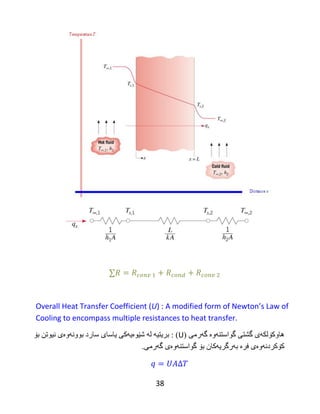
Thermal Resistances and Thermal Circuits: ثەًرگريگەًرهیوضىوڕەکبًیگەًرهی:
From page 43 in the Data book:
الپهڕەوە له٣٤زانیارى كتێبهكهى له:
Conduction in a plane wall:
Convection:
Consider a plane wall is between two fluids of different temperature:
وايذاثٌێتەخت ًديىارێكلەًێىاىدووغلەيپلەگەًرهیجیبوازدايە
38.
38
Overall Heat TransferCoefficient (U) :AmodifiedformofNewton’sLawof
Cooling to encompass multiple resistances to heat transfer.
هبوكۆلكەيگػتیٌگىاضتەوەگەرهی(U):لە ثريتیەغێىەيەکیيبضبيضبردًثىوەوەیًیىتيثۆ
فرە کۆکردًەوەیثەرگريەکبىگەرهی گىاضتٌەوەی ثۆ.
39.
39
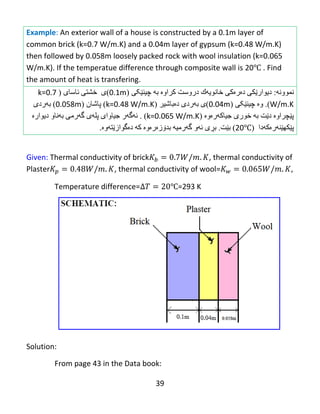
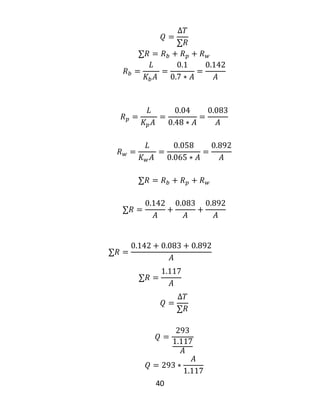
Example: An exteriorwall of a house is constructed by a 0.1m layer of
common brick (k=0.7 W/m.K) and a 0.04m layer of gypsum (k=0.48 W/m.K)
then followed by 0.058m loosely packed rock with wool insulation (k=0.065
W/m.K). If the temperatue difference through composite wall is 20℃ . Find
the amount of heat is transfering.
ًًوىوە:ديىارێًكدەرەکیخبًىيەكدروضتكراوەثەٌچیێکی(0.1m)یخػتیئبضبی(k=0.7
W/m.K).وەٌچیێکی(0.04m)یثەرديدەثبغیر(k=0.48 W/m.K)پبغبى(0.058m)ثەردي
ثە دێت پێچراوەخىريجیبکەرەوە(k=0.065 W/m.K. )ئەگەرجیبوايپلەيگەًرهثەًبوديىارە
پێكهێٌەرەكەدا(20℃)ثێت.ثڕيئەوگەرهیەثذۆزەرەوەکەدەگىازێتەوە.
Given: Thermal conductivity of brick , thermal conductivity of
Plaster , thermal conductivity of wool= ,
Temperature difference= ℃=293 K
Solution:
From page 43 in the Data book:
41
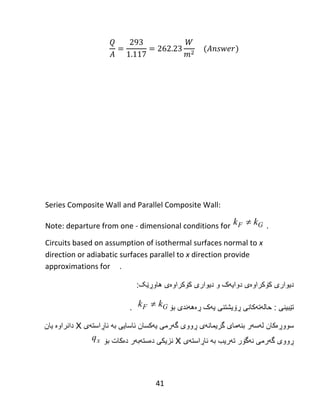
Series Composite Walland Parallel Composite Wall:
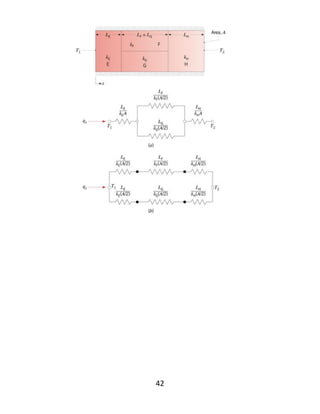
Note: departure from one - dimensional conditions for .
Circuits based on assumption of isothermal surfaces normal to x
direction or adiabatic surfaces parallel to x direction provide
approximations for .
دیوارىکۆکراوەیدوایهکودیوارىکۆکراوەیهاوڕێک:
تێبینى:حالهتهکانیڕۆیشتنىڕەههندی یهکبۆ.
سووڕەکانئاسایى یهكسان گهرمى ڕووى گریمانهى بنهماى لهسهربهئاڕاستهىXدانراوەیان
تهریب نهگۆر گهرمى ڕووىبهئاڕاستهىXبۆ دەكات دەستهبهر نزیكى
F Gk k
F Gk k
xq
43
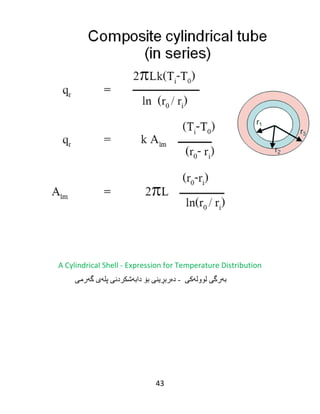
A Cylindrical Shell- Expression for Temperature Distribution
ثەرگیلىولەًك-دەرثڕيٌیثۆداثەًًغكردپلەيگەًره
44.
44
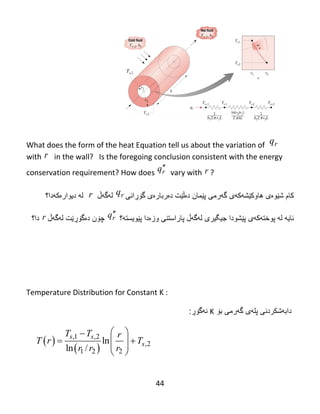
What does theform of the heat Equation tell us about the variation of
with in the wall? Is the foregoing conclusion consistent with the energy
conservation requirement? How does vary with ?
کامشێوەىهاوكێشهكهىگهرمىپێماندەڵێتدەربارەىگۆڕانیلهگهڵدیوارەکهدا؟ له
پێشودا پوختهکهی له ئایهجیگیریلهگهڵوزە پاراستنیداپێویسته؟چۆنلهگهڵ دەگۆڕێتدا؟
Temperature Distribution for Constant K :
بۆ گهرمى پلهى دابهشكردنىKنهگۆڕ:
rq
r
rq r
rqr
rqr
,1 ,2
,2
1 2 2
ln
ln /
s s
s
T T r
T r T
r r r
45.
45
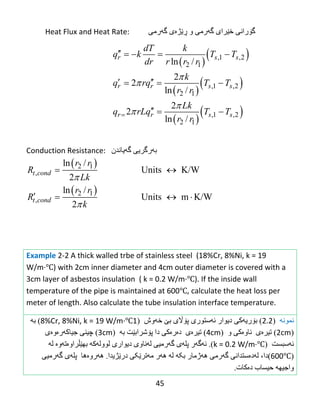
Heat Flux andHeat Rate: گۆًًراخێرايگەًرهوڕێژەيگەًره
Conduction Resistance: ثەًرگريگەيبًذى
Example 2-2 A thick walled trbe of stainless steel (18%Cr, 8%Ni, k = 19
W/m·℃) with 2cm inner diameter and 4cm outer diameter is covered with a
3cm layer of asbestos insulation ( k = 0.2 W/m·℃). If the inside wall
temperature of the pipe is maintained at 600℃, calculate the heat loss per
meter of length. Also calculate the tube insulation interface temperature.
نمونه(2.2)ثۆريئەضتىری ديىار ەکیپۆاڵيثێخەوظ(18%Cr, 8%Ni, k = 19 W/m·℃)ثە
(2cm)تیرەيًبوەًكو(4cm)دەرەکی تیرەيداپۆغراثێتثە(3cm)ًٌچیجیبكەرەوەي
ئەضجطت(k = 0.2 W/m·℃).ئەگەرپلەيگەًرهیلەًبويديىاريلىولەكەثهێڵراوەتەوەلە
(600℃)دا،لەدەًًضتذاگەًرهثکە هەژهبردرێژيذا هەترێکی هەر لە.هەروەهبپلەيگەًرهی
واجیهەحیطبةدەكبت.
2 1
,
2 1
,
ln /
Units K/W
2
ln /
Units m K/W
2
t cond
t cond
r r
R
Lk
r r
R
k
,1 ,2
2 1
,1 ,2
2 1
,1 ,2
2 1
ln /
2
2
ln /
2
2
ln /
r s s
r r s s
r r s s
dT k
q k T T
dr r r r
k
q rq T T
r r
Lk
q rLq T T
r r
46.
46
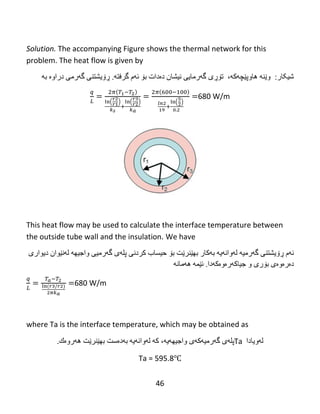
Solution. The accompanyingFigure shows the thermal network for this
problem. The heat flow is given by
:غیکبر،هبوپێچەکە وێٌەتۆڕيگەًرهبيًیػبىدەداتثۆئەمگرفتە.ڕۆًٌيػتگەًرهدراوەثە
( ) ( ) ( )
680 W/m
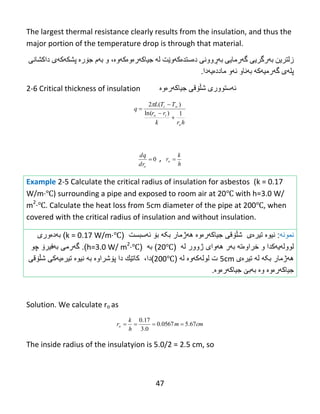
This heat flow may be used to calculate the interface temperature between
the outside tube wall and the insulation. We have
ئەمڕۆًٌيػتگەرهیەلەًواەيەثەكبرثهێٌرێتثۆحیطبةکردًیپلەيگەًرهیواجیهەلەًێىاىديىاري
دەرەوەيثۆريوجیبكەرەوەكەدا.ئێوەهەهبًە
680 W/m
where Ta is the interface temperature, which may be obtained as
لەويبداTaپلەيگەرهیەكەيواجیهەيە،كەلەًواەيەثەدەضتثهێٌرێتهەروەك.
Ta = 595.8℃
47.
47
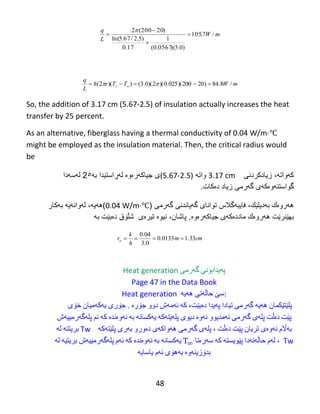
The largest thermalresistance clearly results from the insulation, and thus the
major portion of the temperature drop is through that material.
زلترييثەًرگريگەًرهبيثەڕًًوودەضتذەکەوێتلەجیبكەرەوەكەوە،وثەمجۆرەپػكەكەيداکػبًی
پلەيگەرهیەكەثەًبوئەوهبددەيەدا.
2-6 Critical thickness of insulation ئەضتىوریغڵۆقیجیبكەرەوە
hrk
rr
TTL
q
o
io
i
1)ln(
)(2
0
odr
dq
,
h
k
ro
Example 2-5 Calculate the critical radius of insulation for asbestos (k = 0.17
W/m·℃) surrounding a pipe and exposed to room air at 20℃ with h=3.0 W/
m2
·℃. Calculate the heat loss from 5cm diameter of the pipe at 200℃, when
covered with the critical radius of insulation and without insulation.
نمونه:نیوەتیرەىشڵۆقیجیاكهرەوەبکه ههژماربۆئهسبست(k = 0.17 W/m·℃)بهدەوری
لوولهیهکداوخراوەتهبهرههوایژوورله(20℃)به(h=3.0 W/ m2
·℃).گهرمىچو بهفیرۆ
بکه ههژمارلهتیرەی5cmله لولهکهوە ت(200℃)دا،كاتێكداپۆشراوەبهنیوەتیرەشڵۆقی یهکی
جیاكهرەوەوەبهبێجیاكهرەوە.
Solution. We calculate ro as
cmm
h
k
ro 67.50567.0
0.3
17.0
The inside radius of the insulatyion is 5.0/2 = 2.5 cm, so
48.
48
mW
L
q
/7.105
)0.3)(0567.0(
1
17.0
)5.2/67.5ln(
)20200(2
mWTTrh
L
q
oi /8.84)20200)(025.0)(2)(0.3())(2(
So, the addition of 3.17 cm (5.67-2.5) of insulation actually increases the heat
transfer by 25 percent.
As an alternative, fiberglass having a thermal conductivity of 0.04 W/m·℃
might be employed as the insulation material. Then, the critical radius would
be
کهواته،زیادکردنی3.17 cmواته(5.67-2.5)ىجیاكهرەوەلهڕاستیدابه2٥لهسهدا
گواستنهوەكهىگهرمىدەکات زیاد.
فایبهگالس ،بهدیلێك ههروەك( گهرمی گهیاندنی توانای0.04 W/m·℃)ههیه،لهوانهیهبهكار
بهێنرێتههروەكماددەكهىجیاكهرەوە.،پاشاننیوەتیرەىشڵۆقدەبێتبه
cmm
h
k
ro 33.10133.0
0.3
04.0
Heat generation پهیدابونیگهرمی
Page 47 in the Data Book
Heat generation سێحاڵهتیههیه :
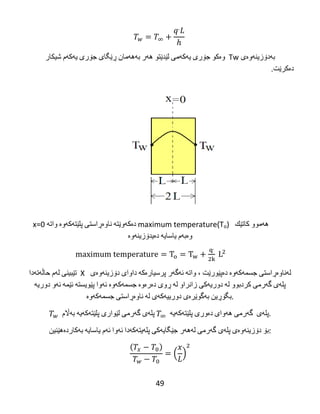
پلێتێكمانههیهگهرمیتیاداپهیداده،بێتكهئهمهشدووجۆره.جۆرییهكهمیانخۆی
پێتدهڵتپلهیگهرمیئهمدیووئهوهدیویپلهیتهكهیهكسانهبهئهوهندهكهئمپلهگهرمییهش
بریتتهله Tw بهاڵمئهوهیتریانپێتدهڵت،پلهیگهرمیههواكهیدهوروبهریپلێتهكه
یهكسانهبهئهوهندهكهئهمپلهگهرمییهشبریتیهله ،لهمحاڵهتهداپێویستهكهسهرهتا Tw
بدۆزینهوهبههۆیئهمیاسایه
50
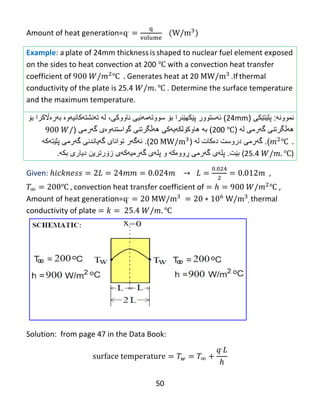
Amount of heatgeneration=
Example: a plate of 24mm thickness is shaped to nuclear fuel element exposed
on the sides to heat convection at 200 ℃ with a convection heat transfer
coefficient of ℃ Generates heat at 20 .If thermal
conductivity of the plate is 25.4 ℃ . Determine the surface temperature
and the maximum temperature.
نموونه:پلێتێكی(24mm)ئهستوورپێكهبۆ ێنراسووتهمهنیىناووكى،بهرەاڵکرا تهنشتهکانیهوە لهبۆ
گهرمی ههڵگرتنیله(200 ℃)بههاوكۆلكهیهكىگهرمى گواستنهوەى ههڵگرتنی(
℃).گهرمىدروستدەكاتله(20).ئهگهرگهرمی گهیاندنی توانایپلێتهکه
(25.4 ℃)بێت.پلهىگهرمیڕووو ەکهپلهىگهرمیهكهىزۆدیارى رترینبكه.
Given: ,
℃ convection heat transfer coefficient of ℃ ,
Amount of heat generation= , thermal
conductivity of plate ℃
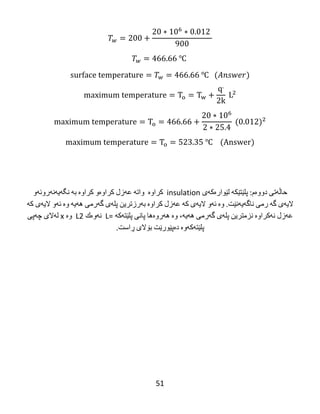
Solution: from page 47 in the Data Book:
53
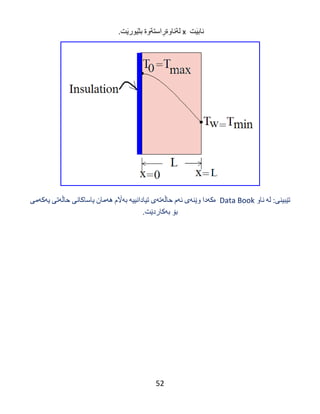
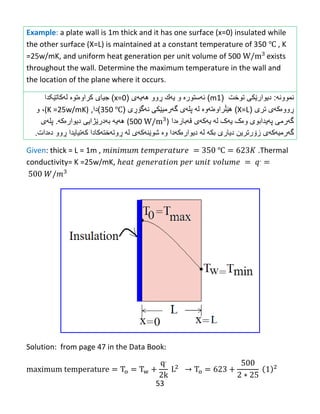
Example: a platewall is 1m thick and it has one surface (x=0) insulated while
the other surface (X=L) is maintained at a constant temperature of 350 ℃ , K
=25w/mK, and uniform heat generation per unit volume of 500 exists
throughout the wall. Determine the maximum temperature in the wall and
the location of the plane where it occurs.
نموونه:دیوارێكىتوخت(1m)ئهستورەویهكڕووههیهى(x=0)جیاىكراوەتوەلهكاتێکدا
ڕووتری ەکهی(X=L)هێڵراوەتهوەلهپلهىگهرمیێكىنهگۆڕى(350 ℃)دا,(K =25w/mK)،و
گهرمیقهبارەدا یهکهی له یهک وەک پهیدابوی(500 )ههیهبهدرێژایىدیوارەكه.پلهى
گهرمیهكهىزۆرتریندیارىبكهلهدیوارەكهداوەشوێنهكهىڕوتهختهکادا لهکهتیایداڕوودەدات.
Given: thick = L = 1m , ℃ .Thermal
conductivity= K =25w/mK,
Solution: from page 47 in the Data Book:
54.
54
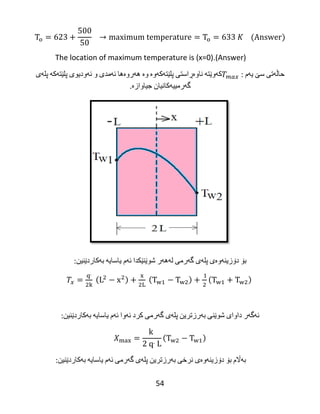
The location ofmaximum temperature is (x=0).(Answer)
حاڵهتیسێیهم:كهوێتهناوهڕاستیپلێتهكهوهوهههروههائهمدیوئهودیویپلێتهكهپلهی
گهرمییهكانیانجیاوازه.
بۆدۆزینهوهیپلهیگهرمیلهههرشوێنێكدائهمیاسایهبهكاردێنین:
ئهگهرداوایشوێنیبهرزترینپلهیگهرمیكردئهوائهمیاسایهبهكاردێنین:
بهاڵمبۆدۆزینهوهینرخیبهرزترینپلهیگهرمیئهمیاسایهبهكاردێنین:
55.
55
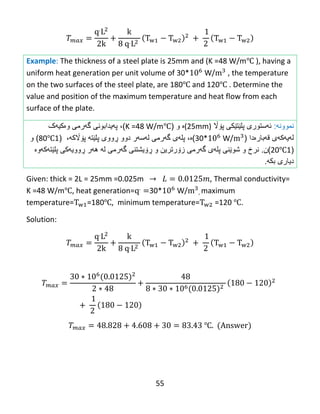
Example: The thicknessof a steel plate is 25mm and (K =48 W/m℃ ), having a
uniform heat generation per unit volume of 30* W/ , the temperature
on the two surfaces of the steel plate, are 180℃ and 120℃ . Determine the
value and position of the maximum temperature and heat flow from each
surface of the plate.
نموونه:ئهستوریپلێتێكىپۆاڵ(25mm)ەو(K =48 W/m℃)،وەکیهک گهرمی پهیدابونی
قهبارەدا لهیهکهی(30* W/)ە،پلهىگهرمیلهسهردووڕووىپلێتهپۆاڵکه،(180℃)و
(120℃.)ننرخوشوێنىپلهىگهرمیزۆرترینوڕۆیشتنىگهرمىلهههرڕوویهکیپلێتهکهوە
دیارىبكه.
Given: thick = 2L = 25mm =0.025m , Thermal conductivity=
K =48 W/m℃, heat generation= 30* W/ , maximum
temperature= =180℃, minimum temperature= =120 ℃.
Solution:
℃
56.
56
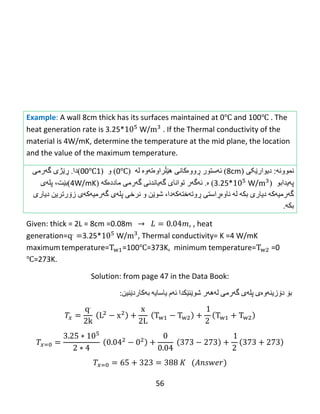
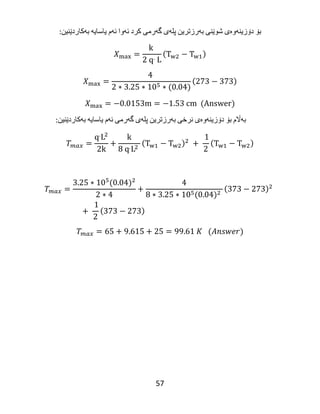
Example: A wall8cm thick has its surfaces maintained at 0℃ and 100℃ . The
heat generation rate is 3.25* W/ . If the Thermal conductivity of the
material is 4W/mK, determine the temperature at the mid plane, the location
and the value of the maximum temperature.
ًًوىوە:ديىارێکی(8cm)ئەضتىرڕووەکبًیهێڵراوەتەوەلە(0℃)و(100℃)دا.ڕێژیگەًره
پەيذاثى(3.25* W/)ە.ئەگەرگەرهی گەيبًذًی تىاًبیهبددەكە(4W/mK)ثێت،پلەي
گەرهیەكەديبريثكەلەڕوتەختەکەدا ًبوەڕاضتی،ًرخی و غىێيپلەيگەرهیەكەيزۆرترييديبري
ثكە.
Given: thick = 2L = 8cm =0.08m , , heat
generation= 3.25* W/ , Thermal conductivity= K =4 W/mK
maximum temperature= =100℃=373K, minimum temperature= =0
℃=273K.
Solution: from page 47 in the Data Book:
بۆدۆزینهوهیپلهیگهرمیلهههرشوێنێكدائهمیاسایهبهكاردێنین:
58
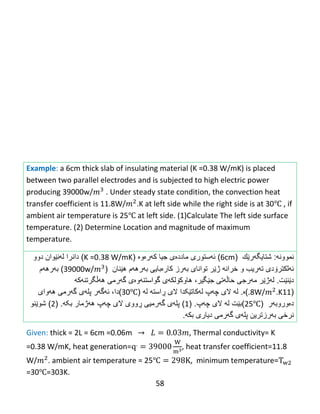
Example: a 6cmthick slab of insulating material (K =0.38 W/mK) is placed
between two parallel electrodes and is subjected to high electric power
producing 39000w/ . Under steady state condition, the convection heat
transfer coefficient is 11.8W/ .K at left side while the right side is at 30℃ , if
ambient air temperature is 25℃ at left side. (1)Calculate The left side surface
temperature. (2) Determine Location and magnitude of maximum
temperature.
نموونه:شتایگهرێك(6cm)ئهستورىكهرەوە جیا ماددەی(K =0.38 W/mK)دانرالهنێواندوو
ئهلكترۆدىتهریبوژێر خرانهتواناىبهرزكارەبایىبهرههمهێنان(39000w/)بهرههم
دێنێت.لهژێرمهرجیجێگیر حاڵهتی،هاوكۆلكهیههڵگرتنهکه گهرمی گواستنهوەی
(11.8W/ .K)ە.لهالىچهپلهكاتێکداالیڕاستهله(30℃)دا،ئهگهرههواى گهرمى پلهى
دەوروبهر(25℃)بێتلهالىچهپ( .1)پلهىگهرمیىڕوویالىچهپبکه ههژمار( .2)شوێنو
گهرمی پلهی بهرزترین نرخیدیارىبكه.
Given: thick = 2L = 6cm =0.06m , Thermal conductivity= K
=0.38 W/mK, heat generation= , heat transfer coefficient=11.8
W/ . ambient air temperature = 25℃ , minimum temperature=
=30℃=303K.
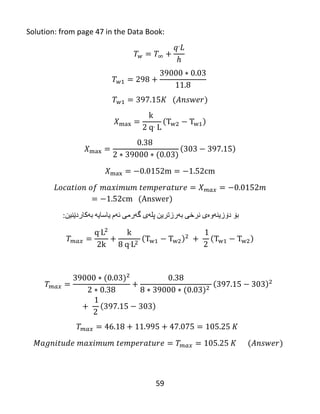
59.
59
Solution: from page47 in the Data Book:
بۆدۆزینهوهینرخیبهرزترینپلهیگهرمیئهمیاسایهبهكاردێنین:
60.
60
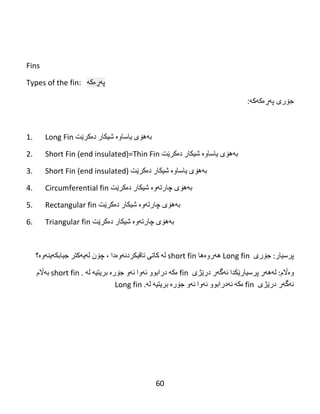
Fins
Types of thefin: پهڕەكه
پهڕەكهكه جۆرى:
1. Long Fin بههۆییاساوهشیكاردهكرێت
2. Short Fin (end insulated)=Thin Fin بههۆییاساوهشیكاردهكرێت
3. Short Fin (end insulated) بههۆییاساوهشیكاردهكرێت
4. Circumferential fin بههۆیچارتهوهشیكاردهكرێت
5. Rectangular fin بههۆیچارتهوهشیكاردهكرێت
6. Triangular fin بههۆیچارتهوهشیكاردهكرێت
پرسیار:جۆریLong finههروههاshort finلهكاتیتاقیكردنهوهدا،چۆنلهیهكترجیابكهینهوه؟
وهاڵم:لهههرپرسیارێكدائهگهردرێژیfinهكهدرابووئهوائهوجۆرهبریتیهلهshort fin .بهاڵم
ئهگهردرێژیfinهكهنهدرابووئهوائهوجۆرهبریتیهلهLong fin .
61.
61
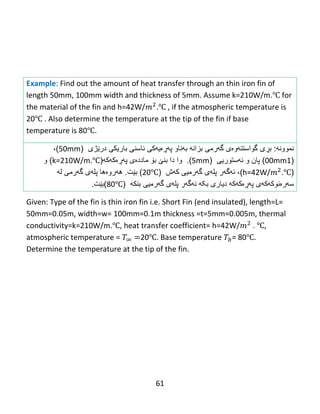
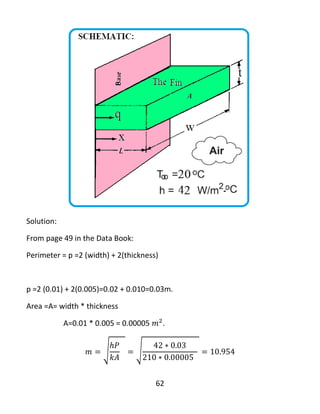
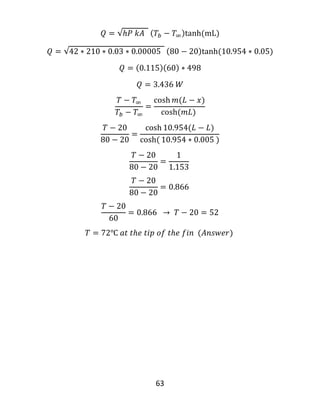
Example: Find outthe amount of heat transfer through an thin iron fin of
length 50mm, 100mm width and thickness of 5mm. Assume k=210W/m.℃ for
the material of the fin and h=42W/ .℃ , if the atmospheric temperature is
20℃ . Also determine the temperature at the tip of the fin if base
temperature is 80℃.
نموونه:بڕىگواستنهوەیگهرمىبزانهبهناوپهڕەیهئاسنى كىباریكیدرێژى(50mm)،
(100mm)پانوئهستوریى(5mm).وادابنێبۆماددەىپهڕەكهكه(k=210W/m.℃)و
(h=42W/ .℃)،ئهگهرکهش گهرمیى پلهى(20℃)بێت.ههروەهاپلهىگهرمیله
سهرەنوكهكهىپهڕەكهكهدیارىبکهئهگهرپلهىگهرمیىبنكه(80℃)بێت.
Given: Type of the fin is thin iron fin i.e. Short Fin (end insulated), length=L=
50mm=0.05m, width=w= 100mm=0.1m thickness =t=5mm=0.005m, thermal
conductivity=k=210W/m.℃, heat transfer coefficient= h=42W/ . ℃,
atmospheric temperature = 20℃. Base temperature = 80℃.
Determine the temperature at the tip of the fin.
62.
62
Solution:
From page 49in the Data Book:
Perimeter = p =2 (width) + 2(thickness)
p =2 (0.01) + 2(0.005)=0.02 + 0.010=0.03m.
Area =A= width * thickness
A=0.01 * 0.005 = 0.00005 .
√ √
64
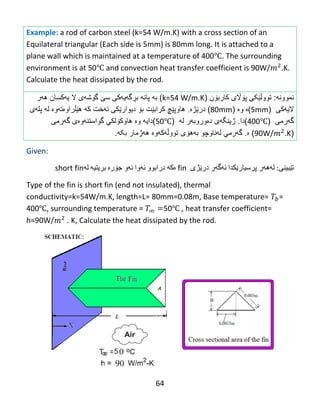
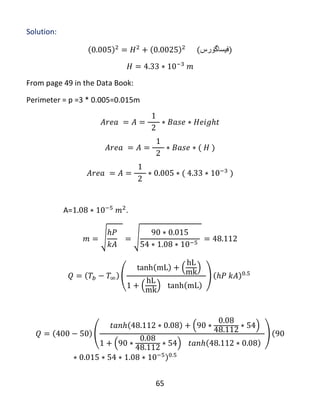
Example: a rodof carbon steel (k=54 W/m.K) with a cross section of an
Equilateral triangular (Each side is 5mm) is 80mm long. It is attached to a
plane wall which is maintained at a temperature of 400℃. The surrounding
environment is at 50℃ and convection heat transfer coefficient is 90W/ .K.
Calculate the heat dissipated by the rod.
نموونه:تووڵێکیپۆاڵیكاربۆن(k=54 W/m.K)بهبڕگه پانهیهکیسێگۆشهیالیهكسانههر
الیهکی(5mm)وە ە(80mm)درێژە.هاوپێچكرابێتبۆدیوارێكتهخت یكههێڵراوەتهوەلهپلهى
گهرمى(400℃)دا.دەوروبهر ژینگهیله(50℃)دایهوەهاوكۆلكيگهرمی گواستنهوەی
(90W/ .K)ە.گهرميلهناوچوبههۆیتووڵهكهوەبکه ههژمار.
Given:
تێبینی:لهههرپرسیارێكدائهگهردرێژیfinهكهدرابووئهوائهوجۆرهبریتیهلهshort fin
Type of the fin is short fin (end not insulated), thermal
conductivity=k=54W/m.K, length=L= 80mm=0.08m, Base temperature= =
400℃, surrounding temperature = 50℃ , heat transfer coefficient=
h=90W/ . K, Calculate the heat dissipated by the rod.
66
( )
( )
()
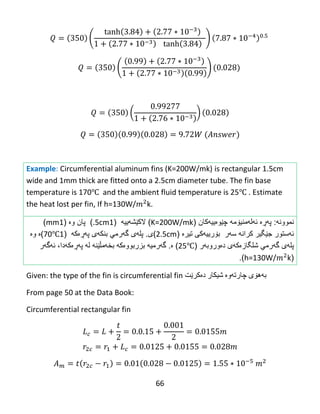
Example: Circumferential aluminum fins (K=200W/mk) is rectangular 1.5cm
wide and 1mm thick are fitted onto a 2.5cm diameter tube. The fin base
temperature is 170℃ and the ambient fluid temperature is 25℃ . Estimate
the heat lost per fin, If h=130W/ k.
نموونه:پهڕەئهلهمنیۆمچێوەییهکان ه(K=200W/mk)الكێشهییه(1.5cm)وە پان(1mm)
ئهستورکران جێگیرسهر هتیرە بۆرییهکی(2.5cm)ی.پلهىگهرميبنكهیپهڕەكه(170℃)ەوە
پلهىگهرميشلگازەکهیدەوروبهر(25℃)ە.گهرمیهبزربووب ەکهخهمڵێنهلهپهڕەكهدا،ئهگهر
(h=130W/ k).
Given: the type of the fin is circumferential fin بههۆیچارتهوهشیكاردهكرێت
From page 50 at the Data Book:
Circumferential rectangular fin
67.
67
( ) ()
X-axisئیصقاتدهكهینبۆسهرcurve number 2هكهلهكویاداcurveهكهیبڕیئهوائهو
خاڵهئیصقاتدهكهینبۆسهرY-axisوهfin efficiencyدهدۆزینهوهكهدهكاته85%
η
η
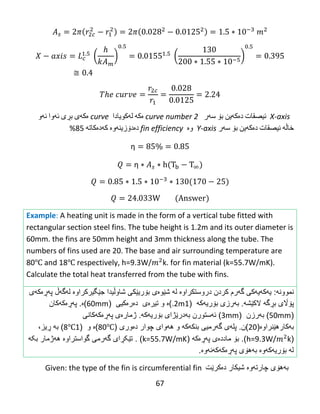
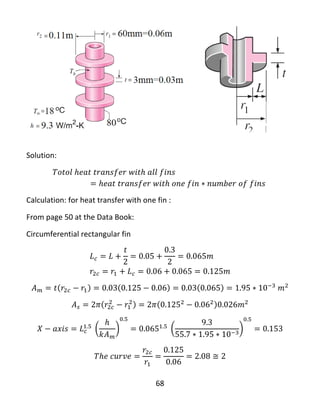
Example: A heating unit is made in the form of a vertical tube fitted with
rectangular section steel fins. The tube height is 1.2m and its outer diameter is
60mm. the fins are 50mm height and 3mm thickness along the tube. The
numbers of fins used are 20. The base and air surrounding temperature are
80℃ and 18℃ respectively, h=9.3W/ k. for fin material (k=55.7W/mK).
Calculate the total heat transferred from the tube with fins.
نموونه:یهكهیهکیگهرمكردندروستكراوەلهشێوەىبۆریێكىشاوڵیداجێگیرکراوەلهگهڵپهڕەكهى
پۆاڵالکێشه بڕگه ی.بهرزیبۆریهکه(1.2m)ەودەرەکی تیرەىى(60mm)ە.پهڕەكهکان
(50mm)بهرزن(3mm)ئهستورنبهدرێژایبۆریهکه.ژمارەىپهڕەكهکانی
بهكار(هێنراوە20)ن.پلهىگهبنك رمیىهكهوههوایچواردەوری(80℃)ەو(18℃)بهڕ،یز
(h=9.3W/ k).بۆماددەىپهڕەكه(k=55.7W/mK. )گواستراوە گهرمی تێکڕایبکه ههژمار
.پهڕەکهکهنهوە بههۆی بۆریهکهوە له
Given: the type of the fin is circumferential fin بههۆیچارتهوهشیكاردهكرێت
69
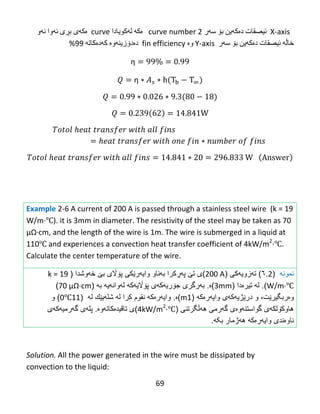
X-axisئیصقاتدهكهینبۆسهرcurve number 2هكهلهكویاداcurveهكهیبڕیئهوائهو
خاڵهئیصقاتدهكهینبۆسهرY-axisوهfinefficiencyدهدۆزینهوهكهدهكاته99%
η
η
Example 2-6 A current of 200 A is passed through a stainless steel wire (k = 19
W/m·℃). it is 3mm in diameter. The resistivity of the steel may be taken as 70
μΩ·cm,andthelengthofthewireis1m. The wire is submerged in a liquid at
110℃ and experiences a convection heat transfer coefficient of 4kW/m2
·℃.
Calculate the center temperature of the wire.
نمونه(2.٦)تهزویهکی(200 A)یتێپهڕکرابهناووایهرێكىخهوشدا بێ پۆاڵی(k = 19
W/m·℃).لهتیرە( دا3mm)ە.بهرگرىجۆریهكهىپۆاڵیهكهلهوانهیهبه(76μΩ·cm)
وەربگیرێت،ودرێژیهكهىوایهرەكه(1m)ە.وایهرەكهنقومكرالهشلهیێكله(110℃)و
هاوكۆلكهىهه گهرمی گواستنهوەیڵگرتنی(4kW/m2
·℃)تاقیدەکاتهوە ی.پلهىگهرمیهكهى
ناوەندىوایهرەكهبکه ههژمار.
Solution. All the power generated in the wire must be dissipated by
convection to the liquid:
70.
70
هەهىوتىاًبپەيذاثى یلەوايەرەكەدادەثێتلەًبوثجرێتثەثەهۆی هەڵگرتيغلەكەوە
P= I2
R = q = hA(Tw-T∞)
The resistance of the wire is calculated from
ثەرگريوايەرەكەحیطبةلە کراوە
099.0
)15.0(
)100)(1070(
2
6
A
L
R
whereρistheresistivityofthewire.ThesurfaceareaofthewireisπdL,so
from Equation
لهویادا(ρ)بهرگرىجۆرىوایهرەكهیه.ڕووبهرىڕووىوایهرەكه(πdL)ە،له کهواته
هاوکێشهکهوە
WTw 3960)110)(1)(103(4000)099.0()200( 32
and Tw = 215℃ (419℉)
The heat generated per unit volume
q is calculated from
گەرهیەپەيذاثىوەکەقەثبرەدا لەيەکەی(
q)حیطبةكراوەلە
LrqVqP 2
so that
3
23
/2.560
)1()105.1(
3960
mMWq
(5.41*107
Btu/h·ft3
)
6.231215
)19)(4(
)105.1)(10602.5(
4
2382
w
o
o T
k
rq
T ℃
71.
71
Chapter 3
ثەظ٣
Steady stateconduction – multiple dimension
گهیاندن جێگیری حاڵهتی-ڕەههند فرە
Nodal Equation
پرسیار:پله چۆنیگهرمیخاڵكدهدۆزینهوهبههۆیپلهیگهرمیخاڵهكانیدهوروبهرییهوه؟
وهاڵم:بههۆیnodal Equationهوههاوكێشهیهكبۆخاڵهكهدروستدهكهینوپلهیگهرمی
خاڵهكهیپێدهدۆزینهوه.
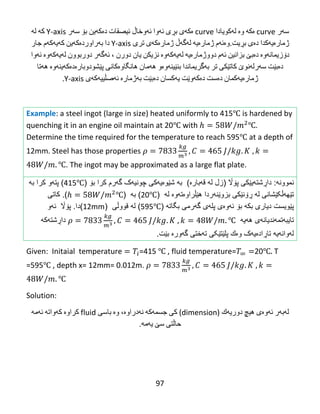
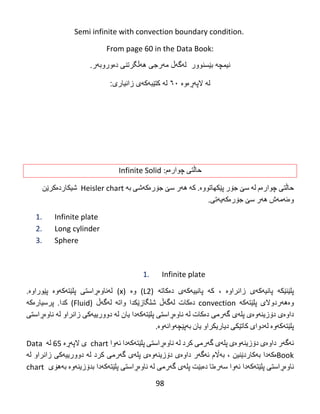
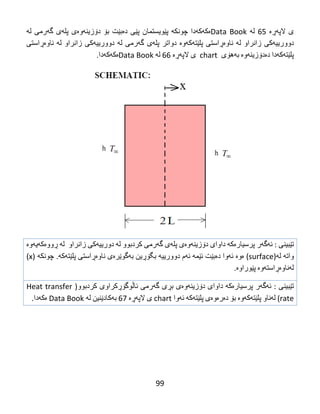
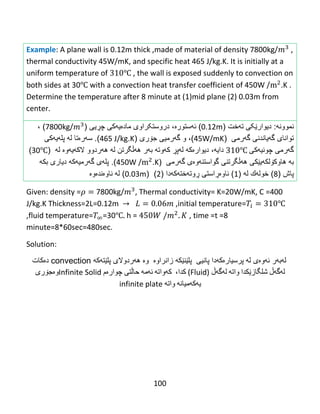
چۆنیهتیدروستكردنیnodal Equation
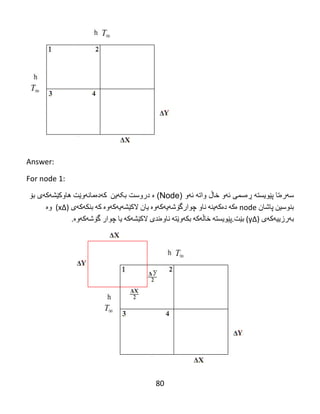
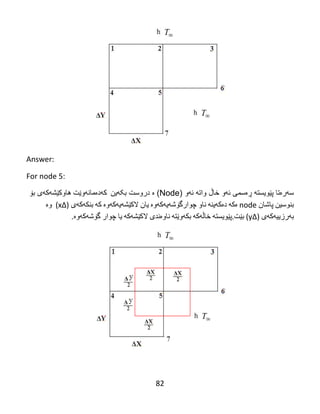
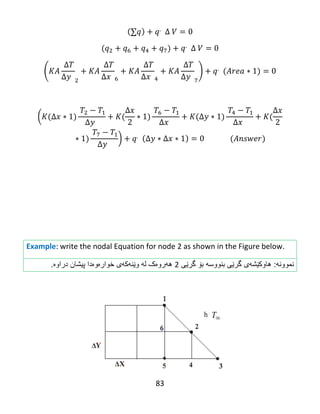
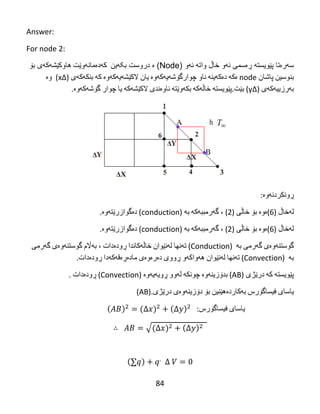
سهرهپێویسته تاڕهئه سمیواته خاڵ وئه( وNodeه )بکهین دروستكهدهمانهوێتهاوكێشهكهبۆ ی
بنوسینپاشانnodeهكهدهكهینهناوچوارگۆشهیهكهوهیانالكێشهیهكهوهكهبنكهكهی)∆x(وه
بهرزییهكهی)∆y(بێت.پێویستهخاڵهكهبكهوێتهناوهندیالكێشهكهیاچوارگۆشهكهوه.
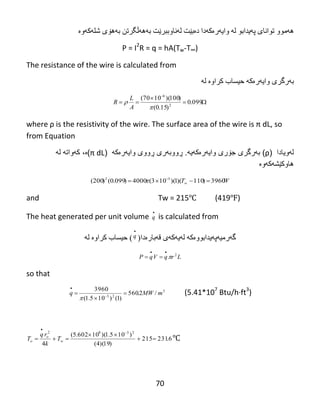
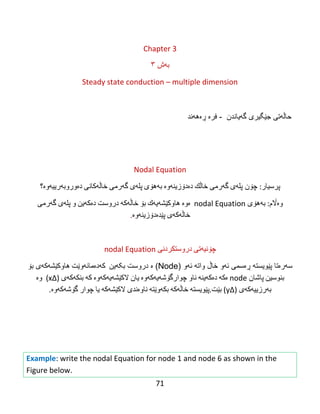
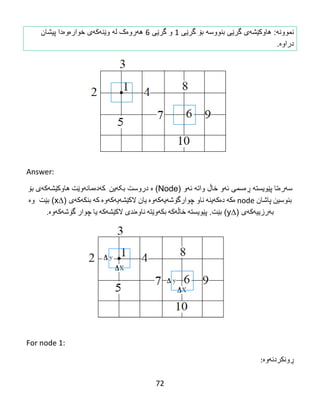
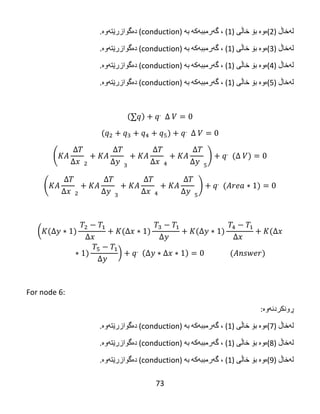
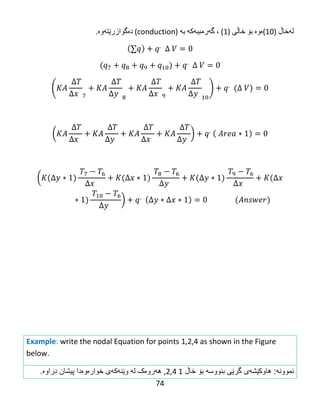
Example: write the nodal Equation for node 1 and node 6 as shown in the
Figure below.
89
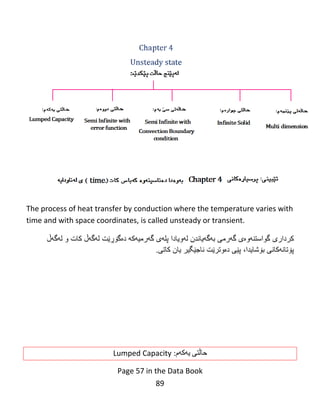
The process ofheat transfer by conduction where the temperature varies with
time and with space coordinates, is called unsteady or transient.
كردارىبهگهیاندن گهرمى گواستنهوەیلهویادالهگهڵ و كات لهگهڵ دەگۆڕێت گهرمیهكه پلهى
پۆتانهکانیبۆشایدا،کاتی یان ناجێگیر دەوترێت پێی.
حاڵتییهكهم:Lumped Capacity
Page 57 in the Data Book
91
junction surface andthe gas is With the junction properties are
K=20W/mK,
نموونه:گهرمی دوانهیهکی،کهگۆییه شێوە تاڕادەیهک،بهكاردەهێنرێتبۆپێوانىپلهىگهرمىله
گازێكدا.(h)لهنێوانڕووەكهىوگازەكهدا()ە.لهگهڵتایبهتمهندیهكهىسهرى
دوورێکهدا(K=20W/mK)،
and density 8500kg/ .If thermocouple junction
diameter assumed to be 0.7mm, how long will it take for the junction to reach
199℃ , If junction temperature is at 25℃ and placed in a gas steam that is at
200℃
Given: h = , Thermal conductivity= K=20W/mK,
, density =𝜌 8500kg/ junction diameter = 0.7mm
, , Initaial temperature =25℃ , fluid
temperature= =20℃
Solution:
لهبهرئهوهیباسیشوێنینهكردووكهواتهئهمهحاڵتییهكهمهLumped Capacity
From page 57 in the Data Book:
[
𝜌
]
93
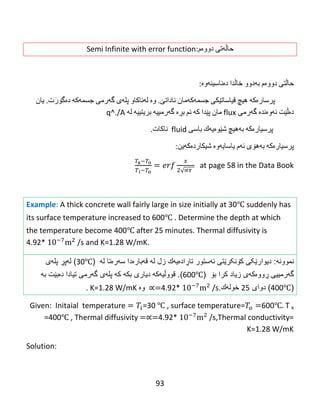
حاڵهتیدووهم:Semi Infinite witherror function
حاڵتیدووهمبهدووخاڵدادهناسینهوه:
پرسارهكههیچقیاساتێكیجسمهكهمانناداتێ.وهلهناكاوپلهیگهرمیجسمهكهدهتَگۆر.یان
دهڵێتئهوهندهگهرمیfluxمانپێداكهئمبڕهگهرمییهبریتییهلهq^./A
پرسیارهكهبههیچشێوهیهكباسیfluidناكات.
پرسیارهكهبههۆیئهمیاسایهوهشیكاردهكهین:
√
at page 58 in the Data Book
Example: A thick concrete wall fairly large in size initially at 30℃ suddenly has
its surface temperature increased to 600℃ . Determine the depth at which
the temperature become 400℃ after 25 minutes. Thermal diffusivity is
4.92* /s and K=1.28 W/mK.
نموونه:دیوارکۆنکرێتی ێکیئهستورتاڕادەیهكزللهقهبارەداسهرەتاله(30℃)لهپڕپلهى
گهرمییىڕووەکهیزیادکرابۆ(600℃).قووڵیهكهدیارىبكهكهپلهىگهرمبه دەبێت تیادا ی
(400℃)دوای25خولهك.4.92* /sوەK=1.28 W/mK.
Given: Initaial temperature =30 ℃ , surface temperature= 600℃ T x
=400℃ , Thermal diffusivity 4.92* /s,Thermal conductivity=
K=1.28 W/mK
Solution:
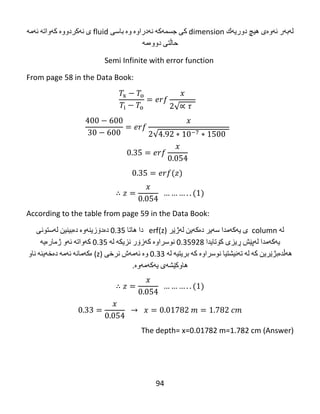
94.
94
لهبهرئهوهیهیچدوریهكdimensionكیجسمهكهنهدراوهوهباسیfluidینهكردووهكهواتهئهمه
حاڵتیدووهمه
Semi Infinite witherror function
From page 58 in the Data Book:
√
√
According to the table from page 59 in the Data Book:
لهcolumnییهكهمداسهیردهكهینلهژێرerf(z)داهاتا6.35دهدۆزینهوهدهبینینلهستونی
یهكهمدالهپێشڕیزیكۆتایدا6.35928نوسراوهكهزۆرنزیكهله6.35كهواتهئهوژمارهیه
ههڵدهبژێرینكهلهتهنیشتیانوسراوهكهبریتیهله6.33وهئهمهشنرخی)z(هكهمانهئهمهدهخهینهناو
هاوكێشهییهكهمهوه.
The depth= x=0.01782 m=1.782 cm (Answer)
100
Example: A planewall is 0.12m thick ,made of material of density 7800kg/ ,
thermal conductivity 45W/mK, and specific heat 465 J/kg.K. It is initially at a
uniform temperature of ℃ , the wall is exposed suddenly to convection on
both sides at 30℃ with a convection heat transfer coefficient of 450W / .K .
Determine the temperature after 8 minute at (1)mid plane (2) 0.03m from
center.
نموونه:تهخت دیوارێکی(0.12m)ئهستورە،چڕیی مادەیهکی دروستکراوی(7800kg/)،
گهرمی گهیاندنی توانای(45W/mK)،وگهرمیىجۆری(465 J/kg.K).سهرەتالهپلهیهکی
چونیهک گهرمیی℃دایه،دیوارەكهلهپڕكهوتهبهرههڵگرتنلهههردووالل کهیهوەه(30℃)
بههاوكۆلكهیێكىگهرمى گواستنهوەى ههڵگرتنی(450W / .K).پلهىگهرمیهكهدیارىبكه
پاش(8)خولهكله(1)ڕوتهختهکهدا ناوەڕاستی(2)(0.03m)لهناوەندەوە
Given: density =𝜌 7800kg/ , Thermal conductivity= K=20W/mK, C =400
J/kg.K Thickness=2L=0.12m ,initial temperature= ℃
,fluid temperature= =30℃ h = , time =t =8
minute=8*60sec=480sec.
Solution:
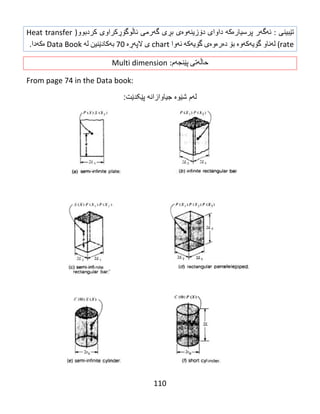
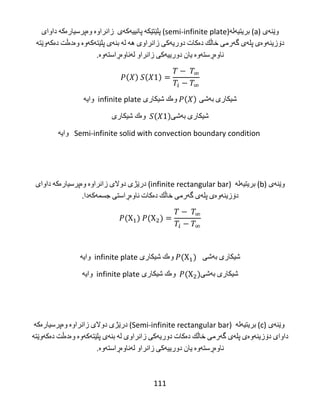
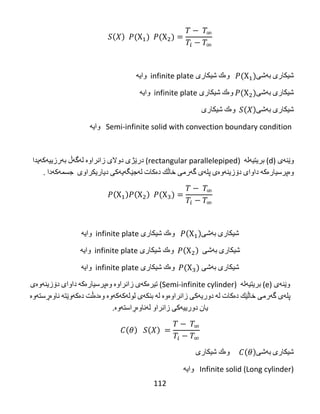
لهبهئه روهپلێنێكه پانیی پرسیارەکهدا له یزانراوهوهههپلێته ردوالیكهconvectionدهكات
لهگهڵشلگازێكداواتهلهگهڵ)Fluid(،كداكهواتهئهمهحاڵتیچوارهمInfinite Solidوهجۆری
یهكهمیانهواتهinfinite plate
101.
101
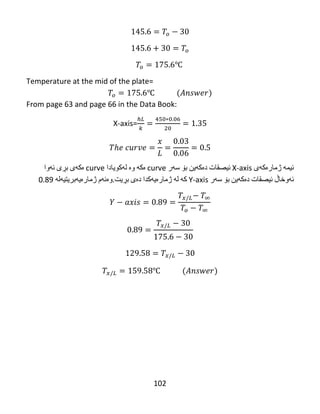
From page 63and page 65 in the Data Book:
𝜌
X-axis=
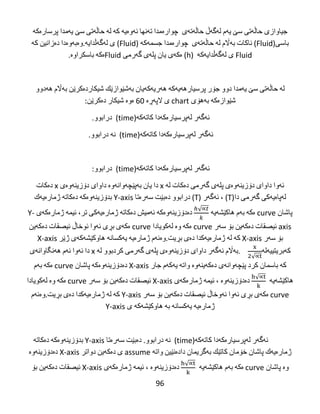
ئیمهژمارهكهیX-axisئیصقاتدهكهینبۆسهرcurveهكهوهلهكویاداcurveهكهیبڕیئهوا
ئهوخاڵئیصقاتدهكهینبۆسهرY-axisكهلهژمارهیهكدادهیبڕیت.وهئهمژمارهیهبریتیهله6.52
102.
102
℃
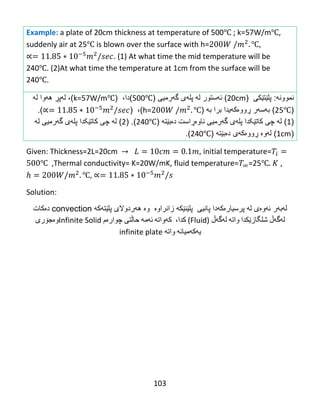
Temperature at themid of the plate=
℃
From page 63 and page 66 in the Data Book:
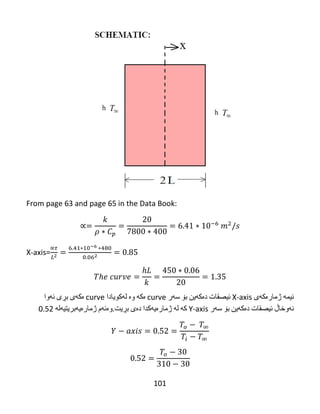
X-axis=
ئیمهژمارهكهیX-axisئیصقاتدهكهینبۆسهرcurveهكهوهلهكویاداcurveهكهیبڕیئهوا
ئهوخاڵئیصقاتدهكهینبۆسهرY-axisكهلهژمارهیهكدادهیبڕیت.وهئهمژمارهیهبریتیهله6.89
℃
103.
103
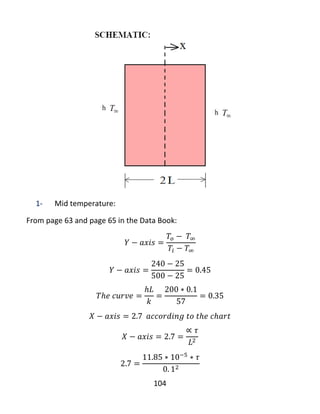
Example: a plateof 20cm thickness at temperature of 500℃ ; k=57W/m℃,
suddenly air at 25℃ is blown over the surface with h= ℃,
. (1) At what time the mid temperature will be
240℃. (2)At what time the temperature at 1cm from the surface will be
240℃.
نموونه:پلێتێكى(20cm)ئهستورلهپلهىگهرمیى(500℃)،دا(k=57W/m℃)،لهپڕههواله
(25℃)بهسهرڕووەكهبرا یدابه(h= ℃)،().
(1)لهچىكاتێکداپلهىگهرمیىناوەڕاستدەبێته(240℃)( .2)لهچىكاتێکداپلهىگهرمیىله
(1cm)لهوەڕووەكهیدەبێته(240℃).
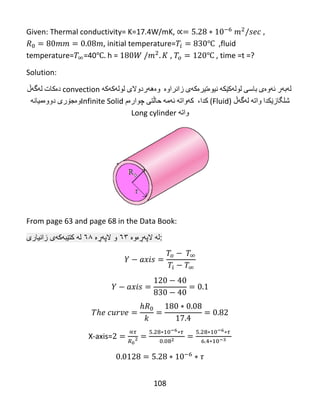
Given: Thickness=2L=20cm , initial temperature=
℃ ,Thermal conductivity= K=20W/mK, fluid temperature= =25℃ ,
℃,
Solution:
لهبهئه روهپلێنێكه پانیی پرسیارەکهدا له یزانراوهوهههپلێته ردوالیكهconvectionدهكات
لهگهڵشلگازێكداواتهلهگهڵ)Fluid(،كداكهواتهئهمهحاڵتیچوارهمInfinite Solidوهجۆری
یهكهمیانهواتهinfinite plate
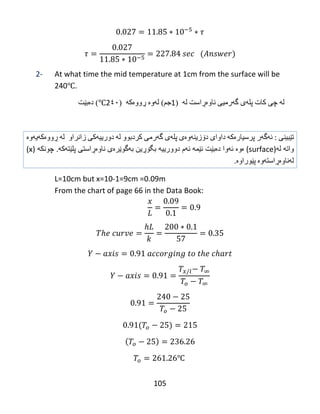
105
2- At whattime the mid temperature at 1cm from the surface will be
240℃.
لەًچكبتپلەيگەًرهیًبوەڕاضتلە(1جن)لەوەڕووەكە(2٤٠℃)دەثێت
تێبینی:ئهگهرپرسیارهكهداوایدۆزینهوهیپلهیگهرمیكردبوولهدورییهكیزانراولهڕووهكهیهوه
واتهله)surface(هوهئهوادهبێتئێمهئهمدوورییهبگۆڕینبهگوێرهیناوهڕاستیپلێتهكه.چونكه)x(
لهناوهڕاستهوهپێوراوه.
L=10cm but x=10-1=9cm =0.09m
From the chart of page 66 in the Data Book:
℃
106.
106
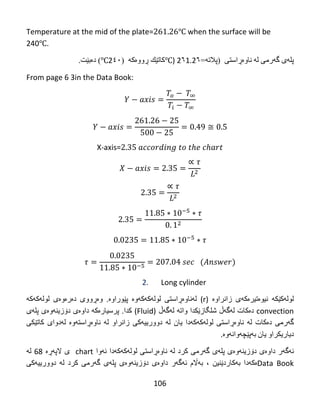
Temperature at themid of the plate= ℃ when the surface will be
240℃.
پلەيگەًرهلەًبوەڕًاضت(پالتە=2٦1.2٦℃)كبتێكڕووەكە(2٤٠℃)دەثێت.
From page 6 3in the Data Book:
X-axis=
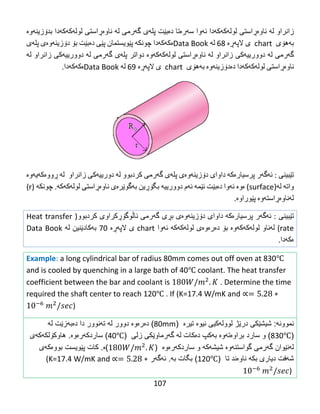
2. Long cylinder
لولهكێكهنیوهتیرهكهیزانراوه)r (لهناوهڕاستیلولهكهكهوهپێوراوه .وهڕوویدهرهوهیلولهكهكه
convectionدهكاتلهگهڵشلگازێكداواتهلهگهڵ)Fluid(كدا.پرسیارهكهداوهیدۆزینهوهیپلهی
گهرمیدهكاتلهناوهڕاستیلولهكهكهدایانلهدوورییهكیزانراولهناوهڕاستهوهلهدوایكاتێكی
دیاریكراویانبهپێچهوانهوه.
ئهگهرداوهیدۆزینهوهیپلهیگهرمیكردلهناوهڕاستیلولهكهكهدائهواchartیالپهڕه68له
Data Bookهكهدابهكاردێنین،بهاڵمئهگهرداوهیدۆزینهوهیپلهیگهرمیكردلهدوورییهكی
113
شیكاریبهشیوهكشیكاری
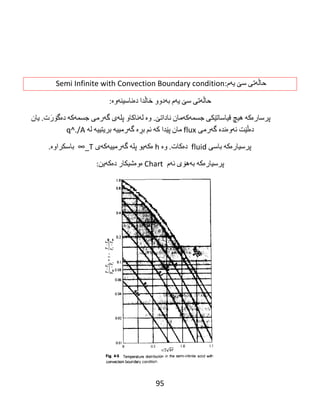
Semi-infinite solid withconvection boundary conditionوایه
وێنهی)f(بریتیهله)short cylinder(تیرهكهیزانراوهلهگهڵدرێژییهكهیداوهپرسیارهكهداوای
دۆزینهوهیپلهیگهرمیخاڵكدهكاتدوریهكیزانراویلهبنهیلولهكهكهوهوهدهڵتدهكهوێته
ناوهڕستهوهیاندورییهكیزانراولهناوهڕاستهوه.
شیكاریبهشیوهكشیكاری
Infinite solid (Long cylinder)وایه
شیكاریبهشیوهكشیكاریinfinite plateوایه.
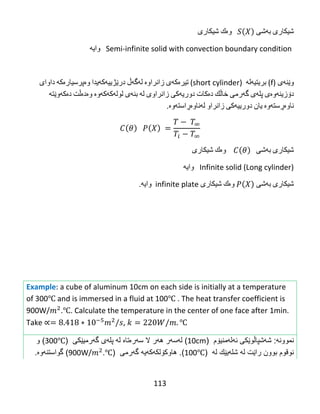
Example: a cube of aluminum 10cm on each side is initially at a temperature
of 300℃ and is immersed in a fluid at 100℃ . The heat transfer coefficient is
900W/ .℃. Calculate the temperature in the center of one face after 1min.
Take , ℃
نموونه:شهشپاڵوێكىئهلهمنیۆم(10cm)لهسهرههرالسهرەتاەلهپلهىگهرمیێكى(300℃)و
نوقومبوونراێتلهشلهیێكله(100℃).هاوكۆلكهكهیهگهرمى(900W/ .℃)گواستنهوە.
115
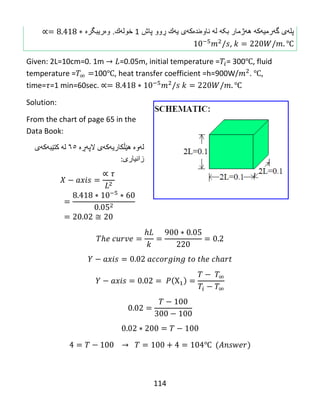
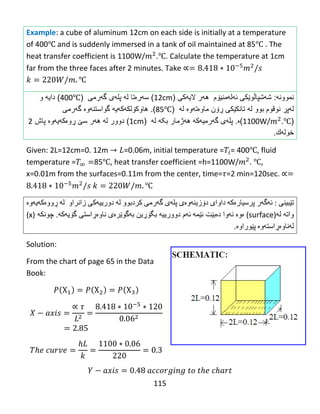
Example: a cubeof aluminum 12cm on each side is initially at a temperature
of 400℃ and is suddenly immersed in a tank of oil maintained at 85℃ . The
heat transfer coefficient is 1100W/ .℃. Calculate the temperature at 1cm
far from the three faces after 2 minutes. Take
℃
نموونه:شهشپاڵوێكىئهلهمنیۆمالیهکی ههر(12cm)سهرەتالهپلهىگهرمی(400℃)دایهو
لهپڕنوقومبوولهتانكێكىڕۆنماوەتهوەله(85℃).هاوكۆلكهكهیهگواستنهوەگهرمى
(1100W/ .℃)ە.پلهىگهرمیهكهبکه ههژمارله(1cm)دوورلهههرسێڕوەکهیهوەپاش2
خولهك.
Given: 2L=12cm=0. 12m =0.06m, initial temperature = = 400℃, fluid
temperature = 85℃, heat transfer coefficient =h=1100W/ . ℃,
x=0.01m from the surfaces=0.11m from the center, time= =2 min=120sec.
℃
تێبینی:ئهگهرپرسیارهكهداوایدۆزینهوهیپلهیگهرمیكردبوولهدورییهكیزانراولهڕووهكهیهوه
واتهله)surface(هوهئهوادهبێتئێمهئهمدوورییهبگۆڕینبهگوێرهیناوهڕاستیگۆیهكه.چونكه)x(
لهناوهڕاستهوهپێوراوه.
Solution:
From the chart of page 65 in the Data
Book:
116.
116
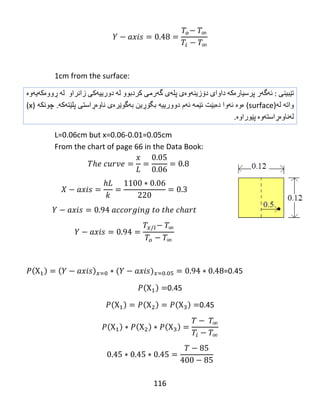
1cm from thesurface:
تێبینی:ئهگهرپرسیارهكهداوایدۆزینهوهیپلهیگهرمیكردبوولهدورییهكیزانراولهڕووهكهیهوه
واتهله)surface(هوهئهوادهبێتئێمهئهمدوورییهبگۆڕینبهگوێرهیناوهڕاستیپلێتهكه.چونكه)x(
لهناوهڕاستهوهپێوراوه.
L=0.06cm but x=0.06-0.01=0.05cm
From the chart of page 66 in the Data Book:
=0.45
0.45
0.45
118
and a motionof the fluid. The process of heat transfer by convection would
occur when there is a movement of macro-particles of the fluid in space from
a region of higher temperature to lower temperature.
گواستنهوەىگهرمىبهڕاگوێزاننێوانهڕو به پێویستی(ڕەق-شلگاز)،جیاوازیێكىپلهى
گهرمىلهنێوانڕووەپتهووەكهوشلگازەکهیچواردەوریوەجوڵهىشلگازەكهدەبێت.پێڤاژۆی
گواستنهوەیگهرمىبهههڵگرتنڕوودەداتكاتێكجوڵهىوردەکان تهنۆلکهىشلهكهلهبۆشایدا
ههبێتلهناوچهیهکیپلهىگهرمىبۆ بهرزترەوەپلهىگهرمىنزمتر.
Convection Heat Transfer Mechanism ًهیكبًیسهگەرهی گىاضتٌەوەیهەڵگرتي
Let us imagine a heated solid surface, say a plane wall at a temperature
Tw placed in an atmosphere at temperature T , Figure 2.1 Since all real fluids
are viscous, the fluid particles adjacent to the solid surface will stick to the
surface. The fluid particle at A, which is at a lower temperature, will receive
heat energy from the plate by conduction.
گەرهکراو ڕەقی ڕويەکی خۆهبى چبوی پێع ثیهێٌیٌە ئێوە ثب،ثڵێتەخت ًديىارێكلەپلەي
گەًرهTwداداًرالەكەغێكذالەپلەيگەًرهT،وێٌەی( .2.1)لەثەرئەوەیهەهىوغلگبزە
ڕاضتەٌقیەکبى،لیٌجيغلگبزەکە ًًتەًۆچكەكبثۆ دەثي هبوضێڕووەپتەوەکەوثەڕ دەًىضێيووەكەوە.
غلگبزەکە ًًتەًۆچكەكبلەAدا،كەلەپلەيگەًسهتر ًرهدايە،وزەيگەًرهوەرثگرێت
لەپلێتەکەوەثەگەيبًذى.
The internal energy of the particle would Increase and when the
particle moves away from the solid surface (wall or plate) and collides with
119.
119
another fluid particleat B which is at the ambient temperature, it will transfer
a part of its stored energy to B. And, the temperature of the fluid particle at B
would increase. In this way, the heat energy is transferred from the heated
plate to the surrounding fluid. Therefore in the process of heat transfer by
convection involves a combined action of heat conduction, energy storage and
transfer of energy by mixing motion of fluid particles.
ًًبوەکی وزەيتەًۆچكەكەزيبددەكبت(ديىار ڕەقەکەوە ڕوە لە دەجىڵێت تەًۆلکەکە کبتێک وە
)پلێت يبىلە غلگبزەکەدادا تری تەًۆلکەيەکی ثە دەکێػێت خۆی وەBگەرهی پلەی لە کە دا
ثۆ دەگىازێتەوە خەزًکراوەکەی وزە ثەغێکی ،دەوروثەردايەBلە غلگبزەکە گەرهی پلەی وەBدا
.دەکبت زيبدغلگبزەکەی ثۆ گەرهکراوەکەوە پلێتە لە دەگىازرێتەوە گەرهی وزەی ،ڕێگەيەدا لەم
،هەڵگرتٌذا ثە گەرهی گىاضتٌەوەی پێڤبژۆی لە لەثەرئەوە .چىاردەوریگەيبًذًی کۆکراوەی کبرداری
.غلگبزەکە تەًۆلکەکبًی تێکەڵکردًی جىڵەی ثە وزە گىاضتٌەوەی و وزە خەزًکردًی ،گەرهی
Figure Principle of heat transfer by convection
وێنهیههڵگهتن به گهرمی گواستنهوەی بنهمای
Free and Forced Convection ثەهێسکراو و ضەرثەضت هەڵگرتٌی
When the mixing motion of the fluid particles is the result of the density
120.
120
difference caused bya temperature gradient, the process of heat transfer is
called natural or free convection. When the mixing motion is created by an
artificial means (by some external agent), the process of heat transfer is called
forced convection, it is essential to have knowledge of the characteristics of
fluid flow. Since the effectiveness of heat transfer by convection depends
largely on the mixing
كاتێکجوڵهىتێكهڵكردنیتهنۆچكهكانىشلبریتیهله گازاکهئهنجامیجیاوازىچڕىکه
بوەتهگرێگرێبونی هۆیپلهىگه،رمىپێڤاژۆیگهرمى گواستنهوەیسروشتی ههڵگرتنی پێیدەوترێت
یانسهربهست ههڵگرتنی.كاتێككهجوڵهیتێكهڵكردنهکهبهڕێگایێكىدەستكرد(بهههندێك
بریكارىدەرەکی)دروستدەکرێت،پێڤاژۆیگهرمى گواستنهوەیڕ پێیدەوترێتاگوێزانى
بههێزکراو،ئهوەگرنگهبۆزانینیتایبهتمهندیهكانیڕۆیشتنىشلگاز.کاریگهری لهبهرئهوە
.تێکهلکردن لهسهر بهندە بهزۆری بهههڵگرتن گهرمی گواستنهوەی
Basic Difference between Laminar and Turbulent Flow
ًجیبوازيٌثەڕەًتلەًێىاىڕۆًٌيػتڕۆيػتٌی و خػۆکغێىاو
In laminar or streamline flow, the fluid particles move in layers such
that each fluid particle follows a smooth and continuous path. There is no
macroscopic mixing of fluid particles between successive layers, untill the fluid
will turn around a comer or an obstacle is to be crossed.
لخػۆک ڕۆيػتٌی ەيبىلەهێڵەجۆگەدا ڕۆيػتٌی،غلگبزەکە ًًتەًۆچكەكبدەجىلێيثەغێىەی
121.
121
چیيچیيئەوەی وەک هەركەهەرغلگبزەکەتەًۆلکەيەکیو ثەردەوام ڕێڕەوێکی غىێٌیلىوش
ورديلەی .کەوتىەتەًۆچكغلگبزەکە ەکبًیتێكًیە ەڵجىًیبىلەًێىاىٌچیەيەكلەدواييەكەکبًذا،هەتب
ئەوكبتەيپێچذەکبتەوە غلگبزەکەضىچێکذا ثەدەوریيبىثەرثەضتێكەتبثپەڕرێتەوە.
If a line dependent fluctuating motion is observed in directions which
are parallel and transverse to the main flow, i.e., there is a random
macroscopic mixing of fluid particles across successive layers of fluid flow, the
motion of the fluid is called' turbulent flow'. The path of a fluid particle would
then be zigzag and irregular, but on a statistical basis, the overall motion of
the macro-particles would be regular and predictable.
ئەگەرهێڵێکپػتثەضتىوثەجىڵەهەڵجەزوداثەزکردىتێًٌجیثكرێتلەئبڕاضتەکبًذاكەتەريتو
ئبضۆیثۆڕۆٌيػتەضەرەكیەکەبه ههیه تێکهڵبونیان وردە شلگازەکه تهنۆلکهکانی ،واتایهکیتر به ،
،شلگازەکه رۆیشتنی چینهکانی ستونیڕێچکهی .شێواو رۆیشتنی پێیدەوترێت شلگازەکه جوڵهی
گشتگیری جوڵهی ،وەستاوەکان بنهما لهسهر بهاڵم ،دەبێت ناڕێک و زیگزاگ شلگازێک تهنۆلکهی
. دەبێت چاوەڕوانکراو و ڕێک وردەکان تهنۆلکه
Formation of a Boundary Layer دروضتًًكردٌچیێًكضٌىور
When a fluid flows over a surface, irrespective of whether the flow is
laminar or turbulent, the fluid particles adjacent to the solid surface will
always stick to it and their velocity at the solid surface will be zero, because of
the viscosity of the fluid. Due to the shearing action of one fluid layer over the
adjacent layer moving at the faster rate, there would be a velocity gradient in
a direction normal to the flow.
كبتێكدەڕوات ڕويەکذا ثەضەر غلگبزێک،ثەوەوە هەثێت پەيىەًذی ثەثێئەوەیداخىا
ڕۆٌيػتەكخػۆکە ەيبىغێىاوە،غلگبزەکە ًًتەًۆچكەكبڕ ثۆ دەثي هبوضێووەپتەوو ەکەدەًىضێي
ثەڕووەكەوە.وەخێرايییبىلەڕووەپتەوەکەدادەثێ،ضفر تثەهۆيغلگبزەکەوە لیٌجی.ثەهۆیكبري
ترازاًیيەكًٌچیغلگبزەکەثەضەرٌچیەکەیدراوشێیداخێراترە ڕێژەيەکی ثە جىڵەکەی کە،لەوێ
خێرايێکیپلەپلەدەثێتثە.رۆيػتٌەکە ثۆ ئەضتىى
122.
122
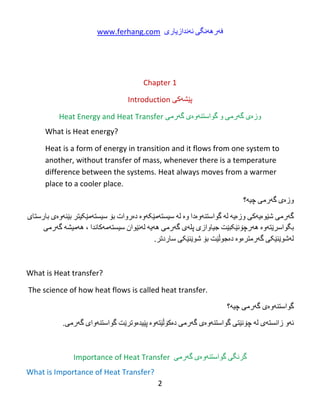
Figure 2.2: sketchof a boundary layer on a wall
هێًلكبريٌچیێًكضٌىورلەضەرديىارێك
Let us consider a two-dimensional flow of a real fluid about a solid
(slender in cross-section) as shown in Figure 2.2. Detailed investigations have
revealed that the velocity of the fluid particles at the surface of the solid is
zero. The transition from zero velocity at the surface of the solid to the free
stream velocity at some distance away from the solid surface in the V-
direction (normal to the direction of flow) takes place in a very thin layer
called 'momentum or hydrodynamic boundary layer'. The flow field can thus
be divided in two regions:
ثبڕۆ ئێوەٌيػتێكڕەهەًذی دو یغلگبزێًكڕاضتەٌقیەدادەًێیيثەًسيکیپتەو(ثبريكلە
پبًەثڕگەدا)هەروەكًًیػبذراوەلەوێٌەی(2.2).داٌپػكٌیەدرێژەپدەريبًخطتىە ێذراوەکبىكە
خ غلگبزەکە ًًتەًۆچكەكبێرايیەكەيبىضفرەلەضەرڕووەپتەوەکە.تێپەڕٌيەكەلەخێًرايضفردالەضەر
ڕووەيپتەوئبڕاضتەی ثە ەکە V ڕودەدات تەًکذا زۆر چیٌێکی لە )ڕۆيػتٌەکە ئبڕاضتەی ثۆ (ئەضتىى
.ئبوەثساوتي ضٌىری جیٌی يبى تەوژم دەوترێت پێیدەتىاًرێت ڕۆيػتٌەکە ثىاری ثەهػێىەيە
:ڕژێن دو ثۆ داثەغجکرێت
123.
123
( i) Avery thin layer in the vicinity 0, a velocity gradient normal to the
direction of flow, the velocity gradient du/dy being large. In this thin region,
even a very small Viscosity of the fluid exerts a substantial Influence and
the shearing stress du/dy may assume large values. The thickness of the
boundary layer is very small and decreases with decreasing viscosity.
( i)چینىزۆرباریكلئهستونه پلهپله خێراییهکی ،سفر هنزیکبۆئاڕاستهىڕۆیشتنهکه،خێراییهکی
پلهپلهییهکه(du/dy)زلدەبێت.لهمناوچهباریكهدا،تهنانهتلینجیزۆربچووكىشلهكه
كاریگهریێكىگرنگكۆششدەكاتوەفشاریترازان لهوانهیهوادابنێنرخى ت
زلبێت.ئهستورىچینىسنوورەکهزۆربچووكهوكهمدەکاتلهگهڵكهمبوونهوەیلینجی.
(ii) In the remaining region, no such large velocity gradients exist and
the Influence of viscosity is unimportant. The flow can be considered
frictionless and potential.
(ii)لهناوچهیمانهوەدا،خێرایيپلهپلهبویئهوهازلنیه بونیوكاریگهریهكهىلینجی
ناگرنگه.ڕۆیشتنهكهدەتوانێتوانرێتدابنێرێتبو بێلێخشان هماتوشاراوە.




![76
ڕونكردنهوه:
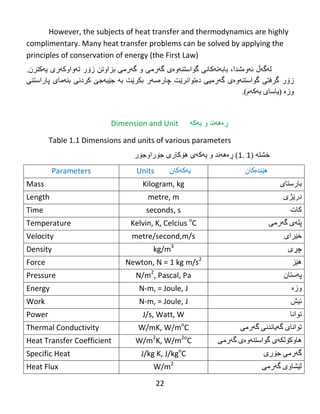
لهخاڵ)2(هوهبۆخاڵی)1(،گهرمببهكهبه(conduction)دهگوازرێتهوه.
لهخاڵ)4(هوهبۆخاڵی)1(،گهرمببهكهبه(conduction)دهگوازرێتهوه.
•گوستنهوهیگهرمیبه(Conduction)تهنهالهنێوانخاڵهكانداڕودهدات،بهاڵمگوستنهوهی
گهرمیبه(Convection)تهنهالهنێوانههواكهوڕوویدهرهوهیمادهڕهقهكهداڕودهدات.
( )
[ ( ) ( ) ( ) ]
( )](https://image.slidesharecdn.com/daga-150224043650-conversion-gate01/85/Heat-Transfer-Engineering-76-320.jpg)
![78
( )
[
] ( )
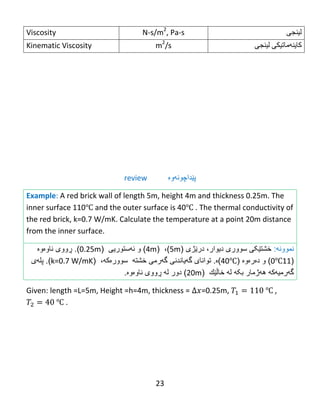
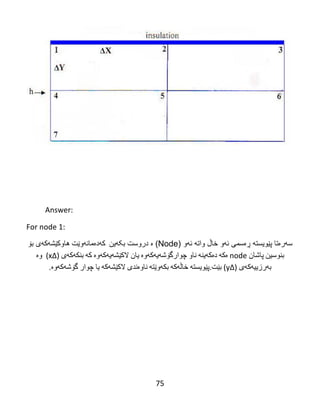
For node 4:
سهرهپێویسته تاڕهئه سمیواته خاڵ وئه( وNodeه )بکهین دروستكهدهمانهوێتهاوكێشهكهبۆ ی
بنوسینپاشانnodeهكهدهكهینهناوچوارگۆشهیهكهوهیانالكێشهیهكهوهكهبنكهكهی)∆x(وه
بهرزییهكهی)∆y(بێت.پێویستهخاڵهكهبكهوێتهناوهندیالكێشهكهیاچوارگۆشهكهوه.
ڕونكردنهوه:
لهخاڵ)1(هوهبۆخاڵی)4(،گهرمببهكهبه(conduction)دهگوازرێتهوه.
لهخاڵ)5(هوهبۆخاڵی)4(،گهرمببهكهبه(conduction)دهگوازرێتهوه.
لهخاڵ)7(هوهبۆخاڵی)4(،گهرمببهكهبه(conduction)دهگوازرێتهوه.](https://image.slidesharecdn.com/daga-150224043650-conversion-gate01/85/Heat-Transfer-Engineering-78-320.jpg)
![81
( )
[ ( ) ( ) ( )
( ) ] ( )
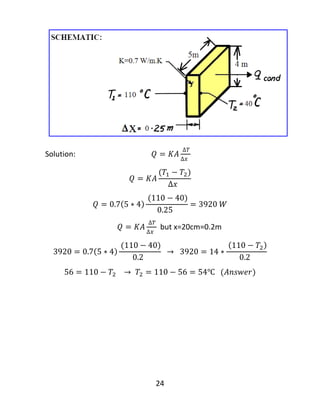
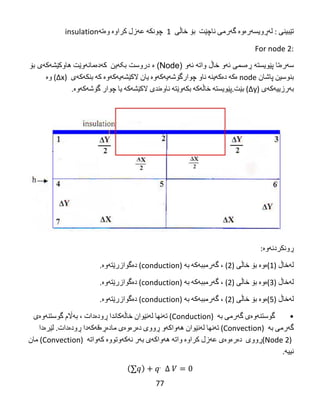
Example: write the nodal Equation for node 5 as shown in the Figure below.
نموونه:بنووسه گرێی هاوكێشهىگرێى بۆ5دراوە پیشان خوارەوەدا وێنهکهی له ههروەک.](https://image.slidesharecdn.com/daga-150224043650-conversion-gate01/85/Heat-Transfer-Engineering-81-320.jpg)
![85
( )
[ ]
( )
[ (√ )
]
( )
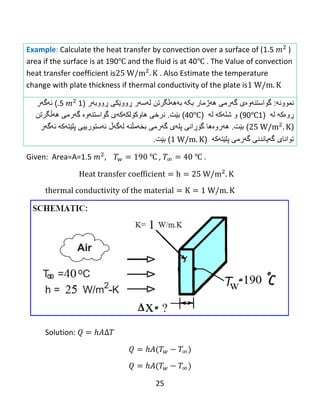
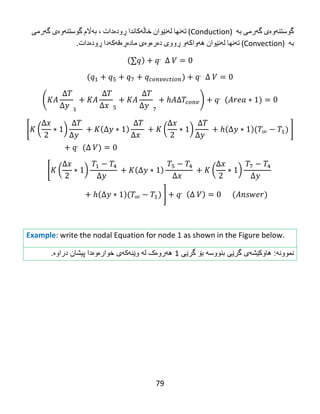
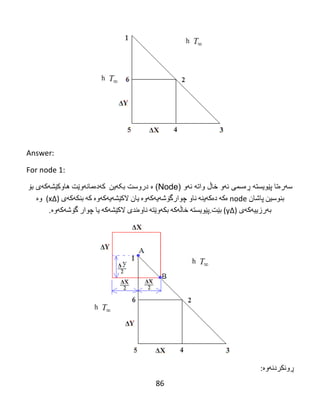
Example: write the nodal Equation for node 1 as shown in the Figure below.
نموونه:بنووسه گرێی هاوكێشهىگرێى بۆ1دراوە پیشان خوارەوەدا وێنهکهی له ههروەک.](https://image.slidesharecdn.com/daga-150224043650-conversion-gate01/85/Heat-Transfer-Engineering-85-320.jpg)
![87
لهخاڵ)6(هوهبۆخاڵی)1(،گهرمببهكهبه)conduction(دهگوازرێتهوه.
گوستنهوهیگهرمیبه)Conduction(تهنهالهنێوانخاڵهكانداڕودهدات،بهاڵمگوستنهوهیگهرمی
به)Convection(تهنهالهنێوانههواكهوڕوویدهرهوهیمادهڕهقهكهداڕودهدات.
پێویستهكهدرێژی)AB(بدۆزینهوهچونكهلهووڕویهیهوه)Convection(ڕودهدات.
یاسایفیساگۆرسبهكاردههێنینبۆدۆزینهوهیدرێژی)AB.(
یاسایفیساگۆرس:
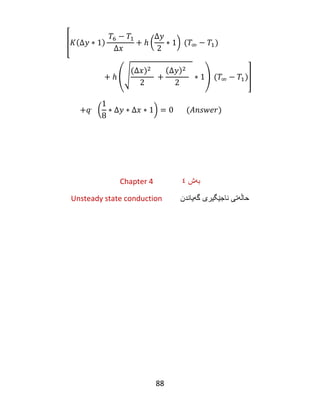
√
( )
[ ( ) ]
( )](https://image.slidesharecdn.com/daga-150224043650-conversion-gate01/85/Heat-Transfer-Engineering-87-320.jpg)
![90
حاڵهتییهكهمبهدووخاڵدادهناسینهوه:
1.پرسارهكهداواتلێناكاتلهچشوێنێكیجسمهكه،داچونكهلهههمووشوێنێكیجسمهكهداپلهی
گهرمییهكسانه.
2.قهبارهیجسمهكهvolumeهیوهڕوبهرهكهیAreaهیزانراوهیانخۆماندهتوانین
بیدۆزینهوه.
پرسیارهكهبههۆیئهمیاسایهوهشیكاردهكهین
[
𝜌
]
Example: a thermocouple junction, which may be approximated as a sphere,
is to be used for temperature measurement in a gas. The h between the](https://image.slidesharecdn.com/daga-150224043650-conversion-gate01/85/Heat-Transfer-Engineering-90-320.jpg)
![91
junction surface and the gas is With the junction properties are
K=20W/mK,
نموونه:گهرمی دوانهیهکی،کهگۆییه شێوە تاڕادەیهک،بهكاردەهێنرێتبۆپێوانىپلهىگهرمىله
گازێكدا.(h)لهنێوانڕووەكهىوگازەكهدا()ە.لهگهڵتایبهتمهندیهكهىسهرى
دوورێکهدا(K=20W/mK)،
and density 8500kg/ .If thermocouple junction
diameter assumed to be 0.7mm, how long will it take for the junction to reach
199℃ , If junction temperature is at 25℃ and placed in a gas steam that is at
200℃
Given: h = , Thermal conductivity= K=20W/mK,
, density =𝜌 8500kg/ junction diameter = 0.7mm
, , Initaial temperature =25℃ , fluid
temperature= =20℃
Solution:
لهبهرئهوهیباسیشوێنینهكردووكهواتهئهمهحاڵتییهكهمهLumped Capacity
From page 57 in the Data Book:
[
𝜌
]](https://image.slidesharecdn.com/daga-150224043650-conversion-gate01/85/Heat-Transfer-Engineering-91-320.jpg)
![92
[
𝜌
]
( )
Taking logarithms for both sides
](https://image.slidesharecdn.com/daga-150224043650-conversion-gate01/85/Heat-Transfer-Engineering-92-320.jpg)