Fluid Statics
Lecture - 2
Fluid Statics
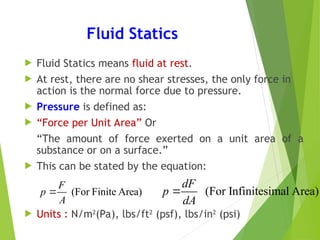
 Fluid Statics means fluid at rest.
 At rest, there are no shear stresses, the only force in
action is the normal force due to pressure.
 Pressure is defined as:
 “Force per Unit Area” Or
“The amount of force exerted on a unit area of a
substance or on a surface.”
 This can be stated by the equation:
 Units : N/m2
(Pa), lbs/ft2
(psf), lbs/in2
(psi)
Area)
Finite
(For
A
F
p  (For Infinitesimal Area)
dF
p
dA

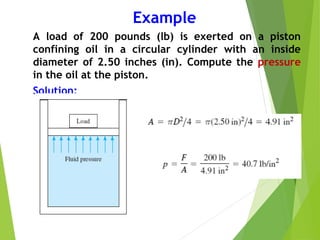
Example
A load of 200 pounds (lb) is exerted on a piston
confining oil in a circular cylinder with an inside
diameter of 2.50 inches (in). Compute the pressure
in the oil at the piston.
Solution:
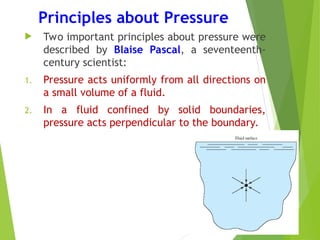
Principles about Pressure
 Two important principles about pressure were
described by Blaise Pascal, a seventeenth-
century scientist:
1. Pressure acts uniformly from all directions on
a small volume of a fluid.
2. In a fluid confined by solid boundaries,
pressure acts perpendicular to the boundary.
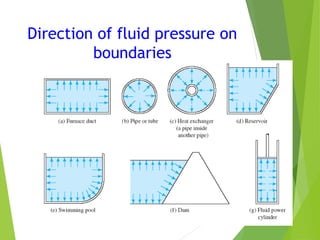
Direction of fluid pressure on
boundaries
Pressure at a Point is same in All
direction
(Pascal’s Law)
x z
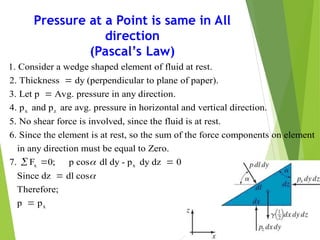
1. Consider a wedge shaped element of fluid at rest.
2. Thickness dy (perpendicular to plane of paper).
3. Let p Avg. pressure in any direction.
4. p and p are avg. pressure in horizontal and verti


x
cal direction.
5. No shear force is involved, since the fluid is at rest.
6. Since the element is at rest, so the sum of the force components on element
in any direction must be equal to Zero.
7. F 0
  x
x
; p cos dl dy - p dy dz 0
Since dz dl cos
Therefore;
p p





Pressure at a Point is same in All direction
z z
z
y
1
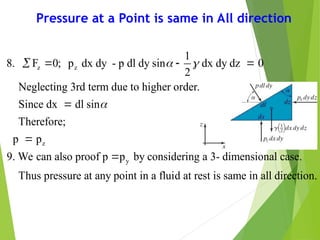
8. F 0; p dx dy - p dl dy sin dx dy dz 0
2
Neglecting 3rd term due to higher order.
Since dx dl sin
Therefore;
p p
9. We can also proof p p by considering a 3- dimensional
 

   


 case.
Thus pressure at any point in a fluid at rest is same in all direction.
Variation of Pressure in a Static
Fluid
(Hydrostatic Law)
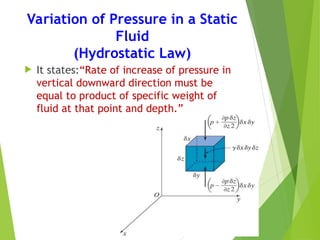
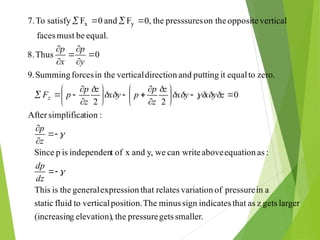
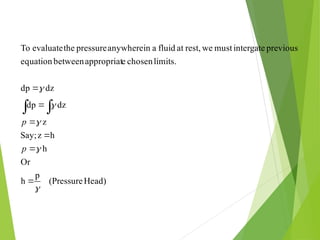
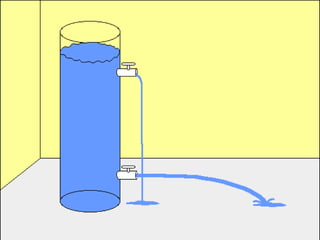
 It states:“Rate of increase of pressure in
vertical downward direction must be
equal to product of specific weight of
fluid at that point and depth.”
Variation of Pressure in a Static
Fluid
(Hydrostatic Law)
1. Consider an element of static fluid.
2. Assume density of fluid to be constant within the element
(Since the element is very small).
3. Pressure at the center of element is p.
4. Dimensions of element are x y and z.
5. Force acting in vertical direction are:
a. Body force: the action of gravity on the mass within the fluid.
b. Surface force: transmitted from the surrounding
  
fluid.
6. If the forces are summed in the horizontal direction, that is x or y,
the only forces acting are the pressure forces on the vertical faces of
element.
smaller.
gets
pressure
the
,
elevation)
g
(increasin
larger
gets
z
as
that
indicates
sign
minus
The
position.
vertical
to
fluid
static
a
in
pressure
of
variation
relates
that
expression
general
the
is
This
:
as
equation
above
can write
we
y,
and
x
of
t
independen
is
p
Since
:
tion
simplifica
After
0
2
2
zero.
to
equal
it
putting
and
direction
vertical
in the
forces
Summing
.
9
0
Thus
8.
equal.
be
must
faces
vertical
opposite
on the
presssures
the
0,
F
and
0
F
satisfy
To
7. y
x


















































dz
dp
z
p
z
y
x
y
x
z
z
p
p
y
x
z
z
p
p
F
y
p
x
p
z
Head)
(Pressure
p
h
Or
h
h
z
Say;
z
dz
dp
dz
dp
limits.
chosen
e
appropriat
between
equation
previous
intergate
must
we
rest,
at
fluid
a
in
anywhere
pressure
the
evaluate
To











 
p
p
Pressure expressed in
Height of Fluid
 The term elevation means the vertical
distance from some reference level to a
point of interest and is called z.
 A change in elevation between two points
is called h. Elevation will always be
measured positively in the upward
direction.
 In other words, a higher point has a larger
elevation than a lower point.
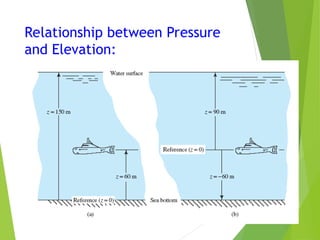
 Fig shows the illustration of reference
level for elevation.
Relationship between Pressure
and Elevation:
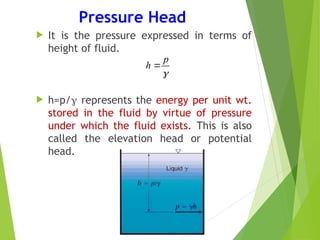
Pressure Head
 It is the pressure expressed in terms of
height of fluid.
 h=p/ represents the energy per unit wt.
stored in the fluid by virtue of pressure
under which the fluid exists. This is also
called the elevation head or potential
head.

p
h 
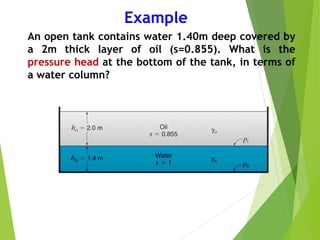
Example
An open tank contains water 1.40m deep covered by
a 2m thick layer of oil (s=0.855). What is the
pressure head at the bottom of the tank, in terms of
a water column?
m
p
h
h
h
p
SOLUTION
m
h
m
p
m
kN
x
h
m
kN
x
m
kN
w
b
we
w
w
o
o
b
w
w
i
o
o
o
w
11
.
3
81
.
9
51
.
30
30.51kN/m
9.81(1.4)
(8.39)2
2
11
.
3
710
.
1
40
.
1
h
h
So
710
.
1
81
.
9
78
.
16
h
:
oil
of
equivalent
for water
/
78
.
16
2
39
.
8
p
:
interface
For
/
39
.
8
81
.
9
855
.
0
/
81
.
9
2
oe
we
oe
2
i
3
3






























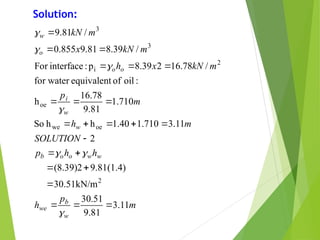
Solution:
Exercises (Assignment):
1. An open tank contains 5 m water covered
with 2 m of oil 8kN/m3). Find the gauge
pressure (a) at interface between the liquids
and at bottom of the tank.
2. An open tank contains 7ft of water covered
with 2.2ft oil (s=0.88). Find the gauge
pressure (a) at the interface between the
liquids and (b) at the bottom of the tank.
3. If air had a constant specific weight of
12N/m3and were incompressible, what would
be the height of air surrounding the earth to
produce a pressure at the surface of 101.3
kPa abs?
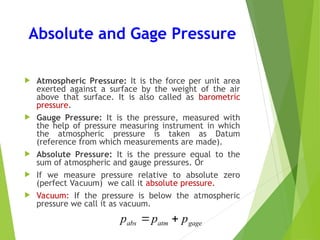
Absolute and Gage Pressure
 Atmospheric Pressure: It is the force per unit area
exerted against a surface by the weight of the air
above that surface. It is also called as barometric
pressure.
 Gauge Pressure: It is the pressure, measured with
the help of pressure measuring instrument in which
the atmospheric pressure is taken as Datum
(reference from which measurements are made).
 Absolute Pressure: It is the pressure equal to the
sum of atmospheric and gauge pressures. Or
 If we measure pressure relative to absolute zero
(perfect Vacuum) we call it absolute pressure.
 Vacuum: If the pressure is below the atmospheric
pressure we call it as vacuum.
gage
atm
abs p
p
p 

Measurement of Pressure
 There are many ways to measure pressure in a fluid.
Some are discussed here:
1. Barometers
2. Bourdon gauge
3. Pressure transducers
4. Piezometer Column
5. Simple Manometers
6. Differential Manometers
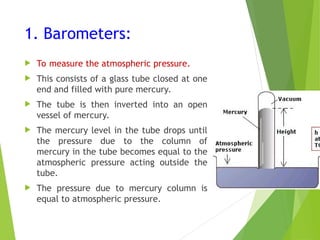
1. Barometers:
 To measure the atmospheric pressure.
 This consists of a glass tube closed at one
end and filled with pure mercury.
 The tube is then inverted into an open
vessel of mercury.
 The mercury level in the tube drops until
the pressure due to the column of
mercury in the tube becomes equal to the
atmospheric pressure acting outside the
tube.
 The pressure due to mercury column is
equal to atmospheric pressure.
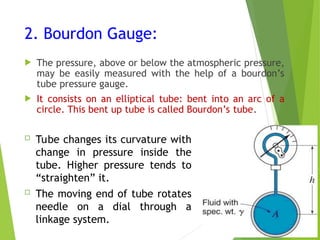
2. Bourdon Gauge:
 The pressure, above or below the atmospheric pressure,
may be easily measured with the help of a bourdon’s
tube pressure gauge.
 It consists on an elliptical tube: bent into an arc of a
circle. This bent up tube is called Bourdon’s tube.
 Tube changes its curvature with
change in pressure inside the
tube. Higher pressure tends to
“straighten” it.
 The moving end of tube rotates
needle on a dial through a
linkage system.
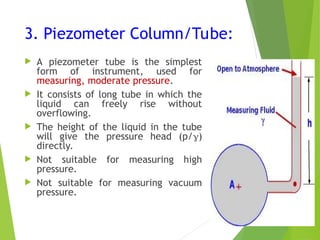
3. Piezometer Column/Tube:
 A piezometer tube is the simplest
form of instrument, used for
measuring, moderate pressure.
 It consists of long tube in which the
liquid can freely rise without
overflowing.
 The height of the liquid in the tube
will give the pressure head (p/)
directly.
 Not suitable for measuring high
pressure.
 Not suitable for measuring vacuum
pressure.
4. Manometer:
 Manometer is an improved form of a piezometer tube.
With its help we can measure comparatively high
pressures and negative pressure also. Following are few
types of manometers.
1. Simple Manometer
2. Micro-manometer
3. Differential manometer
4. Inverted differential manometer
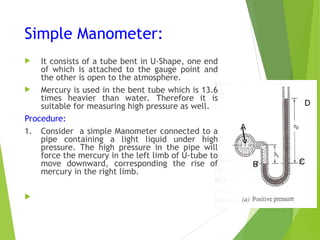
Simple Manometer:
 It consists of a tube bent in U-Shape, one end
of which is attached to the gauge point and
the other is open to the atmosphere.
 Mercury is used in the bent tube which is 13.6
times heavier than water. Therefore it is
suitable for measuring high pressure as well.
Procedure:
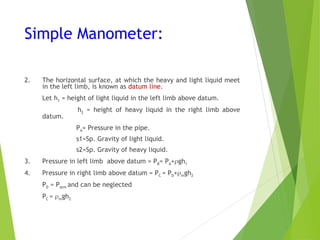
1. Consider a simple Manometer connected to a
pipe containing a light liquid under high
pressure. The high pressure in the pipe will
force the mercury in the left limb of U-tube to
move downward, corresponding the rise of
mercury in the right limb.

A
B C
D
Simple Manometer:
2. The horizontal surface, at which the heavy and light liquid meet
in the left limb, is known as datum line.
Let h1 = height of light liquid in the left limb above datum.
h2 = height of heavy liquid in the right limb above
datum.
PA= Pressure in the pipe.
s1=Sp. Gravity of light liquid.
s2=Sp. Gravity of heavy liquid.
3. Pressure in left limb above datum = PB= PA+gh1
4. Pressure in right limb above datum = PC = PD+mgh2
PD = Patm and can be neglected
PC = mgh2
Simple Manometer:
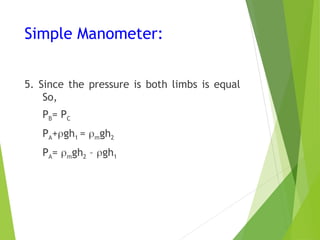
5. Since the pressure is both limbs is equal
So,
PB= PC
PA+gh1 = mgh2
PA= mgh2 – gh1
Simple Manometer:
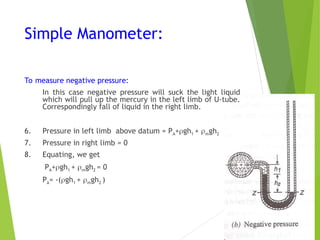
To measure negative pressure:
In this case negative pressure will suck the light liquid
which will pull up the mercury in the left limb of U-tube.
Correspondingly fall of liquid in the right limb.
6. Pressure in left limb above datum = PA+gh1 + mgh2
7. Pressure in right limb = 0
8. Equating, we get
PA+gh1 + mgh2 = 0
PA= -(gh1 + mgh2 )
Example
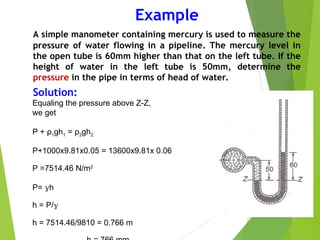
A simple manometer containing mercury is used to measure the
pressure of water flowing in a pipeline. The mercury level in
the open tube is 60mm higher than that on the left tube. If the
height of water in the left tube is 50mm, determine the
pressure in the pipe in terms of head of water.
Solution:
Equaling the pressure above Z-Z,
we get
P + ρ1gh1 = ρ2gh2
P+1000x9.81x0.05 = 13600x9.81x 0.06
P =7514.46 N/m2
P= h
h = P/
h = 7514.46/9810 = 0.766 m
Example
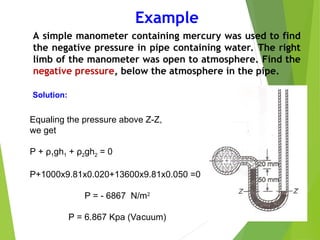
A simple manometer containing mercury was used to find
the negative pressure in pipe containing water. The right
limb of the manometer was open to atmosphere. Find the
negative pressure, below the atmosphere in the pipe.
Equaling the pressure above Z-Z,
we get
P + ρ1gh1 + ρ2gh2 = 0
P+1000x9.81x0.020+13600x9.81x0.050 =0
P = - 6867 N/m2
P = 6.867 Kpa (Vacuum)
Solution:
Example
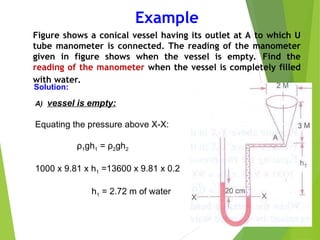
Figure shows a conical vessel having its outlet at A to which U
tube manometer is connected. The reading of the manometer
given in figure shows when the vessel is empty. Find the
reading of the manometer when the vessel is completely filled
with water.
A) vessel is empty:
Equating the pressure above X-X:
ρ1gh1 = ρ2gh2
1000 x 9.81 x h1 =13600 x 9.81 x 0.2
h1 = 2.72 m of water
Solution:
Solution (continued..)
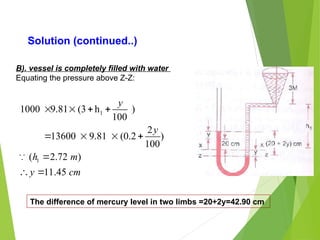
B). vessel is completely filled with water
Equating the pressure above Z-Z:
1
1
1000 9.81 (3 h )
100
2
13600 9.81 (0.2 )
100
( 2.72 )
11.45
y
y
h m
y cm
   
   

 

The difference of mercury level in two limbs =20+2y=42.90 cm
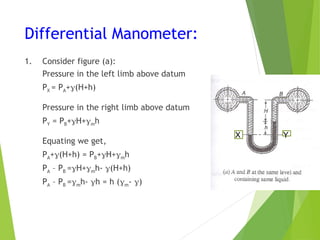
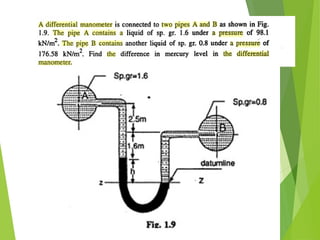
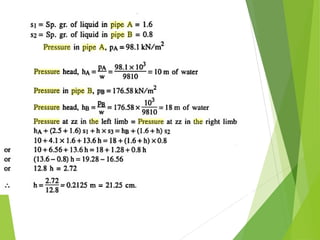
Differential Manometer:
 It is a device used for measuring the difference of
pressures, between the two points in a pipe, or in two
different pipes.
 It consists of U-tube containing a heavy liquid (mercury)
whose ends are connected to the points, for which the
pressure is to be found out.
Procedure:
 Let us take the horizontal surface X-Y, at which heavy
liquid and light liquid meet in the left limb, as datum
line.
 Let, h=Difference of levels (also known as differential
manomter reading)
ha, hb= Pressure head in pipe A and B, respectively.
s1, s2= Sp. Gravity of light and heavy liquid respectively.
Differential Manometer:
1. Consider figure (a):
Pressure in the left limb above datum
PX = PA+(H+h)
Pressure in the right limb above datum
PY = PB+H+mh
Equating we get,
PA+(H+h) = PB+H+mh
PA – PB =H+mh- (H+h)
PA – PB =mh- h = h (m- )
X Y
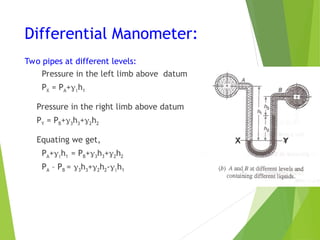
Differential Manometer:
Two pipes at different levels:
Pressure in the left limb above datum
PX = PA+h1
Pressure in the right limb above datum
PY = PB+3h3+2h2
Equating we get,
PA+h1 = PB+3h3+2h2
PA – PB = 3h3+2h2-h1
X Y
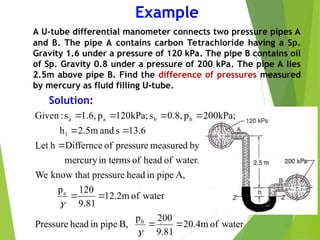
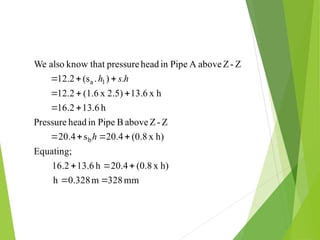
Example
A U-tube differential manometer connects two pressure pipes A
and B. The pipe A contains carbon Tetrachloride having a Sp.
Gravity 1.6 under a pressure of 120 kPa. The pipe B contains oil
of Sp. Gravity 0.8 under a pressure of 200 kPa. The pipe A lies
2.5m above pipe B. Find the difference of pressures measured
by mercury as fluid filling U-tube.
Solution:
water
of
20.4m
9.81
200
p
B,
pipe
in
head
Pressure
water
of
12.2m
9.81
120
p
A,
pipe
in
head
pressure
that
know
We
water.
of
head
of
in terms
mercury
by
measured
pressure
of
Differnce
h
Let
13.6
s
and
2.5m
h
200kPa;
p
0.8,
s
120kPa;
p
1.6,
s
:
Given
b
a
1
b
b
a
a













mm
328
m
0.328
h
h)
x
(0.8
20.4
h
13.6
16.2
Equating;
h)
x
(0.8
20.4
s
20.4
Z
-
Z
above
B
Pipe
in
head
Pressure
h
13.6
16.2
h
x
13.6
2.5)
x
(1.6
12.2
.
)
.
(s
12.2
Z
-
Z
above
A
Pipe
in
head
pressure
that
know
also
We
b
1
a

















h
h
s
h
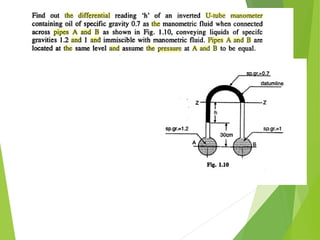
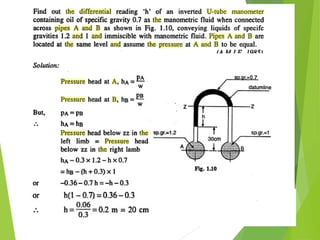
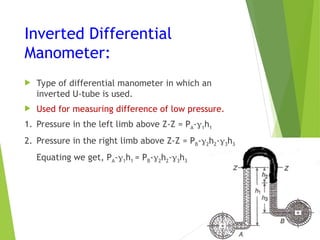
Inverted Differential
Manometer:
 Type of differential manometer in which an
inverted U-tube is used.
 Used for measuring difference of low pressure.
1. Pressure in the left limb above Z-Z = PA-1h1
2. Pressure in the right limb above Z-Z = PB-2h2-3h3
Equating we get, PA-1h1 = PB-2h2-3h3
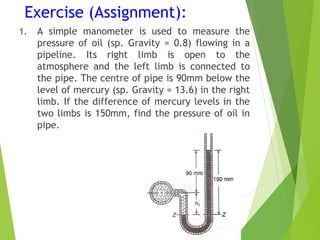
Exercise (Assignment):
1. A simple manometer is used to measure the
pressure of oil (sp. Gravity = 0.8) flowing in a
pipeline. Its right limb is open to the
atmosphere and the left limb is connected to
the pipe. The centre of pipe is 90mm below the
level of mercury (sp. Gravity = 13.6) in the right
limb. If the difference of mercury levels in the
two limbs is 150mm, find the pressure of oil in
pipe.
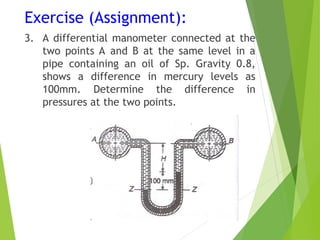
Exercise (Assignment):
3. A differential manometer connected at the
two points A and B at the same level in a
pipe containing an oil of Sp. Gravity 0.8,
shows a difference in mercury levels as
100mm. Determine the difference in
pressures at the two points.
fluid statics+pressure head and devices.ppt

fluid statics+pressure head and devices.ppt

  • 1.
  • 2.
    Fluid Statics  FluidStatics means fluid at rest.  At rest, there are no shear stresses, the only force in action is the normal force due to pressure.  Pressure is defined as:  “Force per Unit Area” Or “The amount of force exerted on a unit area of a substance or on a surface.”  This can be stated by the equation:  Units : N/m2 (Pa), lbs/ft2 (psf), lbs/in2 (psi) Area) Finite (For A F p  (For Infinitesimal Area) dF p dA 
  • 3.
    Example A load of200 pounds (lb) is exerted on a piston confining oil in a circular cylinder with an inside diameter of 2.50 inches (in). Compute the pressure in the oil at the piston. Solution:
  • 4.
    Principles about Pressure Two important principles about pressure were described by Blaise Pascal, a seventeenth- century scientist: 1. Pressure acts uniformly from all directions on a small volume of a fluid. 2. In a fluid confined by solid boundaries, pressure acts perpendicular to the boundary.
  • 5.
    Direction of fluidpressure on boundaries
  • 6.
    Pressure at aPoint is same in All direction (Pascal’s Law) x z 1. Consider a wedge shaped element of fluid at rest. 2. Thickness dy (perpendicular to plane of paper). 3. Let p Avg. pressure in any direction. 4. p and p are avg. pressure in horizontal and verti   x cal direction. 5. No shear force is involved, since the fluid is at rest. 6. Since the element is at rest, so the sum of the force components on element in any direction must be equal to Zero. 7. F 0   x x ; p cos dl dy - p dy dz 0 Since dz dl cos Therefore; p p     
  • 7.
    Pressure at aPoint is same in All direction z z z y 1 8. F 0; p dx dy - p dl dy sin dx dy dz 0 2 Neglecting 3rd term due to higher order. Since dx dl sin Therefore; p p 9. We can also proof p p by considering a 3- dimensional           case. Thus pressure at any point in a fluid at rest is same in all direction.
  • 8.
    Variation of Pressurein a Static Fluid (Hydrostatic Law)  It states:“Rate of increase of pressure in vertical downward direction must be equal to product of specific weight of fluid at that point and depth.”
  • 9.
    Variation of Pressurein a Static Fluid (Hydrostatic Law) 1. Consider an element of static fluid. 2. Assume density of fluid to be constant within the element (Since the element is very small). 3. Pressure at the center of element is p. 4. Dimensions of element are x y and z. 5. Force acting in vertical direction are: a. Body force: the action of gravity on the mass within the fluid. b. Surface force: transmitted from the surrounding    fluid. 6. If the forces are summed in the horizontal direction, that is x or y, the only forces acting are the pressure forces on the vertical faces of element.
  • 10.
    smaller. gets pressure the , elevation) g (increasin larger gets z as that indicates sign minus The position. vertical to fluid static a in pressure of variation relates that expression general the is This : as equation above can write we y, and x of t independen is p Since : tion simplifica After 0 2 2 zero. to equal it putting and direction vertical in the forces Summing . 9 0 Thus 8. equal. be must faces vertical opposite onthe presssures the 0, F and 0 F satisfy To 7. y x                                                   dz dp z p z y x y x z z p p y x z z p p F y p x p z
  • 11.
  • 12.
    Pressure expressed in Heightof Fluid  The term elevation means the vertical distance from some reference level to a point of interest and is called z.  A change in elevation between two points is called h. Elevation will always be measured positively in the upward direction.  In other words, a higher point has a larger elevation than a lower point.  Fig shows the illustration of reference level for elevation.
  • 13.
  • 14.
    Pressure Head  Itis the pressure expressed in terms of height of fluid.  h=p/ represents the energy per unit wt. stored in the fluid by virtue of pressure under which the fluid exists. This is also called the elevation head or potential head.  p h 
  • 16.
    Example An open tankcontains water 1.40m deep covered by a 2m thick layer of oil (s=0.855). What is the pressure head at the bottom of the tank, in terms of a water column?
  • 17.
  • 18.
    Exercises (Assignment): 1. Anopen tank contains 5 m water covered with 2 m of oil 8kN/m3). Find the gauge pressure (a) at interface between the liquids and at bottom of the tank. 2. An open tank contains 7ft of water covered with 2.2ft oil (s=0.88). Find the gauge pressure (a) at the interface between the liquids and (b) at the bottom of the tank. 3. If air had a constant specific weight of 12N/m3and were incompressible, what would be the height of air surrounding the earth to produce a pressure at the surface of 101.3 kPa abs?
  • 19.
    Absolute and GagePressure  Atmospheric Pressure: It is the force per unit area exerted against a surface by the weight of the air above that surface. It is also called as barometric pressure.  Gauge Pressure: It is the pressure, measured with the help of pressure measuring instrument in which the atmospheric pressure is taken as Datum (reference from which measurements are made).  Absolute Pressure: It is the pressure equal to the sum of atmospheric and gauge pressures. Or  If we measure pressure relative to absolute zero (perfect Vacuum) we call it absolute pressure.  Vacuum: If the pressure is below the atmospheric pressure we call it as vacuum. gage atm abs p p p  
  • 20.
    Measurement of Pressure There are many ways to measure pressure in a fluid. Some are discussed here: 1. Barometers 2. Bourdon gauge 3. Pressure transducers 4. Piezometer Column 5. Simple Manometers 6. Differential Manometers
  • 21.
    1. Barometers:  Tomeasure the atmospheric pressure.  This consists of a glass tube closed at one end and filled with pure mercury.  The tube is then inverted into an open vessel of mercury.  The mercury level in the tube drops until the pressure due to the column of mercury in the tube becomes equal to the atmospheric pressure acting outside the tube.  The pressure due to mercury column is equal to atmospheric pressure.
  • 22.
    2. Bourdon Gauge: The pressure, above or below the atmospheric pressure, may be easily measured with the help of a bourdon’s tube pressure gauge.  It consists on an elliptical tube: bent into an arc of a circle. This bent up tube is called Bourdon’s tube.  Tube changes its curvature with change in pressure inside the tube. Higher pressure tends to “straighten” it.  The moving end of tube rotates needle on a dial through a linkage system.
  • 23.
    3. Piezometer Column/Tube: A piezometer tube is the simplest form of instrument, used for measuring, moderate pressure.  It consists of long tube in which the liquid can freely rise without overflowing.  The height of the liquid in the tube will give the pressure head (p/) directly.  Not suitable for measuring high pressure.  Not suitable for measuring vacuum pressure.
  • 24.
    4. Manometer:  Manometeris an improved form of a piezometer tube. With its help we can measure comparatively high pressures and negative pressure also. Following are few types of manometers. 1. Simple Manometer 2. Micro-manometer 3. Differential manometer 4. Inverted differential manometer
  • 25.
    Simple Manometer:  Itconsists of a tube bent in U-Shape, one end of which is attached to the gauge point and the other is open to the atmosphere.  Mercury is used in the bent tube which is 13.6 times heavier than water. Therefore it is suitable for measuring high pressure as well. Procedure: 1. Consider a simple Manometer connected to a pipe containing a light liquid under high pressure. The high pressure in the pipe will force the mercury in the left limb of U-tube to move downward, corresponding the rise of mercury in the right limb.  A B C D
  • 26.
    Simple Manometer: 2. Thehorizontal surface, at which the heavy and light liquid meet in the left limb, is known as datum line. Let h1 = height of light liquid in the left limb above datum. h2 = height of heavy liquid in the right limb above datum. PA= Pressure in the pipe. s1=Sp. Gravity of light liquid. s2=Sp. Gravity of heavy liquid. 3. Pressure in left limb above datum = PB= PA+gh1 4. Pressure in right limb above datum = PC = PD+mgh2 PD = Patm and can be neglected PC = mgh2
  • 27.
    Simple Manometer: 5. Sincethe pressure is both limbs is equal So, PB= PC PA+gh1 = mgh2 PA= mgh2 – gh1
  • 28.
    Simple Manometer: To measurenegative pressure: In this case negative pressure will suck the light liquid which will pull up the mercury in the left limb of U-tube. Correspondingly fall of liquid in the right limb. 6. Pressure in left limb above datum = PA+gh1 + mgh2 7. Pressure in right limb = 0 8. Equating, we get PA+gh1 + mgh2 = 0 PA= -(gh1 + mgh2 )
  • 29.
    Example A simple manometercontaining mercury is used to measure the pressure of water flowing in a pipeline. The mercury level in the open tube is 60mm higher than that on the left tube. If the height of water in the left tube is 50mm, determine the pressure in the pipe in terms of head of water. Solution: Equaling the pressure above Z-Z, we get P + ρ1gh1 = ρ2gh2 P+1000x9.81x0.05 = 13600x9.81x 0.06 P =7514.46 N/m2 P= h h = P/ h = 7514.46/9810 = 0.766 m
  • 30.
    Example A simple manometercontaining mercury was used to find the negative pressure in pipe containing water. The right limb of the manometer was open to atmosphere. Find the negative pressure, below the atmosphere in the pipe. Equaling the pressure above Z-Z, we get P + ρ1gh1 + ρ2gh2 = 0 P+1000x9.81x0.020+13600x9.81x0.050 =0 P = - 6867 N/m2 P = 6.867 Kpa (Vacuum) Solution:
  • 31.
    Example Figure shows aconical vessel having its outlet at A to which U tube manometer is connected. The reading of the manometer given in figure shows when the vessel is empty. Find the reading of the manometer when the vessel is completely filled with water. A) vessel is empty: Equating the pressure above X-X: ρ1gh1 = ρ2gh2 1000 x 9.81 x h1 =13600 x 9.81 x 0.2 h1 = 2.72 m of water Solution:
  • 32.
    Solution (continued..) B). vesselis completely filled with water Equating the pressure above Z-Z: 1 1 1000 9.81 (3 h ) 100 2 13600 9.81 (0.2 ) 100 ( 2.72 ) 11.45 y y h m y cm             The difference of mercury level in two limbs =20+2y=42.90 cm
  • 33.
    Differential Manometer:  Itis a device used for measuring the difference of pressures, between the two points in a pipe, or in two different pipes.  It consists of U-tube containing a heavy liquid (mercury) whose ends are connected to the points, for which the pressure is to be found out. Procedure:  Let us take the horizontal surface X-Y, at which heavy liquid and light liquid meet in the left limb, as datum line.  Let, h=Difference of levels (also known as differential manomter reading) ha, hb= Pressure head in pipe A and B, respectively. s1, s2= Sp. Gravity of light and heavy liquid respectively.
  • 34.
    Differential Manometer: 1. Considerfigure (a): Pressure in the left limb above datum PX = PA+(H+h) Pressure in the right limb above datum PY = PB+H+mh Equating we get, PA+(H+h) = PB+H+mh PA – PB =H+mh- (H+h) PA – PB =mh- h = h (m- ) X Y
  • 35.
    Differential Manometer: Two pipesat different levels: Pressure in the left limb above datum PX = PA+h1 Pressure in the right limb above datum PY = PB+3h3+2h2 Equating we get, PA+h1 = PB+3h3+2h2 PA – PB = 3h3+2h2-h1 X Y
  • 36.
    Example A U-tube differentialmanometer connects two pressure pipes A and B. The pipe A contains carbon Tetrachloride having a Sp. Gravity 1.6 under a pressure of 120 kPa. The pipe B contains oil of Sp. Gravity 0.8 under a pressure of 200 kPa. The pipe A lies 2.5m above pipe B. Find the difference of pressures measured by mercury as fluid filling U-tube. Solution: water of 20.4m 9.81 200 p B, pipe in head Pressure water of 12.2m 9.81 120 p A, pipe in head pressure that know We water. of head of in terms mercury by measured pressure of Differnce h Let 13.6 s and 2.5m h 200kPa; p 0.8, s 120kPa; p 1.6, s : Given b a 1 b b a a             
  • 37.
  • 38.
    Inverted Differential Manometer:  Typeof differential manometer in which an inverted U-tube is used.  Used for measuring difference of low pressure. 1. Pressure in the left limb above Z-Z = PA-1h1 2. Pressure in the right limb above Z-Z = PB-2h2-3h3 Equating we get, PA-1h1 = PB-2h2-3h3
  • 39.
    Exercise (Assignment): 1. Asimple manometer is used to measure the pressure of oil (sp. Gravity = 0.8) flowing in a pipeline. Its right limb is open to the atmosphere and the left limb is connected to the pipe. The centre of pipe is 90mm below the level of mercury (sp. Gravity = 13.6) in the right limb. If the difference of mercury levels in the two limbs is 150mm, find the pressure of oil in pipe.
  • 40.
    Exercise (Assignment): 3. Adifferential manometer connected at the two points A and B at the same level in a pipe containing an oil of Sp. Gravity 0.8, shows a difference in mercury levels as 100mm. Determine the difference in pressures at the two points.