University of Anbar
College of Engineering
Civil Engineering Department
Iraq-Ramadi
Asst. Prof. Khalid R. Mahmood (PhD.)
215
Effective Stress Concept
Topics
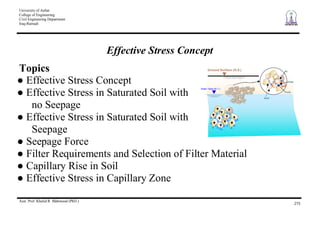
Effective Stress Concept
Effective Stress in Saturated Soil with
no Seepage
Effective Stress in Saturated Soil with
Seepage
Seepage Force
Filter Requirements and Selection of Filter Material
Capillary Rise in Soil
Effective Stress in Capillary Zone
Water
Water Table (W.T.)
Ground Surface (G.S.) Air
Voids
Solid
University of Anbar
College of Engineering
Civil Engineering Department
Iraq-Ramadi
Asst. Prof. Khalid R. Mahmood (PhD.)
216
Effective Stress Concept
•Soil is a multi phase system
•To perform any kind of analysis - we must understand stress
distribution
•The concept of effective stress:
• The soil is “loaded” (footing for example)
• The resulting stress is transmitted to the soil mass
• The soil mass supports those stresses at the point to point
contacts of the individual soil grains
University of Anbar
College of Engineering
Civil Engineering Department
Iraq-Ramadi
Asst. Prof. Khalid R. Mahmood (PhD.)
217
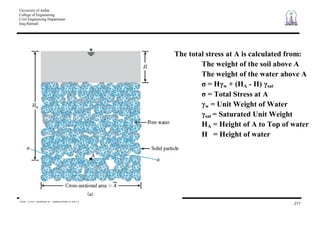
The total stress at A is calculated from:
The weight of the soil above A
The weight of the water above A
= H w + (HA - H) sat
= Total Stress at A
w = Unit Weight of Water
sat = Saturated Unit Weight
HA = Height of A to Top of water
H = Height of water
University of Anbar
College of Engineering
Civil Engineering Department
Iraq-Ramadi
Asst. Prof. Khalid R. Mahmood (PhD.)
218
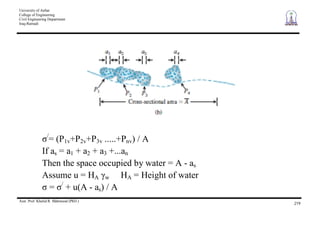
• is the stress applied to the soil by its own weight
• As you go deeper in the soil mass, the stress increases
• The soil carries the stress in 2 ways:
• A portion is carried by the water (acts equally in all
directions)
• A portion is carried by the soil solids at their point of
contact.
University of Anbar
College of Engineering
Civil Engineering Department
Iraq-Ramadi
Asst. Prof. Khalid R. Mahmood (PhD.)
219
/
= (P1v+P2v+P3v .....+Pnv) / A
If as = a1 + a2 + a3 +...an
Then the space occupied by water = A - as
Assume u = HA w HA = Height of water
= /
+ u(A - as) / A
University of Anbar
College of Engineering
Civil Engineering Department
Iraq-Ramadi
Asst. Prof. Khalid R. Mahmood (PhD.)
220
Since as is very small, assume = 0
= /
+ u
Recall the following equation:
= H w + (HA - H) sat
Now, /
= - u
Substituting: /
= [H w + (HA - H) sat] - HA w
Rearranging: /
= (HA - H)( sat - w) = Hsoil
/
Effective Stress is independent of height of water
In the equation: = /
+ u
/
is the soil skeleton stress
u is the stress in the water, or pore water pressure
University of Anbar
College of Engineering
Civil Engineering Department
Iraq-Ramadi
Asst. Prof. Khalid R. Mahmood (PhD.)
221
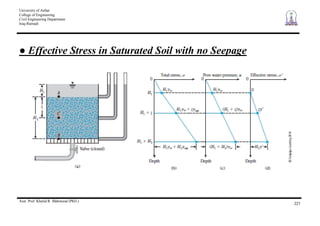
Effective Stress in Saturated Soil with no Seepage
University of Anbar
College of Engineering
Civil Engineering Department
Iraq-Ramadi
Asst. Prof. Khalid R. Mahmood (PhD.)
222
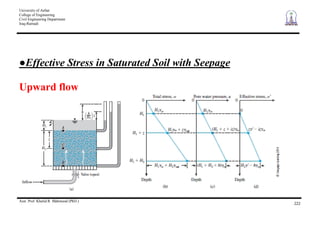
Effective Stress in Saturated Soil with Seepage
Upward flow
University of Anbar
College of Engineering
Civil Engineering Department
Iraq-Ramadi
Asst. Prof. Khalid R. Mahmood (PhD.)
223
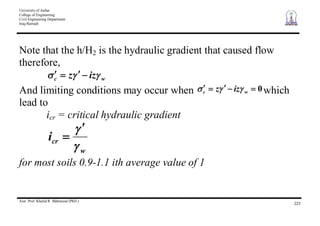
Note that the h/H2 is the hydraulic gradient that caused flow
therefore,
wc izz
And limiting conditions may occur when 0wc izz which
lead to
icr = critical hydraulic gradient
w
cri
for most soils 0.9-1.1 ith average value of 1
University of Anbar
College of Engineering
Civil Engineering Department
Iraq-Ramadi
Asst. Prof. Khalid R. Mahmood (PhD.)
224
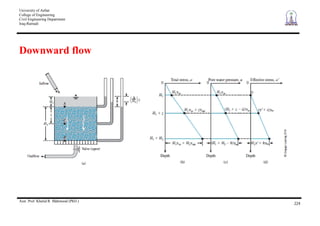
Downward flow
University of Anbar
College of Engineering
Civil Engineering Department
Iraq-Ramadi
Asst. Prof. Khalid R. Mahmood (PhD.)
225
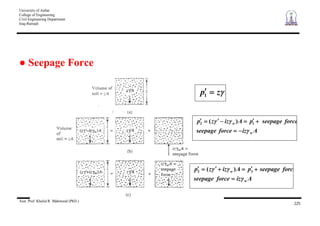
Seepage Force
Azp1
Aizforceseepage
forceseepagepAizzp
w
w 12 )(
Aizforceseepage
forceseepagepAizzp
w
w 33 )(
University of Anbar
College of Engineering
Civil Engineering Department
Iraq-Ramadi
Asst. Prof. Khalid R. Mahmood (PhD.)
226
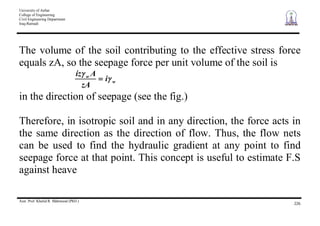
The volume of the soil contributing to the effective stress force
equals zA, so the seepage force per unit volume of the soil is
w
w
i
zA
Aiz
in the direction of seepage (see the fig.)
Therefore, in isotropic soil and in any direction, the force acts in
the same direction as the direction of flow. Thus, the flow nets
can be used to find the hydraulic gradient at any point to find
seepage force at that point. This concept is useful to estimate F.S
against heave
University of Anbar
College of Engineering
Civil Engineering Department
Iraq-Ramadi
Asst. Prof. Khalid R. Mahmood (PhD.)
227
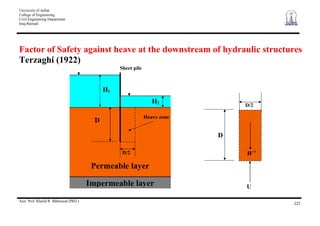
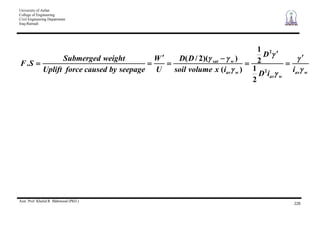
Factor of Safety against heave at the downstream of hydraulic structures
Terzaghi (1922)
H1
H2
Sheet pile
Impermeable layer
Permeable layer
D
D/2
D
D/2
W
U
Heave zone
University of Anbar
College of Engineering
Civil Engineering Department
Iraq-Ramadi
Asst. Prof. Khalid R. Mahmood (PhD.)
228
wav
wav
wav
wsat
i
iD
D
ixvolumesoil
DD
U
W
seepagebycausedforceUplift
weightSubmerged
SF
2
2
2
1
2
1
)(
))(2/(
.
University of Anbar
College of Engineering
Civil Engineering Department
Iraq-Ramadi
Asst. Prof. Khalid R. Mahmood (PhD.)
229
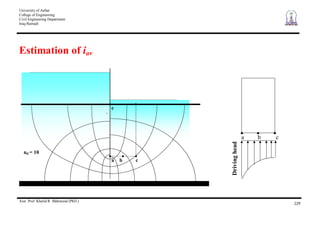
Estimation of iav
a b c
e
d
nd = 10
Drivinghead
a b c
University of Anbar
College of Engineering
Civil Engineering Department
Iraq-Ramadi
Asst. Prof. Khalid R. Mahmood (PhD.)
230
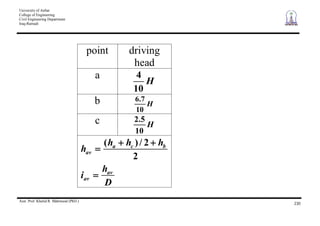
point driving
head
a
H
10
4
b H
10
7.6
c H
10
5.2
D
h
i
hhh
h
av
av
bca
av
2
2/)(
University of Anbar
College of Engineering
Civil Engineering Department
Iraq-Ramadi
Asst. Prof. Khalid R. Mahmood (PhD.)
231
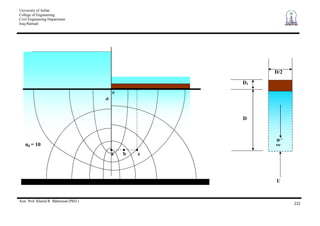
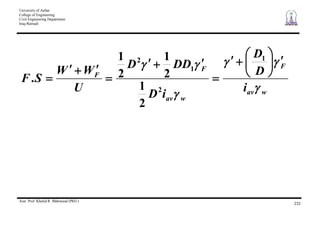
Filter Requirements and Selection of Filter Material
In practice, for the safe of the hydraulic structure, a minimum
value of 4 to 5 for F.S against heaving is used, because of the
uncertainty in the analysis. One way to increase the F.S is using
filter.
Filter:- is a granular material with opening small enough to
prevent the movement of the soil particles upon which is
placed and, at the same time, is previous enough to offer little
resistance to seepage through it.
University of Anbar
College of Engineering
Civil Engineering Department
Iraq-Ramadi
Asst. Prof. Khalid R. Mahmood (PhD.)
232
a b c
e
d
nd = 10
D
D/2
W
W
U
D1
University of Anbar
College of Engineering
Civil Engineering Department
Iraq-Ramadi
Asst. Prof. Khalid R. Mahmood (PhD.)
233
wav
F
wav
F
F
i
D
D
iD
DDD
U
WW
SF
1
2
1
2
2
1
2
1
2
1
.
University of Anbar
College of Engineering
Civil Engineering Department
Iraq-Ramadi
Asst. Prof. Khalid R. Mahmood (PhD.)
234
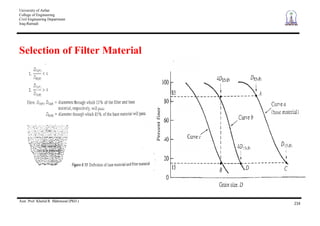
Selection of Filter Material
Capillary R
University of Anbar
College of Engineering
Civil Engineering Department
Iraq-Ramadi
Asst. Prof. Khalid R. Mahmood (PhD.)
235
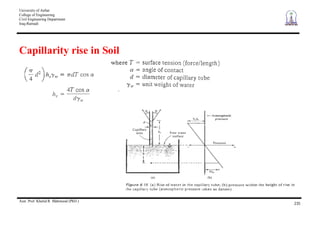
Capillarity rise in Soil
University of Anbar
College of Engineering
Civil Engineering Department
Iraq-Ramadi
Asst. Prof. Khalid R. Mahmood (PhD.)
236
For pure water and clean glass = 0
w
c
d
T
h
4
For water T = 72 m.N/m
d
hc
1
the smaller the capillarity tube, the larger capillary rise
University of Anbar
College of Engineering
Civil Engineering Department
Iraq-Ramadi
Asst. Prof. Khalid R. Mahmood (PhD.)
237
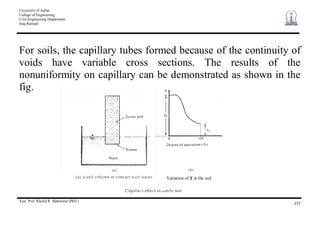
For soils, the capillary tubes formed because of the continuity of
voids have variable cross sections. The results of the
nonuniformity on capillary can be demonstrated as shown in the
fig.
Variation of S in the soil
University of Anbar
College of Engineering
Civil Engineering Department
Iraq-Ramadi
Asst. Prof. Khalid R. Mahmood (PhD.)
238
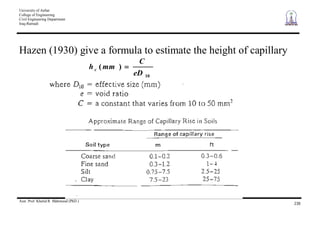
Hazen (1930) give a formula to estimate the height of capillary
10
)(
eD
C
mmh c
University of Anbar
College of Engineering
Civil Engineering Department
Iraq-Ramadi
Asst. Prof. Khalid R. Mahmood (PhD.)
239
Effective Stress in Capillary Zone
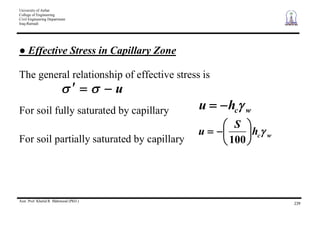
The general relationship of effective stress is
u
For soil fully saturated by capillary wchu
For soil partially saturated by capillary wch
S
u
100
University of Anbar
College of Engineering
Civil Engineering Department
Iraq-Ramadi
Asst. Prof. Khalid R. Mahmood (PhD.)
240
Examples
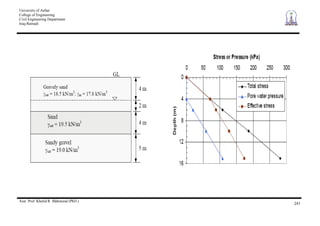
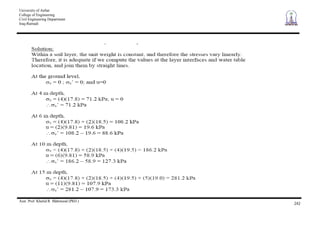
EXAMPLE1. Plot the variation of total and effective vertical
stresses, and pore water pressure with depth for the soil profile
shown below in Fig.
University of Anbar
College of Engineering
Civil Engineering Department
Iraq-Ramadi
Asst. Prof. Khalid R. Mahmood (PhD.)
241
University of Anbar
College of Engineering
Civil Engineering Department
Iraq-Ramadi
Asst. Prof. Khalid R. Mahmood (PhD.)
242
University of Anbar
College of Engineering
Civil Engineering Department
Iraq-Ramadi
Asst. Prof. Khalid R. Mahmood (PhD.)
243
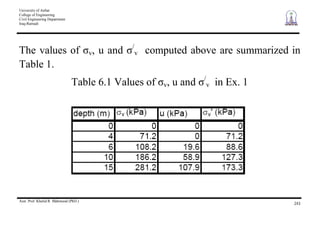
The values of v, u and /
v computed above are summarized in
Table 1.
Table 6.1 Values of v, u and /
v in Ex. 1
University of Anbar
College of Engineering
Civil Engineering Department
Iraq-Ramadi
Asst. Prof. Khalid R. Mahmood (PhD.)
244
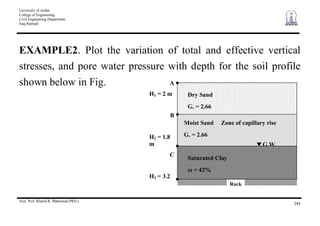
EXAMPLE2. Plot the variation of total and effective vertical
stresses, and pore water pressure with depth for the soil profile
shown below in Fig.
Dry Sand
Gs = 2.66
Moist Sand Zone of capillary rise
Gs = 2.66
Saturated Clay
= 42%
A
H1 = 2 m
B
H2 = 1.8
m
C
H3 = 3.2
m
G.W.
Rock
University of Anbar
College of Engineering
Civil Engineering Department
Iraq-Ramadi
Asst. Prof. Khalid R. Mahmood (PhD.)
245
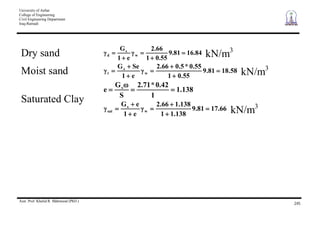
Dry sand 84.1681.9
55.01
66.2
e1
G
w
s
d kN/m3
Moist sand 58.1881.9
55.01
55.0*5.066.2
e1
SeG
w
s
t kN/m3
Saturated Clay
138.1
1
42.0*71.2
S
G
e s
66.1781.9
138.11
138.166.2
e1
eG
w
s
sat kN/m3
University of Anbar
College of Engineering
Civil Engineering Department
Iraq-Ramadi
Asst. Prof. Khalid R. Mahmood (PhD.)
246
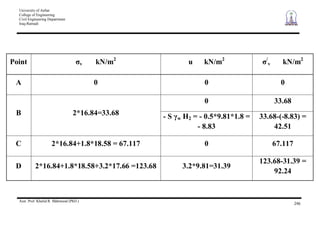
Point v kN/m2
u kN/m2 /
v kN/m2
A 0 0 0
0 33.68
B 2*16.84=33.68 - S w H2 = - 0.5*9.81*1.8 =
- 8.83
33.68-(-8.83) =
42.51
C 2*16.84+1.8*18.58 = 67.117 0 67.117
D 2*16.84+1.8*18.58+3.2*17.66 =123.68 3.2*9.81=31.39
123.68-31.39 =
92.24
University of Anbar
College of Engineering
Civil Engineering Department
Iraq-Ramadi
Asst. Prof. Khalid R. Mahmood (PhD.)
247
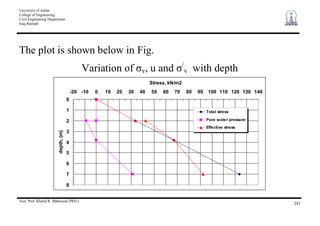
The plot is shown below in Fig.
Variation of v, u and /
v with depth
0
1
2
3
4
5
6
7
8
-20 -10 0 10 20 30 40 50 60 70 80 90 100 110 120 130 140
Stress, kN/m2
depth,(m)
Total stress
Pore water pressure
Effective stress

5 effective stress concept

  • 1.
    University of Anbar Collegeof Engineering Civil Engineering Department Iraq-Ramadi Asst. Prof. Khalid R. Mahmood (PhD.) 215 Effective Stress Concept Topics Effective Stress Concept Effective Stress in Saturated Soil with no Seepage Effective Stress in Saturated Soil with Seepage Seepage Force Filter Requirements and Selection of Filter Material Capillary Rise in Soil Effective Stress in Capillary Zone Water Water Table (W.T.) Ground Surface (G.S.) Air Voids Solid
  • 2.
    University of Anbar Collegeof Engineering Civil Engineering Department Iraq-Ramadi Asst. Prof. Khalid R. Mahmood (PhD.) 216 Effective Stress Concept •Soil is a multi phase system •To perform any kind of analysis - we must understand stress distribution •The concept of effective stress: • The soil is “loaded” (footing for example) • The resulting stress is transmitted to the soil mass • The soil mass supports those stresses at the point to point contacts of the individual soil grains
  • 3.
    University of Anbar Collegeof Engineering Civil Engineering Department Iraq-Ramadi Asst. Prof. Khalid R. Mahmood (PhD.) 217 The total stress at A is calculated from: The weight of the soil above A The weight of the water above A = H w + (HA - H) sat = Total Stress at A w = Unit Weight of Water sat = Saturated Unit Weight HA = Height of A to Top of water H = Height of water
  • 4.
    University of Anbar Collegeof Engineering Civil Engineering Department Iraq-Ramadi Asst. Prof. Khalid R. Mahmood (PhD.) 218 • is the stress applied to the soil by its own weight • As you go deeper in the soil mass, the stress increases • The soil carries the stress in 2 ways: • A portion is carried by the water (acts equally in all directions) • A portion is carried by the soil solids at their point of contact.
  • 5.
    University of Anbar Collegeof Engineering Civil Engineering Department Iraq-Ramadi Asst. Prof. Khalid R. Mahmood (PhD.) 219 / = (P1v+P2v+P3v .....+Pnv) / A If as = a1 + a2 + a3 +...an Then the space occupied by water = A - as Assume u = HA w HA = Height of water = / + u(A - as) / A
  • 6.
    University of Anbar Collegeof Engineering Civil Engineering Department Iraq-Ramadi Asst. Prof. Khalid R. Mahmood (PhD.) 220 Since as is very small, assume = 0 = / + u Recall the following equation: = H w + (HA - H) sat Now, / = - u Substituting: / = [H w + (HA - H) sat] - HA w Rearranging: / = (HA - H)( sat - w) = Hsoil / Effective Stress is independent of height of water In the equation: = / + u / is the soil skeleton stress u is the stress in the water, or pore water pressure
  • 7.
    University of Anbar Collegeof Engineering Civil Engineering Department Iraq-Ramadi Asst. Prof. Khalid R. Mahmood (PhD.) 221 Effective Stress in Saturated Soil with no Seepage
  • 8.
    University of Anbar Collegeof Engineering Civil Engineering Department Iraq-Ramadi Asst. Prof. Khalid R. Mahmood (PhD.) 222 Effective Stress in Saturated Soil with Seepage Upward flow
  • 9.
    University of Anbar Collegeof Engineering Civil Engineering Department Iraq-Ramadi Asst. Prof. Khalid R. Mahmood (PhD.) 223 Note that the h/H2 is the hydraulic gradient that caused flow therefore, wc izz And limiting conditions may occur when 0wc izz which lead to icr = critical hydraulic gradient w cri for most soils 0.9-1.1 ith average value of 1
  • 10.
    University of Anbar Collegeof Engineering Civil Engineering Department Iraq-Ramadi Asst. Prof. Khalid R. Mahmood (PhD.) 224 Downward flow
  • 11.
    University of Anbar Collegeof Engineering Civil Engineering Department Iraq-Ramadi Asst. Prof. Khalid R. Mahmood (PhD.) 225 Seepage Force Azp1 Aizforceseepage forceseepagepAizzp w w 12 )( Aizforceseepage forceseepagepAizzp w w 33 )(
  • 12.
    University of Anbar Collegeof Engineering Civil Engineering Department Iraq-Ramadi Asst. Prof. Khalid R. Mahmood (PhD.) 226 The volume of the soil contributing to the effective stress force equals zA, so the seepage force per unit volume of the soil is w w i zA Aiz in the direction of seepage (see the fig.) Therefore, in isotropic soil and in any direction, the force acts in the same direction as the direction of flow. Thus, the flow nets can be used to find the hydraulic gradient at any point to find seepage force at that point. This concept is useful to estimate F.S against heave
  • 13.
    University of Anbar Collegeof Engineering Civil Engineering Department Iraq-Ramadi Asst. Prof. Khalid R. Mahmood (PhD.) 227 Factor of Safety against heave at the downstream of hydraulic structures Terzaghi (1922) H1 H2 Sheet pile Impermeable layer Permeable layer D D/2 D D/2 W U Heave zone
  • 14.
    University of Anbar Collegeof Engineering Civil Engineering Department Iraq-Ramadi Asst. Prof. Khalid R. Mahmood (PhD.) 228 wav wav wav wsat i iD D ixvolumesoil DD U W seepagebycausedforceUplift weightSubmerged SF 2 2 2 1 2 1 )( ))(2/( .
  • 15.
    University of Anbar Collegeof Engineering Civil Engineering Department Iraq-Ramadi Asst. Prof. Khalid R. Mahmood (PhD.) 229 Estimation of iav a b c e d nd = 10 Drivinghead a b c
  • 16.
    University of Anbar Collegeof Engineering Civil Engineering Department Iraq-Ramadi Asst. Prof. Khalid R. Mahmood (PhD.) 230 point driving head a H 10 4 b H 10 7.6 c H 10 5.2 D h i hhh h av av bca av 2 2/)(
  • 17.
    University of Anbar Collegeof Engineering Civil Engineering Department Iraq-Ramadi Asst. Prof. Khalid R. Mahmood (PhD.) 231 Filter Requirements and Selection of Filter Material In practice, for the safe of the hydraulic structure, a minimum value of 4 to 5 for F.S against heaving is used, because of the uncertainty in the analysis. One way to increase the F.S is using filter. Filter:- is a granular material with opening small enough to prevent the movement of the soil particles upon which is placed and, at the same time, is previous enough to offer little resistance to seepage through it.
  • 18.
    University of Anbar Collegeof Engineering Civil Engineering Department Iraq-Ramadi Asst. Prof. Khalid R. Mahmood (PhD.) 232 a b c e d nd = 10 D D/2 W W U D1
  • 19.
    University of Anbar Collegeof Engineering Civil Engineering Department Iraq-Ramadi Asst. Prof. Khalid R. Mahmood (PhD.) 233 wav F wav F F i D D iD DDD U WW SF 1 2 1 2 2 1 2 1 2 1 .
  • 20.
    University of Anbar Collegeof Engineering Civil Engineering Department Iraq-Ramadi Asst. Prof. Khalid R. Mahmood (PhD.) 234 Selection of Filter Material Capillary R
  • 21.
    University of Anbar Collegeof Engineering Civil Engineering Department Iraq-Ramadi Asst. Prof. Khalid R. Mahmood (PhD.) 235 Capillarity rise in Soil
  • 22.
    University of Anbar Collegeof Engineering Civil Engineering Department Iraq-Ramadi Asst. Prof. Khalid R. Mahmood (PhD.) 236 For pure water and clean glass = 0 w c d T h 4 For water T = 72 m.N/m d hc 1 the smaller the capillarity tube, the larger capillary rise
  • 23.
    University of Anbar Collegeof Engineering Civil Engineering Department Iraq-Ramadi Asst. Prof. Khalid R. Mahmood (PhD.) 237 For soils, the capillary tubes formed because of the continuity of voids have variable cross sections. The results of the nonuniformity on capillary can be demonstrated as shown in the fig. Variation of S in the soil
  • 24.
    University of Anbar Collegeof Engineering Civil Engineering Department Iraq-Ramadi Asst. Prof. Khalid R. Mahmood (PhD.) 238 Hazen (1930) give a formula to estimate the height of capillary 10 )( eD C mmh c
  • 25.
    University of Anbar Collegeof Engineering Civil Engineering Department Iraq-Ramadi Asst. Prof. Khalid R. Mahmood (PhD.) 239 Effective Stress in Capillary Zone The general relationship of effective stress is u For soil fully saturated by capillary wchu For soil partially saturated by capillary wch S u 100
  • 26.
    University of Anbar Collegeof Engineering Civil Engineering Department Iraq-Ramadi Asst. Prof. Khalid R. Mahmood (PhD.) 240 Examples EXAMPLE1. Plot the variation of total and effective vertical stresses, and pore water pressure with depth for the soil profile shown below in Fig.
  • 27.
    University of Anbar Collegeof Engineering Civil Engineering Department Iraq-Ramadi Asst. Prof. Khalid R. Mahmood (PhD.) 241
  • 28.
    University of Anbar Collegeof Engineering Civil Engineering Department Iraq-Ramadi Asst. Prof. Khalid R. Mahmood (PhD.) 242
  • 29.
    University of Anbar Collegeof Engineering Civil Engineering Department Iraq-Ramadi Asst. Prof. Khalid R. Mahmood (PhD.) 243 The values of v, u and / v computed above are summarized in Table 1. Table 6.1 Values of v, u and / v in Ex. 1
  • 30.
    University of Anbar Collegeof Engineering Civil Engineering Department Iraq-Ramadi Asst. Prof. Khalid R. Mahmood (PhD.) 244 EXAMPLE2. Plot the variation of total and effective vertical stresses, and pore water pressure with depth for the soil profile shown below in Fig. Dry Sand Gs = 2.66 Moist Sand Zone of capillary rise Gs = 2.66 Saturated Clay = 42% A H1 = 2 m B H2 = 1.8 m C H3 = 3.2 m G.W. Rock
  • 31.
    University of Anbar Collegeof Engineering Civil Engineering Department Iraq-Ramadi Asst. Prof. Khalid R. Mahmood (PhD.) 245 Dry sand 84.1681.9 55.01 66.2 e1 G w s d kN/m3 Moist sand 58.1881.9 55.01 55.0*5.066.2 e1 SeG w s t kN/m3 Saturated Clay 138.1 1 42.0*71.2 S G e s 66.1781.9 138.11 138.166.2 e1 eG w s sat kN/m3
  • 32.
    University of Anbar Collegeof Engineering Civil Engineering Department Iraq-Ramadi Asst. Prof. Khalid R. Mahmood (PhD.) 246 Point v kN/m2 u kN/m2 / v kN/m2 A 0 0 0 0 33.68 B 2*16.84=33.68 - S w H2 = - 0.5*9.81*1.8 = - 8.83 33.68-(-8.83) = 42.51 C 2*16.84+1.8*18.58 = 67.117 0 67.117 D 2*16.84+1.8*18.58+3.2*17.66 =123.68 3.2*9.81=31.39 123.68-31.39 = 92.24
  • 33.
    University of Anbar Collegeof Engineering Civil Engineering Department Iraq-Ramadi Asst. Prof. Khalid R. Mahmood (PhD.) 247 The plot is shown below in Fig. Variation of v, u and / v with depth 0 1 2 3 4 5 6 7 8 -20 -10 0 10 20 30 40 50 60 70 80 90 100 110 120 130 140 Stress, kN/m2 depth,(m) Total stress Pore water pressure Effective stress