Use of Advanced StackTesting
Technologies to Perform DSI
Evaluation Studies
Thomas A. Dunder, Ph.D.
Principal Scientist - FTIR Emissions Testing
TRC Environmental Corporation
EUEC Paper C5 -1, February 4, 2014
Phoenix, Arizona
1
The Challenge – Accurate, Real-
Time, Multi-Location Data
2
 Dry sorbent injection (DSI) is an option for utilities to
control SO2, acid gases (HCl, HF) and mercury (Hg)
emissions. There are numerous sorbent options
specifically for SO2/acid gases or Hg control
 DSI must be evaluated at each facility to determine
optimal sorbents, injection rate, and injection points.
 DSI studies require accurate and sensitive real-time
emissions/removal efficiency data to identify the
ideal sorbent parameters. There are testing options
that vary in cost and data quality.
 Costly decisions are made based on a DSI
evaluation so quality data is critical.
Consideration for DSI Evaluation –
Testing Prospective
 Sorbent (Lime, SBC, Trona (Acid Gas/SO2),
PAC (Hg), newly developed sorbents)
◦ Vary in cost, effectiveness
 Injection Rate to meet MATS limits
 Injection Location
◦ Maximize gas-particle interaction
 Sorbent Particle Size – on-site mill?
 Sorbent Interaction
◦ Sorbent-Sorbent (PAC/Acid Gas Sorbents)
◦ NH3/SO3 added to gas stream
3
DSI Evaluation Data Requirements
 Removal efficiency for HCl, HF, SO2 and Hg
as a function of sorbent and injection rate
 Extended test periods to ensure stable
plant and sorbent equilibration conditions
 On-site data to evaluate DSI effectiveness
and modify injection rates as needed
 Mapping of removal efficiency over a
range of injection conditions to ensure MATS
compliance now and in the future
 Detailed test plan with close coordination
between plant, DSI vendor, and test team
4
What needs to be measured?
 Acid Gases (HCl, HF) – removal efficiency
 Mercury (elemental, oxidized, particle bound)
– removal efficiency
 Sulfur Dioxide - removal efficiency
 Particulate Matter – demonstrate no
emissions impact due to sorbent
 O2/CO2 – emission rate determination
 Fuel Analysis – F Factor for lb/MMBtu
emission rate (cannot use ppmin vs ppmout)
5
What are the Testing Options?
 Multiple test methods available for acid
gases, mercury, SO2
◦ “manual” methods- impinger, sorbent tube
◦ real-time instrumental technologies
 Data collection points
◦ Measure at stack only (DSI off=baseline)
◦ Measure upstream/downstream of DSI
injection for true removal efficiency
◦ Stack-only data assumes no variation in
plant emissions/DSI rates to determine
removal efficiencies. 6
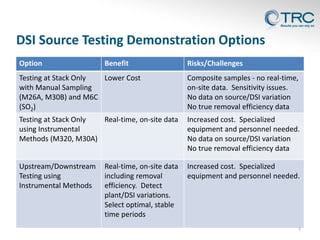
DSI Source Testing Demonstration Options
Option Benefit Risks/Challenges
Testing at Stack Only
with Manual Sampling
(M26A, M30B) and M6C
(SO2)
Lower Cost Composite samples - no real-time,
on-site data. Sensitivity issues.
No data on source/DSI variation
No true removal efficiency data
Testing at Stack Only
using Instrumental
Methods (M320, M30A)
Real-time, on-site data Increased cost. Specialized
equipment and personnel needed.
No data on source/DSI variation
No true removal efficiency data
Upstream/Downstream
Testing using
Instrumental Methods
Real-time, on-site data
including removal
efficiency. Detect
plant/DSI variations.
Select optimal, stable
time periods
Increased cost. Specialized
equipment and personnel needed.
7
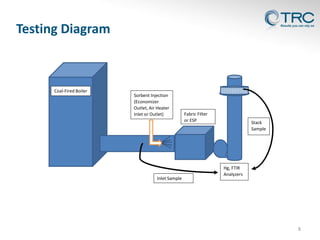
Testing Diagram
8
Fabric Filter
or ESP
Coal-Fired Boiler
Sorbent Injection
(Economizer
Outlet, Air Heater
Inlet or Outlet)
Inlet Sample
Stack
Sample
Hg, FTIR
Analyzers
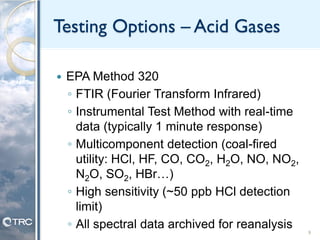
Testing Options – Acid Gases
 EPA Method 320
◦ FTIR (Fourier Transform Infrared)
◦ Instrumental Test Method with real-time
data (typically 1 minute response)
◦ Multicomponent detection (coal-fired
utility: HCl, HF, CO, CO2, H2O, NO, NO2,
N2O, SO2, HBr…)
◦ High sensitivity (~50 ppb HCl detection
limit)
◦ All spectral data archived for reanalysis
9
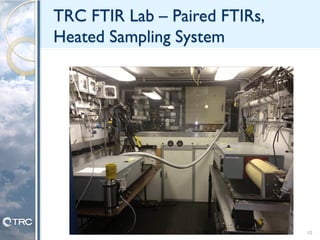
TRC FTIR Lab – Paired FTIRs,
Heated Sampling System
10
Mercury Testing Options
 Mercury can be measured by sorbent tube
(M30B) or real-time analyzer (M30A)
 Instrumental analysis gives speciated
(elemental/oxidized Hg) and continuous, 24
hour/day data
 Sorbent tubes can be analyzed on site for
same day data
 Equipment costs higher for instrumental
analysis, manpower costs higher for
sorbent tube
11
Real-Time Inlet/Outlet Testing
 Simultaneous data allows determination of:
◦ Plant stability
 Conditions like load change, plant upset, and
soot blow are not appropriate to determine DSI
efficiency
◦ DSI Stability
 Variable injection rate or injection interruption
conditions not appropriate
 Allow DSI to equilibrate – can take hours
 Equilibration critical for Fabric Filters
◦ Select data from stable plant/DSI time
periods to calculate efficiency 12
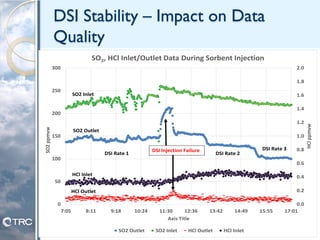
DSI Stability – Impact on Data
Quality
13
0.0
0.2
0.4
0.6
0.8
1.0
1.2
1.4
1.6
1.8
2.0
0
50
100
150
200
250
300
7:05 8:11 9:18 10:24 11:30 12:36 13:42 14:49 15:55 17:01
HClppmvw
SO2ppmvw
Axis Title
SO2, HCl Inlet/Outlet Data During Sorbent Injection
SO2 Outlet SO2 Inlet HCl Outlet HCl Inlet
SO2 Inlet
SO2 Outlet
HCl Inlet
HCl Outlet
DSI Rate 1 DSI Rate 2
DSI Rate 3DSI Injection Failure
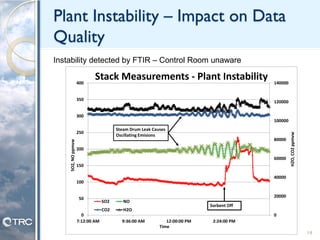
Plant Instability – Impact on Data
Quality
0
20000
40000
60000
80000
100000
120000
140000
0
50
100
150
200
250
300
350
400
7:12:00 AM 9:36:00 AM 12:00:00 PM 2:24:00 PM
H2O,CO2ppmvw
SO2,NOppmvw
Time
Stack Measurements - Plant Instability
SO2 NO
CO2 H2O
Steam Drum Leak Causes
Oscillating Emisions
Sorbent Off
14
Instability detected by FTIR – Control Room unaware
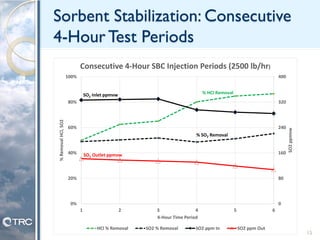
Sorbent Stabilization: Consecutive
4-Hour Test Periods
0
80
160
240
320
400
0%
20%
40%
60%
80%
100%
1 2 3 4 5 6
SO2ppmvw
%RemovalHCl,SO2
4-Hour Time Period
Consecutive 4-Hour SBC Injection Periods (2500 lb/hr)
HCl % Removal SO2 % Removal SO2 ppm In SO2 ppm Out
% HCl Removal
% SO2 Removal
SO2 Inlet ppmvw
SO2 Outlet ppmvw
15
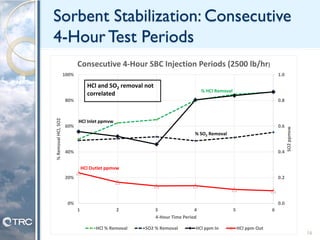
Sorbent Stabilization: Consecutive
4-Hour Test Periods
0.0
0.2
0.4
0.6
0.8
1.0
0%
20%
40%
60%
80%
100%
1 2 3 4 5 6
SO2ppmvw
%RemovalHCl,SO2
4-Hour Time Period
Consecutive 4-Hour SBC Injection Periods (2500 lb/hr)
HCl % Removal SO2 % Removal HCl ppm In HCl ppm Out
% HCl Removal
% SO2 Removal
HCl Inlet ppmvw
HCl Outlet ppmvw
HCl and SO2 removal not
correlated
16
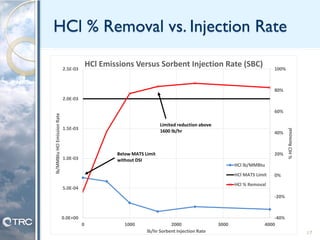
HCl % Removal vs. Injection Rate
-40%
-20%
0%
20%
40%
60%
80%
100%
0.0E+00
5.0E-04
1.0E-03
1.5E-03
2.0E-03
2.5E-03
0 1000 2000 3000 4000
%HClRemoval
lb/MMBtuHClEmissionRate
lb/hr Sorbent Injection Rate
HCl Emissions Versus Sorbent Injection Rate (SBC)
HCl lb/MMBtu
HCl MATS Limit
HCl % Removal
Below MATS Limit
without DSI
Limited reduction above
1600 lb/hr
17
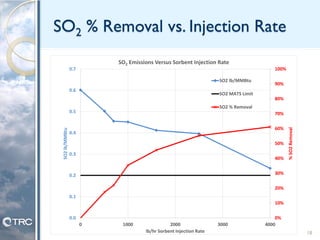
SO2 % Removal vs. Injection Rate
0%
10%
20%
30%
40%
50%
60%
70%
80%
90%
100%
0.0
0.1
0.2
0.3
0.4
0.5
0.6
0.7
0 1000 2000 3000 4000
%SO2Removal
SO2lb/MMBtu
lb/hr Sorbent Injection Rate
SO2 Emissions Versus Sorbent Injection Rate
SO2 lb/MMBtu
SO2 MATS Limit
SO2 % Removal
18
QA Considerations for DSI
Evaluations (FTIRTesting)
 Primary focus of testing is long term,
extended measurements with minimal
downtime for QA procedures
 Generally follow EPA Method requirements
with addition of:
◦ Measure one source with both FTIRs
simultaneously to verify inter-agreement
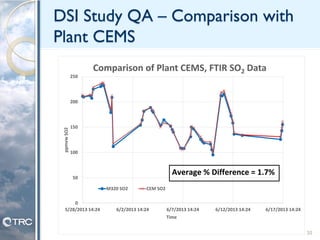
◦ Compare Plant CEMS data with FTIR (CO2, CO,
NOx, SO2)
◦ Compare FTIR data with other methods (M5
moisture)
19
DSI Study QA – Comparison with
Plant CEMS
0
50
100
150
200
250
5/28/2013 14:24 6/2/2013 14:24 6/7/2013 14:24 6/12/2013 14:24 6/17/2013 14:24
ppmvwSO2
Time
Comparison of Plant CEMS, FTIR SO2 Data
M320 SO2 CEM SO2
Average % Difference = 1.7%
20
Practical Testing Considerations
 Extended test- continuous 24/7
◦ Instrument/Sampling System Reliability
 Sampling System Issues
◦ Long sample lines @ 350 oF
◦ Inlet sampling – high particulate
 Monitor pump vacuum, utilize blowback
 Potential inlet scrubbing due to PM in probe filter
 Data reduced daily to select stable time
periods and reduce data (wet-dry, lb/MMBtu
calculation, % removal determination) to
provide feedback to EGU and DSI vendor 21
Test Data Feeds Into DSI Selection
 Test firm provides daily on-site data
summaries and final data (removal
efficiency, emission rate) to EGU and DSI
vendor
 EGU and DSI vendor process data to
compare sorbents and determine optimal
injection conditions
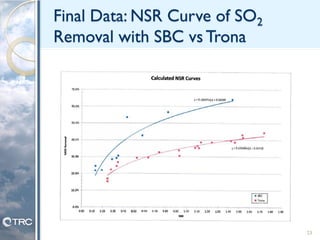
 Convert data to NSR (normalized
stoichiometric ratio) basis to allow sorbents
to be compared
22
Final Data: NSR Curve of SO2
Removal with SBC vs Trona
23
Conclusions
 Advanced instrumental stack testing
technologies like FTIR and Mercury CEMS
provide the time resolved, speciated data
needed for DSI evaluation
 Challenge for emissions testing firms to
provide advanced technology
instrumentation and perform the data-
intensive analysis, including on-site results
24
25
Thanks for your attention
Any questions?
Thomas A. Dunder, Ph.D.
919.256.6242
tdunder@trcsolutions.com
www.trcsolutioons.com

Stack Testing Technologies for DSI Evaluation Studies

  • 1.
    Use of AdvancedStackTesting Technologies to Perform DSI Evaluation Studies Thomas A. Dunder, Ph.D. Principal Scientist - FTIR Emissions Testing TRC Environmental Corporation EUEC Paper C5 -1, February 4, 2014 Phoenix, Arizona 1
  • 2.
    The Challenge –Accurate, Real- Time, Multi-Location Data 2  Dry sorbent injection (DSI) is an option for utilities to control SO2, acid gases (HCl, HF) and mercury (Hg) emissions. There are numerous sorbent options specifically for SO2/acid gases or Hg control  DSI must be evaluated at each facility to determine optimal sorbents, injection rate, and injection points.  DSI studies require accurate and sensitive real-time emissions/removal efficiency data to identify the ideal sorbent parameters. There are testing options that vary in cost and data quality.  Costly decisions are made based on a DSI evaluation so quality data is critical.
  • 3.
    Consideration for DSIEvaluation – Testing Prospective  Sorbent (Lime, SBC, Trona (Acid Gas/SO2), PAC (Hg), newly developed sorbents) ◦ Vary in cost, effectiveness  Injection Rate to meet MATS limits  Injection Location ◦ Maximize gas-particle interaction  Sorbent Particle Size – on-site mill?  Sorbent Interaction ◦ Sorbent-Sorbent (PAC/Acid Gas Sorbents) ◦ NH3/SO3 added to gas stream 3
  • 4.
    DSI Evaluation DataRequirements  Removal efficiency for HCl, HF, SO2 and Hg as a function of sorbent and injection rate  Extended test periods to ensure stable plant and sorbent equilibration conditions  On-site data to evaluate DSI effectiveness and modify injection rates as needed  Mapping of removal efficiency over a range of injection conditions to ensure MATS compliance now and in the future  Detailed test plan with close coordination between plant, DSI vendor, and test team 4
  • 5.
    What needs tobe measured?  Acid Gases (HCl, HF) – removal efficiency  Mercury (elemental, oxidized, particle bound) – removal efficiency  Sulfur Dioxide - removal efficiency  Particulate Matter – demonstrate no emissions impact due to sorbent  O2/CO2 – emission rate determination  Fuel Analysis – F Factor for lb/MMBtu emission rate (cannot use ppmin vs ppmout) 5
  • 6.
    What are theTesting Options?  Multiple test methods available for acid gases, mercury, SO2 ◦ “manual” methods- impinger, sorbent tube ◦ real-time instrumental technologies  Data collection points ◦ Measure at stack only (DSI off=baseline) ◦ Measure upstream/downstream of DSI injection for true removal efficiency ◦ Stack-only data assumes no variation in plant emissions/DSI rates to determine removal efficiencies. 6
  • 7.
    DSI Source TestingDemonstration Options Option Benefit Risks/Challenges Testing at Stack Only with Manual Sampling (M26A, M30B) and M6C (SO2) Lower Cost Composite samples - no real-time, on-site data. Sensitivity issues. No data on source/DSI variation No true removal efficiency data Testing at Stack Only using Instrumental Methods (M320, M30A) Real-time, on-site data Increased cost. Specialized equipment and personnel needed. No data on source/DSI variation No true removal efficiency data Upstream/Downstream Testing using Instrumental Methods Real-time, on-site data including removal efficiency. Detect plant/DSI variations. Select optimal, stable time periods Increased cost. Specialized equipment and personnel needed. 7
  • 8.
    Testing Diagram 8 Fabric Filter orESP Coal-Fired Boiler Sorbent Injection (Economizer Outlet, Air Heater Inlet or Outlet) Inlet Sample Stack Sample Hg, FTIR Analyzers
  • 9.
    Testing Options –Acid Gases  EPA Method 320 ◦ FTIR (Fourier Transform Infrared) ◦ Instrumental Test Method with real-time data (typically 1 minute response) ◦ Multicomponent detection (coal-fired utility: HCl, HF, CO, CO2, H2O, NO, NO2, N2O, SO2, HBr…) ◦ High sensitivity (~50 ppb HCl detection limit) ◦ All spectral data archived for reanalysis 9
  • 10.
    TRC FTIR Lab– Paired FTIRs, Heated Sampling System 10
  • 11.
    Mercury Testing Options Mercury can be measured by sorbent tube (M30B) or real-time analyzer (M30A)  Instrumental analysis gives speciated (elemental/oxidized Hg) and continuous, 24 hour/day data  Sorbent tubes can be analyzed on site for same day data  Equipment costs higher for instrumental analysis, manpower costs higher for sorbent tube 11
  • 12.
    Real-Time Inlet/Outlet Testing Simultaneous data allows determination of: ◦ Plant stability  Conditions like load change, plant upset, and soot blow are not appropriate to determine DSI efficiency ◦ DSI Stability  Variable injection rate or injection interruption conditions not appropriate  Allow DSI to equilibrate – can take hours  Equilibration critical for Fabric Filters ◦ Select data from stable plant/DSI time periods to calculate efficiency 12
  • 13.
    DSI Stability –Impact on Data Quality 13 0.0 0.2 0.4 0.6 0.8 1.0 1.2 1.4 1.6 1.8 2.0 0 50 100 150 200 250 300 7:05 8:11 9:18 10:24 11:30 12:36 13:42 14:49 15:55 17:01 HClppmvw SO2ppmvw Axis Title SO2, HCl Inlet/Outlet Data During Sorbent Injection SO2 Outlet SO2 Inlet HCl Outlet HCl Inlet SO2 Inlet SO2 Outlet HCl Inlet HCl Outlet DSI Rate 1 DSI Rate 2 DSI Rate 3DSI Injection Failure
  • 14.
    Plant Instability –Impact on Data Quality 0 20000 40000 60000 80000 100000 120000 140000 0 50 100 150 200 250 300 350 400 7:12:00 AM 9:36:00 AM 12:00:00 PM 2:24:00 PM H2O,CO2ppmvw SO2,NOppmvw Time Stack Measurements - Plant Instability SO2 NO CO2 H2O Steam Drum Leak Causes Oscillating Emisions Sorbent Off 14 Instability detected by FTIR – Control Room unaware
  • 15.
    Sorbent Stabilization: Consecutive 4-HourTest Periods 0 80 160 240 320 400 0% 20% 40% 60% 80% 100% 1 2 3 4 5 6 SO2ppmvw %RemovalHCl,SO2 4-Hour Time Period Consecutive 4-Hour SBC Injection Periods (2500 lb/hr) HCl % Removal SO2 % Removal SO2 ppm In SO2 ppm Out % HCl Removal % SO2 Removal SO2 Inlet ppmvw SO2 Outlet ppmvw 15
  • 16.
    Sorbent Stabilization: Consecutive 4-HourTest Periods 0.0 0.2 0.4 0.6 0.8 1.0 0% 20% 40% 60% 80% 100% 1 2 3 4 5 6 SO2ppmvw %RemovalHCl,SO2 4-Hour Time Period Consecutive 4-Hour SBC Injection Periods (2500 lb/hr) HCl % Removal SO2 % Removal HCl ppm In HCl ppm Out % HCl Removal % SO2 Removal HCl Inlet ppmvw HCl Outlet ppmvw HCl and SO2 removal not correlated 16
  • 17.
    HCl % Removalvs. Injection Rate -40% -20% 0% 20% 40% 60% 80% 100% 0.0E+00 5.0E-04 1.0E-03 1.5E-03 2.0E-03 2.5E-03 0 1000 2000 3000 4000 %HClRemoval lb/MMBtuHClEmissionRate lb/hr Sorbent Injection Rate HCl Emissions Versus Sorbent Injection Rate (SBC) HCl lb/MMBtu HCl MATS Limit HCl % Removal Below MATS Limit without DSI Limited reduction above 1600 lb/hr 17
  • 18.
    SO2 % Removalvs. Injection Rate 0% 10% 20% 30% 40% 50% 60% 70% 80% 90% 100% 0.0 0.1 0.2 0.3 0.4 0.5 0.6 0.7 0 1000 2000 3000 4000 %SO2Removal SO2lb/MMBtu lb/hr Sorbent Injection Rate SO2 Emissions Versus Sorbent Injection Rate SO2 lb/MMBtu SO2 MATS Limit SO2 % Removal 18
  • 19.
    QA Considerations forDSI Evaluations (FTIRTesting)  Primary focus of testing is long term, extended measurements with minimal downtime for QA procedures  Generally follow EPA Method requirements with addition of: ◦ Measure one source with both FTIRs simultaneously to verify inter-agreement ◦ Compare Plant CEMS data with FTIR (CO2, CO, NOx, SO2) ◦ Compare FTIR data with other methods (M5 moisture) 19
  • 20.
    DSI Study QA– Comparison with Plant CEMS 0 50 100 150 200 250 5/28/2013 14:24 6/2/2013 14:24 6/7/2013 14:24 6/12/2013 14:24 6/17/2013 14:24 ppmvwSO2 Time Comparison of Plant CEMS, FTIR SO2 Data M320 SO2 CEM SO2 Average % Difference = 1.7% 20
  • 21.
    Practical Testing Considerations Extended test- continuous 24/7 ◦ Instrument/Sampling System Reliability  Sampling System Issues ◦ Long sample lines @ 350 oF ◦ Inlet sampling – high particulate  Monitor pump vacuum, utilize blowback  Potential inlet scrubbing due to PM in probe filter  Data reduced daily to select stable time periods and reduce data (wet-dry, lb/MMBtu calculation, % removal determination) to provide feedback to EGU and DSI vendor 21
  • 22.
    Test Data FeedsInto DSI Selection  Test firm provides daily on-site data summaries and final data (removal efficiency, emission rate) to EGU and DSI vendor  EGU and DSI vendor process data to compare sorbents and determine optimal injection conditions  Convert data to NSR (normalized stoichiometric ratio) basis to allow sorbents to be compared 22
  • 23.
    Final Data: NSRCurve of SO2 Removal with SBC vs Trona 23
  • 24.
    Conclusions  Advanced instrumentalstack testing technologies like FTIR and Mercury CEMS provide the time resolved, speciated data needed for DSI evaluation  Challenge for emissions testing firms to provide advanced technology instrumentation and perform the data- intensive analysis, including on-site results 24
  • 25.
    25 Thanks for yourattention Any questions? Thomas A. Dunder, Ph.D. 919.256.6242 tdunder@trcsolutions.com www.trcsolutioons.com