THE ISOLATION, CHARACTERIZATION, AND
IDENTIFICATION OF A BACTERIUM FROM:
STAPHYLOCOCCUS EPIDERMIDIS
Taken from: Stillwell bathroom paper towel dispenser
Hailey Medder
12/08/2016
CULTURE CHARACTERISTICS
Unit Being
Observed
Size Shape Color
Colony 1.0 millimeter Cocci (clusters) Opaque cream
Cell 0.5-.0.7
micrometers
Spherical ‘points’ Opaque cream
Photo by: Brittany H. from
StudyBlue “Microbiology
Final”
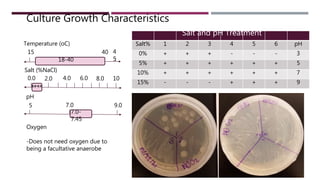
Culture Growth Characteristics
Temperature (oC)
Salt (%NaCl)
pH
Oxygen
-Does not need oxygen due to
being a facultative anaerobe
4
5
15 40
18-40
Salt% 1 2 3 4 5 6 pH
0% + + + - - - 3
5% + + + + + + 5
10% + + + + + + 7
15% - - - + + + 9
Salt and pH Treatment
0.0 102.0 4.0 6.0 8.0
0.0-0.5
5
7.0-
7.45
7.0 9.0
Enteropluri
Glucose fermentation: Yes
Gas production: Partial
Lysine decarboxylation: No
Ornithine decarboxylation: No
Sulfur reduction to H2S:No
Indole produced: No
Adonitol fermentation: No
Lactose fermentation: No
Arabinose fermentation: Partial
Sorbitol fermentation: No
Acetoin production (VP):No
Dulcitol fermentation: No
Phenylalanine deamination:
No
Urea hydrolysis: Yes
Citrate utilization: No
Motility
- No
Oxidase
- No
Catalase
- Yes
Source: ResearchGate
Source:
Microbeinfo.com
Blood agar
Maconkey agar
Although there were tons of colonies present, the
S. epidermidis did not hemolyze the blood agar.
There was absolutely no growth
on this Maconkey agar.
Positive gram stain
DNA SEQUENCES: DATA FOR 16S RDNA ANALYZED USING THE RIBOSOMAL
DATABASE PROJECT
Database Name % Match Environment
Type Cultures
Only
Staphylococcus epidermidis 99.3 Clinical isolates in a Japanese zoo
Staphylococcus capitis 97.3 Japanese veterinary school
Staphylococcus capitis 96.4 Skin samples
Staphylococcus caprae 96.3 Japanese rRNA samples
Staphylococcus
saccharolyticus
95.8 Tissue samples
All RDP Records
Staphylococcus epidermidis 100 GenBank in Northern Ireland
Staphylococcus epidermidis 100 Topoisomerase of isolates
Staphylococcus sp. 100 Wastewater in India
Staphylococcus sp. 100 Bluegill mucus in Japan
DNA Sequences: Data
for 16s rDNA Analyzed
using the Ribosomal
Database Project
Phylum: Firmicutes
Class: Bacilli
Order: Bacillales
Family:
Staphylococcacea
Genus: Staphylococcus
COMPARATIVE CHARACTERISTICS TABLE
Test S. aureus S. caprae S. haemolyticus S. epidermidis
Growth at 40ºC + + + +
Growth at pH 4 - - - -
Growth in 2% NaCl + + + +
Hydrolysis of Tween
80
- - - -
Hemolyze blood cells + + - -
Acid from glucose + - + +
Acid from raffinose - - - -
Triclosan resistnce - - - -
Capsules present + + + +
Nitrate reduction - + + -
HAVE YOU IDENTIFIED A NEW SPECIES OF BACTERIA?
No
No I have not identified a new bacterial species. I
know this because the data found on this species
was published in multiple scholarly articles as well
as in the Bergey’s Manual dating back to the early
1880’s.
ABSTRACT
Cells are Gram-positive, non-spore-forming, non-motile spheres approximately 0.5 μm in
diameter. Colonies are creamy, circular, smooth, and 1.0 μm in diameter after 48 hour
incubation at 37°C on R2A. The species could grow over10 μm from a range of salt
concentrations from 0-0.5%, from pH 7.0-7.45, and at 37°C. Cultures are facultatively anaerobic,
catalase-positive, and oxidase-negative. Colonies are non-hemolytic. Acid is produced from d-
glucose, maltose, and partially from l-arabinose, but not from glycerol, glycogen, inulin, d-
lactose, d-mannitol, raffinose, d-ribose, d-sorbitol, sucrose, trehalose or d-xylose. Hippurate,
gelatin, and aesculin are not hydrolysed but starch and urea are. It does not utilize citrate.
Nitrate is not reduced. Acetoin production is negative. Cells produce capsules but not flagella.
No H2S is formed metabolically. DNAse and lipase activity are not present. Cells are susceptible
to penicillin. The 16S rDNA sequence obtained from the culture revealed it to belong to the
phylum Firmicutes, class Bacilli, order Bacillales, family Staphylococcaceae, and genus
Staphylococcus. The closest relative of the culture is S. capitis, which has a 97.3% sequence
homology to the isolate.
The strain was isolated from the paper towel dispenser handle in Cullowhee, North Carolina and
is given the name Staphylococcus epidermidis.
REFERENCES
ATCC, https://www.atcc.org/Products/All/CRM-12228.aspx#culturemethod
S., F. A., Buchanan, R. E., Gibbons, N. E., & B. (1975). Bergey's Manual of Determinative Bacteriology. Taxon,
24(2/3), 377. doi:10.2307/1218353
Staphylococcus Genus Characteristics, http://biolabs.tmcc.edu/Micro%20Web/Staph.pdf
IJSEM database
M. B. (2004, September 27). Staphylococcus epidrmidis. Staphylococcus Epidrmidis. Retrieved
December 6, 2016, from http://web.uconn.edu/mcbstaff/graf/Student presentations/S
epidermidis/sepidermidis.html
https://www.ncbi.nlm.nih.gov/pubmed/9554167
Questions?
Please be kind!

Micro Lab Final Presentation

  • 1.
    THE ISOLATION, CHARACTERIZATION,AND IDENTIFICATION OF A BACTERIUM FROM: STAPHYLOCOCCUS EPIDERMIDIS Taken from: Stillwell bathroom paper towel dispenser Hailey Medder 12/08/2016
  • 2.
    CULTURE CHARACTERISTICS Unit Being Observed SizeShape Color Colony 1.0 millimeter Cocci (clusters) Opaque cream Cell 0.5-.0.7 micrometers Spherical ‘points’ Opaque cream Photo by: Brittany H. from StudyBlue “Microbiology Final”
  • 3.
    Culture Growth Characteristics Temperature(oC) Salt (%NaCl) pH Oxygen -Does not need oxygen due to being a facultative anaerobe 4 5 15 40 18-40 Salt% 1 2 3 4 5 6 pH 0% + + + - - - 3 5% + + + + + + 5 10% + + + + + + 7 15% - - - + + + 9 Salt and pH Treatment 0.0 102.0 4.0 6.0 8.0 0.0-0.5 5 7.0- 7.45 7.0 9.0
  • 4.
    Enteropluri Glucose fermentation: Yes Gasproduction: Partial Lysine decarboxylation: No Ornithine decarboxylation: No Sulfur reduction to H2S:No Indole produced: No Adonitol fermentation: No Lactose fermentation: No Arabinose fermentation: Partial Sorbitol fermentation: No Acetoin production (VP):No Dulcitol fermentation: No Phenylalanine deamination: No Urea hydrolysis: Yes Citrate utilization: No Motility - No Oxidase - No Catalase - Yes Source: ResearchGate Source: Microbeinfo.com
  • 5.
    Blood agar Maconkey agar Althoughthere were tons of colonies present, the S. epidermidis did not hemolyze the blood agar. There was absolutely no growth on this Maconkey agar. Positive gram stain
  • 6.
    DNA SEQUENCES: DATAFOR 16S RDNA ANALYZED USING THE RIBOSOMAL DATABASE PROJECT Database Name % Match Environment Type Cultures Only Staphylococcus epidermidis 99.3 Clinical isolates in a Japanese zoo Staphylococcus capitis 97.3 Japanese veterinary school Staphylococcus capitis 96.4 Skin samples Staphylococcus caprae 96.3 Japanese rRNA samples Staphylococcus saccharolyticus 95.8 Tissue samples All RDP Records Staphylococcus epidermidis 100 GenBank in Northern Ireland Staphylococcus epidermidis 100 Topoisomerase of isolates Staphylococcus sp. 100 Wastewater in India Staphylococcus sp. 100 Bluegill mucus in Japan DNA Sequences: Data for 16s rDNA Analyzed using the Ribosomal Database Project Phylum: Firmicutes Class: Bacilli Order: Bacillales Family: Staphylococcacea Genus: Staphylococcus
  • 7.
    COMPARATIVE CHARACTERISTICS TABLE TestS. aureus S. caprae S. haemolyticus S. epidermidis Growth at 40ºC + + + + Growth at pH 4 - - - - Growth in 2% NaCl + + + + Hydrolysis of Tween 80 - - - - Hemolyze blood cells + + - - Acid from glucose + - + + Acid from raffinose - - - - Triclosan resistnce - - - - Capsules present + + + + Nitrate reduction - + + -
  • 8.
    HAVE YOU IDENTIFIEDA NEW SPECIES OF BACTERIA? No No I have not identified a new bacterial species. I know this because the data found on this species was published in multiple scholarly articles as well as in the Bergey’s Manual dating back to the early 1880’s.
  • 9.
    ABSTRACT Cells are Gram-positive,non-spore-forming, non-motile spheres approximately 0.5 μm in diameter. Colonies are creamy, circular, smooth, and 1.0 μm in diameter after 48 hour incubation at 37°C on R2A. The species could grow over10 μm from a range of salt concentrations from 0-0.5%, from pH 7.0-7.45, and at 37°C. Cultures are facultatively anaerobic, catalase-positive, and oxidase-negative. Colonies are non-hemolytic. Acid is produced from d- glucose, maltose, and partially from l-arabinose, but not from glycerol, glycogen, inulin, d- lactose, d-mannitol, raffinose, d-ribose, d-sorbitol, sucrose, trehalose or d-xylose. Hippurate, gelatin, and aesculin are not hydrolysed but starch and urea are. It does not utilize citrate. Nitrate is not reduced. Acetoin production is negative. Cells produce capsules but not flagella. No H2S is formed metabolically. DNAse and lipase activity are not present. Cells are susceptible to penicillin. The 16S rDNA sequence obtained from the culture revealed it to belong to the phylum Firmicutes, class Bacilli, order Bacillales, family Staphylococcaceae, and genus Staphylococcus. The closest relative of the culture is S. capitis, which has a 97.3% sequence homology to the isolate. The strain was isolated from the paper towel dispenser handle in Cullowhee, North Carolina and is given the name Staphylococcus epidermidis.
  • 10.
    REFERENCES ATCC, https://www.atcc.org/Products/All/CRM-12228.aspx#culturemethod S., F.A., Buchanan, R. E., Gibbons, N. E., & B. (1975). Bergey's Manual of Determinative Bacteriology. Taxon, 24(2/3), 377. doi:10.2307/1218353 Staphylococcus Genus Characteristics, http://biolabs.tmcc.edu/Micro%20Web/Staph.pdf IJSEM database M. B. (2004, September 27). Staphylococcus epidrmidis. Staphylococcus Epidrmidis. Retrieved December 6, 2016, from http://web.uconn.edu/mcbstaff/graf/Student presentations/S epidermidis/sepidermidis.html https://www.ncbi.nlm.nih.gov/pubmed/9554167
  • 11.