ST Elevation → is that a STEMI?
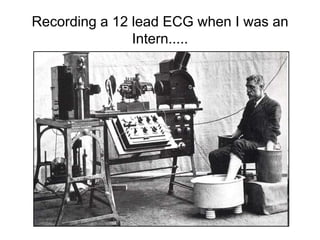
Recording a 12 lead ECG when I was an
               Intern.....
Aims

• Physiology of the ST segment

• ECG quiz

• Interpretation of ST elevation
A Quiz for you now....
The setting...


You’re notified by ambulance of the arrival in 10 minutes of a 56 year
old man with chest pain that started this morning – its now 1530 and after
treatment by them, he’s currently pain free.

They’re not able to send you an ECG at this stage, but they say there’s
ST elevation on their rhythm strip


What actions should we take now?
On arrival he’s alert, pain free with normal vital signs.

You’re handed one of the following three 12 lead ECGs
Would you take the same immediate actions for each of them?
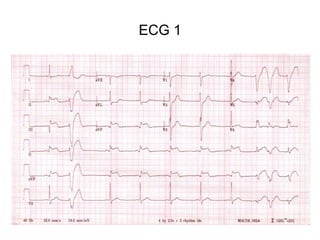
ECG 1
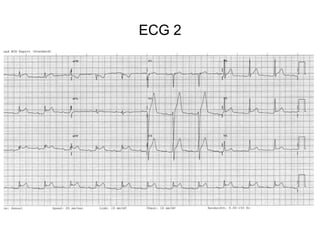
ECG 2
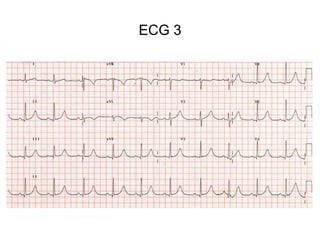
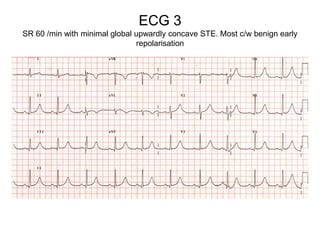
ECG 3
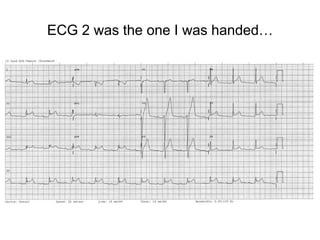
ECG 2 was the one I was handed…
“Code STEMI” activated and patient met and assessed on arrival by ED
staff, Interventional Cardiologist not immediately available

IV x2 and bloods taken

Administered Clopidogrel and Heparin

Taken to coronary catheterisation suite and prepped waiting for
Cardiologist who arrived 5 minutes later...
Cardiologist “pattern recognition” read of ECG as he arrived:

“Why am I rushing in here for pericarditis?”


Result?

Normal angiogram
Admitted to CCU, serial high sensitivity troponin 26 and 41
(normal < 10)
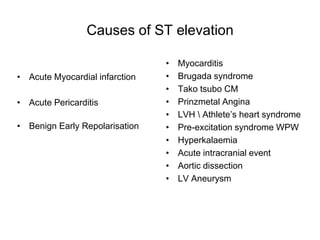
What causes of ST elevation do you know / look for on the ECG?
Causes of ST elevation

                                •   Myocarditis
• Acute Myocardial infarction   •   Brugada syndrome
                                •   Tako tsubo CM
• Acute Pericarditis            •   Prinzmetal Angina
                                •   LVH  Athlete’s heart syndrome
• Benign Early Repolarisation   •   Pre-excitation syndrome WPW
                                •   Hyperkalaemia
                                •   Acute intracranial event
                                •   Aortic dissection
                                •   LV Aneurysm
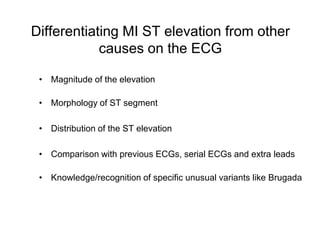
Differentiating MI ST elevation from other
            causes on the ECG

 • Magnitude of the elevation

 • Morphology of ST segment

 • Distribution of the ST elevation

 • Comparison with previous ECGs, serial ECGs and extra leads

 • Knowledge/recognition of specific unusual variants like Brugada
Magnitude of the elevation


The greater the degree of elevation, the more it’s likely to be an AMI
Morphology of ST elevation

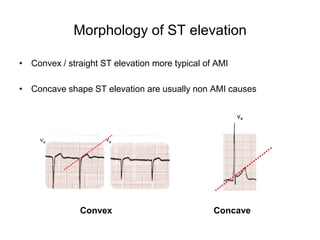
• Convex / straight ST elevation more typical of AMI

• Concave shape ST elevation are usually non AMI causes


               Convex                           Concave
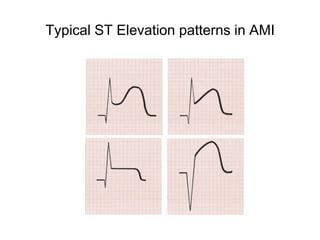
Typical ST Elevation patterns in AMI
Distribution of ST elevation

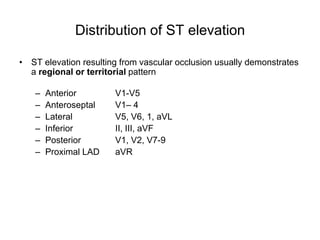
• ST elevation resulting from vascular occlusion usually demonstrates
  a regional or territorial pattern

   –   Anterior        V1-V5
   –   Anteroseptal    V1– 4
   –   Lateral         V5, V6, 1, aVL
   –   Inferior        II, III, aVF
   –   Posterior       V1, V2, V7-9
   –   Proximal LAD    aVR
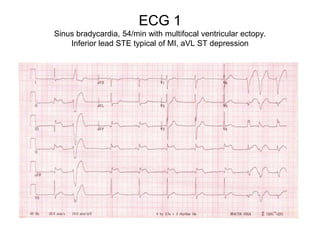
ECG 1
Sinus bradycardia, 54/min with multifocal ventricular ectopy.
    Inferior lead STE typical of MI, aVL ST depression
Pericarditis ECG features


Usually global low magnitude ST elevation

Concave upward morphology

PR depression can be seen early

T wave changes later (days to weeks)

ST changes resolve fully so not persistent on future ECGS
ECG 2
 Sinus rhythm 66/min, first degree heart block, global STE mostly upwardly
 concave (although V2 + 3 look like hyperacute STEMI segments..) No PR
depression (or elevation in aVR remember) but overall most c/w Pericarditis
ECG 3
SR 60 /min with minimal global upwardly concave STE. Most c/w benign early
                               repolarisation
Benign Early Repolarisation

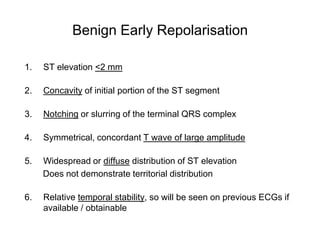
1.   ST elevation <2 mm

2.   Concavity of initial portion of the ST segment

3.   Notching or slurring of the terminal QRS complex

4.   Symmetrical, concordant T wave of large amplitude

5.   Widespread or diffuse distribution of ST elevation
     Does not demonstrate territorial distribution

6.   Relative temporal stability, so will be seen on previous ECGs if
     available / obtainable
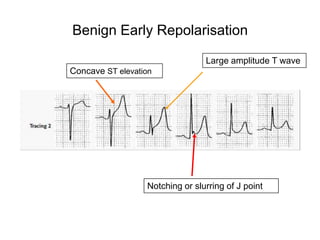
Benign Early Repolarisation

                                 Large amplitude T wave
Concave ST elevation


                  Notching or slurring of J point
So ....recapping


• Magnitude of the elevation

• Morphology of ST segment

• Distribution of the ST elevation

• Comparison with previous / serial / extra lead ECGs
Take home messages

• Many causes for ST elevation other than MI, so always analyse
  within the clinical context (Rule 1: “context is everything”)

• Whenever possible, use previous and serial ECGs
  (more data improves quality of interpretation and decision making)

• If in doubt, seek another expert opinion and/or pursue safe cautious
  clinical approach to patient care

ST elevation

  • 1.
    ST Elevation →is that a STEMI?
  • 2.
    Recording a 12lead ECG when I was an Intern.....
  • 3.
    Aims • Physiology ofthe ST segment • ECG quiz • Interpretation of ST elevation
  • 4.
    A Quiz foryou now....
  • 5.
    The setting... You’re notifiedby ambulance of the arrival in 10 minutes of a 56 year old man with chest pain that started this morning – its now 1530 and after treatment by them, he’s currently pain free. They’re not able to send you an ECG at this stage, but they say there’s ST elevation on their rhythm strip What actions should we take now?
  • 6.
    On arrival he’salert, pain free with normal vital signs. You’re handed one of the following three 12 lead ECGs Would you take the same immediate actions for each of them?
  • 7.
  • 8.
  • 9.
  • 10.
    ECG 2 wasthe one I was handed…
  • 11.
    “Code STEMI” activatedand patient met and assessed on arrival by ED staff, Interventional Cardiologist not immediately available IV x2 and bloods taken Administered Clopidogrel and Heparin Taken to coronary catheterisation suite and prepped waiting for Cardiologist who arrived 5 minutes later...
  • 12.
    Cardiologist “pattern recognition”read of ECG as he arrived: “Why am I rushing in here for pericarditis?” Result? Normal angiogram Admitted to CCU, serial high sensitivity troponin 26 and 41 (normal < 10)
  • 13.
    What causes ofST elevation do you know / look for on the ECG?
  • 14.
    Causes of STelevation • Myocarditis • Acute Myocardial infarction • Brugada syndrome • Tako tsubo CM • Acute Pericarditis • Prinzmetal Angina • LVH Athlete’s heart syndrome • Benign Early Repolarisation • Pre-excitation syndrome WPW • Hyperkalaemia • Acute intracranial event • Aortic dissection • LV Aneurysm
  • 15.
    Differentiating MI STelevation from other causes on the ECG • Magnitude of the elevation • Morphology of ST segment • Distribution of the ST elevation • Comparison with previous ECGs, serial ECGs and extra leads • Knowledge/recognition of specific unusual variants like Brugada
  • 16.
    Magnitude of theelevation The greater the degree of elevation, the more it’s likely to be an AMI
  • 17.
    Morphology of STelevation • Convex / straight ST elevation more typical of AMI • Concave shape ST elevation are usually non AMI causes Convex Concave
  • 18.
    Typical ST Elevationpatterns in AMI
  • 19.
    Distribution of STelevation • ST elevation resulting from vascular occlusion usually demonstrates a regional or territorial pattern – Anterior V1-V5 – Anteroseptal V1– 4 – Lateral V5, V6, 1, aVL – Inferior II, III, aVF – Posterior V1, V2, V7-9 – Proximal LAD aVR
  • 20.
    ECG 1 Sinus bradycardia,54/min with multifocal ventricular ectopy. Inferior lead STE typical of MI, aVL ST depression
  • 21.
    Pericarditis ECG features Usuallyglobal low magnitude ST elevation Concave upward morphology PR depression can be seen early T wave changes later (days to weeks) ST changes resolve fully so not persistent on future ECGS
  • 22.
    ECG 2 Sinusrhythm 66/min, first degree heart block, global STE mostly upwardly concave (although V2 + 3 look like hyperacute STEMI segments..) No PR depression (or elevation in aVR remember) but overall most c/w Pericarditis
  • 23.
    ECG 3 SR 60/min with minimal global upwardly concave STE. Most c/w benign early repolarisation
  • 24.
    Benign Early Repolarisation 1. ST elevation <2 mm 2. Concavity of initial portion of the ST segment 3. Notching or slurring of the terminal QRS complex 4. Symmetrical, concordant T wave of large amplitude 5. Widespread or diffuse distribution of ST elevation Does not demonstrate territorial distribution 6. Relative temporal stability, so will be seen on previous ECGs if available / obtainable
  • 25.
    Benign Early Repolarisation Large amplitude T wave Concave ST elevation Notching or slurring of J point
  • 26.
    So ....recapping • Magnitudeof the elevation • Morphology of ST segment • Distribution of the ST elevation • Comparison with previous / serial / extra lead ECGs
  • 27.
    Take home messages •Many causes for ST elevation other than MI, so always analyse within the clinical context (Rule 1: “context is everything”) • Whenever possible, use previous and serial ECGs (more data improves quality of interpretation and decision making) • If in doubt, seek another expert opinion and/or pursue safe cautious clinical approach to patient care