Assessment of Diastolic Function
by Echocardiography
Diastole phases
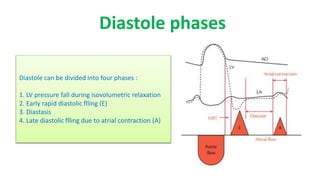
Diastole can be divided into four phases :
1. LV pressure fall during isovolumetric relaxation
2. Early rapid diastolic flling (E)
3. Diastasis
4. Late diastolic flling due to atrial contraction (A)
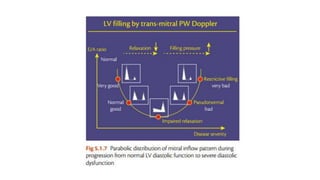
The integrated approach of LV diastolic function
◆ M-mode and 2D/3D echocardiography: LV geometry, left atrial size, rate of wall
thinning, annular and pericardial displacement
◆ PW-Doppler echocardiography: assessment of mitral inflow and pulmonary
venous flow
◆ CW-Doppler echocardiography: assessment of tricuspid regurgitation jet and
pulmonary regurgitation jet to derive pulmonary artery pressures
◆ PW tissue Doppler echocardiography: assessment of early and late diastolic
mitral annular velocities
◆ Colour-flow M-mode Doppler: measuring flow velocity propagation (Vp)
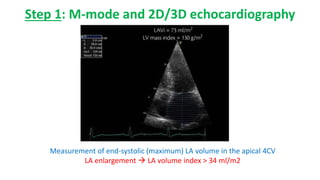
Step 1: M-mode and 2D/3D echocardiography
Measurement of end-systolic (maximum) LA volume in the apical 4CV
LA enlargement  LA volume index > 34 ml/m2
Step 2: Measure Left Ventricular Inflow Velocities
a) E/A ratio:
The flow from the left atrium to the left ventricle occurs in 3 phases: An initial rush of
blood as soon as the valve opens causes a peaking of velocity in early diastole, the E
wave. This is followed by a period of low or no flow, also known as diastasis. In end-
diastole, atrial contraction produces a final rush of blood into the ventricle, the A
wave. While these waves can be analyzed by studying the movement of the anterior
mitral leaflet in M-mode, it is best done with Pulsed wave Doppler.
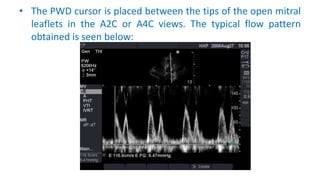
• The PWD cursor is placed between the tips of the open mitral
leaflets in the A2C or A4C views. The typical flow pattern
obtained is seen below:
Measuring the E wave velocity
Obtain the mitral inflow wave pattern on PWD and freeze the image. After selecting "E" under "mitral
valve" in the calculations menu, the height of the E wave is measured to get the E velocity . Similarly the
A wave velocity is also measured. The E/A ratio will be calculated by most echo machines automatically.
Measuring the A wave velocity
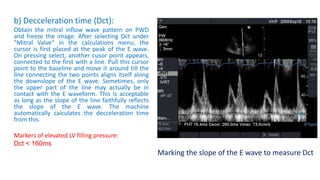
Marking the slope of the E wave to measure Dct
b) Decceleration time (Dct):
Obtain the mitral inflow wave pattern on PWD
and freeze the image. After selecting Dct under
"Mitral Valve" in the calculations menu, the
cursor is first placed at the peak of the E wave.
On pressing select, another cusor point appears,
connected to the first with a line. Pull this cursor
point to the baseline and move it around till the
line connecting the two points aligns itself along
the downslope of the E wave. Sometimes, only
the upper part of the line may actually be in
contact with the E waveform. This is acceptable
as long as the slope of the line faithfully reflects
the slope of the E wave. The machine
automatically calculates the decceleration time
from this.
Markers of elevated LV filling pressure:
Dct < 160ms
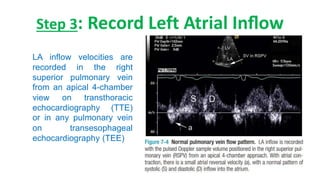
Step 3: Record Left Atrial Inflow
LA inflow velocities are
recorded in the right
superior pulmonary vein
from an apical 4-chamber
view on transthoracic
echocardiography (TTE)
or in any pulmonary vein
on transesophageal
echocardiography (TEE)
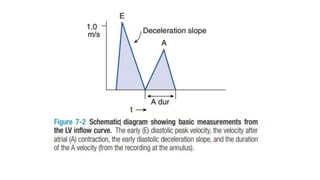
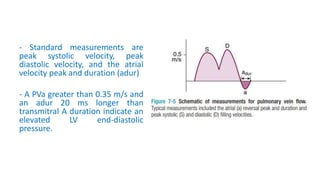
- Standard measurements are
peak systolic velocity, peak
diastolic velocity, and the atrial
velocity peak and duration (adur)
- A PVa greater than 0.35 m/s and
an adur 20 ms longer than
transmitral A duration indicate an
elevated LV end-diastolic
pressure.
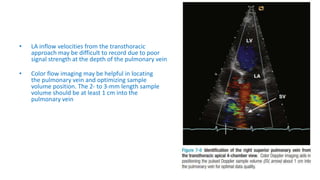
• LA inflow velocities from the transthoracic
approach may be difficult to record due to poor
signal strength at the depth of the pulmonary vein
• Color flow imaging may be helpful in locating
the pulmonary vein and optimizing sample
volume position. The 2- to 3-mm length sample
volume should be at least 1 cm into the
pulmonary vein
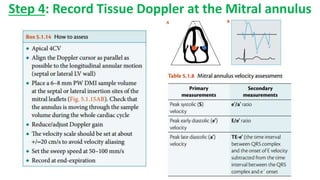
Step 4: Record Tissue Doppler at the Mitral annulus
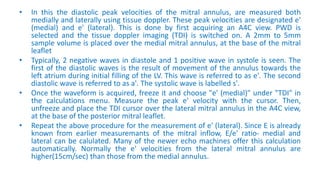
• In this the diastolic peak velocities of the mitral annulus, are measured both
medially and laterally using tissue doppler. These peak velocities are designated e'
(medial) and e' (lateral). This is done by first acquiring an A4C view. PWD is
selected and the tissue doppler imaging (TDI) is switched on. A 2mm to 5mm
sample volume is placed over the medial mitral annulus, at the base of the mitral
leaflet
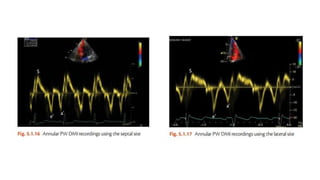
• Typically, 2 negative waves in diastole and 1 positive wave in systole is seen. The
first of the diastolic waves is the result of movement of the annulus towards the
left atrium during initial filling of the LV. This wave is referred to as e'. The second
diastolic wave is referred to as a'. The systolic wave is labelled s'.
• Once the waveform is acquired, freeze it and choose "e' (medial)" under "TDI" in
the calculations menu. Measure the peak e' velocity with the cursor. Then,
unfreeze and place the TDI cursor over the lateral mitral annulus in the A4C view,
at the base of the posterior mitral leaflet.
• Repeat the above procedure for the measurement of e' (lateral). Since E is already
known from earlier measuremants of the mitral inflow, E/e' ratio- medial and
lateral can be calulated. Many of the newer echo machines offer this calculation
automatically. Normally the e' velocities from the lateral mitral annulus are
higher(15cm/sec) than those from the medial annulus.
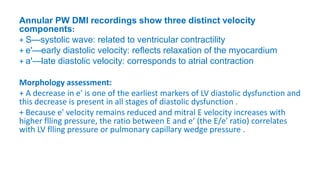
Annular PW DMI recordings show three distinct velocity
components:
+ S—systolic wave: related to ventricular contractility
+ e'—early diastolic velocity: reflects relaxation of the myocardium
+ a'—late diastolic velocity: corresponds to atrial contraction
Morphology assessment:
+ A decrease in e' is one of the earliest markers of LV diastolic dysfunction and
this decrease is present in all stages of diastolic dysfunction .
+ Because e' velocity remains reduced and mitral E velocity increases with
higher flling pressure, the ratio between E and e‘ (the E/e' ratio) correlates
with LV flling pressure or pulmonary capillary wedge pressure .
Step 5: Measure the Isovolumic Relaxation Time
• Pulsed Doppler is used to show the time interval between aortic valve
closure and mitral valve opening (the isovolumic relaxation time [IVRT])
• The IVRT normally 50 to 100 ms, is prolonged with impaired relaxation but
is shortened with severe diastolic dysfunction and reduced compliance
• Measurement of isovolumic relaxation time (IVRT) by placing the PW
Doppler sample volume in between LV inflow and outflow (B) to
simultaneously display the end of aortic ejection and the onset of mitral E-
wave velocity (C)
Step 6: Consider other Useful measurements
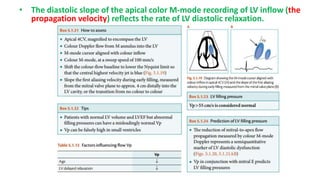
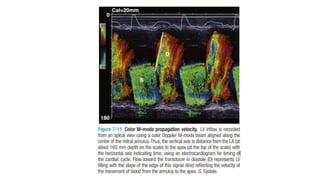
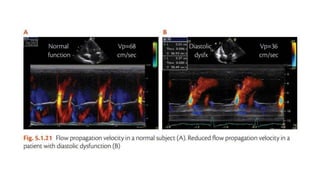
• The diastolic slope of the apical color M-mode recording of LV inflow (the
propagation velocity) reflects the rate of LV diastolic relaxation.
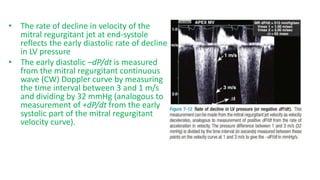
• The rate of decline in velocity of the
mitral regurgitant jet at end-systole
reflects the early diastolic rate of decline
in LV pressure
• The early diastolic –dP/dt is measured
from the mitral regurgitant continuous
wave (CW) Doppler curve by measuring
the time interval between 3 and 1 m/s
and dividing by 32 mmHg (analogous to
measurement of +dP/dt from the early
systolic part of the mitral regurgitant
velocity curve).
Step 7: Integrate the Data
-Measurement of LA size (diameter and/or indexed volume) is useful in the
assessment of diastolic function. Chronically elevated LV filling pressure leads to
increased LA chamber size.
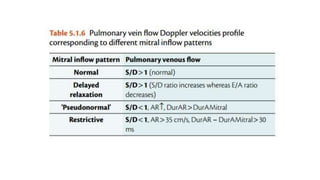
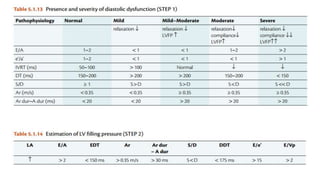
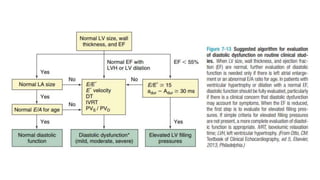
-Based on integration of data from LA size, LV filling velocities, LA filling velocities,
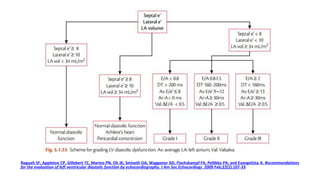
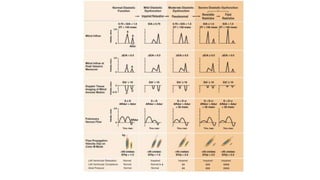
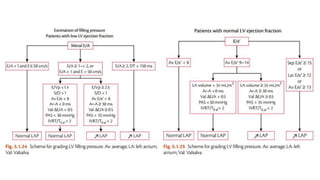
tissue Doppler, and IVRT, diastolic dysfunction can be detected and graded .
-The clinical interpretation of the data also takes several other factors into
consideration, including severity of mitral regurgitation, LV systolic function, LV
wall thickness, and clinical signs and symptoms.
Nagueh SF, Appleton CP, Gillebert TC, Marino PN, Oh JK, Smiseth OA, Waggoner AD, Flachskampf FA, Pellikka PA, and Evangelista A. Recommendations
for the evaluation of left ventricular diastolic function by echocardiography. J Am Soc Echocardiogr. 2009 Feb;22(2):107-33
Suggested reading

Assessment of diastolic function by echo

  • 1.
    Assessment of DiastolicFunction by Echocardiography
  • 2.
    Diastole phases Diastole canbe divided into four phases : 1. LV pressure fall during isovolumetric relaxation 2. Early rapid diastolic flling (E) 3. Diastasis 4. Late diastolic flling due to atrial contraction (A)
  • 3.
    The integrated approachof LV diastolic function ◆ M-mode and 2D/3D echocardiography: LV geometry, left atrial size, rate of wall thinning, annular and pericardial displacement ◆ PW-Doppler echocardiography: assessment of mitral inflow and pulmonary venous flow ◆ CW-Doppler echocardiography: assessment of tricuspid regurgitation jet and pulmonary regurgitation jet to derive pulmonary artery pressures ◆ PW tissue Doppler echocardiography: assessment of early and late diastolic mitral annular velocities ◆ Colour-flow M-mode Doppler: measuring flow velocity propagation (Vp)
  • 4.
    Step 1: M-modeand 2D/3D echocardiography Measurement of end-systolic (maximum) LA volume in the apical 4CV LA enlargement  LA volume index > 34 ml/m2
  • 5.
    Step 2: MeasureLeft Ventricular Inflow Velocities a) E/A ratio: The flow from the left atrium to the left ventricle occurs in 3 phases: An initial rush of blood as soon as the valve opens causes a peaking of velocity in early diastole, the E wave. This is followed by a period of low or no flow, also known as diastasis. In end- diastole, atrial contraction produces a final rush of blood into the ventricle, the A wave. While these waves can be analyzed by studying the movement of the anterior mitral leaflet in M-mode, it is best done with Pulsed wave Doppler.
  • 7.
    • The PWDcursor is placed between the tips of the open mitral leaflets in the A2C or A4C views. The typical flow pattern obtained is seen below:
  • 8.
    Measuring the Ewave velocity Obtain the mitral inflow wave pattern on PWD and freeze the image. After selecting "E" under "mitral valve" in the calculations menu, the height of the E wave is measured to get the E velocity . Similarly the A wave velocity is also measured. The E/A ratio will be calculated by most echo machines automatically. Measuring the A wave velocity
  • 10.
    Marking the slopeof the E wave to measure Dct b) Decceleration time (Dct): Obtain the mitral inflow wave pattern on PWD and freeze the image. After selecting Dct under "Mitral Valve" in the calculations menu, the cursor is first placed at the peak of the E wave. On pressing select, another cusor point appears, connected to the first with a line. Pull this cursor point to the baseline and move it around till the line connecting the two points aligns itself along the downslope of the E wave. Sometimes, only the upper part of the line may actually be in contact with the E waveform. This is acceptable as long as the slope of the line faithfully reflects the slope of the E wave. The machine automatically calculates the decceleration time from this. Markers of elevated LV filling pressure: Dct < 160ms
  • 11.
    Step 3: RecordLeft Atrial Inflow LA inflow velocities are recorded in the right superior pulmonary vein from an apical 4-chamber view on transthoracic echocardiography (TTE) or in any pulmonary vein on transesophageal echocardiography (TEE)
  • 12.
    - Standard measurementsare peak systolic velocity, peak diastolic velocity, and the atrial velocity peak and duration (adur) - A PVa greater than 0.35 m/s and an adur 20 ms longer than transmitral A duration indicate an elevated LV end-diastolic pressure.
  • 13.
    • LA inflowvelocities from the transthoracic approach may be difficult to record due to poor signal strength at the depth of the pulmonary vein • Color flow imaging may be helpful in locating the pulmonary vein and optimizing sample volume position. The 2- to 3-mm length sample volume should be at least 1 cm into the pulmonary vein
  • 15.
    Step 4: RecordTissue Doppler at the Mitral annulus
  • 16.
    • In thisthe diastolic peak velocities of the mitral annulus, are measured both medially and laterally using tissue doppler. These peak velocities are designated e' (medial) and e' (lateral). This is done by first acquiring an A4C view. PWD is selected and the tissue doppler imaging (TDI) is switched on. A 2mm to 5mm sample volume is placed over the medial mitral annulus, at the base of the mitral leaflet • Typically, 2 negative waves in diastole and 1 positive wave in systole is seen. The first of the diastolic waves is the result of movement of the annulus towards the left atrium during initial filling of the LV. This wave is referred to as e'. The second diastolic wave is referred to as a'. The systolic wave is labelled s'. • Once the waveform is acquired, freeze it and choose "e' (medial)" under "TDI" in the calculations menu. Measure the peak e' velocity with the cursor. Then, unfreeze and place the TDI cursor over the lateral mitral annulus in the A4C view, at the base of the posterior mitral leaflet. • Repeat the above procedure for the measurement of e' (lateral). Since E is already known from earlier measuremants of the mitral inflow, E/e' ratio- medial and lateral can be calulated. Many of the newer echo machines offer this calculation automatically. Normally the e' velocities from the lateral mitral annulus are higher(15cm/sec) than those from the medial annulus.
  • 18.
    Annular PW DMIrecordings show three distinct velocity components: + S—systolic wave: related to ventricular contractility + e'—early diastolic velocity: reflects relaxation of the myocardium + a'—late diastolic velocity: corresponds to atrial contraction Morphology assessment: + A decrease in e' is one of the earliest markers of LV diastolic dysfunction and this decrease is present in all stages of diastolic dysfunction . + Because e' velocity remains reduced and mitral E velocity increases with higher flling pressure, the ratio between E and e‘ (the E/e' ratio) correlates with LV flling pressure or pulmonary capillary wedge pressure .
  • 19.
    Step 5: Measurethe Isovolumic Relaxation Time • Pulsed Doppler is used to show the time interval between aortic valve closure and mitral valve opening (the isovolumic relaxation time [IVRT]) • The IVRT normally 50 to 100 ms, is prolonged with impaired relaxation but is shortened with severe diastolic dysfunction and reduced compliance • Measurement of isovolumic relaxation time (IVRT) by placing the PW Doppler sample volume in between LV inflow and outflow (B) to simultaneously display the end of aortic ejection and the onset of mitral E- wave velocity (C)
  • 20.
    Step 6: Considerother Useful measurements
  • 21.
    • The diastolicslope of the apical color M-mode recording of LV inflow (the propagation velocity) reflects the rate of LV diastolic relaxation.
  • 24.
    • The rateof decline in velocity of the mitral regurgitant jet at end-systole reflects the early diastolic rate of decline in LV pressure • The early diastolic –dP/dt is measured from the mitral regurgitant continuous wave (CW) Doppler curve by measuring the time interval between 3 and 1 m/s and dividing by 32 mmHg (analogous to measurement of +dP/dt from the early systolic part of the mitral regurgitant velocity curve).
  • 25.
    Step 7: Integratethe Data -Measurement of LA size (diameter and/or indexed volume) is useful in the assessment of diastolic function. Chronically elevated LV filling pressure leads to increased LA chamber size. -Based on integration of data from LA size, LV filling velocities, LA filling velocities, tissue Doppler, and IVRT, diastolic dysfunction can be detected and graded . -The clinical interpretation of the data also takes several other factors into consideration, including severity of mitral regurgitation, LV systolic function, LV wall thickness, and clinical signs and symptoms.
  • 28.
    Nagueh SF, AppletonCP, Gillebert TC, Marino PN, Oh JK, Smiseth OA, Waggoner AD, Flachskampf FA, Pellikka PA, and Evangelista A. Recommendations for the evaluation of left ventricular diastolic function by echocardiography. J Am Soc Echocardiogr. 2009 Feb;22(2):107-33
  • 31.