ED Dermatology
Aims

   Review terminology of skin conditions

   Identify common non-serious ED presentations

   Discuss serious but rare skin disorders
Definitions
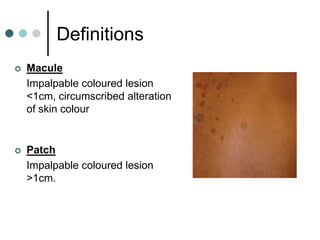
   Macule
    Impalpable coloured lesion
    <1cm, circumscribed alteration
    of skin colour


   Patch
    Impalpable coloured lesion
    >1cm.
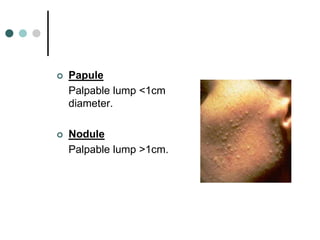
   Papule
    Palpable lump <1cm
    diameter.

   Nodule
    Palpable lump >1cm.
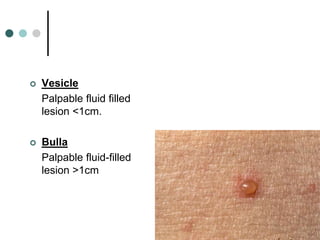
   Vesicle
    Palpable fluid filled
    lesion <1cm.

   Bulla
    Palpable fluid-filled
    lesion >1cm
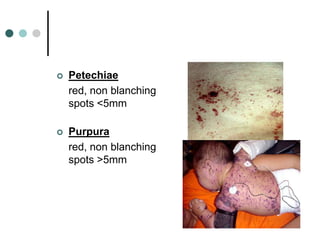
   Petechiae
    red, non blanching
    spots <5mm

   Purpura
    red, non blanching
    spots >5mm
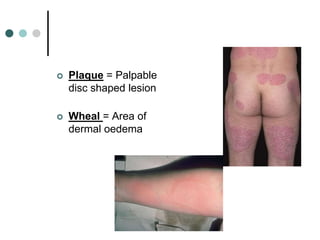
   Plaque = Palpable
    disc shaped lesion

   Wheal = Area of
    dermal oedema
Descriptive Terms
   Annular : Ring shaped, hollow centre
   Arcuate : Curved
   Circinate : Circular
   Confluent : Lesions that run together
   Discoid : Circular without hollow centre
   Eczematous : Inflammed and crusted
   Keratotic: Thickened
   Lichenified: Thickened and roughed with accentuated
    skin markings
   Zosteriform : Nerve distribution
History
   How long
   Had it before
   Is it worsening / anything improving it
   Distribution ie palms / plantar / face / mucosal membranes
   How did it start / evolve
   Itch
   Social changes eg diet / work / cleaning
   Meds & allergies
   Cutaneous manifestations of systemic disorders eg sore joints & past medical
    history
   Family history
   Travel
   Contacts
   Viral symptoms or fevers
?
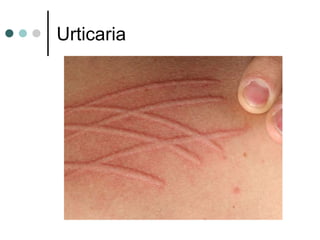
Urticaria
Urticaria

   Physical triggers / drugs / foods / stings / viral/ atopy / blood
    products / temperature...
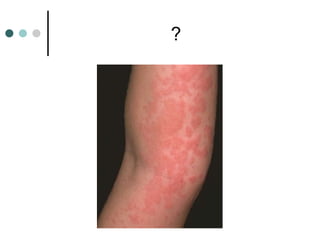
   Wheals, smooth with a red flare with some clearing leaving
    annular pattern & scratch marks. Dermatographism
   Acute / Recurrent / Chronic
   Investigation
    FBC / WCC / Eosinophils / Challenges
    Complement levels with angiooedema
   Management
    Remove cause / anti-histamines / steroids
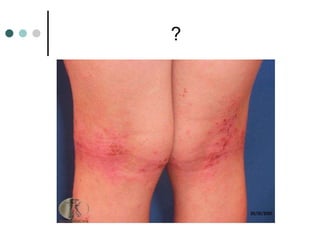
?
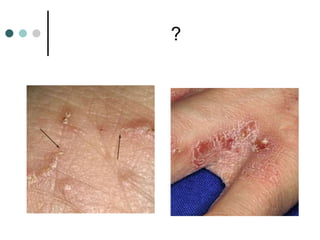
Eczema
   Flexural Distribution
   Itch ++ / Scratch marks, hyper or hypopigmented lesions
   Age related stages
   Atopic vs Contact
   Can be vesicular
   Treatment
       Emollients ++
       Treat infected skin
       Moist dressings
       Avoid triggers
       Antihistamines for itch
       Topical / systemic steroids
       Increase sunlight exposure / Phototherapy
       Immunomodulators / Immunosupressants : Cyclosporin / Azathioprine /
        Tacrolimus /
?
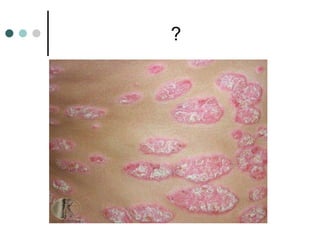
Psoriasis
   Itch / Pain / Decreased movement / FHx
   Extensor Distribution – well demarcated salmon pink silvery scales. Red surface on
    removal / capillary bleeding (Auspitz sign)/ new lesions at site of trauma (Koebner’s
    Phenomenon)
   Plaque / Guttate / Erythrodermic / Pustular variants / Inverse
   Triggers – Stress, Strep, HIV, Trauma, Drugs (Lithium + BetaBlockers Especially)
   Psoriatic Arthritis
   Treatment – topical v’s systemic : Systemic if failed topical / repeated admissions /
    extensive plaques in elderly / severe arthropathy / generalised pustular or
    erythrodermic psoriasis
       Emollients ++ / Keratolytic agents
       Topical Steroids.
       Coal Tar.
       Dithranol.
       Vitamin D3
       Retinoids – topical or oral.
       Phototherapy / Photochemotherapy (& methotrexate)
       Immunosuppressant's – Methotrexate, Cyclosporin, Mycophenalate
       Infliximab / CD4 monoclonal antibodies
?
?
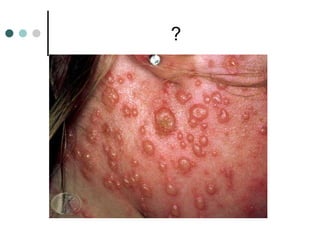
VZV
   Varicella / Chicken Pox – Respiratory droplets. Infectious for 2 days prior to
    lesions. Ends when crusts
       Rash head / trunk /
       Simultaneous presence of rash at different stages. Macule / Papule / Vesicle /
        Pustule / Crusts
       A/w headache / malaise / anorexia / cough / coryza and sore throat / low grade
        fever
       Rx symptomatic. Antivirals in certain cases / Secondary infection risk
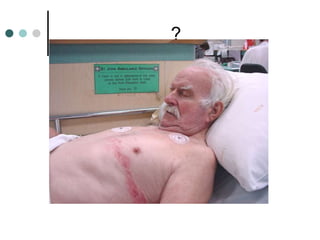
   Shingles
       Dermatomal distribution & enlarged draining node
       Presents as pain, malaise, fever, rash in same distribution several days later
       Dx Clinical but can do smears or titres or isolation of virus in blisters
       Mx – antivirals / pain relief / IV antivirals if immunocompromised / IFN
       Complications : Corneal ulcers / Gangrene of affected area / Phrenic Nerve palsy
        / Meningoencephalitis / Ramsay Hunt syndrome / Neuralgia / Disseminated
        zoster
       NB if AIDS – major CNS effects/
?
?
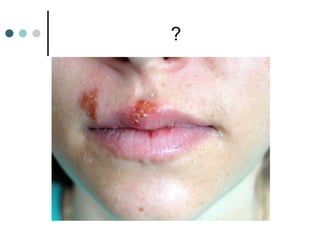
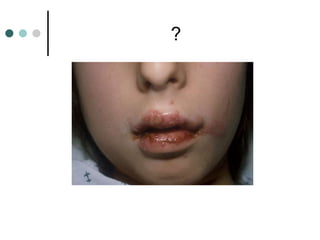
HSV

   Pain / Itch / Vesicles / Sore mouth / Gum swelling /
    Mouth ulcers
   Small vesicles & lymph nodes
   Complications –
      Erythema Multiforme / Encephalitis / Keratitis /
       Whitlow / Disseminated infection if
       immunocompromised / Visceral involvement /
       Neonatal / Meningitis
   Rx topical / oral / IV antivirals
?
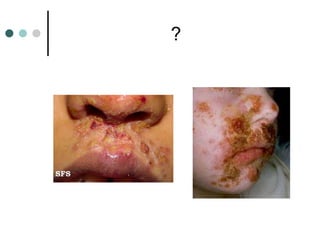
Impetigo
   Group A beta haemolytic Strep or Staph aureus
   Contagious
   Vesicles to honey coloured crusted lesions. Painless. Face
    or extremities
   Local adenopathy / Generally afebrile
   Rx topical / oral antiobiotics
   Generally resolves 7-10/7
   Complications – Osteomyelitis / Septic Arthritis / Sepsis /
    Pneumonia / Endocarditis
   Post strep glomerulonephritis / Scalded skin syndrome
?
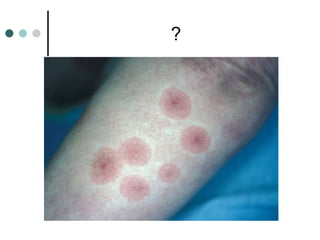
Erythema Multiforme
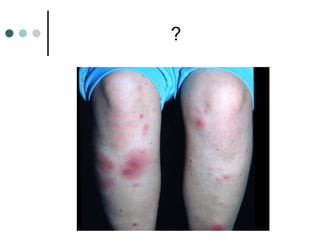
   Hypersensitivity reaction, polymorphous skin eruption
   Target Lesions
      Symmetric eruption red round macules, oedematous papules, target
       lesions (x3 concentric areas of colour change) dorsum hands and
       forearms
      Central dusky area due to keratinocyte necrosis.
      Can be vesicular and painful.
      Minor generally self limiting
   Etiology
      HSV
      Immunologic disorders – IBD / SLE / graft v’s host
      Mycoplasma, TB, Histoplasmosis.
      Drugs: Sulphonamides. Barbiturates. Penicillin. Phenytoin. NSAIDS.
       Allopurinol.
      Malignancy
      Idiopathic
   Mx – Minor consider antivirals if HSV / symptomatic
?
Erythema Nodosum
   Painful nodules, poorly defined. +++ tender
   Hx – fever / painful nodules/ arthralgias / sore throat / drugs / Cough
   Aetiology:
      Strep / TB / Yersinia / Leprosy / Coccidioidomycosis / Histoplasmosis
        Sarcoid
        SLE
        Behcets
        IBD
        Drugs – Sulphonamides / OCP
   Management
        Definitive dx – wedge biopsy
        CXR
        ASOT / Throat Swabs.
        Symptomatic
          •   Self–limiting - 3-6 weeks
          •   NSAIDS
          •   Elevation
          •   Compression Stockings.
?
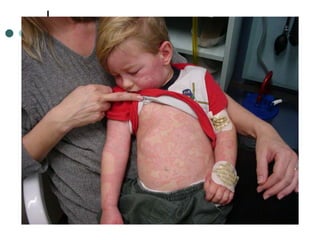
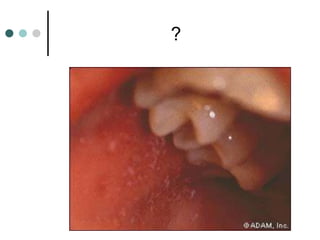
Koplik’s Spots / Measles
   Primary infection respiratory epithelium - droplets
   Highly contagious
   Fever / Coryza / Koplik spots 2-3 days into prodrome
    precedes rash (14 days). Maculopapular, lasts 5-7/7
    may desquamate
   Clinical diagnosis of Measles wrong in 50% of cases
   Probably requires serology for confirmation /
    leucopaenia / lymphopaenia
   Complications: Superimposed bacterial infection.
    Encephalitis. SSPE
?
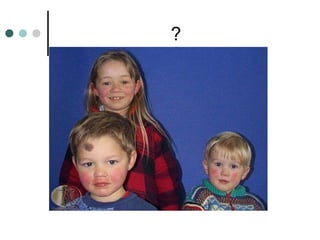
Slapped Cheek Syndrome
   Fifth Disease “Erythema infectiosum”
   Parvovirus B19
   Respiratory droplets
   Viral prodrome, slapped cheek, perioral pallor, later
    extremities with palms and soles spared. Laced
    appearance
   Antipyretics and antihistamines
   Generally benign. Rare aplastic crisis. In utero a/w
    hydrops foetalis
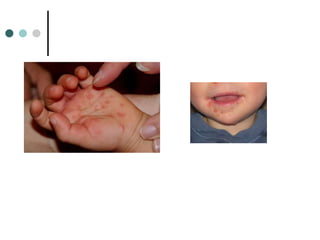
Hand, Foot + Mouth
   Usually Coxsackie A or Enterovirus
   Usually children, very infectious, incubation 3
    days then fever malaise and rash / painful oral
    lesions
   Treatment supportive
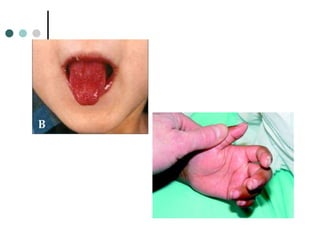
Kawasaki’s disease

   Usually < 5 yo, early phase of prolonged fever,
    irritability, and involvement of mucous
    membranes (conjunctivitis and mouth). Hands
    and feet red and swollen early, later may have
    desquamating maculopapular rash

   Association with cardiac abnormalities...

   Treatment with IV Immunoglobulin
?

    
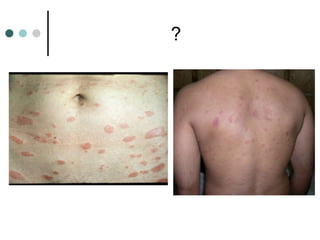
Pityriasis Rosea

 Presumed viral.
 ?HHV 7.

 Christmas tree distribution.

 Self limiting over 6-12 weeks.

 Herald patch often mistaken for
  ringworm.
?
Scabies
   Sarcoptes scabiei
   Intense itch
   Permethrin or Malathion
      Applied at bedtime to whole body from chin
       to soles.
      Treat all close contacts even if
       asymptomatic.
      Wash all towels, clothes worn in last week
       and bedlinen
      Vacuum house and furniture!
   Itch can persist for 6 weeks even after
    successful treatment due to dead mites in skin.
?
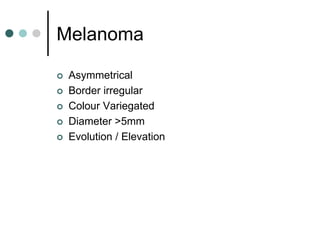
Melanoma

   Asymmetrical
   Border irregular
   Colour Variegated
   Diameter >5mm
   Evolution / Elevation
So far...

   Reviewed terminology

   Common, but usually not serious/life threatening
    conditions
Serious conditions with
     blistering / skin loss
   Erythema Multiforme major / SJS
   Pemphigus
   Pemphigoid
   TENS
   SSS
   ( Kawasaki’s )
?
Erythema Multiforme Major
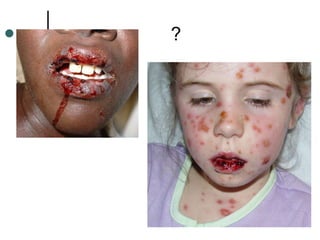
   Stevens Johnson Syndrome
      Symmetric erythematous macules, head and neck and lower
       body
      Progresses to bullae, skin necrosis and denudation, at least
       x2 mucosal surfaces involved
      Widespread rash involving up to 10% BSA skin sloughing /
       blistering.
      Treatment:
      Prompt drug withdrawal.
      Admission / supportive care / general burns care.
?
Toxic Epidermal Necrolysis
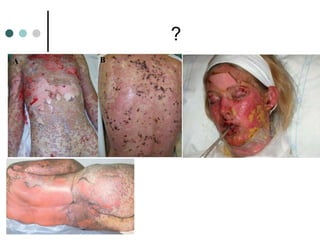
   Widespread rash like sunburn initially >30% TBSA with later
    necrosis and sloughing. +ve Nikolsky sign
   Large mucous membrane involvement.
   Remove causative agent & manage as severe burns (ICU /
    Burns unit)
   Mostly thought to be drug related
   Debates re plasmapheresis / IG / Steroids etc, nil proven
   Complications: High mortality / NB Ophthalmology
    involvement and regular eye irrigation
?
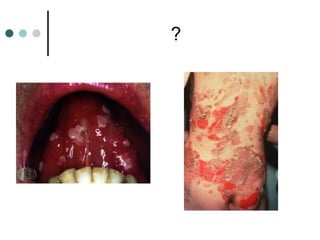
Pemphigus
   Autoimmune
   Blisters in mouth followed by on skin.
   Diagnosis by biopsy – IgG in epidermis, disruption of connections
    intercellular
   3 Types:
      Vulgaris – begins in mouth 50% cases
      Foliaceous – may be drug induced
          • Least severe.
          • Often mistaken for eczema
      Paraneoplastic.
          • NHL most common
   Mx: Barrier nursing / antibx / IV fluids / systemic steroids +/-
    immunosuppressants (azathioprine / cyclophosphamide / methotrexate /
    gold / dapsone /ciclosporin)
?
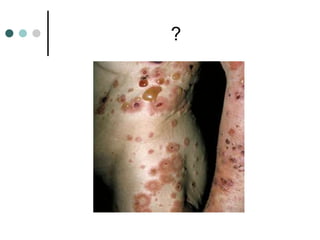
Pemphigoid
   More common than pemphigus
   Generally benign
   Also Autoimmune
   Affects older age group
   Affects deeper layer in skin – tense flexural areas
      Subepidermal / eosinophil rich with IgG and C3
       deposited in basement membrane
   Treatment same as Pemphigus – steroids +/-
    immunosupressants
   Variants
      Gestational
      Mucous membrane (Cicatricial)
?
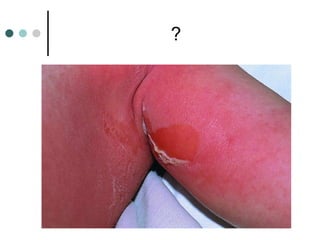
Scalded Skin Syndrome
   Syndrome of acute exfoliation of the skin typically following an
    erythematous cellulitis. Severity varies from a few blisters to a
    severe exfoliation affecting almost the entire body, but doesn’t
    involve mucous membranes as in TENS
    .
   Staph aureus with epidermolytic exotoxins (A+B).

   Nikolsky’s sign -separation of skin with gentle pressure.

   Treatment.
      Antibiotics, supportive care.
?
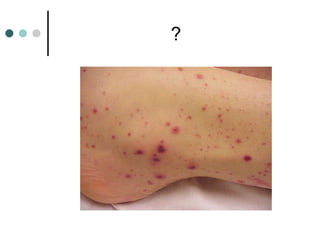
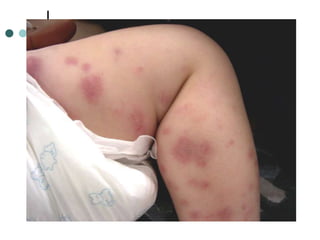
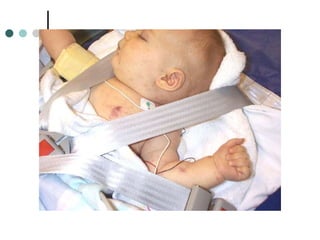
Purpuric Rash
   Petechiae <5mm.
   Purpura >5mm.
   Causes:
       Drugs: Steroids / Gold / Anticoagulants
       Senile
       Trauma
          • Coughing / vomiting / direct.
       Infection
          • Meningococcal, Cellulitis, Viral.
       Vasculitic
          • E.g. HSP / Wegners / PAN
       Thrombocytopenia
          • ITP / TTP / Leukaemia / DIC.
Red flags

   Unwell patient
   Other serious comorbidity, eg immunodeficiency
   Large area of skin
   Mucosal or ocular involvement
   Specific conditions with serious complications
    eg Kawasaki
If any doubts d/w senior colleague / dermatologist

Remember you can easily send them an image of
a rash ! (in hours)

  A good reference website:
http://dermnetnz.org/doctors/

Emergency Dermatology

  • 1.
  • 2.
    Aims  Review terminology of skin conditions  Identify common non-serious ED presentations  Discuss serious but rare skin disorders
  • 4.
    Definitions  Macule Impalpable coloured lesion <1cm, circumscribed alteration of skin colour  Patch Impalpable coloured lesion >1cm.
  • 5.
    Papule Palpable lump <1cm diameter.  Nodule Palpable lump >1cm.
  • 6.
    Vesicle Palpable fluid filled lesion <1cm.  Bulla Palpable fluid-filled lesion >1cm
  • 7.
    Petechiae red, non blanching spots <5mm  Purpura red, non blanching spots >5mm
  • 8.
    Plaque = Palpable disc shaped lesion  Wheal = Area of dermal oedema
  • 9.
    Descriptive Terms  Annular : Ring shaped, hollow centre  Arcuate : Curved  Circinate : Circular  Confluent : Lesions that run together  Discoid : Circular without hollow centre  Eczematous : Inflammed and crusted  Keratotic: Thickened  Lichenified: Thickened and roughed with accentuated skin markings  Zosteriform : Nerve distribution
  • 10.
    History  How long  Had it before  Is it worsening / anything improving it  Distribution ie palms / plantar / face / mucosal membranes  How did it start / evolve  Itch  Social changes eg diet / work / cleaning  Meds & allergies  Cutaneous manifestations of systemic disorders eg sore joints & past medical history  Family history  Travel  Contacts  Viral symptoms or fevers
  • 11.
  • 12.
  • 13.
    Urticaria  Physical triggers / drugs / foods / stings / viral/ atopy / blood products / temperature...  Wheals, smooth with a red flare with some clearing leaving annular pattern & scratch marks. Dermatographism  Acute / Recurrent / Chronic  Investigation FBC / WCC / Eosinophils / Challenges Complement levels with angiooedema  Management Remove cause / anti-histamines / steroids
  • 14.
  • 15.
    Eczema  Flexural Distribution  Itch ++ / Scratch marks, hyper or hypopigmented lesions  Age related stages  Atopic vs Contact  Can be vesicular  Treatment  Emollients ++  Treat infected skin  Moist dressings  Avoid triggers  Antihistamines for itch  Topical / systemic steroids  Increase sunlight exposure / Phototherapy  Immunomodulators / Immunosupressants : Cyclosporin / Azathioprine / Tacrolimus /
  • 16.
  • 17.
    Psoriasis  Itch / Pain / Decreased movement / FHx  Extensor Distribution – well demarcated salmon pink silvery scales. Red surface on removal / capillary bleeding (Auspitz sign)/ new lesions at site of trauma (Koebner’s Phenomenon)  Plaque / Guttate / Erythrodermic / Pustular variants / Inverse  Triggers – Stress, Strep, HIV, Trauma, Drugs (Lithium + BetaBlockers Especially)  Psoriatic Arthritis  Treatment – topical v’s systemic : Systemic if failed topical / repeated admissions / extensive plaques in elderly / severe arthropathy / generalised pustular or erythrodermic psoriasis  Emollients ++ / Keratolytic agents  Topical Steroids.  Coal Tar.  Dithranol.  Vitamin D3  Retinoids – topical or oral.  Phototherapy / Photochemotherapy (& methotrexate)  Immunosuppressant's – Methotrexate, Cyclosporin, Mycophenalate  Infliximab / CD4 monoclonal antibodies
  • 18.
  • 19.
  • 20.
    VZV  Varicella / Chicken Pox – Respiratory droplets. Infectious for 2 days prior to lesions. Ends when crusts  Rash head / trunk /  Simultaneous presence of rash at different stages. Macule / Papule / Vesicle / Pustule / Crusts  A/w headache / malaise / anorexia / cough / coryza and sore throat / low grade fever  Rx symptomatic. Antivirals in certain cases / Secondary infection risk  Shingles  Dermatomal distribution & enlarged draining node  Presents as pain, malaise, fever, rash in same distribution several days later  Dx Clinical but can do smears or titres or isolation of virus in blisters  Mx – antivirals / pain relief / IV antivirals if immunocompromised / IFN  Complications : Corneal ulcers / Gangrene of affected area / Phrenic Nerve palsy / Meningoencephalitis / Ramsay Hunt syndrome / Neuralgia / Disseminated zoster  NB if AIDS – major CNS effects/
  • 21.
  • 22.
  • 23.
    HSV  Pain / Itch / Vesicles / Sore mouth / Gum swelling / Mouth ulcers  Small vesicles & lymph nodes  Complications –  Erythema Multiforme / Encephalitis / Keratitis / Whitlow / Disseminated infection if immunocompromised / Visceral involvement / Neonatal / Meningitis  Rx topical / oral / IV antivirals
  • 24.
  • 25.
    Impetigo  Group A beta haemolytic Strep or Staph aureus  Contagious  Vesicles to honey coloured crusted lesions. Painless. Face or extremities  Local adenopathy / Generally afebrile  Rx topical / oral antiobiotics  Generally resolves 7-10/7  Complications – Osteomyelitis / Septic Arthritis / Sepsis / Pneumonia / Endocarditis  Post strep glomerulonephritis / Scalded skin syndrome
  • 26.
  • 28.
    Erythema Multiforme  Hypersensitivity reaction, polymorphous skin eruption  Target Lesions  Symmetric eruption red round macules, oedematous papules, target lesions (x3 concentric areas of colour change) dorsum hands and forearms  Central dusky area due to keratinocyte necrosis.  Can be vesicular and painful.  Minor generally self limiting  Etiology  HSV  Immunologic disorders – IBD / SLE / graft v’s host  Mycoplasma, TB, Histoplasmosis.  Drugs: Sulphonamides. Barbiturates. Penicillin. Phenytoin. NSAIDS. Allopurinol.  Malignancy  Idiopathic  Mx – Minor consider antivirals if HSV / symptomatic
  • 29.
  • 30.
    Erythema Nodosum  Painful nodules, poorly defined. +++ tender  Hx – fever / painful nodules/ arthralgias / sore throat / drugs / Cough  Aetiology:  Strep / TB / Yersinia / Leprosy / Coccidioidomycosis / Histoplasmosis  Sarcoid  SLE  Behcets  IBD  Drugs – Sulphonamides / OCP  Management  Definitive dx – wedge biopsy  CXR  ASOT / Throat Swabs.  Symptomatic • Self–limiting - 3-6 weeks • NSAIDS • Elevation • Compression Stockings.
  • 31.
  • 32.
    Koplik’s Spots /Measles  Primary infection respiratory epithelium - droplets  Highly contagious  Fever / Coryza / Koplik spots 2-3 days into prodrome precedes rash (14 days). Maculopapular, lasts 5-7/7 may desquamate  Clinical diagnosis of Measles wrong in 50% of cases  Probably requires serology for confirmation / leucopaenia / lymphopaenia  Complications: Superimposed bacterial infection. Encephalitis. SSPE
  • 33.
  • 34.
    Slapped Cheek Syndrome  Fifth Disease “Erythema infectiosum”  Parvovirus B19  Respiratory droplets  Viral prodrome, slapped cheek, perioral pallor, later extremities with palms and soles spared. Laced appearance  Antipyretics and antihistamines  Generally benign. Rare aplastic crisis. In utero a/w hydrops foetalis
  • 36.
    Hand, Foot +Mouth  Usually Coxsackie A or Enterovirus  Usually children, very infectious, incubation 3 days then fever malaise and rash / painful oral lesions  Treatment supportive
  • 38.
    Kawasaki’s disease  Usually < 5 yo, early phase of prolonged fever, irritability, and involvement of mucous membranes (conjunctivitis and mouth). Hands and feet red and swollen early, later may have desquamating maculopapular rash  Association with cardiac abnormalities...  Treatment with IV Immunoglobulin
  • 39.
    ?
  • 40.
    Pityriasis Rosea  Presumedviral.  ?HHV 7.  Christmas tree distribution.  Self limiting over 6-12 weeks.  Herald patch often mistaken for ringworm.
  • 41.
  • 42.
    Scabies  Sarcoptes scabiei  Intense itch  Permethrin or Malathion  Applied at bedtime to whole body from chin to soles.  Treat all close contacts even if asymptomatic.  Wash all towels, clothes worn in last week and bedlinen  Vacuum house and furniture!  Itch can persist for 6 weeks even after successful treatment due to dead mites in skin.
  • 43.
  • 44.
    Melanoma  Asymmetrical  Border irregular  Colour Variegated  Diameter >5mm  Evolution / Elevation
  • 45.
    So far...  Reviewed terminology  Common, but usually not serious/life threatening conditions
  • 46.
    Serious conditions with blistering / skin loss  Erythema Multiforme major / SJS  Pemphigus  Pemphigoid  TENS  SSS  ( Kawasaki’s )
  • 47.
  • 48.
    Erythema Multiforme Major  Stevens Johnson Syndrome  Symmetric erythematous macules, head and neck and lower body  Progresses to bullae, skin necrosis and denudation, at least x2 mucosal surfaces involved  Widespread rash involving up to 10% BSA skin sloughing / blistering.  Treatment:  Prompt drug withdrawal.  Admission / supportive care / general burns care.
  • 49.
  • 50.
    Toxic Epidermal Necrolysis  Widespread rash like sunburn initially >30% TBSA with later necrosis and sloughing. +ve Nikolsky sign  Large mucous membrane involvement.  Remove causative agent & manage as severe burns (ICU / Burns unit)  Mostly thought to be drug related  Debates re plasmapheresis / IG / Steroids etc, nil proven  Complications: High mortality / NB Ophthalmology involvement and regular eye irrigation
  • 51.
  • 52.
    Pemphigus  Autoimmune  Blisters in mouth followed by on skin.  Diagnosis by biopsy – IgG in epidermis, disruption of connections intercellular  3 Types:  Vulgaris – begins in mouth 50% cases  Foliaceous – may be drug induced • Least severe. • Often mistaken for eczema  Paraneoplastic. • NHL most common  Mx: Barrier nursing / antibx / IV fluids / systemic steroids +/- immunosuppressants (azathioprine / cyclophosphamide / methotrexate / gold / dapsone /ciclosporin)
  • 53.
  • 54.
    Pemphigoid  More common than pemphigus  Generally benign  Also Autoimmune  Affects older age group  Affects deeper layer in skin – tense flexural areas  Subepidermal / eosinophil rich with IgG and C3 deposited in basement membrane  Treatment same as Pemphigus – steroids +/- immunosupressants  Variants  Gestational  Mucous membrane (Cicatricial)
  • 55.
  • 56.
    Scalded Skin Syndrome  Syndrome of acute exfoliation of the skin typically following an erythematous cellulitis. Severity varies from a few blisters to a severe exfoliation affecting almost the entire body, but doesn’t involve mucous membranes as in TENS .  Staph aureus with epidermolytic exotoxins (A+B).  Nikolsky’s sign -separation of skin with gentle pressure.  Treatment.  Antibiotics, supportive care.
  • 57.
  • 60.
    Purpuric Rash  Petechiae <5mm.  Purpura >5mm.  Causes:  Drugs: Steroids / Gold / Anticoagulants  Senile  Trauma • Coughing / vomiting / direct.  Infection • Meningococcal, Cellulitis, Viral.  Vasculitic • E.g. HSP / Wegners / PAN  Thrombocytopenia • ITP / TTP / Leukaemia / DIC.
  • 61.
    Red flags  Unwell patient  Other serious comorbidity, eg immunodeficiency  Large area of skin  Mucosal or ocular involvement  Specific conditions with serious complications eg Kawasaki
  • 62.
    If any doubtsd/w senior colleague / dermatologist Remember you can easily send them an image of a rash ! (in hours)  A good reference website: http://dermnetnz.org/doctors/