Hemodynamics in cath lab:
Aortic stenosis & HOCM
RAHUL ARORA
INTRODUCTION
• stenotic lesions start in anatomic LVOT extend upto the descending
portion of aortic arch.
• obstruction
• valvular,
• subvalvular
• Fixed
• dynamic
• supravalvular.
• impose increased afterload on LV and if severe and untreated lead
to hypertrophy, eventual dilation and failure of LV.
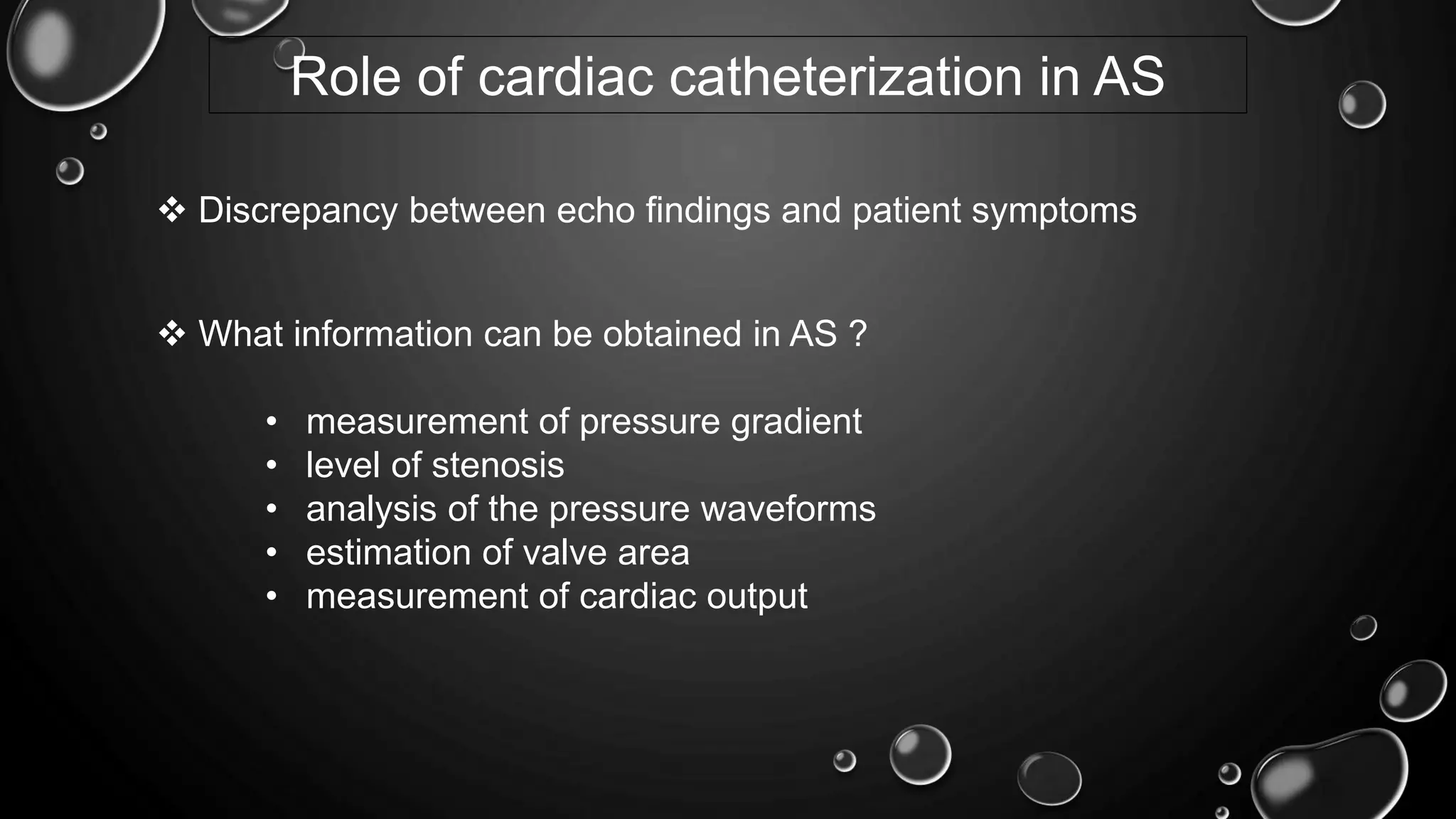
Role of cardiac catheterization in AS
 What information can be obtained in AS ?
• measurement of pressure gradient
• level of stenosis
• analysis of the pressure waveforms
• estimation of valve area
• measurement of cardiac output
 Discrepancy between echo findings and patient symptoms
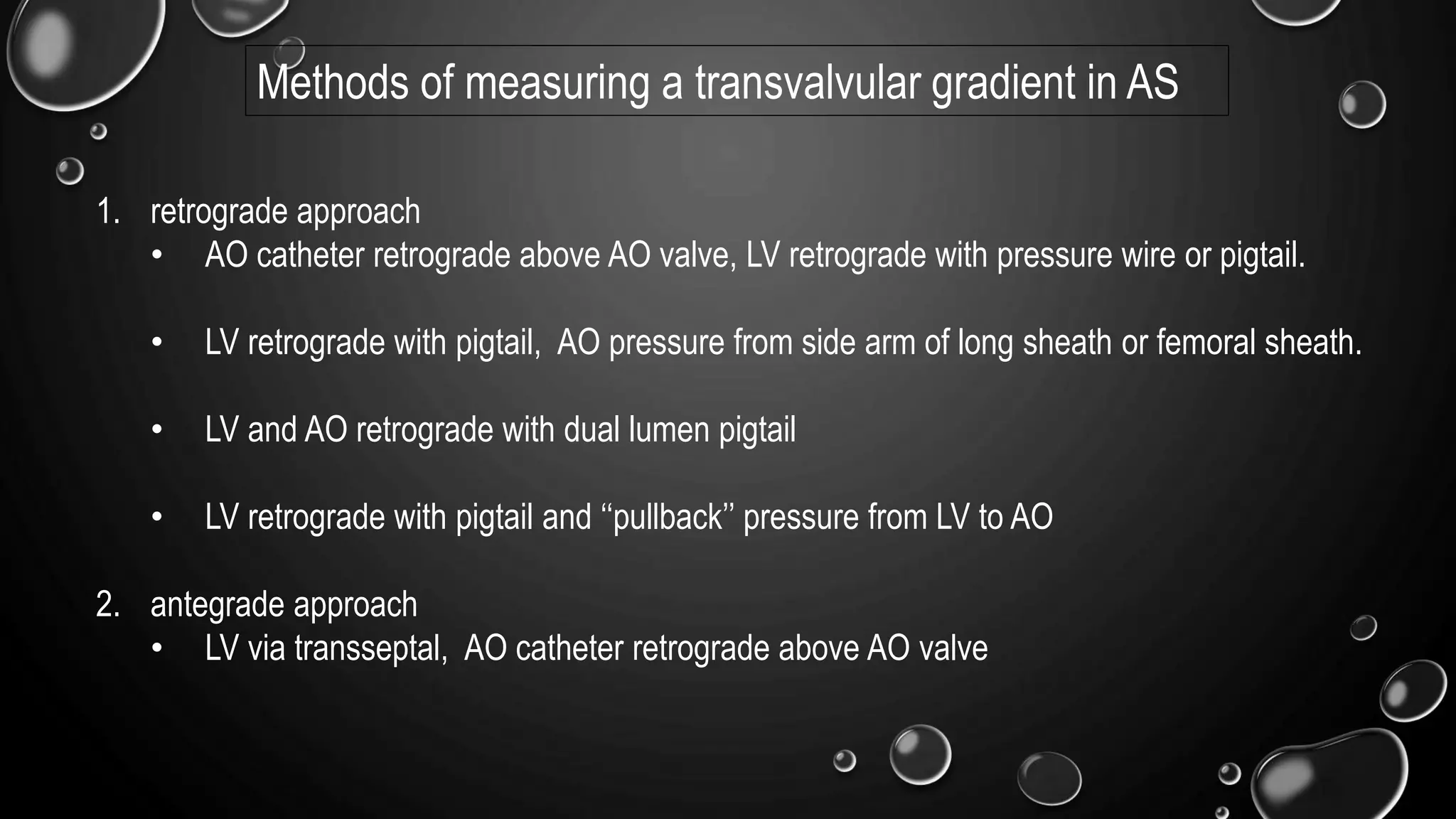
Methods of measuring a transvalvular gradient in AS
1. retrograde approach
• AO catheter retrograde above AO valve, LV retrograde with pressure wire or pigtail.
• LV retrograde with pigtail, AO pressure from side arm of long sheath or femoral sheath.
• LV and AO retrograde with dual lumen pigtail
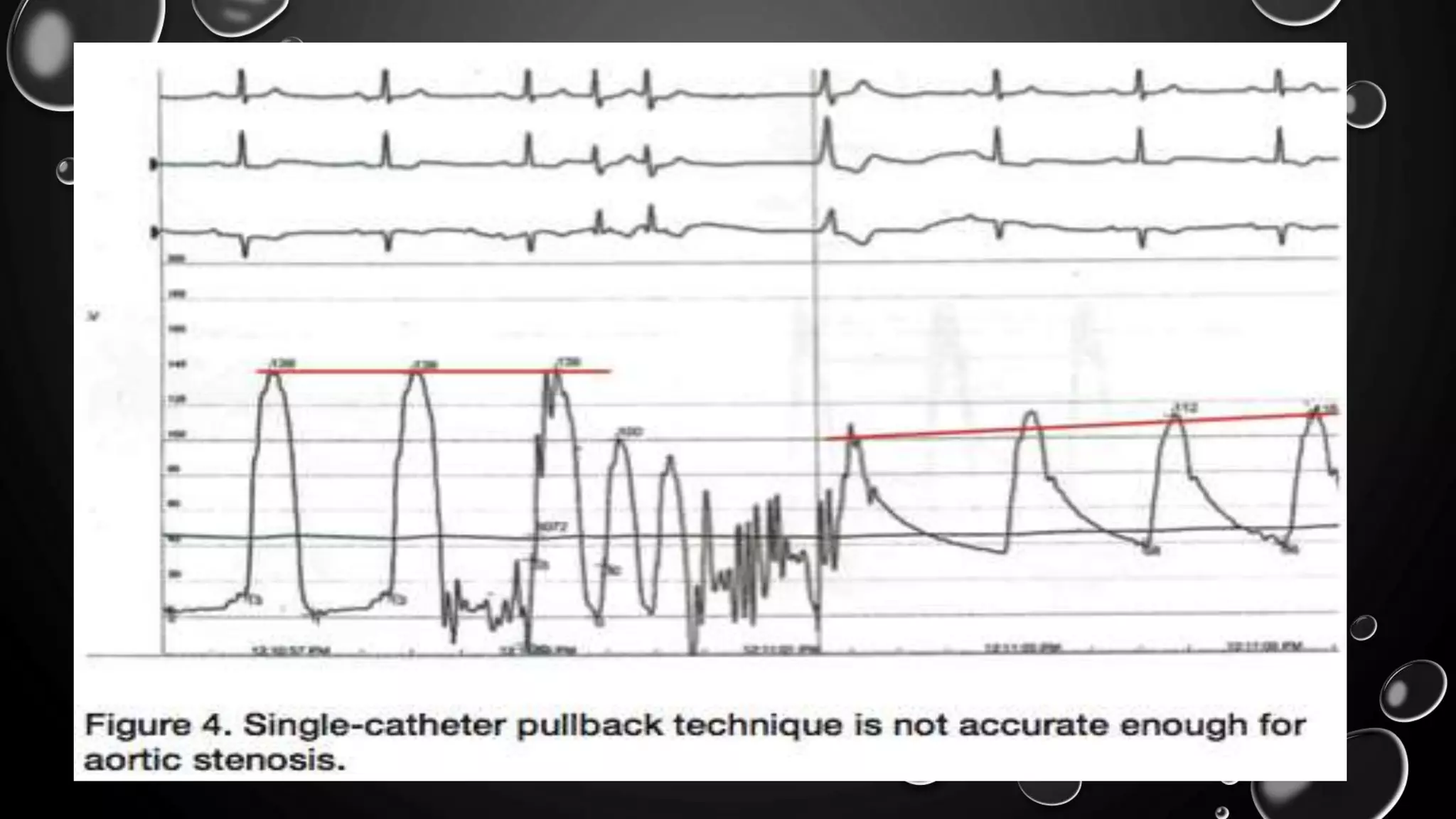
• LV retrograde with pigtail and ‘‘pullback’’ pressure from LV to AO
2. antegrade approach
• LV via transseptal, AO catheter retrograde above AO valve
CAVEAT: both measurement at same time with
direct measurement of aortic pressure is best
means of assessment.
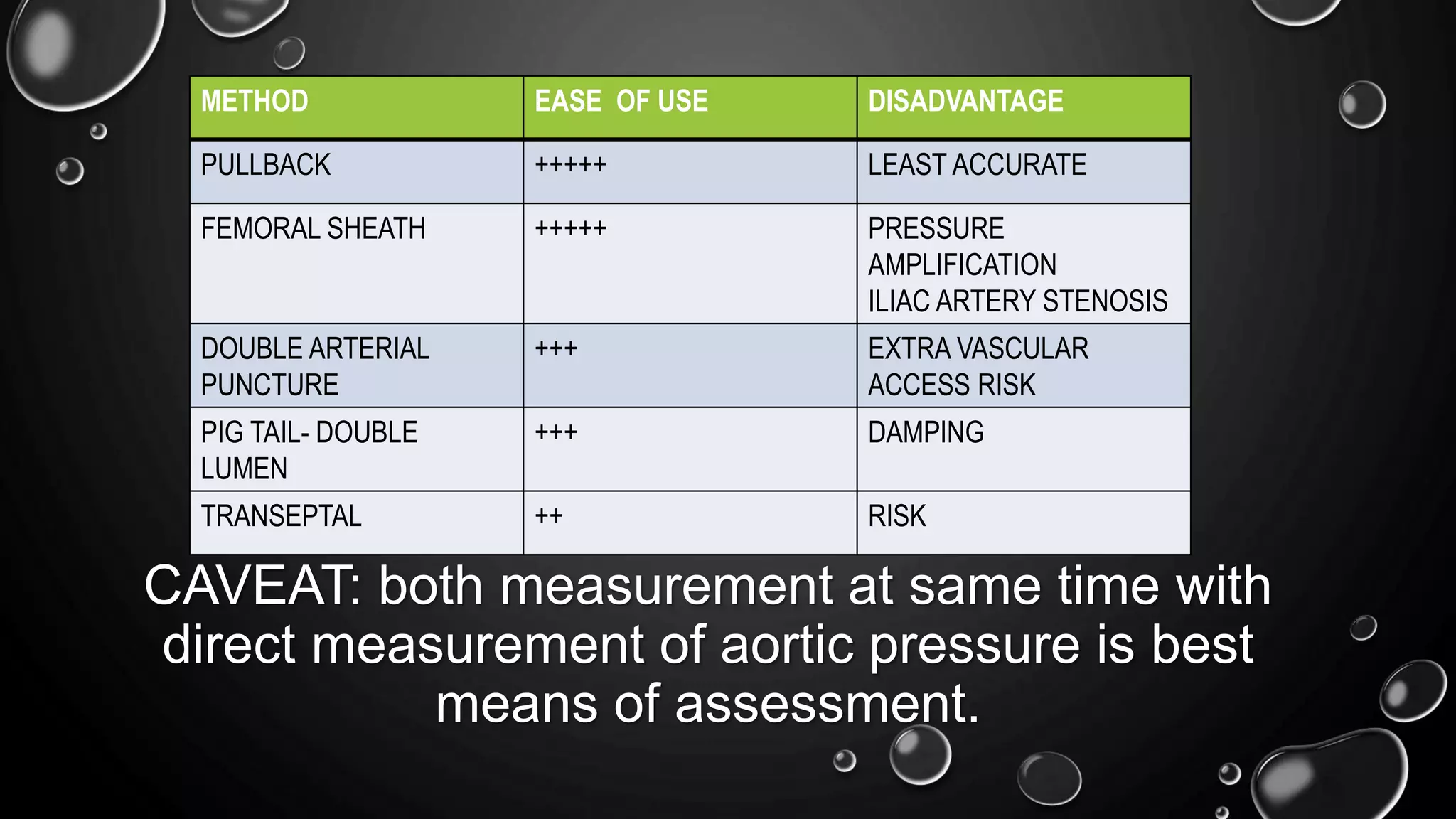
METHOD EASE OF USE DISADVANTAGE
PULLBACK +++++ LEAST ACCURATE
FEMORAL SHEATH +++++ PRESSURE
AMPLIFICATION
ILIAC ARTERY STENOSIS
DOUBLE ARTERIAL
PUNCTURE
+++ EXTRA VASCULAR
ACCESS RISK
PIG TAIL- DOUBLE
LUMEN
+++ DAMPING
TRANSEPTAL ++ RISK
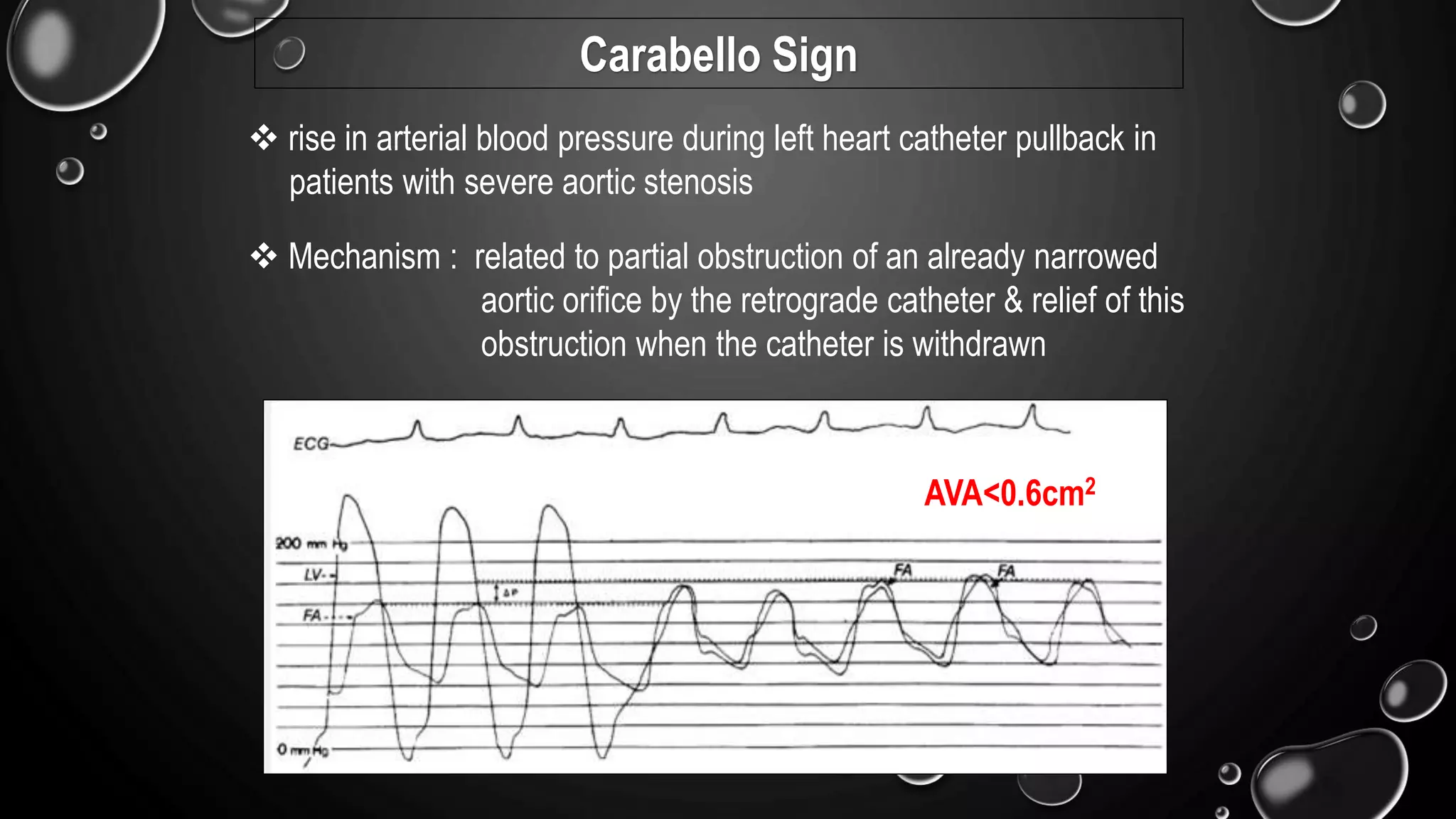
Carabello Sign
 rise in arterial blood pressure during left heart catheter pullback in
patients with severe aortic stenosis
 Mechanism : related to partial obstruction of an already narrowed
aortic orifice by the retrograde catheter & relief of this
obstruction when the catheter is withdrawn
AVA<0.6cm2
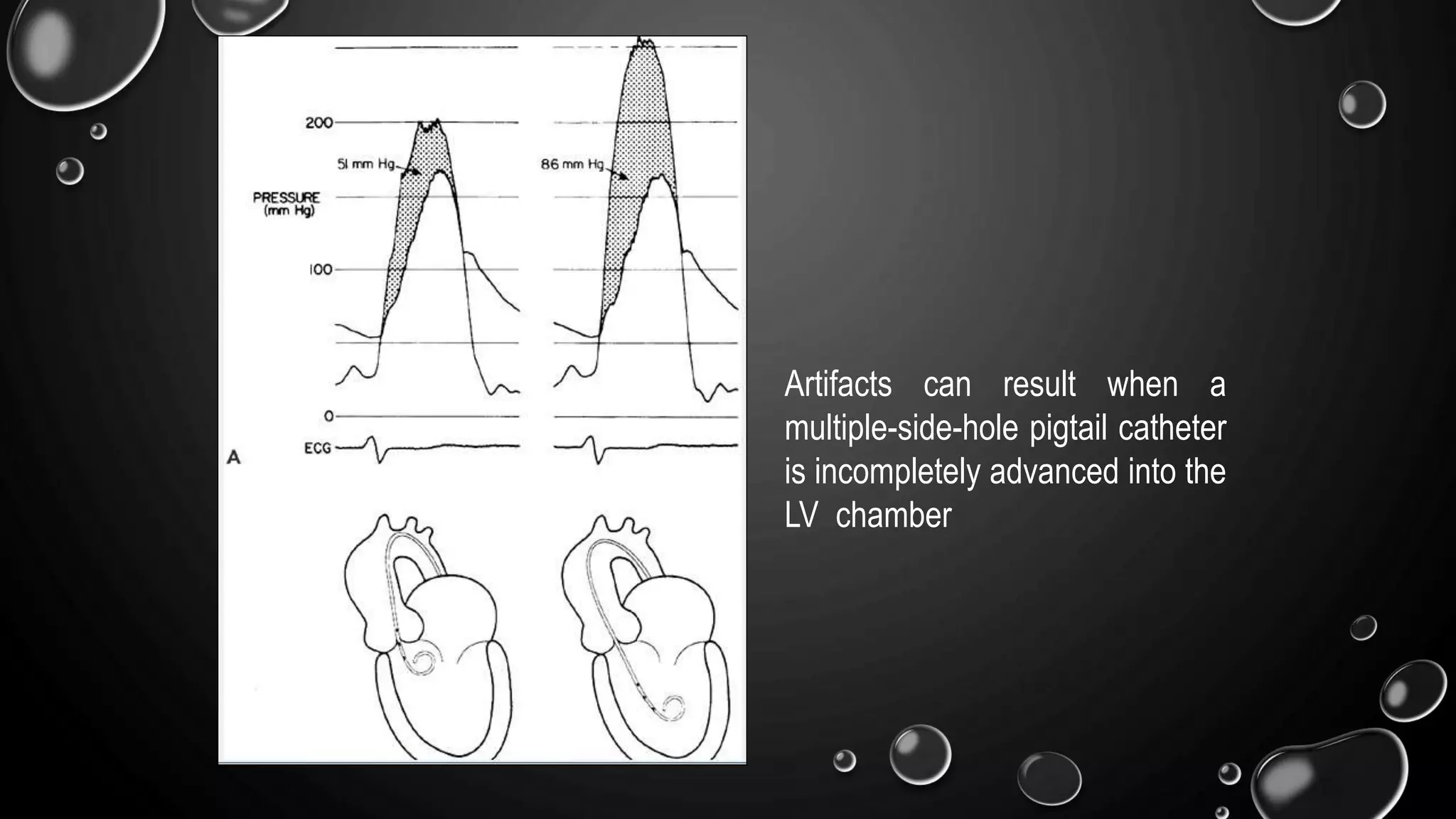
Artifacts can result when a
multiple-side-hole pigtail catheter
is incompletely advanced into the
LV chamber
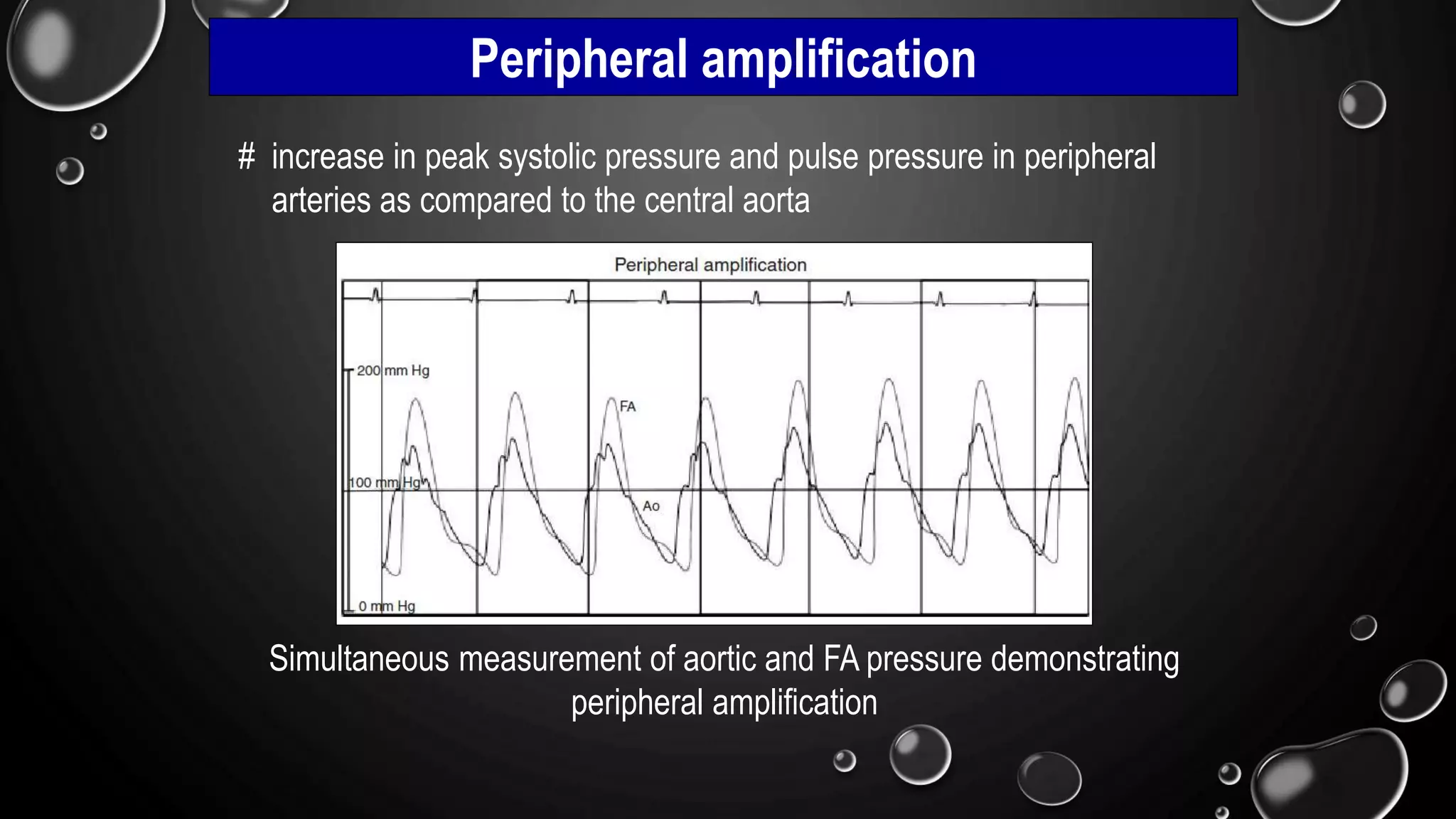
Simultaneous measurement of aortic and FA pressure demonstrating
peripheral amplification
Peripheral amplification
# increase in peak systolic pressure and pulse pressure in peripheral
arteries as compared to the central aorta
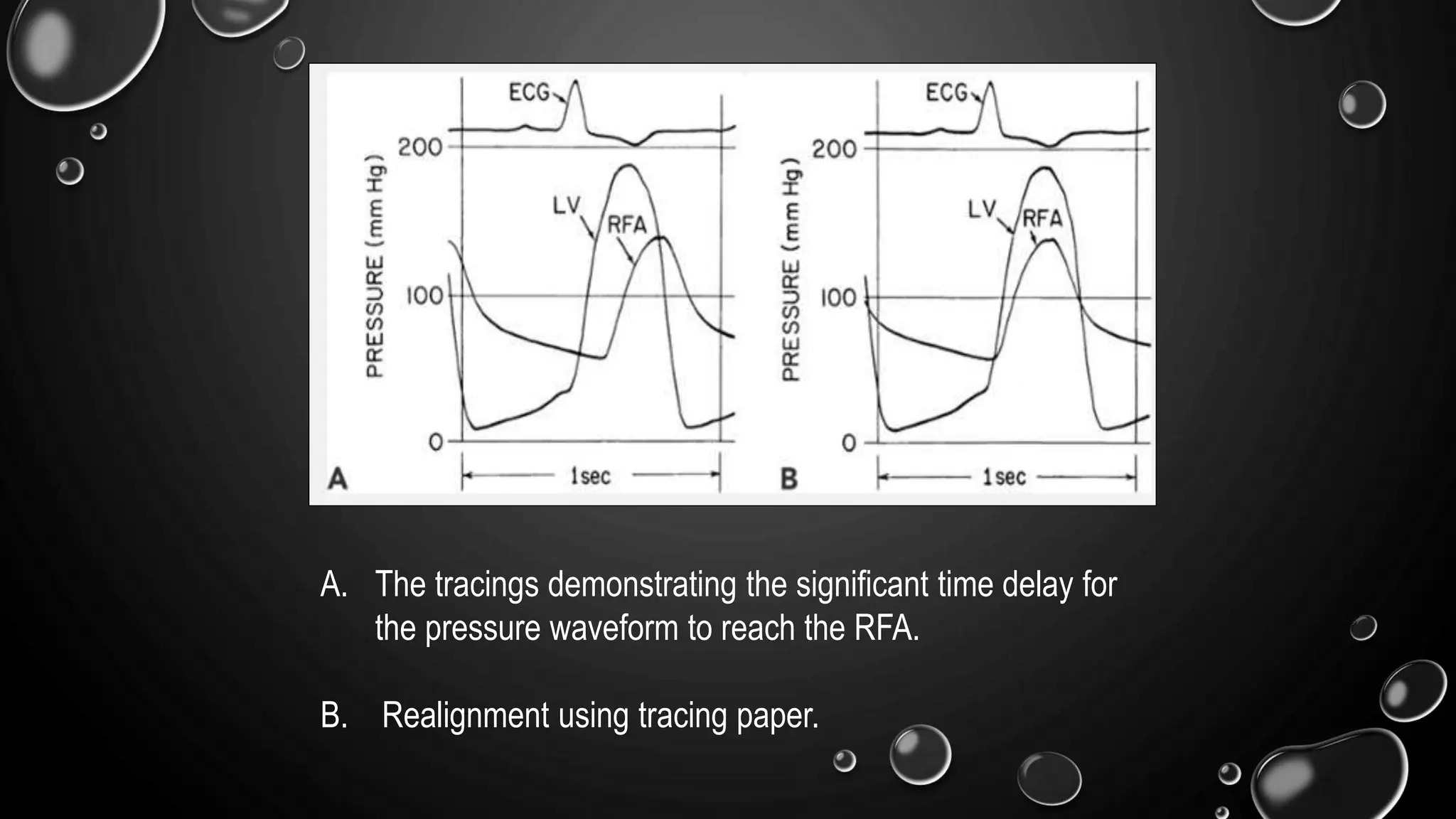
A. The tracings demonstrating the significant time delay for
the pressure waveform to reach the RFA.
B. Realignment using tracing paper.
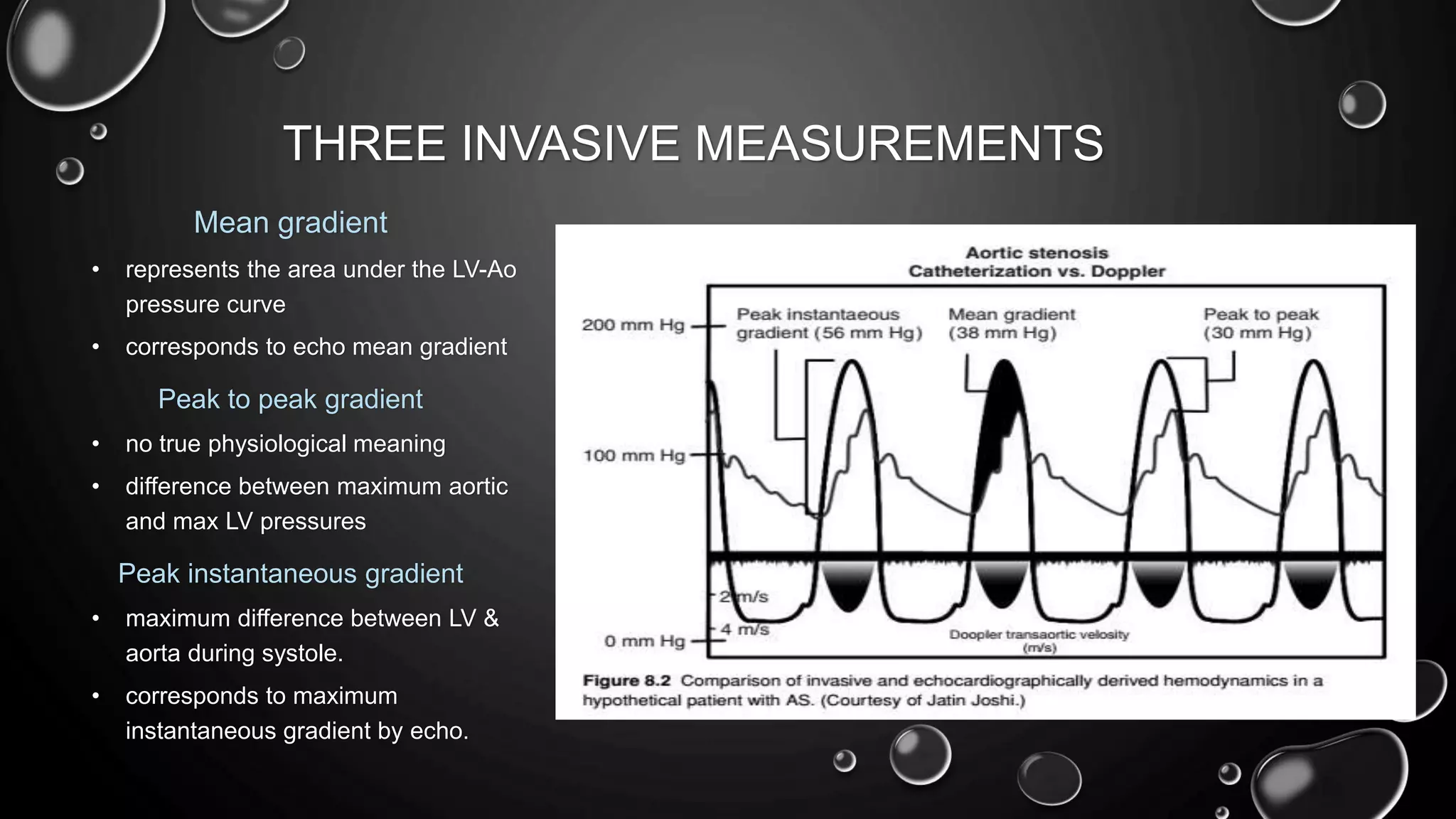
THREE INVASIVE MEASUREMENTS
Mean gradient
• represents the area under the LV-Ao
pressure curve
• corresponds to echo mean gradient
Peak to peak gradient
• no true physiological meaning
• difference between maximum aortic
and max LV pressures
Peak instantaneous gradient
• maximum difference between LV &
aorta during systole.
• corresponds to maximum
instantaneous gradient by echo.
Supra Valvular AS
Valvular AS
Sub valvular AS
Aorta pull back tracing- level of
stenosis
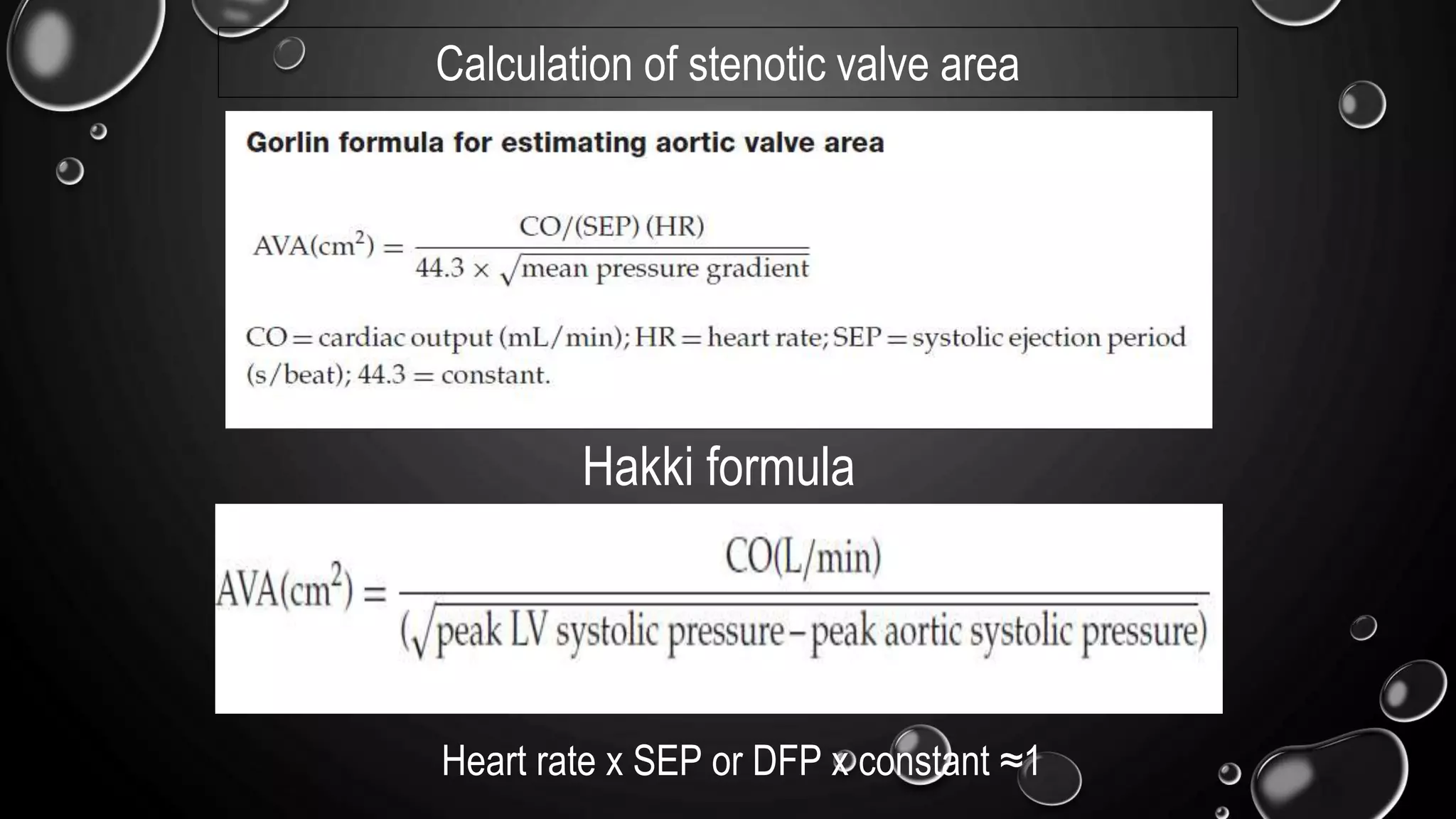
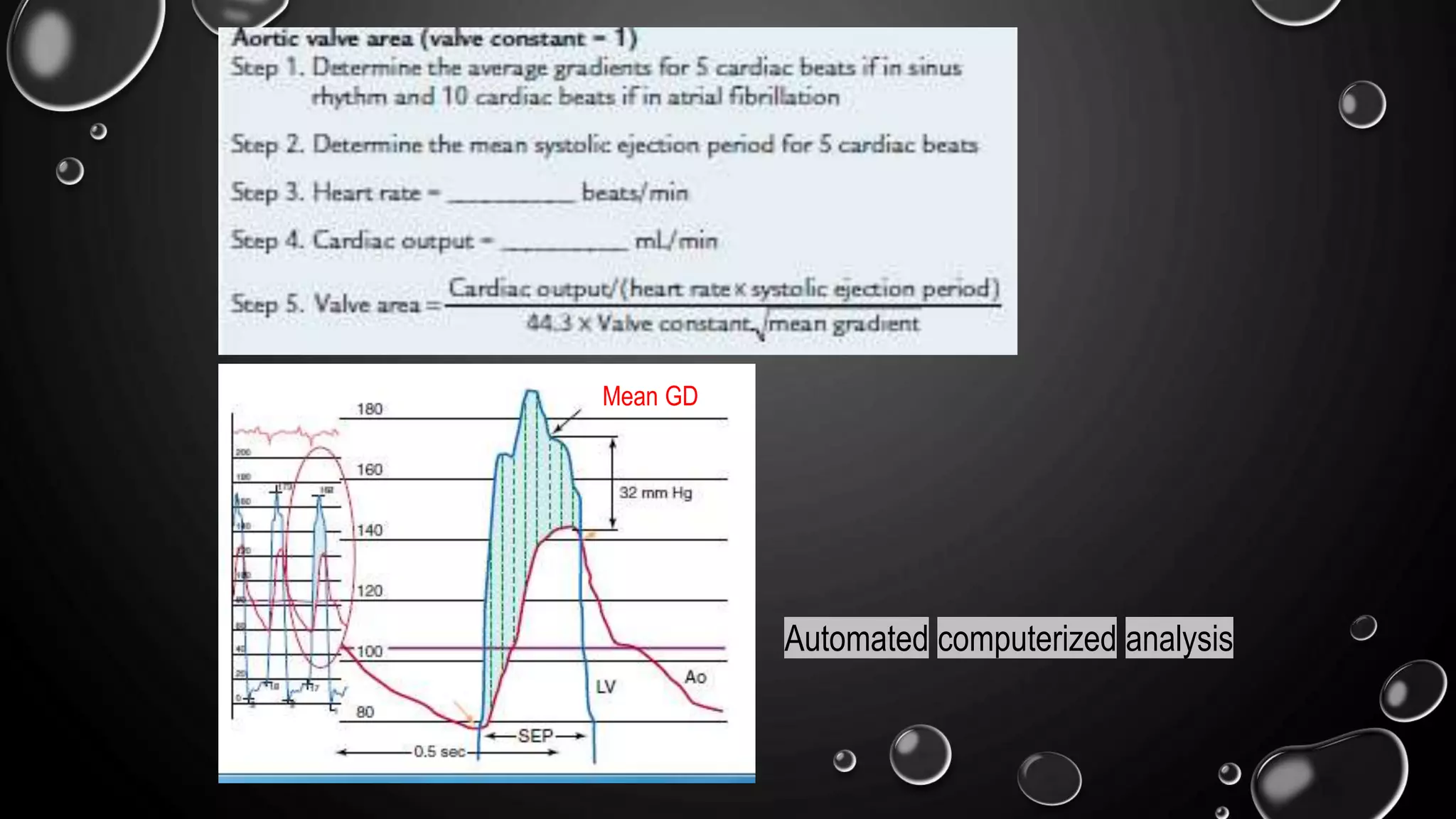
Hakki formula
Heart rate x SEP or DFP x constant ≈1
Calculation of stenotic valve area
Mean GD
Automated computerized analysis
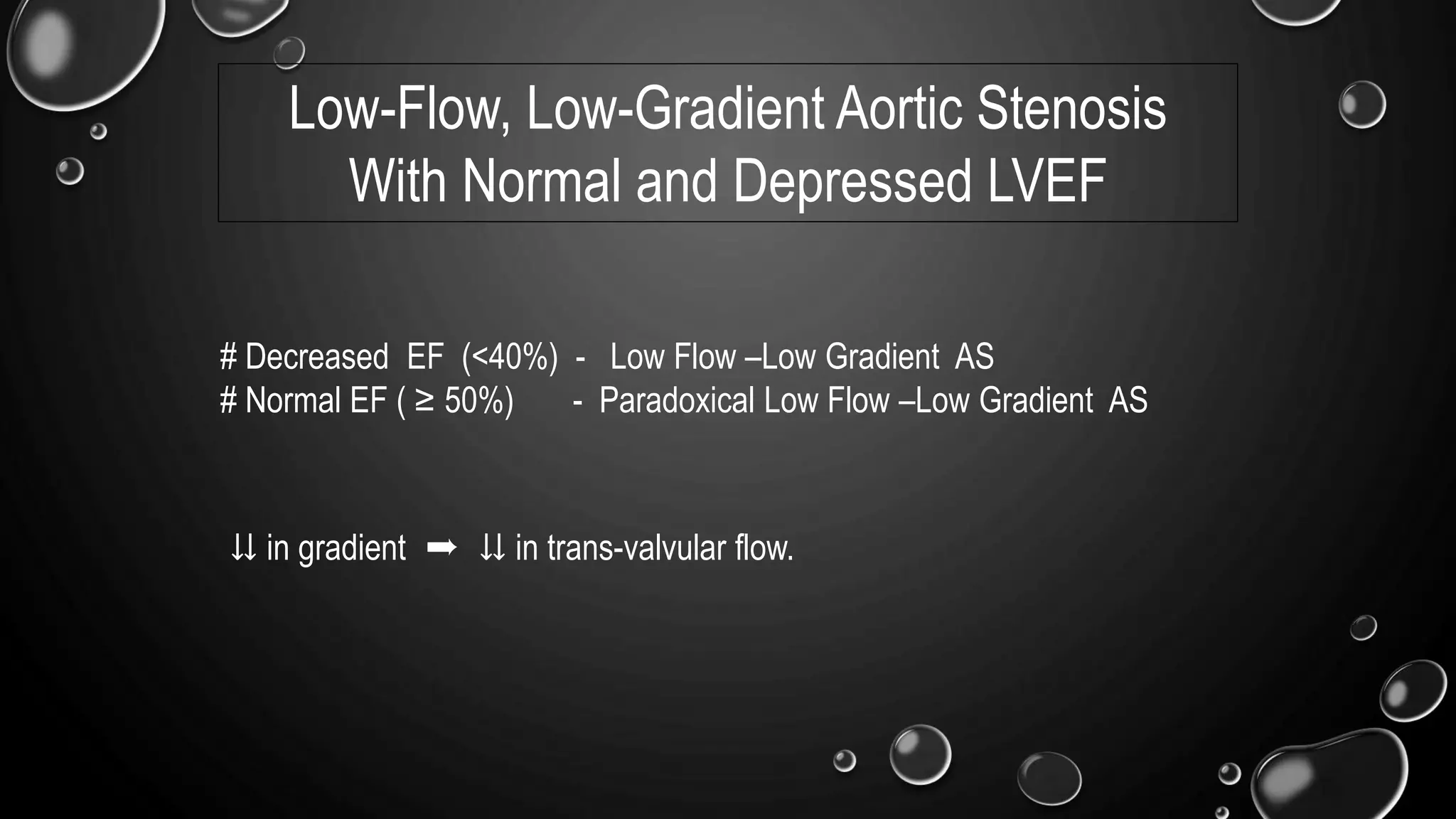
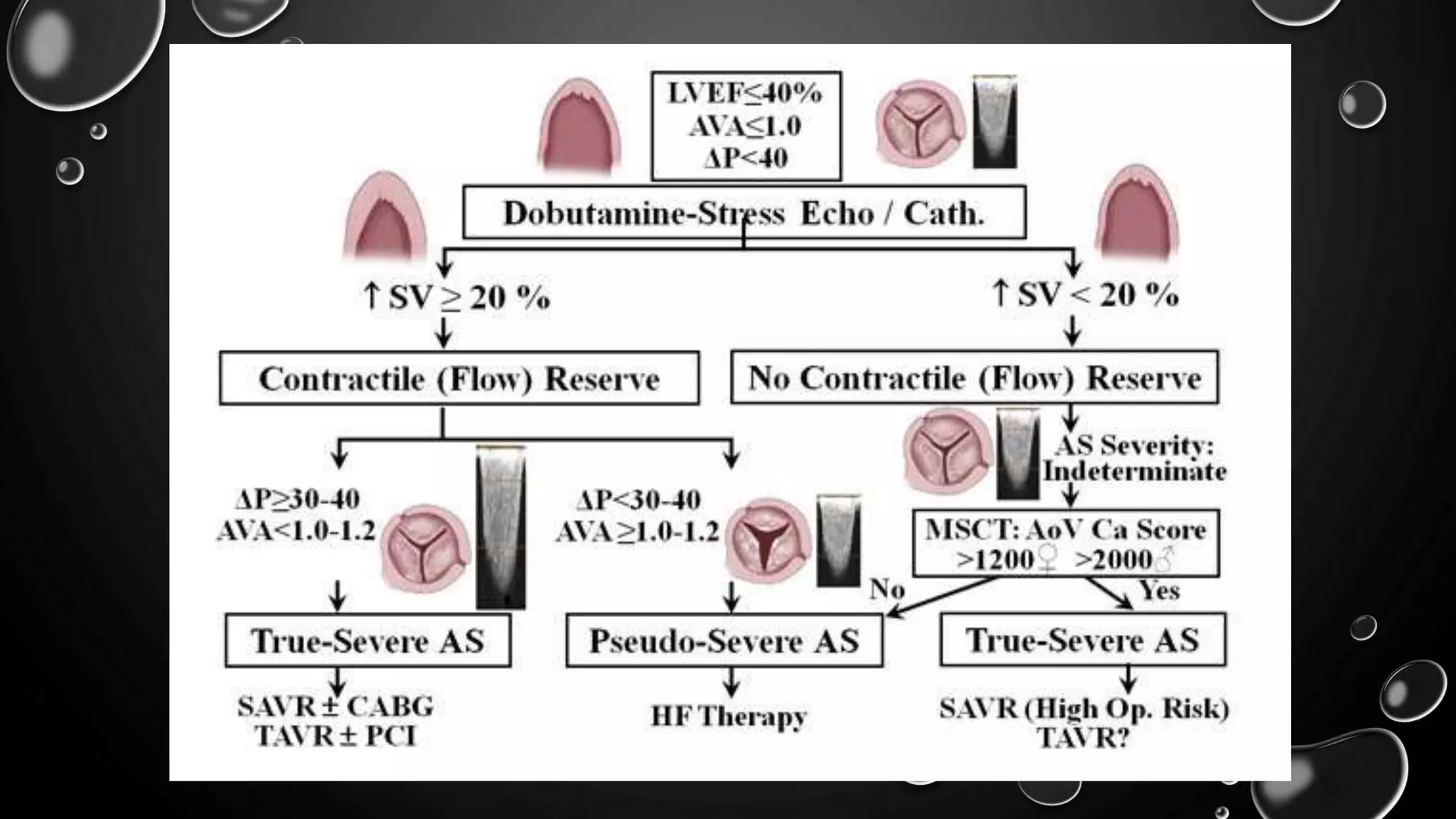
Low-Flow, Low-Gradient Aortic Stenosis
With Normal and Depressed LVEF
# Decreased EF (<40%) - Low Flow –Low Gradient AS
# Normal EF ( ≥ 50%) - Paradoxical Low Flow –Low Gradient AS
⇊ in gradient ➨ ⇊ in trans-valvular flow.
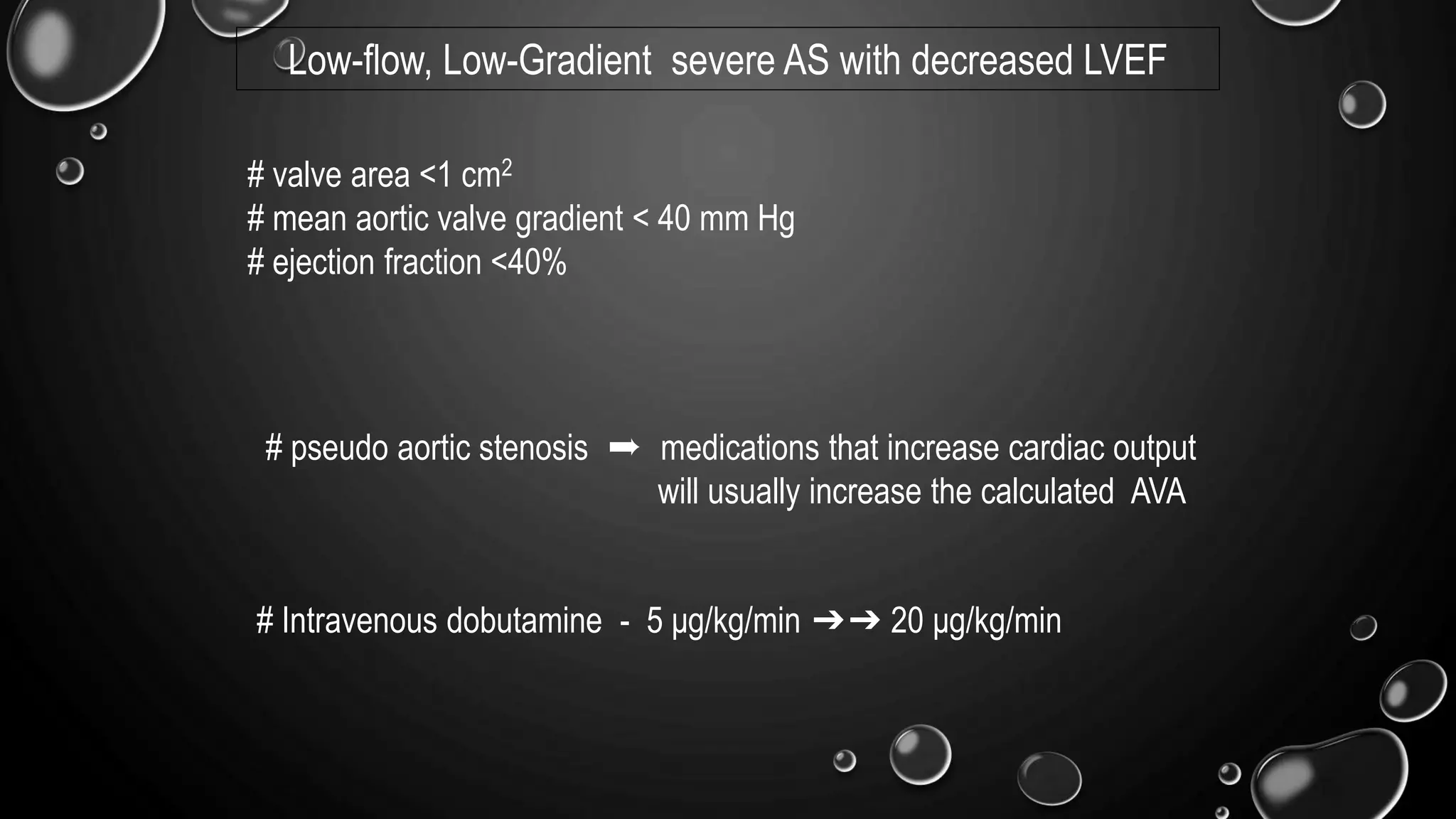
Low-flow, Low-Gradient severe AS with decreased LVEF
# valve area <1 cm2
# mean aortic valve gradient < 40 mm Hg
# ejection fraction <40%
# pseudo aortic stenosis ➨ medications that increase cardiac output
will usually increase the calculated AVA
# Intravenous dobutamine - 5 μg/kg/min ➔➔ 20 μg/kg/min
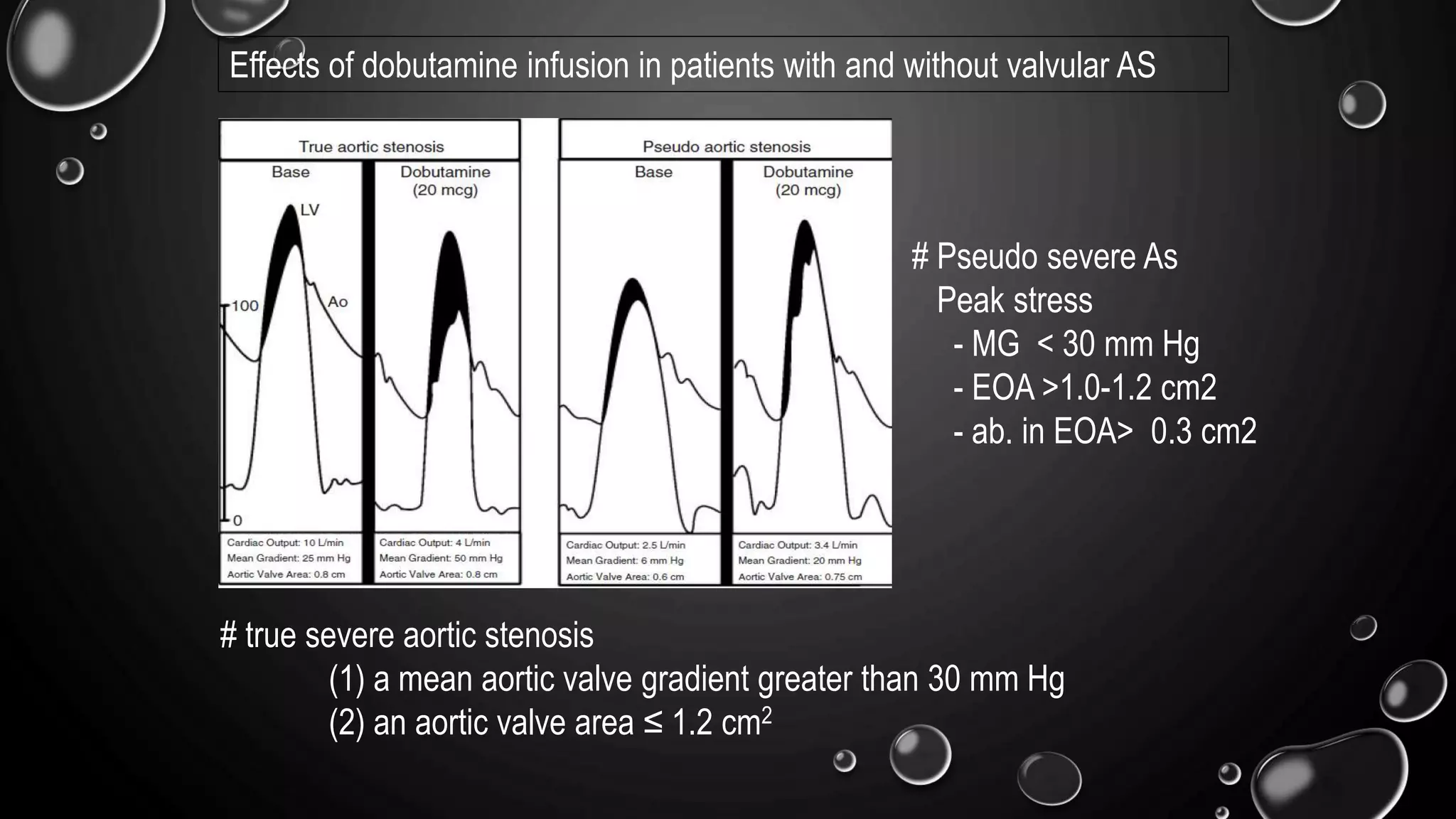
# true severe aortic stenosis
(1) a mean aortic valve gradient greater than 30 mm Hg
(2) an aortic valve area ≤ 1.2 cm2
Effects of dobutamine infusion in patients with and without valvular AS
# Pseudo severe As
Peak stress
- MG < 30 mm Hg
- EOA >1.0-1.2 cm2
- ab. in EOA> 0.3 cm2
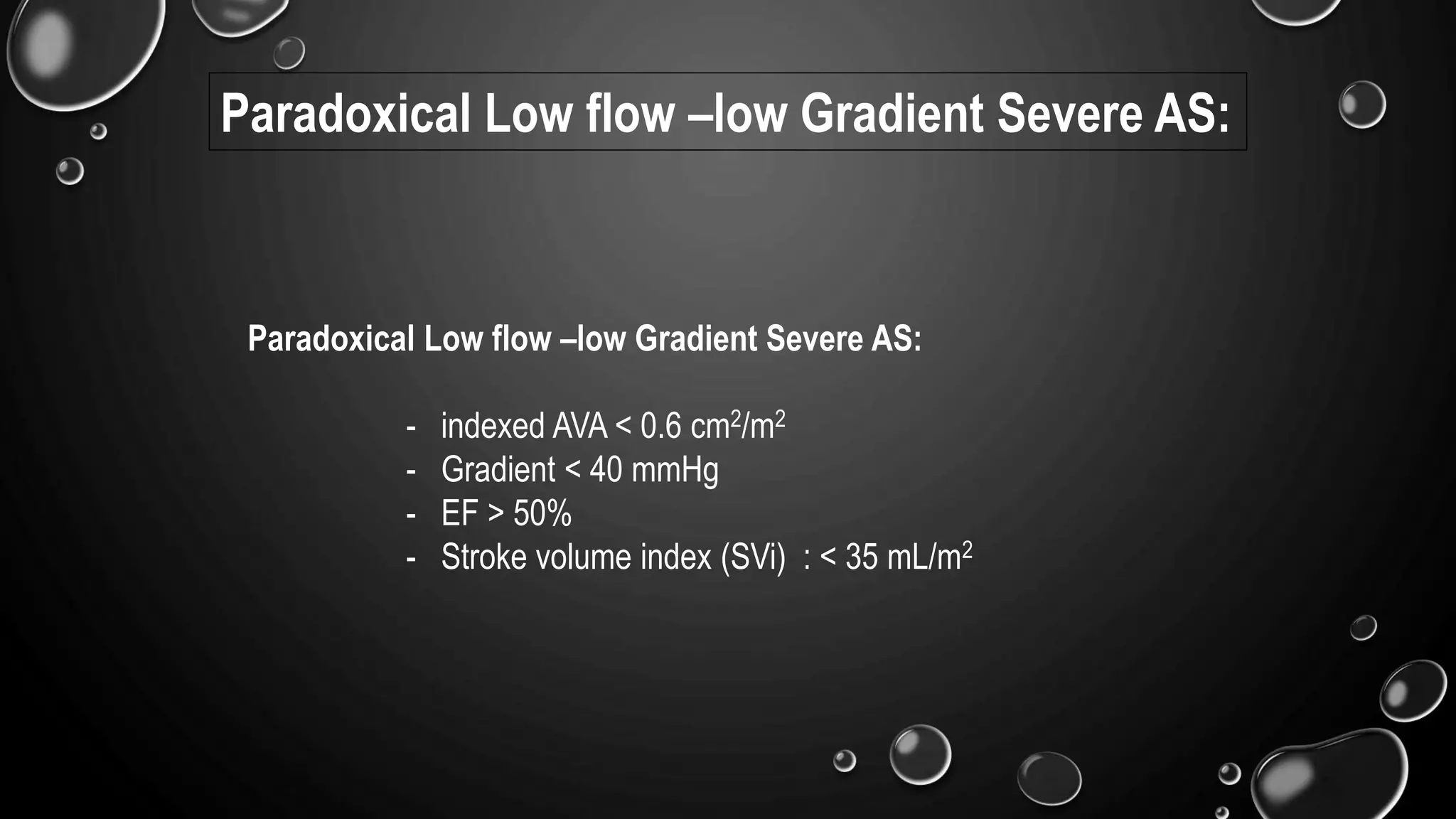
Paradoxical Low flow –low Gradient Severe AS:
- indexed AVA < 0.6 cm2/m2
- Gradient < 40 mmHg
- EF > 50%
- Stroke volume index (SVi) : < 35 mL/m2
Paradoxical Low flow –low Gradient Severe AS:
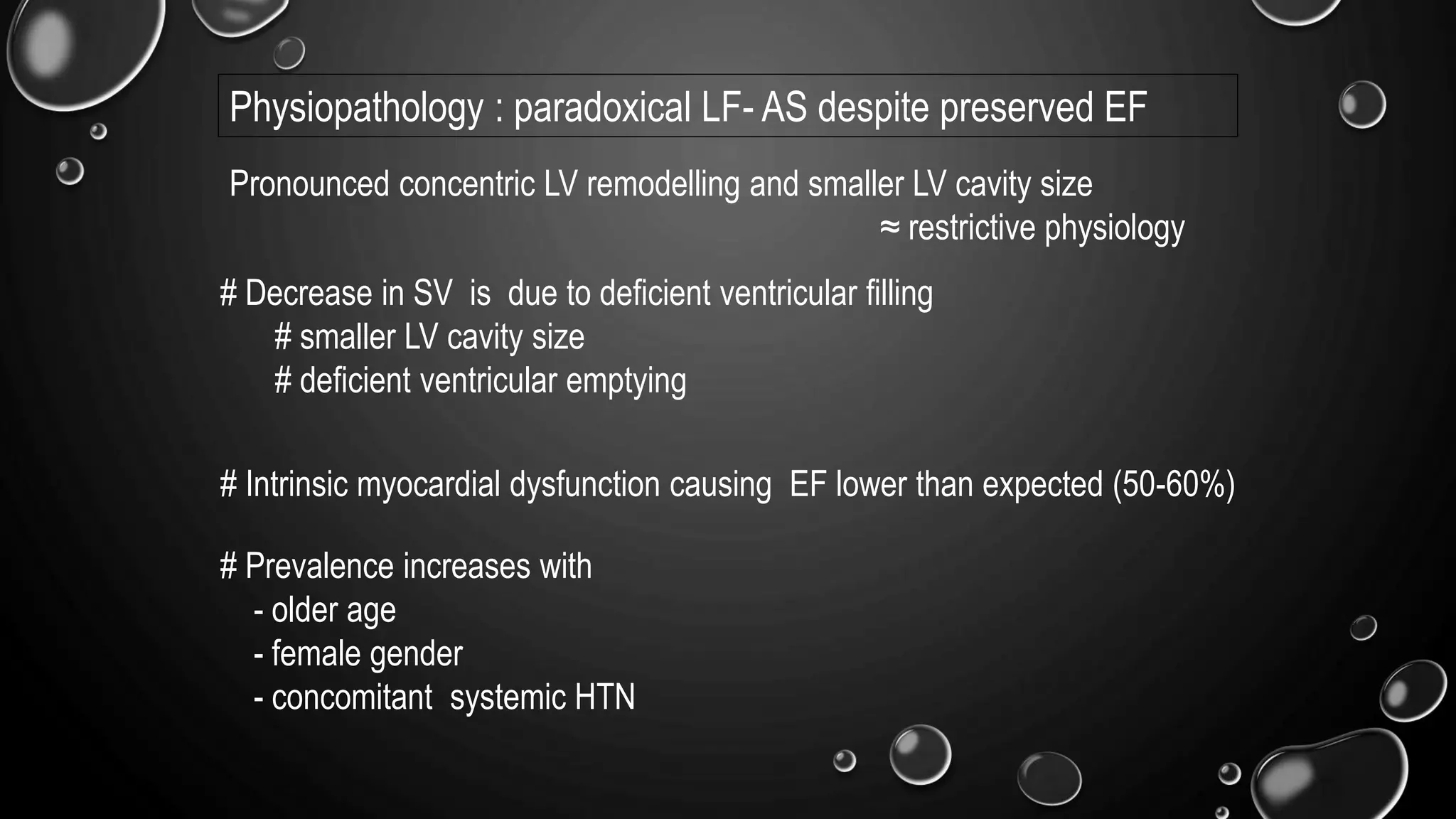
Physiopathology : paradoxical LF- AS despite preserved EF
Pronounced concentric LV remodelling and smaller LV cavity size
≈ restrictive physiology
# Decrease in SV is due to deficient ventricular filling
# smaller LV cavity size
# deficient ventricular emptying
# Intrinsic myocardial dysfunction causing EF lower than expected (50-60%)
# Prevalence increases with
- older age
- female gender
- concomitant systemic HTN
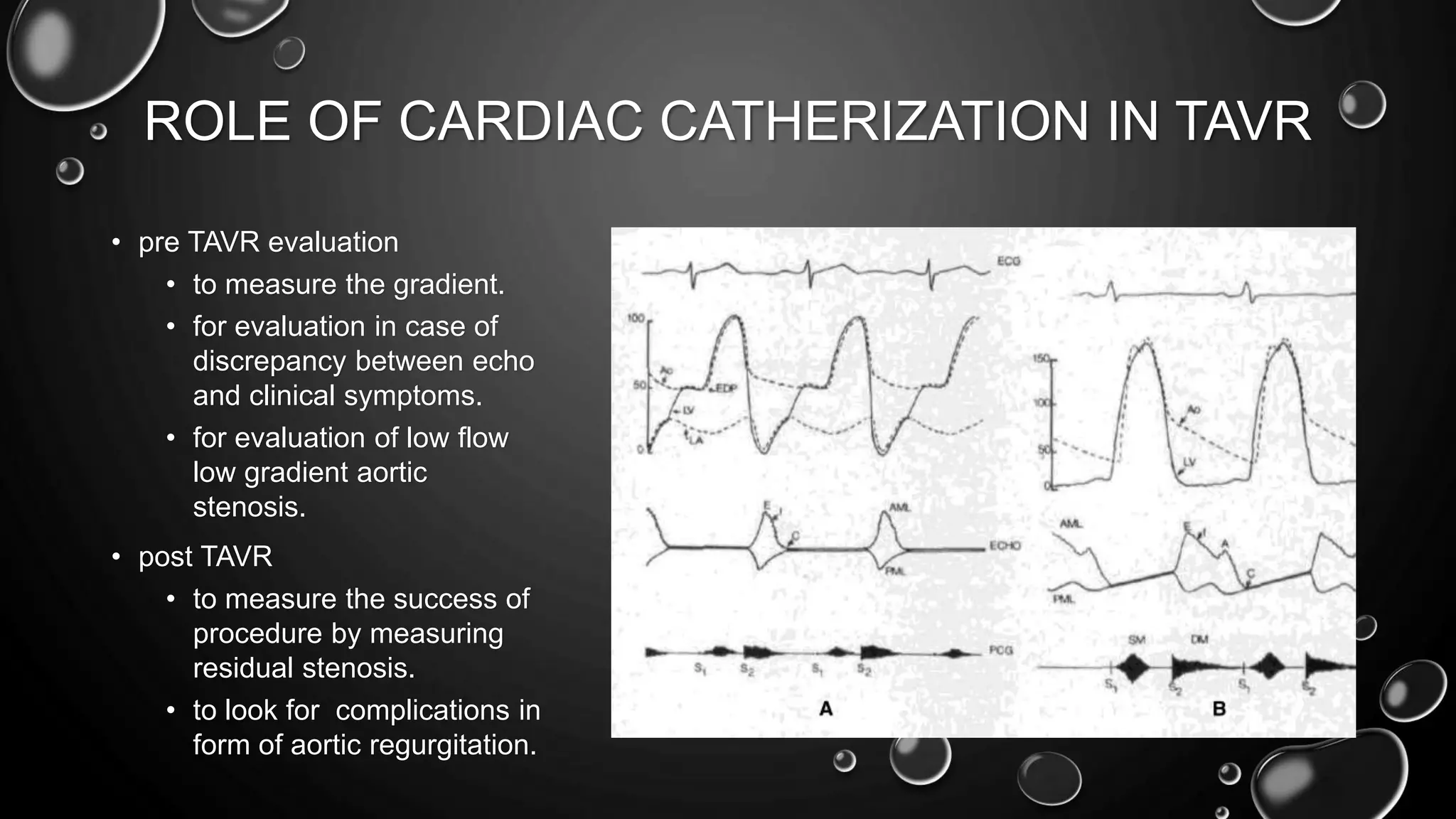
ROLE OF CARDIAC CATHERIZATION IN TAVR
• pre TAVR evaluation
• to measure the gradient.
• for evaluation in case of
discrepancy between echo
and clinical symptoms.
• for evaluation of low flow
low gradient aortic
stenosis.
• post TAVR
• to measure the success of
procedure by measuring
residual stenosis.
• to look for complications in
form of aortic regurgitation.
Hypertrophic cardiomyopathy
 dynamic intraventricular pressure gradient
 may/ may not have systolic pressure gradient at rest
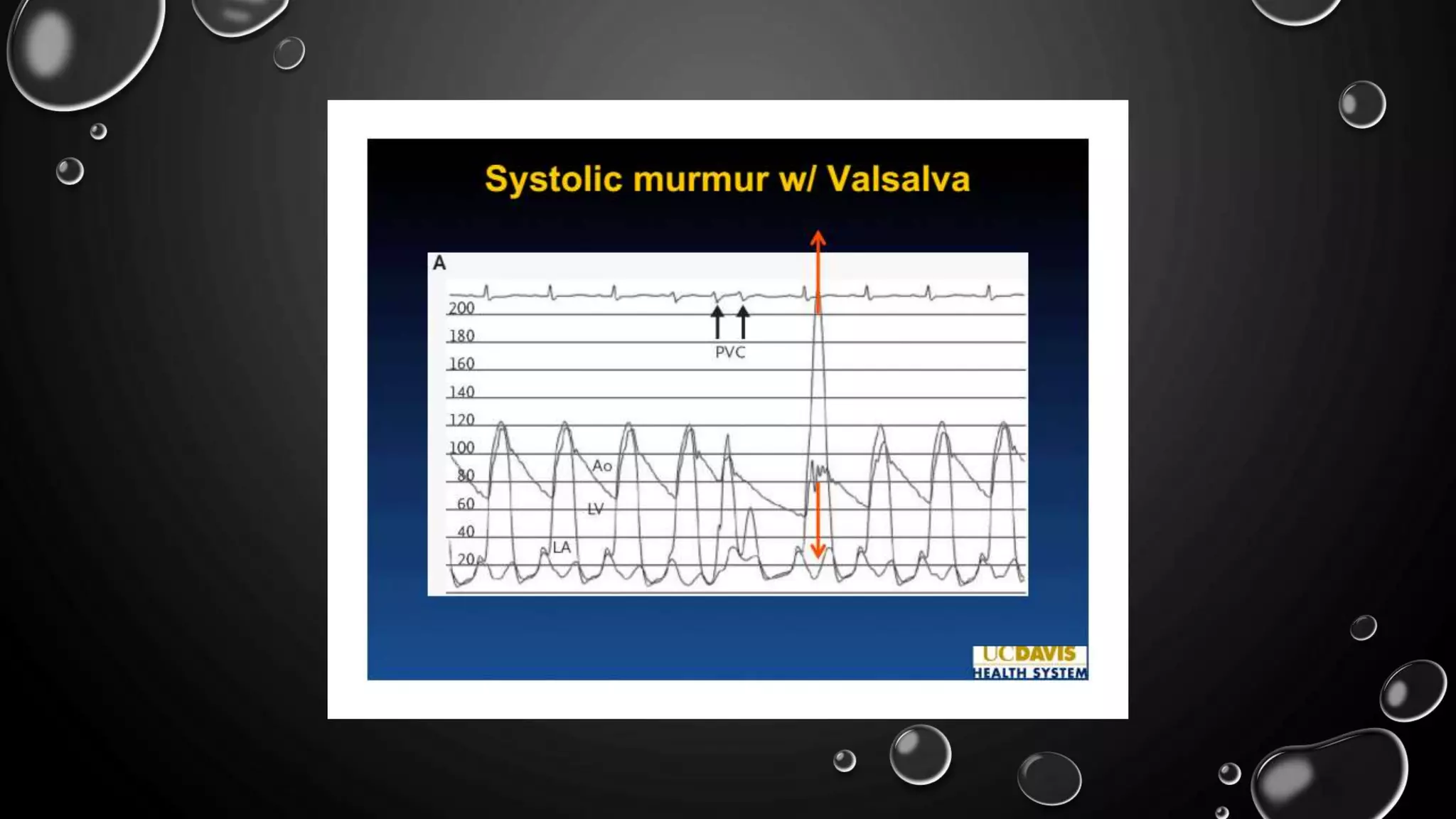
 gradient - provoked with : Valsalva maneuver
: extra systole
: systemic vasodilator (amyl nitrate)
: inotropic stimulation
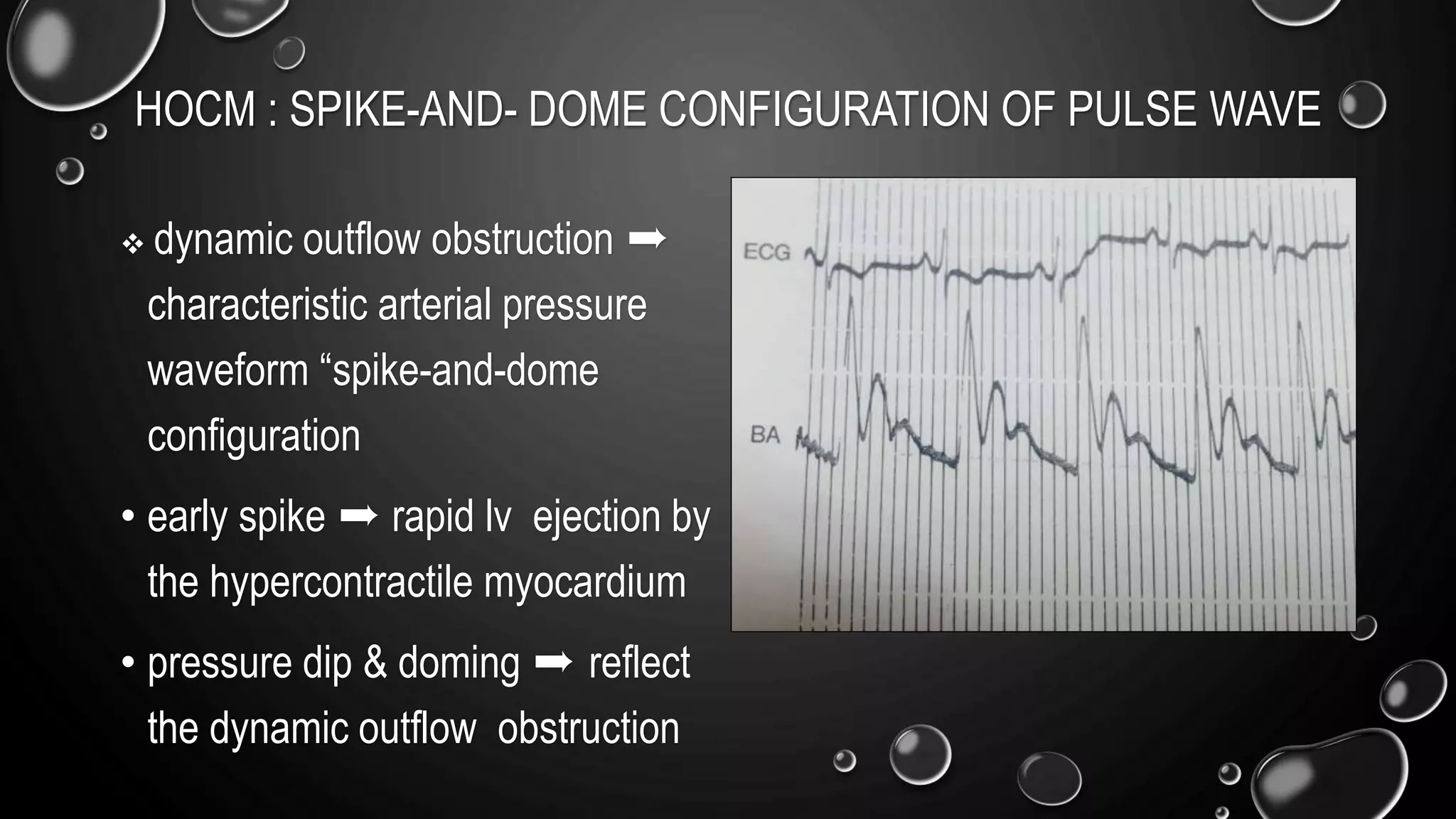
HOCM : SPIKE-AND- DOME CONFIGURATION OF PULSE WAVE
 dynamic outflow obstruction ➨
characteristic arterial pressure
waveform “spike-and-dome
configuration
• early spike ➨ rapid lv ejection by
the hypercontractile myocardium
• pressure dip & doming ➨ reflect
the dynamic outflow obstruction
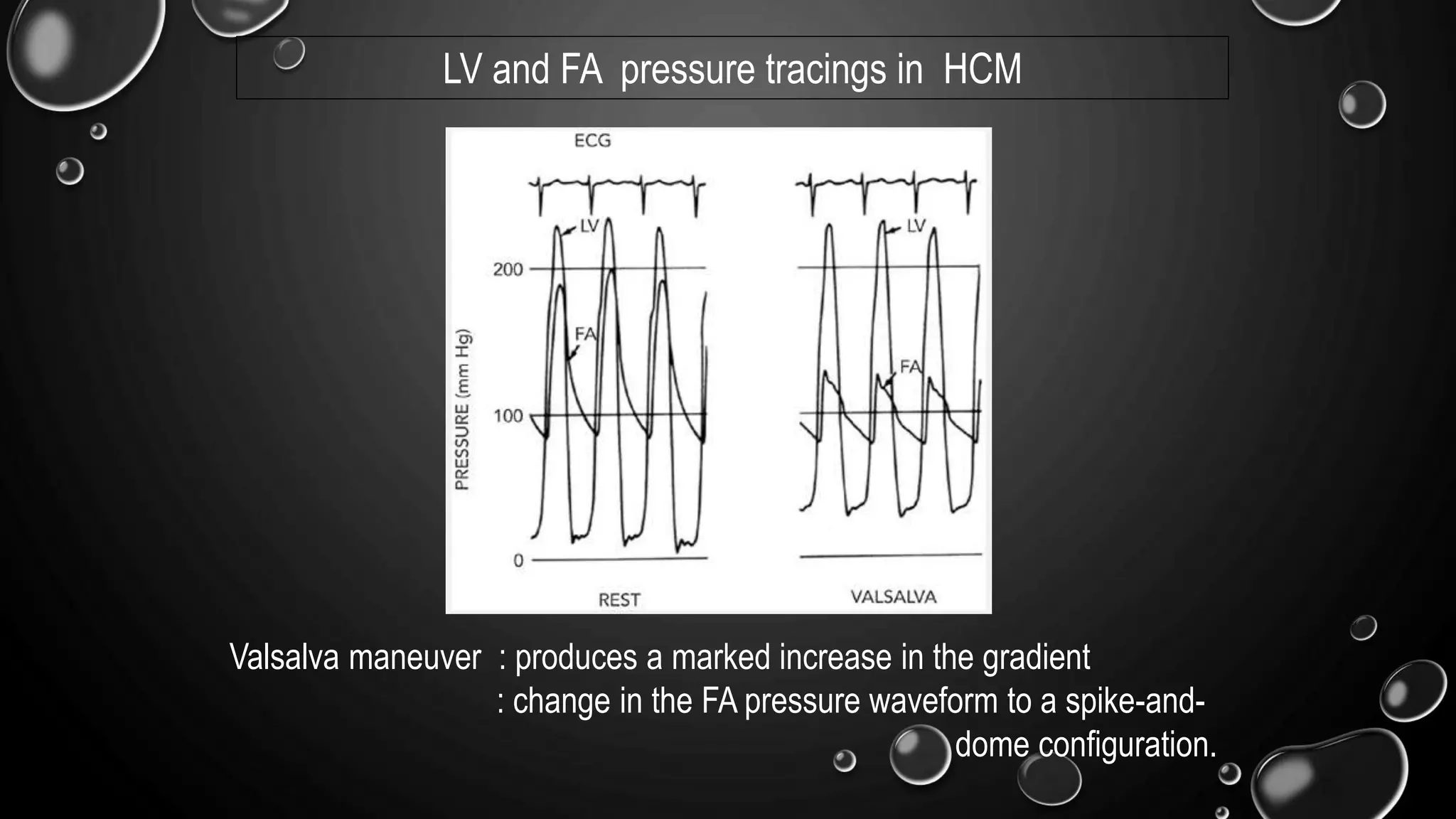
Valsalva maneuver : produces a marked increase in the gradient
: change in the FA pressure waveform to a spike-and-
dome configuration.
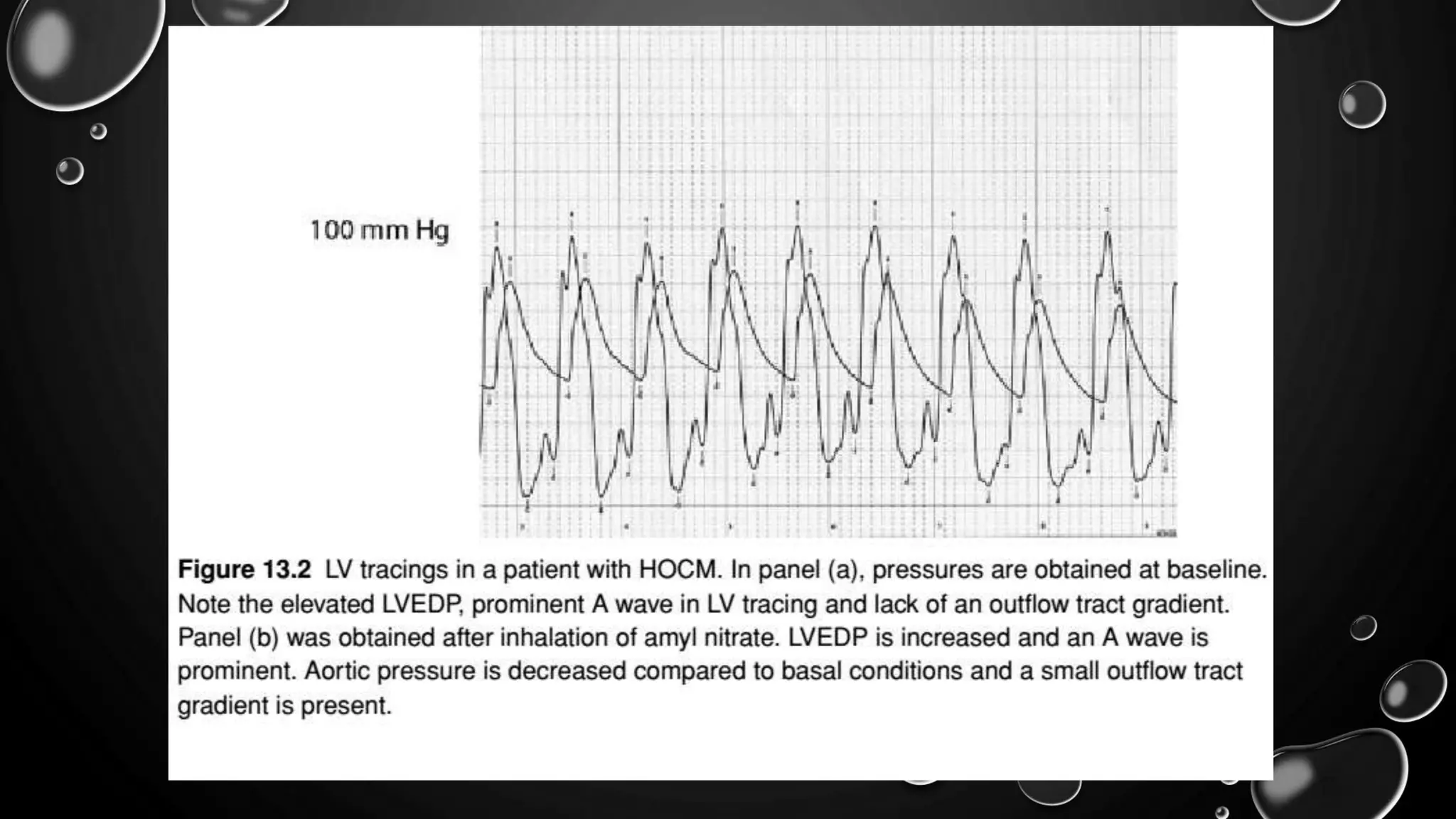
LV and FA pressure tracings in HCM
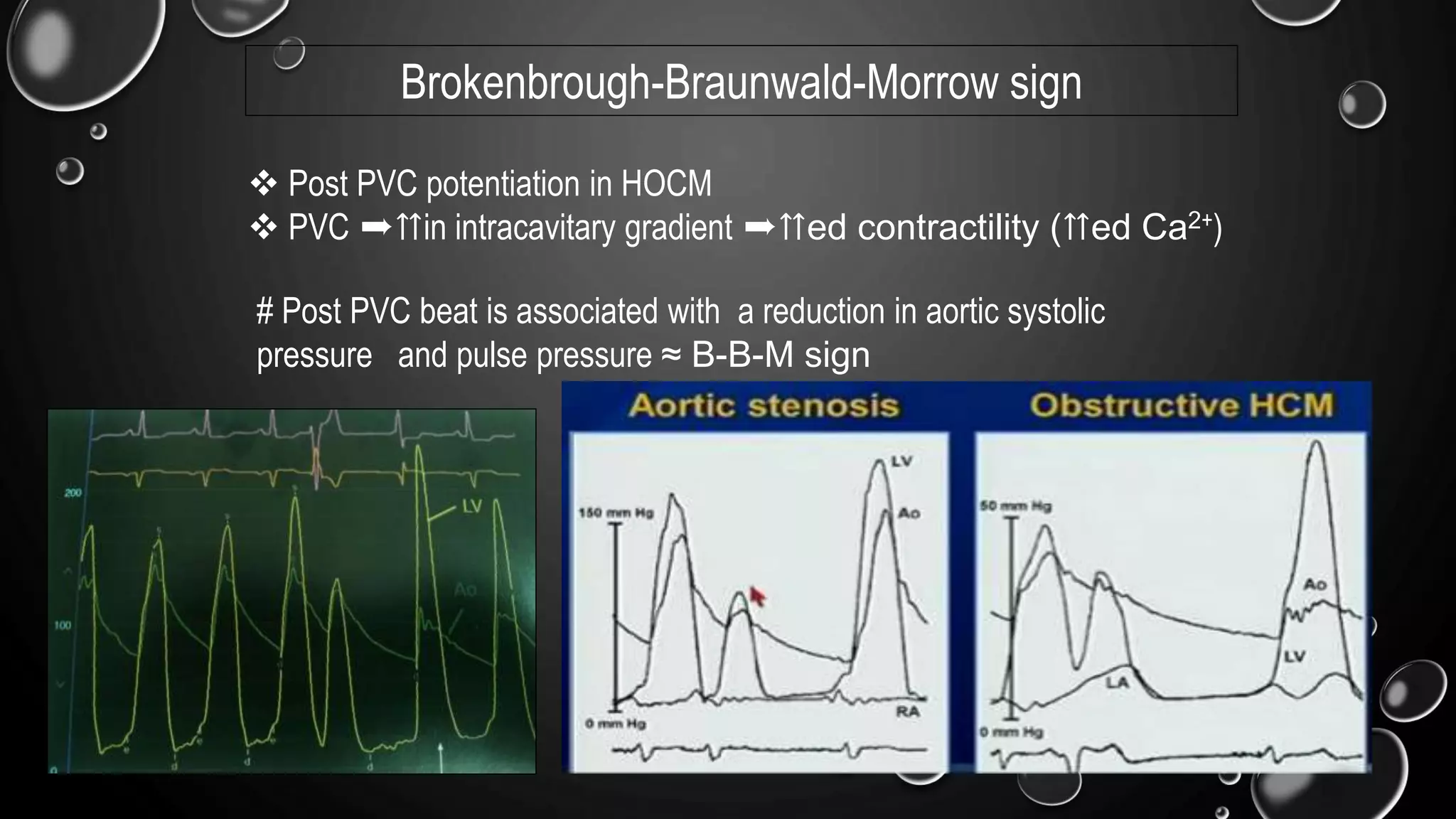
Brokenbrough-Braunwald-Morrow sign
 Post PVC potentiation in HOCM
 PVC ➨⇈in intracavitary gradient ➨⇈ed contractility (⇈ed Ca2+)
# Post PVC beat is associated with a reduction in aortic systolic
pressure and pulse pressure ≈ B-B-M sign
THANK
YOU
• NO OBSTRUCTION AT ONSET OF VENTRICULAR EJECTION.
• BRISK, INITIAL UPSTROKE- PEAK SYSTOLIC PRESSURE.
• OBSTRUCTION PROGRESSIVELY DURING SYSTOLE AS THE CONTRACTILE
FORCE OF THE LV BUILDS.
• WHEN OBSTRUCTION REACHES A MAXIMUM ,AORTIC PRESSURE DROPS.
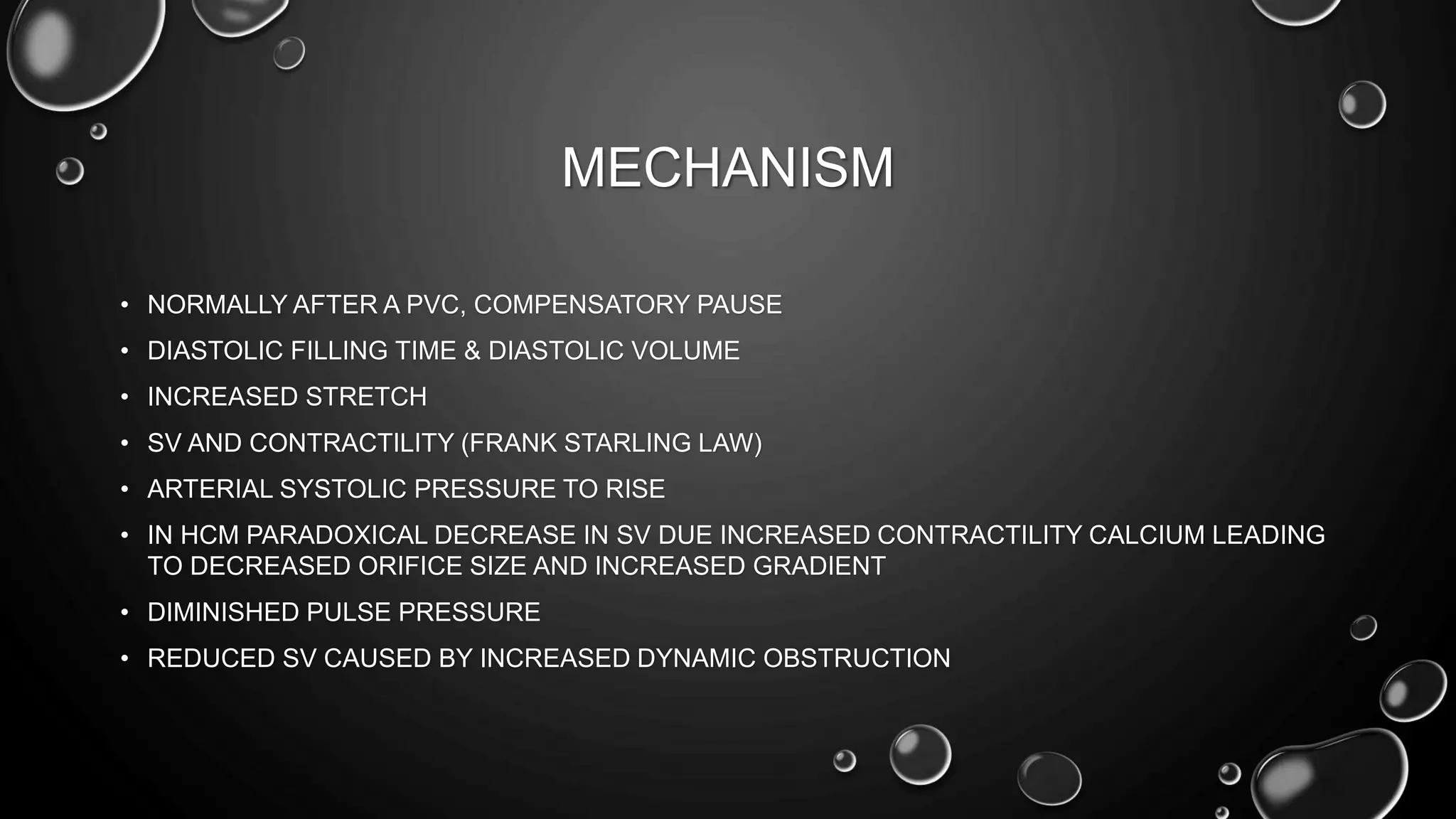
MECHANISM
• NORMALLY AFTER A PVC, COMPENSATORY PAUSE
• DIASTOLIC FILLING TIME & DIASTOLIC VOLUME
• INCREASED STRETCH
• SV AND CONTRACTILITY (FRANK STARLING LAW)
• ARTERIAL SYSTOLIC PRESSURE TO RISE
• IN HCM PARADOXICAL DECREASE IN SV DUE INCREASED CONTRACTILITY CALCIUM LEADING
TO DECREASED ORIFICE SIZE AND INCREASED GRADIENT
• DIMINISHED PULSE PRESSURE
• REDUCED SV CAUSED BY INCREASED DYNAMIC OBSTRUCTION
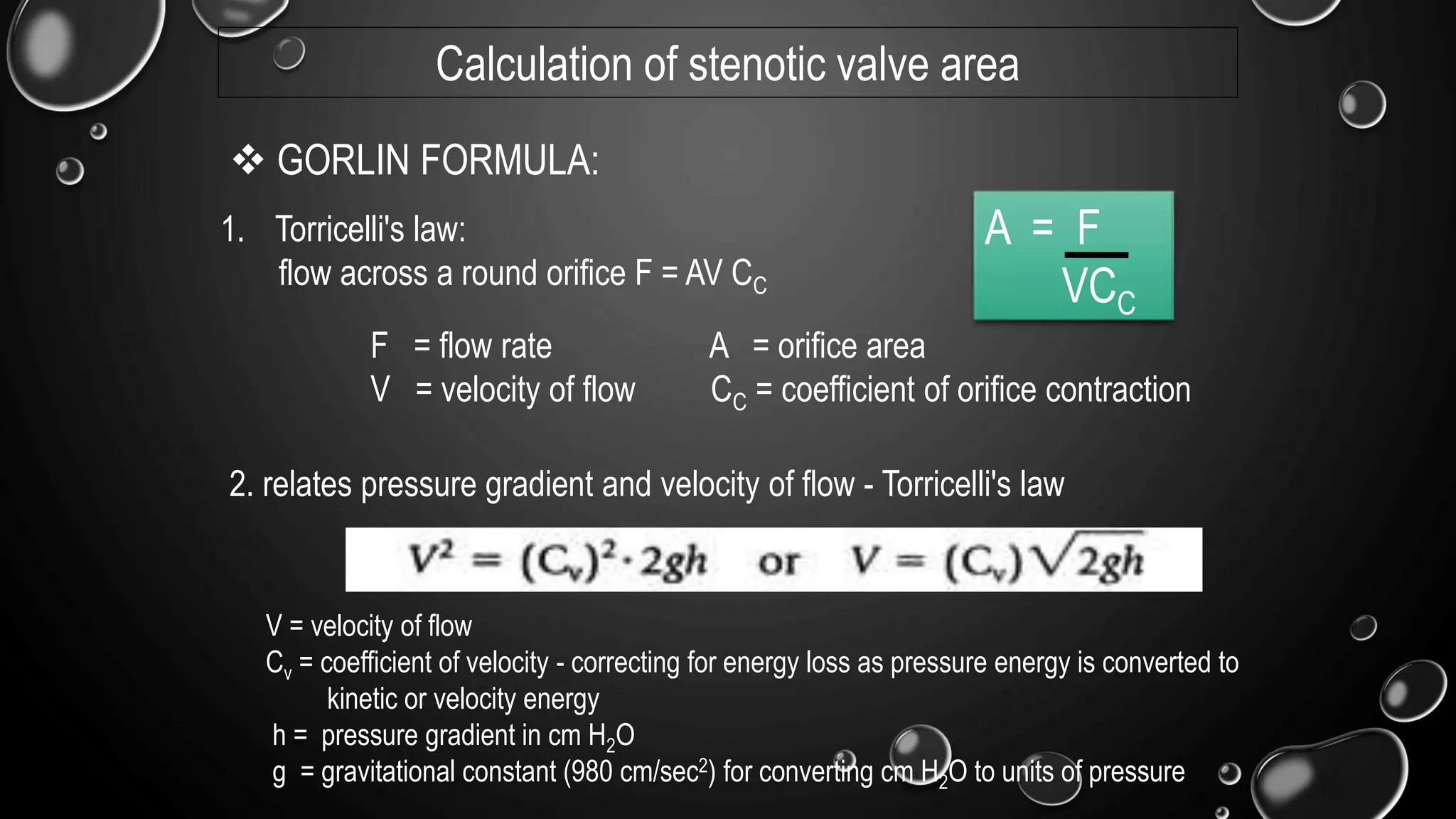
1. Torricelli's law:
flow across a round orifice F = AV CC
F = flow rate A = orifice area
V = velocity of flow CC = coefficient of orifice contraction
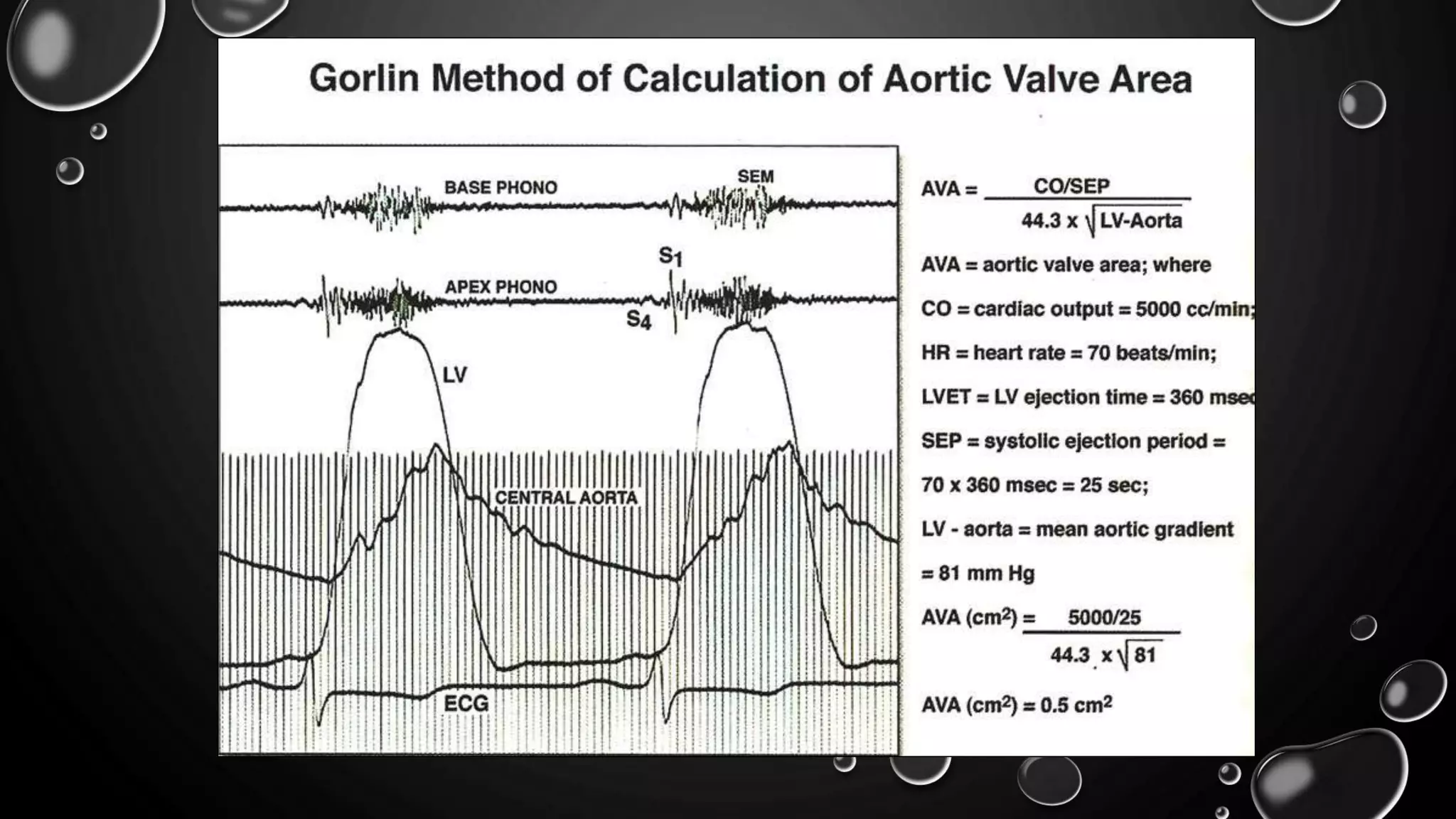
 GORLIN FORMULA:
2. relates pressure gradient and velocity of flow - Torricelli's law
V = velocity of flow
Cv = coefficient of velocity - correcting for energy loss as pressure energy is converted to
kinetic or velocity energy
h = pressure gradient in cm H2O
g = gravitational constant (980 cm/sec2) for converting cm H2O to units of pressure
A = F
VCC
Calculation of stenotic valve area
C = empirical constant accounting for CV and CC
h = mm Hg (rather than cm H2O)
 GORLIN FORMULA:
C - empirical constant ( 0.85 for mitral valve, 1.0 for Aortic valve)
Flow (F) = is the total cardiac output expressed in terms of the seconds
per minute during which there is actually forward flow across the valve.
F= CO (ml or cm3/min)
SEP (sec/min) x HR
cm3 x min
Min x Sec
cm3 /sec

hemodynamic in cath lab: aortic stenosis and hocm

  • 1.
    Hemodynamics in cathlab: Aortic stenosis & HOCM RAHUL ARORA
  • 2.
    INTRODUCTION • stenotic lesionsstart in anatomic LVOT extend upto the descending portion of aortic arch. • obstruction • valvular, • subvalvular • Fixed • dynamic • supravalvular. • impose increased afterload on LV and if severe and untreated lead to hypertrophy, eventual dilation and failure of LV.
  • 3.
    Role of cardiaccatheterization in AS  What information can be obtained in AS ? • measurement of pressure gradient • level of stenosis • analysis of the pressure waveforms • estimation of valve area • measurement of cardiac output  Discrepancy between echo findings and patient symptoms
  • 4.
    Methods of measuringa transvalvular gradient in AS 1. retrograde approach • AO catheter retrograde above AO valve, LV retrograde with pressure wire or pigtail. • LV retrograde with pigtail, AO pressure from side arm of long sheath or femoral sheath. • LV and AO retrograde with dual lumen pigtail • LV retrograde with pigtail and ‘‘pullback’’ pressure from LV to AO 2. antegrade approach • LV via transseptal, AO catheter retrograde above AO valve
  • 5.
    CAVEAT: both measurementat same time with direct measurement of aortic pressure is best means of assessment. METHOD EASE OF USE DISADVANTAGE PULLBACK +++++ LEAST ACCURATE FEMORAL SHEATH +++++ PRESSURE AMPLIFICATION ILIAC ARTERY STENOSIS DOUBLE ARTERIAL PUNCTURE +++ EXTRA VASCULAR ACCESS RISK PIG TAIL- DOUBLE LUMEN +++ DAMPING TRANSEPTAL ++ RISK
  • 7.
    Carabello Sign  risein arterial blood pressure during left heart catheter pullback in patients with severe aortic stenosis  Mechanism : related to partial obstruction of an already narrowed aortic orifice by the retrograde catheter & relief of this obstruction when the catheter is withdrawn AVA<0.6cm2
  • 8.
    Artifacts can resultwhen a multiple-side-hole pigtail catheter is incompletely advanced into the LV chamber
  • 9.
    Simultaneous measurement ofaortic and FA pressure demonstrating peripheral amplification Peripheral amplification # increase in peak systolic pressure and pulse pressure in peripheral arteries as compared to the central aorta
  • 10.
    A. The tracingsdemonstrating the significant time delay for the pressure waveform to reach the RFA. B. Realignment using tracing paper.
  • 11.
    THREE INVASIVE MEASUREMENTS Meangradient • represents the area under the LV-Ao pressure curve • corresponds to echo mean gradient Peak to peak gradient • no true physiological meaning • difference between maximum aortic and max LV pressures Peak instantaneous gradient • maximum difference between LV & aorta during systole. • corresponds to maximum instantaneous gradient by echo.
  • 12.
    Supra Valvular AS ValvularAS Sub valvular AS Aorta pull back tracing- level of stenosis
  • 13.
    Hakki formula Heart ratex SEP or DFP x constant ≈1 Calculation of stenotic valve area
  • 15.
  • 16.
    Low-Flow, Low-Gradient AorticStenosis With Normal and Depressed LVEF # Decreased EF (<40%) - Low Flow –Low Gradient AS # Normal EF ( ≥ 50%) - Paradoxical Low Flow –Low Gradient AS ⇊ in gradient ➨ ⇊ in trans-valvular flow.
  • 17.
    Low-flow, Low-Gradient severeAS with decreased LVEF # valve area <1 cm2 # mean aortic valve gradient < 40 mm Hg # ejection fraction <40% # pseudo aortic stenosis ➨ medications that increase cardiac output will usually increase the calculated AVA # Intravenous dobutamine - 5 μg/kg/min ➔➔ 20 μg/kg/min
  • 18.
    # true severeaortic stenosis (1) a mean aortic valve gradient greater than 30 mm Hg (2) an aortic valve area ≤ 1.2 cm2 Effects of dobutamine infusion in patients with and without valvular AS # Pseudo severe As Peak stress - MG < 30 mm Hg - EOA >1.0-1.2 cm2 - ab. in EOA> 0.3 cm2
  • 21.
    Paradoxical Low flow–low Gradient Severe AS: - indexed AVA < 0.6 cm2/m2 - Gradient < 40 mmHg - EF > 50% - Stroke volume index (SVi) : < 35 mL/m2 Paradoxical Low flow –low Gradient Severe AS:
  • 22.
    Physiopathology : paradoxicalLF- AS despite preserved EF Pronounced concentric LV remodelling and smaller LV cavity size ≈ restrictive physiology # Decrease in SV is due to deficient ventricular filling # smaller LV cavity size # deficient ventricular emptying # Intrinsic myocardial dysfunction causing EF lower than expected (50-60%) # Prevalence increases with - older age - female gender - concomitant systemic HTN
  • 23.
    ROLE OF CARDIACCATHERIZATION IN TAVR • pre TAVR evaluation • to measure the gradient. • for evaluation in case of discrepancy between echo and clinical symptoms. • for evaluation of low flow low gradient aortic stenosis. • post TAVR • to measure the success of procedure by measuring residual stenosis. • to look for complications in form of aortic regurgitation.
  • 24.
    Hypertrophic cardiomyopathy  dynamicintraventricular pressure gradient  may/ may not have systolic pressure gradient at rest  gradient - provoked with : Valsalva maneuver : extra systole : systemic vasodilator (amyl nitrate) : inotropic stimulation
  • 26.
    HOCM : SPIKE-AND-DOME CONFIGURATION OF PULSE WAVE  dynamic outflow obstruction ➨ characteristic arterial pressure waveform “spike-and-dome configuration • early spike ➨ rapid lv ejection by the hypercontractile myocardium • pressure dip & doming ➨ reflect the dynamic outflow obstruction
  • 27.
    Valsalva maneuver :produces a marked increase in the gradient : change in the FA pressure waveform to a spike-and- dome configuration. LV and FA pressure tracings in HCM
  • 29.
    Brokenbrough-Braunwald-Morrow sign  PostPVC potentiation in HOCM  PVC ➨⇈in intracavitary gradient ➨⇈ed contractility (⇈ed Ca2+) # Post PVC beat is associated with a reduction in aortic systolic pressure and pulse pressure ≈ B-B-M sign
  • 30.
  • 31.
    • NO OBSTRUCTIONAT ONSET OF VENTRICULAR EJECTION. • BRISK, INITIAL UPSTROKE- PEAK SYSTOLIC PRESSURE. • OBSTRUCTION PROGRESSIVELY DURING SYSTOLE AS THE CONTRACTILE FORCE OF THE LV BUILDS. • WHEN OBSTRUCTION REACHES A MAXIMUM ,AORTIC PRESSURE DROPS.
  • 32.
    MECHANISM • NORMALLY AFTERA PVC, COMPENSATORY PAUSE • DIASTOLIC FILLING TIME & DIASTOLIC VOLUME • INCREASED STRETCH • SV AND CONTRACTILITY (FRANK STARLING LAW) • ARTERIAL SYSTOLIC PRESSURE TO RISE • IN HCM PARADOXICAL DECREASE IN SV DUE INCREASED CONTRACTILITY CALCIUM LEADING TO DECREASED ORIFICE SIZE AND INCREASED GRADIENT • DIMINISHED PULSE PRESSURE • REDUCED SV CAUSED BY INCREASED DYNAMIC OBSTRUCTION
  • 34.
    1. Torricelli's law: flowacross a round orifice F = AV CC F = flow rate A = orifice area V = velocity of flow CC = coefficient of orifice contraction  GORLIN FORMULA: 2. relates pressure gradient and velocity of flow - Torricelli's law V = velocity of flow Cv = coefficient of velocity - correcting for energy loss as pressure energy is converted to kinetic or velocity energy h = pressure gradient in cm H2O g = gravitational constant (980 cm/sec2) for converting cm H2O to units of pressure A = F VCC Calculation of stenotic valve area
  • 35.
    C = empiricalconstant accounting for CV and CC h = mm Hg (rather than cm H2O)  GORLIN FORMULA: C - empirical constant ( 0.85 for mitral valve, 1.0 for Aortic valve)
  • 36.
    Flow (F) =is the total cardiac output expressed in terms of the seconds per minute during which there is actually forward flow across the valve. F= CO (ml or cm3/min) SEP (sec/min) x HR cm3 x min Min x Sec cm3 /sec

Editor's Notes

  • #4 In a study published in Lancet, 22 of 101 pts (22%) had MRI abnormalities c/w acute cerebreal embolic events after crossing AV valve for AS assessment.3 of these pts (3%) had clinically apparent neurologic deficits.
  • #8 n patients with AS, Carrabello’s sign is defined as a rise in peak aortic systolic pressure by greater than 5 mm Hg when a catheter is removed from the left ventricle (Figure 8.8). This phenomenon occurs in the setting of a highly stenosed valve because the additional occlusive effect of the catheter across the valve is enough to further decrease aortic pressure. Carrabello and colleagues found this sign in 15 of 20 patients with AVA < 0.6 cm2 and in none of 22 patients with AVA > 0.7 cm2. (Am J Cardiol 1979;44:424)
  • #10 There is a temporal delay in the peripheral pressure. There is also a pressure “overshoot”These will lead to problems with aortic valve gradient.
  • #12 In an invasive hemodynamic AS study, why should the mean gradient be used instead of the peak to peak gradient? The peak to peak gradient is not simultaneous and is therefore not physiologic.
  • #14 Hakki is valid only for 60-100/min Co estimation Ficks – oxygen consumption Thermodilution method- low output state, tr Another major challenge is accurate calculation of aortic valve area in patients with concurrent aortic regurgitation (AR). The problem lies in the numerator of the Gorlin equation, namely, the accurate determination of flow across the aortic valve. Commonly used ways to estimate cardiac output such as Fick and thermodilution measure effective and right-sided cardiac output, respectively, and thus will underestimate the flow across the aortic valve (flow across the aortic valve = cardiac output + regurgitant volume) and thus overestimate the severity of AS.
  • #16 If there is co-existent regurgitation, the AVA will be underestimated. Therefore, if you see a pt with both AS and AR, the AVA will be underestimated
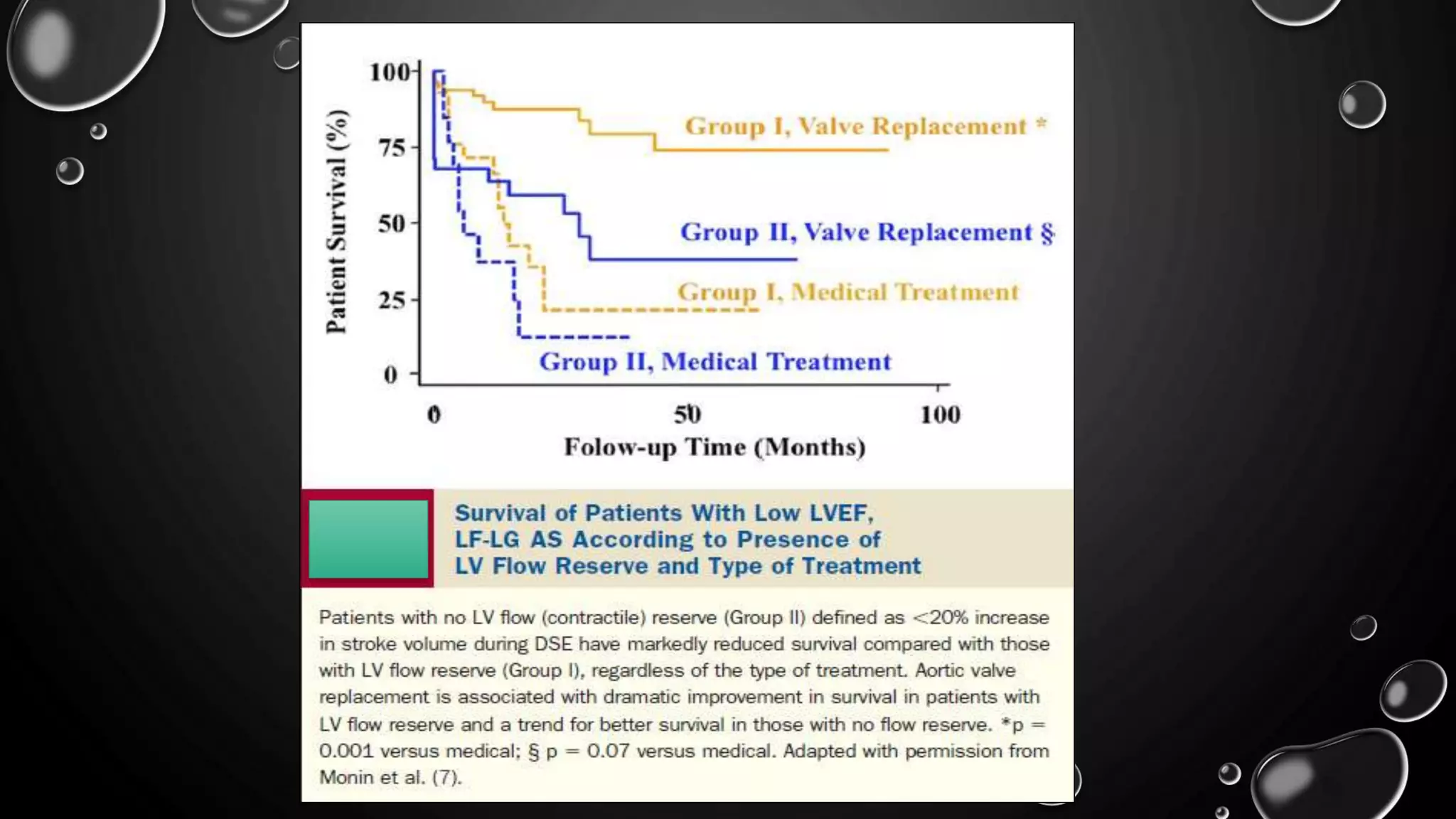
  • #19 Post AVR : lower peri-operative mortality (5% v/s 32%) ( n=136) In contrast the patients with pseudo AS will not have contractile reserve, will not significantly increase their LV–aortic pressure gradient, and will often have an increase in calculated aortic valve area with dobutamine. These latter patients typically have myocardial disease as their primary lesion and “incidental” AS. They do not respond favorably to aortic valve replacement
  • #23 Poor prognosis if treated medically rather than treated surgically