

LOW FLOW LOW GRADIENT
SEVERE AORTIC STENOSIS
» DR.ANUJ MEHTA(DNB- CTU)
» GKNM Hospital,Coimbatore
1
LOW FLOW, LOW GRADIENT, SEVERE AS
LOW EF
5- 10 % of all patients of AVA < 1.0
PRESERVED EF
10-25 % of all patients of AVA < 1.0
2
PATHOPHYSIOLOGY
• LOW FLOW secondary to LOW EF
-myocardial dysfunction
-secondary to AS
-secondary to other causes, or
-primary myocardial disease, needs to be evaluated. 3
MYOCARDIAL DYSFUNCTION SECONDARY
TO CAUSES OTHER THAN AS
-DILATED CARDIOMYOPATHIES (1O MYOCARDIAL
DYFUNCTION)
-ISCHAEMIC HEART DISEASE
-HTN HEART DISEASE (AFTER LOAD MISMATCH)
4
AVA can be misjudged as <1.0 due to incomplete
opening of AV due to low EF and labelled as
“PSEUDO SEVERE AS”
MYOCARDIAL DYSFUNCTION
SECONDARY TO AS
• “ True severe AS”
• Removal of the only afterload-AS can lead to
dramatic improvements in patients’
symptoms/survival compared to medical therapy
alone
5
DIAGNOSIS
• FIRST SUSPICION — GRADIENT-AVA
MISMATCH during routine echo
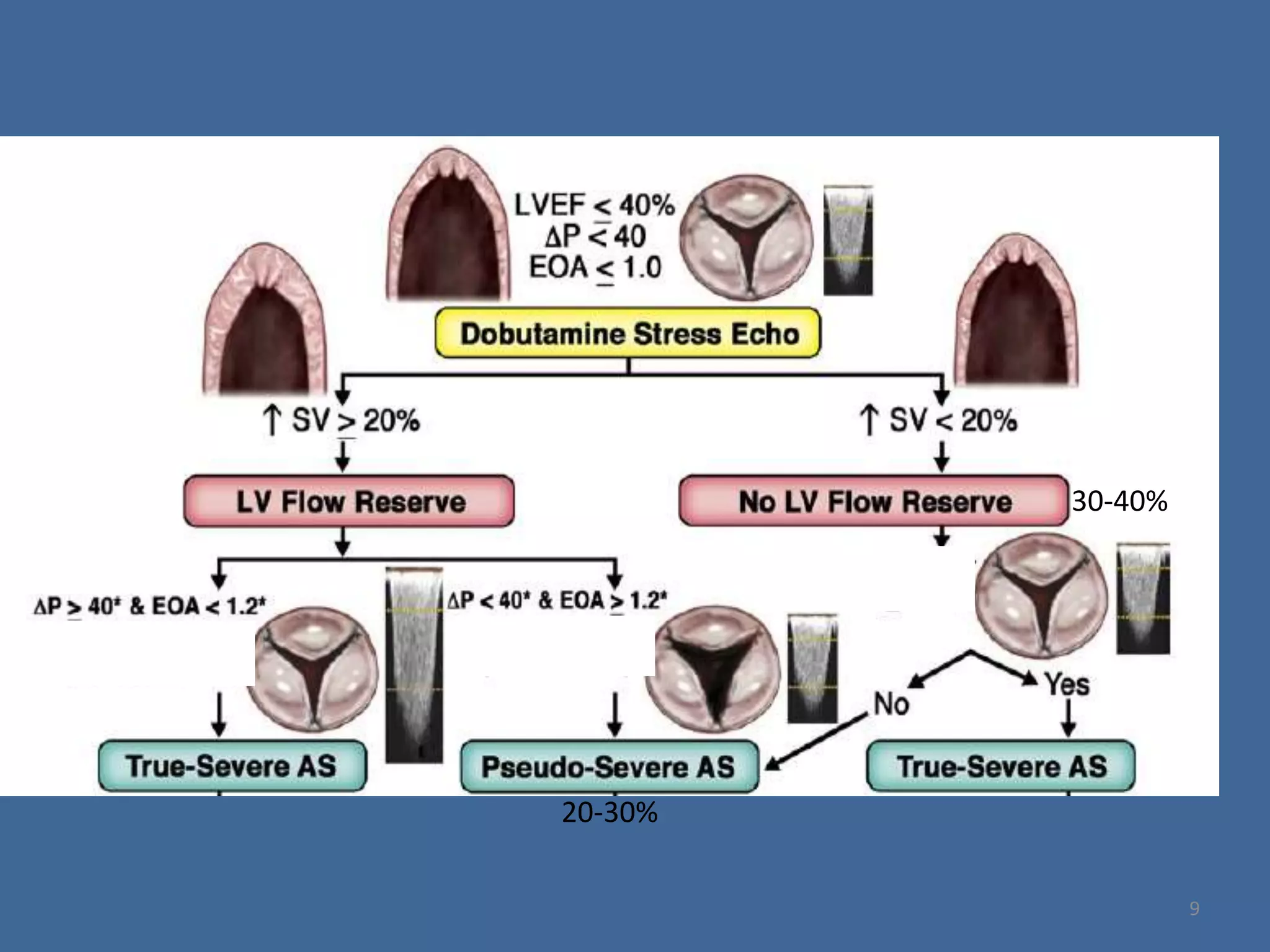
• GRADIENT < 40 mm Hg, AVA <1.0 , EF <40
%
• Dobutamine stress echo (exercise stress echo)
6
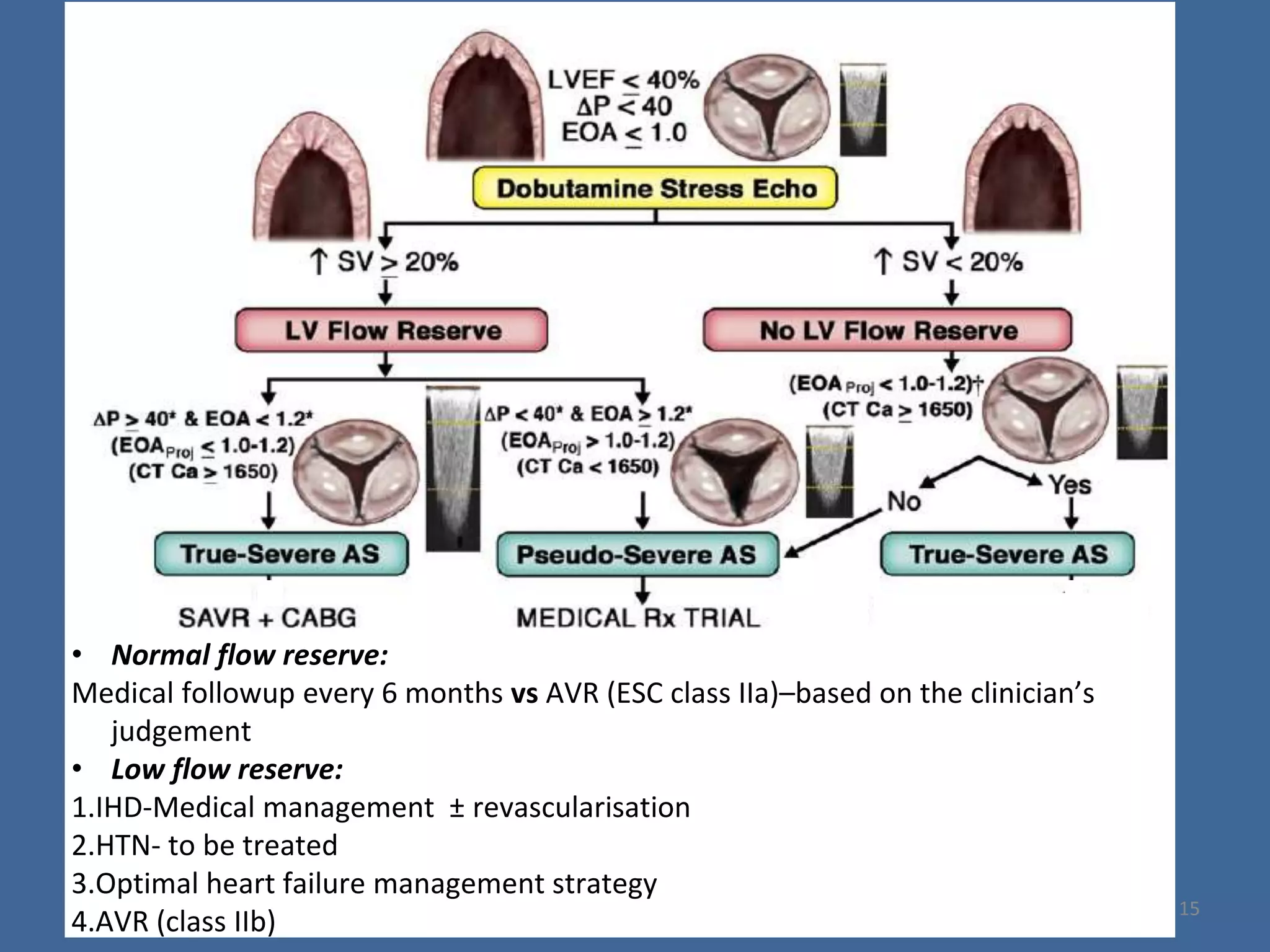
Dobutamine stress Echo
• Provides information regarding:
-Flow reserve
-Change in EOA
-Change in Gradient
7
Dobutamine stress Echo
• Low dose - 2.5 to 5 mcg/kg/min. and incremental dose
every 3-5 minutes .
• Max. dose-10-20 mcg/kg/min
• To stop —> positive result obtained
—>H.R. increase >10-20 bpm over baseline or
exceeds 100 bpm.
8
9
30-40%
20-30%
CT AV CALCIUM SCORING
• Score >1,650 Agatston units provides good accuracy (93 %
sensitive, 75 % specific) to distinguish true severe from
pseudo-severe AS
10
Treatment Decision
• SYMPTOM STATUS
• VALVULAR SEVERITY
“ANY SYMPTOMATIC SEVERE AS, IRRESPECTIVE
OF EF AND FLOW RESERVE, HAS TO BE
INTERVENED (class I)”
11
Severe ‘Asymptomatic’ AS WITH LOW EF
• WITH NORMAL EF-management is challenging, an abnormal response to
exercise stress testing and elevated BNP may identify a higher-risk group
that might benefit from closer followup and earlier surgery
12
Recommendation:
AVR (class I indication, level of evidence C)
• PERIOP RISK- FLOW RESERVE (+)=5-8%,
• FLOW RESERVE (-)=30%*
13
Role of TAVI
• Absence of flow reserve
• TAVI - valuable alternative in these patients
• Recent studies reported a greater and more rapid improvement of LVEF in
patients treated by TAVR than those treated by surgical AVR
• RATIONALE related to a lesser incidence of patient–prosthesis
mismatch.
• In contrast, TAVI associated with a higher incidence of perivalvular
regurgitation, stroke, vascular complications which may eventually
have a negative impact on outcomes
• PARTNER A & B .
14
15
• Normal flow reserve:
Medical followup every 6 months vs AVR (ESC class IIa)–based on the clinician’s
judgement
• Low flow reserve:
1.IHD-Medical management ± revascularisation
2.HTN- to be treated
3.Optimal heart failure management strategy
4.AVR (class IIb)
• LOW EF SEVERE AS
compared to Normal EF severe
AS have higher periop mortality
rates (6-33%), depending on
presence of myocardial contractile
reserve (5-8%) or not (22-33%)
16
Group I= Flow reserve +
Group II= Flow reserve -
Patients benefit more with AVR than medical management in both groups.
PROGNOSIS
LOW FLOW NORMAL EF SEVERE AS
“PARADOXICAL”
17
LOW EF
5- 10 % of all patients of AVA < 1.0
PRESERVED EF
10-25 % of all patients of AVA < 1.0
-Mean gradient < 40 mmHg,
-AVA < 1.0 cm2,
-Flow <35 ml/mt2,
-EF≥40 %
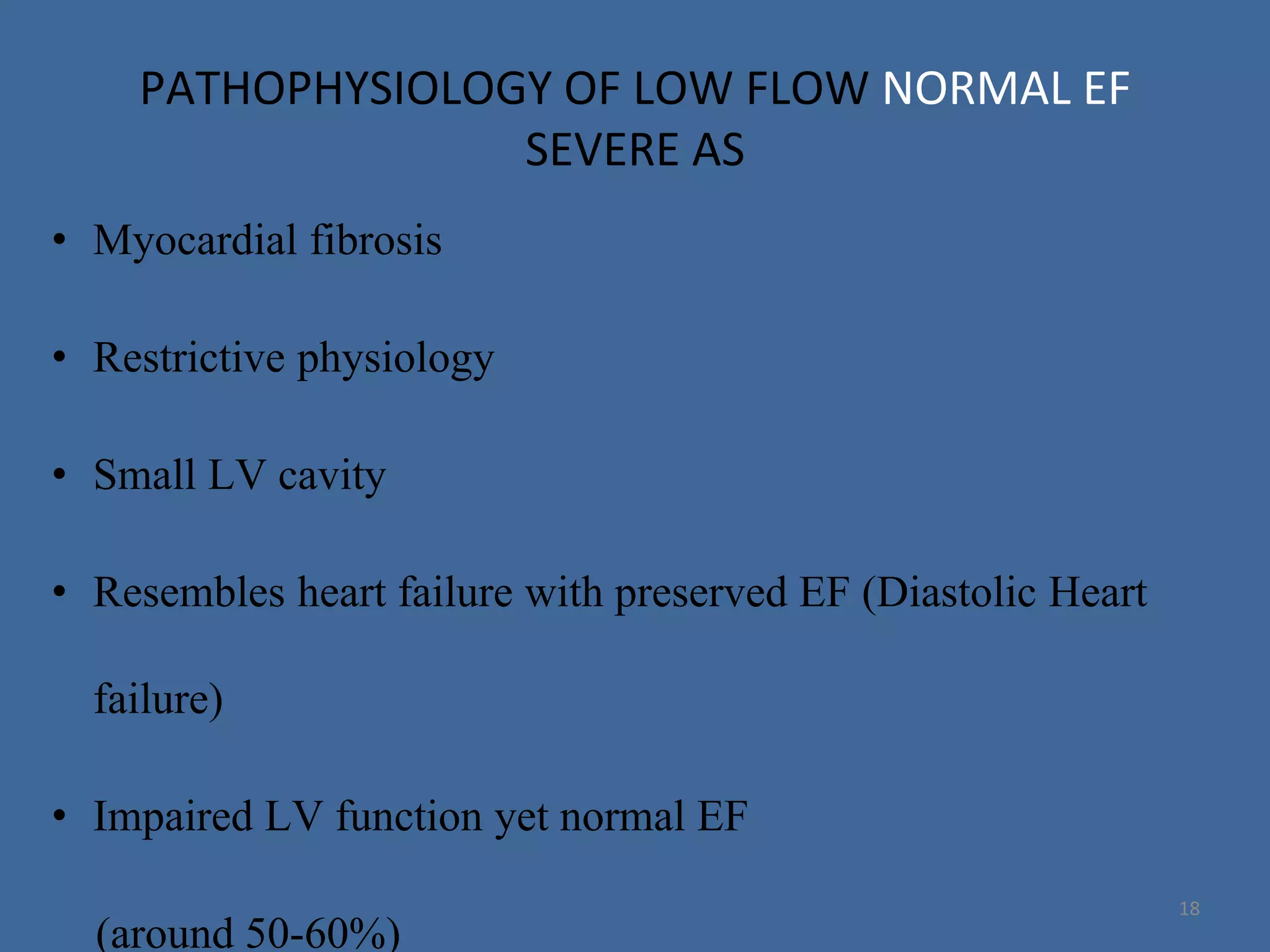
PATHOPHYSIOLOGY OF LOW FLOW NORMAL EF
SEVERE AS
• Myocardial fibrosis
• Restrictive physiology
• Small LV cavity
• Resembles heart failure with preserved EF (Diastolic Heart
failure)
• Impaired LV function yet normal EF
(around 50-60%)
18
DIAGNOSIS
19
“Normal LVEF Does Not Mean Normal Myocardial Function”
• LVEF is a late and insensitive marker for study of LV
function.
21
ALTERNATIVES TO ‘EF’
>5.5
>0.42
< 12 mm
< 10%
>1650 AU
>550 pg/ml
• Valvulo-Arterial Impedance (Zva)
• MPI (Tei Index)
• Mitral annular displacement (By TDI)
• Global LV Strain
• CT AV Calcium Scoring
• BNP levels
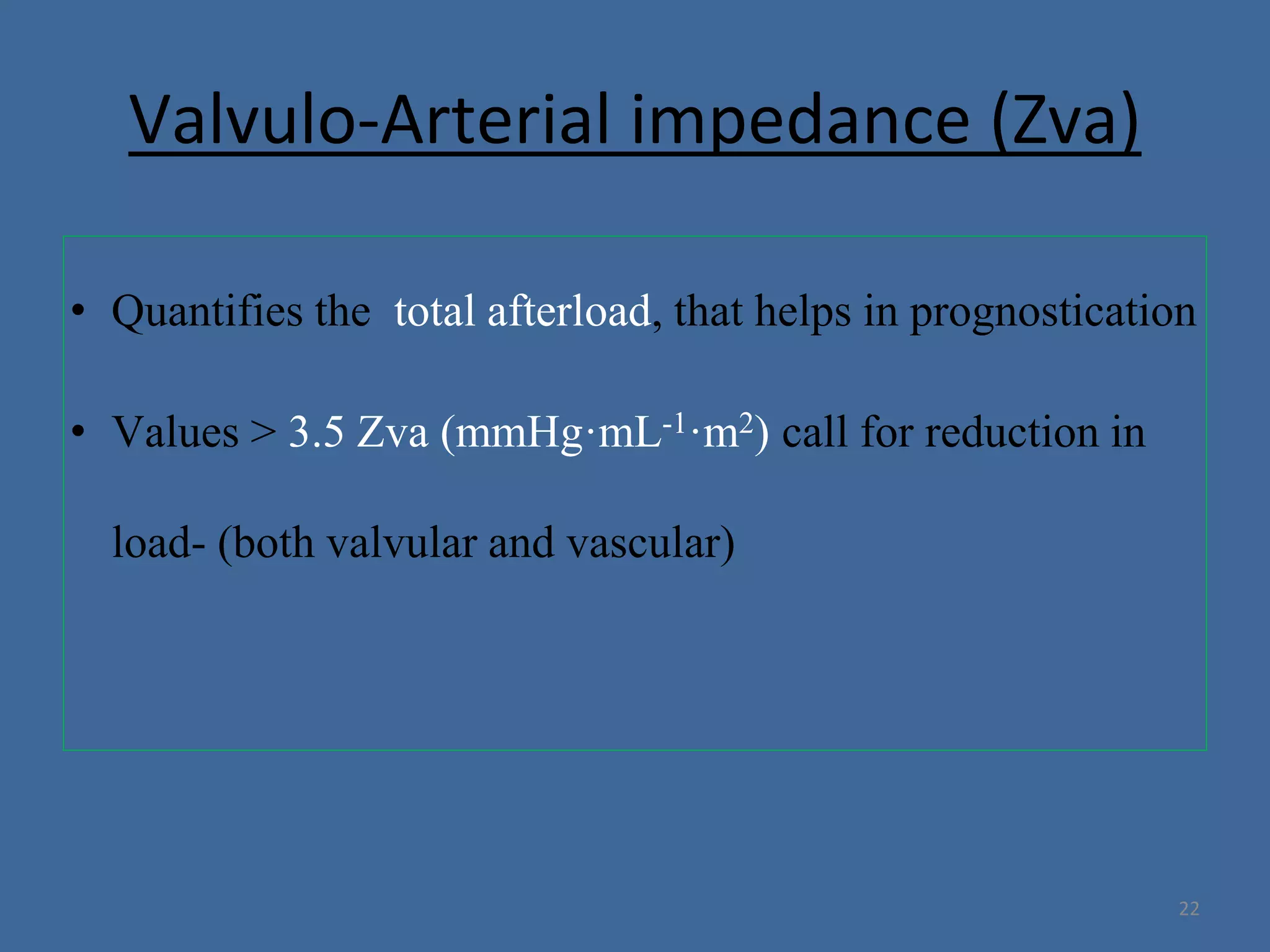
Valvulo-Arterial impedance (Zva)
• Quantifies the total afterload, that helps in prognostication
• Values > 3.5 Zva (mmHg·mL-1·m2) call for reduction in
load- (both valvular and vascular)
22
TREATMENT DECISIONS
23
• Class IIa indication for AVR
• “This subgroup of patients
seems to be at a more advanced
stage and has a poorer
prognosis if treated medically
rather than surgically”
• It remains to be determined if
TAVI could not be a better
alternative in these patients
24
The Annals of Thoracic Surgery,
LOW FLOW, NORMAL EF, SEVERE AS
• Worse than severe AS with high gradient group
lower overall 3-year survival
• Two-fold increase in mortality for AVR in the low-
gradient AS compared to the high gradient group
25
PROGNOSIS
SUMMARY
26
• ACCURATE AVA CALCULATION BY CONTINUITY
EQUATION MUST BE A STANDARD IN EVALUATION OF
A.S BY ECHO
• MISS 30 % CASES OF SEVERE AS
• LOW FLOW AS COULD BE DUE TO BOTH NORMAL AND
REDUCED EF
• INSTITUTION PROTOCOLS TO BE DESIGNED
27
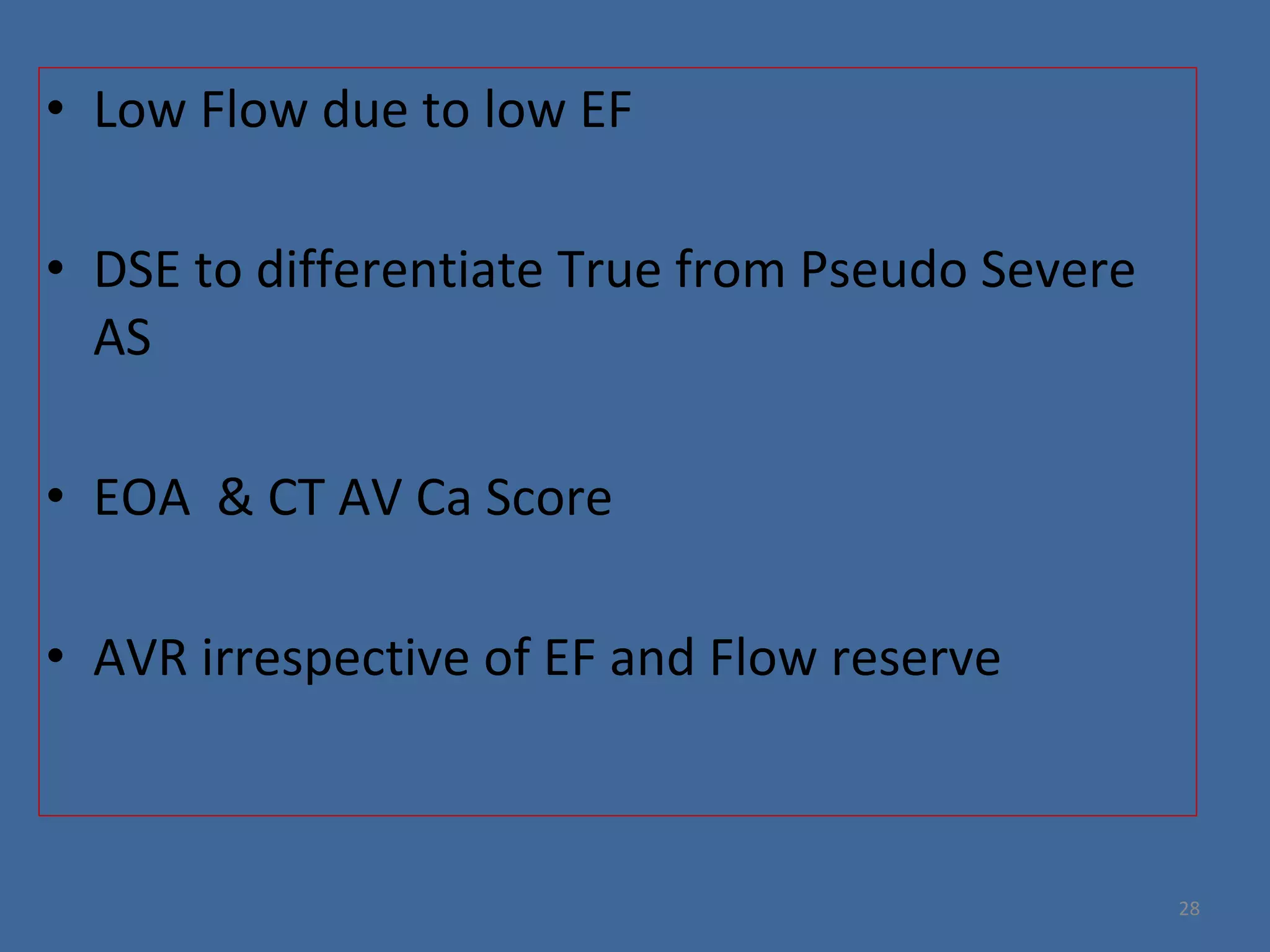
• Low Flow due to low EF
• DSE to differentiate True from Pseudo Severe
AS
• EOA & CT AV Ca Score
• AVR irrespective of EF and Flow reserve
28
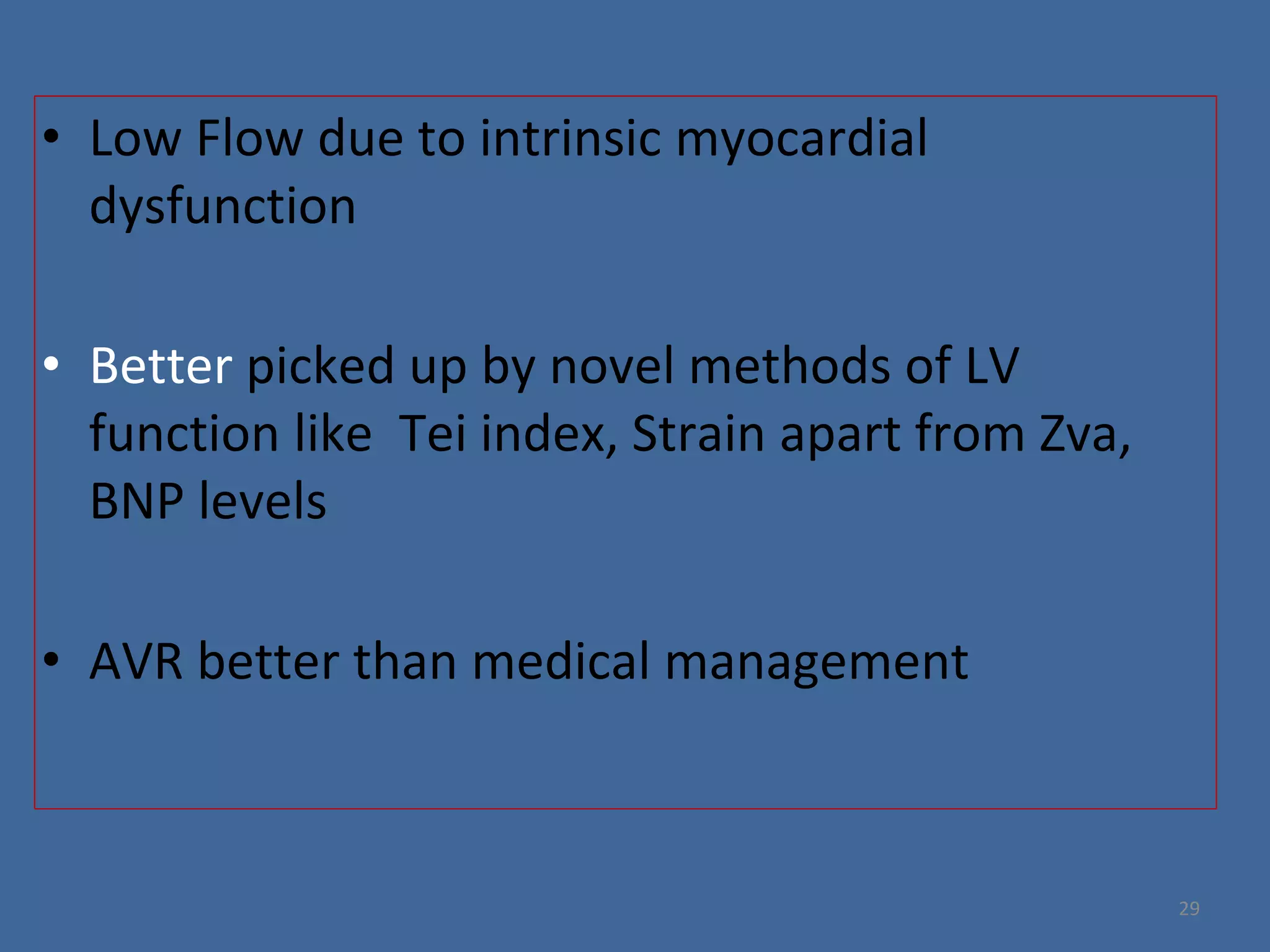
• Low Flow due to intrinsic myocardial
dysfunction
• Better picked up by novel methods of LV
function like Tei index, Strain apart from Zva,
BNP levels
• AVR better than medical management
29
30
SEVERE AS (indexed AVA < 0.6 cm2)
ASYMPTOMATIC NORMAL EF NORMAL FLOW EXERCISE TESTING(IIa) &
FOLLOW UP
ASYMPTOMATIC LOW EF LOW FLOW AVR (I)
SYMPTOMATIC NORMAL EF NORMAL FLOW AVR (I)
SYMPTOMATIC LOW EF
(EVEN IF FLOW RESERVE IS LOW)
LOW FLOW AVR (I)
SYMPTOMATIC NORMAL EF LOW FLOW AVR (IIa)
PSEUDO-SEVERE AS (AVA <1.0 cm2 in ECHO, AVA >1.2 cm2 in DSE)
SYMPTOMATIC LOW EF NORMAL FLOW RESERVE AVR (IIa)
SYMPTOMATIC LOW EF LOW FLOW RESERVE AVR (IIb)
MODERATE AS (AVA 1-1.5 cm2)
ASYMPTOMATIC NORMAL EF FOLLOW UP
SYMPTOMATIC NORMAL EF FOLLOW UP, AVR (IIb)
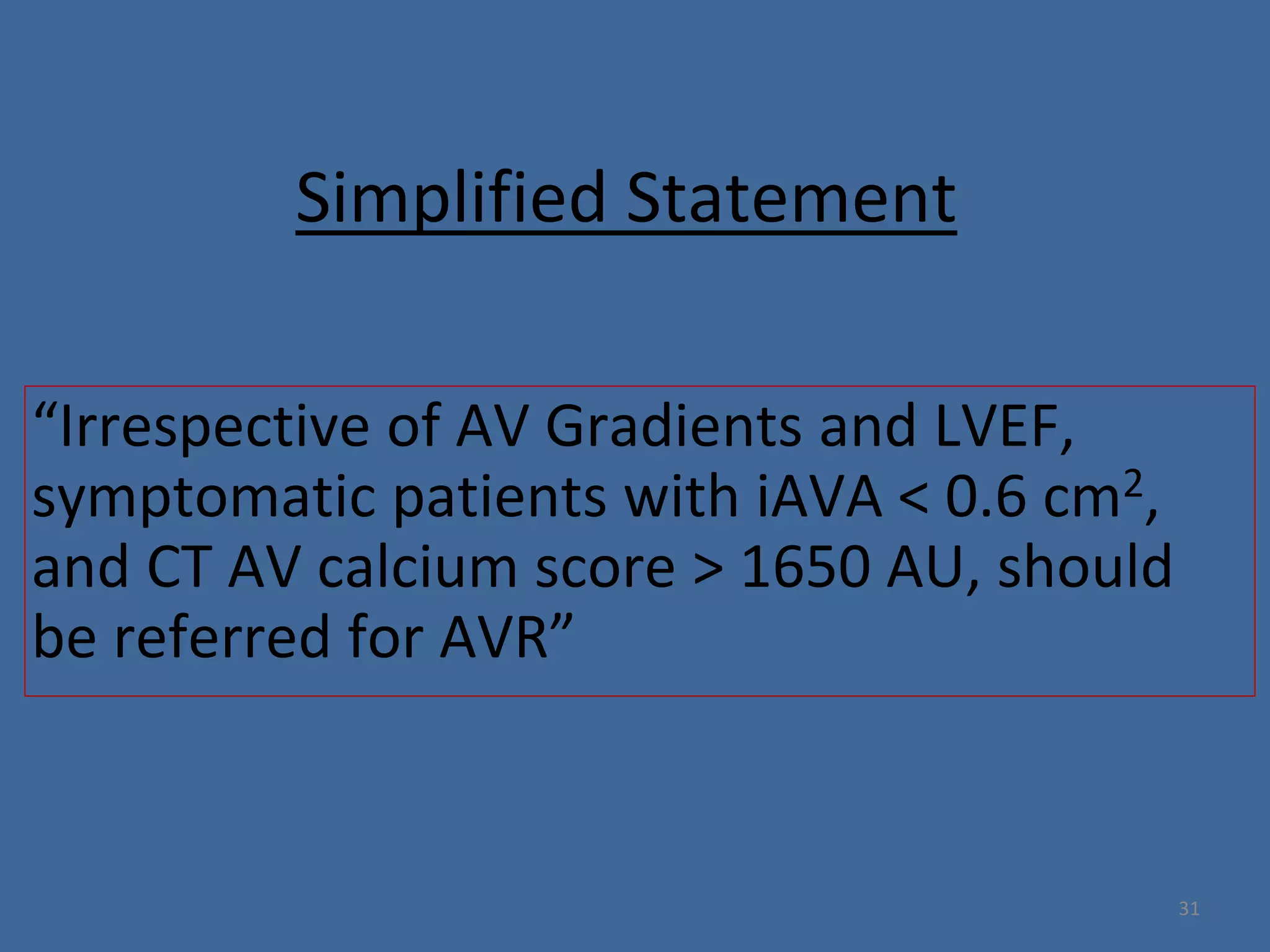
Simplified Statement
“Irrespective of AV Gradients and LVEF,
symptomatic patients with iAVA < 0.6 cm2,
and CT AV calcium score > 1650 AU, should
be referred for AVR”
31
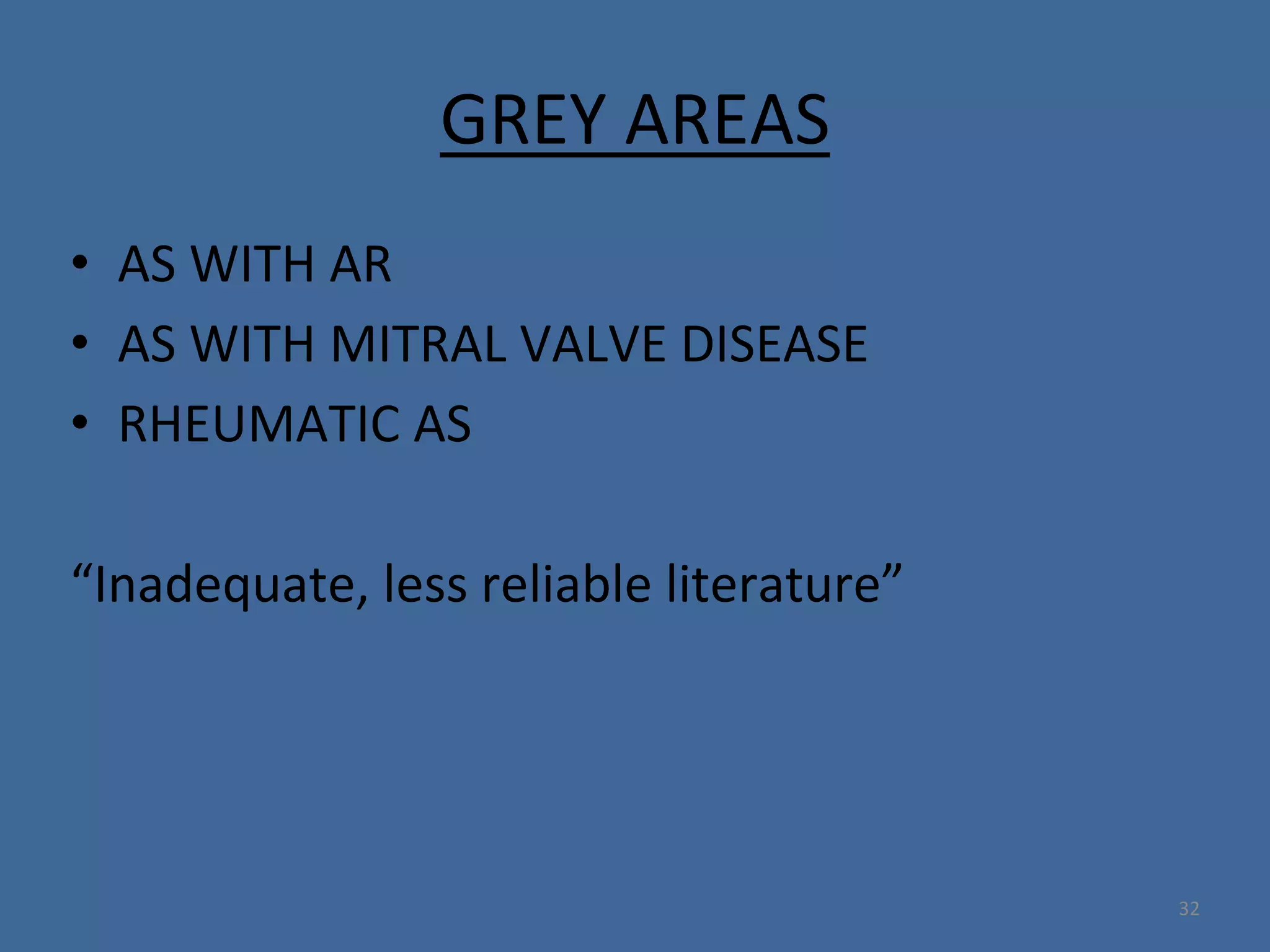
GREY AREAS
• AS WITH AR
• AS WITH MITRAL VALVE DISEASE
• RHEUMATIC AS
“Inadequate, less reliable literature”
32

Low flow Low gradient severe aortic stenosis

  • 1.
    LOW FLOW LOWGRADIENT SEVERE AORTIC STENOSIS » DR.ANUJ MEHTA(DNB- CTU) » GKNM Hospital,Coimbatore 1
  • 2.
    LOW FLOW, LOWGRADIENT, SEVERE AS LOW EF 5- 10 % of all patients of AVA < 1.0 PRESERVED EF 10-25 % of all patients of AVA < 1.0 2
  • 3.
    PATHOPHYSIOLOGY • LOW FLOWsecondary to LOW EF -myocardial dysfunction -secondary to AS -secondary to other causes, or -primary myocardial disease, needs to be evaluated. 3
  • 4.
    MYOCARDIAL DYSFUNCTION SECONDARY TOCAUSES OTHER THAN AS -DILATED CARDIOMYOPATHIES (1O MYOCARDIAL DYFUNCTION) -ISCHAEMIC HEART DISEASE -HTN HEART DISEASE (AFTER LOAD MISMATCH) 4 AVA can be misjudged as <1.0 due to incomplete opening of AV due to low EF and labelled as “PSEUDO SEVERE AS”
  • 5.
    MYOCARDIAL DYSFUNCTION SECONDARY TOAS • “ True severe AS” • Removal of the only afterload-AS can lead to dramatic improvements in patients’ symptoms/survival compared to medical therapy alone 5
  • 6.
    DIAGNOSIS • FIRST SUSPICION— GRADIENT-AVA MISMATCH during routine echo • GRADIENT < 40 mm Hg, AVA <1.0 , EF <40 % • Dobutamine stress echo (exercise stress echo) 6
  • 7.
    Dobutamine stress Echo •Provides information regarding: -Flow reserve -Change in EOA -Change in Gradient 7
  • 8.
    Dobutamine stress Echo •Low dose - 2.5 to 5 mcg/kg/min. and incremental dose every 3-5 minutes . • Max. dose-10-20 mcg/kg/min • To stop —> positive result obtained —>H.R. increase >10-20 bpm over baseline or exceeds 100 bpm. 8
  • 9.
  • 10.
    CT AV CALCIUMSCORING • Score >1,650 Agatston units provides good accuracy (93 % sensitive, 75 % specific) to distinguish true severe from pseudo-severe AS 10
  • 11.
    Treatment Decision • SYMPTOMSTATUS • VALVULAR SEVERITY “ANY SYMPTOMATIC SEVERE AS, IRRESPECTIVE OF EF AND FLOW RESERVE, HAS TO BE INTERVENED (class I)” 11
  • 12.
    Severe ‘Asymptomatic’ ASWITH LOW EF • WITH NORMAL EF-management is challenging, an abnormal response to exercise stress testing and elevated BNP may identify a higher-risk group that might benefit from closer followup and earlier surgery 12 Recommendation: AVR (class I indication, level of evidence C)
  • 13.
    • PERIOP RISK-FLOW RESERVE (+)=5-8%, • FLOW RESERVE (-)=30%* 13
  • 14.
    Role of TAVI •Absence of flow reserve • TAVI - valuable alternative in these patients • Recent studies reported a greater and more rapid improvement of LVEF in patients treated by TAVR than those treated by surgical AVR • RATIONALE related to a lesser incidence of patient–prosthesis mismatch. • In contrast, TAVI associated with a higher incidence of perivalvular regurgitation, stroke, vascular complications which may eventually have a negative impact on outcomes • PARTNER A & B . 14
  • 15.
    15 • Normal flowreserve: Medical followup every 6 months vs AVR (ESC class IIa)–based on the clinician’s judgement • Low flow reserve: 1.IHD-Medical management ± revascularisation 2.HTN- to be treated 3.Optimal heart failure management strategy 4.AVR (class IIb)
  • 16.
    • LOW EFSEVERE AS compared to Normal EF severe AS have higher periop mortality rates (6-33%), depending on presence of myocardial contractile reserve (5-8%) or not (22-33%) 16 Group I= Flow reserve + Group II= Flow reserve - Patients benefit more with AVR than medical management in both groups. PROGNOSIS
  • 17.
    LOW FLOW NORMALEF SEVERE AS “PARADOXICAL” 17 LOW EF 5- 10 % of all patients of AVA < 1.0 PRESERVED EF 10-25 % of all patients of AVA < 1.0 -Mean gradient < 40 mmHg, -AVA < 1.0 cm2, -Flow <35 ml/mt2, -EF≥40 %
  • 18.
    PATHOPHYSIOLOGY OF LOWFLOW NORMAL EF SEVERE AS • Myocardial fibrosis • Restrictive physiology • Small LV cavity • Resembles heart failure with preserved EF (Diastolic Heart failure) • Impaired LV function yet normal EF (around 50-60%) 18
  • 19.
  • 20.
    “Normal LVEF DoesNot Mean Normal Myocardial Function” • LVEF is a late and insensitive marker for study of LV function.
  • 21.
    21 ALTERNATIVES TO ‘EF’ >5.5 >0.42 <12 mm < 10% >1650 AU >550 pg/ml • Valvulo-Arterial Impedance (Zva) • MPI (Tei Index) • Mitral annular displacement (By TDI) • Global LV Strain • CT AV Calcium Scoring • BNP levels
  • 22.
    Valvulo-Arterial impedance (Zva) •Quantifies the total afterload, that helps in prognostication • Values > 3.5 Zva (mmHg·mL-1·m2) call for reduction in load- (both valvular and vascular) 22
  • 23.
  • 24.
    • Class IIaindication for AVR • “This subgroup of patients seems to be at a more advanced stage and has a poorer prognosis if treated medically rather than surgically” • It remains to be determined if TAVI could not be a better alternative in these patients 24 The Annals of Thoracic Surgery, LOW FLOW, NORMAL EF, SEVERE AS
  • 25.
    LOW FLOW, NORMALEF, SEVERE AS • Worse than severe AS with high gradient group lower overall 3-year survival • Two-fold increase in mortality for AVR in the low- gradient AS compared to the high gradient group 25 PROGNOSIS
  • 26.
  • 27.
    • ACCURATE AVACALCULATION BY CONTINUITY EQUATION MUST BE A STANDARD IN EVALUATION OF A.S BY ECHO • MISS 30 % CASES OF SEVERE AS • LOW FLOW AS COULD BE DUE TO BOTH NORMAL AND REDUCED EF • INSTITUTION PROTOCOLS TO BE DESIGNED 27
  • 28.
    • Low Flowdue to low EF • DSE to differentiate True from Pseudo Severe AS • EOA & CT AV Ca Score • AVR irrespective of EF and Flow reserve 28
  • 29.
    • Low Flowdue to intrinsic myocardial dysfunction • Better picked up by novel methods of LV function like Tei index, Strain apart from Zva, BNP levels • AVR better than medical management 29
  • 30.
    30 SEVERE AS (indexedAVA < 0.6 cm2) ASYMPTOMATIC NORMAL EF NORMAL FLOW EXERCISE TESTING(IIa) & FOLLOW UP ASYMPTOMATIC LOW EF LOW FLOW AVR (I) SYMPTOMATIC NORMAL EF NORMAL FLOW AVR (I) SYMPTOMATIC LOW EF (EVEN IF FLOW RESERVE IS LOW) LOW FLOW AVR (I) SYMPTOMATIC NORMAL EF LOW FLOW AVR (IIa) PSEUDO-SEVERE AS (AVA <1.0 cm2 in ECHO, AVA >1.2 cm2 in DSE) SYMPTOMATIC LOW EF NORMAL FLOW RESERVE AVR (IIa) SYMPTOMATIC LOW EF LOW FLOW RESERVE AVR (IIb) MODERATE AS (AVA 1-1.5 cm2) ASYMPTOMATIC NORMAL EF FOLLOW UP SYMPTOMATIC NORMAL EF FOLLOW UP, AVR (IIb)
  • 31.
    Simplified Statement “Irrespective ofAV Gradients and LVEF, symptomatic patients with iAVA < 0.6 cm2, and CT AV calcium score > 1650 AU, should be referred for AVR” 31
  • 32.
    GREY AREAS • ASWITH AR • AS WITH MITRAL VALVE DISEASE • RHEUMATIC AS “Inadequate, less reliable literature” 32

Editor's Notes

  • #6 Lond standing ASmyo dysfunctionlow eflow flow
  • #7 Suspect a low flow state…
  • #10 Monin JL, Monchi M, Gest V, Duval-Moulin AM, Dubois-Rande JL, Gueret P. Aortic stenosis with severe left ventricular dysfunction and low transvalvular pressure gradients: risk stratification by low-dose dobutamine echocardiography. J Am Coll Cardiol. 2001;37:2101–2107
  • #11 Cueff C, Serfaty JM, Cimadevilla C, et al. Measurement of aortic valve calcification using multislice computed tomography: correlation with haemodynamic severity of aortic stenosis and clinical implication for patients with low ejection fraction. Heart 2011;97:721– 6.
  • #13 UNIKE ASYMTOMATIC AS, severe as WITH NORMAL EF, WHERE MANAGEMENT IS CHALLENGING WITH NEED FOR ADDITIONAL EXERCISE , BNP TESTING, THOSE WITH LOW EF HAVE A CLASS 1 REC FOR AVR…. abnormal blood pressure response, ST segment changes, symptoms such as limiting dyspnea, chest discomfort, or dizziness on a modified Bruce protocol, or complex ventricular arrhythmias
  • #14 PERI OP RISK FOR N EF= 1.3% Brown et al J Thorac Cardiovasc Surg 2009; 137:82–90. 5-year survival rate in patients with no contractile reserve who underwent aortic valve replacement than in similar patients who received medical management (65% ± 11% vs 11 ± 7%, P = .019) * Burwash IG. Low-flow, low-gradient aortic stenosis: from evaluation to treatment. Curr Opin Cardiol 2007; 22:84–91
  • #15 *Clavel MA, Webb JG, Rodés-Cabau J, et al. Comparison between transcatheter and surgical prosthetic valve implantation in patients with severe aortic stenosis and reduced left ventricular ejection fraction. Circulation 2010;122:1928 –36 *Gotzmann M, Lindstaedt M, Bojara W, Ewers A, Mugge A. Clinical outcome of transcatheter aortic valve implantation in patients with low-flow, low gradient aortic stenosis. Catheter Cardiovasc Interv 2012;79:693–701 Procedural success rates 95%.. PARTNER A AND B---TAVI VS MEDICAL MANAGEMENT VS BALLOON ANGIOPLASTY VS SURGICAL AVR
  • #16 These pts of PseuSevere AS have an underlying myocardial dysfunction…. Balance between the myocardial disease and AS severity.. …but, periop mortality rates appraoch 50 % in these patients cos of underlying heart dysfunction and hence benefit more from medical management….but it also true that what is moderate stenosis for a normal ventricle may correspond to a severe stenosis for a diseased ventricle…NO SPECIFIC ACC GUIDELINES…ESC 2012 GUIDELINES… Connolly HM, Oh JK, Schaff HV, et al. Severe aortic stenosis with low transvalvular gradient and severe left ventricular dysfunction: result of aortic valve replacement in 52 patients. Circulation 2000; 101:1940–1946
  • #17 Connolly HM, Oh JK, Schaff HV, et al. Severe aortic stenosis with low transvalvular gradient and severe left ventricular dysfunction. Result of aortic valve replacement. Circulation 2000; 101:1940–6 PERI OP RISK FOR N EF= 1.3% Brown et al J Thorac Cardiovasc Surg 2009; 137:82–90. 5-year survival rate in patients with no contractile reserve who underwent aortic valve replacement than in similar patients who received medical management (65% ± 11% vs 11 ± 7%, P = .019) * Burwash IG. Low-flow, low-gradient aortic stenosis: from evaluation to treatment. Curr Opin Cardiol 2007; 22:84–91
  • #19 -Higher prevalence of women, older age, smaller LV end-diastolic volume, -Signs of AS severity can be masked by the presence of concomitant hypertension, blood pressure should routinely be measured at the time of the echocardiogram in every patient with AS -Patients with severe AS and LV concentric remodelling often tend to have relatively higher EF’s than normal (e.g. .70%)…and that is why in these patients we go other better markers of lv function…..
  • #21 Specially affected by comorbidities like htn, ihd
  • #22 Tei index .0.42 has been reported to differentiate almost all patients with severe aortic stenosis and left ventricular dysfunction from control subjects or patients with aortic stenosis and preserved left ventricles
  • #23 Hachicha et al
  • #25 The Annals of Thoracic Surgery, Volume 91(6), Tarantini G, Covolo E, Razzolini R, et al. No ACC guidleines as it was formulated in 2006, the time when this new entity was not even introduced….
  • #26 Barasch E, Fan D, Chukwu EO, et al. Severe isolated aortic stenosis with normal left ventricular systolic function and low transvalvular gradients: pathophysiologic and prognostic insights. J Heart Valve Dis 2008;17:81-8. Hachicha Z, Dumesnil JG, Bogaty P, et al. Paradoxical low-flow, low-gradient severe aortic stenosis despite preserved ejection fraction is associated with higher afterload and reduced survival. Circulation 2007;115:2856-64. Jander N, Minners J, Holme I, et al. Outcome of patients with low-gradient "severe" aortic stenosis and preserved ejection fraction. Circulation 2011;123:887-95.
  • #31 In pseudo severe AS, peri AVR mortality rates approach 50 % due to underlying myoc. Dysfunction unrelated to AS…and hence benefit better from HF management…. If the clinician needs better markers for LV function than EF, he can always go for other params like Mitral annular displacement, Tei index, global strain measurements…..
  • #32 This ct av calcium score is to diff. from pseudo severe as when we have a pt of low ef…we can also do DSE….
  • #33 INADE