Dr Dane Horsfall FACEM
    Cabrini Hospital
   Literature extensive
   Listen to this talk!
   Journal watch-http://emergency-medicine.jwatch.org/
   EM:RAP-http://www.emrap.org/
   Landmark Trials -Trials that affect our
    practice
   NINDS 1995/ECASS III 2008
   Rivers 2001/Surviving Sepsis 2008 + Case
   USA vs Canada: NEXUS 2001/Canadian
    Cervical Spine 2001
   SAFE 2004
   Sullivan 2007
   Perry/Steill SAH 2011
   National Institute of Neurological Disorders
    and Stroke-Washington DC
   “t-PA for acute ischemic stroke”
   Randomized, Double Blinded, recombt-PA
    (Alteplase)
   tPA 0.9mg/kg(max 90mg) 10% bolus then inf
    1/24
   Recommended tPA< 3/24
   NIHSS-National Institutes of Health Stroke Scale
    ◦ neuro deficit, 42-point scale, neurologic deficits in 11 categories.
      Eg mild facial paralysis = 1, complete right hemiplegia/aphasia
      =25.
   Barthel Index
    ◦ perform activities of daily living (eating, bathing, walking, toilet)
      out of 100
   Modified Rankin Scale-overall assessment of function
    ◦ 0= asymptomatic up to 5 =severe disability
   Glasgow Outcome Scale-global assessment of function
    ◦   1=good recovery,
    ◦   2=moderate disability
    ◦   3=severe disability
    ◦   4=vegetative state
    ◦   5=death
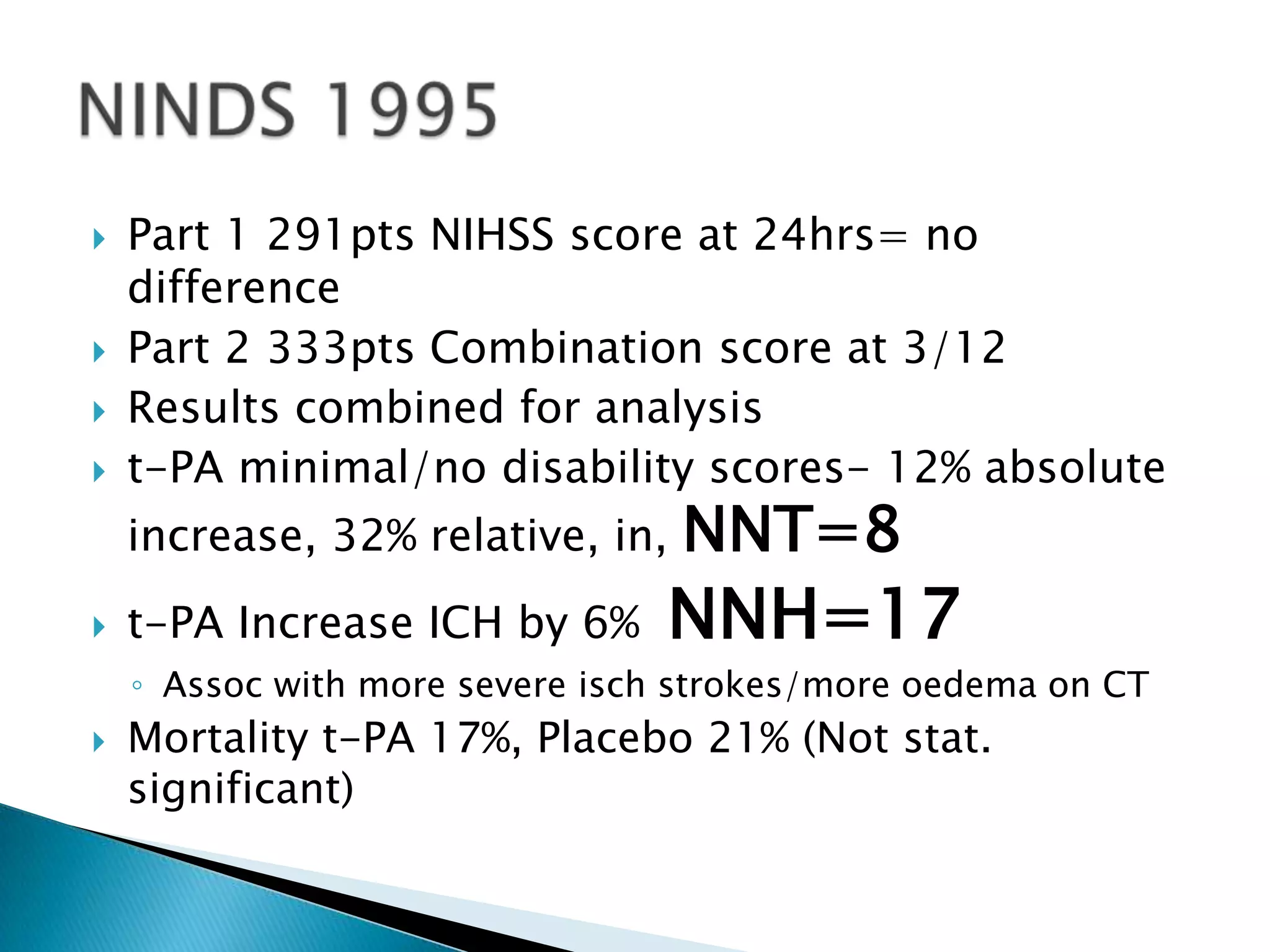
   Part 1 291pts NIHSS score at 24hrs= no
    difference
   Part 2 333pts Combination score at 3/12
   Results combined for analysis
   t-PA minimal/no disability scores- 12% absolute
    increase, 32% relative, in,   NNT=8
   t-PA Increase ICH by 6%     NNH=17
    ◦ Assoc with more severe isch strokes/more oedema on CT
   Mortality t-PA 17%, Placebo 21% (Not stat.
    significant)
   European Cooperative Acute Stroke Study
   “Thrombolysis with Alteplase 3 to 4.5 Hrs after
    Acute Ischemic Stroke”
   821pts tPA 3-4.5 hrs
   90 day disability –modified Rankin Scale
    ◦ 0-1 no disability t-PA 52% vsPlac 45% - NNT 14
    ◦ 2-6 disability
   ICH(symp) t-PA 2.4% vsPlac 0.2% - NNH 45
   Mortality t-PA 7.7% vsPlac 8.4% no difference
   BUT studies showing no Difference:
    ◦ ECASS I 1995 620pts tPA< 6/24
    ◦ ECASS II 1998 300pts 0-6hrs
   Contraindications:
    ◦ Bleeding risk
      Anticoagulants, Platelets <100
      Massive CVA > 1/3 cerebral hemisphere-obtund/complete
       hemiplegia
      Uncontrolled HT >185/110
      CVA/Head Injury in last 3/12 or ICH at an time
      Bleed in last 3/52, bleeding diathesis, arterial puncture last 7/7
      Pregnancy
      Trauma/Surgery in last 14/7
    ◦ Not Stroke:
      Seizures
      Hypoglycaemia
    ◦ No significant improvement possible
      Resolving stroke
      Previous disability
   263 pts Rx in ED for 6/24 prior to ICU:
    ◦   130 EGDT
    ◦   133 standard Rx
    ◦   In hospital Mortality EGDT 30%, Standard 46%
    ◦   NNT 6
   EGDT:
    ◦ CVP 8-12mmHg if < Fill 500ml bolus N/S every 30
      mins
    ◦ MAP >65mmHg if <vasopressorsNoradrenaline
    ◦ ScvO2 (central mixed venous O2 sat) >70% if <Tx
      RBC to Hct> 30% if ScvO2 still
      <inotropes(dobutamine)
         Central venous Sats>70% surrogate marker of adequate
          tissue perfusion-ie adequate resus from septic shock
   Funded by manufacturer of CVC
   High control mortality
   Dr Rivers managing pts in ED
   Continuous Scv O2sats not practical to
    measure
   Cant argue against concept
   EGDT
   Antibiotic within 1 hr
   Source Control
   crystalloid or colloid fluid resuscitation
   Vasopressor = Noradrenaline
   Dobutamine if CO low post
    filling/vasopressors
   Stress-dose steroid only if BP poorly
    responsive to vasopressors
BIBA at 0430 - fever and severe R leg pain since 0100

PHx
 CLL/Neutropenia - treated with gCSF

0435-
Temp         400C
BP           87/62      mmHg
HR           160/min irregular (AF)
RR           17/min
O2 sat       95% (air)

Right leg red / swollen to thigh “Cellulitis”
Two peripheral IVs,
IV Tazocin            4.5g (early broad spectrum antis✔)
IV fluid              N/saline 1000mls (filling✔)
IV analgesia          Morphine increments
IV Digoxin            500 mcg
   Persistent hypotension, SBP 70-90/DBP 50-60
   Remained in AF
   Pain very difficult to control
   Temp 38.4

   0720-Hypotension persists 80/50
    Rx-Gelofusine 500 and further 1000 ml N/Saline
    (Filling✔)
   0845             IDC
   0900             IV Metaraminol increments
   0930             IV Gelofusine then IV Albumin
   1000             CVC (1000, IJV) CVP 28-30-well filled ✔
   1035             Noradrenalineinf -Vasopressor ✔
   1200             IV Vancomycin 1g
   1220             Transfer ICU

   Non EGDT-central venous sats, Survivng sepsis-
    Source control

   Outcome
    ◦ Clinical Dx Necrotizing Fasciitis by ID, pt palliated
      deceased later that day in ICU
   National Emergency X-ray Utilization Study
    (Jerry Hoffman UCLA)
   34,000pts, 21 sites, prospective observation
    of decision tool: Sens>99% Spec 12%
   If none of 5 clinical signs=clear Cx spine
    ◦   Midline tenderness
    ◦   Distracting injury
    ◦   Altered GCS
    ◦   Neurology
    ◦   Intoxication
   9000pts normal conscious state**
   Sens 100%, spec 45%
   1. High risk factors
    ◦ age>65
    ◦ Mechanism (fall>1m,axial,MCA >100km/hr, motorbike,
      bicycle)
    ◦ Neuro*
   2. Low Risk factors
    ◦ low speed MCA
    ◦ sitting/ walking
    ◦ no midline tenderness*/delayed pain
   3. Able to Laterally neck rotation 45 degrees?
   Advantages
    ◦ Mechanism
    ◦ Age >65
   Disadvantages
    ◦ Complicated
    ◦ No distracting injury*
   A comparison of Albumin and Saline for fluid
    resus in ICU (Saline vsAlbumin Fluid
    Evaluation)
   Multicentre, randomised, double blinded,
    7000pts 4% Alb vs N/Saline 28/7- no
    difference in mortality
   Conclusion- Use N/Saline
   “Early treatment with prednisolone or acyclovir in
    Bell's palsy”
   Double-blind, placebo-control, randomized trial
   500 Pts with Bells (no Herpes vesicles) < 72 hrs
    onset
   10/7 Rx with:
    ◦   Pred 25mg bd
    ◦   Acyclovir
    ◦   Both
    ◦   Placebo
   Rating facial paralysis at 3 and 9/12 with
    “House-Brackmann scale” (1 normal to 6 total
    paralysis)
   Recovery at 3/12
    ◦ Pred 83% vs no Pred 64%
    ◦ Acyclovir 71% vs no Acyclovir 75%
    ◦ Both 80%
   Recovery at 9/12
    ◦ Pred 94% vs no Pred 82%
    ◦ Acyclovir 85% vs no Acyclovir 91%
    ◦ Both 93%
   Conclusion-Give Prednisolone!!!
   Supported by results from: T Berg et al “The Effect of
    Prednisolone on Sequelae in Bell's Palsy” Arch Otolaryngololgy
    - Head Neck Surg. 2012;138(5):445-449 May 2012
   “Sensitivity of CT < 6/24 H/A onset for Dx
    SAH: prospective cohort study”
   3100 pts, 11 Hospitals, 2000-2009
   Adults, New acute h/a, no abNNeuro-?SAH
   240 SAH (8%)
   Overall CT(3rd Gen) 93% sensitive, 100%specific
   Subgroup 950pts CT < 6/24 100%
    sens/specific (Dx all 121 SAH) ie Normal CT
    <6/24 rules oot SAH
   Urgent CT (Cabrini CT ?3rd Gen)
   ?to LP or not to LP – depends on case and
    discussion with patient
   Perry study not validated in Australia-unlikely
    to be repeated
   Some ED’s have changed protocols
   NINDS - “t-PA for acute ischemic stroke”, N Engl J Med
    1995;333:1581-7
   ECASS III – “Thrombolysis with Alteplase 3 to 4.5 Hours after
    Acute Ischemic Stroke” N Eng J Med 2008;359:1317
   Rivers et al – “Early goal-directed therapy in the treatment of
    severe sepsis and septic shock”, N Engl J Med, 345(19):1368-
    77, 2001 Nov 8.
   Surviving Sepsis–Dellinger RP et al. January 2008 "Surviving
    Sepsis Campaign: international guidelines for management of
    severe sepsis and septic shock: 2008". Intensive Care Med 34
    (1): 17–60.
   NEXUS – J Hoffman and The National Emergency X-Ray
    Utilization Study Group – “Validity of a set of clinical criteria
    to rule out injury to the cervical spine in patients with blunt
    trauma”, N Engl J Med 2000;343:94-9
   Stiell IG et al, “The Canadian C-spine rule for radiography in
    alert and stable trauma Patients”, JAMA. 2001 Oct
    17;286(15):1841-8
   SAFE – “A Comparison of Albumin and Saline for Fluid
    Resuscitation in the ICU”, N Engl J Med 2004;350: 2247-56.
   Sullivan et al – “Early treatment with prednisolone or acyclovir
    in Bell's palsy”, N Engl J Med. 2007 Oct 18;357(16):1598-607
   “The Effect of Prednisolone on Sequelae in Bell's Palsy” Arch
    Otolaryngology Head Neck Surg. 2012;138(5):445-449 May
    2012
   Perry/Steill et al – “Sensitivity of CT performed within six
    hours of onset of headache for diagnosis of SAH: prospective
    cohort study” , BMJ 2011 July18;343:d4277

Emergency medicine research

  • 1.
    Dr Dane HorsfallFACEM Cabrini Hospital
  • 2.
    Literature extensive  Listen to this talk!  Journal watch-http://emergency-medicine.jwatch.org/  EM:RAP-http://www.emrap.org/  Landmark Trials -Trials that affect our practice
  • 3.
    NINDS 1995/ECASS III 2008  Rivers 2001/Surviving Sepsis 2008 + Case  USA vs Canada: NEXUS 2001/Canadian Cervical Spine 2001  SAFE 2004  Sullivan 2007  Perry/Steill SAH 2011
  • 4.
    National Institute of Neurological Disorders and Stroke-Washington DC  “t-PA for acute ischemic stroke”  Randomized, Double Blinded, recombt-PA (Alteplase)  tPA 0.9mg/kg(max 90mg) 10% bolus then inf 1/24  Recommended tPA< 3/24
  • 5.
    NIHSS-National Institutes of Health Stroke Scale ◦ neuro deficit, 42-point scale, neurologic deficits in 11 categories. Eg mild facial paralysis = 1, complete right hemiplegia/aphasia =25.  Barthel Index ◦ perform activities of daily living (eating, bathing, walking, toilet) out of 100  Modified Rankin Scale-overall assessment of function ◦ 0= asymptomatic up to 5 =severe disability  Glasgow Outcome Scale-global assessment of function ◦ 1=good recovery, ◦ 2=moderate disability ◦ 3=severe disability ◦ 4=vegetative state ◦ 5=death
  • 6.
    Part 1 291pts NIHSS score at 24hrs= no difference  Part 2 333pts Combination score at 3/12  Results combined for analysis  t-PA minimal/no disability scores- 12% absolute increase, 32% relative, in, NNT=8  t-PA Increase ICH by 6% NNH=17 ◦ Assoc with more severe isch strokes/more oedema on CT  Mortality t-PA 17%, Placebo 21% (Not stat. significant)
  • 7.
    European Cooperative Acute Stroke Study  “Thrombolysis with Alteplase 3 to 4.5 Hrs after Acute Ischemic Stroke”  821pts tPA 3-4.5 hrs  90 day disability –modified Rankin Scale ◦ 0-1 no disability t-PA 52% vsPlac 45% - NNT 14 ◦ 2-6 disability  ICH(symp) t-PA 2.4% vsPlac 0.2% - NNH 45  Mortality t-PA 7.7% vsPlac 8.4% no difference  BUT studies showing no Difference: ◦ ECASS I 1995 620pts tPA< 6/24 ◦ ECASS II 1998 300pts 0-6hrs
  • 8.
    Contraindications: ◦ Bleeding risk  Anticoagulants, Platelets <100  Massive CVA > 1/3 cerebral hemisphere-obtund/complete hemiplegia  Uncontrolled HT >185/110  CVA/Head Injury in last 3/12 or ICH at an time  Bleed in last 3/52, bleeding diathesis, arterial puncture last 7/7  Pregnancy  Trauma/Surgery in last 14/7 ◦ Not Stroke:  Seizures  Hypoglycaemia ◦ No significant improvement possible  Resolving stroke  Previous disability
  • 9.
    263 pts Rx in ED for 6/24 prior to ICU: ◦ 130 EGDT ◦ 133 standard Rx ◦ In hospital Mortality EGDT 30%, Standard 46% ◦ NNT 6  EGDT: ◦ CVP 8-12mmHg if < Fill 500ml bolus N/S every 30 mins ◦ MAP >65mmHg if <vasopressorsNoradrenaline ◦ ScvO2 (central mixed venous O2 sat) >70% if <Tx RBC to Hct> 30% if ScvO2 still <inotropes(dobutamine)  Central venous Sats>70% surrogate marker of adequate tissue perfusion-ie adequate resus from septic shock
  • 11.
    Funded by manufacturer of CVC  High control mortality  Dr Rivers managing pts in ED  Continuous Scv O2sats not practical to measure  Cant argue against concept
  • 12.
    EGDT  Antibiotic within 1 hr  Source Control  crystalloid or colloid fluid resuscitation  Vasopressor = Noradrenaline  Dobutamine if CO low post filling/vasopressors  Stress-dose steroid only if BP poorly responsive to vasopressors
  • 13.
    BIBA at 0430- fever and severe R leg pain since 0100 PHx CLL/Neutropenia - treated with gCSF 0435- Temp 400C BP 87/62 mmHg HR 160/min irregular (AF) RR 17/min O2 sat 95% (air) Right leg red / swollen to thigh “Cellulitis”
  • 14.
    Two peripheral IVs, IVTazocin 4.5g (early broad spectrum antis✔) IV fluid N/saline 1000mls (filling✔) IV analgesia Morphine increments IV Digoxin 500 mcg
  • 15.
    Persistent hypotension, SBP 70-90/DBP 50-60  Remained in AF  Pain very difficult to control  Temp 38.4  0720-Hypotension persists 80/50 Rx-Gelofusine 500 and further 1000 ml N/Saline (Filling✔)
  • 16.
    0845 IDC  0900 IV Metaraminol increments  0930 IV Gelofusine then IV Albumin  1000 CVC (1000, IJV) CVP 28-30-well filled ✔  1035 Noradrenalineinf -Vasopressor ✔  1200 IV Vancomycin 1g  1220 Transfer ICU  Non EGDT-central venous sats, Survivng sepsis- Source control  Outcome ◦ Clinical Dx Necrotizing Fasciitis by ID, pt palliated deceased later that day in ICU
  • 17.
    National Emergency X-ray Utilization Study (Jerry Hoffman UCLA)  34,000pts, 21 sites, prospective observation of decision tool: Sens>99% Spec 12%  If none of 5 clinical signs=clear Cx spine ◦ Midline tenderness ◦ Distracting injury ◦ Altered GCS ◦ Neurology ◦ Intoxication
  • 18.
    9000pts normal conscious state**  Sens 100%, spec 45%  1. High risk factors ◦ age>65 ◦ Mechanism (fall>1m,axial,MCA >100km/hr, motorbike, bicycle) ◦ Neuro*  2. Low Risk factors ◦ low speed MCA ◦ sitting/ walking ◦ no midline tenderness*/delayed pain  3. Able to Laterally neck rotation 45 degrees?
  • 19.
    Advantages ◦ Mechanism ◦ Age >65  Disadvantages ◦ Complicated ◦ No distracting injury*
  • 21.
    A comparison of Albumin and Saline for fluid resus in ICU (Saline vsAlbumin Fluid Evaluation)  Multicentre, randomised, double blinded, 7000pts 4% Alb vs N/Saline 28/7- no difference in mortality  Conclusion- Use N/Saline
  • 22.
    “Early treatment with prednisolone or acyclovir in Bell's palsy”  Double-blind, placebo-control, randomized trial  500 Pts with Bells (no Herpes vesicles) < 72 hrs onset  10/7 Rx with: ◦ Pred 25mg bd ◦ Acyclovir ◦ Both ◦ Placebo  Rating facial paralysis at 3 and 9/12 with “House-Brackmann scale” (1 normal to 6 total paralysis)
  • 23.
    Recovery at 3/12 ◦ Pred 83% vs no Pred 64% ◦ Acyclovir 71% vs no Acyclovir 75% ◦ Both 80%  Recovery at 9/12 ◦ Pred 94% vs no Pred 82% ◦ Acyclovir 85% vs no Acyclovir 91% ◦ Both 93%  Conclusion-Give Prednisolone!!!  Supported by results from: T Berg et al “The Effect of Prednisolone on Sequelae in Bell's Palsy” Arch Otolaryngololgy - Head Neck Surg. 2012;138(5):445-449 May 2012
  • 24.
    “Sensitivity of CT < 6/24 H/A onset for Dx SAH: prospective cohort study”  3100 pts, 11 Hospitals, 2000-2009  Adults, New acute h/a, no abNNeuro-?SAH  240 SAH (8%)  Overall CT(3rd Gen) 93% sensitive, 100%specific  Subgroup 950pts CT < 6/24 100% sens/specific (Dx all 121 SAH) ie Normal CT <6/24 rules oot SAH
  • 25.
    Urgent CT (Cabrini CT ?3rd Gen)  ?to LP or not to LP – depends on case and discussion with patient  Perry study not validated in Australia-unlikely to be repeated  Some ED’s have changed protocols
  • 26.
    NINDS - “t-PA for acute ischemic stroke”, N Engl J Med 1995;333:1581-7  ECASS III – “Thrombolysis with Alteplase 3 to 4.5 Hours after Acute Ischemic Stroke” N Eng J Med 2008;359:1317  Rivers et al – “Early goal-directed therapy in the treatment of severe sepsis and septic shock”, N Engl J Med, 345(19):1368- 77, 2001 Nov 8.  Surviving Sepsis–Dellinger RP et al. January 2008 "Surviving Sepsis Campaign: international guidelines for management of severe sepsis and septic shock: 2008". Intensive Care Med 34 (1): 17–60.  NEXUS – J Hoffman and The National Emergency X-Ray Utilization Study Group – “Validity of a set of clinical criteria to rule out injury to the cervical spine in patients with blunt trauma”, N Engl J Med 2000;343:94-9
  • 27.
    Stiell IG et al, “The Canadian C-spine rule for radiography in alert and stable trauma Patients”, JAMA. 2001 Oct 17;286(15):1841-8  SAFE – “A Comparison of Albumin and Saline for Fluid Resuscitation in the ICU”, N Engl J Med 2004;350: 2247-56.  Sullivan et al – “Early treatment with prednisolone or acyclovir in Bell's palsy”, N Engl J Med. 2007 Oct 18;357(16):1598-607  “The Effect of Prednisolone on Sequelae in Bell's Palsy” Arch Otolaryngology Head Neck Surg. 2012;138(5):445-449 May 2012  Perry/Steill et al – “Sensitivity of CT performed within six hours of onset of headache for diagnosis of SAH: prospective cohort study” , BMJ 2011 July18;343:d4277