M.Venkatasami,
Ph.D. (Processing and Food Engineering)
Department of Food Process Engineering
AEC&RI, TNAU.
SPRAY DRYER
4/21/2021
SPRAY DRYER 1
The first patented design – USA (1872).
Dairy industries - continuous production of milk powder.
An industry‐friendly drying technique.
Liquid drying
Operates on convection mode
INTRODUCTION
• “Spray drying is the transformation of feed from a fluid state
into a dried particulate form by spraying the feed into a hot
drying medium.”
Masters,
1991
DEFINITION
4/21/2021
SPRAY DRYER 2
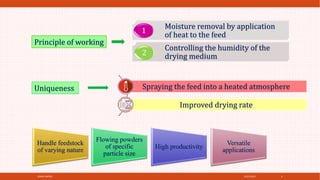
• Moisture removal by application
of heat to the feed
1
• Controlling the humidity of the
drying medium
2
Principle of working
Spraying the feed into a heated atmosphere
Improved drying rate
Uniqueness
Handle feedstock
of varying nature
Flowing powders
of specific
particle size
High productivity
Versatile
applications
4/21/2021
SPRAY DRYER 3
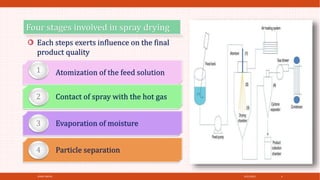
Four stages involved in spray drying
• Atomization of the feed solution
1
• Contact of spray with the hot gas
2
• Evaporation of moisture
3
• Particle separation
4
Each steps exerts influence on the final
product quality
4/21/2021
SPRAY DRYER 4
4/21/2021
SPRAY DRYER 5
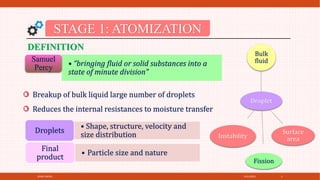
STAGE 1: ATOMIZATION
DEFINITION
• “bringing fluid or solid substances into a
state of minute division”
Samuel
Percy
Breakup of bulk liquid large number of droplets
Reduces the internal resistances to moisture transfer
Droplet
Instability
Fission
Surface
area
Bulk
fluid
• Shape, structure, velocity and
size distribution
Droplets
• Particle size and nature
Final
product
4/21/2021
SPRAY DRYER 6
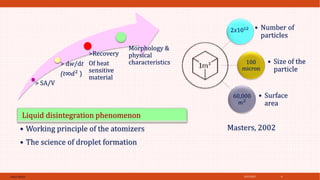
2𝑥1012 • Number of
particles
100
micron
• Size of the
particle
60,000
𝑚2
• Surface
area
Masters, 2002
> SA/V
> dw/dt
(t∞𝑑2 )
>Recovery
Of heat
sensitive
material
Morphology &
physical
characteristics
Liquid disintegration phenomenon
• Working principle of the atomizers
• The science of droplet formation
4/21/2021
SPRAY DRYER 7
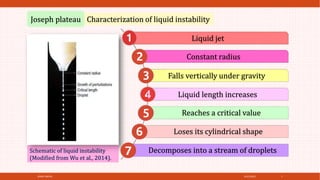
Liquid jet
Constant radius
Falls vertically under gravity
Liquid length increases
Reaches a critical value
Loses its cylindrical shape
Decomposes into a stream of droplets
Characterization of liquid instability
Joseph plateau
Schematic of liquid instability
(Modified from Wu et al., 2014).
4/21/2021
SPRAY DRYER 8
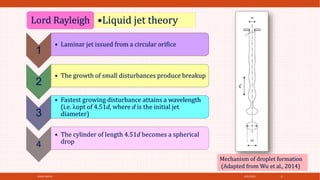
Mechanism of droplet formation
(Adapted from Wu et al., 2014)
•Liquid jet theory
Lord Rayleigh
1
• Laminar jet issued from a circular orifice
2
• The growth of small disturbances produce breakup
3
• Fastest growing disturbance attains a wavelength
(i.e. λopt of 4.51d, where d is the initial jet
diameter)
4
• The cylinder of length 4.51d becomes a spherical
drop
4/21/2021
SPRAY DRYER 9
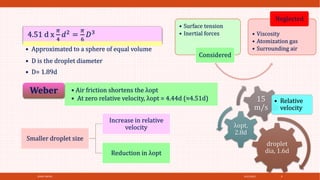
• Surface tension
• Inertial forces
Considered
• Viscosity
• Atomization gas
• Surrounding air
Neglected
4.51 d x
𝜋
4
𝑑2 =
𝜋
6
𝐷3
• Approximated to a sphere of equal volume
• D is the droplet diameter
• D= 1.89d
• Air friction shortens the λopt
• At zero relative velocity, λopt = 4.44d (≈4.51d)
Weber
droplet
dia, 1.6d
λopt,
2.8d
15
m/s
• Relative
velocity
Smaller droplet size
Increase in relative
velocity
Reduction in λopt
4/21/2021
SPRAY DRYER 10
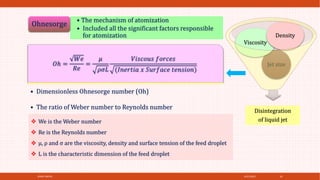
• The mechanism of atomization
• Included all the significant factors responsible
for atomization
Ohnesorge
Disintegration
of liquid jet
Jet size
Viscosity
Density
𝑂ℎ =
𝑊𝑒
𝑅𝑒
=
𝜇
𝜌𝜎𝐿
𝑉𝑖𝑠𝑐𝑜𝑢𝑠 𝑓𝑜𝑟𝑐𝑒𝑠
(𝐼𝑛𝑒𝑟𝑡𝑖𝑎 𝑥 𝑆𝑢𝑟𝑓𝑎𝑐𝑒 𝑡𝑒𝑛𝑠𝑖𝑜𝑛)
• Dimensionless Ohnesorge number (Oh)
• The ratio of Weber number to Reynolds number
 We is the Weber number
 Re is the Reynolds number
 μ, ρ and σ are the viscosity, density and surface tension of the feed droplet
 L is the characteristic dimension of the feed droplet
4/21/2021
SPRAY DRYER 11
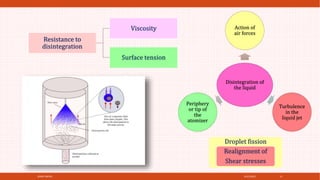
Disintegration of
the liquid
Action of
air forces
Turbulence
in the
liquid jet
Periphery
or tip of
the
atomizer
Resistance to
disintegration
Viscosity
Surface tension
Droplet fission
Realignment of
Shear stresses
4/21/2021
SPRAY DRYER 12
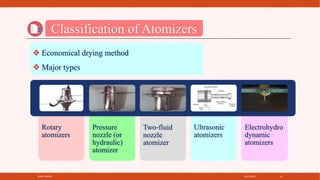
Classification of Atomizers
 Economical drying method
 Major types
Rotary
atomizers
Pressure
nozzle (or
hydraulic)
atomizer
Two‐fluid
nozzle
atomizer
Ultrasonic
atomizers
Electrohydro
dynamic
atomizers
4/21/2021
SPRAY DRYER 13
,
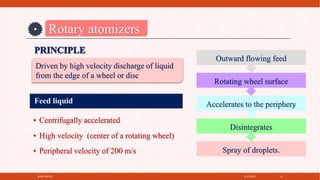
Rotary atomizers
Driven by high velocity discharge of liquid
from the edge of a wheel or disc
Spray of droplets.
Disintegrates
Accelerates to the periphery
Rotating wheel surface
Outward flowing feed
Feed liquid
• Centrifugally accelerated
• High velocity (center of a rotating wheel)
• Peripheral velocity of 200 m/s
4/21/2021
SPRAY DRYER 14
Features
Atomization energy • Centrifugal energy
Atomization
parameters
• Wheel speed in rotation per minute (RPM).
Type of spray • Fine, coarse or medium
Mean droplet size • 30–120 μm
Relationship between
mean droplet size (d)
and atomization
parameters
• d ∞ feed rate and feed viscosity
• (1/d) ∞ wheel speed and wheel diameter
4/21/2021
SPRAY DRYER 15
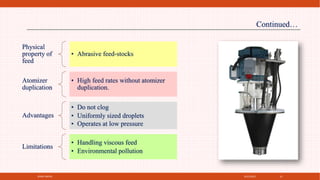
Physical
property of
feed
• Abrasive feed‐stocks
Atomizer
duplication
• High feed rates without atomizer
duplication.
Advantages
• Do not clog
• Uniformly sized droplets
• Operates at low pressure
Limitations
• Handling viscous feed
• Environmental pollution
Continued…
4/21/2021
SPRAY DRYER 16
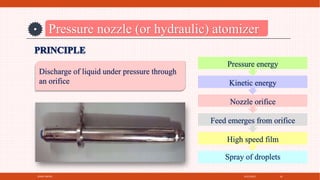
Pressure nozzle (or hydraulic) atomizer
Discharge of liquid under pressure through
an orifice
Spray of droplets
High speed film
Feed emerges from orifice
Nozzle orifice
Kinetic energy
Pressure energy
4/21/2021
SPRAY DRYER 17
Features
Atomization energy
• Pressure energy
• 250–10,000 PSI
Atomization
parameters
• Nozzle pressure
Type of spray • Coarse and less homogeneous
Mean droplet size • 120–250 μm
Relationship between
mean droplet size (d)
and atomization
parameters
• d ∞ feed rate and feed viscosity
• (1/d) ∞ Atomization Pressure
4/21/2021
SPRAY DRYER 18
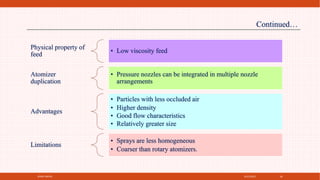
Physical property of
feed
• Low viscosity feed
Atomizer
duplication
• Pressure nozzles can be integrated in multiple nozzle
arrangements
Advantages
• Particles with less occluded air
• Higher density
• Good flow characteristics
• Relatively greater size
Limitations
• Sprays are less homogeneous
• Coarser than rotary atomizers.
Continued…
4/21/2021
SPRAY DRYER 19
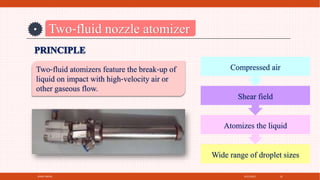
Two‐fluid nozzle atomizer
Two‐fluid atomizers feature the break‐up of
liquid on impact with high‐velocity air or
other gaseous flow.
Wide range of droplet sizes
Atomizes the liquid
Shear field
Compressed air
4/21/2021
SPRAY DRYER 20
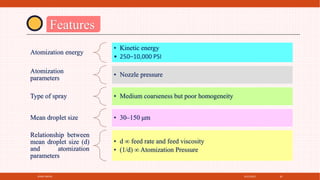
Features
Atomization energy
• Kinetic energy
• 250–10,000 PSI
Atomization
parameters
• Nozzle pressure
Type of spray • Medium coarseness but poor homogeneity
Mean droplet size • 30–150 μm
Relationship between
mean droplet size (d)
and atomization
parameters
• d ∞ feed rate and feed viscosity
• (1/d) ∞ Atomization Pressure
4/21/2021
SPRAY DRYER 21
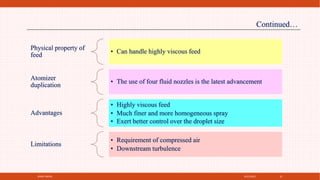
Physical property of
feed
• Can handle highly viscous feed
Atomizer
duplication
• The use of four fluid nozzles is the latest advancement
Advantages
• Highly viscous feed
• Much finer and more homogeneous spray
• Exert better control over the droplet size
Limitations
• Requirement of compressed air
• Downstream turbulence
Continued…
4/21/2021
SPRAY DRYER 22
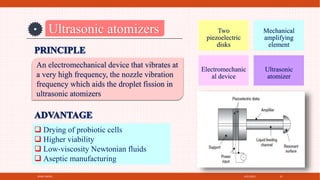
Ultrasonic atomizers
An electromechanical device that vibrates at
a very high frequency, the nozzle vibration
frequency which aids the droplet fission in
ultrasonic atomizers
Two
piezoelectric
disks
Mechanical
amplifying
element
Electromechanic
al device
Ultrasonic
atomizer
 Drying of probiotic cells
 Higher viability
 Low‐viscosity Newtonian fluids
 Aseptic manufacturing
4/21/2021
SPRAY DRYER 23
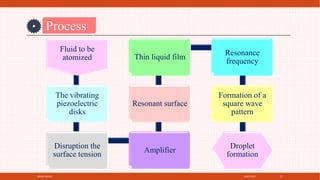
Process
Fluid to be
atomized
The vibrating
piezoelectric
disks
Disruption the
surface tension
Amplifier
Resonant surface
Thin liquid film
Resonance
frequency
Formation of a
square wave
pattern
Droplet
formation
4/21/2021
SPRAY DRYER 24
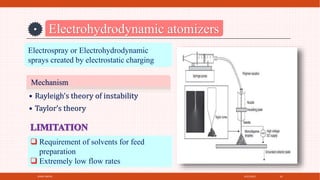
Electrohydrodynamic atomizers
Electrospray or Electrohydrodynamic
sprays created by electrostatic charging
Mechanism
• Rayleigh’s theory of instability
• Taylor’s theory
 Requirement of solvents for feed
preparation
 Extremely low flow rates
4/21/2021
SPRAY DRYER 25
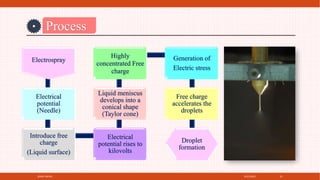
Process
Electrospray
Electrical
potential
(Needle)
Introduce free
charge
(Liquid surface)
Electrical
potential rises to
kilovolts
Liquid meniscus
develops into a
conical shape
(Taylor cone)
Highly
concentrated Free
charge
Generation of
Electric stress
Free charge
accelerates the
droplets
Droplet
formation
4/21/2021
SPRAY DRYER 26
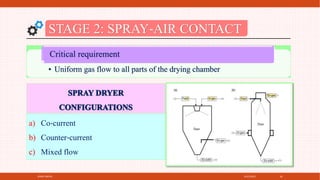
STAGE 2: SPRAY‐AIR CONTACT
• Uniform gas flow to all parts of the drying chamber
Critical requirement
a) Co‐current
b) Counter‐current
c) Mixed flow
4/21/2021
SPRAY DRYER 27
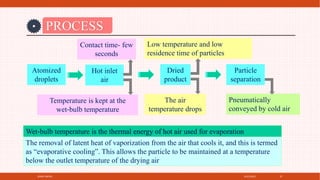
PROCESS
Hot inlet
air
Atomized
droplets
Temperature is kept at the
wet‐bulb temperature
Contact time- few
seconds
Dried
product
The air
temperature drops
Low temperature and low
residence time of particles
Particle
separation
Pneumatically
conveyed by cold air
Wet‐bulb temperature is the thermal energy of hot air used for evaporation
The removal of latent heat of vaporization from the air that cools it, and this is termed
as “evaporative cooling”. This allows the particle to be maintained at a temperature
below the outlet temperature of the drying air
4/21/2021
SPRAY DRYER 28
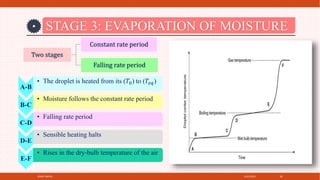
STAGE 3: EVAPORATION OF MOISTURE
Two stages
Constant rate period
Falling rate period
A-B
• The droplet is heated from its (𝑇0) to (𝑇𝑒𝑞)
B-C
• Moisture follows the constant rate period
C-D
• Falling rate period
D-E
• Sensible heating halts
E-F
• Rises in the dry‐bulb temperature of the air
4/21/2021
SPRAY DRYER 29
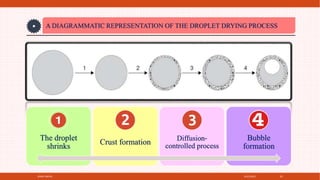
A DIAGRAMMATIC REPRESENTATION OF THE DROPLET DRYING PROCESS
The droplet
shrinks
Crust formation Diffusion‐
controlled process
Bubble
formation
4/21/2021
SPRAY DRYER 30
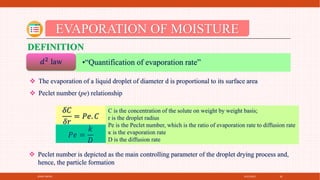
EVAPORATION OF MOISTURE
•“Quantification of evaporation rate”
𝑑2 law
DEFINITION
 The evaporation of a liquid droplet of diameter d is proportional to its surface area
 Peclet number (pe) relationship
𝛿𝐶
𝛿𝑟
= 𝑃𝑒. 𝐶
C is the concentration of the solute on weight by weight basis;
r is the droplet radius
Pe is the Peclet number, which is the ratio of evaporation rate to diffusion rate
κ is the evaporation rate
D is the diffusion rate
𝑃𝑒 =
𝑘
𝐷
 Peclet number is depicted as the main controlling parameter of the droplet drying process and,
hence, the particle formation
4/21/2021
SPRAY DRYER 31
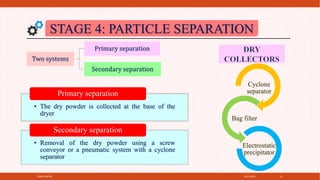
STAGE 4: PARTICLE SEPARATION
Two systems
Primary separation
Secondary separation
• The dry powder is collected at the base of the
dryer
Primary separation
• Removal of the dry powder using a screw
conveyor or a pneumatic system with a cyclone
separator
Secondary separation
Cyclone
separator
Bag filter
Electrostatic
precipitator
4/21/2021
SPRAY DRYER 32
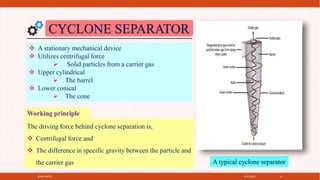
A typical cyclone separator
CYCLONE SEPARATOR
 A stationary mechanical device
 Utilizes centrifugal force
 Solid particles from a carrier gas
 Upper cylindrical
 The barrel
 Lower conical
 The cone
The driving force behind cyclone separation is,
 Centrifugal force and
 The difference in specific gravity between the particle and
the carrier gas
Working principle
4/21/2021
SPRAY DRYER 33
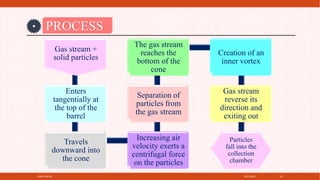
PROCESS
Gas stream +
solid particles
Enters
tangentially at
the top of the
barrel
Travels
downward into
the cone
Increasing air
velocity exerts a
centrifugal force
on the particles
Separation of
particles from
the gas stream
The gas stream
reaches the
bottom of the
cone
Creation of an
inner vortex
Gas stream
reverse its
direction and
exiting out
Particles
fall into the
collection
chamber
4/21/2021
SPRAY DRYER 34
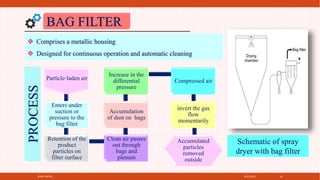
BAG FILTER
Schematic of spray
dryer with bag filter
 Comprises a metallic housing
 Designed for continuous operation and automatic cleaning
Particle‐laden air
Enters under
suction or
pressure to the
bag filter
Retention of the
product
particles on
filter surface
Clean air passes
out through
bags and
plenum
Accumulation
of dust on bags
Increase in the
differential
pressure
Compressed air
invert the gas
flow
momentarily
Accumulated
particles
removed
outside
PROCESS
4/21/2021
SPRAY DRYER 35
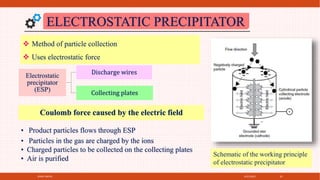
ELECTROSTATIC PRECIPITATOR
Schematic of the working principle
of electrostatic precipitator
Electrostatic
precipitator
(ESP)
Discharge wires
Collecting plates
 Method of particle collection
 Uses electrostatic force
Coulomb force caused by the electric field
• Product particles flows through ESP
• Particles in the gas are charged by the ions
• Charged particles to be collected on the collecting plates
• Air is purified
4/21/2021
SPRAY DRYER 36
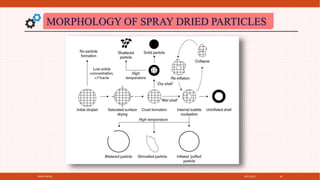
MORPHOLOGY OF SPRAY DRIED PARTICLES
4/21/2021
SPRAY DRYER 37
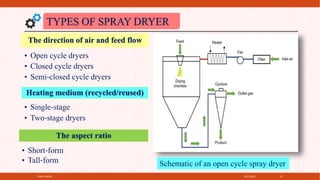
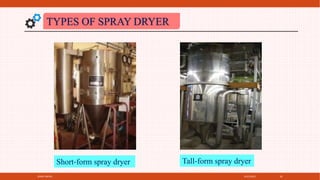
TYPES OF SPRAY DRYER
The direction of air and feed flow
• Open cycle dryers
• Closed cycle dryers
• Semi‐closed cycle dryers
Heating medium (recycled/reused)
• Single‐stage
• Two‐stage dryers
The aspect ratio
• Short‐form
• Tall‐form Schematic of an open cycle spray dryer
4/21/2021
SPRAY DRYER 38
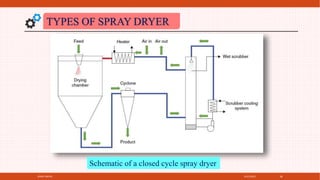
TYPES OF SPRAY DRYER
Schematic of a closed cycle spray dryer
4/21/2021
SPRAY DRYER 39
TYPES OF SPRAY DRYER
Short‐form spray dryer Tall‐form spray dryer
4/21/2021
SPRAY DRYER 40
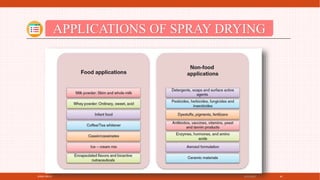
APPLICATIONS OF SPRAY DRYING
4/21/2021
SPRAY DRYER 41
REFERENCE
 Anandharamakrishnan, C. 2015. Spray drying techniques for food
ingredient encapsulation: John Wiley & Sons.
4/21/2021
SPRAY DRYER 42
THANK YOU

Spray dryer

  • 1.
    M.Venkatasami, Ph.D. (Processing andFood Engineering) Department of Food Process Engineering AEC&RI, TNAU. SPRAY DRYER 4/21/2021 SPRAY DRYER 1
  • 2.
    The first patenteddesign – USA (1872). Dairy industries - continuous production of milk powder. An industry‐friendly drying technique. Liquid drying Operates on convection mode INTRODUCTION • “Spray drying is the transformation of feed from a fluid state into a dried particulate form by spraying the feed into a hot drying medium.” Masters, 1991 DEFINITION 4/21/2021 SPRAY DRYER 2
  • 3.
    • Moisture removalby application of heat to the feed 1 • Controlling the humidity of the drying medium 2 Principle of working Spraying the feed into a heated atmosphere Improved drying rate Uniqueness Handle feedstock of varying nature Flowing powders of specific particle size High productivity Versatile applications 4/21/2021 SPRAY DRYER 3
  • 4.
    Four stages involvedin spray drying • Atomization of the feed solution 1 • Contact of spray with the hot gas 2 • Evaporation of moisture 3 • Particle separation 4 Each steps exerts influence on the final product quality 4/21/2021 SPRAY DRYER 4
  • 5.
    4/21/2021 SPRAY DRYER 5 STAGE1: ATOMIZATION DEFINITION • “bringing fluid or solid substances into a state of minute division” Samuel Percy Breakup of bulk liquid large number of droplets Reduces the internal resistances to moisture transfer Droplet Instability Fission Surface area Bulk fluid • Shape, structure, velocity and size distribution Droplets • Particle size and nature Final product
  • 6.
    4/21/2021 SPRAY DRYER 6 2𝑥1012• Number of particles 100 micron • Size of the particle 60,000 𝑚2 • Surface area Masters, 2002 > SA/V > dw/dt (t∞𝑑2 ) >Recovery Of heat sensitive material Morphology & physical characteristics Liquid disintegration phenomenon • Working principle of the atomizers • The science of droplet formation
  • 7.
    4/21/2021 SPRAY DRYER 7 Liquidjet Constant radius Falls vertically under gravity Liquid length increases Reaches a critical value Loses its cylindrical shape Decomposes into a stream of droplets Characterization of liquid instability Joseph plateau Schematic of liquid instability (Modified from Wu et al., 2014).
  • 8.
    4/21/2021 SPRAY DRYER 8 Mechanismof droplet formation (Adapted from Wu et al., 2014) •Liquid jet theory Lord Rayleigh 1 • Laminar jet issued from a circular orifice 2 • The growth of small disturbances produce breakup 3 • Fastest growing disturbance attains a wavelength (i.e. λopt of 4.51d, where d is the initial jet diameter) 4 • The cylinder of length 4.51d becomes a spherical drop
  • 9.
    4/21/2021 SPRAY DRYER 9 •Surface tension • Inertial forces Considered • Viscosity • Atomization gas • Surrounding air Neglected 4.51 d x 𝜋 4 𝑑2 = 𝜋 6 𝐷3 • Approximated to a sphere of equal volume • D is the droplet diameter • D= 1.89d • Air friction shortens the λopt • At zero relative velocity, λopt = 4.44d (≈4.51d) Weber droplet dia, 1.6d λopt, 2.8d 15 m/s • Relative velocity Smaller droplet size Increase in relative velocity Reduction in λopt
  • 10.
    4/21/2021 SPRAY DRYER 10 •The mechanism of atomization • Included all the significant factors responsible for atomization Ohnesorge Disintegration of liquid jet Jet size Viscosity Density 𝑂ℎ = 𝑊𝑒 𝑅𝑒 = 𝜇 𝜌𝜎𝐿 𝑉𝑖𝑠𝑐𝑜𝑢𝑠 𝑓𝑜𝑟𝑐𝑒𝑠 (𝐼𝑛𝑒𝑟𝑡𝑖𝑎 𝑥 𝑆𝑢𝑟𝑓𝑎𝑐𝑒 𝑡𝑒𝑛𝑠𝑖𝑜𝑛) • Dimensionless Ohnesorge number (Oh) • The ratio of Weber number to Reynolds number  We is the Weber number  Re is the Reynolds number  μ, ρ and σ are the viscosity, density and surface tension of the feed droplet  L is the characteristic dimension of the feed droplet
  • 11.
    4/21/2021 SPRAY DRYER 11 Disintegrationof the liquid Action of air forces Turbulence in the liquid jet Periphery or tip of the atomizer Resistance to disintegration Viscosity Surface tension Droplet fission Realignment of Shear stresses
  • 12.
    4/21/2021 SPRAY DRYER 12 Classificationof Atomizers  Economical drying method  Major types Rotary atomizers Pressure nozzle (or hydraulic) atomizer Two‐fluid nozzle atomizer Ultrasonic atomizers Electrohydro dynamic atomizers
  • 13.
    4/21/2021 SPRAY DRYER 13 , Rotaryatomizers Driven by high velocity discharge of liquid from the edge of a wheel or disc Spray of droplets. Disintegrates Accelerates to the periphery Rotating wheel surface Outward flowing feed Feed liquid • Centrifugally accelerated • High velocity (center of a rotating wheel) • Peripheral velocity of 200 m/s
  • 14.
    4/21/2021 SPRAY DRYER 14 Features Atomizationenergy • Centrifugal energy Atomization parameters • Wheel speed in rotation per minute (RPM). Type of spray • Fine, coarse or medium Mean droplet size • 30–120 μm Relationship between mean droplet size (d) and atomization parameters • d ∞ feed rate and feed viscosity • (1/d) ∞ wheel speed and wheel diameter
  • 15.
    4/21/2021 SPRAY DRYER 15 Physical propertyof feed • Abrasive feed‐stocks Atomizer duplication • High feed rates without atomizer duplication. Advantages • Do not clog • Uniformly sized droplets • Operates at low pressure Limitations • Handling viscous feed • Environmental pollution Continued…
  • 16.
    4/21/2021 SPRAY DRYER 16 Pressurenozzle (or hydraulic) atomizer Discharge of liquid under pressure through an orifice Spray of droplets High speed film Feed emerges from orifice Nozzle orifice Kinetic energy Pressure energy
  • 17.
    4/21/2021 SPRAY DRYER 17 Features Atomizationenergy • Pressure energy • 250–10,000 PSI Atomization parameters • Nozzle pressure Type of spray • Coarse and less homogeneous Mean droplet size • 120–250 μm Relationship between mean droplet size (d) and atomization parameters • d ∞ feed rate and feed viscosity • (1/d) ∞ Atomization Pressure
  • 18.
    4/21/2021 SPRAY DRYER 18 Physicalproperty of feed • Low viscosity feed Atomizer duplication • Pressure nozzles can be integrated in multiple nozzle arrangements Advantages • Particles with less occluded air • Higher density • Good flow characteristics • Relatively greater size Limitations • Sprays are less homogeneous • Coarser than rotary atomizers. Continued…
  • 19.
    4/21/2021 SPRAY DRYER 19 Two‐fluidnozzle atomizer Two‐fluid atomizers feature the break‐up of liquid on impact with high‐velocity air or other gaseous flow. Wide range of droplet sizes Atomizes the liquid Shear field Compressed air
  • 20.
    4/21/2021 SPRAY DRYER 20 Features Atomizationenergy • Kinetic energy • 250–10,000 PSI Atomization parameters • Nozzle pressure Type of spray • Medium coarseness but poor homogeneity Mean droplet size • 30–150 μm Relationship between mean droplet size (d) and atomization parameters • d ∞ feed rate and feed viscosity • (1/d) ∞ Atomization Pressure
  • 21.
    4/21/2021 SPRAY DRYER 21 Physicalproperty of feed • Can handle highly viscous feed Atomizer duplication • The use of four fluid nozzles is the latest advancement Advantages • Highly viscous feed • Much finer and more homogeneous spray • Exert better control over the droplet size Limitations • Requirement of compressed air • Downstream turbulence Continued…
  • 22.
    4/21/2021 SPRAY DRYER 22 Ultrasonicatomizers An electromechanical device that vibrates at a very high frequency, the nozzle vibration frequency which aids the droplet fission in ultrasonic atomizers Two piezoelectric disks Mechanical amplifying element Electromechanic al device Ultrasonic atomizer  Drying of probiotic cells  Higher viability  Low‐viscosity Newtonian fluids  Aseptic manufacturing
  • 23.
    4/21/2021 SPRAY DRYER 23 Process Fluidto be atomized The vibrating piezoelectric disks Disruption the surface tension Amplifier Resonant surface Thin liquid film Resonance frequency Formation of a square wave pattern Droplet formation
  • 24.
    4/21/2021 SPRAY DRYER 24 Electrohydrodynamicatomizers Electrospray or Electrohydrodynamic sprays created by electrostatic charging Mechanism • Rayleigh’s theory of instability • Taylor’s theory  Requirement of solvents for feed preparation  Extremely low flow rates
  • 25.
    4/21/2021 SPRAY DRYER 25 Process Electrospray Electrical potential (Needle) Introducefree charge (Liquid surface) Electrical potential rises to kilovolts Liquid meniscus develops into a conical shape (Taylor cone) Highly concentrated Free charge Generation of Electric stress Free charge accelerates the droplets Droplet formation
  • 26.
    4/21/2021 SPRAY DRYER 26 STAGE2: SPRAY‐AIR CONTACT • Uniform gas flow to all parts of the drying chamber Critical requirement a) Co‐current b) Counter‐current c) Mixed flow
  • 27.
    4/21/2021 SPRAY DRYER 27 PROCESS Hotinlet air Atomized droplets Temperature is kept at the wet‐bulb temperature Contact time- few seconds Dried product The air temperature drops Low temperature and low residence time of particles Particle separation Pneumatically conveyed by cold air Wet‐bulb temperature is the thermal energy of hot air used for evaporation The removal of latent heat of vaporization from the air that cools it, and this is termed as “evaporative cooling”. This allows the particle to be maintained at a temperature below the outlet temperature of the drying air
  • 28.
    4/21/2021 SPRAY DRYER 28 STAGE3: EVAPORATION OF MOISTURE Two stages Constant rate period Falling rate period A-B • The droplet is heated from its (𝑇0) to (𝑇𝑒𝑞) B-C • Moisture follows the constant rate period C-D • Falling rate period D-E • Sensible heating halts E-F • Rises in the dry‐bulb temperature of the air
  • 29.
    4/21/2021 SPRAY DRYER 29 ADIAGRAMMATIC REPRESENTATION OF THE DROPLET DRYING PROCESS The droplet shrinks Crust formation Diffusion‐ controlled process Bubble formation
  • 30.
    4/21/2021 SPRAY DRYER 30 EVAPORATIONOF MOISTURE •“Quantification of evaporation rate” 𝑑2 law DEFINITION  The evaporation of a liquid droplet of diameter d is proportional to its surface area  Peclet number (pe) relationship 𝛿𝐶 𝛿𝑟 = 𝑃𝑒. 𝐶 C is the concentration of the solute on weight by weight basis; r is the droplet radius Pe is the Peclet number, which is the ratio of evaporation rate to diffusion rate κ is the evaporation rate D is the diffusion rate 𝑃𝑒 = 𝑘 𝐷  Peclet number is depicted as the main controlling parameter of the droplet drying process and, hence, the particle formation
  • 31.
    4/21/2021 SPRAY DRYER 31 STAGE4: PARTICLE SEPARATION Two systems Primary separation Secondary separation • The dry powder is collected at the base of the dryer Primary separation • Removal of the dry powder using a screw conveyor or a pneumatic system with a cyclone separator Secondary separation Cyclone separator Bag filter Electrostatic precipitator
  • 32.
    4/21/2021 SPRAY DRYER 32 Atypical cyclone separator CYCLONE SEPARATOR  A stationary mechanical device  Utilizes centrifugal force  Solid particles from a carrier gas  Upper cylindrical  The barrel  Lower conical  The cone The driving force behind cyclone separation is,  Centrifugal force and  The difference in specific gravity between the particle and the carrier gas Working principle
  • 33.
    4/21/2021 SPRAY DRYER 33 PROCESS Gasstream + solid particles Enters tangentially at the top of the barrel Travels downward into the cone Increasing air velocity exerts a centrifugal force on the particles Separation of particles from the gas stream The gas stream reaches the bottom of the cone Creation of an inner vortex Gas stream reverse its direction and exiting out Particles fall into the collection chamber
  • 34.
    4/21/2021 SPRAY DRYER 34 BAGFILTER Schematic of spray dryer with bag filter  Comprises a metallic housing  Designed for continuous operation and automatic cleaning Particle‐laden air Enters under suction or pressure to the bag filter Retention of the product particles on filter surface Clean air passes out through bags and plenum Accumulation of dust on bags Increase in the differential pressure Compressed air invert the gas flow momentarily Accumulated particles removed outside PROCESS
  • 35.
    4/21/2021 SPRAY DRYER 35 ELECTROSTATICPRECIPITATOR Schematic of the working principle of electrostatic precipitator Electrostatic precipitator (ESP) Discharge wires Collecting plates  Method of particle collection  Uses electrostatic force Coulomb force caused by the electric field • Product particles flows through ESP • Particles in the gas are charged by the ions • Charged particles to be collected on the collecting plates • Air is purified
  • 36.
    4/21/2021 SPRAY DRYER 36 MORPHOLOGYOF SPRAY DRIED PARTICLES
  • 37.
    4/21/2021 SPRAY DRYER 37 TYPESOF SPRAY DRYER The direction of air and feed flow • Open cycle dryers • Closed cycle dryers • Semi‐closed cycle dryers Heating medium (recycled/reused) • Single‐stage • Two‐stage dryers The aspect ratio • Short‐form • Tall‐form Schematic of an open cycle spray dryer
  • 38.
    4/21/2021 SPRAY DRYER 38 TYPESOF SPRAY DRYER Schematic of a closed cycle spray dryer
  • 39.
    4/21/2021 SPRAY DRYER 39 TYPESOF SPRAY DRYER Short‐form spray dryer Tall‐form spray dryer
  • 40.
  • 41.
    4/21/2021 SPRAY DRYER 41 REFERENCE Anandharamakrishnan, C. 2015. Spray drying techniques for food ingredient encapsulation: John Wiley & Sons.
  • 42.