

Md Shahjahan Kabir
MS in Food Processing and Preservation
Student ID: 1807053
Hajee Mohammad Danesh Science and Technology University
(HSTU), Dinajpur.
Spray Drying: A Versatile Technique for Food, Pharmaceutical, and
Chemical Industries
Spray drying can be defined as a continuous process of transforming a liquid feed into a dry powder through
the application of heat and the removal of moisture. This process is accomplished by atomizing the feed into
small droplets, which are rapidly dried by contact with hot air or gas.
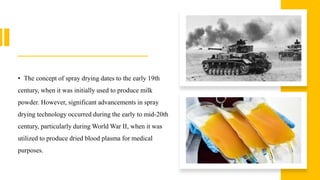
• The concept of spray drying dates to the early 19th
century, when it was initially used to produce milk
powder. However, significant advancements in spray
drying technology occurred during the early to mid-20th
century, particularly during World War II, when it was
utilized to produce dried blood plasma for medical
purposes.
• Versatile Application: For producing high-quality powders like food commodities (milk, coffee),
pharmaceutical formulations (inhalable powders), ceramics, and specialty chemicals.
• Preservation of Product Integrity: Retains original liquid's flavor, aroma, and nutritional
composition while enhancing shelf stability, facilitating handling, and ensuring consistent attributes
in the final product.
• Enhanced Performance and Efficiency: Encapsulates active ingredients in pharmaceuticals,
controls particle size in materials manufacturing, and tailors' characteristics in chemical production,
advancing solubility, bioavailability, material properties, and process efficiency.
• Driving Innovation Forward: Maintains stringent quality standards while driving innovation across
industries, serving as a cornerstone process for diverse powder production needs.
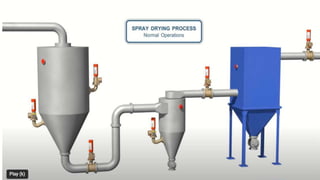
Fig. Spray Dryer
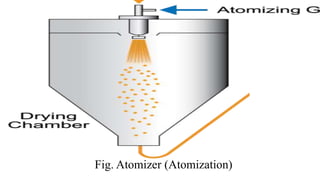
Fig. Atomizer (Atomization)
Fig. Drying Chember
Fig. Feeding System
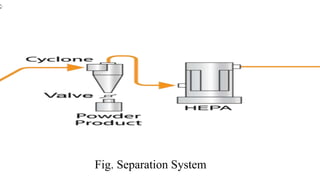
Fig. Separation System
Fig. Air Supply System
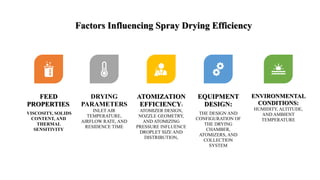
Factors Influencing Spray Drying Efficiency
FEED
PROPERTIES:
VISCOSITY, SOLIDS
CONTENT, AND
THERMAL
SENSITIVITY
DRYING
PARAMETERS
INLET AIR
TEMPERATURE,
AIRFLOW RATE, AND
RESIDENCE TIME
ATOMIZATION
EFFICIENCY:
ATOMIZER DESIGN,
NOZZLE GEOMETRY,
AND ATOMIZING
PRESSURE INFLUENCE
DROPLET SIZE AND
DISTRIBUTION,
EQUIPMENT
DESIGN:
THE DESIGN AND
CONFIGURATION OF
THE DRYING
CHAMBER,
ATOMIZERS, AND
COLLECTION
SYSTEM
ENVIRONMENTAL
CONDITIONS:
HUMIDITY, ALTITUDE,
AND AMBIENT
TEMPERATURE
Types of Spray Dryers
1. Conventional Spray Dryers.
2. Fluidized Bed Spray Dryers
3. Rotary Atomizer Spray Dryers
4. Nozzle Atomizer Spray Dryers
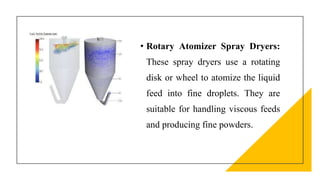
• Rotary Atomizer Spray Dryers:
These spray dryers use a rotating
disk or wheel to atomize the liquid
feed into fine droplets. They are
suitable for handling viscous feeds
and producing fine powders.
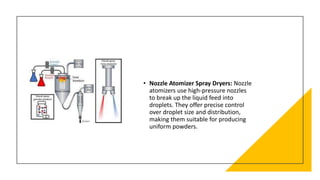
• Nozzle Atomizer Spray Dryers: Nozzle
atomizers use high-pressure nozzles
to break up the liquid feed into
droplets. They offer precise control
over droplet size and distribution,
making them suitable for producing
uniform powders.
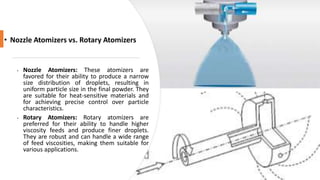
• Nozzle Atomizers: These atomizers are
favored for their ability to produce a narrow
size distribution of droplets, resulting in
uniform particle size in the final powder. They
are suitable for heat-sensitive materials and
for achieving precise control over particle
characteristics.
• Rotary Atomizers: Rotary atomizers are
preferred for their ability to handle higher
viscosity feeds and produce finer droplets.
They are robust and can handle a wide range
of feed viscosities, making them suitable for
various applications.
• Nozzle Atomizers vs. Rotary Atomizers
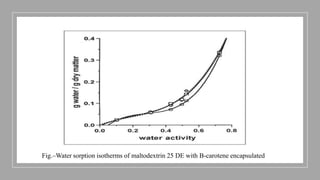
Fig.–Water sorption isotherms of maltodextrin 25 DE with B-carotene encapsulated
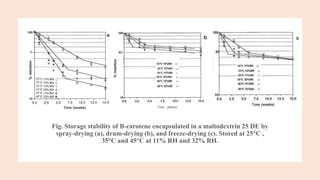
Fig. Storage stability of B-carotene encapsulated in a maltodextrin 25 DE by
spray-drying (a), drum-drying (b), and freeze-drying (c). Stored at 25°C ,
35°C and 45°C at 11% RH and 32% RH.
• Fig. Variation of the colorimetry parameter “L” and “a” during storage of B-carotene
encapsulated in a maltodextrin 25 DE by spray-drying (a), drum-drying (b), and freeze-
drying (c). Stored at 25°C, 35°C and 45°C and both 11% RH and 32% RH.
Applications of
Spray Drying
Food Industry:
Spray drying plays a vital role in the food industry, enabling the production of
powdered forms of various food products, including:
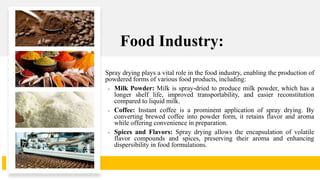
• Milk Powder: Milk is spray-dried to produce milk powder, which has a
longer shelf life, improved transportability, and easier reconstitution
compared to liquid milk.
• Coffee: Instant coffee is a prominent application of spray drying. By
converting brewed coffee into powder form, it retains flavor and aroma
while offering convenience in preparation.
• Spices and Flavors: Spray drying allows the encapsulation of volatile
flavor compounds and spices, preserving their aroma and enhancing
dispersibility in food formulations.
Pharmaceutical Industry:
• In pharmaceuticals, spray drying is utilized for various purposes,
including:
• Drug Encapsulation: Active pharmaceutical ingredients (APIs)
can be encapsulated within inert materials through spray
drying. This method improves drug stability, bioavailability, and
controlled release characteristics.
• Inhalable Powders: Respiratory drugs, vaccines, and inhalable
antibiotics are often formulated as dry powders using spray
drying. This enables efficient delivery to the lungs and enhances
patient compliance.
Chemical Industry:
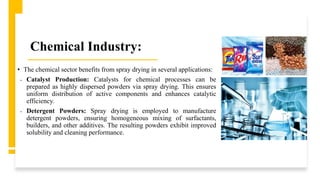
• The chemical sector benefits from spray drying in several applications:
• Catalyst Production: Catalysts for chemical processes can be
prepared as highly dispersed powders via spray drying. This ensures
uniform distribution of active components and enhances catalytic
efficiency.
• Detergent Powders: Spray drying is employed to manufacture
detergent powders, ensuring homogeneous mixing of surfactants,
builders, and other additives. The resulting powders exhibit improved
solubility and cleaning performance.
Biotechnology:
• In biotechnology, spray drying finds applications in:
• Protein Powders: Biopharmaceuticals, such as therapeutic
proteins and enzymes, can be spray-dried to produce stable
powders suitable for long-term storage and convenient dosing.
• Microencapsulation: Active ingredients, probiotics, and
bioactive compounds can be encapsulated within protective
matrices using spray drying. This enables controlled release and
targeted delivery in food, pharmaceutical, and agricultural
applications.
• Efficiency: Spray drying offers high production rates and energy efficiency compared to other
drying methods.
• Product Quality: It allows precise control over particle size, morphology, and moisture content,
leading to consistent product quality.
• Scale-up Capability: The process can be scaled from laboratory to industrial scale with relative
ease.
• Cost-effectiveness: Despite initial setup costs, spray drying can be cost-effective in large-scale
production due to its efficiency and product consistency.
Advantages and Considerations:
Advantages of Spray Drying:
• Rapid Drying
• Particle Size Control
• Product Stability
Challenges of Spray Drying:
 It can still pose challenges, particularly if not properly optimized. High drying temperatures
can cause thermal degradation or denaturation of sensitive compounds, leading to loss of
nutritional value, reduced efficacy, or undesirable changes in product properties.
 It requires careful selection of process parameters, such as drying temperature and residence time,
to minimize heat exposure while ensuring adequate moisture removal.
 Spray drying can result in product loss due to factors such as incomplete drying, agglomeration, or
improper collection methods.
 Spray drying equipment requires regular maintenance to ensure optimal performance and product
quality. Routine cleaning, inspection, and replacement of worn parts are essential to prevent
downtime, minimize product contamination, and prolong equipment lifespan.
 Proper training of personnel in equipment operation and maintenance practices is crucial for safe
and efficient operation.
Challenges of Spray Drying:
 It can still pose challenges, particularly if not properly optimized. High drying temperatures can
cause thermal degradation or denaturation of sensitive compounds, leading to loss of nutritional
value, reduced efficacy, or undesirable changes in product properties.
 It requires careful selection of process parameters, such as drying temperature and residence time,
to minimize heat exposure while ensuring adequate moisture removal.
 Spray drying can result in product loss due to factors such as incomplete drying, agglomeration, or
improper collection methods.
 Spray drying equipment requires regular maintenance to ensure optimal performance and product
quality. Routine cleaning, inspection, and replacement of worn parts are essential to prevent
downtime, minimize product contamination, and prolong equipment lifespan.
 Proper training of personnel in equipment operation and maintenance practices is crucial for safe
and efficient operation.
. Recent Advancements
• Computational Modeling: Utilizing advanced algorithms and computing power to simulate complex
systems, optimize processes, and predict outcomes across industries, leading to faster and more cost-effective
optimization compared to traditional methods.
• Novel Materials: Breakthroughs in materials science and nanotechnology have led to the development of
innovative materials with superior properties such as strength, durability, and conductivity, revolutionizing
industries like aerospace and electronics.
• Process Integration: Companies are increasingly integrating different stages of production to streamline
operations, minimize waste, and deliver higher-quality products at lower costs, as seen in the food industry's
supply chain management systems and renewable energy sector's integration of solar panels with storage and
grid technologies.
• Automotive Industry: Computational fluid dynamics (CFD) simulations are optimizing vehicle
aerodynamics, reducing drag, and enhancing fuel efficiency, while lightweight composite materials are
transforming aircraft design for greater environmental sustainability.
Future Perspectives
• Sustainability Drive: Spray drying advancements focus on energy efficiency, waste reduction, and
renewable energy integration. Novel drying systems and additives aim to minimize environmental
impact and enhance eco-friendliness.
• Automation Integration: Enhanced by real-time monitoring and machine learning, spray drying
systems optimize parameters, ensuring consistent quality while reducing production costs. Robotics and
automated handling streamline operations for improved efficiency.
• Niche Industry Applications: Pharmaceutical, nutraceutical, and functional food sectors benefit
from spray drying's ability to tailor powder properties. This includes precise particle control and
encapsulation of bioactive compounds, expanding possibilities for drug delivery and dietary
supplements.
• Novel Additive Development: Ongoing research focuses on enhancing efficiency and stability
through the use of natural polymers, surfactants, and emulsifiers. These additives modify feed solution
properties, improving atomization and drying kinetics for better overall performance.
• Exploring Emerging Technologies: Investigation into supercritical fluid drying and microwave-
assisted drying aims to overcome conventional spray drying limitations. By broadening material
processing capabilities, these technologies promise to expand the scope of spray drying applications.
Conclusion
 Spray drying efficiently converts liquid feedstock into precise, dried particles,
crucial for industries like food, pharmaceuticals, ceramics, and detergents.
 It enhances product stability, prolongs shelf life, aids in transportation, and enables
encapsulation of sensitive materials, addressing complex manufacturing needs.
 Spray drying offers potential for energy efficiency and waste reduction, though
continuous optimization is necessary for further environmental benefits.
 Integration of advanced control systems and novel feedstock materials promises to
revolutionize manufacturing processes and product design.
 Addressing energy consumption, production costs, and product quality while
leveraging advancements in process modeling and simulation are vital for
maximizing spray drying's potential in the future.
Spray Drying: a comprehensive presentation.pptx

Spray Drying: a comprehensive presentation.pptx

  • 1.
    Md Shahjahan Kabir MSin Food Processing and Preservation Student ID: 1807053 Hajee Mohammad Danesh Science and Technology University (HSTU), Dinajpur. Spray Drying: A Versatile Technique for Food, Pharmaceutical, and Chemical Industries
  • 2.
    Spray drying canbe defined as a continuous process of transforming a liquid feed into a dry powder through the application of heat and the removal of moisture. This process is accomplished by atomizing the feed into small droplets, which are rapidly dried by contact with hot air or gas.
  • 3.
    • The conceptof spray drying dates to the early 19th century, when it was initially used to produce milk powder. However, significant advancements in spray drying technology occurred during the early to mid-20th century, particularly during World War II, when it was utilized to produce dried blood plasma for medical purposes.
  • 4.
    • Versatile Application:For producing high-quality powders like food commodities (milk, coffee), pharmaceutical formulations (inhalable powders), ceramics, and specialty chemicals. • Preservation of Product Integrity: Retains original liquid's flavor, aroma, and nutritional composition while enhancing shelf stability, facilitating handling, and ensuring consistent attributes in the final product. • Enhanced Performance and Efficiency: Encapsulates active ingredients in pharmaceuticals, controls particle size in materials manufacturing, and tailors' characteristics in chemical production, advancing solubility, bioavailability, material properties, and process efficiency. • Driving Innovation Forward: Maintains stringent quality standards while driving innovation across industries, serving as a cornerstone process for diverse powder production needs.
  • 6.
  • 7.
  • 8.
  • 9.
  • 10.
  • 11.
  • 12.
    Factors Influencing SprayDrying Efficiency FEED PROPERTIES: VISCOSITY, SOLIDS CONTENT, AND THERMAL SENSITIVITY DRYING PARAMETERS INLET AIR TEMPERATURE, AIRFLOW RATE, AND RESIDENCE TIME ATOMIZATION EFFICIENCY: ATOMIZER DESIGN, NOZZLE GEOMETRY, AND ATOMIZING PRESSURE INFLUENCE DROPLET SIZE AND DISTRIBUTION, EQUIPMENT DESIGN: THE DESIGN AND CONFIGURATION OF THE DRYING CHAMBER, ATOMIZERS, AND COLLECTION SYSTEM ENVIRONMENTAL CONDITIONS: HUMIDITY, ALTITUDE, AND AMBIENT TEMPERATURE
  • 13.
    Types of SprayDryers 1. Conventional Spray Dryers. 2. Fluidized Bed Spray Dryers 3. Rotary Atomizer Spray Dryers 4. Nozzle Atomizer Spray Dryers
  • 16.
    • Rotary AtomizerSpray Dryers: These spray dryers use a rotating disk or wheel to atomize the liquid feed into fine droplets. They are suitable for handling viscous feeds and producing fine powders.
  • 17.
    • Nozzle AtomizerSpray Dryers: Nozzle atomizers use high-pressure nozzles to break up the liquid feed into droplets. They offer precise control over droplet size and distribution, making them suitable for producing uniform powders.
  • 18.
    • Nozzle Atomizers:These atomizers are favored for their ability to produce a narrow size distribution of droplets, resulting in uniform particle size in the final powder. They are suitable for heat-sensitive materials and for achieving precise control over particle characteristics. • Rotary Atomizers: Rotary atomizers are preferred for their ability to handle higher viscosity feeds and produce finer droplets. They are robust and can handle a wide range of feed viscosities, making them suitable for various applications. • Nozzle Atomizers vs. Rotary Atomizers
  • 20.
    Fig.–Water sorption isothermsof maltodextrin 25 DE with B-carotene encapsulated
  • 21.
    Fig. Storage stabilityof B-carotene encapsulated in a maltodextrin 25 DE by spray-drying (a), drum-drying (b), and freeze-drying (c). Stored at 25°C , 35°C and 45°C at 11% RH and 32% RH.
  • 22.
    • Fig. Variationof the colorimetry parameter “L” and “a” during storage of B-carotene encapsulated in a maltodextrin 25 DE by spray-drying (a), drum-drying (b), and freeze- drying (c). Stored at 25°C, 35°C and 45°C and both 11% RH and 32% RH.
  • 23.
  • 24.
    Food Industry: Spray dryingplays a vital role in the food industry, enabling the production of powdered forms of various food products, including: • Milk Powder: Milk is spray-dried to produce milk powder, which has a longer shelf life, improved transportability, and easier reconstitution compared to liquid milk. • Coffee: Instant coffee is a prominent application of spray drying. By converting brewed coffee into powder form, it retains flavor and aroma while offering convenience in preparation. • Spices and Flavors: Spray drying allows the encapsulation of volatile flavor compounds and spices, preserving their aroma and enhancing dispersibility in food formulations.
  • 25.
    Pharmaceutical Industry: • Inpharmaceuticals, spray drying is utilized for various purposes, including: • Drug Encapsulation: Active pharmaceutical ingredients (APIs) can be encapsulated within inert materials through spray drying. This method improves drug stability, bioavailability, and controlled release characteristics. • Inhalable Powders: Respiratory drugs, vaccines, and inhalable antibiotics are often formulated as dry powders using spray drying. This enables efficient delivery to the lungs and enhances patient compliance.
  • 26.
    Chemical Industry: • Thechemical sector benefits from spray drying in several applications: • Catalyst Production: Catalysts for chemical processes can be prepared as highly dispersed powders via spray drying. This ensures uniform distribution of active components and enhances catalytic efficiency. • Detergent Powders: Spray drying is employed to manufacture detergent powders, ensuring homogeneous mixing of surfactants, builders, and other additives. The resulting powders exhibit improved solubility and cleaning performance.
  • 27.
    Biotechnology: • In biotechnology,spray drying finds applications in: • Protein Powders: Biopharmaceuticals, such as therapeutic proteins and enzymes, can be spray-dried to produce stable powders suitable for long-term storage and convenient dosing. • Microencapsulation: Active ingredients, probiotics, and bioactive compounds can be encapsulated within protective matrices using spray drying. This enables controlled release and targeted delivery in food, pharmaceutical, and agricultural applications.
  • 28.
    • Efficiency: Spraydrying offers high production rates and energy efficiency compared to other drying methods. • Product Quality: It allows precise control over particle size, morphology, and moisture content, leading to consistent product quality. • Scale-up Capability: The process can be scaled from laboratory to industrial scale with relative ease. • Cost-effectiveness: Despite initial setup costs, spray drying can be cost-effective in large-scale production due to its efficiency and product consistency. Advantages and Considerations:
  • 29.
    Advantages of SprayDrying: • Rapid Drying • Particle Size Control • Product Stability
  • 30.
    Challenges of SprayDrying:  It can still pose challenges, particularly if not properly optimized. High drying temperatures can cause thermal degradation or denaturation of sensitive compounds, leading to loss of nutritional value, reduced efficacy, or undesirable changes in product properties.  It requires careful selection of process parameters, such as drying temperature and residence time, to minimize heat exposure while ensuring adequate moisture removal.  Spray drying can result in product loss due to factors such as incomplete drying, agglomeration, or improper collection methods.  Spray drying equipment requires regular maintenance to ensure optimal performance and product quality. Routine cleaning, inspection, and replacement of worn parts are essential to prevent downtime, minimize product contamination, and prolong equipment lifespan.  Proper training of personnel in equipment operation and maintenance practices is crucial for safe and efficient operation.
  • 32.
    Challenges of SprayDrying:  It can still pose challenges, particularly if not properly optimized. High drying temperatures can cause thermal degradation or denaturation of sensitive compounds, leading to loss of nutritional value, reduced efficacy, or undesirable changes in product properties.  It requires careful selection of process parameters, such as drying temperature and residence time, to minimize heat exposure while ensuring adequate moisture removal.  Spray drying can result in product loss due to factors such as incomplete drying, agglomeration, or improper collection methods.  Spray drying equipment requires regular maintenance to ensure optimal performance and product quality. Routine cleaning, inspection, and replacement of worn parts are essential to prevent downtime, minimize product contamination, and prolong equipment lifespan.  Proper training of personnel in equipment operation and maintenance practices is crucial for safe and efficient operation.
  • 33.
    . Recent Advancements •Computational Modeling: Utilizing advanced algorithms and computing power to simulate complex systems, optimize processes, and predict outcomes across industries, leading to faster and more cost-effective optimization compared to traditional methods. • Novel Materials: Breakthroughs in materials science and nanotechnology have led to the development of innovative materials with superior properties such as strength, durability, and conductivity, revolutionizing industries like aerospace and electronics. • Process Integration: Companies are increasingly integrating different stages of production to streamline operations, minimize waste, and deliver higher-quality products at lower costs, as seen in the food industry's supply chain management systems and renewable energy sector's integration of solar panels with storage and grid technologies. • Automotive Industry: Computational fluid dynamics (CFD) simulations are optimizing vehicle aerodynamics, reducing drag, and enhancing fuel efficiency, while lightweight composite materials are transforming aircraft design for greater environmental sustainability.
  • 34.
    Future Perspectives • SustainabilityDrive: Spray drying advancements focus on energy efficiency, waste reduction, and renewable energy integration. Novel drying systems and additives aim to minimize environmental impact and enhance eco-friendliness. • Automation Integration: Enhanced by real-time monitoring and machine learning, spray drying systems optimize parameters, ensuring consistent quality while reducing production costs. Robotics and automated handling streamline operations for improved efficiency. • Niche Industry Applications: Pharmaceutical, nutraceutical, and functional food sectors benefit from spray drying's ability to tailor powder properties. This includes precise particle control and encapsulation of bioactive compounds, expanding possibilities for drug delivery and dietary supplements. • Novel Additive Development: Ongoing research focuses on enhancing efficiency and stability through the use of natural polymers, surfactants, and emulsifiers. These additives modify feed solution properties, improving atomization and drying kinetics for better overall performance. • Exploring Emerging Technologies: Investigation into supercritical fluid drying and microwave- assisted drying aims to overcome conventional spray drying limitations. By broadening material processing capabilities, these technologies promise to expand the scope of spray drying applications.
  • 36.
    Conclusion  Spray dryingefficiently converts liquid feedstock into precise, dried particles, crucial for industries like food, pharmaceuticals, ceramics, and detergents.  It enhances product stability, prolongs shelf life, aids in transportation, and enables encapsulation of sensitive materials, addressing complex manufacturing needs.  Spray drying offers potential for energy efficiency and waste reduction, though continuous optimization is necessary for further environmental benefits.  Integration of advanced control systems and novel feedstock materials promises to revolutionize manufacturing processes and product design.  Addressing energy consumption, production costs, and product quality while leveraging advancements in process modeling and simulation are vital for maximizing spray drying's potential in the future.

Editor's Notes

  • #5 Versatile Application: Spray drying is pivotal across industries for producing high-quality powders like food commodities (milk, coffee), pharmaceutical formulations (inhalable powders), ceramics, and specialty chemicals. Preservation of Product Integrity: Retains original liquid's flavor, aroma, and nutritional composition while enhancing shelf stability, facilitating handling, and ensuring consistent attributes in the final product. Enhanced Performance and Efficiency: Encapsulates active ingredients in pharmaceuticals, controls particle size in materials manufacturing, and tailors characteristics in chemical production, advancing solubility, bioavailability, material properties, and process efficiency. Driving Innovation Forward: Maintains stringent quality standards while driving innovation across industries, serving as a cornerstone process for diverse powder production needs.
  • #6 The spray drying process typically consists of four main stages: Atomization: The liquid feedstock is atomized into fine droplets using various atomization techniques such as pressure nozzles, rotary atomizers, or centrifugal atomizers. The choice of atomization method depends on factors like feed viscosity, desired particle size, and production scale. Drying: The atomized droplets are introduced into a drying chamber, where they come into contact with hot air. As the droplets move through the chamber, moisture evaporates rapidly, leaving behind dry particles. The drying temperature, airflow rate, and residence time in the chamber are carefully controlled to achieve the desired product characteristics. Particle Formation: During drying, the droplets undergo phase transitions, evolving from liquid to solid particles. The size, shape, and morphology of the particles are influenced by factors such as feed formulation, drying conditions, and atomization parameters. Collection: The dried particles are separated from the drying air using a collection system, which may consist of cyclones, bag filters, or electrostatic precipitators. The collected powder is then discharged for further processing or packaging.
  • #8 Atomization: This is the process of breaking the liquid feedstock into small droplets. Atomization can be achieved using different methods such as pressure nozzles, rotary atomizers, or centrifugal atomizers. The choice of atomization technique depends on factors such as feed viscosity, desired particle size distribution, and production capacity.
  • #9 Atomization: This is the process of breaking the liquid feedstock into small droplets. Atomization can be achieved using different methods such as pressure nozzles, rotary atomizers, or centrifugal atomizers. The choice of atomization technique depends on factors such as feed viscosity, desired particle size distribution, and production capacity.
  • #13 Feed Properties: The properties of the liquid feedstock, such as viscosity, solids content, and thermal sensitivity, can significantly affect spray drying efficiency. Optimizing feed formulation and pre-treatment processes can improve process stability and product yield. Drying Parameters: Factors such as inlet air temperature, airflow rate, and residence time in the drying chamber play a critical role in determining drying efficiency and product quality. Balancing these parameters to achieve rapid moisture removal without causing thermal degradation is essential for optimal performance. Atomization Efficiency: The efficiency of atomization directly impacts the particle size distribution and drying kinetics. Factors such as atomizer design, nozzle geometry, and atomizing pressure influence droplet size and distribution, thereby affecting drying efficiency and powder properties. Equipment Design: The design and configuration of spray drying equipment, including the drying chamber, atomizers, and collection system, can impact process efficiency and productivity. Proper equipment selection, maintenance, and optimization are essential for achieving desired performance and product quality. Environmental Conditions: Environmental factors such as humidity, altitude, and ambient temperature can affect spray drying performance by influencing drying kinetics and powder properties. Controlling these variables within optimal ranges helps ensure consistent product quality and process efficiency.
  • #30 Rapid Drying: Spray drying offers a quick and efficient method for drying liquids into powders. By atomizing the liquid into small droplets and exposing them to hot air, moisture is rapidly removed, resulting in fast drying times. This makes it particularly useful for industries requiring high production rates and quick turnaround times. Particle Size Control: Spray drying allows for precise control over the particle size of the final product. By adjusting parameters such as the atomization pressure, drying temperature, and airflow rate, manufacturers can tailor the particle size distribution to meet specific requirements. This versatility makes spray drying suitable for producing a wide range of products with varying particle sizes, from fine powders to coarse granules. Product Stability: Spray drying helps preserve the stability and integrity of heat-sensitive materials. Unlike other drying methods that expose the product to prolonged heat or mechanical agitation, spray drying involves brief exposure to high temperatures, minimizing thermal degradation and preserving the product's quality. This is especially beneficial for sensitive materials such as proteins, vitamins, and pharmaceuticals, where maintaining potency and bioactivity is critical.