Department of Rasa Shastra and Bhaishajya Kalpana
National Institute of Ayurveda
Deemed to be University, Jaipur, Rajasthan
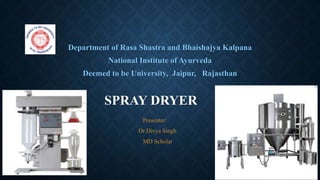
SPRAY DRYER
Presenter:
Dr Divya Singh
MD Scholar
• Introduction
• Spray drying is a well-known method of particle production which consists on the transformation
of a fluid material into dried particles, taking advantage of a gaseous hot drying medium .
• Its first observation is dated 1860 and a primitive spray dryer device was patented by Samuel
Percy in United States in 1872.
• Ever since it was first discovered, the spray-drying technique has been improved concerning its
operational design and applications. In fact, the primordial spray dryer devices lacked process
efficiency and safety.
• After overcoming these issues, spray drying became an atractive method for food industry
purposes, ending up to be used in milk powder production in the 1920s, remaining one of the most
important applications until the current days. Spray-drying evolution was directly influenced by
World War II, where there was an imperative need to reduce the weight and volume of food and
other materials to be carried .
• As a result, spray drying has become an industry benchmark, namely in the dairy products’
fabrication. In the post-war period, the spray-drying method continued progressing, reaching the
pharmaceutical, chemical, ceramic and polymer industries .
• It is a method of producing a dry powder from a liquid or slurry by rapidly drying with a hot gas.
Principle
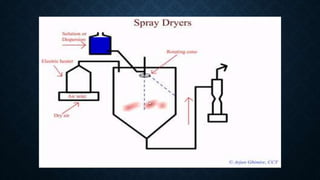
• In spray dryer the liquid is sprayed in small droplets by atomizer in a drying chamber.
• Droplets are sprayed in to stream of hot air.
• So that each droplet dries to a solid particle.
• The feed may either be solution ,suspension or paste .
Construction
It consist –
 Drying chamber
 Atomizer
 Cyclone separator
Drying chamber
• It consist large cylindrical body with conical bottom.
• It is made up of stainless steel .
• Diameter of chamber is 2.5 to 9.0 meters.
• Height of chamber is 25 meter or more .
• Tangential air inlet is placed on the roof of chamber .
• Feed inlet on the roof of chamber .
Atomizer
• Feed inlet carrying atomizer is placed on roof .
• Feed is atomized in to small droplet .
the type of atomizer is important because it determines: the energy required to form the spray, size and
distribution of the droplets, available heat transfer area, drying rate, droplet speed and trajectory, and final
product size
types:
a.Rotary atomizer (atomization by centrifugal energy)
b.Pressure nozzle (atomization by pressure energy)
c.Two-fluid nozzle (atomization by kinetic energy)
Cyclone separator
• Bottom of dryer is connected to cyclone separator.
• Bag filter
• Filtration based on bags is extensively used in the spray-drying process. Herein,
the air streamline containing the dry particles enters the bag filter under pressure
or suction by its hopper and is passed through a fabric, which halts the particles
path .This means that the dry particles are retained on the bag surface while the
clean air passes through it, being expelled from the device. The accumulated
particles on the bag surface are then collected due to pulses of compressed air
injected in counter-current low inside the bags . Bag filters present high operation
efficiency, especially when they are arranged in filtering units with decreasing
fabric pores diameter .
• Electrostatic precipitator
• Electrostatic precipitation is a method of particle collection whose principle is based on
electrostatic forces. A high voltage is applied to discharged wires, forming an electric
field between them and the collecting plates that constitute the precipitator .As a result,
the gas around these wires is ionized, being capable of charging the particle content of the
drying air lowing around this area. Due to Columbic forces, the charged particles
converge to the collecting plates and thus the air becomes devoid of dust.
• Electrostatic precipitators are also very efficient but seldom used taking into account the
high equipment costs .Wet scrubbers In a spray-drying process, it is usual to find some
particles escaping in the air stream after the dry collection. Owing to this, it is quite
common to install an additional collecting system after the dry collectors, the wet
scrubbers. These devices are economical and efective alternatives which perform a inal
gas cleaning step, being thus capable of minimizing the particle content or even some
odor intensity before releasing the gas streamline to the atmosphere
• Venturi wet scrubbers
• are well studied devices of easy cleaning or maintenance, being therefore one of
the most used equipment in the spray-drying process. They present a converging
section, a throat (narrowest part) and a divergent section (difuser). The inlet air
carrying ine particles enters the scrubber and is mixed up with the scrubbing liquid
(usually water). This mixture lows throughout the converging section, reaching the
throat at high velocity. As a result, a spray of droplets is formed with the dust
particles entrapped inside them (scrubbing liquid could also be injected at the
throat level). Lastly, the luid content is separated from the clean gas, being the
former discharged and the later released into the atmosphere
• Working process
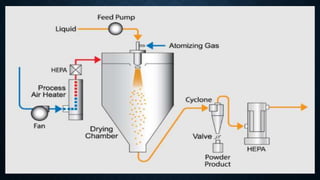
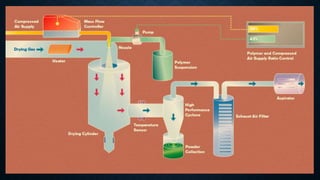
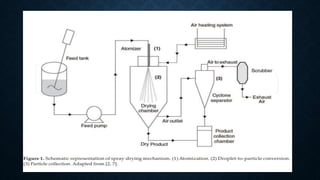
• The spray drying process involves four basic stages;
• 1.Atomization of feed in to spray ( formation of fine droplets )
• 2. spray air contact
• 3. drying of droplet
• 4. particle collection (Dry product separation from the exit air.)
• [ the air passes through HEPA ( high efficiency particulate air ) Filter]
• 1.Atomization of feed in to spray ( formation of fine droplets )
• Feed pass through feed inlet.
• Feed pass through atomizer and convert in to small droplet .
• Feed is atomized in to small droplet its specific surface area increases many folds .
• So drying takes place at a very fast rate.
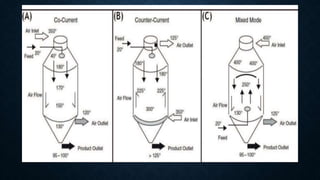
• 2. spray air contact
• Spray the hot air in to chamber through air inlet.
• Hot air can flow in to three ways ;
1. Co-current Low,
2. Counter-current Low
3. Mixed Low
• 3. drying of droplet
• Heat is transferred to droplets by convection from air
• The moisture from the interior migrates to the surface and evaporation takes place from the
surface.
• The air temperature is so high that migration of moisture from the interior of the droplet cannot
provide the moisture necessary to keep the surface wet.
• So the surface becomes dried quickly and the moisture in the interior produces vapor that expands
the droplet .
• The final product depends on the nature of the surface layer.
• 4. separation and recovery of dried products
• Majority of dried product falls to the base of the chamber where primary separation takes place.
• The particles entrained in the air recovered by any one of the separation equipment like
• Cyclone separator
• Bag filters
• Electrostatic precipators or wet scrubbers
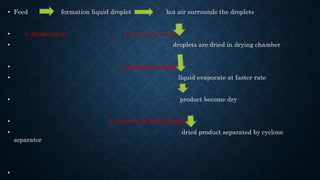
• Feed formation liquid droplet hot air surrounds the droplets
• 1. Atomization 2. spray air contact
• droplets are dried in drying chamber
• 3. drying the droplets
• liquid evaporate at faster rate
• product become dry
• 4. recovery of dried product
• dried product separated by cyclone
separator
•
• Parameters to be controlled
• The pharmaceutical spray-dried products have important properties like-
• -Uniform Particle size,
• -Nearly spherical regular particle shape,
• -Excellent Flowability,
• -Improved Compressibility
• -Low Bulk Density,
• -Better Solubility,
• -Reduced Moisture Content,
• -Increased Thermal stability, and suitability for further applications.
• Advantages
• It is continuous process.
• Drying time is less (10 -30 ) sec.so suitable for thermolabile materials .
• Drying rate is high.
• Fine droplet provides large surface area for heat & mass transfer .
• Products have uniform and controlled size .
• It’s an ongoing process, hence less labor intensive.
• Sterilized products can be dried with it
• It is very easy to dry solutions or suspensions.
• The product produced is highly concentrated and has excellent solubility.
• Disadvantage
• Expansive instruments
• Materials can coat the wall of drying chamber.
• Low thermals efficiency ( most of heat loss in environment).
• Complete recovery of materials is difficult .
• Applications
• Degree of application decides the importance of process. Spray drying technology
is widely applied in pharmaceutical fields as well as non-pharmaceutical fields.
• Non-pharmaceutical applications
• Chemical industry, Ceramic materials, Detergents, soaps and surface-active
agents, Pesticides, herbicides, fungicides and insecticides, Dyestuffs, pigments,
fertilizers, mineral floatation concentrates, inorganic chemicals, organic chemicals,
spray concentration (purification), milk products, egg products, food and plant
products, fruits, vegetables, carbohydrates and similar products, slaughterhouse
products, fish products and many others.
• Pharmaceutical applications
• Many pharmaceutical and biochemical products are spray dried, including
antibiotics, enzymes, vitamins, yeasts, vaccines, and plasma. The spray drying
capacity required for these products ranges from high, in the case of yeasts to low,
as in the case of plasma. Spray drying of most pharmaceutical and biochemical
products is done using two-fluid or pressure nozzle atomizers. Spray drying
systems used for pharmaceutical/biochemical applications include: Open-cycle,
aseptic open-cycle and closed-cycle.
• Pharmaceutical products
• Algae, antibiotics and moulds, bacitracin, penicillin, streptomycin, sulphathiazole,
tetracycline, dextran, enzymes, hormones, lysine (amino acids), pharmaceutical
gums, sera, spores, tableting constituents, vaccines, vitamins, yeast products,
tannin products, etc
• Granulation and tabletting
• Aerosol formulation
• Micro particles
• Coating applications
• Dry emulsions and dry elixirs
• It is certainly very useful for the development of drug delivery systems
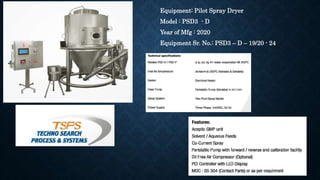
Equipment: Pilot Spray Dryer
Model : PSD3 - D
Year of Mfg : 2020
Equipment Sr. No.: PSD3 – D – 19/20 - 24
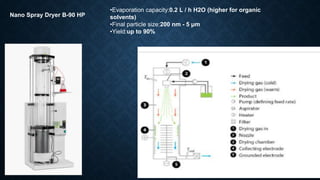
•Evaporation capacity:0.2 L / h H2O (higher for organic
solvents)
•Final particle size:200 nm - 5 μm
•Yield:up to 90%
Nano Spray Dryer B-90 HP
• Types of spray dryer systems
(A) On the basis of the type of flow
1. Co-current Low,
2. Counter-current Low
3. Mixed Low
(B) On the basis of the type of cycle
1. Open cycle dryer
2. Closed cycle dryer
3. Semi-closed cycle dryer
(C) On the basis of the type of stage
1. Single stage dryer
2. Two stage dryer
(D) On the basis of the position
1. Vertical dryer
2. Horizontal dryer
Thank you

spray dryer.pptx

  • 1.
    Department of RasaShastra and Bhaishajya Kalpana National Institute of Ayurveda Deemed to be University, Jaipur, Rajasthan SPRAY DRYER Presenter: Dr Divya Singh MD Scholar
  • 2.
    • Introduction • Spraydrying is a well-known method of particle production which consists on the transformation of a fluid material into dried particles, taking advantage of a gaseous hot drying medium . • Its first observation is dated 1860 and a primitive spray dryer device was patented by Samuel Percy in United States in 1872. • Ever since it was first discovered, the spray-drying technique has been improved concerning its operational design and applications. In fact, the primordial spray dryer devices lacked process efficiency and safety. • After overcoming these issues, spray drying became an atractive method for food industry purposes, ending up to be used in milk powder production in the 1920s, remaining one of the most important applications until the current days. Spray-drying evolution was directly influenced by World War II, where there was an imperative need to reduce the weight and volume of food and other materials to be carried . • As a result, spray drying has become an industry benchmark, namely in the dairy products’ fabrication. In the post-war period, the spray-drying method continued progressing, reaching the pharmaceutical, chemical, ceramic and polymer industries .
  • 5.
    • It isa method of producing a dry powder from a liquid or slurry by rapidly drying with a hot gas. Principle • In spray dryer the liquid is sprayed in small droplets by atomizer in a drying chamber. • Droplets are sprayed in to stream of hot air. • So that each droplet dries to a solid particle. • The feed may either be solution ,suspension or paste . Construction It consist –  Drying chamber  Atomizer  Cyclone separator
  • 7.
    Drying chamber • Itconsist large cylindrical body with conical bottom. • It is made up of stainless steel . • Diameter of chamber is 2.5 to 9.0 meters. • Height of chamber is 25 meter or more . • Tangential air inlet is placed on the roof of chamber . • Feed inlet on the roof of chamber . Atomizer • Feed inlet carrying atomizer is placed on roof . • Feed is atomized in to small droplet .
  • 8.
    the type ofatomizer is important because it determines: the energy required to form the spray, size and distribution of the droplets, available heat transfer area, drying rate, droplet speed and trajectory, and final product size types: a.Rotary atomizer (atomization by centrifugal energy) b.Pressure nozzle (atomization by pressure energy) c.Two-fluid nozzle (atomization by kinetic energy) Cyclone separator • Bottom of dryer is connected to cyclone separator.
  • 9.
    • Bag filter •Filtration based on bags is extensively used in the spray-drying process. Herein, the air streamline containing the dry particles enters the bag filter under pressure or suction by its hopper and is passed through a fabric, which halts the particles path .This means that the dry particles are retained on the bag surface while the clean air passes through it, being expelled from the device. The accumulated particles on the bag surface are then collected due to pulses of compressed air injected in counter-current low inside the bags . Bag filters present high operation efficiency, especially when they are arranged in filtering units with decreasing fabric pores diameter .
  • 10.
    • Electrostatic precipitator •Electrostatic precipitation is a method of particle collection whose principle is based on electrostatic forces. A high voltage is applied to discharged wires, forming an electric field between them and the collecting plates that constitute the precipitator .As a result, the gas around these wires is ionized, being capable of charging the particle content of the drying air lowing around this area. Due to Columbic forces, the charged particles converge to the collecting plates and thus the air becomes devoid of dust. • Electrostatic precipitators are also very efficient but seldom used taking into account the high equipment costs .Wet scrubbers In a spray-drying process, it is usual to find some particles escaping in the air stream after the dry collection. Owing to this, it is quite common to install an additional collecting system after the dry collectors, the wet scrubbers. These devices are economical and efective alternatives which perform a inal gas cleaning step, being thus capable of minimizing the particle content or even some odor intensity before releasing the gas streamline to the atmosphere
  • 11.
    • Venturi wetscrubbers • are well studied devices of easy cleaning or maintenance, being therefore one of the most used equipment in the spray-drying process. They present a converging section, a throat (narrowest part) and a divergent section (difuser). The inlet air carrying ine particles enters the scrubber and is mixed up with the scrubbing liquid (usually water). This mixture lows throughout the converging section, reaching the throat at high velocity. As a result, a spray of droplets is formed with the dust particles entrapped inside them (scrubbing liquid could also be injected at the throat level). Lastly, the luid content is separated from the clean gas, being the former discharged and the later released into the atmosphere
  • 12.
    • Working process •The spray drying process involves four basic stages; • 1.Atomization of feed in to spray ( formation of fine droplets ) • 2. spray air contact • 3. drying of droplet • 4. particle collection (Dry product separation from the exit air.) • [ the air passes through HEPA ( high efficiency particulate air ) Filter]
  • 13.
    • 1.Atomization offeed in to spray ( formation of fine droplets ) • Feed pass through feed inlet. • Feed pass through atomizer and convert in to small droplet . • Feed is atomized in to small droplet its specific surface area increases many folds . • So drying takes place at a very fast rate. • 2. spray air contact • Spray the hot air in to chamber through air inlet. • Hot air can flow in to three ways ; 1. Co-current Low, 2. Counter-current Low 3. Mixed Low
  • 15.
    • 3. dryingof droplet • Heat is transferred to droplets by convection from air • The moisture from the interior migrates to the surface and evaporation takes place from the surface. • The air temperature is so high that migration of moisture from the interior of the droplet cannot provide the moisture necessary to keep the surface wet. • So the surface becomes dried quickly and the moisture in the interior produces vapor that expands the droplet . • The final product depends on the nature of the surface layer. • 4. separation and recovery of dried products • Majority of dried product falls to the base of the chamber where primary separation takes place. • The particles entrained in the air recovered by any one of the separation equipment like • Cyclone separator • Bag filters • Electrostatic precipators or wet scrubbers
  • 16.
    • Feed formationliquid droplet hot air surrounds the droplets • 1. Atomization 2. spray air contact • droplets are dried in drying chamber • 3. drying the droplets • liquid evaporate at faster rate • product become dry • 4. recovery of dried product • dried product separated by cyclone separator •
  • 17.
    • Parameters tobe controlled • The pharmaceutical spray-dried products have important properties like- • -Uniform Particle size, • -Nearly spherical regular particle shape, • -Excellent Flowability, • -Improved Compressibility • -Low Bulk Density, • -Better Solubility, • -Reduced Moisture Content, • -Increased Thermal stability, and suitability for further applications.
  • 18.
    • Advantages • Itis continuous process. • Drying time is less (10 -30 ) sec.so suitable for thermolabile materials . • Drying rate is high. • Fine droplet provides large surface area for heat & mass transfer . • Products have uniform and controlled size . • It’s an ongoing process, hence less labor intensive. • Sterilized products can be dried with it • It is very easy to dry solutions or suspensions. • The product produced is highly concentrated and has excellent solubility.
  • 19.
    • Disadvantage • Expansiveinstruments • Materials can coat the wall of drying chamber. • Low thermals efficiency ( most of heat loss in environment). • Complete recovery of materials is difficult .
  • 20.
    • Applications • Degreeof application decides the importance of process. Spray drying technology is widely applied in pharmaceutical fields as well as non-pharmaceutical fields. • Non-pharmaceutical applications • Chemical industry, Ceramic materials, Detergents, soaps and surface-active agents, Pesticides, herbicides, fungicides and insecticides, Dyestuffs, pigments, fertilizers, mineral floatation concentrates, inorganic chemicals, organic chemicals, spray concentration (purification), milk products, egg products, food and plant products, fruits, vegetables, carbohydrates and similar products, slaughterhouse products, fish products and many others.
  • 21.
    • Pharmaceutical applications •Many pharmaceutical and biochemical products are spray dried, including antibiotics, enzymes, vitamins, yeasts, vaccines, and plasma. The spray drying capacity required for these products ranges from high, in the case of yeasts to low, as in the case of plasma. Spray drying of most pharmaceutical and biochemical products is done using two-fluid or pressure nozzle atomizers. Spray drying systems used for pharmaceutical/biochemical applications include: Open-cycle, aseptic open-cycle and closed-cycle. • Pharmaceutical products • Algae, antibiotics and moulds, bacitracin, penicillin, streptomycin, sulphathiazole, tetracycline, dextran, enzymes, hormones, lysine (amino acids), pharmaceutical gums, sera, spores, tableting constituents, vaccines, vitamins, yeast products, tannin products, etc
  • 22.
    • Granulation andtabletting • Aerosol formulation • Micro particles • Coating applications • Dry emulsions and dry elixirs • It is certainly very useful for the development of drug delivery systems
  • 23.
    Equipment: Pilot SprayDryer Model : PSD3 - D Year of Mfg : 2020 Equipment Sr. No.: PSD3 – D – 19/20 - 24
  • 24.
    •Evaporation capacity:0.2 L/ h H2O (higher for organic solvents) •Final particle size:200 nm - 5 μm •Yield:up to 90% Nano Spray Dryer B-90 HP
  • 26.
    • Types ofspray dryer systems (A) On the basis of the type of flow 1. Co-current Low, 2. Counter-current Low 3. Mixed Low (B) On the basis of the type of cycle 1. Open cycle dryer 2. Closed cycle dryer 3. Semi-closed cycle dryer (C) On the basis of the type of stage 1. Single stage dryer 2. Two stage dryer (D) On the basis of the position 1. Vertical dryer 2. Horizontal dryer
  • 28.