Distillation
Britto Samuel M
II Msc Biotechnology,
Department of Biotechnology
AVS College of Arts and Science ,
Salem.
Distillation
• Distillation is a process of separating the component from
a liquid mixture by evaporation and condensation.
• Distillation gives the expected component which we
expecting.
• Distillation of fermented products produces distilled
beverages with a high alcohol content, or separates out
other fermentation products for commercial value
• In short: “Distillation is the process of heating a liquid to
form its vapours and then condensing the vapour to form
the liquid
History
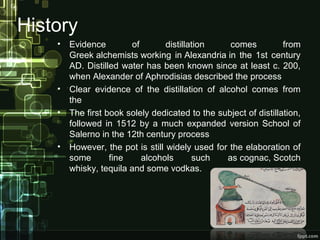
• Evidence of distillation comes from
Greek alchemists working in Alexandria in the 1st century
AD. Distilled water has been known since at least c. 200,
when Alexander of Aphrodisias described the process
• Clear evidence of the distillation of alcohol comes from
the
• The first book solely dedicated to the subject of distillation,
followed in 1512 by a much expanded version School of
Salerno in the 12th century process
• However, the pot is still widely used for the elaboration of
some fine alcohols such as cognac, Scotch
whisky, tequila and some vodkas.
Applications
• Distillation used mostly in 4 different areas:
* Laboratory scale
* Industrial distillation
* Distillation of herbs for perfumery and medicinal
* Food processing
Process of Distillation
• Heat observed by the water will get evaporation.
• When the evaporated gas forced to cool using
water reflux,
• the evaporated gas converted t liquid form and it
can be collected
• The End product will be pure and expected
component.
Few Types of Distillation
• 1.Batch distillation
• 2.Continuous distillation
• 3.Fractional distillation
• 4.Vacuum distillation
• 5.Zone distillation
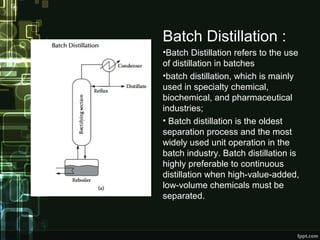
Batch Distillation :
•Batch Distillation refers to the use
of distillation in batches
•batch distillation, which is mainly
used in specialty chemical,
biochemical, and pharmaceutical
industries;
• Batch distillation is the oldest
separation process and the most
widely used unit operation in the
batch industry. Batch distillation is
highly preferable to continuous
distillation when high-value-added,
low-volume chemicals must be
separated.
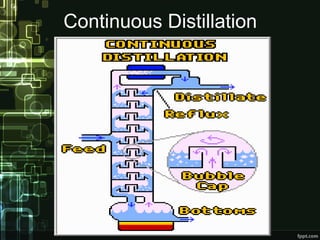
continuous distillation.
• continuous distillation, which is
primarily implemented in the
petrochemical and bulk chemical
industries
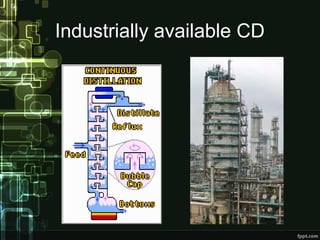
• In continuous distillation the feed is
constantly supplied to the column,
and the top and bottom products are
simultaneously obtained under a
steady-state operation. The upper
section of the feed point is referred
to as the rectifying section, as a low-
boiling temperature component is
enriched.
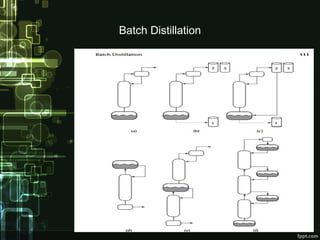
Batch Distillation
Continuous Distillation
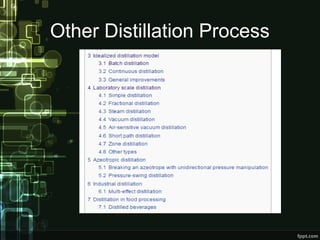
Other Distillation Process
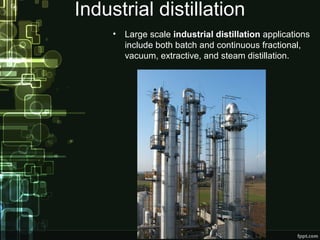
Industrial distillation
• Large scale industrial distillation applications
include both batch and continuous fractional,
vacuum, extractive, and steam distillation.
Industrially available CD
Distillation in food processing
• plant materials are allowed to ferment, producing a
dilute solution of ethanol in the process.
• Spirits such as whiskey and rum are prepared by
distilling these dilute solutions of ethanol.
• Components other than ethanol, including water,
esters, and other alcohols, are collected in the
condensate, which account for the flavor of the
beverage
Reference
• https://en.wikipedia.org/wiki/Distillation
• https://www.google.co.in/url?
sa=i&rct=j&q=&esrc=s&source=images&cd=&ved=0ahU
KEwjGk8HxgIzOAhUI8mMKHcN0D8wQjxwIAw&url=http
%3A%2F%2Felseware.univ-pau.fr%2FMAINPAGEPUB
%2Fdistill
%2Findex.html&psig=AFQjCNEEQHbTIiS0lEi5Vv3--
xdL90BVFg&ust=1469446483189214
• https://www.youtube.com/watch?v=xxNfJLMNS4E
Questions ?
Thank You

Distillation in short

  • 1.
    Distillation Britto Samuel M IIMsc Biotechnology, Department of Biotechnology AVS College of Arts and Science , Salem.
  • 2.
    Distillation • Distillation isa process of separating the component from a liquid mixture by evaporation and condensation. • Distillation gives the expected component which we expecting. • Distillation of fermented products produces distilled beverages with a high alcohol content, or separates out other fermentation products for commercial value • In short: “Distillation is the process of heating a liquid to form its vapours and then condensing the vapour to form the liquid
  • 3.
    History • Evidence ofdistillation comes from Greek alchemists working in Alexandria in the 1st century AD. Distilled water has been known since at least c. 200, when Alexander of Aphrodisias described the process • Clear evidence of the distillation of alcohol comes from the • The first book solely dedicated to the subject of distillation, followed in 1512 by a much expanded version School of Salerno in the 12th century process • However, the pot is still widely used for the elaboration of some fine alcohols such as cognac, Scotch whisky, tequila and some vodkas.
  • 4.
    Applications • Distillation usedmostly in 4 different areas: * Laboratory scale * Industrial distillation * Distillation of herbs for perfumery and medicinal * Food processing
  • 5.
  • 6.
    Process of Distillation •Heat observed by the water will get evaporation. • When the evaporated gas forced to cool using water reflux, • the evaporated gas converted t liquid form and it can be collected • The End product will be pure and expected component.
  • 7.
    Few Types ofDistillation • 1.Batch distillation • 2.Continuous distillation • 3.Fractional distillation • 4.Vacuum distillation • 5.Zone distillation
  • 8.
    Batch Distillation : •BatchDistillation refers to the use of distillation in batches •batch distillation, which is mainly used in specialty chemical, biochemical, and pharmaceutical industries; • Batch distillation is the oldest separation process and the most widely used unit operation in the batch industry. Batch distillation is highly preferable to continuous distillation when high-value-added, low-volume chemicals must be separated.
  • 9.
    continuous distillation. • continuousdistillation, which is primarily implemented in the petrochemical and bulk chemical industries • In continuous distillation the feed is constantly supplied to the column, and the top and bottom products are simultaneously obtained under a steady-state operation. The upper section of the feed point is referred to as the rectifying section, as a low- boiling temperature component is enriched.
  • 10.
  • 11.
  • 12.
  • 13.
    Industrial distillation • Largescale industrial distillation applications include both batch and continuous fractional, vacuum, extractive, and steam distillation.
  • 14.
  • 15.
    Distillation in foodprocessing • plant materials are allowed to ferment, producing a dilute solution of ethanol in the process. • Spirits such as whiskey and rum are prepared by distilling these dilute solutions of ethanol. • Components other than ethanol, including water, esters, and other alcohols, are collected in the condensate, which account for the flavor of the beverage
  • 16.
  • 17.
  • 18.