M.Venkatasami
M.Tech (Processing and Food Engineering)
Department of food process engineering
AEC&RI, TNAU
INTRODUCTION
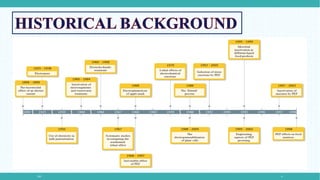
HISTORICAL BACKGROUND
MECHANISMS OF ACTION
PEF TREATMENT SYSTEMS
TREATMENT CHAMBER DESIGN
PROCESSING PARAMETERS
APPLICATIONS
PEF 2
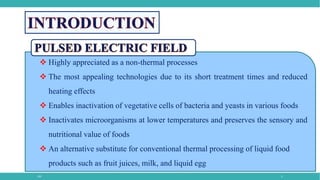
 Highly appreciated as a non-thermal processes
 The most appealing technologies due to its short treatment times and reduced
heating effects
 Enables inactivation of vegetative cells of bacteria and yeasts in various foods
 Inactivates microorganisms at lower temperatures and preserves the sensory and
nutritional value of foods
 An alternative substitute for conventional thermal processing of liquid food
products such as fruit juices, milk, and liquid egg
PEF 3
PEF 4
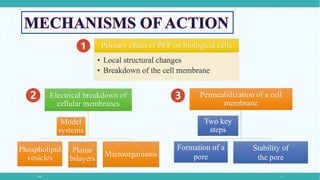
Electrical breakdown of
cellular membranes
Phospholipid
vesicles
Planar
bilayers
Microorganisms
Model
systems
Permeabilization of a cell
membrane
Formation of a
pore
Stability of
the pore
Two key
steps
Primary effect of PEF on biological cells
• Local structural changes
• Breakdown of the cell membrane
PEF 5
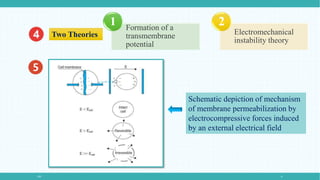
Two Theories
Formation of a
transmembrane
potential
1
Electromechanical
instability theory
2
Schematic depiction of mechanism
of membrane permeabilization by
electrocompressive forces induced
by an external electrical field
PEF 6
PEF 7
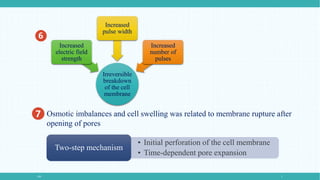
Irreversible
breakdown
of the cell
membrane
Increased
electric field
strength
Increased
pulse width
Increased
number of
pulses
Osmotic imbalances and cell swelling was related to membrane rupture after
opening of pores
• Initial perforation of the cell membrane
• Time-dependent pore expansion
Two-step mechanism
PEF 8
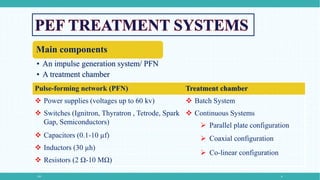
Main components
• An impulse generation system/ PFN
• A treatment chamber
Pulse-forming network (PFN) Treatment chamber
 Power supplies (voltages up to 60 kv)  Batch System
 Switches (Ignitron, Thyratron , Tetrode, Spark
Gap, Semiconductors)
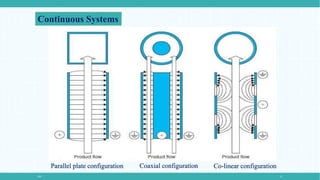
 Continuous Systems
 Capacitors (0.1-10 µf)
 Inductors (30 µh)
 Resistors (2 Ω-10 MΩ)
 Parallel plate configuration
 Coaxial configuration
 Co-linear configuration
PEF 9
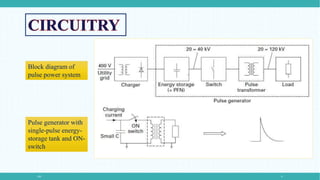
Block diagram of
pulse power system
Pulse generator with
single-pulse energy-
storage tank and ON-
switch
PEF 10
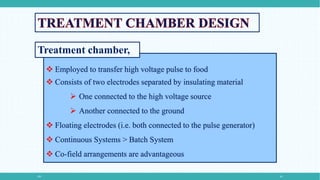
 Employed to transfer high voltage pulse to food
 Consists of two electrodes separated by insulating material
 One connected to the high voltage source
 Another connected to the ground
 Floating electrodes (i.e. both connected to the pulse generator)
 Continuous Systems > Batch System
 Co-field arrangements are advantageous
Treatment chamber,
PEF 11
Continuous Systems
Co-linear configurationParallel plate configuration Coaxial configuration
PEF 12
 Electric field strength
 Treatment time, specific energy and pulse geometry
 Treatment temperature
 Treatment medium factors
 Conductivity
 Effect of air bubbles and particles
 Cell characteristics
Main processing parameters
PEF 13
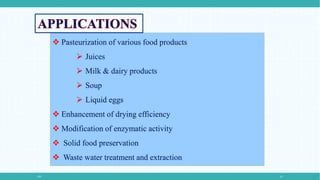
 Pasteurization of various food products
 Juices
 Milk & dairy products
 Soup
 Liquid eggs
 Enhancement of drying efficiency
 Modification of enzymatic activity
 Solid food preservation
 Waste water treatment and extraction
PEF 14
•Sun, D-W. 2014. Emerging technologies for food processing: Elsevier.1
• Raso-Pueyo, J, and V Heinz. 2010. Pulsed electric fields technology for the
food industry: fundamentals and applications: Springer Science & Business
Media.
2
• Lelieveld, HL, S Notermans, and S De Haan. 2007. Food preservation by
pulsed electric fields: from research to application: Elsevier.3

Pulsed electric field processing

  • 1.
    M.Venkatasami M.Tech (Processing andFood Engineering) Department of food process engineering AEC&RI, TNAU
  • 2.
    INTRODUCTION HISTORICAL BACKGROUND MECHANISMS OFACTION PEF TREATMENT SYSTEMS TREATMENT CHAMBER DESIGN PROCESSING PARAMETERS APPLICATIONS PEF 2
  • 3.
     Highly appreciatedas a non-thermal processes  The most appealing technologies due to its short treatment times and reduced heating effects  Enables inactivation of vegetative cells of bacteria and yeasts in various foods  Inactivates microorganisms at lower temperatures and preserves the sensory and nutritional value of foods  An alternative substitute for conventional thermal processing of liquid food products such as fruit juices, milk, and liquid egg PEF 3
  • 4.
  • 5.
    Electrical breakdown of cellularmembranes Phospholipid vesicles Planar bilayers Microorganisms Model systems Permeabilization of a cell membrane Formation of a pore Stability of the pore Two key steps Primary effect of PEF on biological cells • Local structural changes • Breakdown of the cell membrane PEF 5
  • 6.
    Two Theories Formation ofa transmembrane potential 1 Electromechanical instability theory 2 Schematic depiction of mechanism of membrane permeabilization by electrocompressive forces induced by an external electrical field PEF 6
  • 7.
    PEF 7 Irreversible breakdown of thecell membrane Increased electric field strength Increased pulse width Increased number of pulses Osmotic imbalances and cell swelling was related to membrane rupture after opening of pores • Initial perforation of the cell membrane • Time-dependent pore expansion Two-step mechanism
  • 8.
    PEF 8 Main components •An impulse generation system/ PFN • A treatment chamber Pulse-forming network (PFN) Treatment chamber  Power supplies (voltages up to 60 kv)  Batch System  Switches (Ignitron, Thyratron , Tetrode, Spark Gap, Semiconductors)  Continuous Systems  Capacitors (0.1-10 µf)  Inductors (30 µh)  Resistors (2 Ω-10 MΩ)  Parallel plate configuration  Coaxial configuration  Co-linear configuration
  • 9.
    PEF 9 Block diagramof pulse power system Pulse generator with single-pulse energy- storage tank and ON- switch
  • 10.
    PEF 10  Employedto transfer high voltage pulse to food  Consists of two electrodes separated by insulating material  One connected to the high voltage source  Another connected to the ground  Floating electrodes (i.e. both connected to the pulse generator)  Continuous Systems > Batch System  Co-field arrangements are advantageous Treatment chamber,
  • 11.
    PEF 11 Continuous Systems Co-linearconfigurationParallel plate configuration Coaxial configuration
  • 12.
    PEF 12  Electricfield strength  Treatment time, specific energy and pulse geometry  Treatment temperature  Treatment medium factors  Conductivity  Effect of air bubbles and particles  Cell characteristics Main processing parameters
  • 13.
    PEF 13  Pasteurizationof various food products  Juices  Milk & dairy products  Soup  Liquid eggs  Enhancement of drying efficiency  Modification of enzymatic activity  Solid food preservation  Waste water treatment and extraction
  • 14.
    PEF 14 •Sun, D-W.2014. Emerging technologies for food processing: Elsevier.1 • Raso-Pueyo, J, and V Heinz. 2010. Pulsed electric fields technology for the food industry: fundamentals and applications: Springer Science & Business Media. 2 • Lelieveld, HL, S Notermans, and S De Haan. 2007. Food preservation by pulsed electric fields: from research to application: Elsevier.3