OSCILLATING MAGNETIC FIELDS (OMF) 1
OSCILLATING MAGNETIC FIELDS
(OMF)
M.Venkatasami
M.Tech (Processing and Food Engineering)
Department of food process engineering
AEC&RI, TNAU
OSCILLATING MAGNETIC FIELDS (OMF) 2
CONTENTS
INTRODUCTION
• Magnetic fields
HIGH INTENSITY MAGNETIC FIELDS
• Generation
• Hybrid magnet
• Mechanism of action
• ICR and IPR Models
• Food preservation
DRAWBACKS
OSCILLATING MAGNETIC FIELDS (OMF) 3
INTRODUCTION
Oscillating magnetic fields,
 Potential to inactivate microorganisms
 Pasteurize food with an improvement in the quality and shelf life
 Alters the growth and reproduction of microorganisms
 Magnetic fields increase DNA synthesis
 Changes the orientation of biomolecules
 Changes the ionic drift across the plasma
 Alters the rate of cell reproduction
 Reduce the malignant cell population (Treatment of cancer)
OSCILLATING MAGNETIC FIELDS (OMF) 4
MAGNETIC FIELDS
The region in which a magnetic body is capable of magnetizing the particles
around is called the magnetic field.
 Diamagnetism
 Most organic and inorganic compounds
 Paramagnetism
 Free radicals and compounds of transition elements
Carbon atoms Two carbon atoms bonded by single,
double, or triple bonds
 Isotropic susceptibility  Anisotropic susceptibility
 Diamagnetic anisotropy
OSCILLATING MAGNETIC FIELDS (OMF) 5
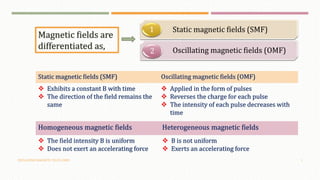
Magnetic fields are
differentiated as,
• Static magnetic fields (SMF)1
• Oscillating magnetic fields (OMF)2
Static magnetic fields (SMF) Oscillating magnetic fields (OMF)
 Exhibits a constant B with time
 The direction of the field remains the
same
 Applied in the form of pulses
 Reverses the charge for each pulse
 The intensity of each pulse decreases with
time
Homogeneous magnetic fields Heterogeneous magnetic fields
 The field intensity B is uniform
 Does not exert an accelerating force
 B is not uniform
 Exerts an accelerating force
OSCILLATING MAGNETIC FIELDS (OMF) 6
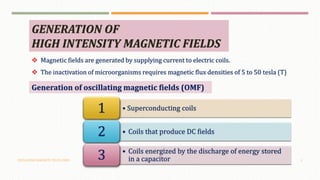
GENERATION OF
HIGH INTENSITY MAGNETIC FIELDS
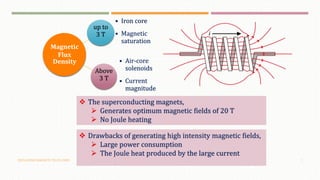
 Magnetic fields are generated by supplying current to electric coils.
 The inactivation of microorganisms requires magnetic flux densities of 5 to 50 tesla (T)
• Superconducting coils1
• Coils that produce DC fields2
• Coils energized by the discharge of energy stored
in a capacitor3
Generation of oscillating magnetic fields (OMF)
OSCILLATING MAGNETIC FIELDS (OMF) 7
up to
3 T
• Iron core
• Magnetic
saturation
Above
3 T
• Air-core
solenoids
• Current
magnitude
Magnetic
Flux
Density
 Drawbacks of generating high intensity magnetic fields,
 Large power consumption
 The Joule heat produced by the large current
 The superconducting magnets,
 Generates optimum magnetic fields of 20 T
 No Joule heating
OSCILLATING MAGNETIC FIELDS (OMF) 8
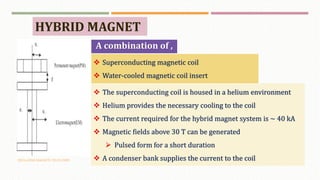
HYBRID MAGNET
 The superconducting coil is housed in a helium environment
 Helium provides the necessary cooling to the coil
 The current required for the hybrid magnet system is ~ 40 kA
 Magnetic fields above 30 T can be generated
 Pulsed form for a short duration
 A condenser bank supplies the current to the coil
A combination of ,
 Superconducting magnetic coil
 Water-cooled magnetic coil insert
OSCILLATING MAGNETIC FIELDS (OMF) 9
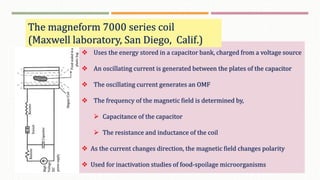
 Uses the energy stored in a capacitor bank, charged from a voltage source
 An oscillating current is generated between the plates of the capacitor
 The oscillating current generates an OMF
 The frequency of the magnetic field is determined by,
 Capacitance of the capacitor
 The resistance and inductance of the coil
 As the current changes direction, the magnetic field changes polarity
 Used for inactivation studies of food-spoilage microorganisms
The magneform 7000 series coil
(Maxwell laboratory, San Diego, Calif.)
OSCILLATING MAGNETIC FIELDS (OMF) 10
Mechanisms of Magnetic Field Inactivation of Microorganisms
ICR MODELS IPR
1. The ion cyclotron resonance (ICR) model
2. The ion parametric resonance (IPR) model
OSCILLATING MAGNETIC FIELDS (OMF) 11
The ion cyclotron resonance (ICR) model
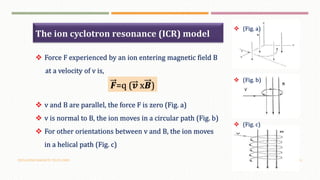
 Force F experienced by an ion entering magnetic field B
at a velocity of v is,
𝑭=q (𝒗 x𝑩)
 v and B are parallel, the force F is zero (Fig. a)
 v is normal to B, the ion moves in a circular path (Fig. b)
 For other orientations between v and B, the ion moves
in a helical path (Fig. c)
 (Fig. a)
 (Fig. b)
 (Fig. c)
OSCILLATING MAGNETIC FIELDS (OMF) 12
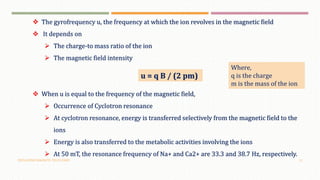
 The gyrofrequency u, the frequency at which the ion revolves in the magnetic field
 It depends on
 The charge-to mass ratio of the ion
 The magnetic field intensity
 When u is equal to the frequency of the magnetic field,
 Occurrence of Cyclotron resonance
 At cyclotron resonance, energy is transferred selectively from the magnetic field to the
ions
 Energy is also transferred to the metabolic activities involving the ions
 At 50 mT, the resonance frequency of Na+ and Ca2+ are 33.3 and 38.7 Hz, respectively.
u = q B / (2 pm)
Where,
q is the charge
m is the mass of the ion
OSCILLATING MAGNETIC FIELDS (OMF) 13
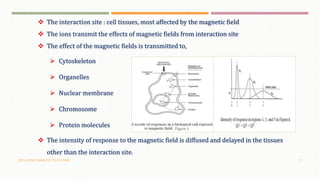
 The interaction site : cell tissues, most affected by the magnetic field
 The ions transmit the effects of magnetic fields from interaction site
 The effect of the magnetic fields is transmitted to,
 Cytoskeleton
 Organelles
 Nuclear membrane
 Chromosome
 Protein molecules Figure 1
 The intensity of response to the magnetic field is diffused and delayed in the tissues
other than the interaction site.
OSCILLATING MAGNETIC FIELDS (OMF) 14
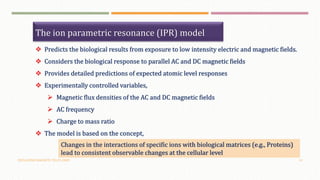
The ion parametric resonance (IPR) model
 Predicts the biological results from exposure to low intensity electric and magnetic fields.
 Considers the biological response to parallel AC and DC magnetic fields
 Provides detailed predictions of expected atomic level responses
 Experimentally controlled variables,
 Magnetic flux densities of the AC and DC magnetic fields
 AC frequency
 Charge to mass ratio
 The model is based on the concept,
Changes in the interactions of specific ions with biological matrices (e.g., Proteins)
lead to consistent observable changes at the cellular level
OSCILLATING MAGNETIC FIELDS (OMF) 15
MAGNETIC FIELDS IN FOOD PRESERVATION
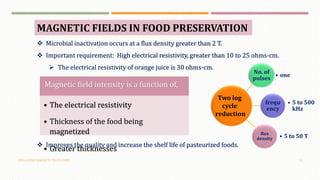
 Microbial inactivation occurs at a flux density greater than 2 T.
 Important requirement: High electrical resistivity, greater than 10 to 25 ohms-cm.
 The electrical resistivity of orange juice is 30 ohms-cm.
No. of
pulses
• one
frequ
ency
• 5 to 500
kHz
flux
density • 5 to 50 T
Two log
cycle
reduction
Magnetic field intensity is a function of,
• The electrical resistivity
• Thickness of the food being
magnetized
• Greater thicknesses
 Improves the quality and increase the shelf life of pasteurized foods.
OSCILLATING MAGNETIC FIELDS (OMF) 16
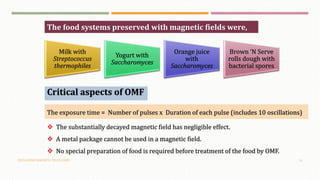
Milk with
Streptococcus
thermophiles
Yogurt with
Saccharomyces
Orange juice
with
Saccharomyces
Brown ‘N Serve
rolls dough with
bacterial spores
The food systems preserved with magnetic fields were,
Critical aspects of OMF
The exposure time = Number of pulses x Duration of each pulse (includes 10 oscillations)
 The substantially decayed magnetic field has negligible effect.
 A metal package cannot be used in a magnetic field.
 No special preparation of food is required before treatment of the food by OMF.
OSCILLATING MAGNETIC FIELDS (OMF) 17
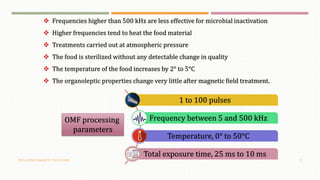
 Frequencies higher than 500 kHz are less effective for microbial inactivation
 Higher frequencies tend to heat the food material
 Treatments carried out at atmospheric pressure
 The food is sterilized without any detectable change in quality
 The temperature of the food increases by 2° to 5°C
 The organoleptic properties change very little after magnetic field treatment.
1 to 100 pulses
Frequency between 5 and 500 kHz
Temperature, 0° to 50°C
Total exposure time, 25 ms to 10 ms
OMF processing
parameters
OSCILLATING MAGNETIC FIELDS (OMF) 18
DRAWBACKS
 The high intensity magnetic field exists,
 Only within the coil
 Within a very short distance from the coil
 The intensity of the magnetic field drops drastically
 Most theoretical models are unable to establish a predictive association between low
intensity field exposure and biological results
 Many experimental reports fail to document relevant field exposure parameters and do not
establish a clear reproducible protocol.
 Inconsistencies between experimental results may be interpreted as evidence that electric
and magnetic fields may not be the causal factors of the biological responses
OSCILLATING MAGNETIC FIELDS (OMF) 19
 The effects of magnetic fields are not clearly understood
 Inhibitory effects
 Stimulatory effects
 No effects
 Several mechanisms are proposed to explain the inhibitory effects of magnetic fields
on microorganisms, there is little explanation for the stimulatory effects.
 The reported inactivation of the microbial population is limited to two log cycles.
 For commercialization of OMF technology, more effective and uniform inactivation of
microorganisms will be required.
OSCILLATING MAGNETIC FIELDS (OMF) 20
REFERENCE
• Barbosa Cánovas, GV, UR Pothakamury, E Palou, and B Swason.
1997. Nonthermal preservation of foods: Marcel Dekker Inc.
THANK YOU !

Oscillating magnetic field

  • 1.
    OSCILLATING MAGNETIC FIELDS(OMF) 1 OSCILLATING MAGNETIC FIELDS (OMF) M.Venkatasami M.Tech (Processing and Food Engineering) Department of food process engineering AEC&RI, TNAU
  • 2.
    OSCILLATING MAGNETIC FIELDS(OMF) 2 CONTENTS INTRODUCTION • Magnetic fields HIGH INTENSITY MAGNETIC FIELDS • Generation • Hybrid magnet • Mechanism of action • ICR and IPR Models • Food preservation DRAWBACKS
  • 3.
    OSCILLATING MAGNETIC FIELDS(OMF) 3 INTRODUCTION Oscillating magnetic fields,  Potential to inactivate microorganisms  Pasteurize food with an improvement in the quality and shelf life  Alters the growth and reproduction of microorganisms  Magnetic fields increase DNA synthesis  Changes the orientation of biomolecules  Changes the ionic drift across the plasma  Alters the rate of cell reproduction  Reduce the malignant cell population (Treatment of cancer)
  • 4.
    OSCILLATING MAGNETIC FIELDS(OMF) 4 MAGNETIC FIELDS The region in which a magnetic body is capable of magnetizing the particles around is called the magnetic field.  Diamagnetism  Most organic and inorganic compounds  Paramagnetism  Free radicals and compounds of transition elements Carbon atoms Two carbon atoms bonded by single, double, or triple bonds  Isotropic susceptibility  Anisotropic susceptibility  Diamagnetic anisotropy
  • 5.
    OSCILLATING MAGNETIC FIELDS(OMF) 5 Magnetic fields are differentiated as, • Static magnetic fields (SMF)1 • Oscillating magnetic fields (OMF)2 Static magnetic fields (SMF) Oscillating magnetic fields (OMF)  Exhibits a constant B with time  The direction of the field remains the same  Applied in the form of pulses  Reverses the charge for each pulse  The intensity of each pulse decreases with time Homogeneous magnetic fields Heterogeneous magnetic fields  The field intensity B is uniform  Does not exert an accelerating force  B is not uniform  Exerts an accelerating force
  • 6.
    OSCILLATING MAGNETIC FIELDS(OMF) 6 GENERATION OF HIGH INTENSITY MAGNETIC FIELDS  Magnetic fields are generated by supplying current to electric coils.  The inactivation of microorganisms requires magnetic flux densities of 5 to 50 tesla (T) • Superconducting coils1 • Coils that produce DC fields2 • Coils energized by the discharge of energy stored in a capacitor3 Generation of oscillating magnetic fields (OMF)
  • 7.
    OSCILLATING MAGNETIC FIELDS(OMF) 7 up to 3 T • Iron core • Magnetic saturation Above 3 T • Air-core solenoids • Current magnitude Magnetic Flux Density  Drawbacks of generating high intensity magnetic fields,  Large power consumption  The Joule heat produced by the large current  The superconducting magnets,  Generates optimum magnetic fields of 20 T  No Joule heating
  • 8.
    OSCILLATING MAGNETIC FIELDS(OMF) 8 HYBRID MAGNET  The superconducting coil is housed in a helium environment  Helium provides the necessary cooling to the coil  The current required for the hybrid magnet system is ~ 40 kA  Magnetic fields above 30 T can be generated  Pulsed form for a short duration  A condenser bank supplies the current to the coil A combination of ,  Superconducting magnetic coil  Water-cooled magnetic coil insert
  • 9.
    OSCILLATING MAGNETIC FIELDS(OMF) 9  Uses the energy stored in a capacitor bank, charged from a voltage source  An oscillating current is generated between the plates of the capacitor  The oscillating current generates an OMF  The frequency of the magnetic field is determined by,  Capacitance of the capacitor  The resistance and inductance of the coil  As the current changes direction, the magnetic field changes polarity  Used for inactivation studies of food-spoilage microorganisms The magneform 7000 series coil (Maxwell laboratory, San Diego, Calif.)
  • 10.
    OSCILLATING MAGNETIC FIELDS(OMF) 10 Mechanisms of Magnetic Field Inactivation of Microorganisms ICR MODELS IPR 1. The ion cyclotron resonance (ICR) model 2. The ion parametric resonance (IPR) model
  • 11.
    OSCILLATING MAGNETIC FIELDS(OMF) 11 The ion cyclotron resonance (ICR) model  Force F experienced by an ion entering magnetic field B at a velocity of v is, 𝑭=q (𝒗 x𝑩)  v and B are parallel, the force F is zero (Fig. a)  v is normal to B, the ion moves in a circular path (Fig. b)  For other orientations between v and B, the ion moves in a helical path (Fig. c)  (Fig. a)  (Fig. b)  (Fig. c)
  • 12.
    OSCILLATING MAGNETIC FIELDS(OMF) 12  The gyrofrequency u, the frequency at which the ion revolves in the magnetic field  It depends on  The charge-to mass ratio of the ion  The magnetic field intensity  When u is equal to the frequency of the magnetic field,  Occurrence of Cyclotron resonance  At cyclotron resonance, energy is transferred selectively from the magnetic field to the ions  Energy is also transferred to the metabolic activities involving the ions  At 50 mT, the resonance frequency of Na+ and Ca2+ are 33.3 and 38.7 Hz, respectively. u = q B / (2 pm) Where, q is the charge m is the mass of the ion
  • 13.
    OSCILLATING MAGNETIC FIELDS(OMF) 13  The interaction site : cell tissues, most affected by the magnetic field  The ions transmit the effects of magnetic fields from interaction site  The effect of the magnetic fields is transmitted to,  Cytoskeleton  Organelles  Nuclear membrane  Chromosome  Protein molecules Figure 1  The intensity of response to the magnetic field is diffused and delayed in the tissues other than the interaction site.
  • 14.
    OSCILLATING MAGNETIC FIELDS(OMF) 14 The ion parametric resonance (IPR) model  Predicts the biological results from exposure to low intensity electric and magnetic fields.  Considers the biological response to parallel AC and DC magnetic fields  Provides detailed predictions of expected atomic level responses  Experimentally controlled variables,  Magnetic flux densities of the AC and DC magnetic fields  AC frequency  Charge to mass ratio  The model is based on the concept, Changes in the interactions of specific ions with biological matrices (e.g., Proteins) lead to consistent observable changes at the cellular level
  • 15.
    OSCILLATING MAGNETIC FIELDS(OMF) 15 MAGNETIC FIELDS IN FOOD PRESERVATION  Microbial inactivation occurs at a flux density greater than 2 T.  Important requirement: High electrical resistivity, greater than 10 to 25 ohms-cm.  The electrical resistivity of orange juice is 30 ohms-cm. No. of pulses • one frequ ency • 5 to 500 kHz flux density • 5 to 50 T Two log cycle reduction Magnetic field intensity is a function of, • The electrical resistivity • Thickness of the food being magnetized • Greater thicknesses  Improves the quality and increase the shelf life of pasteurized foods.
  • 16.
    OSCILLATING MAGNETIC FIELDS(OMF) 16 Milk with Streptococcus thermophiles Yogurt with Saccharomyces Orange juice with Saccharomyces Brown ‘N Serve rolls dough with bacterial spores The food systems preserved with magnetic fields were, Critical aspects of OMF The exposure time = Number of pulses x Duration of each pulse (includes 10 oscillations)  The substantially decayed magnetic field has negligible effect.  A metal package cannot be used in a magnetic field.  No special preparation of food is required before treatment of the food by OMF.
  • 17.
    OSCILLATING MAGNETIC FIELDS(OMF) 17  Frequencies higher than 500 kHz are less effective for microbial inactivation  Higher frequencies tend to heat the food material  Treatments carried out at atmospheric pressure  The food is sterilized without any detectable change in quality  The temperature of the food increases by 2° to 5°C  The organoleptic properties change very little after magnetic field treatment. 1 to 100 pulses Frequency between 5 and 500 kHz Temperature, 0° to 50°C Total exposure time, 25 ms to 10 ms OMF processing parameters
  • 18.
    OSCILLATING MAGNETIC FIELDS(OMF) 18 DRAWBACKS  The high intensity magnetic field exists,  Only within the coil  Within a very short distance from the coil  The intensity of the magnetic field drops drastically  Most theoretical models are unable to establish a predictive association between low intensity field exposure and biological results  Many experimental reports fail to document relevant field exposure parameters and do not establish a clear reproducible protocol.  Inconsistencies between experimental results may be interpreted as evidence that electric and magnetic fields may not be the causal factors of the biological responses
  • 19.
    OSCILLATING MAGNETIC FIELDS(OMF) 19  The effects of magnetic fields are not clearly understood  Inhibitory effects  Stimulatory effects  No effects  Several mechanisms are proposed to explain the inhibitory effects of magnetic fields on microorganisms, there is little explanation for the stimulatory effects.  The reported inactivation of the microbial population is limited to two log cycles.  For commercialization of OMF technology, more effective and uniform inactivation of microorganisms will be required.
  • 20.
    OSCILLATING MAGNETIC FIELDS(OMF) 20 REFERENCE • Barbosa Cánovas, GV, UR Pothakamury, E Palou, and B Swason. 1997. Nonthermal preservation of foods: Marcel Dekker Inc. THANK YOU !