Presented by:
AMNINDER SINGH SEKHON
(Batch-2014)
Registration No. L2014DT03
Bachelor in Dairy Technology
Presented to:
ER . NARENDER KUMAR
ASSTT. PROF. (DAIRY ENGINEERING)
Department of Dairy Engineering , CODST,
Guru Angad Dev Veterinary and Animal Science University
(GADVASU), Ludhiana, Punjab,
India -141001
6 May, 2016
Drum dryers
The removal of nearly all the water present through
vaporization is known as drying or dehydration.
Removal of moisture to a very low moisture content
nearly to a bone dry condition
Bone dry material is the material from which all the
moisture has been removed
INTRODUCTION
• Drying is carried out for one or more of the following reasons:
 To eliminate moisture which may lead to corrosion and
decrease the product or drug stability.
 To improve the good properties of a material, e.g. flowability,
compressibility.
 To reduce the cost of transportation
 To make the material easy to handle
 to increase the shelf life
PURPOSES OF DRYING
 Minimal chemical and biochemical degradation reactions
 Selective removal of water over other salts and volatile
flavor and aroma substances
 Maintenance of product structure (for a structured food)
 Control of density
 Lack of contamination or adulteration
 Minimal product loss
GOALS OF DRYING
 Rapid rate of water removal
 Inexpensive energy source (if phase change is involved)
 Facility of continuous operation
 Noncomplex apparatus (reliable and minimal labor
requirement)
 Minimal environmental impact
DRYING SHOULD ACHIEVE
THESE GOALS (CONTD…)

 In drying processes, the main operation usually
carried out on solid materials, e.g. powders, or
products
 Drying in most of the cases means the removal
of relatively small amounts of water from solids .
 Evaporation include the removal of large
amounts of water from solutions.
DIFFERENCE BETWEEN DRYING
AND EVAPORATION

 In most cases, drying involves the removal of water at
temperatures below its boiling point, whereas evaporation
means the removal of water by boiling a solution.
 In drying , water is usually removed by circulating air over the
material in order to carry away the water vapour , while in
evaporation , water is removed from the material as pure water
vapour mixed with other gases.

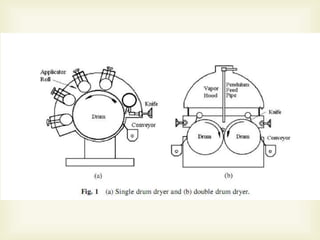
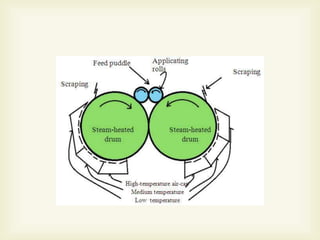
The drum dryer is an indirect type dryer in which the
milk to be dried is maintained in a thin film on a rotating
steam heated drum.
The milk being dried is spread over the outside surface
of the dryer. Clinging to it and drying continues as the
hot drum rotates.
DRUM DRYING
 At the end of a revolution, the drum comes to a ‘doctor blade’
which scrapes the dried film from the drum, when the
product has made about three-quarter of a complete rotation
on the drum surface
 The process is also known as roller drying
 Drum drying requires less space and is more economical than
spray dryers for small volumes. The ratio of steam
consumption to water evaporation is from 1.2 to 1.6:1
Drum Drying(contd..)

 Diameter of typical drums ranges from 0.5m to 6m and the
length from 1m to 6m.
 In operation , steam at temperature up to 200 degree
Celsius heats the inner surface of the drum.
 The moist material is uniformly applied in a thin
layer(0.5mmñ2mm)on to the outer drum surface.
SYSTEM DESCRIPTION

 The energy consumption in a drum dryer may range between
1.1 kg steam per kg of evaporated water and 1.6kg steam per
kg of evaporated water , corresponding to energy efficiencies
of about 60%-90%.
 Under ideal conditions ,the maximum evaporation capacity of
a drum dryer is 80 kg H2O/hour m2

 Number of drums (a) single drum, (b) double drum, or (c) twin
drum.
 Pressure surrounding the product (a) atmospheric, and (b)
vacuum.
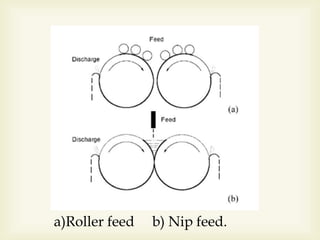
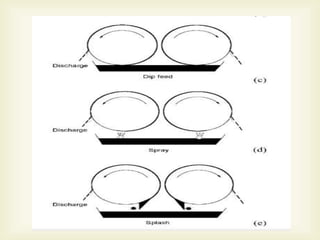
 Feeding arrangement: (a) nip feed, (b) splash feed, (c) dip
feed or (d) roller feed.
 Material of construction: (a) alloy steel, (b) stainless steel, or
(c) chrome, or nickel plate steel
CLASSIFICATION
a)Roller feed b) Nip feed.
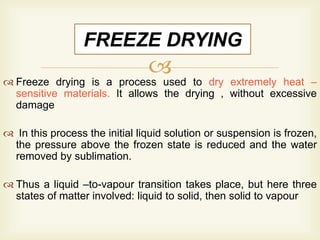
 Freeze drying is a process used to dry extremely heat –
sensitive materials. It allows the drying , without excessive
damage
 In this process the initial liquid solution or suspension is frozen,
the pressure above the frozen state is reduced and the water
removed by sublimation.
 Thus a liquid –to-vapour transition takes place, but here three
states of matter involved: liquid to solid, then solid to vapour
FREEZE DRYING

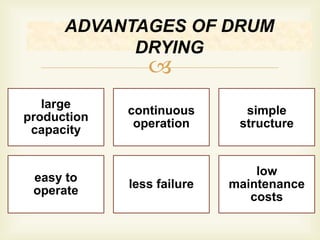
large
production
capacity
continuous
operation
simple
structure
easy to
operate
less failure
low
maintenance
costs
ADVANTAGES OF DRUM
DRYING

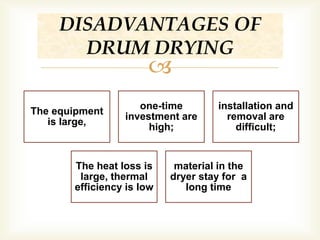
The equipment
is large,
one-time
investment are
high;
installation and
removal are
difficult;
The heat loss is
large, thermal
efficiency is low
material in the
dryer stay for a
long time
DISADVANTAGES OF
DRUM DRYING
 Not able to process salty or other corrosive materials due
to potential pitting of drum surface
 High cost of changing drum surface because of the
precision machining that is required
 Some products ,especially those with high sugar content ,
may not be easily scrapped off from the drum
Continued…


Drum dryers

  • 2.
    Presented by: AMNINDER SINGHSEKHON (Batch-2014) Registration No. L2014DT03 Bachelor in Dairy Technology Presented to: ER . NARENDER KUMAR ASSTT. PROF. (DAIRY ENGINEERING) Department of Dairy Engineering , CODST, Guru Angad Dev Veterinary and Animal Science University (GADVASU), Ludhiana, Punjab, India -141001 6 May, 2016 Drum dryers
  • 3.
    The removal ofnearly all the water present through vaporization is known as drying or dehydration. Removal of moisture to a very low moisture content nearly to a bone dry condition Bone dry material is the material from which all the moisture has been removed INTRODUCTION
  • 4.
    • Drying iscarried out for one or more of the following reasons:  To eliminate moisture which may lead to corrosion and decrease the product or drug stability.  To improve the good properties of a material, e.g. flowability, compressibility.  To reduce the cost of transportation  To make the material easy to handle  to increase the shelf life PURPOSES OF DRYING
  • 5.
     Minimal chemicaland biochemical degradation reactions  Selective removal of water over other salts and volatile flavor and aroma substances  Maintenance of product structure (for a structured food)  Control of density  Lack of contamination or adulteration  Minimal product loss GOALS OF DRYING
  • 6.
     Rapid rateof water removal  Inexpensive energy source (if phase change is involved)  Facility of continuous operation  Noncomplex apparatus (reliable and minimal labor requirement)  Minimal environmental impact DRYING SHOULD ACHIEVE THESE GOALS (CONTD…)
  • 7.
      In dryingprocesses, the main operation usually carried out on solid materials, e.g. powders, or products  Drying in most of the cases means the removal of relatively small amounts of water from solids .  Evaporation include the removal of large amounts of water from solutions. DIFFERENCE BETWEEN DRYING AND EVAPORATION
  • 8.
      In mostcases, drying involves the removal of water at temperatures below its boiling point, whereas evaporation means the removal of water by boiling a solution.  In drying , water is usually removed by circulating air over the material in order to carry away the water vapour , while in evaporation , water is removed from the material as pure water vapour mixed with other gases.
  • 9.
     The drum dryeris an indirect type dryer in which the milk to be dried is maintained in a thin film on a rotating steam heated drum. The milk being dried is spread over the outside surface of the dryer. Clinging to it and drying continues as the hot drum rotates. DRUM DRYING
  • 10.
     At theend of a revolution, the drum comes to a ‘doctor blade’ which scrapes the dried film from the drum, when the product has made about three-quarter of a complete rotation on the drum surface  The process is also known as roller drying  Drum drying requires less space and is more economical than spray dryers for small volumes. The ratio of steam consumption to water evaporation is from 1.2 to 1.6:1 Drum Drying(contd..)
  • 11.
      Diameter oftypical drums ranges from 0.5m to 6m and the length from 1m to 6m.  In operation , steam at temperature up to 200 degree Celsius heats the inner surface of the drum.  The moist material is uniformly applied in a thin layer(0.5mmñ2mm)on to the outer drum surface. SYSTEM DESCRIPTION
  • 12.
      The energyconsumption in a drum dryer may range between 1.1 kg steam per kg of evaporated water and 1.6kg steam per kg of evaporated water , corresponding to energy efficiencies of about 60%-90%.  Under ideal conditions ,the maximum evaporation capacity of a drum dryer is 80 kg H2O/hour m2
  • 13.
      Number ofdrums (a) single drum, (b) double drum, or (c) twin drum.  Pressure surrounding the product (a) atmospheric, and (b) vacuum.  Feeding arrangement: (a) nip feed, (b) splash feed, (c) dip feed or (d) roller feed.  Material of construction: (a) alloy steel, (b) stainless steel, or (c) chrome, or nickel plate steel CLASSIFICATION
  • 16.
  • 20.
     Freeze dryingis a process used to dry extremely heat – sensitive materials. It allows the drying , without excessive damage  In this process the initial liquid solution or suspension is frozen, the pressure above the frozen state is reduced and the water removed by sublimation.  Thus a liquid –to-vapour transition takes place, but here three states of matter involved: liquid to solid, then solid to vapour FREEZE DRYING
  • 21.
  • 22.
     The equipment is large, one-time investmentare high; installation and removal are difficult; The heat loss is large, thermal efficiency is low material in the dryer stay for a long time DISADVANTAGES OF DRUM DRYING
  • 23.
     Not ableto process salty or other corrosive materials due to potential pitting of drum surface  High cost of changing drum surface because of the precision machining that is required  Some products ,especially those with high sugar content , may not be easily scrapped off from the drum Continued…
  • 24.