DRYING 2
Md. Saiful Islam
BPharm, MSc
North South University
Fb Group: Pharmacy Universe
Classification of dryers
A. Based on heat transfer
• Drying of wet solids
-Convective drying :e.g. tray dryer,
tunnel dryer, rotary dryer.
-Conductive drying: e.g. vacuum dryer
-Radiation drying: e.g. microwave dryer.
2. Drying of dilute solutions & suspensions
-Drum dryer.
3. Freeze drying
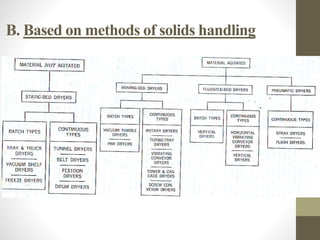
B. Based on methods of solids handling
Static bed dryers
Systems in which there is no relative movement among the solid
particles being dried, although there may be bulk motion of the
entire drying mass.
Example : Tray dryer
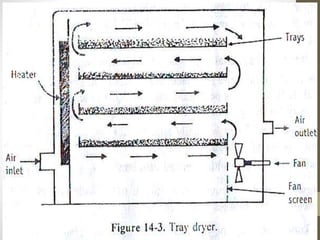
CONSTRUCTION : It consists of a rectangular chamber whose
walls are insulated.
Trays are placed inside the heating chamber. The number of trays
may vary with the size of the dryer. Each tray is rectangular or
square and about 1.2 to 2.4 metres square in area .
Trays are usually loaded from 10.0 to 100 millimetres deep.
Dryer is fitted with a fan for circulating air over the trays.
Electrically heated elements are provided inside (rather than
outside) to heat the air.
In the corner of the chamber, direction vanes are placed to direct
air in the expected path.
OPERATION: Wet solid is loaded into trays. Trays are placed in
the chamber.
Fresh air is introduced through inlet, which passes through the
heaters and gets heated up. The hot air is circulated by means of
fans at 2 to 5 meters per second. Turbulent flow lowers the
partial vapors pressure in the atmosphere and also reduces the
thickness of the air boundary layer. The water is picked up by
air.
As water evaporates from the surface, the water diffuses from the
interior of the solid by capillary action. These events occur in a
single pass of air.
The time of contact is short and the amount of water picked up
in a single pass is small. Moist air is discharged through outlet.
Thus constant temperature and uniform airflow over the material
can be maintained for achieving uniform drying.
In case of wet granules (as in tablets and capsules) drying is
continued until the desired moisture content is obtained.
At the end of drying, trays are pulled out of the chamber and taken
to a tray dumping station.
MERITS:
• The method is operated batch wise.
• Attrition is not observed.
• Loading and unloading can be done without losses.
DEMERITS:
• Only a fraction of the solid particles is directly exposed.
• The method is costly and time consuming.
USE :
Sticky materials, plastic substances, granular mass or crystalline
materials, precipitates and paste can be dried in a tray dryer.
Fluidized bed dryers
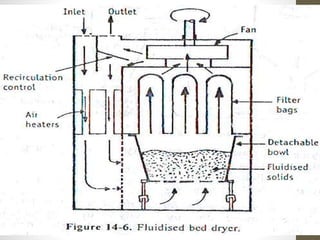
Principle: Systems in which the solid particles
are partially suspended in an upward moving gas
stream. In this dryer hot air (gas) is passed at
high pressure through a perforated bottom of the
container containing granules to be dried.
The granular are lifted from the bottom
suspended in the stream of air. This condition is
called fluidized state.
The hot gas is surrounding every granule to
completely dry them. Thus materials or granules
are uniformly dried.
• Construction: Two types of bed dryers are
available, vertical fluid bed dryer and horizontal
fluid bed dryer.
The dryer is made up of stainless steel or plastic. A
detachable bowl is placed at the bottom of the
dryer, which is used for charging and
discharging.
The bowl has a perforated bottom with a wire
mesh support for placing materials to be dried.
A fan is mounted in the upper part for circulating
hot air. Fresh air inlet, prefilter and heat
exchanger are connected serially to heat the air to
the required temperatures. The temperature of hot
air and exit air are monitored.
Bag filters are placed above the drying bowl for
the recovery of fines.
OPERATOIN: The wet granules to be dried are placed in the
detachable bowl. The bowl is pushed into the dryer.
Fresh air is allowed to pass through a prefilter, which
subsequently gets heated by passing through a heat
exchanger.
The hot air flows through the bottom of the bowl
simultaneously fan is allowed to rotate. The air velocity is
gradually increased.
When the velocity of the air is greater than settling velocity of
granules, the granules remain partially suspended in the gas
stream.
The granules rise in the container because of high velocity gas
( 1.5 to 7.5) and later fall back in a random boiling motion.
This condition is said to be fluidized state.
The bags are shaken to remove the entrained particles.
The residence time for drying is about 40 minutes. The bowl
is taken out for discharging. The end product is free flowing.
MERITS:
1. Efficient heat and mass transfer give high
drying rates, so that drying times are shorter
than with static bed dryers.
2. The temperature of a fluidized bed is uniform
throughout and can be controlled precisely.
3. The free movement of individual particles
eliminates the risk of soluble materials.
4. The unit has a high output from a small floor
space.
5. The thermal efficiency is 2 to 6 times than tray

dryer.
6. It can be used either batch type or continuous
type.
7. Used for mixing the ingredients and its mixing
efficiency is also high.
DEMERITS:
1.The turbulence of the fluidized state may cause
excessive attrition of some particles, with damage to
some granules and the production of too much dust.
2.The vigorous movement of particles in hot dry air can
lead to the generation of static electricity charges and
suitable precautions must be taken.
USE :
This dryer is properly used for drying of granules in
the production of tablets. It can be used for three
operations such as mixing, granulation and drying.
Moving bed dryers
Systems in which the drying particles are partially
separated so that they flow over each other. Motion
may be induced by either gravity or mechanical
agitation. E.g. Drum dryer
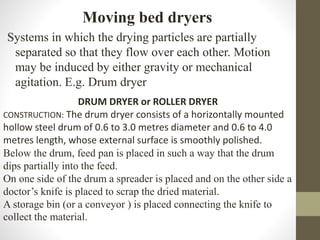
DRUM DRYER or ROLLER DRYER
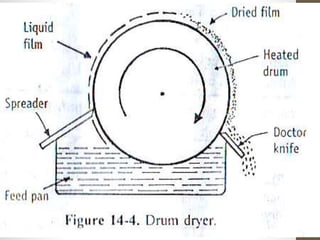
CONSTRUCTION: The drum dryer consists of a horizontally mounted
hollow steel drum of 0.6 to 3.0 metres diameter and 0.6 to 4.0
metres length, whose external surface is smoothly polished.
Below the drum, feed pan is placed in such a way that the drum
dips partially into the feed.
On one side of the drum a spreader is placed and on the other side a
doctor’s knife is placed to scrap the dried material.
A storage bin (or a conveyor ) is placed connecting the knife to
collect the material.
OPERATION:
Steam is passed inside the drum. Heat transfer coefficient of the
drum metal is high. Heat is transferred by conduction to the
material.
Simultaneously drum is rotated at the rate of 1-10 revolutions per
minute.
The liquid material present in the feed pan adheres as a thin layer
to the external surface of the drum during its rotation.
The materials are completely dried during its journey in slightly
less than one rotation (from one side to another side of the
drum).
The dried materials are scrapped by the doctor’s knife, which than
falls into a storage bin.
The time of contact of the material with hot metal is 6 to 15
seconds only.
Therefore processing conditions such as film thickness, steam
temperature are closely controlled.
MERITS:
• The method gives rapid heat drying and mass transfer are
higher.
• The entire material is continuously exposed to heat source.
• The equipment is compact.
• Heating time is short being only a few seconds.
• The product obtained is completely dried and is in the final
form.
DEMERITS:
• Operating conditions are critical.
• Attrition is not possible.
• Skilled operators are essential to control feed rate ,film
thickness, speed of rotation and temperature.
• Maintenance cost of a drum dryer is higher than spray dryer.
• It is not suitable for solutions of salts with less solubility.
USE :
Drum dryer is used for drying solution slurries
suspensions etc.
• The products dried are milk products, starch products,
ferrous salts, suspensions of zinc oxide, suspension of
kaolin, yeasts, pigments, malt extracts, antibiotics,
DDT, calcium, insecticides and barium carbonates.
Pneumatic dryers
Principle: Systems in which the drying particles are
entrained and conveyed in a high velocity gas stream.
This systems further improved on fluidized bed.
Ex : Spray dryer
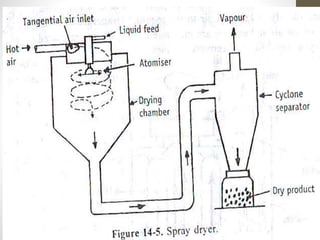
Construction: The spray dryer consists of a large
cylindrical drying chamber with a short conical
bottom, made up of stainless steel.
An inlet for hot air is placed in the roof of the chamber.
Another inlet carrying spray-disk atomizer rotates at a
speed of 3,000 to 50,000 rpm.
Bottom of the dryer is connected to a cyclone separator.
OPERATION: Drying of the materials in spray dryer involves 3
stages-
1. Atomization of the liquid from liquid droplets.
2. Drying of the liquid droplets.
3. Recovery of the dried product
1. Atomization of the liquid to form liquid droplets:
The feed is introduced through the atomizer either by gravity or
by using suitable pump to form fine droplets. The properties of
the final product depend on the droplet form, hence the
selection of the type of atomizer is important. Atomizer can be
of different types-
a) Pneumatic atomizer b) Pressure nozzle and c) Spinning
disc atomizer.
The rate of feed is adjusted in such a way that the droplets
should be completely dried before reaching the walls of the
drying chamber. At the same time , the product should not be
over heated.
2.Dryingoftheliquiddroplets:
Fine droplets are dried in the drying chamber by supplying hot
air through the inlet.
The surface of the liquid drop is dried immediately to form a
tough shell. Further, the liquid inside must escape by diffusing
through the shell at a particular rate. At the same time, heat
transfer from outside to inside takes place at a rate greater than
liquid diffusion rate. As a result, heat inside mounts up which
allows the liquid to evaporate at a faster rate.
This tendency of a liquid leads to rise in the internal pressure,
which causes the droplets to swell. The shell’s thickness
decreases where as permeability for vapor increases. If the shell
is neither elastic nor permeable, it ruptures and the internal
pressure escapes.
The temperature of air is adjusted in such a way that the
droplets should be completely dried before reaching the walls of
the drying chamber. At the same time, the product should not be
over heated.
3.Recoveryofthedriedproduct:
Centrifugal force of atomizer drives the droplets to follow
helical path. Particles are dried during their journey and finally
fall at the conical bottom.
All these processes are completed in a few seconds. Particles
size of the final product ranges from 2 to 500 mm. Particles size
depends on solid content in the feed, liquid viscosity, feed rate
and disc speed. Spray dryer of maximum size have got
evaporating capacity up to 2000 kg per hour.
MERITS:
• The method is a continuous process and drying is
rapid and efficient. Drying completes within 3 to 30
seconds.
• Labour costs are low.
• It is suitable for the drying of sterile products.
• Either the solution or suspension or thin paste can be
dried in one step to get the final product ready for
package.
DEMERITS:
• The method is very bulky and expensive.
• The thermal efficiency is low, as much heat is lost in
the discharged gases.
• Such a huge equipment is not always easy to operate
Use:
Spray dryers are caused compulsorily, if
1) The product is a better form than that obtained by
any other dryer.
2)The quantity of the material to be dried is large.
3)the product is thermo labile, hygroscopic or
undergoes chemical decomposition.
Example of few products are dried using spray dryer:
Acacia, blood, borax, plasma, serum, adrenalin, fruit
juice.
Vacuum dryer
Principle:
In vacuum dryer, material is dried by
the application of vacuum. When
vacuum is created the pressure is
lowered so that water boils at a lower
temperature. Hence water evaporates
faster. The heat transfer becomes
efficient, i.e., rate of drying enhances
substantially.
Construction
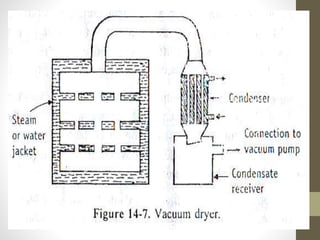
•The construction of a vacuum dryer is shown
in the following figure. It is made of a cast
iron heavy-jacked vessel. It is so strong that it
can withstand high vacuum within the oven
and steam pressure in the jacket. The
enclosed space is divided into a number of
portions by means of 20 hollow shelves, which
are part of the jacket. These shelves provide
larger surface area for keeping the material.
The oven door can be locked tightly to give an
air tight seal. The oven is connected to a
vacuum pump by placing condenser in
between.
Advantages:
1. Vacuum dryer provides large surface area for heat
transfer.
2. Handling of the material, trays and equipment is
easy.
3. It is easy for switching over to the next materials.
4. Hot water of desired temperatures can be
supplied.
5. Electrically heated hollow shelves can be used.
Disadvantages:
1. In vacuum dryer, heat transfer coefficients are low.
2. It has a limited capacity and used for batch process.
3. It is more expensive than dryer. Labour and running
costs are also high.
4. Sometimes, there is a danger of over heating as the
material as the material is in contact with steam
heated surface for longer period.
Preliminary dryer selection
The important factors to be considered in the preliminary selection
of a dryer are as follows:
1.Properties of the material being handled :
Physical characteristics when wet or dry
Corrosiveness
Toxicity
Flammability
Particle size
Abrasiveness
2. Drying characteristics of the material :
-Type of moisture present (bound, unbound or both )
-Initial moisture content
-Final moisture content (maximum up to which it is to be
dried )
-Permissible drying temperature
-Probable drying time for different dryers
3. Flow of material to and from the dryer :
-Quality to be handled per hour
-Continuous or batch operation
-Process prior to drying
-Process subsequent to drying
4. Economic consideration:
-Value of the materials
-Maintenance cost
-Labour cost
5. Product qualities :
Contamination
Uniformity of final moisture content
Decomposition of product
Bulk density
6. Recovery problems:
Dust Recovery; Solvent recovery
7.Facilities available at site of proposed installation :
Temperature, humidity and cleanliness of air
Available fuels
Available electric power
Permissible noise, vibration, dust or heat losses
Source of wet feed
Exhaust-gas outlets
Drying tests :
These tests should establish the optimum
operating conditions, the ability of the dryer to handle
the material physically, product quality and
characteristics, and dryer size. The principal
manufacturers of drying equipment are usually
prepared to perform the required tests on dryers
simulating their equipment.
Based upon the results of the drying tests that establish
size and operating characteristics, formal quotations
and guarantees should be obtained from dryer
manufacturers. Initial costs, installation costs, operating
costs, product quality, dryer operability, and dryer
flexibility can then be given proper weight in the final
evaluation and selection.
THANK YOU

Drying (dryers)

  • 1.
    DRYING 2 Md. SaifulIslam BPharm, MSc North South University Fb Group: Pharmacy Universe
  • 2.
    Classification of dryers A.Based on heat transfer • Drying of wet solids -Convective drying :e.g. tray dryer, tunnel dryer, rotary dryer. -Conductive drying: e.g. vacuum dryer -Radiation drying: e.g. microwave dryer. 2. Drying of dilute solutions & suspensions -Drum dryer. 3. Freeze drying
  • 3.
    B. Based onmethods of solids handling
  • 4.
    Static bed dryers Systemsin which there is no relative movement among the solid particles being dried, although there may be bulk motion of the entire drying mass. Example : Tray dryer CONSTRUCTION : It consists of a rectangular chamber whose walls are insulated. Trays are placed inside the heating chamber. The number of trays may vary with the size of the dryer. Each tray is rectangular or square and about 1.2 to 2.4 metres square in area . Trays are usually loaded from 10.0 to 100 millimetres deep. Dryer is fitted with a fan for circulating air over the trays. Electrically heated elements are provided inside (rather than outside) to heat the air. In the corner of the chamber, direction vanes are placed to direct air in the expected path.
  • 6.
    OPERATION: Wet solidis loaded into trays. Trays are placed in the chamber. Fresh air is introduced through inlet, which passes through the heaters and gets heated up. The hot air is circulated by means of fans at 2 to 5 meters per second. Turbulent flow lowers the partial vapors pressure in the atmosphere and also reduces the thickness of the air boundary layer. The water is picked up by air. As water evaporates from the surface, the water diffuses from the interior of the solid by capillary action. These events occur in a single pass of air. The time of contact is short and the amount of water picked up in a single pass is small. Moist air is discharged through outlet. Thus constant temperature and uniform airflow over the material can be maintained for achieving uniform drying. In case of wet granules (as in tablets and capsules) drying is continued until the desired moisture content is obtained. At the end of drying, trays are pulled out of the chamber and taken to a tray dumping station.
  • 7.
    MERITS: • The methodis operated batch wise. • Attrition is not observed. • Loading and unloading can be done without losses. DEMERITS: • Only a fraction of the solid particles is directly exposed. • The method is costly and time consuming. USE : Sticky materials, plastic substances, granular mass or crystalline materials, precipitates and paste can be dried in a tray dryer.
  • 8.
    Fluidized bed dryers Principle:Systems in which the solid particles are partially suspended in an upward moving gas stream. In this dryer hot air (gas) is passed at high pressure through a perforated bottom of the container containing granules to be dried. The granular are lifted from the bottom suspended in the stream of air. This condition is called fluidized state. The hot gas is surrounding every granule to completely dry them. Thus materials or granules are uniformly dried.
  • 9.
    • Construction: Twotypes of bed dryers are available, vertical fluid bed dryer and horizontal fluid bed dryer. The dryer is made up of stainless steel or plastic. A detachable bowl is placed at the bottom of the dryer, which is used for charging and discharging. The bowl has a perforated bottom with a wire mesh support for placing materials to be dried. A fan is mounted in the upper part for circulating hot air. Fresh air inlet, prefilter and heat exchanger are connected serially to heat the air to the required temperatures. The temperature of hot air and exit air are monitored. Bag filters are placed above the drying bowl for the recovery of fines.
  • 11.
    OPERATOIN: The wetgranules to be dried are placed in the detachable bowl. The bowl is pushed into the dryer. Fresh air is allowed to pass through a prefilter, which subsequently gets heated by passing through a heat exchanger. The hot air flows through the bottom of the bowl simultaneously fan is allowed to rotate. The air velocity is gradually increased. When the velocity of the air is greater than settling velocity of granules, the granules remain partially suspended in the gas stream. The granules rise in the container because of high velocity gas ( 1.5 to 7.5) and later fall back in a random boiling motion. This condition is said to be fluidized state. The bags are shaken to remove the entrained particles. The residence time for drying is about 40 minutes. The bowl is taken out for discharging. The end product is free flowing.
  • 12.
    MERITS: 1. Efficient heatand mass transfer give high drying rates, so that drying times are shorter than with static bed dryers. 2. The temperature of a fluidized bed is uniform throughout and can be controlled precisely. 3. The free movement of individual particles eliminates the risk of soluble materials. 4. The unit has a high output from a small floor space. 5. The thermal efficiency is 2 to 6 times than tray dryer. 6. It can be used either batch type or continuous type. 7. Used for mixing the ingredients and its mixing efficiency is also high.
  • 13.
    DEMERITS: 1.The turbulence ofthe fluidized state may cause excessive attrition of some particles, with damage to some granules and the production of too much dust. 2.The vigorous movement of particles in hot dry air can lead to the generation of static electricity charges and suitable precautions must be taken. USE : This dryer is properly used for drying of granules in the production of tablets. It can be used for three operations such as mixing, granulation and drying.
  • 14.
    Moving bed dryers Systemsin which the drying particles are partially separated so that they flow over each other. Motion may be induced by either gravity or mechanical agitation. E.g. Drum dryer DRUM DRYER or ROLLER DRYER CONSTRUCTION: The drum dryer consists of a horizontally mounted hollow steel drum of 0.6 to 3.0 metres diameter and 0.6 to 4.0 metres length, whose external surface is smoothly polished. Below the drum, feed pan is placed in such a way that the drum dips partially into the feed. On one side of the drum a spreader is placed and on the other side a doctor’s knife is placed to scrap the dried material. A storage bin (or a conveyor ) is placed connecting the knife to collect the material.
  • 16.
    OPERATION: Steam is passedinside the drum. Heat transfer coefficient of the drum metal is high. Heat is transferred by conduction to the material. Simultaneously drum is rotated at the rate of 1-10 revolutions per minute. The liquid material present in the feed pan adheres as a thin layer to the external surface of the drum during its rotation. The materials are completely dried during its journey in slightly less than one rotation (from one side to another side of the drum). The dried materials are scrapped by the doctor’s knife, which than falls into a storage bin. The time of contact of the material with hot metal is 6 to 15 seconds only. Therefore processing conditions such as film thickness, steam temperature are closely controlled.
  • 17.
    MERITS: • The methodgives rapid heat drying and mass transfer are higher. • The entire material is continuously exposed to heat source. • The equipment is compact. • Heating time is short being only a few seconds. • The product obtained is completely dried and is in the final form. DEMERITS: • Operating conditions are critical. • Attrition is not possible. • Skilled operators are essential to control feed rate ,film thickness, speed of rotation and temperature. • Maintenance cost of a drum dryer is higher than spray dryer. • It is not suitable for solutions of salts with less solubility.
  • 18.
    USE : Drum dryeris used for drying solution slurries suspensions etc. • The products dried are milk products, starch products, ferrous salts, suspensions of zinc oxide, suspension of kaolin, yeasts, pigments, malt extracts, antibiotics, DDT, calcium, insecticides and barium carbonates.
  • 19.
    Pneumatic dryers Principle: Systemsin which the drying particles are entrained and conveyed in a high velocity gas stream. This systems further improved on fluidized bed. Ex : Spray dryer Construction: The spray dryer consists of a large cylindrical drying chamber with a short conical bottom, made up of stainless steel. An inlet for hot air is placed in the roof of the chamber. Another inlet carrying spray-disk atomizer rotates at a speed of 3,000 to 50,000 rpm. Bottom of the dryer is connected to a cyclone separator.
  • 21.
    OPERATION: Drying ofthe materials in spray dryer involves 3 stages- 1. Atomization of the liquid from liquid droplets. 2. Drying of the liquid droplets. 3. Recovery of the dried product 1. Atomization of the liquid to form liquid droplets: The feed is introduced through the atomizer either by gravity or by using suitable pump to form fine droplets. The properties of the final product depend on the droplet form, hence the selection of the type of atomizer is important. Atomizer can be of different types- a) Pneumatic atomizer b) Pressure nozzle and c) Spinning disc atomizer. The rate of feed is adjusted in such a way that the droplets should be completely dried before reaching the walls of the drying chamber. At the same time , the product should not be over heated.
  • 22.
    2.Dryingoftheliquiddroplets: Fine droplets aredried in the drying chamber by supplying hot air through the inlet. The surface of the liquid drop is dried immediately to form a tough shell. Further, the liquid inside must escape by diffusing through the shell at a particular rate. At the same time, heat transfer from outside to inside takes place at a rate greater than liquid diffusion rate. As a result, heat inside mounts up which allows the liquid to evaporate at a faster rate. This tendency of a liquid leads to rise in the internal pressure, which causes the droplets to swell. The shell’s thickness decreases where as permeability for vapor increases. If the shell is neither elastic nor permeable, it ruptures and the internal pressure escapes. The temperature of air is adjusted in such a way that the droplets should be completely dried before reaching the walls of the drying chamber. At the same time, the product should not be over heated.
  • 23.
    3.Recoveryofthedriedproduct: Centrifugal force ofatomizer drives the droplets to follow helical path. Particles are dried during their journey and finally fall at the conical bottom. All these processes are completed in a few seconds. Particles size of the final product ranges from 2 to 500 mm. Particles size depends on solid content in the feed, liquid viscosity, feed rate and disc speed. Spray dryer of maximum size have got evaporating capacity up to 2000 kg per hour.
  • 24.
    MERITS: • The methodis a continuous process and drying is rapid and efficient. Drying completes within 3 to 30 seconds. • Labour costs are low. • It is suitable for the drying of sterile products. • Either the solution or suspension or thin paste can be dried in one step to get the final product ready for package. DEMERITS: • The method is very bulky and expensive. • The thermal efficiency is low, as much heat is lost in the discharged gases. • Such a huge equipment is not always easy to operate
  • 25.
    Use: Spray dryers arecaused compulsorily, if 1) The product is a better form than that obtained by any other dryer. 2)The quantity of the material to be dried is large. 3)the product is thermo labile, hygroscopic or undergoes chemical decomposition. Example of few products are dried using spray dryer: Acacia, blood, borax, plasma, serum, adrenalin, fruit juice.
  • 26.
    Vacuum dryer Principle: In vacuumdryer, material is dried by the application of vacuum. When vacuum is created the pressure is lowered so that water boils at a lower temperature. Hence water evaporates faster. The heat transfer becomes efficient, i.e., rate of drying enhances substantially.
  • 27.
    Construction •The construction ofa vacuum dryer is shown in the following figure. It is made of a cast iron heavy-jacked vessel. It is so strong that it can withstand high vacuum within the oven and steam pressure in the jacket. The enclosed space is divided into a number of portions by means of 20 hollow shelves, which are part of the jacket. These shelves provide larger surface area for keeping the material. The oven door can be locked tightly to give an air tight seal. The oven is connected to a vacuum pump by placing condenser in between.
  • 29.
    Advantages: 1. Vacuum dryerprovides large surface area for heat transfer. 2. Handling of the material, trays and equipment is easy. 3. It is easy for switching over to the next materials. 4. Hot water of desired temperatures can be supplied. 5. Electrically heated hollow shelves can be used. Disadvantages: 1. In vacuum dryer, heat transfer coefficients are low. 2. It has a limited capacity and used for batch process. 3. It is more expensive than dryer. Labour and running costs are also high. 4. Sometimes, there is a danger of over heating as the material as the material is in contact with steam heated surface for longer period.
  • 30.
    Preliminary dryer selection Theimportant factors to be considered in the preliminary selection of a dryer are as follows: 1.Properties of the material being handled : Physical characteristics when wet or dry Corrosiveness Toxicity Flammability Particle size Abrasiveness 2. Drying characteristics of the material : -Type of moisture present (bound, unbound or both ) -Initial moisture content -Final moisture content (maximum up to which it is to be dried ) -Permissible drying temperature -Probable drying time for different dryers
  • 31.
    3. Flow ofmaterial to and from the dryer : -Quality to be handled per hour -Continuous or batch operation -Process prior to drying -Process subsequent to drying 4. Economic consideration: -Value of the materials -Maintenance cost -Labour cost 5. Product qualities : Contamination Uniformity of final moisture content Decomposition of product Bulk density
  • 32.
    6. Recovery problems: DustRecovery; Solvent recovery 7.Facilities available at site of proposed installation : Temperature, humidity and cleanliness of air Available fuels Available electric power Permissible noise, vibration, dust or heat losses Source of wet feed Exhaust-gas outlets
  • 33.
    Drying tests : Thesetests should establish the optimum operating conditions, the ability of the dryer to handle the material physically, product quality and characteristics, and dryer size. The principal manufacturers of drying equipment are usually prepared to perform the required tests on dryers simulating their equipment. Based upon the results of the drying tests that establish size and operating characteristics, formal quotations and guarantees should be obtained from dryer manufacturers. Initial costs, installation costs, operating costs, product quality, dryer operability, and dryer flexibility can then be given proper weight in the final evaluation and selection.
  • 34.