DEPARTMENT OF FOOD PROCESS ENGINEERING 1
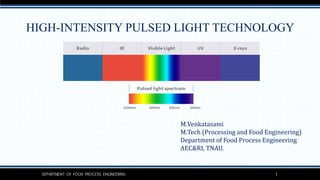
HIGH-INTENSITY PULSED LIGHT TECHNOLOGY
M.Venkatasami
M.Tech (Processing and Food Engineering)
Department of Food Process Engineering
AEC&RI, TNAU.
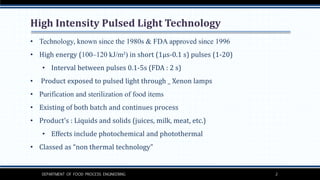
High Intensity Pulsed Light Technology
DEPARTMENT OF FOOD PROCESS ENGINEERING 2
• Technology, known since the 1980s & FDA approved since 1996
• High energy (100–120 kJ/m²) in short (1µs-0.1 s) pulses (1-20)
• Interval between pulses 0.1-5s (FDA : 2 s)
• Product exposed to pulsed light through _ Xenon lamps
• Purification and sterilization of food items
• Existing of both batch and continues process
• Product's : Liquids and solids (juices, milk, meat, etc.)
• Effects include photochemical and photothermal
• Classed as “non thermal technology”
DEPARTMENT OF FOOD PROCESS ENGINEERING 3
PRINCIPLE
Dunn et al., 1989
• Conductive heat transfer q (W) and T (˚C) –depends on
intensity and duration of incident ray
• Effect of radiation evaluated using the energy density or
fluence F
Parameter Symbol Unit Key Relations
Pulse duration s
Pulse frequency ƒ Hz ƒ= 1/t
Peak Power Ppeak W
Pulse energy E J
Pulse spot area A cm2 𝐴 = 𝜋×𝑟2
Peak Intensity Ipeak W/cm2
Pulse fluence Fpulse J/cm2 𝐹𝑝𝑢𝑙𝑠𝑒=𝐸 /𝐴
Calculation of output parameters of pulsed light
Gomez-Lopez et al., 2007
5
Power delivered by
continuous light and
light pulses
KINETICS
Pulsed light destruction kinetics : first order
Logarithmic order of death
•Logₑ(N/Nₒ)=-kt
The decimal reduction Time (D-value)
•DF=-(1/slope)=(t₂-t₁)/(log(N/Nₒ)
zF= increment of n required to reduce DF by 1 log
•zF =-(1/slope)=(n₂-n₁)/(logD1/D2)
•Ftot = n.F
No =the initial number of microorganisms
N =number of organisms that survived
t (min)=treatment time
k =reaction rate constant (min-1)
n=number of pulses
Allison Pollock, 2007
6
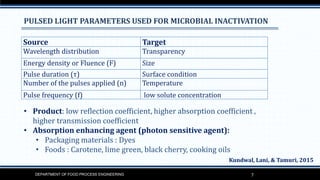
PULSED LIGHT PARAMETERS USED FOR MICROBIAL INACTIVATION
Source Target
Wavelength distribution Transparency
Energy density or Fluence (F) Size
Pulse duration (τ) Surface condition
Number of the pulses applied (n) Temperature
Pulse frequency (f) low solute concentration
• Product: low reflection coefficient, higher absorption coefficient ,
higher transmission coefficient
• Absorption enhancing agent (photon sensitive agent):
• Packaging materials : Dyes
• Foods : Carotene, lime green, black cherry, cooking oils
Kundwal, Lani, & Tamuri, 2015
7
Lamp
Spectral
range
(nm)
Treatment
time
(s)
Pulse
Duration
(μs)
Total
Fluence
(J/cm²)
Puls
e Per
Sec
(Hz)
Host Medium Log
Reduction
Sample- lamp
distance
(cm)
200-1100 3.3 ** 360 4 3 Apple Juice 3.1 1.9
200-1100 4.2 ** 360 5.1 3 Apple Juice 4.9 1.9
100-1100 - 360 4 3 Apple Juice 4 5.8
100-1100 - 360 4 3 Orange Juice 2.9 5.8
Inactivation of Escherichia coli using HIPLF
• Inactivation of enzyme
• No change in nutritional quality (riboflavin and vitamin E)
• No change in sensory attributes
Kundwal, Lani, & Tamuri, 2015
8
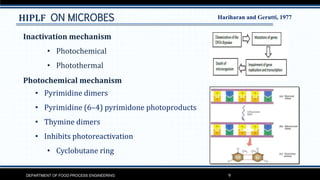
HIPLF ON MICROBES
Inactivation mechanism
• Photochemical
• Photothermal
Photochemical mechanism
• Pyrimidine dimers
• Pyrimidine (6–4) pyrimidone photoproducts
• Thymine dimers
• Inhibits photoreactivation
• Cyclobutane ring
Hariharan and Gerutti, 1977
9
PHOTOTHERMAL MECHANISM
• Cell membrane damage
Mansel Griffiths, 2005
10
bond
Pore formation on cell membrane
MICROBIAL INACTIVATION
Gram stain
Size
Spore
Strain Variation
Mould Bacteria
Rowan et al. (1999)
Dunn et al. (1991)
11
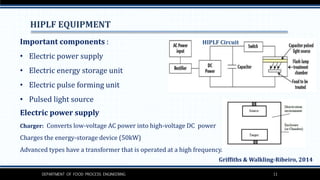
HIPLF EQUIPMENT
DEPARTMENT OF FOOD PROCESS ENGINEERING 11
Important components :
• Electric power supply
• Electric energy storage unit
• Electric pulse forming unit
• Pulsed light source
Electric power supply
Charger: Converts low-voltage AC power into high-voltage DC power
Charges the energy-storage device (50kW)
Advanced types have a transformer that is operated at a high frequency.
Griffiths & Walkling-Ribeiro, 2014
HIPLF Circuit
DEPARTMENT OF FOOD PROCESS ENGINEERING 12
• Capacitor (0.1-10µ F), or an inductor (30 µH )
• High voltage capacitors are connected in parallel
• Alternative: Marx generators
• Generates high-voltage pulse from a low-voltage DC supply
• Voltage amplifiers _large amounts of higher voltage current
Electric energy storage
Pai and Zhang, 1995
10µ F Capacitor
Marx generators
Switches
DEPARTMENT OF FOOD PROCESS ENGINEERING 13
• Starts and/or terminates the pulse (100 kV)
• Duration of the pulse is determined only by the closing and
the opening of the switch
• Trigatrons (three-electrode spark gaps)
• Thyratrons and pseudospark switches
• Thyristors and IGCTs (70kv).
• Insulated Gate Bipolar Transistor (IGBT)
Gongora-Nieto et al., 2002
IGBT
IC 555
DEPARTMENT OF FOOD PROCESS ENGINEERING 14
Useful in timer pulse generation and oscillator applications
2 modes :
• Mono stable multi vibrator
• Astable multi vibrator
Mono stable multi vibrator
• Remain indefinitely in stable state
• Application of trigger pulse - quasi-stable state
• Produces pulse with fixed duration
• Time t=RCln(3)
Ashoksuraj, 2017
IC 555
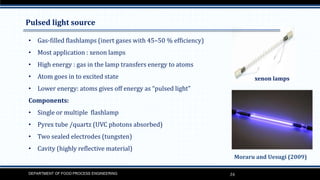
Pulsed light source
• Gas-filled flashlamps (inert gases with 45–50 % efficiency)
• Most application : xenon lamps
• High energy : gas in the lamp transfers energy to atoms
• Atom goes in to excited state
• Lower energy: atoms gives off energy as “pulsed light”
Components:
• Single or multiple flashlamp
• Pyrex tube /quartz (UVC photons absorbed)
• Two sealed electrodes (tungsten)
• Cavity (highly reflective material)
Moraru and Uesugi (2009)
16
xenon lamps
SCHEMATIC VIEW
Dunn et al., 1989
18
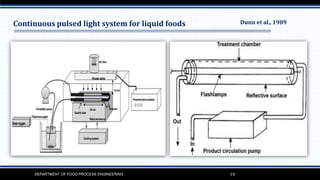
Continuous pulsed light system for liquid foods Dunn et al., 1989
19
CASE STUDY
20
CASE STUDY 1
21
22
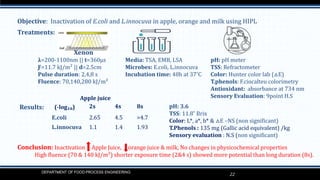
Objective: Inactivation of E.coli and L.innocuva in apple, orange and milk using HIPL
Treatments:
Results:
Conclusion: Inactivation Apple Juice, orange juice & milk, No changes in physicochemical properties
High fluence (70 & 140 kJ/m²) shorter exposure time (2&4 s) showed more potential than long duration (8s).
Xenon
λ=200-1100nm || t=360µs
Ƒ=11.7 kJ/m² || d=2.5cm
Pulse duration: 2,4,8 s
Fluence: 70,140,280 kJ/m²
Media: TSA, EMB, LSA
Microbes: E.coli, L.innocuva
Incubation time: 48h at 37˚C
pH: pH meter
TSS: Refractometer
Color: Hunter color lab (△E)
T.phenols: F.ciocalteu colorimetry
Antioxidant: absorbance at 734 nm
Sensory Evaluation: 9point H.S
2s 4s 8s pH: 3.6
TSS: 11.8˚ Brix
Color: L*, a*, b* & △E –NS (non significant)
T.Phenols : 135 mg (Gallic acid equivalent) /kg
Sensory evaluation : N.S (non significant)
E.coli 2.65 4.5 >4.7
L.innocuva 1.1 1.4 1.93
(-log₁₀)
Apple juice
CASE STUDY 2
23
24
Objective: Surface decontamination and quality impact of IPL on spinach
Treatments:
λ=180-1100nm || t=0.3ms
Ƒ=4 kJ/m² || d=8.5cm
Pulse dosage: 0,2,5,10,15,20, 30
Fluence: 0,8,20,40,60,80,120 kJ/m²
Microbes: E.coli,
L.innocuva
Incubation time:
24-48h at 35-37˚C
Color: D75 illuminant at 5˚
T.phenols: F.ciocalteu-765nm
Antioxidant: Free radical scavenging
DPPH-515nm
Gas analysis: Micro GC : O₂-60˚C -100kpa
Co2-70˚C -200kpa
Ƒ=20&40 kJ/m²
Pulse dosage=5, 10
Results:
Conclusion: +ve micro. Inactivation, respiration, phenolic content
Xenon
(-log₁₀): 1.85 &1.72 at 10kJ/m²
(2pulse) 2.6 & 2.3 120kJ/m²
Color (8th day): L*(36.5/37.1), a*(-9.5/-10.2), b*(12.9/14.6)
Gas: Co2-0.22./0.04 bar (8th day), O₂ -0.04/0.00 bar (8th day)
T.Phenols (8th day): 1100/1850 mg/kg
Antioxidant (8th day): 420/900 mg/kg
REFERENCES:
Agüero, M. Victoria, Jagus, Rosa J., Martín-Belloso, Olga, & Soliva-Fortuny, Robert. (2016). Surface
decontamination of spinach by intense pulsed light treatments: Impact on quality attributes.
Postharvest Biology and Technology, 121, 118-125. doi: 10.1016/j.postharvbio.2016.07.018
Avalos Llano, Karina R., Marsellés-Fontanet, Angel R., Martín-Belloso, Olga, & Soliva-Fortuny,
Robert. (2016). Impact of pulsed light treatments on antioxidant characteristics and quality
attributes of fresh-cut apples. Innovative Food Science & Emerging Technologies, 33, 206-215.
doi: 10.1016/j.ifset.2015.10.021
Babilas, P., Schreml, S., Szeimies, R. M., & Landthaler, M. (2010). Intense pulsed light (IPL): a
review. Lasers Surg Med, 42(2), 93-104. doi: 10.1002/lsm.20877
Bhavya, M. L., & Umesh Hebbar, H. (2017). Pulsed light processing of foods for microbial safety.
Food Quality and Safety, 1(3), 187-202. doi: 10.1093/fqsafe/fyx017
25
Boulaaba, A., Egen, N., & Klein, G. (2014). Effect of pulsed electric fields on microbial inactivation and physico-
chemical properties of whole porcine blood. Food Sci Technol Int, 20(3), 215-225. doi:
10.1177/1082013213482475
Elmnasser, N., Guillou, S., Leroi, F., Orange, N., Bakhrouf, A., & Federighi, M. (2007). Pulsed-light system as a novel
food decontamination technology: a review. Can J Microbiol, 53(7), 813-821. doi: 10.1139/W07-042
Gómez-López, Vicente M., Ragaert, Peter, Debevere, Johan, & Devlieghere, Frank. (2007). Pulsed light for food
decontamination: a review. Trends in Food Science & Technology, 18(9), 464-473. doi:
10.1016/j.tifs.2007.03.010
Hilton, S. T., de Moraes, J. O., & Moraru, C. I. (2017). Effect of sublethal temperatures on pulsed light inactivation
of bacteria. Innovative Food Science & Emerging Technologies, 39, 49-54. doi: 10.1016/j.ifset.2016.11.002
Oms-Oliu, Gemma, Martín-Belloso, Olga, & Soliva-Fortuny, Robert. (2008). Pulsed Light Treatments for Food
Preservation. A Review. Food and Bioprocess Technology, 3(1), 13-23. doi: 10.1007/s11947-008-0147-x
Preetha, P., Venugopal, Arun Prasath, Varadharaju, N., & Kennedy, Z. John. (2017). Inactivation of Escherichia coli
in Tender Coconut (Cocos Nucifera L.) Water by Pulsed Light Treatment. International Journal of Current
Microbiology and Applied Sciences, 6(7), 1453-1461. doi: 10.20546/ijcmas.2017.607.174
26
Thank You !!!
Questions ?
27

High intensity pulsed light technology

  • 1.
    DEPARTMENT OF FOODPROCESS ENGINEERING 1 HIGH-INTENSITY PULSED LIGHT TECHNOLOGY M.Venkatasami M.Tech (Processing and Food Engineering) Department of Food Process Engineering AEC&RI, TNAU.
  • 2.
    High Intensity PulsedLight Technology DEPARTMENT OF FOOD PROCESS ENGINEERING 2 • Technology, known since the 1980s & FDA approved since 1996 • High energy (100–120 kJ/m²) in short (1µs-0.1 s) pulses (1-20) • Interval between pulses 0.1-5s (FDA : 2 s) • Product exposed to pulsed light through _ Xenon lamps • Purification and sterilization of food items • Existing of both batch and continues process • Product's : Liquids and solids (juices, milk, meat, etc.) • Effects include photochemical and photothermal • Classed as “non thermal technology”
  • 3.
    DEPARTMENT OF FOODPROCESS ENGINEERING 3 PRINCIPLE Dunn et al., 1989
  • 4.
    • Conductive heattransfer q (W) and T (˚C) –depends on intensity and duration of incident ray • Effect of radiation evaluated using the energy density or fluence F Parameter Symbol Unit Key Relations Pulse duration s Pulse frequency ƒ Hz ƒ= 1/t Peak Power Ppeak W Pulse energy E J Pulse spot area A cm2 𝐴 = 𝜋×𝑟2 Peak Intensity Ipeak W/cm2 Pulse fluence Fpulse J/cm2 𝐹𝑝𝑢𝑙𝑠𝑒=𝐸 /𝐴 Calculation of output parameters of pulsed light Gomez-Lopez et al., 2007 5 Power delivered by continuous light and light pulses
  • 5.
    KINETICS Pulsed light destructionkinetics : first order Logarithmic order of death •Logₑ(N/Nₒ)=-kt The decimal reduction Time (D-value) •DF=-(1/slope)=(t₂-t₁)/(log(N/Nₒ) zF= increment of n required to reduce DF by 1 log •zF =-(1/slope)=(n₂-n₁)/(logD1/D2) •Ftot = n.F No =the initial number of microorganisms N =number of organisms that survived t (min)=treatment time k =reaction rate constant (min-1) n=number of pulses Allison Pollock, 2007 6
  • 6.
    PULSED LIGHT PARAMETERSUSED FOR MICROBIAL INACTIVATION Source Target Wavelength distribution Transparency Energy density or Fluence (F) Size Pulse duration (τ) Surface condition Number of the pulses applied (n) Temperature Pulse frequency (f) low solute concentration • Product: low reflection coefficient, higher absorption coefficient , higher transmission coefficient • Absorption enhancing agent (photon sensitive agent): • Packaging materials : Dyes • Foods : Carotene, lime green, black cherry, cooking oils Kundwal, Lani, & Tamuri, 2015 7
  • 7.
    Lamp Spectral range (nm) Treatment time (s) Pulse Duration (μs) Total Fluence (J/cm²) Puls e Per Sec (Hz) Host MediumLog Reduction Sample- lamp distance (cm) 200-1100 3.3 ** 360 4 3 Apple Juice 3.1 1.9 200-1100 4.2 ** 360 5.1 3 Apple Juice 4.9 1.9 100-1100 - 360 4 3 Apple Juice 4 5.8 100-1100 - 360 4 3 Orange Juice 2.9 5.8 Inactivation of Escherichia coli using HIPLF • Inactivation of enzyme • No change in nutritional quality (riboflavin and vitamin E) • No change in sensory attributes Kundwal, Lani, & Tamuri, 2015 8
  • 8.
    HIPLF ON MICROBES Inactivationmechanism • Photochemical • Photothermal Photochemical mechanism • Pyrimidine dimers • Pyrimidine (6–4) pyrimidone photoproducts • Thymine dimers • Inhibits photoreactivation • Cyclobutane ring Hariharan and Gerutti, 1977 9
  • 9.
    PHOTOTHERMAL MECHANISM • Cellmembrane damage Mansel Griffiths, 2005 10 bond Pore formation on cell membrane
  • 10.
    MICROBIAL INACTIVATION Gram stain Size Spore StrainVariation Mould Bacteria Rowan et al. (1999) Dunn et al. (1991) 11
  • 11.
    HIPLF EQUIPMENT DEPARTMENT OFFOOD PROCESS ENGINEERING 11 Important components : • Electric power supply • Electric energy storage unit • Electric pulse forming unit • Pulsed light source Electric power supply Charger: Converts low-voltage AC power into high-voltage DC power Charges the energy-storage device (50kW) Advanced types have a transformer that is operated at a high frequency. Griffiths & Walkling-Ribeiro, 2014 HIPLF Circuit
  • 12.
    DEPARTMENT OF FOODPROCESS ENGINEERING 12 • Capacitor (0.1-10µ F), or an inductor (30 µH ) • High voltage capacitors are connected in parallel • Alternative: Marx generators • Generates high-voltage pulse from a low-voltage DC supply • Voltage amplifiers _large amounts of higher voltage current Electric energy storage Pai and Zhang, 1995 10µ F Capacitor Marx generators
  • 13.
    Switches DEPARTMENT OF FOODPROCESS ENGINEERING 13 • Starts and/or terminates the pulse (100 kV) • Duration of the pulse is determined only by the closing and the opening of the switch • Trigatrons (three-electrode spark gaps) • Thyratrons and pseudospark switches • Thyristors and IGCTs (70kv). • Insulated Gate Bipolar Transistor (IGBT) Gongora-Nieto et al., 2002 IGBT
  • 14.
    IC 555 DEPARTMENT OFFOOD PROCESS ENGINEERING 14 Useful in timer pulse generation and oscillator applications 2 modes : • Mono stable multi vibrator • Astable multi vibrator Mono stable multi vibrator • Remain indefinitely in stable state • Application of trigger pulse - quasi-stable state • Produces pulse with fixed duration • Time t=RCln(3) Ashoksuraj, 2017 IC 555
  • 15.
    Pulsed light source •Gas-filled flashlamps (inert gases with 45–50 % efficiency) • Most application : xenon lamps • High energy : gas in the lamp transfers energy to atoms • Atom goes in to excited state • Lower energy: atoms gives off energy as “pulsed light” Components: • Single or multiple flashlamp • Pyrex tube /quartz (UVC photons absorbed) • Two sealed electrodes (tungsten) • Cavity (highly reflective material) Moraru and Uesugi (2009) 16 xenon lamps
  • 16.
  • 17.
    Continuous pulsed lightsystem for liquid foods Dunn et al., 1989 19
  • 18.
  • 19.
  • 20.
    22 Objective: Inactivation ofE.coli and L.innocuva in apple, orange and milk using HIPL Treatments: Results: Conclusion: Inactivation Apple Juice, orange juice & milk, No changes in physicochemical properties High fluence (70 & 140 kJ/m²) shorter exposure time (2&4 s) showed more potential than long duration (8s). Xenon λ=200-1100nm || t=360µs Ƒ=11.7 kJ/m² || d=2.5cm Pulse duration: 2,4,8 s Fluence: 70,140,280 kJ/m² Media: TSA, EMB, LSA Microbes: E.coli, L.innocuva Incubation time: 48h at 37˚C pH: pH meter TSS: Refractometer Color: Hunter color lab (△E) T.phenols: F.ciocalteu colorimetry Antioxidant: absorbance at 734 nm Sensory Evaluation: 9point H.S 2s 4s 8s pH: 3.6 TSS: 11.8˚ Brix Color: L*, a*, b* & △E –NS (non significant) T.Phenols : 135 mg (Gallic acid equivalent) /kg Sensory evaluation : N.S (non significant) E.coli 2.65 4.5 >4.7 L.innocuva 1.1 1.4 1.93 (-log₁₀) Apple juice
  • 21.
  • 22.
    24 Objective: Surface decontaminationand quality impact of IPL on spinach Treatments: λ=180-1100nm || t=0.3ms Ƒ=4 kJ/m² || d=8.5cm Pulse dosage: 0,2,5,10,15,20, 30 Fluence: 0,8,20,40,60,80,120 kJ/m² Microbes: E.coli, L.innocuva Incubation time: 24-48h at 35-37˚C Color: D75 illuminant at 5˚ T.phenols: F.ciocalteu-765nm Antioxidant: Free radical scavenging DPPH-515nm Gas analysis: Micro GC : O₂-60˚C -100kpa Co2-70˚C -200kpa Ƒ=20&40 kJ/m² Pulse dosage=5, 10 Results: Conclusion: +ve micro. Inactivation, respiration, phenolic content Xenon (-log₁₀): 1.85 &1.72 at 10kJ/m² (2pulse) 2.6 & 2.3 120kJ/m² Color (8th day): L*(36.5/37.1), a*(-9.5/-10.2), b*(12.9/14.6) Gas: Co2-0.22./0.04 bar (8th day), O₂ -0.04/0.00 bar (8th day) T.Phenols (8th day): 1100/1850 mg/kg Antioxidant (8th day): 420/900 mg/kg
  • 23.
    REFERENCES: Agüero, M. Victoria,Jagus, Rosa J., Martín-Belloso, Olga, & Soliva-Fortuny, Robert. (2016). Surface decontamination of spinach by intense pulsed light treatments: Impact on quality attributes. Postharvest Biology and Technology, 121, 118-125. doi: 10.1016/j.postharvbio.2016.07.018 Avalos Llano, Karina R., Marsellés-Fontanet, Angel R., Martín-Belloso, Olga, & Soliva-Fortuny, Robert. (2016). Impact of pulsed light treatments on antioxidant characteristics and quality attributes of fresh-cut apples. Innovative Food Science & Emerging Technologies, 33, 206-215. doi: 10.1016/j.ifset.2015.10.021 Babilas, P., Schreml, S., Szeimies, R. M., & Landthaler, M. (2010). Intense pulsed light (IPL): a review. Lasers Surg Med, 42(2), 93-104. doi: 10.1002/lsm.20877 Bhavya, M. L., & Umesh Hebbar, H. (2017). Pulsed light processing of foods for microbial safety. Food Quality and Safety, 1(3), 187-202. doi: 10.1093/fqsafe/fyx017 25
  • 24.
    Boulaaba, A., Egen,N., & Klein, G. (2014). Effect of pulsed electric fields on microbial inactivation and physico- chemical properties of whole porcine blood. Food Sci Technol Int, 20(3), 215-225. doi: 10.1177/1082013213482475 Elmnasser, N., Guillou, S., Leroi, F., Orange, N., Bakhrouf, A., & Federighi, M. (2007). Pulsed-light system as a novel food decontamination technology: a review. Can J Microbiol, 53(7), 813-821. doi: 10.1139/W07-042 Gómez-López, Vicente M., Ragaert, Peter, Debevere, Johan, & Devlieghere, Frank. (2007). Pulsed light for food decontamination: a review. Trends in Food Science & Technology, 18(9), 464-473. doi: 10.1016/j.tifs.2007.03.010 Hilton, S. T., de Moraes, J. O., & Moraru, C. I. (2017). Effect of sublethal temperatures on pulsed light inactivation of bacteria. Innovative Food Science & Emerging Technologies, 39, 49-54. doi: 10.1016/j.ifset.2016.11.002 Oms-Oliu, Gemma, Martín-Belloso, Olga, & Soliva-Fortuny, Robert. (2008). Pulsed Light Treatments for Food Preservation. A Review. Food and Bioprocess Technology, 3(1), 13-23. doi: 10.1007/s11947-008-0147-x Preetha, P., Venugopal, Arun Prasath, Varadharaju, N., & Kennedy, Z. John. (2017). Inactivation of Escherichia coli in Tender Coconut (Cocos Nucifera L.) Water by Pulsed Light Treatment. International Journal of Current Microbiology and Applied Sciences, 6(7), 1453-1461. doi: 10.20546/ijcmas.2017.607.174 26
  • 25.