Presented to- Mrs. Neha Singh
Presented by- Ridham Walia
Roll No.- 14/PFT/003
NOZZLE DRYERS
CONTENTS
* Spray Drying
* Types of atomizers: Rotary atomizer
* Pressure Nozzle atomizer
* Two- fluid nozzle atomizer
* Pneumatic nozzle
* Common uses
References
Spray Drying
Definition-
A special process which is used to transform the feed from a
liquid state into a dried particulate form (Powder or Particles)
by spraying the feed into a hot drying medium.
Contd.
*Atomizer or spray nozzles are used to disperse the liquid or slurry into a
controlled drop size spray.
*Most common of these are rotary disks and single-fluid high pressure swirl
nozzles.
*Atomizer wheels are known to provide broader particle size distribution.
*Alternatively, for some applications two-fluid or ultrasonic nozzles are used.
*Depending on the process needs, drop sizes from 10 to 500 µm can be achieved
with the appropriate choices.
*Most common applications are in the 100 to 200 µm diameter range. The dry
powder is often free-flowing.
*For many industries a standard pressure nozzle operating in the 3,000-4,000 psi
and 175-400°F will excel.
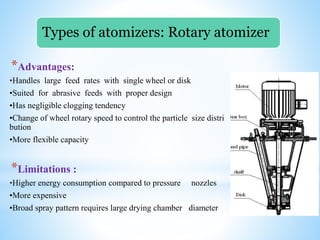
Types of atomizers: Rotary atomizer
*Advantages:
•Handles large feed rates with single wheel or disk
•Suited for abrasive feeds with proper design
•Has negligible clogging tendency
•Change of wheel rotary speed to control the particle size distri
bution
•More flexible capacity
*Limitations :
•Higher energy consumption compared to pressure nozzles
•More expensive
•Broad spray pattern requires large drying chamber diameter
Pressure nozzle atomiser
*Liquid is forced at a high pressure (700-2000 kPa) through a small
orifice. Nozzles have a maximum flow rate of 1 L/h.
*Typical pressures range from 300 to 4000 psi.
*Dryers with pressure nozzles typically contain drying chambers that
are narrow in diameter and tall in height.
* The small orifice facilitates clogging, so pressure nozzles are
seldom used when the feed is highly concentrated.
*Grooves on the inside of the nozzle cause the spray to form into a
cone shape and then reform to use the full volume of the drying
chamber.
Pressure Nozzle
*Advantages:
* Simple, compact and cheap
* No moving parts
* Low energy consumption
*Limitations:
* Low capacity (feed rate for single nozzle)
* High tendency to clog
* Erosion can change spray characteristics
Two - fluid nozzle atomiser
*Compressed air creates turbulence, which
atomises the liquid.
*The operating pressure is lower than the
pressure nozzle, but a wider range of droplet
sizes is produced.
*Both types of nozzle atomiser are susceptible to
blockage by particulate foods, and abrasive
foods gradually widen the apertures and
increase the average droplet size.
Pneumatic nozzles
*Advantages:
* Simple, compact and cheap
* No moving parts
* Handle the feedstocks with high‐viscosity
* Produce products with very small size particle
*Limitations:
* High energy consumption
* Low capacity (feed rate)
* High tendency to clog
Pneumatic nozzle
Common Uses / Installations of
Spray Drying Nozzles
Dairy Industry: drying full cream and skim milk, cheese, whey, and
baby formula.
Foodstuffs: instant coffee, edible plant proteins, tomato, egg, baking
products, yeasts, and other extracts.
Chemical industry: polycarbonate and polyvinyl products among many
other organic and inorganic chemicals. Ceramics, soaps and detergents,
agricultural products, dyestuffs, mineral and ore products, and cellulose.
REFERENCES
 en.wikipedia.org
 ppt on spray drying of foods
 PDF file on Classification of dryers
 Spray drying technology: An overview
Indian Journal of Science and Technology
Nozzle dryers...

Nozzle dryers...

  • 1.
    Presented to- Mrs.Neha Singh Presented by- Ridham Walia Roll No.- 14/PFT/003 NOZZLE DRYERS
  • 2.
    CONTENTS * Spray Drying *Types of atomizers: Rotary atomizer * Pressure Nozzle atomizer * Two- fluid nozzle atomizer * Pneumatic nozzle * Common uses References
  • 3.
    Spray Drying Definition- A specialprocess which is used to transform the feed from a liquid state into a dried particulate form (Powder or Particles) by spraying the feed into a hot drying medium.
  • 5.
    Contd. *Atomizer or spraynozzles are used to disperse the liquid or slurry into a controlled drop size spray. *Most common of these are rotary disks and single-fluid high pressure swirl nozzles. *Atomizer wheels are known to provide broader particle size distribution. *Alternatively, for some applications two-fluid or ultrasonic nozzles are used. *Depending on the process needs, drop sizes from 10 to 500 µm can be achieved with the appropriate choices. *Most common applications are in the 100 to 200 µm diameter range. The dry powder is often free-flowing. *For many industries a standard pressure nozzle operating in the 3,000-4,000 psi and 175-400°F will excel.
  • 6.
    Types of atomizers:Rotary atomizer *Advantages: •Handles large feed rates with single wheel or disk •Suited for abrasive feeds with proper design •Has negligible clogging tendency •Change of wheel rotary speed to control the particle size distri bution •More flexible capacity *Limitations : •Higher energy consumption compared to pressure nozzles •More expensive •Broad spray pattern requires large drying chamber diameter
  • 7.
    Pressure nozzle atomiser *Liquidis forced at a high pressure (700-2000 kPa) through a small orifice. Nozzles have a maximum flow rate of 1 L/h. *Typical pressures range from 300 to 4000 psi. *Dryers with pressure nozzles typically contain drying chambers that are narrow in diameter and tall in height. * The small orifice facilitates clogging, so pressure nozzles are seldom used when the feed is highly concentrated. *Grooves on the inside of the nozzle cause the spray to form into a cone shape and then reform to use the full volume of the drying chamber.
  • 8.
    Pressure Nozzle *Advantages: * Simple,compact and cheap * No moving parts * Low energy consumption *Limitations: * Low capacity (feed rate for single nozzle) * High tendency to clog * Erosion can change spray characteristics
  • 9.
    Two - fluidnozzle atomiser *Compressed air creates turbulence, which atomises the liquid. *The operating pressure is lower than the pressure nozzle, but a wider range of droplet sizes is produced. *Both types of nozzle atomiser are susceptible to blockage by particulate foods, and abrasive foods gradually widen the apertures and increase the average droplet size.
  • 10.
  • 11.
    *Advantages: * Simple, compactand cheap * No moving parts * Handle the feedstocks with high‐viscosity * Produce products with very small size particle *Limitations: * High energy consumption * Low capacity (feed rate) * High tendency to clog Pneumatic nozzle
  • 13.
    Common Uses /Installations of Spray Drying Nozzles Dairy Industry: drying full cream and skim milk, cheese, whey, and baby formula. Foodstuffs: instant coffee, edible plant proteins, tomato, egg, baking products, yeasts, and other extracts. Chemical industry: polycarbonate and polyvinyl products among many other organic and inorganic chemicals. Ceramics, soaps and detergents, agricultural products, dyestuffs, mineral and ore products, and cellulose.
  • 14.
    REFERENCES  en.wikipedia.org  ppton spray drying of foods  PDF file on Classification of dryers  Spray drying technology: An overview Indian Journal of Science and Technology