EVAPORATION
Mamta Sahurkar
• Frequently in the food industry a raw material or a potential
foodstuff contains more water than is required in the final
product.
• When the food stuff is liquid, the easiest method of removing
the water, in general, is to apply heat to evaporate it.
• Evaporation is thus a process which is often used by food
technologist.
Introduction
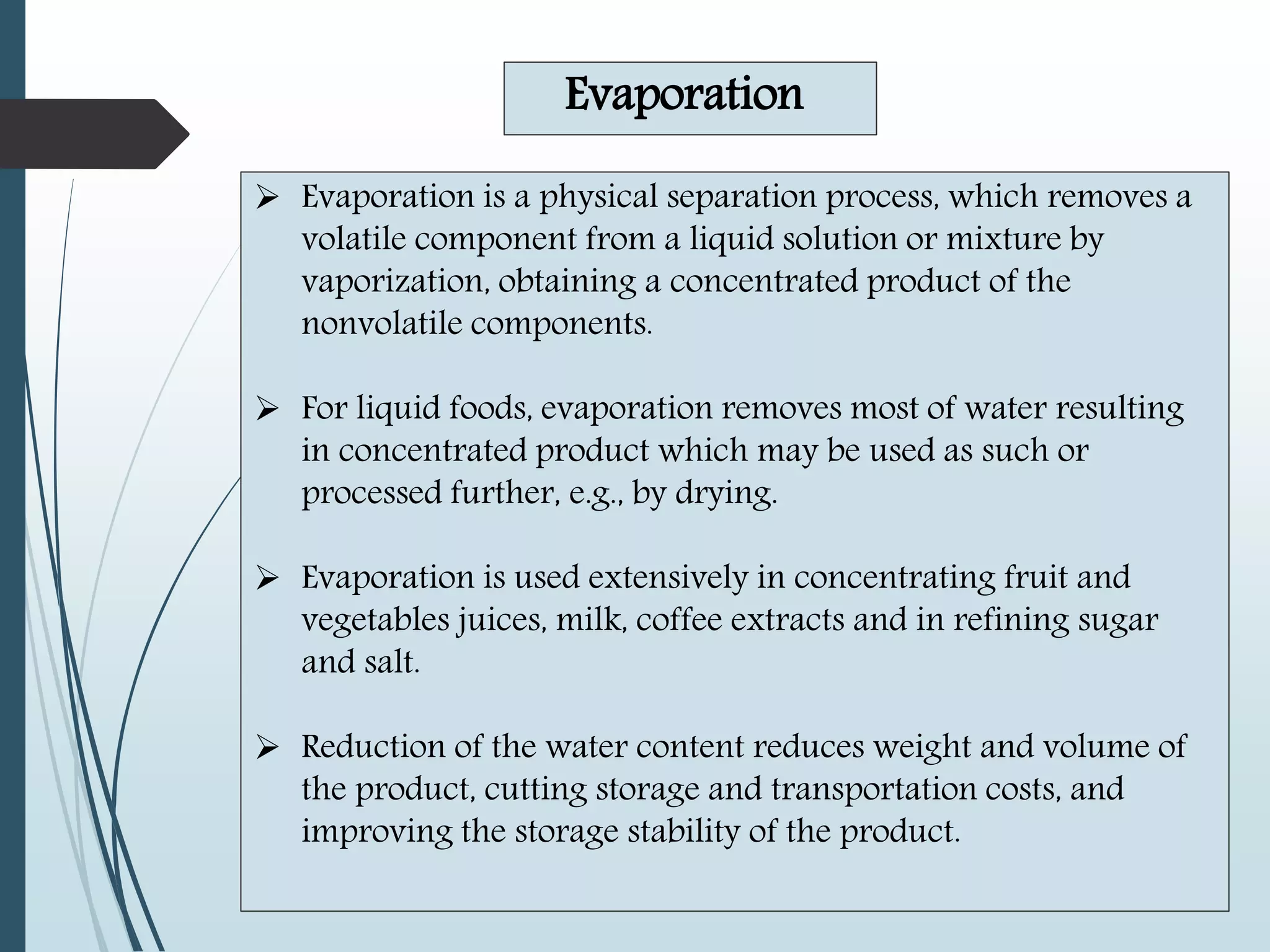
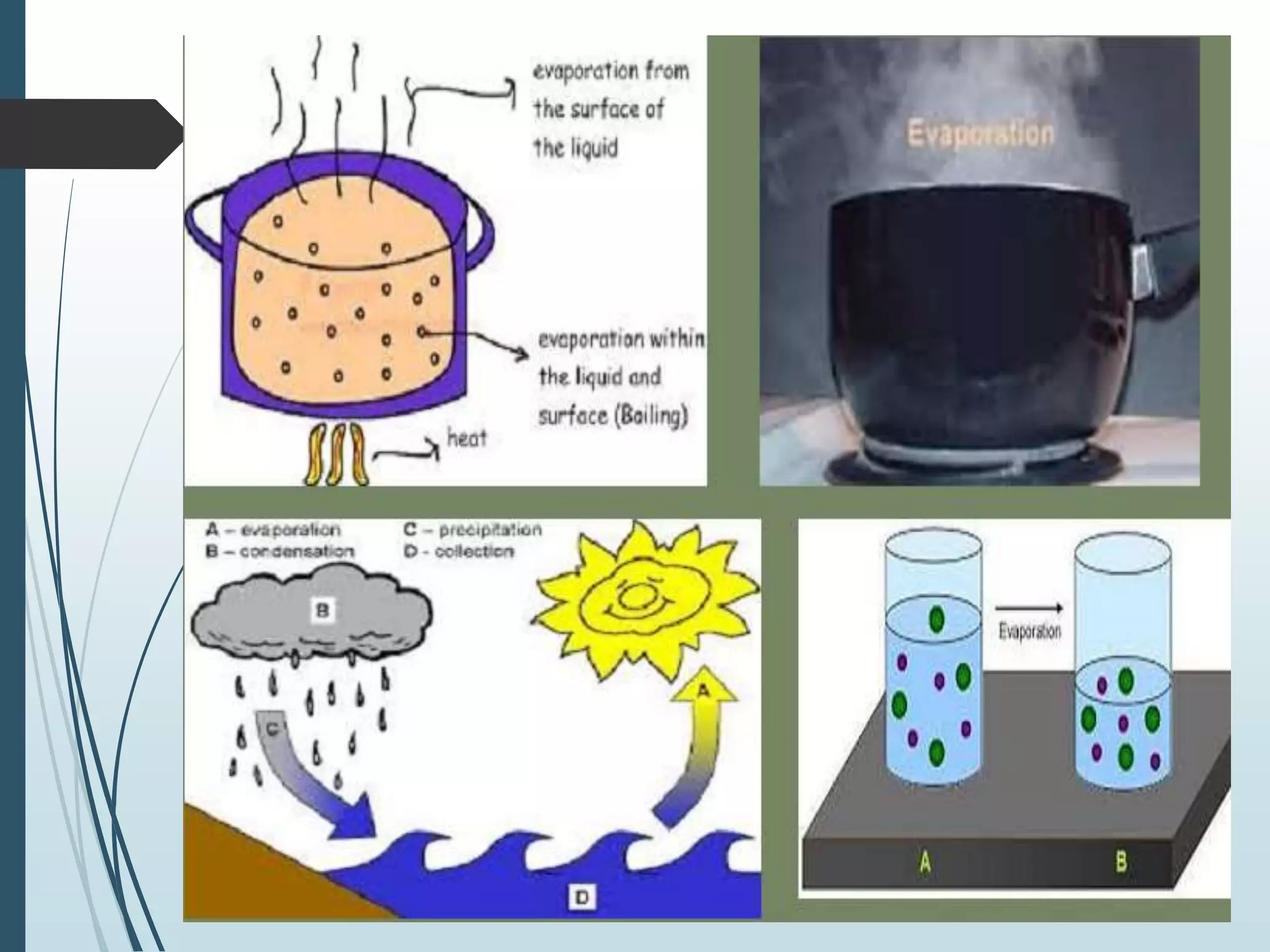
 Evaporation is a physical separation process, which removes a
volatile component from a liquid solution or mixture by
vaporization, obtaining a concentrated product of the
nonvolatile components.
 For liquid foods, evaporation removes most of water resulting
in concentrated product which may be used as such or
processed further, e.g., by drying.
 Evaporation is used extensively in concentrating fruit and
vegetables juices, milk, coffee extracts and in refining sugar
and salt.
 Reduction of the water content reduces weight and volume of
the product, cutting storage and transportation costs, and
improving the storage stability of the product.
Evaporation
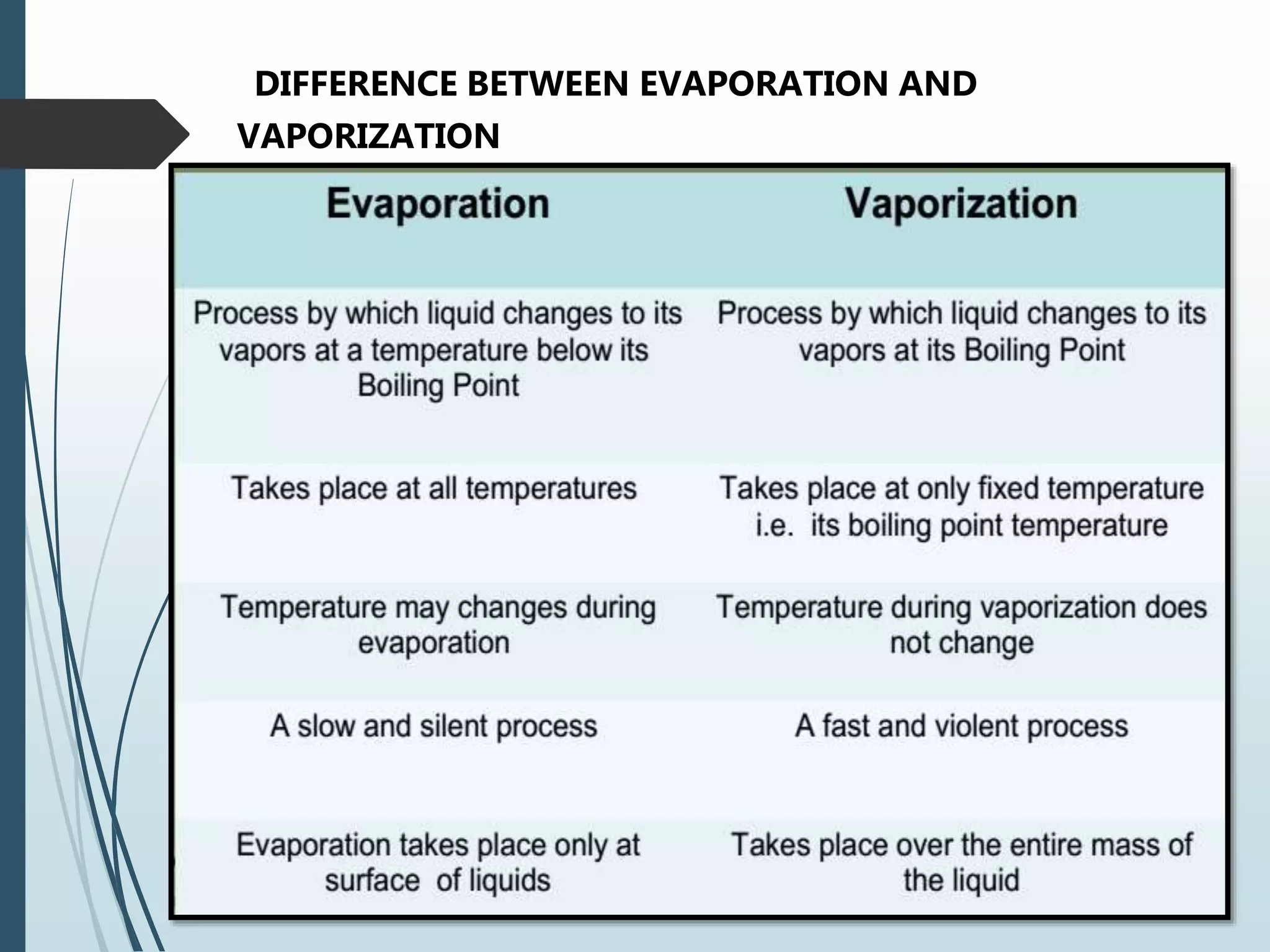
DIFFERENCE BETWEEN EVAPORATION AND
VAPORIZATION
DIFFERENCE BETWEEN DRYING AND EVAPORIZATION
• Reduces transportation cost
• Storage costs
• Prepare for the next Unit operation –
drying, crystallisation etc.
• Reduces deteriorative chemical reactions
• Better microbiological stability
• Recovery of solvent
Why we need evaporation???
• Temperature:-
The rate of evaporation is directly proportional to the rate of
temperature. Higher the temperature higher will be rate of
evaporation but evaporation is maximum at boiling point of the
liquid.
• Surface Area:-
The rate of evaporation is directly proportional to the surface area of
the vessel exposed to evaporation. Greater the surface exposed to
evaporation higher will be rate of evaporation.
• Agitation:-
During evaporation the upper layer of liquid to be evaporated has a
tendency to form a scum or layer which lowers the rate of
evaporation. Therefore it becomes necessary to agitate or stirrer the
solution under evaporation. This will also prevent the decomposition
of product at the bottom due to excessive heat and will also prevent
the settling of solids at the bottom of container.
Factors Affecting Evaporation
• The equipment used to remove water from the food
product is called evaporator.
• Evaporators are used to separate materials based on
differences in their boiling temperatures.
• Its purpose is to concentrate nonvolatile solutes such
as organic compounds, inorganic salts, acids or bases.
• Typical solutes include phosphoric acid, caustic soda,
sodium chloride, sodium sulfate, gelatin, syrups and
urea.
Evaporator
• An evaporator is used to evaporate a volatile solvent,
usually water, from a solution. Its purpose is to concentrate
non-volatile solutes such as organic compounds, inorganic
salts, acids or bases.
• Typical solutes include phosphoric acid, caustic soda,
sodium chloride, sodium sulphate, gelatin, syrups and urea.
• In many applications, evaporation results in the
precipitation of solutes in the form of crystals, which are
usually separated from the solution with cyclones, settlers,
wash columns, elutriating legs, filters or centrifuges.
• Examples of precipitates are sodium chloride, sodium
sulfate, sodium carbonate and calcium sulphate.
• The desired product can be the concentrated solution, the
precipitated solids, or both.
Evaporator
Basic Parts of an Evaporator
• Heat-exchanger
• Vacuum
• Vapour separator
• Condenser
SELECTION OF EVAPORATOR
• Type of Product required
The selection of method and apparatus to be used for evaporation depends
upon the type of product required and product characteristics, including
heat sensitivity, viscosity and flow properties, foaming tendency, fouling
and precipitation, boiling behavior etc.
• Economic Factors
While selecting the method and apparatus employed for evaporation, due
consideration must be given to economy of labour, fuel, floor area and
materials. The recovery of solvents and the utilization of ‘waste’ heat are
also important factors which contribute significantly in the reduction of
overall costs.
• Capacity and operational data, including quantities,
concentrations, temperatures, annual operating hours,
change of product etc.
• Required operating media, such as steam, cooling water,
electric power, cleaning agents, spare parts, etc.
• Standards and conditions for manufacture delivery,
acceptance, etc.
• Site conditions, such as available space, climate (for
outdoor sites), connections for energy and product, service
platforms, etc.
Energy Saving Evaporation Systems.
• Single effect evaporators
• Multiple effect evaporators
• Vapor Recompression Evaporators
• The typical evaporator is made up of three
functional sections:
• The heat exchanger
• The evaporating section – where liquid boils
and evaporates
• Separator– in which vapor leaves the liquid
and passes off to the condenser or the other
equipment.
• In many evaporators all these three sections
are contained in a single vertical cylinder.
The single effect evaporator
• In the centre of cylinder there is steam heating section, with pipes
passing through it in which the evaporating liquors rise.
• At the top of the cylinder the baffles which allow the vapors to
escape but check liquid droplets which may accompany the
vapors from the liquid surface this type of evaporator which may
be called conventional evaporator.
• In the centre of cylinder there is steam heating section, with pipes
passing through it in which the evaporating liquors rise.
• At the top of the cylinder the baffles which allow the
vapors to escape but check liquid droplets which may accompany
the vapors from the liquid surface this type of evaporator which may
be called conventional evaporator.
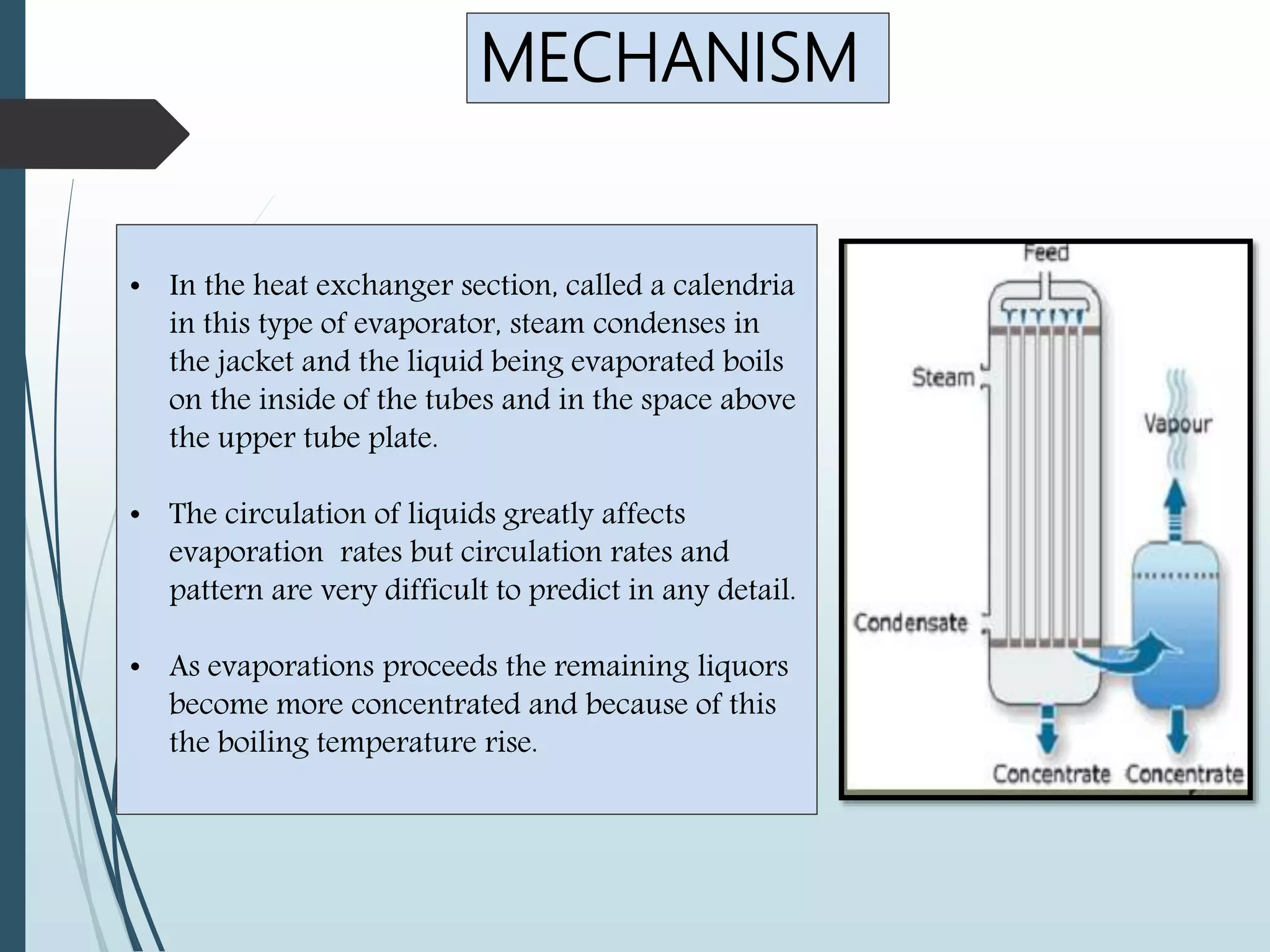
• In the heat exchanger section, called a calendria
in this type of evaporator, steam condenses in
the jacket and the liquid being evaporated boils
on the inside of the tubes and in the space above
the upper tube plate.
• The circulation of liquids greatly affects
evaporation rates but circulation rates and
pattern are very difficult to predict in any detail.
• As evaporations proceeds the remaining liquors
become more concentrated and because of this
the boiling temperature rise.
MECHANISM
• The rise in temperature of boiling reduces the
available temperature drop, assuming no change in the
heat source. And so the total rate of heat transfer will
drop accordingly.
• Also the viscosity of liquid will increase, often quite
substantially, this affects circulations and heat transfer
coefficients leading again to lower rates of boiling.
• Multi-Effect Evaporation is an important procedure
adopted to economize the consumption of energy.
• Multi effect evaporation system is based on the
repeated use of the water vapors from one
evaporation unit (effect) to heat the next effect,
which operates at a lower pressure.
• Thus, 1kg of steam can evaporate more water,
depending on the number of effects and the
operating pressures.
Multiple effect evaporator
FEEDING OPERATIONS
There are two feed operations - backward feed and forward feed operations.
Backward operation
• In the backward operation, the raw feed enters the last (coldest)
effect and the discharge from this effect becomes a feed for the
next to last effect.
• This technique of evaporations is advantageous, in case the feed
is cold, as much less liquid must be heated to the higher
temperature existing in the early effects.
• The procedure is also used if the product is viscous and high
temperatures are required to keep the viscosity low enough to
produce good heat transfer coefficients.
Forward operation
In the case of a forward feed operation, the raw feed is introduced
in the first effect and is passed from effect to effect parallel to
steam flow. The product is withdrawn from the last effect. This
procedure is highly advantageous if the feed is hot. The method is
also used if the concentrated product may be damaged or may
deposit scale at high temperature.
Chemical Industry
Dyes, Pickle Liquor, Plating
bath, Salt, Glycerin, Sodium
Nitrate, Sodium Sulphate,
Paints, Pigments.
Corn Industry
Whey, Gelatin, Malt Extract,
Glucose, Fructose, Dextrose,
Corn Steep Liquor, Sorbitol,
Maltodextrin.
Waste Water Treatment
Blow Down, RO reject, Floor
washings, Process effluents,
Black Liquor, Fish Sick Water.
Food Industry
Milk, Fruit Juice, Pulps, Tomato
Puree, Herbal Extracts, Coffee, Tea,
Protein, Gelatin, Coconut Water.
Pharmaceutical Industry
Bulk drugs, Glycerin, Sweet
water, Yeast
Extract, Protein
Hydrolysate
APPLICATIONS
• Evaporation should minimize the undesirable changes
in quality and nutritive value of heat sensitive food
materials.
• Such changes are losses of organoleptic quality( flavor,
aroma, and color), losses of vitamins, and production
of undesirable compounds( browning,
Caramelization).
• Losses of aroma components during evaporation of
fruit juices and aqueous extracts can be restored by
aroma recovery in the distillate or add-back of fresh
juice.
Food quality consideration
THANK
YOU

Evaporation

  • 1.
  • 2.
    • Frequently inthe food industry a raw material or a potential foodstuff contains more water than is required in the final product. • When the food stuff is liquid, the easiest method of removing the water, in general, is to apply heat to evaporate it. • Evaporation is thus a process which is often used by food technologist. Introduction
  • 3.
     Evaporation isa physical separation process, which removes a volatile component from a liquid solution or mixture by vaporization, obtaining a concentrated product of the nonvolatile components.  For liquid foods, evaporation removes most of water resulting in concentrated product which may be used as such or processed further, e.g., by drying.  Evaporation is used extensively in concentrating fruit and vegetables juices, milk, coffee extracts and in refining sugar and salt.  Reduction of the water content reduces weight and volume of the product, cutting storage and transportation costs, and improving the storage stability of the product. Evaporation
  • 5.
  • 6.
    DIFFERENCE BETWEEN DRYINGAND EVAPORIZATION
  • 7.
    • Reduces transportationcost • Storage costs • Prepare for the next Unit operation – drying, crystallisation etc. • Reduces deteriorative chemical reactions • Better microbiological stability • Recovery of solvent Why we need evaporation???
  • 8.
    • Temperature:- The rateof evaporation is directly proportional to the rate of temperature. Higher the temperature higher will be rate of evaporation but evaporation is maximum at boiling point of the liquid. • Surface Area:- The rate of evaporation is directly proportional to the surface area of the vessel exposed to evaporation. Greater the surface exposed to evaporation higher will be rate of evaporation. • Agitation:- During evaporation the upper layer of liquid to be evaporated has a tendency to form a scum or layer which lowers the rate of evaporation. Therefore it becomes necessary to agitate or stirrer the solution under evaporation. This will also prevent the decomposition of product at the bottom due to excessive heat and will also prevent the settling of solids at the bottom of container. Factors Affecting Evaporation
  • 9.
    • The equipmentused to remove water from the food product is called evaporator. • Evaporators are used to separate materials based on differences in their boiling temperatures. • Its purpose is to concentrate nonvolatile solutes such as organic compounds, inorganic salts, acids or bases. • Typical solutes include phosphoric acid, caustic soda, sodium chloride, sodium sulfate, gelatin, syrups and urea. Evaporator
  • 10.
    • An evaporatoris used to evaporate a volatile solvent, usually water, from a solution. Its purpose is to concentrate non-volatile solutes such as organic compounds, inorganic salts, acids or bases. • Typical solutes include phosphoric acid, caustic soda, sodium chloride, sodium sulphate, gelatin, syrups and urea. • In many applications, evaporation results in the precipitation of solutes in the form of crystals, which are usually separated from the solution with cyclones, settlers, wash columns, elutriating legs, filters or centrifuges. • Examples of precipitates are sodium chloride, sodium sulfate, sodium carbonate and calcium sulphate. • The desired product can be the concentrated solution, the precipitated solids, or both. Evaporator
  • 11.
    Basic Parts ofan Evaporator • Heat-exchanger • Vacuum • Vapour separator • Condenser
  • 13.
    SELECTION OF EVAPORATOR •Type of Product required The selection of method and apparatus to be used for evaporation depends upon the type of product required and product characteristics, including heat sensitivity, viscosity and flow properties, foaming tendency, fouling and precipitation, boiling behavior etc. • Economic Factors While selecting the method and apparatus employed for evaporation, due consideration must be given to economy of labour, fuel, floor area and materials. The recovery of solvents and the utilization of ‘waste’ heat are also important factors which contribute significantly in the reduction of overall costs.
  • 14.
    • Capacity andoperational data, including quantities, concentrations, temperatures, annual operating hours, change of product etc. • Required operating media, such as steam, cooling water, electric power, cleaning agents, spare parts, etc. • Standards and conditions for manufacture delivery, acceptance, etc. • Site conditions, such as available space, climate (for outdoor sites), connections for energy and product, service platforms, etc.
  • 15.
    Energy Saving EvaporationSystems. • Single effect evaporators • Multiple effect evaporators • Vapor Recompression Evaporators
  • 16.
    • The typicalevaporator is made up of three functional sections: • The heat exchanger • The evaporating section – where liquid boils and evaporates • Separator– in which vapor leaves the liquid and passes off to the condenser or the other equipment. • In many evaporators all these three sections are contained in a single vertical cylinder. The single effect evaporator
  • 17.
    • In thecentre of cylinder there is steam heating section, with pipes passing through it in which the evaporating liquors rise. • At the top of the cylinder the baffles which allow the vapors to escape but check liquid droplets which may accompany the vapors from the liquid surface this type of evaporator which may be called conventional evaporator. • In the centre of cylinder there is steam heating section, with pipes passing through it in which the evaporating liquors rise. • At the top of the cylinder the baffles which allow the vapors to escape but check liquid droplets which may accompany the vapors from the liquid surface this type of evaporator which may be called conventional evaporator.
  • 18.
    • In theheat exchanger section, called a calendria in this type of evaporator, steam condenses in the jacket and the liquid being evaporated boils on the inside of the tubes and in the space above the upper tube plate. • The circulation of liquids greatly affects evaporation rates but circulation rates and pattern are very difficult to predict in any detail. • As evaporations proceeds the remaining liquors become more concentrated and because of this the boiling temperature rise. MECHANISM
  • 19.
    • The risein temperature of boiling reduces the available temperature drop, assuming no change in the heat source. And so the total rate of heat transfer will drop accordingly. • Also the viscosity of liquid will increase, often quite substantially, this affects circulations and heat transfer coefficients leading again to lower rates of boiling.
  • 20.
    • Multi-Effect Evaporationis an important procedure adopted to economize the consumption of energy. • Multi effect evaporation system is based on the repeated use of the water vapors from one evaporation unit (effect) to heat the next effect, which operates at a lower pressure. • Thus, 1kg of steam can evaporate more water, depending on the number of effects and the operating pressures. Multiple effect evaporator
  • 22.
    FEEDING OPERATIONS There aretwo feed operations - backward feed and forward feed operations. Backward operation
  • 23.
    • In thebackward operation, the raw feed enters the last (coldest) effect and the discharge from this effect becomes a feed for the next to last effect. • This technique of evaporations is advantageous, in case the feed is cold, as much less liquid must be heated to the higher temperature existing in the early effects. • The procedure is also used if the product is viscous and high temperatures are required to keep the viscosity low enough to produce good heat transfer coefficients.
  • 24.
    Forward operation In thecase of a forward feed operation, the raw feed is introduced in the first effect and is passed from effect to effect parallel to steam flow. The product is withdrawn from the last effect. This procedure is highly advantageous if the feed is hot. The method is also used if the concentrated product may be damaged or may deposit scale at high temperature.
  • 25.
    Chemical Industry Dyes, PickleLiquor, Plating bath, Salt, Glycerin, Sodium Nitrate, Sodium Sulphate, Paints, Pigments. Corn Industry Whey, Gelatin, Malt Extract, Glucose, Fructose, Dextrose, Corn Steep Liquor, Sorbitol, Maltodextrin. Waste Water Treatment Blow Down, RO reject, Floor washings, Process effluents, Black Liquor, Fish Sick Water. Food Industry Milk, Fruit Juice, Pulps, Tomato Puree, Herbal Extracts, Coffee, Tea, Protein, Gelatin, Coconut Water. Pharmaceutical Industry Bulk drugs, Glycerin, Sweet water, Yeast Extract, Protein Hydrolysate APPLICATIONS
  • 26.
    • Evaporation shouldminimize the undesirable changes in quality and nutritive value of heat sensitive food materials. • Such changes are losses of organoleptic quality( flavor, aroma, and color), losses of vitamins, and production of undesirable compounds( browning, Caramelization). • Losses of aroma components during evaporation of fruit juices and aqueous extracts can be restored by aroma recovery in the distillate or add-back of fresh juice. Food quality consideration
  • 27.