4/6/2022 1
HURDLE
TECHNOLOGY
M.Venkatasami, I.D.No: 2020641005
Ph.D. (Processing and Food Engineering)
Department of Food Process Engineering
AEC&RI, TNAU.
PFE 602 Advances in Food Engineering (2+1)
4/6/2022 2
INTRODUCTION
Food preservation methods
 Control the growth of microorganisms
 Temperature, water activity(𝑎𝑤), pH, oxidation–reduction potential(Eh), and preservatives
 An optimum to minimum level
 Single factor – reduce nutritional quality
 Preference: fresh, natural, and healthy foods
Hurdle technology
Combination of a
number of milder
preservation factors
Enhanced level of
product quality,
safety, and stability
Limit or prevent
microbial growth
4/6/2022 3
CONT…
 Factors used for food preservation are called “hurdles”.
 Hurdle groups
Physical
Physical
nonthermal
Physicochemical Microbiological Miscellaneous
hurdles
 Influence the quality, safety and stability of foods
 Improper application: loss of nutrients, texture, and color
 Achieve synergies at low intensity
 Prevent the growth of pathogenic or spoilage microorganisms
4/6/2022 4
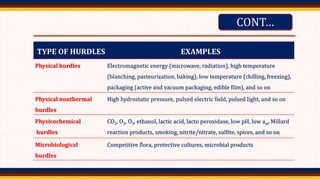
TYPE OF HURDLES EXAMPLES
Physical hurdles Electromagnetic energy (microwave, radiation), high temperature
(blanching, pasteurization, baking), low temperature (chilling, freezing),
packaging (active and vacuum packaging, edible film), and so on
Physical nonthermal
hurdles
High hydrostatic pressure, pulsed electric field, pulsed light, and so on
Physicochemical
hurdles
CO2, O2, O3, ethanol, lactic acid, lacto peroxidase, low pH, low aw, Millard
reaction products, smoking, nitrite/nitrate, sulfite, spices, and so on
Microbiological
hurdles
Competitive flora, protective cultures, microbial products
CONT…
4/6/2022 5
CONT…
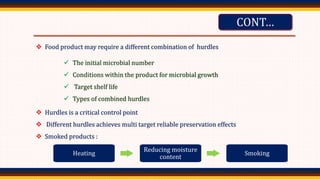
 Food product may require a different combination of hurdles
 The initial microbial number
 Conditions within the product for microbial growth
 Target shelf life
 Types of combined hurdles
 Hurdles is a critical control point
 Different hurdles achieves multi target reliable preservation effects
 Smoked products :
Heating
Reducing moisture
content
Smoking
4/6/2022 6
 Hurdle technology arose from a number of developments :
CONT…
 Consumer demands for healthier foods that retain their original nutritional
properties
 The shift to ready-to-eat and convenience foods that require little further
processing by consumers
 Consumer preference for more “natural” foods that require less processing and
fewer chemical preservatives.
Desired product quality and microbial stability
4/6/2022 7
PRINCIPLES OF COMBINED PRESERVATION METHODS
The factors
Major importance
Secondary importance
Heat resistance
𝑎𝑤
Heat resistance
Preservatives
Inhibition
𝐸ℎ
Mild heating Refrigeration
Canned
foods
4/6/2022 8
CONT…
𝑎𝑤 pH Fermented
sausages
Interaction of different hurdles Improvements in food preservation
 Energy-consuming hurdles
(refrigeration) 𝑎𝑤, pH, Eh
 Hurdle adjustments:
4/6/2022 9
HURDLE EFFECT
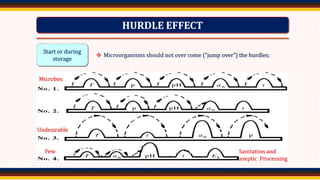
 Microorganisms should not over come (“jump over”) the hurdles;
Start or during
storage
Microbes
Undesirable
Few Sanitation and
aseptic Processing
4/6/2022 10
CONT…
Different
intensities
Important
Bacterial
spores
Inhibited
Fermented
sausage
Nitrite,
salt
Aerobic microbes
LAB
𝑂2 Strong
Synergistic
effect
Homeostasis,
osmoregulation
4/6/2022 11
TOTAL QUALITY OF FOODS
 Hurdles of foods can influence,
Stability
Safety
Sensory
Nutritive
Technological
Economic properties
 Hurdles intensity, Negative Positive
 Chilling at low temperature – chilling injury
 Moderate chilling – inhibiting the microbial growth
 pH- inhibits pathogenic bacteria – Taste impairs
(Fermented sausages )
Intensity of
hurdle
4/6/2022 12
HOMEOSTASIS
 Tendency to maintain uniformity and stability in the internal
microbial cells
Homeostasis
Physiological systems
Operating in balance under unfavorable
environmental condition
 Preservatives - Microbes
 Disturb one or more of the homeostatic mechanisms
 Microorganisms will not multiply
 Remain in the lag phase
 Die before their homeostasis is reestablished
 Metabolic exhaustion
Osmoregulation
 Osmohomeostasis
(tuger - proline and
betaine)
4/6/2022 13
Stress factor in
environment
Homeostatic response of microbial cell
Low level of nutrients
Low level of metabolism, stationary phase, viable non
culturable forms
Low pH Removal of protons from cell, maintenance of pH gradient
Low water activity
Osmoregulation, accumulation of solutes, reduction of water
loss, maintenance of membrane turgor
Low temperature
“Cold shock” response: change in membrane lipid
composition to maintain fluidity
CONT…
4/6/2022 14
Stress factor in
environment
Homeostatic response of microbial cell
Raising temperature “Heat shock” response: change in membrane lipid composition
Raising levels of O2 Enzyme protection (production of catalase, peroxidase, and
superoxide dismutase) from H2O2 and oxygen-derived free
radicals
Presence of biocides Phenotypic adaptation, reduction of cell permeability
Ionizing radiation Repair of single-strand breaks in DNA
Competition Aggregation of cells to show symbiosis and produce biofilms
CONT…
4/6/2022 15
METABOLIC EXHAUSTION
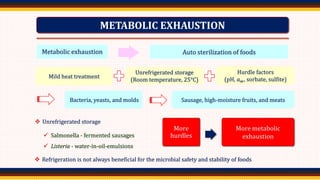
Metabolic exhaustion Auto sterilization of foods
Mild heat treatment
Sausage, high-moisture fruits, and meats
Unrefrigerated storage
(Room temperature, 25°C)
Hurdle factors
(pH, 𝑎𝑤, sorbate, sulfite)
Bacteria, yeasts, and molds
 Salmonella - fermented sausages
 Listeria - water-in-oil-emulsions
 Unrefrigerated storage
 Refrigeration is not always beneficial for the microbial safety and stability of foods
More
hurdles
More metabolic
exhaustion
4/6/2022 16
STRESS REACTIONS
Cross tolerance  Stressed microorganisms become more tolerant to other stresses
 Escherichia coli O157:H7
 Salmonella enterica subsp. enterica ser. Typhimurium,
 Listeria monocytogenes
 Resistance induced by,
Protective stress shock proteins
(PSSPs)
Bacteria may become more
resistant or more virulent
 Heat
 pH
 𝑎𝑤
 Ethanol
 oxidative compounds
 starvation of nutrients
 Acid-shock or acid-adapted cells tolerant to stresses
 Mild heating of microbial cells may increase acid tolerance
4/6/2022 17
MULTITARGET PRESERVATION
Synergistic effect Different preservative factors
 Different stresses will sharply reduce energy of microbial cells
 Increase in the antimicrobial effect of each hurdle
 Synthesis of PSSPs avoided
 Individual hurdles at lower intensity improves product quality
 Antimicrobial action on different targets by the hurdles is known as “multitarget
preservation
 Targets Cell membrane DNA Enzyme systems
4/6/2022 18
APPLICATION
Intermediate-
moisture foods
High-moisture foods Integer foods
 Foods must be differentiated before application of hurdle technology
IMFs HMFs IFs
Fermented Foods Heated Foods Chilled Foods Healthy Foods
4/6/2022 19
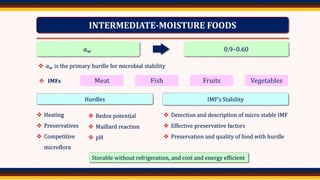
INTERMEDIATE-MOISTURE FOODS
Storable without refrigeration, and cost and energy efficient
𝑎𝑤 0.9–0.60
 𝑎𝑤 is the primary hurdle for microbial stability
Meat Fish Fruits Vegetables
 IMFs
Hurdles IMF’s Stability
 Heating
 Preservatives
 Competitive
microflora
 Redox potential
 Maillard reaction
 pH
 Detection and description of micro stable IMF
 Effective preservative factors
 Preservation and quality of food with hurdle
4/6/2022 20
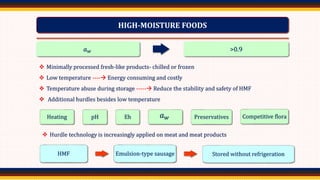
HIGH-MOISTURE FOODS
𝑎𝑤 >0.9
 Minimally processed fresh-like products- chilled or frozen
 Low temperature ---- Energy consuming and costly
 Temperature abuse during storage ----- Reduce the stability and safety of HMF
 Additional hurdles besides low temperature
Heating pH Eh 𝑎𝑤 Preservatives Competitive flora
 Hurdle technology is increasingly applied on meat and meat products
HMF Emulsion-type sausage Stored without refrigeration
4/6/2022 21
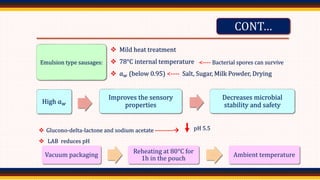
 Mild heat treatment
 78°C internal temperature
 𝑎𝑤 (below 0.95) <---- Salt, Sugar, Milk Powder, Drying
<---- Bacterial spores can survive
Emulsion type sausages:
High 𝑎𝑤
Improves the sensory
properties
Decreases microbial
stability and safety
 Glucono-delta-lactone and sodium acetate ---------
 LAB reduces pH
pH 5.5
Vacuum packaging
Reheating at 80°C for
1h in the pouch
Ambient temperature
CONT…
4/6/2022 22
CONT…
 Heat treatment ------- Eliminates vegetative microorganisms
 The low aw and pH and nitrite ------- Sausage ------- Bacillus and Clostridium spores
 Microbiologically stable and safe ------ Refrigeration not required
 Number of microorganisms decreases faster during storage --- 25°C than at 10°C
 Ambient temperature ---- High metabolic exhaustion
 Highly seasoned chopped or ground pork sausage
 Made with fresh (raw, uncooked) pork/ smoked
4/6/2022 23
 New technologies for the preservation of high-moisture fruit products (HMFPs) – Based
on GMP
CONT…
 Blanching
for 1–3min
 Steam
Mild heat
treatment
 0.98–0.93
 Glucose or
sucrose
Slight
reduction of 𝑎𝑤
 4.1–3.0
 Citric or
phosphoric
acid
Lowering of pH
 Potassium sorbate
 Sodium benzoate
 Sodium sulfite
 Sodium bisulfite
Antimicrobials
 Reuse of syrup in HMFP processing is recommended after pasteurization
 Zygosaccharomyces bailii and Zygosaccharomyces rouxii
4/6/2022 24
INTEGER FOODS
 Whole or integer foods---- Consist of large pieces of plant or animal tissue
Coatings
 Contain and maintain inhibitory substances
 Protect the surface of the foods against microbial spoilage
 Dewatering and impregnation process
 Soaking foods in highly concentrated solutions
 Humectants or other food additions
Solid foods Edible coatings and osmotic dehydration
 Soaking of foods Fruits Vegetables Meat Cheese fish
 Concentrated solutions of humectants (sucrose and NaCl
4/6/2022 25
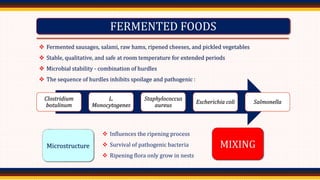
FERMENTED FOODS
 Fermented sausages, salami, raw hams, ripened cheeses, and pickled vegetables
 Stable, qualitative, and safe at room temperature for extended periods
 Microbial stability - combination of hurdles
 The sequence of hurdles inhibits spoilage and pathogenic :
Clostridium
botulinum
L.
Monocytogenes
Staphylococcus
aureus
Escherichia coli Salmonella
Microstructure
 Influences the ripening process
 Survival of pathogenic bacteria
 Ripening flora only grow in nests
MIXING
4/6/2022 26
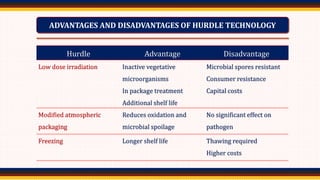
ADVANTAGES AND DISADVANTAGES OF HURDLE TECHNOLOGY
Hurdle Advantage Disadvantage
Low dose irradiation Inactive vegetative
microorganisms
In package treatment
Additional shelf life
Microbial spores resistant
Consumer resistance
Capital costs
Modified atmospheric
packaging
Reduces oxidation and
microbial spoilage
No significant effect on
pathogen
Freezing Longer shelf life Thawing required
Higher costs
4/6/2022 27
High hydrostatic pressure In- package treatment Spores resistant
Possibility of textural changes
Chemicals (pH, salt, spices) Low cost Impact on sensory quality
Protective cultures Effective against spore
formers
Cost of handling cultures
Heat sensitivity
Bacteriocins Many are heat stable
Effective against spore
formers
Inconsistency of inhibitory
effect
Decompose during storage
CONT…
Hurdle Advantage Disadvantage
4/6/2022 28
THANK YOU

Hurdle technology

  • 1.
    4/6/2022 1 HURDLE TECHNOLOGY M.Venkatasami, I.D.No:2020641005 Ph.D. (Processing and Food Engineering) Department of Food Process Engineering AEC&RI, TNAU. PFE 602 Advances in Food Engineering (2+1)
  • 2.
    4/6/2022 2 INTRODUCTION Food preservationmethods  Control the growth of microorganisms  Temperature, water activity(𝑎𝑤), pH, oxidation–reduction potential(Eh), and preservatives  An optimum to minimum level  Single factor – reduce nutritional quality  Preference: fresh, natural, and healthy foods Hurdle technology Combination of a number of milder preservation factors Enhanced level of product quality, safety, and stability Limit or prevent microbial growth
  • 3.
    4/6/2022 3 CONT…  Factorsused for food preservation are called “hurdles”.  Hurdle groups Physical Physical nonthermal Physicochemical Microbiological Miscellaneous hurdles  Influence the quality, safety and stability of foods  Improper application: loss of nutrients, texture, and color  Achieve synergies at low intensity  Prevent the growth of pathogenic or spoilage microorganisms
  • 4.
    4/6/2022 4 TYPE OFHURDLES EXAMPLES Physical hurdles Electromagnetic energy (microwave, radiation), high temperature (blanching, pasteurization, baking), low temperature (chilling, freezing), packaging (active and vacuum packaging, edible film), and so on Physical nonthermal hurdles High hydrostatic pressure, pulsed electric field, pulsed light, and so on Physicochemical hurdles CO2, O2, O3, ethanol, lactic acid, lacto peroxidase, low pH, low aw, Millard reaction products, smoking, nitrite/nitrate, sulfite, spices, and so on Microbiological hurdles Competitive flora, protective cultures, microbial products CONT…
  • 5.
    4/6/2022 5 CONT…  Foodproduct may require a different combination of hurdles  The initial microbial number  Conditions within the product for microbial growth  Target shelf life  Types of combined hurdles  Hurdles is a critical control point  Different hurdles achieves multi target reliable preservation effects  Smoked products : Heating Reducing moisture content Smoking
  • 6.
    4/6/2022 6  Hurdletechnology arose from a number of developments : CONT…  Consumer demands for healthier foods that retain their original nutritional properties  The shift to ready-to-eat and convenience foods that require little further processing by consumers  Consumer preference for more “natural” foods that require less processing and fewer chemical preservatives. Desired product quality and microbial stability
  • 7.
    4/6/2022 7 PRINCIPLES OFCOMBINED PRESERVATION METHODS The factors Major importance Secondary importance Heat resistance 𝑎𝑤 Heat resistance Preservatives Inhibition 𝐸ℎ Mild heating Refrigeration Canned foods
  • 8.
    4/6/2022 8 CONT… 𝑎𝑤 pHFermented sausages Interaction of different hurdles Improvements in food preservation  Energy-consuming hurdles (refrigeration) 𝑎𝑤, pH, Eh  Hurdle adjustments:
  • 9.
    4/6/2022 9 HURDLE EFFECT Microorganisms should not over come (“jump over”) the hurdles; Start or during storage Microbes Undesirable Few Sanitation and aseptic Processing
  • 10.
  • 11.
    4/6/2022 11 TOTAL QUALITYOF FOODS  Hurdles of foods can influence, Stability Safety Sensory Nutritive Technological Economic properties  Hurdles intensity, Negative Positive  Chilling at low temperature – chilling injury  Moderate chilling – inhibiting the microbial growth  pH- inhibits pathogenic bacteria – Taste impairs (Fermented sausages ) Intensity of hurdle
  • 12.
    4/6/2022 12 HOMEOSTASIS  Tendencyto maintain uniformity and stability in the internal microbial cells Homeostasis Physiological systems Operating in balance under unfavorable environmental condition  Preservatives - Microbes  Disturb one or more of the homeostatic mechanisms  Microorganisms will not multiply  Remain in the lag phase  Die before their homeostasis is reestablished  Metabolic exhaustion Osmoregulation  Osmohomeostasis (tuger - proline and betaine)
  • 13.
    4/6/2022 13 Stress factorin environment Homeostatic response of microbial cell Low level of nutrients Low level of metabolism, stationary phase, viable non culturable forms Low pH Removal of protons from cell, maintenance of pH gradient Low water activity Osmoregulation, accumulation of solutes, reduction of water loss, maintenance of membrane turgor Low temperature “Cold shock” response: change in membrane lipid composition to maintain fluidity CONT…
  • 14.
    4/6/2022 14 Stress factorin environment Homeostatic response of microbial cell Raising temperature “Heat shock” response: change in membrane lipid composition Raising levels of O2 Enzyme protection (production of catalase, peroxidase, and superoxide dismutase) from H2O2 and oxygen-derived free radicals Presence of biocides Phenotypic adaptation, reduction of cell permeability Ionizing radiation Repair of single-strand breaks in DNA Competition Aggregation of cells to show symbiosis and produce biofilms CONT…
  • 15.
    4/6/2022 15 METABOLIC EXHAUSTION Metabolicexhaustion Auto sterilization of foods Mild heat treatment Sausage, high-moisture fruits, and meats Unrefrigerated storage (Room temperature, 25°C) Hurdle factors (pH, 𝑎𝑤, sorbate, sulfite) Bacteria, yeasts, and molds  Salmonella - fermented sausages  Listeria - water-in-oil-emulsions  Unrefrigerated storage  Refrigeration is not always beneficial for the microbial safety and stability of foods More hurdles More metabolic exhaustion
  • 16.
    4/6/2022 16 STRESS REACTIONS Crosstolerance  Stressed microorganisms become more tolerant to other stresses  Escherichia coli O157:H7  Salmonella enterica subsp. enterica ser. Typhimurium,  Listeria monocytogenes  Resistance induced by, Protective stress shock proteins (PSSPs) Bacteria may become more resistant or more virulent  Heat  pH  𝑎𝑤  Ethanol  oxidative compounds  starvation of nutrients  Acid-shock or acid-adapted cells tolerant to stresses  Mild heating of microbial cells may increase acid tolerance
  • 17.
    4/6/2022 17 MULTITARGET PRESERVATION Synergisticeffect Different preservative factors  Different stresses will sharply reduce energy of microbial cells  Increase in the antimicrobial effect of each hurdle  Synthesis of PSSPs avoided  Individual hurdles at lower intensity improves product quality  Antimicrobial action on different targets by the hurdles is known as “multitarget preservation  Targets Cell membrane DNA Enzyme systems
  • 18.
    4/6/2022 18 APPLICATION Intermediate- moisture foods High-moisturefoods Integer foods  Foods must be differentiated before application of hurdle technology IMFs HMFs IFs Fermented Foods Heated Foods Chilled Foods Healthy Foods
  • 19.
    4/6/2022 19 INTERMEDIATE-MOISTURE FOODS Storablewithout refrigeration, and cost and energy efficient 𝑎𝑤 0.9–0.60  𝑎𝑤 is the primary hurdle for microbial stability Meat Fish Fruits Vegetables  IMFs Hurdles IMF’s Stability  Heating  Preservatives  Competitive microflora  Redox potential  Maillard reaction  pH  Detection and description of micro stable IMF  Effective preservative factors  Preservation and quality of food with hurdle
  • 20.
    4/6/2022 20 HIGH-MOISTURE FOODS 𝑎𝑤>0.9  Minimally processed fresh-like products- chilled or frozen  Low temperature ---- Energy consuming and costly  Temperature abuse during storage ----- Reduce the stability and safety of HMF  Additional hurdles besides low temperature Heating pH Eh 𝑎𝑤 Preservatives Competitive flora  Hurdle technology is increasingly applied on meat and meat products HMF Emulsion-type sausage Stored without refrigeration
  • 21.
    4/6/2022 21  Mildheat treatment  78°C internal temperature  𝑎𝑤 (below 0.95) <---- Salt, Sugar, Milk Powder, Drying <---- Bacterial spores can survive Emulsion type sausages: High 𝑎𝑤 Improves the sensory properties Decreases microbial stability and safety  Glucono-delta-lactone and sodium acetate ---------  LAB reduces pH pH 5.5 Vacuum packaging Reheating at 80°C for 1h in the pouch Ambient temperature CONT…
  • 22.
    4/6/2022 22 CONT…  Heattreatment ------- Eliminates vegetative microorganisms  The low aw and pH and nitrite ------- Sausage ------- Bacillus and Clostridium spores  Microbiologically stable and safe ------ Refrigeration not required  Number of microorganisms decreases faster during storage --- 25°C than at 10°C  Ambient temperature ---- High metabolic exhaustion  Highly seasoned chopped or ground pork sausage  Made with fresh (raw, uncooked) pork/ smoked
  • 23.
    4/6/2022 23  Newtechnologies for the preservation of high-moisture fruit products (HMFPs) – Based on GMP CONT…  Blanching for 1–3min  Steam Mild heat treatment  0.98–0.93  Glucose or sucrose Slight reduction of 𝑎𝑤  4.1–3.0  Citric or phosphoric acid Lowering of pH  Potassium sorbate  Sodium benzoate  Sodium sulfite  Sodium bisulfite Antimicrobials  Reuse of syrup in HMFP processing is recommended after pasteurization  Zygosaccharomyces bailii and Zygosaccharomyces rouxii
  • 24.
    4/6/2022 24 INTEGER FOODS Whole or integer foods---- Consist of large pieces of plant or animal tissue Coatings  Contain and maintain inhibitory substances  Protect the surface of the foods against microbial spoilage  Dewatering and impregnation process  Soaking foods in highly concentrated solutions  Humectants or other food additions Solid foods Edible coatings and osmotic dehydration  Soaking of foods Fruits Vegetables Meat Cheese fish  Concentrated solutions of humectants (sucrose and NaCl
  • 25.
    4/6/2022 25 FERMENTED FOODS Fermented sausages, salami, raw hams, ripened cheeses, and pickled vegetables  Stable, qualitative, and safe at room temperature for extended periods  Microbial stability - combination of hurdles  The sequence of hurdles inhibits spoilage and pathogenic : Clostridium botulinum L. Monocytogenes Staphylococcus aureus Escherichia coli Salmonella Microstructure  Influences the ripening process  Survival of pathogenic bacteria  Ripening flora only grow in nests MIXING
  • 26.
    4/6/2022 26 ADVANTAGES ANDDISADVANTAGES OF HURDLE TECHNOLOGY Hurdle Advantage Disadvantage Low dose irradiation Inactive vegetative microorganisms In package treatment Additional shelf life Microbial spores resistant Consumer resistance Capital costs Modified atmospheric packaging Reduces oxidation and microbial spoilage No significant effect on pathogen Freezing Longer shelf life Thawing required Higher costs
  • 27.
    4/6/2022 27 High hydrostaticpressure In- package treatment Spores resistant Possibility of textural changes Chemicals (pH, salt, spices) Low cost Impact on sensory quality Protective cultures Effective against spore formers Cost of handling cultures Heat sensitivity Bacteriocins Many are heat stable Effective against spore formers Inconsistency of inhibitory effect Decompose during storage CONT… Hurdle Advantage Disadvantage
  • 28.