SMART AND ACTIVE
PACKAGING SYSTEMS
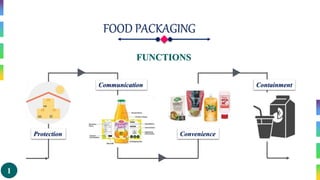
FOOD PACKAGING
1
FUNCTIONS
Protection
Communication
Convenience
Containment
2
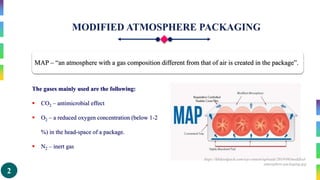
The gases mainly used are the following:
 CO2 – antimicrobial effect
 O2 – a reduced oxygen concentration (below 1-2
%) in the head-space of a package.
 N2 – inert gas
MAP – “an atmosphere with a gas composition different from that of air is created in the package”.
https://kbtfoodpack.com/wp-content/uploads/2019/08/modified-
atmosphere-packaging.jpg
3 Nesic et al., 2019
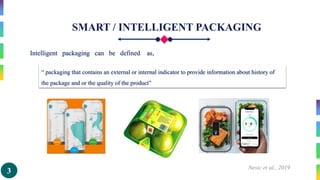
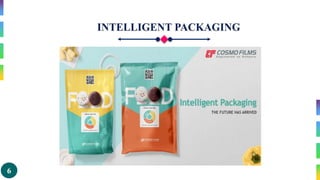
Intelligent packaging can be defined as,
“ packaging that contains an external or internal indicator to provide information about history of
the package and or the quality of the product”
4
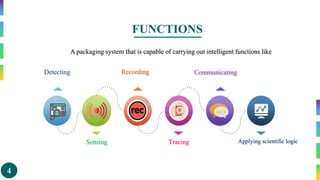
FUNCTIONS
A packaging system that is capable of carrying out intelligent functions like
Sensing
Detecting
Tracing
Recording Communicating
Applying scientific logic
5
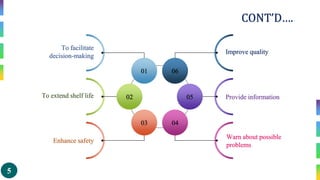
Improve quality
To extend shelf life 02
To facilitate
decision-making
01
Enhance safety
03
Provide information
05
06
Warn about possible
problems
04
CONT’D….
6
7
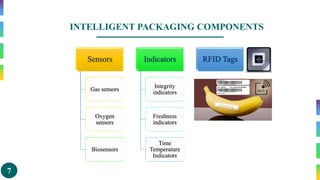
INTELLIGENT PACKAGING COMPONENTS
Sensors
Gas sensors
Oxygen
sensors
Biosensors
Indicators
Integrity
indicators
Freshness
indicators
Time
Temperature
Indicators
RFID Tags
8
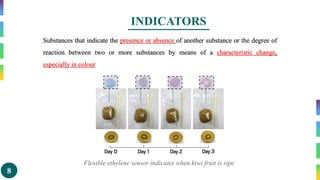
INDICATORS
Substances that indicate the presence or absence of another substance or the degree of
reaction between two or more substances by means of a characteristic change,
especially in colour
Flexible ethylene sensor indicates when kiwi fruit is ripe
9
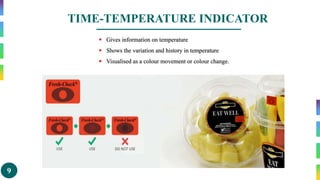
TIME-TEMPERATURE INDICATOR
 Gives information on temperature
 Shows the variation and history in temperature
 Visualised as a colour movement or colour change.
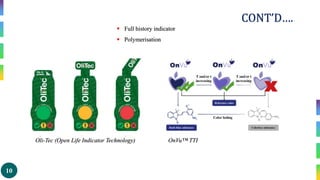
10
Oli-Tec (Open Life Indicator Technology)
CONT’D….
 Full history indicator
 Polymerisation
OnVu™ TTI
11
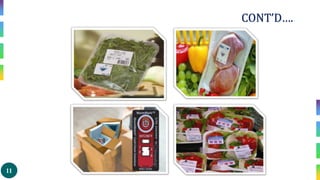
CONT’D….
12
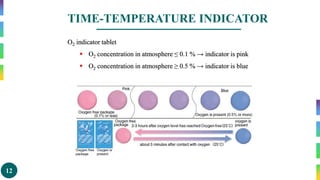
TIME-TEMPERATURE INDICATOR
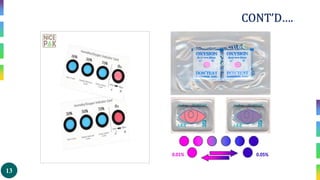
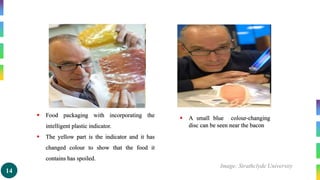
O2 indicator tablet
 O2 concentration in atmosphere ≤ 0.1 % → indicator is pink
 O2 concentration in atmosphere ≥ 0.5 % → indicator is blue
13
CONT’D….
14
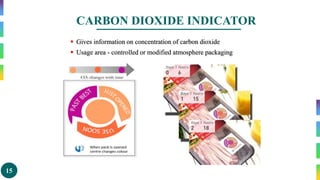
 Food packaging with incorporating the
intelligent plastic indicator.
 The yellow part is the indicator and it has
changed colour to show that the food it
contains has spoiled.
 A small blue colour-changing
disc can be seen near the bacon
Image: Strathclyde University
15
CARBON DIOXIDE INDICATOR
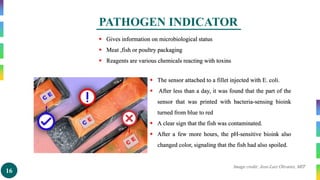
 Gives information on concentration of carbon dioxide
 Usage area - controlled or modified atmosphere packaging
16
PATHOGEN INDICATOR
 Gives information on microbiological status
 Meat ,fish or poultry packaging
 Reagents are various chemicals reacting with toxins
 The sensor attached to a fillet injected with E. coli.
 After less than a day, it was found that the part of the
sensor that was printed with bacteria-sensing bioink
turned from blue to red
 A clear sign that the fish was contaminated.
 After a few more hours, the pH-sensitive bioink also
changed color, signaling that the fish had also spoiled.
Image credit: Jose-Luis Olivares, MIT
17
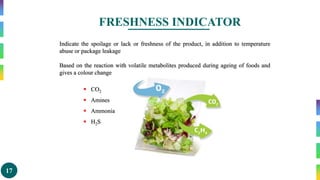
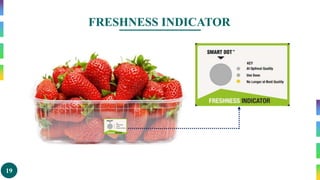
FRESHNESS INDICATOR
Indicate the spoilage or lack or freshness of the product, in addition to temperature
abuse or package leakage
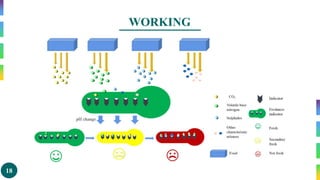
Based on the reaction with volatile metabolites produced during ageing of foods and
gives a colour change
 CO2
 Amines
 Ammonia
 H2S
18
WORKING
19
FRESHNESS INDICATOR
20
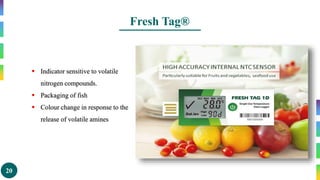
Fresh Tag®
 Indicator sensitive to volatile
nitrogen compounds.
 Packaging of fish
 Colour change in response to the
release of volatile amines
21
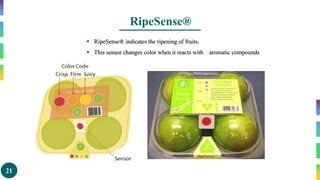
RipeSense®
 RipeSense® indicates the ripening of fruits.
 This sensor changes color when it reacts with aromatic compounds
22
SENSORS
A sensor is defined as a device used to
detect, locate or quantify energy or matter,
giving a signal for the detection or
measurement of a physical or chemical
property to which the device responds.
INTELLIGENT SENSORS
Two functional units:
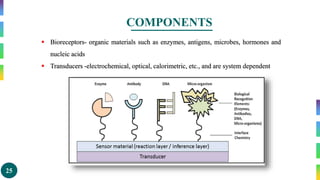
Receptor - transforms chemical or physical
information into a form of energy
Transducer - transforms this energy into a
useful analytical signal
23
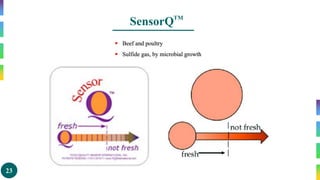
SensorQTM
 Beef and poultry
 Sulfide gas, by microbial growth
24
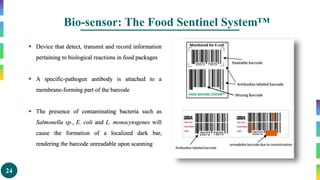
Bio-sensor: The Food Sentinel System™
 Device that detect, transmit and record information
pertaining to biological reactions in food packages
 A specific-pathogen antibody is attached to a
membrane-forming part of the barcode
 The presence of contaminating bacteria such as
Salmonella sp., E. coli and L. monocytogenes will
cause the formation of a localized dark bar,
rendering the barcode unreadable upon scanning
25
COMPONENTS
 Bioreceptors- organic materials such as enzymes, antigens, microbes, hormones and
nucleic acids
 Transducers -electrochemical, optical, calorimetric, etc., and are system dependent
26
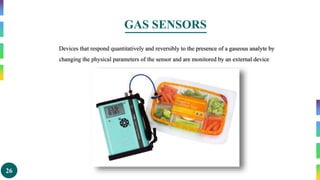
GAS SENSORS
Devices that respond quantitatively and reversibly to the presence of a gaseous analyte by
changing the physical parameters of the sensor and are monitored by an external device
27
ADVANTAGES
 Provides the user with reliable and correct
information on the conditions of the food,
the environment and the packaging integrity
 Enables the detection of calamities and
possible abuse through the entire supply
chain, from farm to fork.
 Reducing food loss and waste
 Prevent unnecessary transport and logistics
from an early stage
 Enhancing food safety and biosecurity
 Enhancing food quality assurance
 Extra cost
 Possible migration issues of complex
packaging materials into product
 Lack of recyclability of disposable
packages
 Possible mistrust/confusion of technology
SENSORS
DISADVANTAGES
28
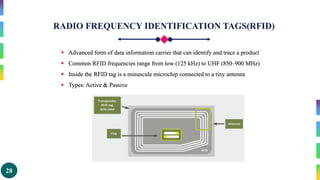
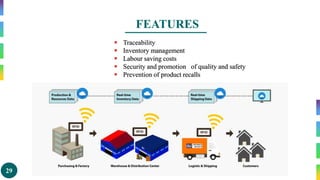
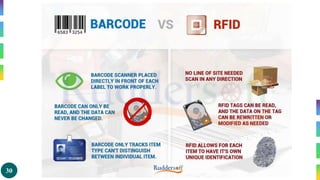
 Advanced form of data information carrier that can identify and trace a product
 Common RFID frequencies range from low (125 kHz) to UHF (850–900 MHz)
 Inside the RFID tag is a minuscule microchip connected to a tiny antenna
 Types: Active & Passive
29
FEATURES
 Traceability
 Inventory management
 Labour saving costs
 Security and promotion of quality and safety
 Prevention of product recalls
30
31
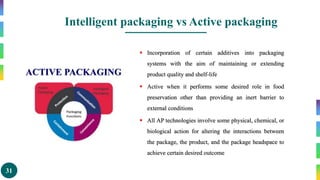
Intelligent packaging vs Active packaging
ACTIVE PACKAGING
 Incorporation of certain additives into packaging
systems with the aim of maintaining or extending
product quality and shelf-life
 Active when it performs some desired role in food
preservation other than providing an inert barrier to
external conditions
 All AP technologies involve some physical, chemical, or
biological action for altering the interactions between
the package, the product, and the package headspace to
achieve certain desired outcome
32
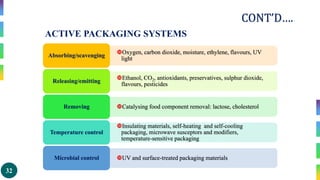
CONT’D….
ACTIVE PACKAGING SYSTEMS
Oxygen, carbon dioxide, moisture, ethylene, flavours, UV
light
Absorbing/scavenging
Ethanol, CO2, antioxidants, preservatives, sulphur dioxide,
flavours, pesticides
Releasing/emitting
Catalysing food component removal: lactose, cholesterol
Removing
Insulating materials, self-heating and self-cooling
packaging, microwave susceptors and modifiers,
temperature-sensitive packaging
Temperature control
UV and surface-treated packaging materials
Microbial control
33
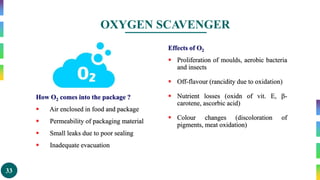
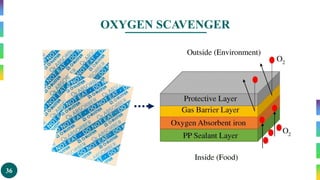
OXYGEN SCAVENGER
How O2 comes into the package ?
 Air enclosed in food and package
 Permeability of packaging material
 Small leaks due to poor sealing
 Inadequate evacuation
Effects of O2
 Proliferation of moulds, aerobic bacteria
and insects
 Off-flavour (rancidity due to oxidation)
 Nutrient losses (oxidn of vit. E, -
carotene, ascorbic acid)
 Colour changes (discoloration of
pigments, meat oxidation)
34
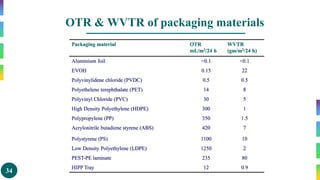
OTR & WVTR of packaging materials
Packaging material OTR
mL/m2/24 h
WVTR
(gm/m2/24 h)
Aluminium foil <0.1 <0.1
EVOH 0.15 22
Polyvinylidene chloride (PVDC) 0.5 0.5
Polyethelene terephthalate (PET) 14 8
Polyvinyl Chloride (PVC) 30 5
High Density Polyethylene (HDPE) 300 1
Polypropylene (PP) 350 1.5
Acrylonitrile butadiene styrene (ABS) 420 7
Polystyrene (PS) 1100 10
Low Density Polyethylene (LDPE) 1250 2
PEST-PE laminate 235 80
HIPP Tray 12 0.9
35
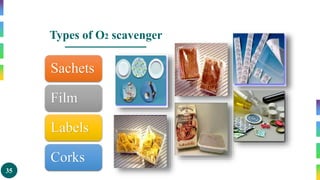
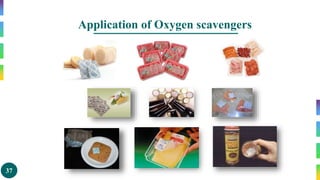
Types of O2 scavenger
Sachets
Film
Labels
Corks
36
OXYGEN SCAVENGER
37
Application of Oxygen scavengers
38
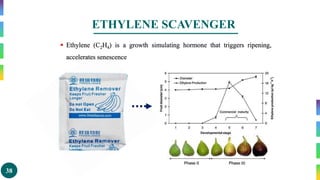
ETHYLENE SCAVENGER
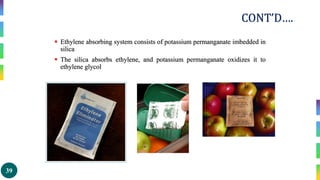
 Ethylene (C2H4) is a growth simulating hormone that triggers ripening,
accelerates senescence
39
CONT’D….
 Ethylene absorbing system consists of potassium permanganate imbedded in
silica
 The silica absorbs ethylene, and potassium permanganate oxidizes it to
ethylene glycol
40
CARBON DIOXIDE SCAVENGER
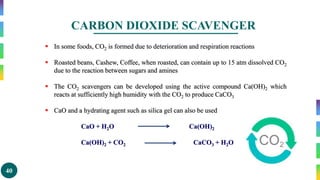
 In some foods, CO2 is formed due to deterioration and respiration reactions
 Roasted beans, Cashew, Coffee, when roasted, can contain up to 15 atm dissolved CO2
due to the reaction between sugars and amines
 The CO2 scavengers can be developed using the active compound Ca(OH)2 which
reacts at sufficiently high humidity with the CO2 to produce CaCO3
 CaO and a hydrating agent such as silica gel can also be used
CaO + H2O Ca(OH)2
Ca(OH)2 + CO2 CaCO3 + H2O
41
MOISTURE CONTROL
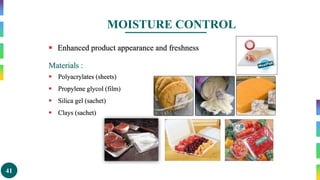
 Enhanced product appearance and freshness
Materials :
 Polyacrylates (sheets)
 Propylene glycol (film)
 Silica gel (sachet)
 Clays (sachet)
42
ODOUR SCAVENGERS
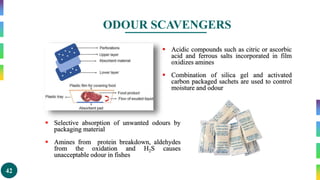
 Selective absorption of unwanted odours by
packaging material
 Amines from protein breakdown, aldehydes
from the oxidation and H2S causes
unacceptable odour in fishes
 Acidic compounds such as citric or ascorbic
acid and ferrous salts incorporated in film
oxidizes amines
 Combination of silica gel and activated
carbon packaged sachets are used to control
moisture and odour
43
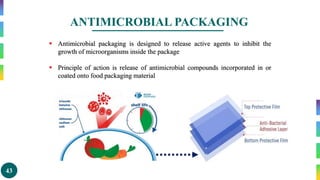
ANTIMICROBIAL PACKAGING
 Antimicrobial packaging is designed to release active agents to inhibit the
growth of microorganisms inside the package
 Principle of action is release of antimicrobial compounds incorporated in or
coated onto food packaging material
44
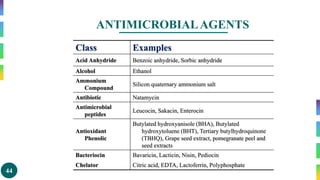
ANTIMICROBIALAGENTS
Class Examples
Acid Anhydride Benzoic anhydride, Sorbic anhydride
Alcohol Ethanol
Ammonium
Compound
Silicon quaternary ammonium salt
Antibiotic Natamycin
Antimicrobial
peptides
Leucocin, Sakacin, Enterocin
Antioxidant
Phenolic
Butylated hydroxyanisole (BHA), Butylated
hydroxytoluene (BHT), Tertiary butylhydroquinone
(TBHQ), Grape seed extract, pomegranate peel and
seed extracts
Bacteriocin Bavaricin, Lacticin, Nisin, Pediocin
Chelator Citric acid, EDTA, Lactoferrin, Polyphosphate
45
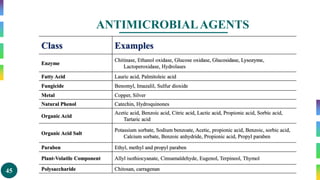
ANTIMICROBIALAGENTS
Class Examples
Enzyme
Chitinase, Ethanol oxidase, Glucose oxidase, Glucosidase, Lysozyme,
Lactoperoxidase, Hydrolases
Fatty Acid Lauric acid, Palmitoleic acid
Fungicide Benomyl, Imazalil, Sulfur dioxide
Metal Copper, Silver
Natural Phenol Catechin, Hydroquinones
Organic Acid
Acetic acid, Benzoic acid, Citric acid, Lactic acid, Propionic acid, Sorbic acid,
Tartaric acid
Organic Acid Salt
Potassium sorbate, Sodium benzoate, Acetic, propionic acid, Benzoic, sorbic acid,
Calcium sorbate, Benzoic anhydride, Propionic acid, Propyl paraben
Paraben Ethyl, methyl and propyl paraben
Plant-Volatile Component Allyl isothiocyanate, Cinnamaldehyde, Eugenol, Terpineol, Thymol
Polysaccharide Chitosan, carragenan
46
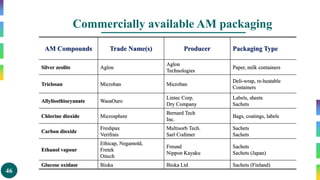
Commercially available AM packaging
AM Compounds Trade Name(s) Producer Packaging Type
Silver zeolite Aglon
Aglon
Technologies
Paper, milk containers
Triclosan Microban Microban
Deli-wrap, re-heatable
Containers
Allylisothiocyanate WasaOuro
Lintec Corp.
Dry Company
Labels, sheets
Sachets
Chlorine dioxide Microsphere
Bernard Tech
Inc.
Bags, coatings, labels
Carbon dioxide
Freshpax
Verifrais
Multisorb Tech.
Sarl Codimer
Sachets
Sachets
Ethanol vapour
Ethicap, Negamold,
Fretek
Oitech
Freund
Nippon Kayaku
Sachets
Sachets (Japan)
Glucose oxidase Bioka Bioka Ltd Sachets (Finland)
47
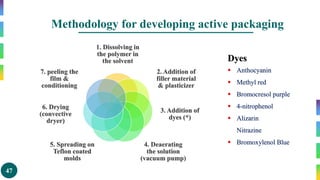
Methodology for developing active packaging
1. Dissolving in
the polymer in
the solvent
2. Addition of
filler material
& plasticizer
3. Addition of
dyes (*)
4. Deaerating
the solution
(vacuum pump)
5. Spreading on
Teflon coated
molds
6. Drying
(convective
dryer)
7. peeling the
film &
conditioning
Dyes
 Anthocyanin
 Methyl red
 Bromocresol purple
 4-nitrophenol
 Alizarin
Nitrazine
 Bromoxylenol Blue
Smart Packaging.pptx

Smart Packaging.pptx

  • 1.
  • 2.
  • 3.
    2 The gases mainlyused are the following:  CO2 – antimicrobial effect  O2 – a reduced oxygen concentration (below 1-2 %) in the head-space of a package.  N2 – inert gas MAP – “an atmosphere with a gas composition different from that of air is created in the package”. https://kbtfoodpack.com/wp-content/uploads/2019/08/modified- atmosphere-packaging.jpg
  • 4.
    3 Nesic etal., 2019 Intelligent packaging can be defined as, “ packaging that contains an external or internal indicator to provide information about history of the package and or the quality of the product”
  • 5.
    4 FUNCTIONS A packaging systemthat is capable of carrying out intelligent functions like Sensing Detecting Tracing Recording Communicating Applying scientific logic
  • 6.
    5 Improve quality To extendshelf life 02 To facilitate decision-making 01 Enhance safety 03 Provide information 05 06 Warn about possible problems 04 CONT’D….
  • 7.
  • 8.
    7 INTELLIGENT PACKAGING COMPONENTS Sensors Gassensors Oxygen sensors Biosensors Indicators Integrity indicators Freshness indicators Time Temperature Indicators RFID Tags
  • 9.
    8 INDICATORS Substances that indicatethe presence or absence of another substance or the degree of reaction between two or more substances by means of a characteristic change, especially in colour Flexible ethylene sensor indicates when kiwi fruit is ripe
  • 10.
    9 TIME-TEMPERATURE INDICATOR  Givesinformation on temperature  Shows the variation and history in temperature  Visualised as a colour movement or colour change.
  • 11.
    10 Oli-Tec (Open LifeIndicator Technology) CONT’D….  Full history indicator  Polymerisation OnVu™ TTI
  • 12.
  • 13.
    12 TIME-TEMPERATURE INDICATOR O2 indicatortablet  O2 concentration in atmosphere ≤ 0.1 % → indicator is pink  O2 concentration in atmosphere ≥ 0.5 % → indicator is blue
  • 14.
  • 15.
    14  Food packagingwith incorporating the intelligent plastic indicator.  The yellow part is the indicator and it has changed colour to show that the food it contains has spoiled.  A small blue colour-changing disc can be seen near the bacon Image: Strathclyde University
  • 16.
    15 CARBON DIOXIDE INDICATOR Gives information on concentration of carbon dioxide  Usage area - controlled or modified atmosphere packaging
  • 17.
    16 PATHOGEN INDICATOR  Givesinformation on microbiological status  Meat ,fish or poultry packaging  Reagents are various chemicals reacting with toxins  The sensor attached to a fillet injected with E. coli.  After less than a day, it was found that the part of the sensor that was printed with bacteria-sensing bioink turned from blue to red  A clear sign that the fish was contaminated.  After a few more hours, the pH-sensitive bioink also changed color, signaling that the fish had also spoiled. Image credit: Jose-Luis Olivares, MIT
  • 18.
    17 FRESHNESS INDICATOR Indicate thespoilage or lack or freshness of the product, in addition to temperature abuse or package leakage Based on the reaction with volatile metabolites produced during ageing of foods and gives a colour change  CO2  Amines  Ammonia  H2S
  • 19.
  • 20.
  • 21.
    20 Fresh Tag®  Indicatorsensitive to volatile nitrogen compounds.  Packaging of fish  Colour change in response to the release of volatile amines
  • 22.
    21 RipeSense®  RipeSense® indicatesthe ripening of fruits.  This sensor changes color when it reacts with aromatic compounds
  • 23.
    22 SENSORS A sensor isdefined as a device used to detect, locate or quantify energy or matter, giving a signal for the detection or measurement of a physical or chemical property to which the device responds. INTELLIGENT SENSORS Two functional units: Receptor - transforms chemical or physical information into a form of energy Transducer - transforms this energy into a useful analytical signal
  • 24.
    23 SensorQTM  Beef andpoultry  Sulfide gas, by microbial growth
  • 25.
    24 Bio-sensor: The FoodSentinel System™  Device that detect, transmit and record information pertaining to biological reactions in food packages  A specific-pathogen antibody is attached to a membrane-forming part of the barcode  The presence of contaminating bacteria such as Salmonella sp., E. coli and L. monocytogenes will cause the formation of a localized dark bar, rendering the barcode unreadable upon scanning
  • 26.
    25 COMPONENTS  Bioreceptors- organicmaterials such as enzymes, antigens, microbes, hormones and nucleic acids  Transducers -electrochemical, optical, calorimetric, etc., and are system dependent
  • 27.
    26 GAS SENSORS Devices thatrespond quantitatively and reversibly to the presence of a gaseous analyte by changing the physical parameters of the sensor and are monitored by an external device
  • 28.
    27 ADVANTAGES  Provides theuser with reliable and correct information on the conditions of the food, the environment and the packaging integrity  Enables the detection of calamities and possible abuse through the entire supply chain, from farm to fork.  Reducing food loss and waste  Prevent unnecessary transport and logistics from an early stage  Enhancing food safety and biosecurity  Enhancing food quality assurance  Extra cost  Possible migration issues of complex packaging materials into product  Lack of recyclability of disposable packages  Possible mistrust/confusion of technology SENSORS DISADVANTAGES
  • 29.
    28  Advanced formof data information carrier that can identify and trace a product  Common RFID frequencies range from low (125 kHz) to UHF (850–900 MHz)  Inside the RFID tag is a minuscule microchip connected to a tiny antenna  Types: Active & Passive
  • 30.
    29 FEATURES  Traceability  Inventorymanagement  Labour saving costs  Security and promotion of quality and safety  Prevention of product recalls
  • 31.
  • 32.
    31 Intelligent packaging vsActive packaging ACTIVE PACKAGING  Incorporation of certain additives into packaging systems with the aim of maintaining or extending product quality and shelf-life  Active when it performs some desired role in food preservation other than providing an inert barrier to external conditions  All AP technologies involve some physical, chemical, or biological action for altering the interactions between the package, the product, and the package headspace to achieve certain desired outcome
  • 33.
    32 CONT’D…. ACTIVE PACKAGING SYSTEMS Oxygen,carbon dioxide, moisture, ethylene, flavours, UV light Absorbing/scavenging Ethanol, CO2, antioxidants, preservatives, sulphur dioxide, flavours, pesticides Releasing/emitting Catalysing food component removal: lactose, cholesterol Removing Insulating materials, self-heating and self-cooling packaging, microwave susceptors and modifiers, temperature-sensitive packaging Temperature control UV and surface-treated packaging materials Microbial control
  • 34.
    33 OXYGEN SCAVENGER How O2comes into the package ?  Air enclosed in food and package  Permeability of packaging material  Small leaks due to poor sealing  Inadequate evacuation Effects of O2  Proliferation of moulds, aerobic bacteria and insects  Off-flavour (rancidity due to oxidation)  Nutrient losses (oxidn of vit. E, - carotene, ascorbic acid)  Colour changes (discoloration of pigments, meat oxidation)
  • 35.
    34 OTR & WVTRof packaging materials Packaging material OTR mL/m2/24 h WVTR (gm/m2/24 h) Aluminium foil <0.1 <0.1 EVOH 0.15 22 Polyvinylidene chloride (PVDC) 0.5 0.5 Polyethelene terephthalate (PET) 14 8 Polyvinyl Chloride (PVC) 30 5 High Density Polyethylene (HDPE) 300 1 Polypropylene (PP) 350 1.5 Acrylonitrile butadiene styrene (ABS) 420 7 Polystyrene (PS) 1100 10 Low Density Polyethylene (LDPE) 1250 2 PEST-PE laminate 235 80 HIPP Tray 12 0.9
  • 36.
    35 Types of O2scavenger Sachets Film Labels Corks
  • 37.
  • 38.
  • 39.
    38 ETHYLENE SCAVENGER  Ethylene(C2H4) is a growth simulating hormone that triggers ripening, accelerates senescence
  • 40.
    39 CONT’D….  Ethylene absorbingsystem consists of potassium permanganate imbedded in silica  The silica absorbs ethylene, and potassium permanganate oxidizes it to ethylene glycol
  • 41.
    40 CARBON DIOXIDE SCAVENGER In some foods, CO2 is formed due to deterioration and respiration reactions  Roasted beans, Cashew, Coffee, when roasted, can contain up to 15 atm dissolved CO2 due to the reaction between sugars and amines  The CO2 scavengers can be developed using the active compound Ca(OH)2 which reacts at sufficiently high humidity with the CO2 to produce CaCO3  CaO and a hydrating agent such as silica gel can also be used CaO + H2O Ca(OH)2 Ca(OH)2 + CO2 CaCO3 + H2O
  • 42.
    41 MOISTURE CONTROL  Enhancedproduct appearance and freshness Materials :  Polyacrylates (sheets)  Propylene glycol (film)  Silica gel (sachet)  Clays (sachet)
  • 43.
    42 ODOUR SCAVENGERS  Selectiveabsorption of unwanted odours by packaging material  Amines from protein breakdown, aldehydes from the oxidation and H2S causes unacceptable odour in fishes  Acidic compounds such as citric or ascorbic acid and ferrous salts incorporated in film oxidizes amines  Combination of silica gel and activated carbon packaged sachets are used to control moisture and odour
  • 44.
    43 ANTIMICROBIAL PACKAGING  Antimicrobialpackaging is designed to release active agents to inhibit the growth of microorganisms inside the package  Principle of action is release of antimicrobial compounds incorporated in or coated onto food packaging material
  • 45.
    44 ANTIMICROBIALAGENTS Class Examples Acid AnhydrideBenzoic anhydride, Sorbic anhydride Alcohol Ethanol Ammonium Compound Silicon quaternary ammonium salt Antibiotic Natamycin Antimicrobial peptides Leucocin, Sakacin, Enterocin Antioxidant Phenolic Butylated hydroxyanisole (BHA), Butylated hydroxytoluene (BHT), Tertiary butylhydroquinone (TBHQ), Grape seed extract, pomegranate peel and seed extracts Bacteriocin Bavaricin, Lacticin, Nisin, Pediocin Chelator Citric acid, EDTA, Lactoferrin, Polyphosphate
  • 46.
    45 ANTIMICROBIALAGENTS Class Examples Enzyme Chitinase, Ethanoloxidase, Glucose oxidase, Glucosidase, Lysozyme, Lactoperoxidase, Hydrolases Fatty Acid Lauric acid, Palmitoleic acid Fungicide Benomyl, Imazalil, Sulfur dioxide Metal Copper, Silver Natural Phenol Catechin, Hydroquinones Organic Acid Acetic acid, Benzoic acid, Citric acid, Lactic acid, Propionic acid, Sorbic acid, Tartaric acid Organic Acid Salt Potassium sorbate, Sodium benzoate, Acetic, propionic acid, Benzoic, sorbic acid, Calcium sorbate, Benzoic anhydride, Propionic acid, Propyl paraben Paraben Ethyl, methyl and propyl paraben Plant-Volatile Component Allyl isothiocyanate, Cinnamaldehyde, Eugenol, Terpineol, Thymol Polysaccharide Chitosan, carragenan
  • 47.
    46 Commercially available AMpackaging AM Compounds Trade Name(s) Producer Packaging Type Silver zeolite Aglon Aglon Technologies Paper, milk containers Triclosan Microban Microban Deli-wrap, re-heatable Containers Allylisothiocyanate WasaOuro Lintec Corp. Dry Company Labels, sheets Sachets Chlorine dioxide Microsphere Bernard Tech Inc. Bags, coatings, labels Carbon dioxide Freshpax Verifrais Multisorb Tech. Sarl Codimer Sachets Sachets Ethanol vapour Ethicap, Negamold, Fretek Oitech Freund Nippon Kayaku Sachets Sachets (Japan) Glucose oxidase Bioka Bioka Ltd Sachets (Finland)
  • 48.
    47 Methodology for developingactive packaging 1. Dissolving in the polymer in the solvent 2. Addition of filler material & plasticizer 3. Addition of dyes (*) 4. Deaerating the solution (vacuum pump) 5. Spreading on Teflon coated molds 6. Drying (convective dryer) 7. peeling the film & conditioning Dyes  Anthocyanin  Methyl red  Bromocresol purple  4-nitrophenol  Alizarin Nitrazine  Bromoxylenol Blue