Drying
theory
� Drying is the process of complete removal of solvent from the substance and the end
product is a solid- Thermal and non-thermal are the two methods of drying process Mass
and heat transfer are the two process of drying
� Wet solid mass contains both bound and unbound water
� Equilibrium moisture content is the amount of water present in the solid which exerts
vapor pressure equal to atmosphere surrounding it•
� Rate of drying curve is obtained by plotting free moisture content versus drying rate
Different stages of drying include initial adjustment period, constant rate period, first
falling rate period and second falling rate period.
� Tray dryer is used for localized drying of substances Vaccum dryer is used for drying heat
sensitive substances-Fluidized bed dryer is used for generalized drying process
� Bag filters used in the F.B.D. prevents the escape of finer particles from the equipment
during drying process· Drum dryers are used for drying solutions, slurries and suspensions.
Spray dryer utilizes generalized drying process.
� It can be used for coating of polymer over the granules - Spansule technology• Freeze
dryer utilizes triple point as the drying phenomenon.
� It can be used in the preparation of vaccines and blood products.
Tray dryer
Spray dryer
� Spray drying is applied to improve the compactability of drugs and to perform microencapsulation,
granulation and complex formation. In addition, spray drying is successfully used for the modification of
biopharmaceutical properties and the formulation of dry powder aerosols and heat sensitive materials.
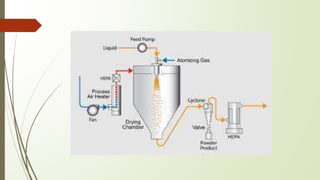
� Spray drying is a one-step continuous unit operation that employs liquid atomization to produce droplets
that are dried to individual particles when moved in a hot gaseous drying medium. A spray dryer consists
of a feed pump, atomizer, air heater, air dispenser, drying chamber, and systems for exhaust air cleaning
and powder recovery/separator.
The three stages that occur in a spray dryer before drying is accomplished include:
� Atomization
� Spray-air mixing and moisture evaporation.
� Dry product separation from the exit air.
The nature of the final product obtained after drying in a spray dryer depends on;
� The design and operation of the spray dryer.
� The physicochemical properties of the feed.
1. Atomization of liquid
� Atomization of liquid is done to form liquid droplets.
� The feed is introduced through atomizer by gravity or suitable pump to
form fine droplet.
� The characteristics of final product depend on droplet (Size/shell) .
� Selection of type of atomizer
� Atomizers : Pneumatic , pressure nozzle spinning disc atomizer
� The rate of feed is adjusted in such a way that the droplets should be
completely dried before reaching the walls of the drying chamber. At the
same time, the product should not be over heated.
2. Drying of liquid droplets
� Drying of liquid droplets starts with Spray-air mixing and moisture
evaporation.
� Drying of the liquid droplets
� Fine droplets are dried in the drying chamber by supplying hot air through
the inlet. The surface of the liquid drop is dried immediately to form a tough
shell. Further, the liquid inside must escape by diffusing through the shell at a
particular rate.
� At the same time, heat transfer from outside to inside takes place at a rate
greater than liquid diffusion rate. As a result, heat inside mounts up which
allows the liquid to evaporate at a faster rate.
� This tendency of a liquid leads to rise in the internal pressure, which causes
the droplets to swell. The shell's thickness decreases where as permeability
for Vapour increases.
� If the shell is neither elastic nor permeable, it ruptures and the internal
pressure escapes.
2. Drying of liquid droplets….
� Fine droplets are dried in the drying chamber by supplying hot air
through the inlet. The surface of the liquid drop is dried immediately to
form a tough shell.
� Further, the liquid inside must escape by diffusing through the shell at a
particular rate. At the same time, heat transfer from outside to inside
takes place at a rate greater than the liquid diffusion rate.
� As a result, the heat inside mounts up which allows the liquid to
evaporate at a faster rate. This tendency of a liquid leads to a rise in
internal pressure, which causes the droplets to swell.
� The shell’s thickness decreases whereas permeability for vapor
increases. If the shell is neither elastic nor permeable, it ruptures and
the internal pressure escapes.
� The temperature of the air is adjusted in such a way that the droplets
should be completely dried before reaching the walls of the drying
chamber. At the same time, the product should not be overheated.
Recovery of dried product
� The centrifugal force of the atomizer drives the droplets to follow a helical
path. Particles are dried during their journey and finally fall at the conical
bottom. All these processes are completed in a few seconds. The particle
size of the final product ranges from 2 to 500 mm.
� Particle size depends on solid content in the feed, liquid viscosity, feed rate,
and disc speed. Spray dryers of maximum size have got evaporating
capacity of up to 2000 kg per hour.
� The uses of spray dryer are the product is a better form than that obtained
by any other dryer, the quantity of the material to be dried is large, the
product is thermolabile, hygroscopic, or undergoes chemical
decomposition.
� The main advantages are spray drying is a continuous process and drying is
very rapid. Drying completes within 3 to 30 sec labor costs are low as it
combines the function of an evaporator, a crystallizer dryer a size reduction
unit, and a classifier, it is suitable for the drying of the sterile product.
� Demerits of spray dryers are very bulky and expensive. Such huge
equipment is not always easy to operate. The thermal efficiency is low, as
much heat is lost in the discharged gases.
Construction
� Large cylindrical drying chamber with short conical bottom of
stainless steel
� Diameter 2.5 – 9.0 meters
� Height 25 meters
� Inlet for hot air is placed in the roof of chamber. The hot air is
passed tangentially through the inlet.
� Other Inlet carrying spray-disk atomizer is set in roof.
� Spray-disk atomizer will produce fluid droplets.
Diameter 300 milliliters
Rotation 3000-50,000
Bottom of dyer is connected to cyclone separator.
� BK
APPLICATION
1. Spray dryer is used in drying pharmaceuticals like penicillin, blood
products, enzymes, vaccines, etc.
2. It is used in the production of excipients and co-processed excipients
with increased flowability, compatibility, and tablet disintegration.
3. To improve drug compressibility and reduce capping tendencies in
crystals.
4. It is equally used in the preparation of matrix microcapsule containing
drug substances and a biodegradable polymer in order to obtain
controlled drug release formulation.
5. It is employed in enhancing solubility and dissolution rates of poorly
soluble drugs by formation of pharmaceutical complexes or via the
development of solid dispersion thus increasing bioavailability.
6. It is used in the production of dry powder formulation/dry powder
aerosol and thermolabile materials.
Apart from its applications in the pharmaceutical industries, spray dryers also find
use in;
7. Chemical industries e.g. phenol-formaldehyde resin, catalysts, PVC emulsion
type, amino acids etc.
8. Ceramic industries e.g. aluminum oxide, carbides, iron oxides, kaolin, etc.
9. Dyestuffs and pigments e.g. chrome yellow, food color, titanium dioxide, paint
pigments, etc.
10. Fertilizer production e.g. nitrates, ammonium salts, phosphates, etc.
11. Detergent and surface-active agents e.g. detergent enzymes, bleach powders,
emulsifying agents etc.
12. Food industries e.g. milk, whey, egg, soya protein, etc.
13. Fruits and vegetables e.g. banana, tomatoes, coconut milk, etc.
15. Beverage e.g. coffee, tea, etc.
16. Biochemical industries e.g. algae, fodder antibiotics, yeast extracts, enzymes,
etc.
17. Environmental pollution control e.g. flue gas desulfurization, black liquor from
paper-making etc.
Advantages of Spray Dryers
� Product quality and properties can be effectively controlled and
maintained through the entire drying operation.
� Thermolabile products/ pharmaceuticals can be dried at atmospheric
pressure and low temperature.
� Spray dryer permits high- tonnage production in continuous operation
adaptable to conventional PLC control (Programmable Logic Controller)
and it is relatively simple to operate.
� Feedstock in solution, slurry, emulsion, paste, and melt form can be dried if
pumpable.
� Corrosion problem is minimal and the selection of materials of construction
of spray dryer is simplified since the dried material comes in contact with
the equipment surfaces in an anhydrous condition.
� Spray dryer produces dry powder particles of controllable particle
size, shape, form, moisture content, and other specific properties
irrespective of dryer capacity and heat sensitivity.
� Spray dryer handles a wide range of production rates and provides
extensive flexibility in its design that is product specification are
readily met through the selection of appropriate spray dryer design
and its operation from a wide range of available design.
� It is an energy-intensive equipment because -
� Specific heat of evaporation can be supplied in a short time.
� The temperature difference across the drying chamber is
relatively small and
� An appreciable amount of heat is lost with exhaust air.
Disadvantages of spray dryers
� Spray dryer is bulky and also expensive to install.
� It is difficult to clean after use.
� It has a low thermal efficiency that is a lot of heat is wasted during
operation.
� Solid materials cannot be dried using spray dryers.
� Product degradation or fire hazard may result from product deposit on the
drying chamber
FLUIDIZED BED DRYER
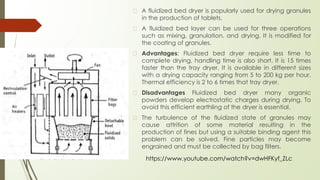
� Hot air is passed at high pressure through a perforated bottom of the container
containing granules to be dried . The granules are lifted from the bottom and
suspended in the stream of air. This condition is called fluidized state.
� The hot gas is surrounding every granule to completely dry them. Thus, materials or
granules are uniformly dried.
� Two types of bed dryers are available, vertical fluid bed dryer and horizontal fluid
bed dryer.
� Construction: The dryer is made up of stainless steel or plastic. A detachable bowl is
placed at the bottom of the dryer, which is used for charging and discharging.
� The bowl has a perforated bottom with a wire mesh support for placing materials to
be dried. A fan is mounted in the upper part for circulating hot air. Fresh air inlet,
prefilled and heat exchanger are connected serially to heat the air to the required
temperatures. The temperature of hot air is monitored.
� Working: Bag filters are placed above the drying bowl for the recovery of fines. The
wet granules to be dried are placed in the detached bowl. The bowl is pushed into
the dryer. Fresh air is allowed to pass through a prefilled, which subsequently gets
heated by passing through a heat exchanger.
� The hot air flows through the bottom of the bowl. Simultaneously fan is
allowed to rotate. The air velocity is gradually increased. When the velocity
of the air is greater than the settling velocity of granules, the granules
remain partially suspended in the gas stream.
� After some time, a point of pressure is reached at which frictional drag on
the particles is equal to the force of gravity. The granules rise in the later fall
back in a random boiling motion. This condition is said to be a fluidized
state.
� The gas surrounds every granule to completely dry them. The air leaves the
dryer by passing through the bag filter. The engrained particles remain
adhered to the inside surface of the bags.
� Periodically the bags are shaken to remove the entrained particles. Intense
mixing between granules and hot gas provides uniform conditions of
temperature composition and particle size distribution.
� Drying is achieved at a constant rate and the falling rate period is very
short. Any attempt to increase the air velocity may result in entrainment.
The residence time for drying is about 40 minutes. The material is left for
some time in the dryer for reaching ambient temperature. The bowl is taken
out for discharging. The end product is free flowing.
� A fluidized bed dryer is popularly used for drying granules
in the production of tablets.
� A fluidized bed layer can be used for three operations
such as mixing, granulation, and drying. It is modified for
the coating of granules.
� Advantages: Fluidized bed dryer require less time to
complete drying, handling time is also short. It is 15 times
faster than the tray dryer. It is available in different sizes
with a drying capacity ranging from 5 to 200 kg per hour.
Thermal efficiency is 2 to 6 times that tray dryer.
� Disadvantages Fluidized bed dryer many organic
powders develop electrostatic charges during drying. To
avoid this efficient earthling of the dryer is essential.
� The turbulence of the fluidized state of granules may
cause attrition of some material resulting in the
production of fines but using a suitable binding agent this
problem can be solved. Fine particles may become
engrained and must be collected by bag filters.
https://www.youtube.com/watch?v=dwHFKyf_ZLc
Vacuum dryer
VACUUM DRYER
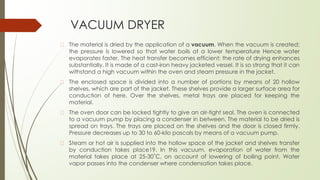
� The material is dried by the application of a vacuum. When the vacuum is created;
the pressure is lowered so that water boils at a lower temperature Hence water
evaporates faster. The heat transfer becomes efficient; the rate of drying enhances
substantially. It is made of a cast-iron heavy jacketed vessel. It is so strong that it can
withstand a high vacuum within the oven and steam pressure in the jacket.
� The enclosed space is divided into a number of portions by means of 20 hollow
shelves, which are part of the jacket. These shelves provide a larger surface area for
conduction of here. Over the shelves, metal trays are placed for keeping the
material.
� The oven door can be locked tightly to give an air-tight seal. The oven is connected
to a vacuum pump by placing a condenser in between. The material to be dried is
spread on trays. The trays are placed on the shelves and the door is closed firmly.
Pressure decreases up to 30 to 60-kilo pascals by means of a vacuum pump.
� Steam or hot air is supplied into the hollow space of the jacket and shelves transfer
by conduction takes place19. In this vacuum, evaporation of water from the
material takes place at 25-30˚C, on account of lowering of boiling point. Water
vapor passes into the condenser where condensation takes place.
VACUUM DRYER…
� At the end of the drying vacuum line is disconnected. The material is
collected from the trays. The vacuum dryer is used for heat-sensitive
materials, which undergo decomposition. Dusty and hygroscopic materials,
drugs containing toxic solvent. These can be separated into closed
containers, feed containing valuable solvents.
� These are recovered by condensation. Advantages of the vacuum dryer
are providing a large surface area for heat transfer, handling of material,
tray and equipment is easy, It is easy for switching over to the next
materials.
� The demerits included low transfer coefficient, limited capacity and use for
a batch process, more expensive than tray dryer, and labor and running
costs are also high.
FREEZE DRYER
� Freeze dryer which is also known as lyophilizers is a system that is made solvent
loving for removing the same.In freeze-drying, water is removed from the frozen
state by sublimation i.e direct change of water from solid into vapor without
conversion to a liquid phase.
� Solid – liquid-vapor equilibrium phase diagram of water is useful to decide the
experimental conditions.
� The drying is achieved by subjecting the material to temperature and pressure
below the triple point. Under these conditions, any heat transferred is used as
latent heat, and ice sublime directly into the vapor state.
� The water vapor is removed from the system by condensation in a cold trap
maintained at a temperature lower than the frozen material.
FREEZE DRYER
� It consists of a drying chamber in which
trays are located, heat supply in the form of
the radiation source, heating coils, vapor
condensing or adsorption system vacuum
pump or steam ejector, or both.
� The chamber for vacuum dryers is generally
designed for batch operation .
� It consists of shelves for keeping the
material. The distances between subliming
surface and condenser must be less than
the mean path of molecules. This increases
the rate of drying.
� The condenser consists of a relatively large
surface cooled by solid carbon dioxide
DRYiNG 1.pptx

DRYiNG 1.pptx

  • 1.
  • 2.
    theory � Drying isthe process of complete removal of solvent from the substance and the end product is a solid- Thermal and non-thermal are the two methods of drying process Mass and heat transfer are the two process of drying � Wet solid mass contains both bound and unbound water � Equilibrium moisture content is the amount of water present in the solid which exerts vapor pressure equal to atmosphere surrounding it• � Rate of drying curve is obtained by plotting free moisture content versus drying rate Different stages of drying include initial adjustment period, constant rate period, first falling rate period and second falling rate period. � Tray dryer is used for localized drying of substances Vaccum dryer is used for drying heat sensitive substances-Fluidized bed dryer is used for generalized drying process
  • 3.
    � Bag filtersused in the F.B.D. prevents the escape of finer particles from the equipment during drying process· Drum dryers are used for drying solutions, slurries and suspensions. Spray dryer utilizes generalized drying process. � It can be used for coating of polymer over the granules - Spansule technology• Freeze dryer utilizes triple point as the drying phenomenon. � It can be used in the preparation of vaccines and blood products.
  • 4.
  • 6.
    Spray dryer � Spraydrying is applied to improve the compactability of drugs and to perform microencapsulation, granulation and complex formation. In addition, spray drying is successfully used for the modification of biopharmaceutical properties and the formulation of dry powder aerosols and heat sensitive materials. � Spray drying is a one-step continuous unit operation that employs liquid atomization to produce droplets that are dried to individual particles when moved in a hot gaseous drying medium. A spray dryer consists of a feed pump, atomizer, air heater, air dispenser, drying chamber, and systems for exhaust air cleaning and powder recovery/separator. The three stages that occur in a spray dryer before drying is accomplished include: � Atomization � Spray-air mixing and moisture evaporation. � Dry product separation from the exit air. The nature of the final product obtained after drying in a spray dryer depends on; � The design and operation of the spray dryer. � The physicochemical properties of the feed.
  • 7.
    1. Atomization ofliquid � Atomization of liquid is done to form liquid droplets. � The feed is introduced through atomizer by gravity or suitable pump to form fine droplet. � The characteristics of final product depend on droplet (Size/shell) . � Selection of type of atomizer � Atomizers : Pneumatic , pressure nozzle spinning disc atomizer � The rate of feed is adjusted in such a way that the droplets should be completely dried before reaching the walls of the drying chamber. At the same time, the product should not be over heated.
  • 8.
    2. Drying ofliquid droplets � Drying of liquid droplets starts with Spray-air mixing and moisture evaporation. � Drying of the liquid droplets � Fine droplets are dried in the drying chamber by supplying hot air through the inlet. The surface of the liquid drop is dried immediately to form a tough shell. Further, the liquid inside must escape by diffusing through the shell at a particular rate. � At the same time, heat transfer from outside to inside takes place at a rate greater than liquid diffusion rate. As a result, heat inside mounts up which allows the liquid to evaporate at a faster rate. � This tendency of a liquid leads to rise in the internal pressure, which causes the droplets to swell. The shell's thickness decreases where as permeability for Vapour increases. � If the shell is neither elastic nor permeable, it ruptures and the internal pressure escapes.
  • 9.
    2. Drying ofliquid droplets…. � Fine droplets are dried in the drying chamber by supplying hot air through the inlet. The surface of the liquid drop is dried immediately to form a tough shell. � Further, the liquid inside must escape by diffusing through the shell at a particular rate. At the same time, heat transfer from outside to inside takes place at a rate greater than the liquid diffusion rate. � As a result, the heat inside mounts up which allows the liquid to evaporate at a faster rate. This tendency of a liquid leads to a rise in internal pressure, which causes the droplets to swell. � The shell’s thickness decreases whereas permeability for vapor increases. If the shell is neither elastic nor permeable, it ruptures and the internal pressure escapes. � The temperature of the air is adjusted in such a way that the droplets should be completely dried before reaching the walls of the drying chamber. At the same time, the product should not be overheated.
  • 10.
    Recovery of driedproduct � The centrifugal force of the atomizer drives the droplets to follow a helical path. Particles are dried during their journey and finally fall at the conical bottom. All these processes are completed in a few seconds. The particle size of the final product ranges from 2 to 500 mm. � Particle size depends on solid content in the feed, liquid viscosity, feed rate, and disc speed. Spray dryers of maximum size have got evaporating capacity of up to 2000 kg per hour. � The uses of spray dryer are the product is a better form than that obtained by any other dryer, the quantity of the material to be dried is large, the product is thermolabile, hygroscopic, or undergoes chemical decomposition. � The main advantages are spray drying is a continuous process and drying is very rapid. Drying completes within 3 to 30 sec labor costs are low as it combines the function of an evaporator, a crystallizer dryer a size reduction unit, and a classifier, it is suitable for the drying of the sterile product. � Demerits of spray dryers are very bulky and expensive. Such huge equipment is not always easy to operate. The thermal efficiency is low, as much heat is lost in the discharged gases.
  • 11.
    Construction � Large cylindricaldrying chamber with short conical bottom of stainless steel � Diameter 2.5 – 9.0 meters � Height 25 meters � Inlet for hot air is placed in the roof of chamber. The hot air is passed tangentially through the inlet. � Other Inlet carrying spray-disk atomizer is set in roof. � Spray-disk atomizer will produce fluid droplets. Diameter 300 milliliters Rotation 3000-50,000 Bottom of dyer is connected to cyclone separator.
  • 12.
  • 13.
    APPLICATION 1. Spray dryeris used in drying pharmaceuticals like penicillin, blood products, enzymes, vaccines, etc. 2. It is used in the production of excipients and co-processed excipients with increased flowability, compatibility, and tablet disintegration. 3. To improve drug compressibility and reduce capping tendencies in crystals. 4. It is equally used in the preparation of matrix microcapsule containing drug substances and a biodegradable polymer in order to obtain controlled drug release formulation. 5. It is employed in enhancing solubility and dissolution rates of poorly soluble drugs by formation of pharmaceutical complexes or via the development of solid dispersion thus increasing bioavailability. 6. It is used in the production of dry powder formulation/dry powder aerosol and thermolabile materials.
  • 14.
    Apart from itsapplications in the pharmaceutical industries, spray dryers also find use in; 7. Chemical industries e.g. phenol-formaldehyde resin, catalysts, PVC emulsion type, amino acids etc. 8. Ceramic industries e.g. aluminum oxide, carbides, iron oxides, kaolin, etc. 9. Dyestuffs and pigments e.g. chrome yellow, food color, titanium dioxide, paint pigments, etc. 10. Fertilizer production e.g. nitrates, ammonium salts, phosphates, etc. 11. Detergent and surface-active agents e.g. detergent enzymes, bleach powders, emulsifying agents etc. 12. Food industries e.g. milk, whey, egg, soya protein, etc. 13. Fruits and vegetables e.g. banana, tomatoes, coconut milk, etc. 15. Beverage e.g. coffee, tea, etc. 16. Biochemical industries e.g. algae, fodder antibiotics, yeast extracts, enzymes, etc. 17. Environmental pollution control e.g. flue gas desulfurization, black liquor from paper-making etc.
  • 15.
    Advantages of SprayDryers � Product quality and properties can be effectively controlled and maintained through the entire drying operation. � Thermolabile products/ pharmaceuticals can be dried at atmospheric pressure and low temperature. � Spray dryer permits high- tonnage production in continuous operation adaptable to conventional PLC control (Programmable Logic Controller) and it is relatively simple to operate. � Feedstock in solution, slurry, emulsion, paste, and melt form can be dried if pumpable. � Corrosion problem is minimal and the selection of materials of construction of spray dryer is simplified since the dried material comes in contact with the equipment surfaces in an anhydrous condition.
  • 16.
    � Spray dryerproduces dry powder particles of controllable particle size, shape, form, moisture content, and other specific properties irrespective of dryer capacity and heat sensitivity. � Spray dryer handles a wide range of production rates and provides extensive flexibility in its design that is product specification are readily met through the selection of appropriate spray dryer design and its operation from a wide range of available design. � It is an energy-intensive equipment because - � Specific heat of evaporation can be supplied in a short time. � The temperature difference across the drying chamber is relatively small and � An appreciable amount of heat is lost with exhaust air.
  • 17.
    Disadvantages of spraydryers � Spray dryer is bulky and also expensive to install. � It is difficult to clean after use. � It has a low thermal efficiency that is a lot of heat is wasted during operation. � Solid materials cannot be dried using spray dryers. � Product degradation or fire hazard may result from product deposit on the drying chamber
  • 18.
    FLUIDIZED BED DRYER �Hot air is passed at high pressure through a perforated bottom of the container containing granules to be dried . The granules are lifted from the bottom and suspended in the stream of air. This condition is called fluidized state. � The hot gas is surrounding every granule to completely dry them. Thus, materials or granules are uniformly dried. � Two types of bed dryers are available, vertical fluid bed dryer and horizontal fluid bed dryer. � Construction: The dryer is made up of stainless steel or plastic. A detachable bowl is placed at the bottom of the dryer, which is used for charging and discharging. � The bowl has a perforated bottom with a wire mesh support for placing materials to be dried. A fan is mounted in the upper part for circulating hot air. Fresh air inlet, prefilled and heat exchanger are connected serially to heat the air to the required temperatures. The temperature of hot air is monitored. � Working: Bag filters are placed above the drying bowl for the recovery of fines. The wet granules to be dried are placed in the detached bowl. The bowl is pushed into the dryer. Fresh air is allowed to pass through a prefilled, which subsequently gets heated by passing through a heat exchanger.
  • 19.
    � The hotair flows through the bottom of the bowl. Simultaneously fan is allowed to rotate. The air velocity is gradually increased. When the velocity of the air is greater than the settling velocity of granules, the granules remain partially suspended in the gas stream. � After some time, a point of pressure is reached at which frictional drag on the particles is equal to the force of gravity. The granules rise in the later fall back in a random boiling motion. This condition is said to be a fluidized state. � The gas surrounds every granule to completely dry them. The air leaves the dryer by passing through the bag filter. The engrained particles remain adhered to the inside surface of the bags. � Periodically the bags are shaken to remove the entrained particles. Intense mixing between granules and hot gas provides uniform conditions of temperature composition and particle size distribution. � Drying is achieved at a constant rate and the falling rate period is very short. Any attempt to increase the air velocity may result in entrainment. The residence time for drying is about 40 minutes. The material is left for some time in the dryer for reaching ambient temperature. The bowl is taken out for discharging. The end product is free flowing.
  • 20.
    � A fluidizedbed dryer is popularly used for drying granules in the production of tablets. � A fluidized bed layer can be used for three operations such as mixing, granulation, and drying. It is modified for the coating of granules. � Advantages: Fluidized bed dryer require less time to complete drying, handling time is also short. It is 15 times faster than the tray dryer. It is available in different sizes with a drying capacity ranging from 5 to 200 kg per hour. Thermal efficiency is 2 to 6 times that tray dryer. � Disadvantages Fluidized bed dryer many organic powders develop electrostatic charges during drying. To avoid this efficient earthling of the dryer is essential. � The turbulence of the fluidized state of granules may cause attrition of some material resulting in the production of fines but using a suitable binding agent this problem can be solved. Fine particles may become engrained and must be collected by bag filters. https://www.youtube.com/watch?v=dwHFKyf_ZLc
  • 21.
  • 22.
    VACUUM DRYER � Thematerial is dried by the application of a vacuum. When the vacuum is created; the pressure is lowered so that water boils at a lower temperature Hence water evaporates faster. The heat transfer becomes efficient; the rate of drying enhances substantially. It is made of a cast-iron heavy jacketed vessel. It is so strong that it can withstand a high vacuum within the oven and steam pressure in the jacket. � The enclosed space is divided into a number of portions by means of 20 hollow shelves, which are part of the jacket. These shelves provide a larger surface area for conduction of here. Over the shelves, metal trays are placed for keeping the material. � The oven door can be locked tightly to give an air-tight seal. The oven is connected to a vacuum pump by placing a condenser in between. The material to be dried is spread on trays. The trays are placed on the shelves and the door is closed firmly. Pressure decreases up to 30 to 60-kilo pascals by means of a vacuum pump. � Steam or hot air is supplied into the hollow space of the jacket and shelves transfer by conduction takes place19. In this vacuum, evaporation of water from the material takes place at 25-30˚C, on account of lowering of boiling point. Water vapor passes into the condenser where condensation takes place.
  • 23.
    VACUUM DRYER… � Atthe end of the drying vacuum line is disconnected. The material is collected from the trays. The vacuum dryer is used for heat-sensitive materials, which undergo decomposition. Dusty and hygroscopic materials, drugs containing toxic solvent. These can be separated into closed containers, feed containing valuable solvents. � These are recovered by condensation. Advantages of the vacuum dryer are providing a large surface area for heat transfer, handling of material, tray and equipment is easy, It is easy for switching over to the next materials. � The demerits included low transfer coefficient, limited capacity and use for a batch process, more expensive than tray dryer, and labor and running costs are also high.
  • 25.
    FREEZE DRYER � Freezedryer which is also known as lyophilizers is a system that is made solvent loving for removing the same.In freeze-drying, water is removed from the frozen state by sublimation i.e direct change of water from solid into vapor without conversion to a liquid phase. � Solid – liquid-vapor equilibrium phase diagram of water is useful to decide the experimental conditions. � The drying is achieved by subjecting the material to temperature and pressure below the triple point. Under these conditions, any heat transferred is used as latent heat, and ice sublime directly into the vapor state. � The water vapor is removed from the system by condensation in a cold trap maintained at a temperature lower than the frozen material.
  • 26.
    FREEZE DRYER � Itconsists of a drying chamber in which trays are located, heat supply in the form of the radiation source, heating coils, vapor condensing or adsorption system vacuum pump or steam ejector, or both. � The chamber for vacuum dryers is generally designed for batch operation . � It consists of shelves for keeping the material. The distances between subliming surface and condenser must be less than the mean path of molecules. This increases the rate of drying. � The condenser consists of a relatively large surface cooled by solid carbon dioxide