•Mamta Sahurkar
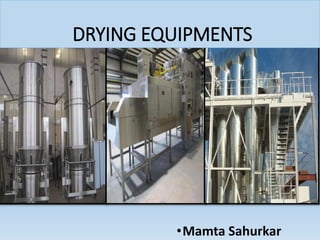
DRYING EQUIPMENTS
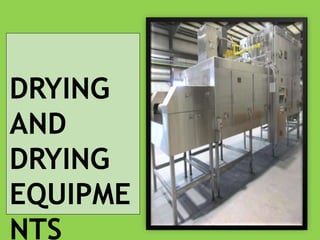
DRYING
AND
DRYING
EQUIPME
NTS
DRYING/DEHYDRATI
ON
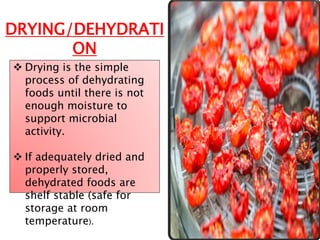
 Drying is the simple
process of dehydrating
foods until there is not
enough moisture to
support microbial
activity.
 If adequately dried and
properly stored,
dehydrated foods are
shelf stable (safe for
storage at room
temperature).
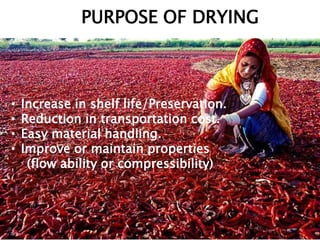
PURPOSE OF DRYING
• Increase in shelf life/Preservation.
• Reduction in transportation cost.
• Easy material handling.
• Improve or maintain properties
(flow ability or compressibility)
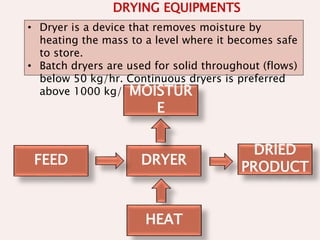
• Dryer is a device that removes moisture by
heating the mass to a level where it becomes safe
to store.
• Batch dryers are used for solid throughout (flows)
below 50 kg/hr. Continuous dryers is preferred
above 1000 kg/hr.
DRYER
MOISTUR
E
HEAT
FEED
DRIED
PRODUCT
DRYING EQUIPMENTS
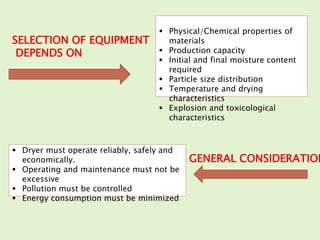
SELECTION OF EQUIPMENT
DEPENDS ON
GENERAL CONSIDERATION
 Physical/Chemical properties of
materials
 Production capacity
 Initial and final moisture content
required
 Particle size distribution
 Temperature and drying
characteristics
 Explosion and toxicological
characteristics
 Dryer must operate reliably, safely and
economically.
 Operating and maintenance must not be
excessive
 Pollution must be controlled
 Energy consumption must be minimized
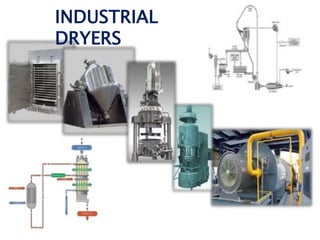
INDUSTRIAL
DRYERS
CLASSIFICATION OF
DRYERS
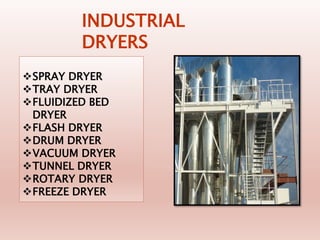
INDUSTRIAL
DRYERS
SPRAY DRYER
TRAY DRYER
FLUIDIZED BED
DRYER
FLASH DRYER
DRUM DRYER
VACUUM DRYER
TUNNEL DRYER
ROTARY DRYER
FREEZE DRYER
SPRAY DRYER
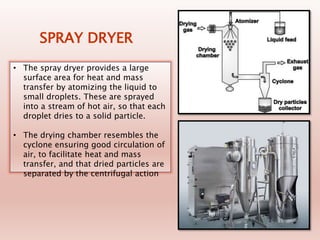
• The spray dryer provides a large
surface area for heat and mass
transfer by atomizing the liquid to
small droplets. These are sprayed
into a stream of hot air, so that each
droplet dries to a solid particle.
• The drying chamber resembles the
cyclone ensuring good circulation of
air, to facilitate heat and mass
transfer, and that dried particles are
separated by the centrifugal action
• Product quality effectively
controlled
• Product properties effectively
controlled
• Suitable for heat sensitive foods
eg: milk
• High tonnage equipment
• Corrosion problem minimized
• Good efficiency
ADVANTAGE
S
• Product quality effectively
controlled
• Product properties effectively
controlled
• Suitable for heat sensitive foods
eg: milk
• High tonnage equipment
• Corrosion problem minimized
• Good efficiency
DISADVANTAGES
APPLICATIO
NS
• Drying of any substance in solution or in
suspension form
• It is most useful for drying thermolabile
materials eg: antibiotics
• Suitable for large quantities solution
• Suitable for both soluble and insoluble
substances
• It can produce spherical particles in the
respiratory range
• Drying of milk, soap and detergents
TRAY DRYER
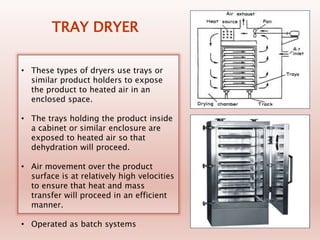
• These types of dryers use trays or
similar product holders to expose
the product to heated air in an
enclosed space.
• The trays holding the product inside
a cabinet or similar enclosure are
exposed to heated air so that
dehydration will proceed.
• Air movement over the product
surface is at relatively high velocities
to ensure that heat and mass
transfer will proceed in an efficient
manner.
• Operated as batch systems
• Simple in
handling
• Lesser capital
cost
ADVANTAGES
• Non-uniform drying of a product at
different locations within the system
• Time required for drying is more
• The major disadvantages of this type
of dryers are the high labor cost
involved during loading and
unloading of the drying materials and
the low capacities of the units
DISADVANTAGES
• Mainly used for drying agricultural produce
• Drying foods Eg:( chillies and spices etc)
• Of potential use in
pharmaceuticals,paints,textile and other
industries
APPLICATIONS
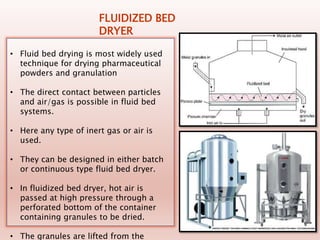
FLUIDIZED BED
DRYER
• Fluid bed drying is most widely used
technique for drying pharmaceutical
powders and granulation
• The direct contact between particles
and air/gas is possible in fluid bed
systems.
• Here any type of inert gas or air is
used.
• They can be designed in either batch
or continuous type fluid bed dryer.
• In fluidized bed dryer, hot air is
passed at high pressure through a
perforated bottom of the container
containing granules to be dried.
• The granules are lifted from the
• The hot gas surrounding every granule to completely dry
them.
• The material or granule are uniformly dried.
• The hot air/gas used for drying can be generated by
either steam coils or a combustion furnace.
• The angle of repose of gas-solid mixture is zero and it
assumes the shape of vessel that contains it.
• Uniform conditions of temperature, composition and
particle size distribution is achieved throughout the bed
because of complete mixing between the solids and gas
is obtained.
• Fluidized bed dryer requires less time
to complete drying ie: 20 to 40 min.
• Hot spots are observed in the dryer,
because of its excellent mixing and
drying capacities.
• The thermal efficiency is 2 to 6 times
greater than tray dryer
• It facilitates the drying of
thermolabile substances, since
contact time for drying is short.
• It can be used as batch type or
continuous type.
• The free movement of individual
particles eliminates the risk of
soluble material migrating as may
occur in static bed
• Equipment is bulky.
• Expensive
ADVANTAGES DISADVANTAGES
APPLICATIONS
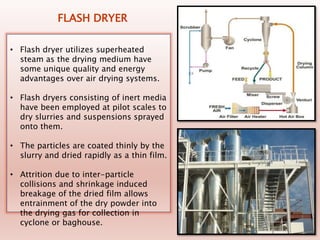
• Flash dryer utilizes superheated
steam as the drying medium have
some unique quality and energy
advantages over air drying systems.
• Flash dryers consisting of inert media
have been employed at pilot scales to
dry slurries and suspensions sprayed
onto them.
• The particles are coated thinly by the
slurry and dried rapidly as a thin film.
• Attrition due to inter-particle
collisions and shrinkage induced
breakage of the dried film allows
entrainment of the dry powder into
the drying gas for collection in
cyclone or baghouse.
FLASH DRYER
• Short contact time and parallel
flow make possible to dry thermo
liable materials.
• The dryer needs only a very small
area and can be installed outside a
building.
• The dryer is easy to control. The
low material content in the dryer
enables equilibrium conditions to
be reached very quickly.
• Due to small number of moving
parts the maintenance cost is low.
• The capital cost are low in
comparison with other types of
dryers.
• Simultaneous drying and
transportation is useful for
material handling.
ADVANTAGES DISADVANTAGES
• High efficiency of gas cleaning
system is required.
• Dryer cannot be used for toxic
materials.
• Not suitable for lumped
materials.
• Risk of fire and explosion.
• Generally, not all the particles
have same residence time in the
dryer.
• Drying of heat sensitive
products in this type of dryers is
very useful.
• They are successfully used in
food, chemical, pharmaceutical,
mining, ceramic and wood
industries.
• Widely used in plastic and
APPLICATIONS
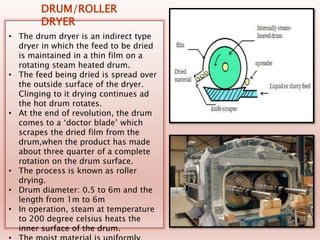
• The drum dryer is an indirect type
dryer in which the feed to be dried
is maintained in a thin film on a
rotating steam heated drum.
• The feed being dried is spread over
the outside surface of the dryer.
Clinging to it drying continues ad
the hot drum rotates.
• At the end of revolution, the drum
comes to a ‘doctor blade’ which
scrapes the dried film from the
drum,when the product has made
about three quarter of a complete
rotation on the drum surface.
• The process is known as roller
drying.
• Drum diameter: 0.5 to 6m and the
length from 1m to 6m
• In operation, steam at temperature
to 200 degree celsius heats the
inner surface of the drum.
DRUM/ROLLER
DRYER
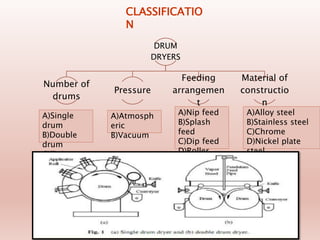
CLASSIFICATIO
N
DRUM
DRYERS
Number of
drums
Pressure
Feeding
arrangemen
t
Material of
constructio
n
A)Single
drum
B)Double
drum
C)Twin
drum
A)Atmosph
eric
B)Vacuum
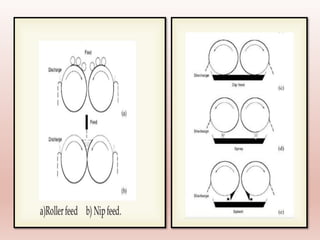
A)Nip feed
B)Splash
feed
C)Dip feed
D)Roller
feed
A)Alloy steel
B)Stainless steel
C)Chrome
D)Nickel plate
steel
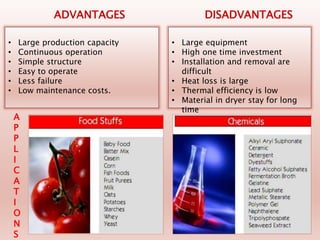
• Large production capacity
• Continuous operation
• Simple structure
• Easy to operate
• Less failure
• Low maintenance costs.
ADVANTAGES
• Large equipment
• High one time investment
• Installation and removal are
difficult
• Heat loss is large
• Thermal efficiency is low
• Material in dryer stay for long
time
DISADVANTAGES
A
P
P
L
I
C
A
T
I
O
N
S
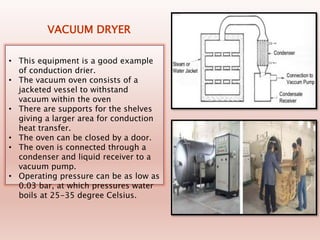
VACUUM DRYER
• This equipment is a good example
of conduction drier.
• The vacuum oven consists of a
jacketed vessel to withstand
vacuum within the oven
• There are supports for the shelves
giving a larger area for conduction
heat transfer.
• The oven can be closed by a door.
• The oven is connected through a
condenser and liquid receiver to a
vacuum pump.
• Operating pressure can be as low as
0.03 bar, at which pressures water
boils at 25-35 degree Celsius.
• Drying takes place at low
temperature.
• Maximum retention of nutrition.
• There is little air present, so there
is minimum risk of oxidation.
ADVANTAGES DISADVANTAGES
• Drying takes place at low
temperature.
• Maximum retention of nutrition.
• There is little air present, so
there is minimum risk of
oxidation.
• Mainly used for puffed cereals.
APPLICATIONS
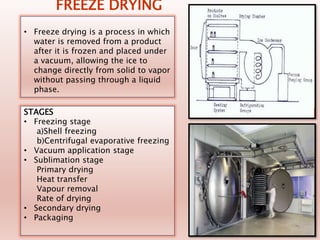
• Freeze drying is a process in which
water is removed from a product
after it is frozen and placed under
a vacuum, allowing the ice to
change directly from solid to vapor
without passing through a liquid
phase.
FREEZE DRYING
STAGES
• Freezing stage
a)Shell freezing
b)Centrifugal evaporative freezing
• Vacuum application stage
• Sublimation stage
Primary drying
Heat transfer
Vapour removal
Rate of drying
• Secondary drying
• Packaging
• Drying takes place at low
temperature.
• Product is light and porous
• The porous form of the product
gives ready solubility
• No concentration of solution prior
to drying
• Nutrition retention.
• There is little air present, so there
is minimum risk of oxidation.
ADVANTAGES DISADVANTAGES
• The porosity, ready solubility and
complete dryness yield a very
hygroscopic product. Unless the
products are dried in their final
container and sealed in situ,
packing require special
conditions.
• The process is very slow.
• Uses complicated plant which is
very expensive.
• Limited to certain types of
valuable products
• The method is used for products that cannot be dried by any other heat
method. These include biological products,eg:antibiotics,blood
products,vaccines,enzyme preparations and microbiological cultures.
APPLICATIONS
Drying equipments

Drying equipments

  • 1.
  • 2.
  • 3.
    DRYING/DEHYDRATI ON  Drying isthe simple process of dehydrating foods until there is not enough moisture to support microbial activity.  If adequately dried and properly stored, dehydrated foods are shelf stable (safe for storage at room temperature).
  • 4.
    PURPOSE OF DRYING •Increase in shelf life/Preservation. • Reduction in transportation cost. • Easy material handling. • Improve or maintain properties (flow ability or compressibility)
  • 5.
    • Dryer isa device that removes moisture by heating the mass to a level where it becomes safe to store. • Batch dryers are used for solid throughout (flows) below 50 kg/hr. Continuous dryers is preferred above 1000 kg/hr. DRYER MOISTUR E HEAT FEED DRIED PRODUCT DRYING EQUIPMENTS
  • 6.
    SELECTION OF EQUIPMENT DEPENDSON GENERAL CONSIDERATION  Physical/Chemical properties of materials  Production capacity  Initial and final moisture content required  Particle size distribution  Temperature and drying characteristics  Explosion and toxicological characteristics  Dryer must operate reliably, safely and economically.  Operating and maintenance must not be excessive  Pollution must be controlled  Energy consumption must be minimized
  • 7.
  • 8.
  • 9.
    INDUSTRIAL DRYERS SPRAY DRYER TRAY DRYER FLUIDIZEDBED DRYER FLASH DRYER DRUM DRYER VACUUM DRYER TUNNEL DRYER ROTARY DRYER FREEZE DRYER
  • 10.
    SPRAY DRYER • Thespray dryer provides a large surface area for heat and mass transfer by atomizing the liquid to small droplets. These are sprayed into a stream of hot air, so that each droplet dries to a solid particle. • The drying chamber resembles the cyclone ensuring good circulation of air, to facilitate heat and mass transfer, and that dried particles are separated by the centrifugal action
  • 11.
    • Product qualityeffectively controlled • Product properties effectively controlled • Suitable for heat sensitive foods eg: milk • High tonnage equipment • Corrosion problem minimized • Good efficiency ADVANTAGE S • Product quality effectively controlled • Product properties effectively controlled • Suitable for heat sensitive foods eg: milk • High tonnage equipment • Corrosion problem minimized • Good efficiency DISADVANTAGES APPLICATIO NS • Drying of any substance in solution or in suspension form • It is most useful for drying thermolabile materials eg: antibiotics • Suitable for large quantities solution • Suitable for both soluble and insoluble substances • It can produce spherical particles in the respiratory range • Drying of milk, soap and detergents
  • 12.
    TRAY DRYER • Thesetypes of dryers use trays or similar product holders to expose the product to heated air in an enclosed space. • The trays holding the product inside a cabinet or similar enclosure are exposed to heated air so that dehydration will proceed. • Air movement over the product surface is at relatively high velocities to ensure that heat and mass transfer will proceed in an efficient manner. • Operated as batch systems
  • 13.
    • Simple in handling •Lesser capital cost ADVANTAGES • Non-uniform drying of a product at different locations within the system • Time required for drying is more • The major disadvantages of this type of dryers are the high labor cost involved during loading and unloading of the drying materials and the low capacities of the units DISADVANTAGES • Mainly used for drying agricultural produce • Drying foods Eg:( chillies and spices etc) • Of potential use in pharmaceuticals,paints,textile and other industries APPLICATIONS
  • 14.
    FLUIDIZED BED DRYER • Fluidbed drying is most widely used technique for drying pharmaceutical powders and granulation • The direct contact between particles and air/gas is possible in fluid bed systems. • Here any type of inert gas or air is used. • They can be designed in either batch or continuous type fluid bed dryer. • In fluidized bed dryer, hot air is passed at high pressure through a perforated bottom of the container containing granules to be dried. • The granules are lifted from the
  • 15.
    • The hotgas surrounding every granule to completely dry them. • The material or granule are uniformly dried. • The hot air/gas used for drying can be generated by either steam coils or a combustion furnace. • The angle of repose of gas-solid mixture is zero and it assumes the shape of vessel that contains it. • Uniform conditions of temperature, composition and particle size distribution is achieved throughout the bed because of complete mixing between the solids and gas is obtained.
  • 16.
    • Fluidized beddryer requires less time to complete drying ie: 20 to 40 min. • Hot spots are observed in the dryer, because of its excellent mixing and drying capacities. • The thermal efficiency is 2 to 6 times greater than tray dryer • It facilitates the drying of thermolabile substances, since contact time for drying is short. • It can be used as batch type or continuous type. • The free movement of individual particles eliminates the risk of soluble material migrating as may occur in static bed • Equipment is bulky. • Expensive ADVANTAGES DISADVANTAGES APPLICATIONS
  • 17.
    • Flash dryerutilizes superheated steam as the drying medium have some unique quality and energy advantages over air drying systems. • Flash dryers consisting of inert media have been employed at pilot scales to dry slurries and suspensions sprayed onto them. • The particles are coated thinly by the slurry and dried rapidly as a thin film. • Attrition due to inter-particle collisions and shrinkage induced breakage of the dried film allows entrainment of the dry powder into the drying gas for collection in cyclone or baghouse. FLASH DRYER
  • 18.
    • Short contacttime and parallel flow make possible to dry thermo liable materials. • The dryer needs only a very small area and can be installed outside a building. • The dryer is easy to control. The low material content in the dryer enables equilibrium conditions to be reached very quickly. • Due to small number of moving parts the maintenance cost is low. • The capital cost are low in comparison with other types of dryers. • Simultaneous drying and transportation is useful for material handling. ADVANTAGES DISADVANTAGES • High efficiency of gas cleaning system is required. • Dryer cannot be used for toxic materials. • Not suitable for lumped materials. • Risk of fire and explosion. • Generally, not all the particles have same residence time in the dryer. • Drying of heat sensitive products in this type of dryers is very useful. • They are successfully used in food, chemical, pharmaceutical, mining, ceramic and wood industries. • Widely used in plastic and APPLICATIONS
  • 19.
    • The drumdryer is an indirect type dryer in which the feed to be dried is maintained in a thin film on a rotating steam heated drum. • The feed being dried is spread over the outside surface of the dryer. Clinging to it drying continues ad the hot drum rotates. • At the end of revolution, the drum comes to a ‘doctor blade’ which scrapes the dried film from the drum,when the product has made about three quarter of a complete rotation on the drum surface. • The process is known as roller drying. • Drum diameter: 0.5 to 6m and the length from 1m to 6m • In operation, steam at temperature to 200 degree celsius heats the inner surface of the drum. DRUM/ROLLER DRYER
  • 20.
  • 22.
    • Large productioncapacity • Continuous operation • Simple structure • Easy to operate • Less failure • Low maintenance costs. ADVANTAGES • Large equipment • High one time investment • Installation and removal are difficult • Heat loss is large • Thermal efficiency is low • Material in dryer stay for long time DISADVANTAGES A P P L I C A T I O N S
  • 23.
    VACUUM DRYER • Thisequipment is a good example of conduction drier. • The vacuum oven consists of a jacketed vessel to withstand vacuum within the oven • There are supports for the shelves giving a larger area for conduction heat transfer. • The oven can be closed by a door. • The oven is connected through a condenser and liquid receiver to a vacuum pump. • Operating pressure can be as low as 0.03 bar, at which pressures water boils at 25-35 degree Celsius.
  • 24.
    • Drying takesplace at low temperature. • Maximum retention of nutrition. • There is little air present, so there is minimum risk of oxidation. ADVANTAGES DISADVANTAGES • Drying takes place at low temperature. • Maximum retention of nutrition. • There is little air present, so there is minimum risk of oxidation. • Mainly used for puffed cereals. APPLICATIONS
  • 26.
    • Freeze dryingis a process in which water is removed from a product after it is frozen and placed under a vacuum, allowing the ice to change directly from solid to vapor without passing through a liquid phase. FREEZE DRYING STAGES • Freezing stage a)Shell freezing b)Centrifugal evaporative freezing • Vacuum application stage • Sublimation stage Primary drying Heat transfer Vapour removal Rate of drying • Secondary drying • Packaging
  • 27.
    • Drying takesplace at low temperature. • Product is light and porous • The porous form of the product gives ready solubility • No concentration of solution prior to drying • Nutrition retention. • There is little air present, so there is minimum risk of oxidation. ADVANTAGES DISADVANTAGES • The porosity, ready solubility and complete dryness yield a very hygroscopic product. Unless the products are dried in their final container and sealed in situ, packing require special conditions. • The process is very slow. • Uses complicated plant which is very expensive. • Limited to certain types of valuable products • The method is used for products that cannot be dried by any other heat method. These include biological products,eg:antibiotics,blood products,vaccines,enzyme preparations and microbiological cultures. APPLICATIONS