M.Venkatasami, I.D.No: 2020641005
Ph.D. (Processing and Food Engineering)
Department of Food Process Engineering
AEC&RI, TNAU.
LOW-TEMPERATURE
PRESERVATION
7/16/2021 LOW-TEMPERATURE PRESERVATION 1
INTRODUCTION
• Chilling is defined by a storage
temperature range between −1 and
8 ⁰C
Chilling
• Freezing refers to the storage of
food at temperatures between −18
and −30⁰C.
Freezing
 Reduces microbiological and biochemical spoilage
 Lower storage temperatures give a longer shelf life
 Little or no effect on the nutritional content or organoleptic properties of food
 Meat, fish, dairy products and chilled recipe dishes
 High-quality raw materials should be selected for freezing
7/16/2021 LOW-TEMPERATURE PRESERVATION 2
Cont.
• Retention of
organoleptic
properties
Advantages
• Recrystallization
• Vitamin loss
• Oxidative rancidity
Disadvantages
Low temperature storage prevents,
 The growth of microorganisms
 Activity of enzymes
 Purely chemical reactions
Shelf life
Soft fruits
3 and 6 months at
−12⁰C
24 months and beyond
at −24⁰ C
Meat
6–9 months at −12⁰ C
15 and 24 months at
−24⁰ C
7/16/2021 LOW-TEMPERATURE PRESERVATION 3
FREEZING RATE AND FREEZING POINT
7/16/2021 LOW-TEMPERATURE PRESERVATION 4
 There is no clear freezing point of a food material
 water has a distinctive freezing point (0 ⁰C)
 For foods, the freezing range is normally between 0 and about −2 or −3⁰C.
Cont.
Three stages
 The removal of sensible heat from the food (Ti-Tf)
 The removal of the latent heat of fusion
 Sensible heat removal down to required storage temperature
The freezing point is usually defined as the highest temperature at which ice
crystals are found to be stable
7/16/2021 LOW-TEMPERATURE PRESERVATION 5
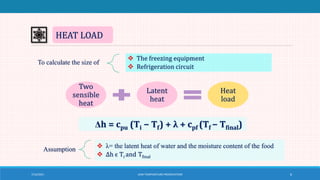
HEAT LOAD
To calculate the size of
 The freezing equipment
 Refrigeration circuit
Two
sensible
heat
Latent
heat
Heat
load
Δh = cpu (Ti − Tf) + λ + cpf (Tf − Tfinal)
Assumption  λ= the latent heat of water and the moisture content of the food
 Δh ϵ Ti and Tfinal
7/16/2021 LOW-TEMPERATURE PRESERVATION 6
7/16/2021 LOW-TEMPERATURE PRESERVATION 7
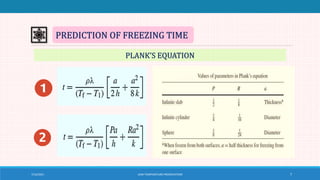
PREDICTION OF FREEZING TIME
PLANK’S EQUATION
7/16/2021 LOW-TEMPERATURE PRESERVATION 8
Cont.
NAGAOKA’S EQUATION STEFAN’S MODEL
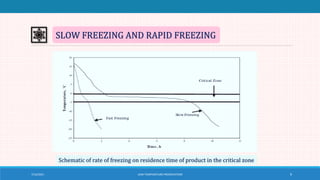
SLOW FREEZING AND RAPID FREEZING
Schematic of rate of freezing on residence time of product in the critical zone
7/16/2021 LOW-TEMPERATURE PRESERVATION 9
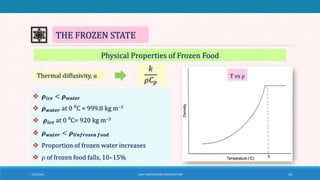
Physical Properties of Frozen Food
Thermal diffusivity, α
THE FROZEN STATE
𝑘
𝜌𝐶𝑝
 𝝆𝒊𝒄𝒆 < 𝝆𝒘𝒂𝒕𝒆𝒓
 𝝆𝒘𝒂𝒕𝒆𝒓 at 0 ⁰C = 999.8 kg m−3
 𝝆𝒊𝒄𝒆 at 0 ⁰C= 920 kg m−3
 𝝆𝒘𝒂𝒕𝒆𝒓 < 𝝆𝑼𝒏𝒇𝒓𝒐𝒛𝒆𝒏 𝒇𝒐𝒐𝒅
 Proportion of frozen water increases
 ρ of frozen food falls, 10–15%
T vs ρ
7/16/2021 LOW-TEMPERATURE PRESERVATION 10
Cont.
 𝐶𝑝, decreases on freezing
7/16/2021 LOW-TEMPERATURE PRESERVATION 11
Cont.
 k increases on freezing, α independent of temperature, α, increases steeply as ‘T’ falls
7/16/2021 LOW-TEMPERATURE PRESERVATION 12
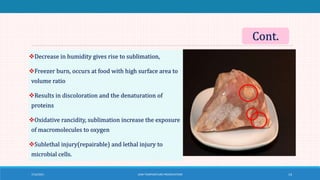
Commercial cold stores are held at about −25⁰C
Domestic freezers normally operate at −18⁰C
Constant low temperature should be maintained
Fluctuations in freezer temperature give rise to the thawing
Recrystallization of ice can result in a severe loss of quality
Disruption to cell walls and a loss of texture
FOOD QUALITY DURING FROZEN STORAGE
7/16/2021 LOW-TEMPERATURE PRESERVATION 13
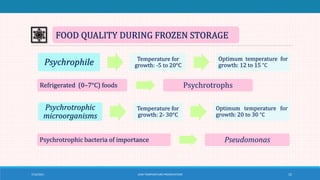
Decrease in humidity gives rise to sublimation,
Freezer burn, occurs at food with high surface area to
volume ratio
Results in discoloration and the denaturation of
proteins
Oxidative rancidity, sublimation increase the exposure
of macromolecules to oxygen
Sublethal injury(repairable) and lethal injury to
microbial cells.
Cont.
7/16/2021 LOW-TEMPERATURE PRESERVATION 14
7/16/2021 LOW-TEMPERATURE PRESERVATION 15
FOOD QUALITY DURING FROZEN STORAGE
Psychrophile Temperature for
growth: -5 to 20°C
Optimum temperature for
growth: 12 to 15 °C
Refrigerated (0–7°C) foods Psychrotrophs
Psychrotrophic
microorganisms
Temperature for
growth: 2- 30°C
Optimum temperature for
growth: 20 to 30 °C
Psychrotrophic bacteria of importance Pseudomonas
7/16/2021 LOW-TEMPERATURE PRESERVATION 16
Cont.
Psychrotrophs
BACTERIA
 Pseudomonas
 Cinetobacter
 Alcaligenes
 Flavobacterium
MOLD
 Botrytis
 Cladosporium
 Geotrichum
 Mucor
 Penicillium
 Sporotrichum
YEAST
 Candida
 Debaryomyces
 Rhodotorula
 Torulopsis
FREEZING
 Prevents the growth of most foodborne
microbes
REFRIGERATION
 Slows down the growth of
microbes
7/16/2021 LOW-TEMPERATURE PRESERVATION 17
 Clostridium botulinum type E
3.3 °C
 Yersiniaent erocolitica
3 °C
 Salmonella spp.
4 °C
 Aeromonas hydrophila and Listeria monocytogenes
<7 °C
 Monera, Penicillium, and Sporotrichum
-4 °C
 Yeast
-3 °C
Refrigeration below 5°C effectively retards the growth of many foodborne pathogens
Cont.
Humidity should be kept above 90%
Reduce the movement of air across the stored product
Frozen food should be glazed
Layer of ice applied by a spray or by immersion, prior to freezing
Protects food from sublimation
Appropriate packaging
Preventing freezer burn and reducing the risk of oxidative rancidity
7/16/2021 LOW-TEMPERATURE PRESERVATION 18
Cont.
Good practices to minimize loss of quality
7/16/2021 LOW-TEMPERATURE PRESERVATION 19
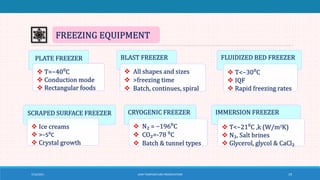
FREEZING EQUIPMENT
PLATE FREEZER
 T=−40⁰C
 Conduction mode
 Rectangular foods
BLAST FREEZER
 All shapes and sizes
 >freezing time
 Batch, continues, spiral
FLUIDIZED BED FREEZER
 T<−30⁰C
 IQF
 Rapid freezing rates
SCRAPED SURFACE FREEZER
 Ice creams
 >−5⁰C
 Crystal growth
CRYOGENIC FREEZER
 N₂ = −196⁰C
 CO₂=-78 ⁰C
 Batch & tunnel types
IMMERSION FREEZER
 T<−21⁰C ,k (W/m²K)
 N₂, Salt brines
 Glycerol, glycol & CaCl₂
7/16/2021 LOW-TEMPERATURE PRESERVATION 20
THANK YOU

Low temperature preservation

  • 1.
    M.Venkatasami, I.D.No: 2020641005 Ph.D.(Processing and Food Engineering) Department of Food Process Engineering AEC&RI, TNAU. LOW-TEMPERATURE PRESERVATION 7/16/2021 LOW-TEMPERATURE PRESERVATION 1
  • 2.
    INTRODUCTION • Chilling isdefined by a storage temperature range between −1 and 8 ⁰C Chilling • Freezing refers to the storage of food at temperatures between −18 and −30⁰C. Freezing  Reduces microbiological and biochemical spoilage  Lower storage temperatures give a longer shelf life  Little or no effect on the nutritional content or organoleptic properties of food  Meat, fish, dairy products and chilled recipe dishes  High-quality raw materials should be selected for freezing 7/16/2021 LOW-TEMPERATURE PRESERVATION 2
  • 3.
    Cont. • Retention of organoleptic properties Advantages •Recrystallization • Vitamin loss • Oxidative rancidity Disadvantages Low temperature storage prevents,  The growth of microorganisms  Activity of enzymes  Purely chemical reactions Shelf life Soft fruits 3 and 6 months at −12⁰C 24 months and beyond at −24⁰ C Meat 6–9 months at −12⁰ C 15 and 24 months at −24⁰ C 7/16/2021 LOW-TEMPERATURE PRESERVATION 3
  • 4.
    FREEZING RATE ANDFREEZING POINT 7/16/2021 LOW-TEMPERATURE PRESERVATION 4
  • 5.
     There isno clear freezing point of a food material  water has a distinctive freezing point (0 ⁰C)  For foods, the freezing range is normally between 0 and about −2 or −3⁰C. Cont. Three stages  The removal of sensible heat from the food (Ti-Tf)  The removal of the latent heat of fusion  Sensible heat removal down to required storage temperature The freezing point is usually defined as the highest temperature at which ice crystals are found to be stable 7/16/2021 LOW-TEMPERATURE PRESERVATION 5
  • 6.
    HEAT LOAD To calculatethe size of  The freezing equipment  Refrigeration circuit Two sensible heat Latent heat Heat load Δh = cpu (Ti − Tf) + λ + cpf (Tf − Tfinal) Assumption  λ= the latent heat of water and the moisture content of the food  Δh ϵ Ti and Tfinal 7/16/2021 LOW-TEMPERATURE PRESERVATION 6
  • 7.
    7/16/2021 LOW-TEMPERATURE PRESERVATION7 PREDICTION OF FREEZING TIME PLANK’S EQUATION
  • 8.
    7/16/2021 LOW-TEMPERATURE PRESERVATION8 Cont. NAGAOKA’S EQUATION STEFAN’S MODEL
  • 9.
    SLOW FREEZING ANDRAPID FREEZING Schematic of rate of freezing on residence time of product in the critical zone 7/16/2021 LOW-TEMPERATURE PRESERVATION 9
  • 10.
    Physical Properties ofFrozen Food Thermal diffusivity, α THE FROZEN STATE 𝑘 𝜌𝐶𝑝  𝝆𝒊𝒄𝒆 < 𝝆𝒘𝒂𝒕𝒆𝒓  𝝆𝒘𝒂𝒕𝒆𝒓 at 0 ⁰C = 999.8 kg m−3  𝝆𝒊𝒄𝒆 at 0 ⁰C= 920 kg m−3  𝝆𝒘𝒂𝒕𝒆𝒓 < 𝝆𝑼𝒏𝒇𝒓𝒐𝒛𝒆𝒏 𝒇𝒐𝒐𝒅  Proportion of frozen water increases  ρ of frozen food falls, 10–15% T vs ρ 7/16/2021 LOW-TEMPERATURE PRESERVATION 10
  • 11.
    Cont.  𝐶𝑝, decreaseson freezing 7/16/2021 LOW-TEMPERATURE PRESERVATION 11
  • 12.
    Cont.  k increaseson freezing, α independent of temperature, α, increases steeply as ‘T’ falls 7/16/2021 LOW-TEMPERATURE PRESERVATION 12
  • 13.
    Commercial cold storesare held at about −25⁰C Domestic freezers normally operate at −18⁰C Constant low temperature should be maintained Fluctuations in freezer temperature give rise to the thawing Recrystallization of ice can result in a severe loss of quality Disruption to cell walls and a loss of texture FOOD QUALITY DURING FROZEN STORAGE 7/16/2021 LOW-TEMPERATURE PRESERVATION 13
  • 14.
    Decrease in humiditygives rise to sublimation, Freezer burn, occurs at food with high surface area to volume ratio Results in discoloration and the denaturation of proteins Oxidative rancidity, sublimation increase the exposure of macromolecules to oxygen Sublethal injury(repairable) and lethal injury to microbial cells. Cont. 7/16/2021 LOW-TEMPERATURE PRESERVATION 14
  • 15.
    7/16/2021 LOW-TEMPERATURE PRESERVATION15 FOOD QUALITY DURING FROZEN STORAGE Psychrophile Temperature for growth: -5 to 20°C Optimum temperature for growth: 12 to 15 °C Refrigerated (0–7°C) foods Psychrotrophs Psychrotrophic microorganisms Temperature for growth: 2- 30°C Optimum temperature for growth: 20 to 30 °C Psychrotrophic bacteria of importance Pseudomonas
  • 16.
    7/16/2021 LOW-TEMPERATURE PRESERVATION16 Cont. Psychrotrophs BACTERIA  Pseudomonas  Cinetobacter  Alcaligenes  Flavobacterium MOLD  Botrytis  Cladosporium  Geotrichum  Mucor  Penicillium  Sporotrichum YEAST  Candida  Debaryomyces  Rhodotorula  Torulopsis FREEZING  Prevents the growth of most foodborne microbes REFRIGERATION  Slows down the growth of microbes
  • 17.
    7/16/2021 LOW-TEMPERATURE PRESERVATION17  Clostridium botulinum type E 3.3 °C  Yersiniaent erocolitica 3 °C  Salmonella spp. 4 °C  Aeromonas hydrophila and Listeria monocytogenes <7 °C  Monera, Penicillium, and Sporotrichum -4 °C  Yeast -3 °C Refrigeration below 5°C effectively retards the growth of many foodborne pathogens Cont.
  • 18.
    Humidity should bekept above 90% Reduce the movement of air across the stored product Frozen food should be glazed Layer of ice applied by a spray or by immersion, prior to freezing Protects food from sublimation Appropriate packaging Preventing freezer burn and reducing the risk of oxidative rancidity 7/16/2021 LOW-TEMPERATURE PRESERVATION 18 Cont. Good practices to minimize loss of quality
  • 19.
    7/16/2021 LOW-TEMPERATURE PRESERVATION19 FREEZING EQUIPMENT PLATE FREEZER  T=−40⁰C  Conduction mode  Rectangular foods BLAST FREEZER  All shapes and sizes  >freezing time  Batch, continues, spiral FLUIDIZED BED FREEZER  T<−30⁰C  IQF  Rapid freezing rates SCRAPED SURFACE FREEZER  Ice creams  >−5⁰C  Crystal growth CRYOGENIC FREEZER  N₂ = −196⁰C  CO₂=-78 ⁰C  Batch & tunnel types IMMERSION FREEZER  T<−21⁰C ,k (W/m²K)  N₂, Salt brines  Glycerol, glycol & CaCl₂
  • 20.