SPEECH DISORDERS
SAFI-UR-REHMAN QAMAR (2017-AG-2943)
UNIVERSITY OF AGRICULTURE FAISALABAD
CONTENTS
INTRODUCTION
TYPES OF SPEECH DISORDERS
CAUSES OF SPEECH DISORDERS
IMPECT ON LIFE
CONCLUSION
INTRODUCTION
◦ A speech disorder refers to a problem with the actual production of sounds.
◦ Speech gives us a means by which we can connect and build intimate relationships with others.
◦ Speech impediments can take place because of genetic influences, physical deformities or
neurological malfunctions.
◦ Structural defects that disrupt a child’s ability to speak clearly occur in approximately 1 out of every
700 births (Sataloff, 2011).
◦ It has been found that pathologists view emotional hardships as a much less threatening issue than
physical bullying and often lack emphasis on emotional support in speech therapy (Blood, Blood,
Tramontana, Sylvia, & Boyle 2011).
TYPES OF SPEECH DISORDERS
1. Dysfluent
2. Articulation Disorders
3. Fluency disorders
4. Resonance or Voice Disorders
5. Apraxia
6. Dysarthria
7. Dysprosody
8. Muteness
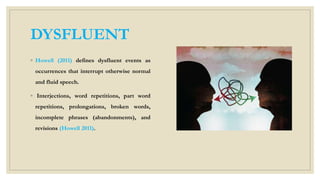
DYSFLUENT
◦ Howell (2011) defines dysfluent events as
occurrences that interrupt otherwise normal
and fluid speech.
◦ Interjections, word repetitions, part word
repetitions, prolongations, broken words,
incomplete phrases (abandonments), and
revisions (Howell 2011).
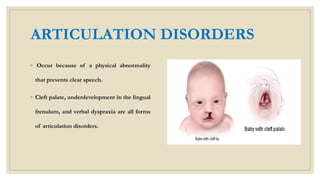
ARTICULATION DISORDERS
◦ Occur because of a physical abnormality
that prevents clear speech.
◦ Cleft palate, underdevelopment in the lingual
frenulum, and verbal dyspraxia are all forms
of articulation disorders.
FLUENCY DISORDERS
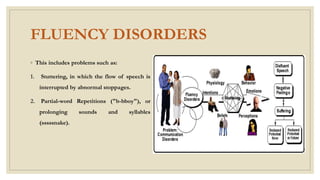
◦ This includes problems such as:
1. Stuttering, in which the flow of speech is
interrupted by abnormal stoppages.
2. Partial-word Repetitions ("b-bboy"), or
prolonging sounds and syllables
(sssssnake).
RESONANCE/VOICE DISORDERS
◦ This cause problems with the :
1. Pitch
2. Volume
3. Quality of the voice that distract listeners
from what's being said.
◦ These types of disorders may also cause
pain or discomfort for a child when
speaking.
APRAXIA
◦ Production of words becomes more difficult
with effort, but common phrases may
sometimes be spoken spontaneously without
effort.
◦ This may result from:
 stroke or progressive illness
◦ Involves inconsistent production of speech
sounds and rearranging of sounds in a word
("potato" may become "topato" and next
"totapo").
DYSARTHRIA
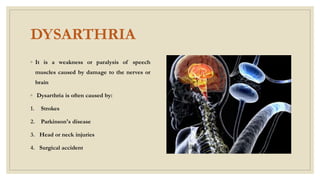
◦ It is a weakness or paralysis of speech
muscles caused by damage to the nerves or
brain
◦ Dysarthria is often caused by:
1. Strokes
2. Parkinson's disease
3. Head or neck injuries
4. Surgical accident
DYSPROSODY
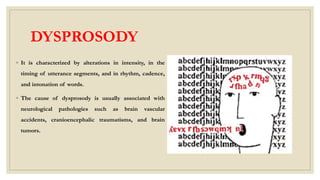
◦ It is characterized by alterations in intensity, in the
timing of utterance segments, and in rhythm, cadence,
and intonation of words.
◦ The cause of dysprosody is usually associated with
neurological pathologies such as brain vascular
accidents, cranioencephalic traumatisms, and brain
tumors.
MUTENESS
◦ It is complete inability to speak.
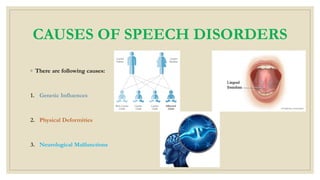
CAUSES OF SPEECH DISORDERS
◦ There are following causes:
1. Genetic Influences
2. Physical Deformities
3. Neurological Malfunctions
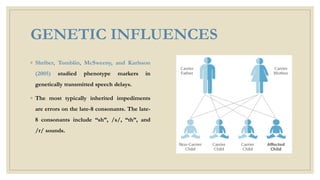
GENETIC INFLUENCES
◦ Drayna and Kang (2011) located a central
area of the DNA that appears to be
responsible for the disruption of the
lysosomal pathway, a passageway of
enzymes.
◦ They found a region on chromosome 12 that
shows mutation in the GNPTA and NAGPA
genes in many of their stuttering
participants.
GENETIC INFLUENCES
◦ Shriber, Tomblin, McSweeny, and Karlsson
(2005) studied phenotype markers in
genetically transmitted speech delays.
◦ The most typically inherited impediments
are errors on the late-8 consonants. The late-
8 consonants include “sh”, /s/, “th”, and
/r/ sounds.
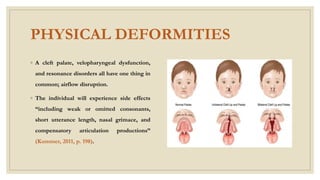
PHYSICAL DEFORMITIES
◦ A cleft palate, velopharyngeal dysfunction,
and resonance disorders all have one thing in
common; airflow disruption.
◦ The individual will experience side effects
“including weak or omitted consonants,
short utterance length, nasal grimace, and
compensatory articulation productions”
(Kummer, 2011, p. 198).
PHYSICAL DEFORMITIES
◦ Sataloff (2011) researched the major defects
that cause palpable effects on speech which
is an extremely short lingual frenulum.
◦ When the frenulum is too short, the
individual is unable to accurately manipulate
their tongue and articulate sounds (Sataloff,
2011).
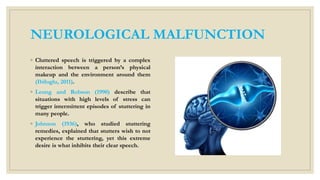
NEUROLOGICAL MALFUNCTION
◦ Cluttered speech is triggered by a complex
interaction between a person’s physical
makeup and the environment around them
(Ibiloglu, 2011).
◦ Leung and Robson (1990) describe that
situations with high levels of stress can
trigger intermittent episodes of stuttering in
many people.
◦ Johnson (1936), who studied stuttering
remedies, explained that stutters wish to not
experience the stuttering, yet this extreme
desire is what inhibits their clear speech.
IMPECT ON LIFE
◦ Speech is the key to communication. When
its not good the following things a individual
suffer:
1. Social Acceptance
2. Lack of Confidence
3. Over All Life Satisfaction
CONCLUSION
◦ Wankoff (2011), adolescence and later life
can be improved with early identification
and proper intervention.
◦ Wankoff (2011) found that earlier speech
intervention yielded a much higher
satisfaction and confidence in adolescence
and decreased negative experiences in
school.
◦ This occurs as the impediment is combated
against early, stopping it from becoming an
overpowering and predominant disability.
◦ The students with speech disorders often
suffer from distinctive traits such as anxiety,
stress, nervousness, and a disruption in
typical neurological function (Ibiloglu, 2001).
Emotional support is a component that has been an area traditionally
left out of speech therapy.
References
◦ Blood, G., Blood, I., Tramontana, I., Sylvia, A., Boyle, M., Motzko, G., (2011). Self-reported experience of bullying of students who
stutter: Relations with life satisfaction, life orientation, and self-esteem. Perceptual and Motor Skills, 113(2), 353-364.
◦ Blood, G. , Blood, I. , Tellis, G. , & Gabel, R. (2003). A preliminary study of self-esteem, stigma, and disclosure in adolescents who
stutter. Journal of Fluency Disorders, 28(2), 143-159.
◦ Blood, G. , Boyle, M. , Blood, I. , & Nalesnik, G. (2010). Bullying in children who stutter: Speech-language pathologists' perceptions
and intervention strategies. Journal of Fluency
Disorders, 35(2), 92-109.
◦ Craig, H. (1993). Social skills of children with specific language impairment: Peer relationships.
Language, Speech, and Hearing Services in Schools, 24(4), 206-215.
◦ Davis, S. , Howell, P. , & Cooke, F. (2002). Socio dynamic relationships between children who stutter and their non-stuttering
classmates. Journal of Child Psychology and Psychiatry,
43(7), 939-947.
◦ Davis, S. , Shisca, D. , & Howell, P. (2007). Anxiety in speakers who persist and recover from stuttering. Journal of Communication
Disorders, 40(5), 398-417.
◦ Drayna, D. , & Kang, C. (2011). Genetic approaches to understanding the causes of stuttering. Journal of Neurodevelopmental Disorders,
3(4), 374-380.
Speech Disorders

Speech Disorders

  • 1.
    SPEECH DISORDERS SAFI-UR-REHMAN QAMAR(2017-AG-2943) UNIVERSITY OF AGRICULTURE FAISALABAD
  • 2.
    CONTENTS INTRODUCTION TYPES OF SPEECHDISORDERS CAUSES OF SPEECH DISORDERS IMPECT ON LIFE CONCLUSION
  • 3.
    INTRODUCTION ◦ A speechdisorder refers to a problem with the actual production of sounds. ◦ Speech gives us a means by which we can connect and build intimate relationships with others. ◦ Speech impediments can take place because of genetic influences, physical deformities or neurological malfunctions. ◦ Structural defects that disrupt a child’s ability to speak clearly occur in approximately 1 out of every 700 births (Sataloff, 2011). ◦ It has been found that pathologists view emotional hardships as a much less threatening issue than physical bullying and often lack emphasis on emotional support in speech therapy (Blood, Blood, Tramontana, Sylvia, & Boyle 2011).
  • 4.
    TYPES OF SPEECHDISORDERS 1. Dysfluent 2. Articulation Disorders 3. Fluency disorders 4. Resonance or Voice Disorders 5. Apraxia 6. Dysarthria 7. Dysprosody 8. Muteness
  • 5.
    DYSFLUENT ◦ Howell (2011)defines dysfluent events as occurrences that interrupt otherwise normal and fluid speech. ◦ Interjections, word repetitions, part word repetitions, prolongations, broken words, incomplete phrases (abandonments), and revisions (Howell 2011).
  • 6.
    ARTICULATION DISORDERS ◦ Occurbecause of a physical abnormality that prevents clear speech. ◦ Cleft palate, underdevelopment in the lingual frenulum, and verbal dyspraxia are all forms of articulation disorders.
  • 7.
    FLUENCY DISORDERS ◦ Thisincludes problems such as: 1. Stuttering, in which the flow of speech is interrupted by abnormal stoppages. 2. Partial-word Repetitions ("b-bboy"), or prolonging sounds and syllables (sssssnake).
  • 8.
    RESONANCE/VOICE DISORDERS ◦ Thiscause problems with the : 1. Pitch 2. Volume 3. Quality of the voice that distract listeners from what's being said. ◦ These types of disorders may also cause pain or discomfort for a child when speaking.
  • 9.
    APRAXIA ◦ Production ofwords becomes more difficult with effort, but common phrases may sometimes be spoken spontaneously without effort. ◦ This may result from:  stroke or progressive illness ◦ Involves inconsistent production of speech sounds and rearranging of sounds in a word ("potato" may become "topato" and next "totapo").
  • 10.
    DYSARTHRIA ◦ It isa weakness or paralysis of speech muscles caused by damage to the nerves or brain ◦ Dysarthria is often caused by: 1. Strokes 2. Parkinson's disease 3. Head or neck injuries 4. Surgical accident
  • 11.
    DYSPROSODY ◦ It ischaracterized by alterations in intensity, in the timing of utterance segments, and in rhythm, cadence, and intonation of words. ◦ The cause of dysprosody is usually associated with neurological pathologies such as brain vascular accidents, cranioencephalic traumatisms, and brain tumors.
  • 12.
    MUTENESS ◦ It iscomplete inability to speak.
  • 13.
    CAUSES OF SPEECHDISORDERS ◦ There are following causes: 1. Genetic Influences 2. Physical Deformities 3. Neurological Malfunctions
  • 14.
    GENETIC INFLUENCES ◦ Draynaand Kang (2011) located a central area of the DNA that appears to be responsible for the disruption of the lysosomal pathway, a passageway of enzymes. ◦ They found a region on chromosome 12 that shows mutation in the GNPTA and NAGPA genes in many of their stuttering participants.
  • 15.
    GENETIC INFLUENCES ◦ Shriber,Tomblin, McSweeny, and Karlsson (2005) studied phenotype markers in genetically transmitted speech delays. ◦ The most typically inherited impediments are errors on the late-8 consonants. The late- 8 consonants include “sh”, /s/, “th”, and /r/ sounds.
  • 16.
    PHYSICAL DEFORMITIES ◦ Acleft palate, velopharyngeal dysfunction, and resonance disorders all have one thing in common; airflow disruption. ◦ The individual will experience side effects “including weak or omitted consonants, short utterance length, nasal grimace, and compensatory articulation productions” (Kummer, 2011, p. 198).
  • 17.
    PHYSICAL DEFORMITIES ◦ Sataloff(2011) researched the major defects that cause palpable effects on speech which is an extremely short lingual frenulum. ◦ When the frenulum is too short, the individual is unable to accurately manipulate their tongue and articulate sounds (Sataloff, 2011).
  • 18.
    NEUROLOGICAL MALFUNCTION ◦ Clutteredspeech is triggered by a complex interaction between a person’s physical makeup and the environment around them (Ibiloglu, 2011). ◦ Leung and Robson (1990) describe that situations with high levels of stress can trigger intermittent episodes of stuttering in many people. ◦ Johnson (1936), who studied stuttering remedies, explained that stutters wish to not experience the stuttering, yet this extreme desire is what inhibits their clear speech.
  • 19.
    IMPECT ON LIFE ◦Speech is the key to communication. When its not good the following things a individual suffer: 1. Social Acceptance 2. Lack of Confidence 3. Over All Life Satisfaction
  • 20.
    CONCLUSION ◦ Wankoff (2011),adolescence and later life can be improved with early identification and proper intervention. ◦ Wankoff (2011) found that earlier speech intervention yielded a much higher satisfaction and confidence in adolescence and decreased negative experiences in school. ◦ This occurs as the impediment is combated against early, stopping it from becoming an overpowering and predominant disability. ◦ The students with speech disorders often suffer from distinctive traits such as anxiety, stress, nervousness, and a disruption in typical neurological function (Ibiloglu, 2001). Emotional support is a component that has been an area traditionally left out of speech therapy.
  • 21.
    References ◦ Blood, G.,Blood, I., Tramontana, I., Sylvia, A., Boyle, M., Motzko, G., (2011). Self-reported experience of bullying of students who stutter: Relations with life satisfaction, life orientation, and self-esteem. Perceptual and Motor Skills, 113(2), 353-364. ◦ Blood, G. , Blood, I. , Tellis, G. , & Gabel, R. (2003). A preliminary study of self-esteem, stigma, and disclosure in adolescents who stutter. Journal of Fluency Disorders, 28(2), 143-159. ◦ Blood, G. , Boyle, M. , Blood, I. , & Nalesnik, G. (2010). Bullying in children who stutter: Speech-language pathologists' perceptions and intervention strategies. Journal of Fluency Disorders, 35(2), 92-109. ◦ Craig, H. (1993). Social skills of children with specific language impairment: Peer relationships. Language, Speech, and Hearing Services in Schools, 24(4), 206-215. ◦ Davis, S. , Howell, P. , & Cooke, F. (2002). Socio dynamic relationships between children who stutter and their non-stuttering classmates. Journal of Child Psychology and Psychiatry, 43(7), 939-947. ◦ Davis, S. , Shisca, D. , & Howell, P. (2007). Anxiety in speakers who persist and recover from stuttering. Journal of Communication Disorders, 40(5), 398-417. ◦ Drayna, D. , & Kang, C. (2011). Genetic approaches to understanding the causes of stuttering. Journal of Neurodevelopmental Disorders, 3(4), 374-380.