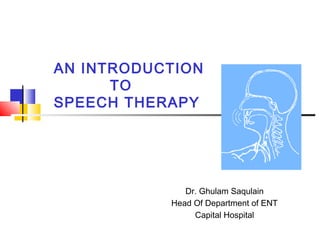
AN INTRODUCTION
TO
SPEECH THERAPY
Dr. Ghulam Saqulain
Head Of Department of ENT
Capital Hospital
Who is a ‘Speech
Therapist’?
A person who specializes in the diagnostic
procedures, evaluation techniques,
assessment tools and various therapeutic
techniques related to different
communicative disorders.
What is Speech Therapy?
“Speech Therapy is a rehabilitative
procedure undertaken in order to help
the people having any kind of
Communication Disorders or Problems
and some swallowing problems”
AIMS
The problems these people face have many sources,
some stem from the Physical cause, Psychologically
based, some have roots in the Childhood
environment, and some may result from an un
measurable combinations of these factors/ causes.
Regardless of the cause or causes Speech
Language Therapist tries to help the whole person
who is experiencing the communicative difficulty.
In some instances the problem is “CURED”, In other
cases no cure is found but the person is helped to
COMPENSATE and to REACH MAXIMUM
COMMUNICATIVE POTENTIAL.
Speech &Language Rehabilitation
A
TeamWork
The specialities involved are:
Psychiatry & Psychology, Neurology,
Pediatrics, Medical Specialist, an
Audiologist, a Rehab. specialist and above
all a Otolaryngologists and a Speech
Language Pathologist.
Speech Therapist
Role
A Speech Therapist may assist relevant
specialists by providing their patients with
diagnostic and therapeutic techniques related
to speech therapy for the following types of
speech language disorders :
COMMUNICATIONAL DISORDERS
Types
 Stammering
 Voice Disorders
 Language Disorders
 Aphasia
 Articulation Disorders
 Neurogenic Speech & Swallowing Disorders
 Dysarthia
 Apraxia of Speech
 Dysphagia
 Aphasia
 Psychological, Emotional and Behavioral Based Communication
Disorders:
 Hyperactivity
 Autism
 Anxiety, depression, phobias.
STAMMERING
 Stammering is a frequent disruption in the fluency of
verbal expression and is a multi dimentional problem.
 It is best categorized as a cluster of a particular kind
of speech behaviors, feelings, believes, self concepts
and social interactions
 It may be characterized by: Blocking, prolongations,
pauses, and repetitions.
 with wide variety of secondary symptoms:
Eye blinking,facial grimaces,head/ body
jerking,and shaking the hands and limbs etc
STAMMERING
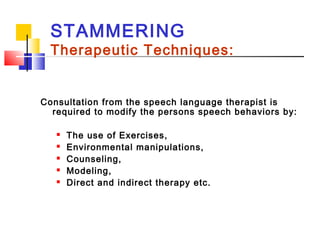
Therapeutic Techniques:
Consultation from the speech language therapist is
required to modify the persons speech behaviors by:
 The use of Exercises,
 Environmental manipulations,
 Counseling,
 Modeling,
 Direct and indirect therapy etc.
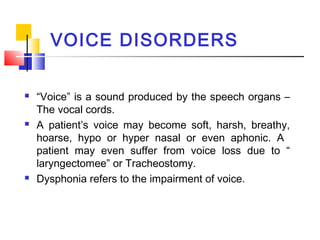
VOICE DISORDERS
 “Voice” is a sound produced by the speech organs –
The vocal cords.
 A patient’s voice may become soft, harsh, breathy,
hoarse, hypo or hyper nasal or even aphonic. A
patient may even suffer from voice loss due to “
laryngectomee” or Tracheostomy.
 Dysphonia refers to the impairment of voice.
VOICE DISORDERS
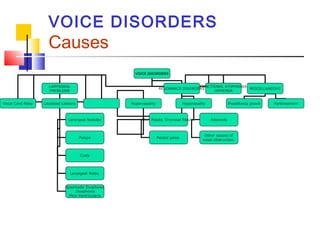
Causes
VOICE DISORDERS
LARYNGEAL
PROBLEMS
Vocal Cord Palsy Localized Leisions
Laryngeal Nodules
Polyps
Cysts
Laryngeal Webs.
Spasmodic Dysphonia
,Dysphonia
Plica Ventricularis
RESONANCE DISORDERS
Hypernasality Hyponasality
Cleft Palate, Oronasal fistulae
Palatal palsy.
Adenoids
Other causes of
nasal obstruction.
FUNCTIONAL DYSPHONIA
/APHONIA
MISCELLANEOUS
Myasthenia gravis Parkinsonism
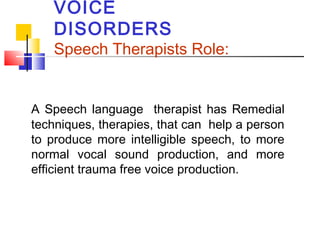
VOICE
DISORDERS
Speech Therapists Role:
A Speech language therapist has Remedial
techniques, therapies, that can help a person
to produce more intelligible speech, to more
normal vocal sound production, and more
efficient trauma free voice production.
LANGUAGE DISORDERS
 Language can be defined as the socially shared code
or conventional system for representing concepts
through the use of arbitrary symbols and rule
governed combinations of those symbols.
 In language disorders the person is either unable to
comprehend the symbols of language used by the
speakers, or he does not have the ability to use the
language symbols on his own.
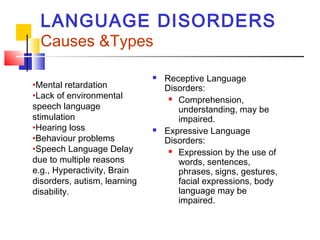
LANGUAGE DISORDERS
Causes &Types
 Receptive Language
Disorders:
 Comprehension,
understanding, may be
impaired.
 Expressive Language
Disorders:
 Expression by the use of
words, sentences,
phrases, signs, gestures,
facial expressions, body
language may be
impaired.
•Mental retardation
•Lack of environmental
speech language
stimulation
•Hearing loss
•Behaviour problems
•Speech Language Delay
due to multiple reasons
e.g., Hyperactivity, Brain
disorders, autism, learning
disability.
LANGUAGE DISORDERS
Speech Therapists role:
 Speech Language Therapist helps the patient with
the use of diagnosing, testing, screening tests and
interventions, counselling and Behaviour therapy
approaches (Reward, Reinforcement, punishment
etc)
 Prognosis: Depends on the cause, type, age,
persistency of the therapy motivation and
environmental variables.
APHASIA
 “Aphasia is an acquired language disorder caused by
Brain Damage, Resulting in Partial or complete
Impairment of Language Comprehension, formulation
and the use for communication”
 In aphasia there is a break down in the ability of a
person to formulate or to retrieve and to decode the
arbitrary symbols of language.
 Types:

Fluent: Wernicke’s, Conduction, Anomic, Transcortica

Non Fluent: Broca’s and Transcortical Motor aphasia

Global or Mixed Aphasia.
APHASIA
Speech therapists role:
 Help the aphasic patient in reducing and minimizing
the communication problem produced by any one of
the cause.
 Rehabilitation of the aphasic patient requires the
cooperative efforts of a team consisting of
Neurologist, psychiatrist, psychologist,
physiotherapist and speech language therapist.
ARTICULATION DISORDERS
“Articulation refers to the movements of the
articulators in the production of speech sounds
that make up the words of our language.”
Types of Articulation Errors:
 Substitution,
 Distortion,
 Omission,
 Addition etc.
ARTICULATION DISORDERS
Causes:
 Orofacial Anomalies eg., cleft lip and palate
 Dysarthria
 Oral apraxia
 Cerebral palsy
 Hearing Impairment
 Tongue tie,
 Malocclusion
ARTICULATION DISORDERS
Treatment:
 Articulation problems are successfully identified
,assessed and treated with surgical and therapeutic
measures
 The Therapeutic measures include:
 Traditional articulation therapy, immitation, modeling and
Counselling etc.
 Prognosis: Depends upon the cause, age, social
variable, intelligence and socio-economic status of
patient.
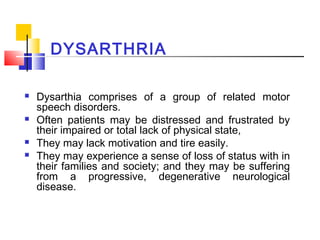
DYSARTHRIA
 Dysarthia comprises of a group of related motor
speech disorders.
 Often patients may be distressed and frustrated by
their impaired or total lack of physical state,
 They may lack motivation and tire easily.
 They may experience a sense of loss of status with in
their families and society; and they may be suffering
from a progressive, degenerative neurological
disease.
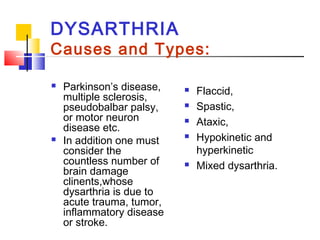
DYSARTHRIA
Causes and Types:
 Parkinson’s disease,
multiple sclerosis,
pseudobalbar palsy,
or motor neuron
disease etc.
 In addition one must
consider the
countless number of
brain damage
clinents,whose
dysarthria is due to
acute trauma, tumor,
inflammatory disease
or stroke.
 Flaccid,
 Spastic,
 Ataxic,
 Hypokinetic and
hyperkinetic
 Mixed dysarthria.
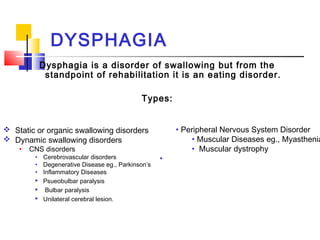
DYSPHAGIA
Dysphagia is a disorder of swallowing but from the
standpoint of rehabilitation it is an eating disorder.
Types:
 Static or organic swallowing disorders
 Dynamic swallowing disorders
• CNS disorders
• Cerebrovascular disorders
• Degenerative Disease eg., Parkinson’s
• Inflammatory Diseases

Psueobulbar paralysis

Bulbar paralysis

Unilateral cerebral lesion.
• Peripheral Nervous System Disorder
• Muscular Diseases eg., Myasthenia
• Muscular dystrophy
•
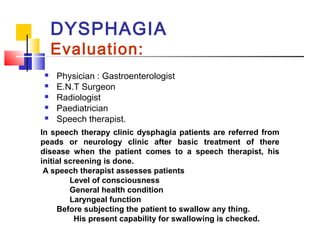
DYSPHAGIA
Evaluation:
 Physician : Gastroenterologist
 E.N.T Surgeon
 Radiologist
 Paediatrician
 Speech therapist.
In speech therapy clinic dysphagia patients are referred from
peads or neurology clinic after basic treatment of there
disease when the patient comes to a speech therapist, his
initial screening is done.
A speech therapist assesses patients
Level of consciousness
General health condition
Laryngeal function
Before subjecting the patient to swallow any thing.
His present capability for swallowing is checked.
WE PERFORM :
 Oral motor examination
procedure
 Laryngeal function Test
 RSST
 (Repetative Saliva
Swallowing Test)
 Water drinking test
 Food intake test.
 Flourography
EXAMINATION PROCEDURES
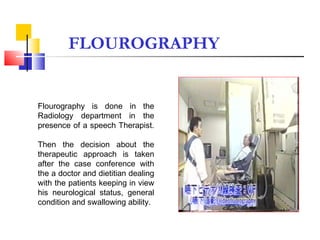
Flourography is done in the
Radiology department in the
presence of a speech Therapist.
Then the decision about the
therapeutic approach is taken
after the case conference with
the a doctor and dietitian dealing
with the patients keeping in view
his neurological status, general
condition and swallowing ability.
FLOUROGRAPHY
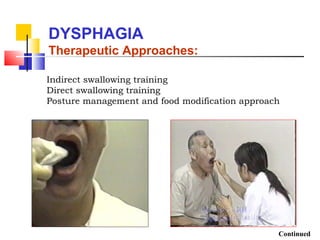
Indirect swallowing training
Direct swallowing training
Posture management and food modification approach
DYSPHAGIA
Therapeutic Approaches:
Continued
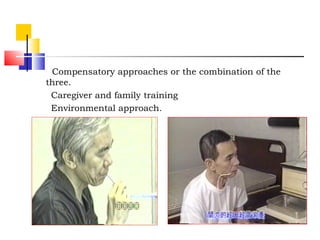
Compensatory approaches or the combination of the
three.
Caregiver and family training
Environmental approach.
AUTISM
“It is a developmental disability significantly affecting
verbal and non verbal communication and social
interaction, that adversely effects educational
performance, involving extreme sense of isolation
and detachment, from the world around them that
characterize these individuals who are ‘autistic’”
AUTISM
Intervention:
 Educational Management
 Psychological Management
 Medical Management
 Behavioural Management
SPEECH THERAPY AND
DISABILITY
According to WHO:
“Disability is any restriction or lack resulting
from an impairment of ability to perform an
activity in the manner or within range
considered normal for a human being”
 Speech and language therapy helps the disabled or
impaired individual, by providing maximum
communicative potential, compensatory methods,
rehablitation and mainstreaming.
 Early diagnosis, treatment and intervening the
communicative problem will reduce the intensity and
severity of the problem which enhances the
effectiveness of Speech Language Therapy.
SPEECH THERAPY AND
DISABILITY
SPEECH THERAPY AND DISABILITY
Hearing Impairment:
 The impaired hearing either in childhood or adulthood
leads to communicative disorders.
 Speech Therapy procedures helps the hearing
impaired individuals specially children, to acquire
maximum of their interactive and communicative
potentials.
SPEECH THERAPY AND DISABILITY
Mental Retardation:
Speech Language Procedure cannot cure the
organic cause but helps in developing more or
near normal speech language acquisition, or may
use compensatory approaches to minimize the
communicative problems.
SPEECH THERAPY AND
DISABILITY Cerebral Palsy:
 Speech Therapy Procedures helps the C.P child by
providing extensive home plans and management for
compensation of the lost ability.
SPEECH THERAPY AND
DISABILITY Visual Impairment:
Speech Language Therapy procedures help the
V. Impaired individual in oral-verbal aspect of
communication only.

An introduction to speech therapy

  • 1.
    AN INTRODUCTION TO SPEECH THERAPY Dr.Ghulam Saqulain Head Of Department of ENT Capital Hospital
  • 2.
    Who is a‘Speech Therapist’? A person who specializes in the diagnostic procedures, evaluation techniques, assessment tools and various therapeutic techniques related to different communicative disorders.
  • 3.
    What is SpeechTherapy? “Speech Therapy is a rehabilitative procedure undertaken in order to help the people having any kind of Communication Disorders or Problems and some swallowing problems”
  • 4.
    AIMS The problems thesepeople face have many sources, some stem from the Physical cause, Psychologically based, some have roots in the Childhood environment, and some may result from an un measurable combinations of these factors/ causes. Regardless of the cause or causes Speech Language Therapist tries to help the whole person who is experiencing the communicative difficulty. In some instances the problem is “CURED”, In other cases no cure is found but the person is helped to COMPENSATE and to REACH MAXIMUM COMMUNICATIVE POTENTIAL.
  • 5.
    Speech &Language Rehabilitation A TeamWork Thespecialities involved are: Psychiatry & Psychology, Neurology, Pediatrics, Medical Specialist, an Audiologist, a Rehab. specialist and above all a Otolaryngologists and a Speech Language Pathologist.
  • 6.
    Speech Therapist Role A SpeechTherapist may assist relevant specialists by providing their patients with diagnostic and therapeutic techniques related to speech therapy for the following types of speech language disorders :
  • 7.
    COMMUNICATIONAL DISORDERS Types  Stammering Voice Disorders  Language Disorders  Aphasia  Articulation Disorders  Neurogenic Speech & Swallowing Disorders  Dysarthia  Apraxia of Speech  Dysphagia  Aphasia  Psychological, Emotional and Behavioral Based Communication Disorders:  Hyperactivity  Autism  Anxiety, depression, phobias.
  • 8.
    STAMMERING  Stammering isa frequent disruption in the fluency of verbal expression and is a multi dimentional problem.  It is best categorized as a cluster of a particular kind of speech behaviors, feelings, believes, self concepts and social interactions  It may be characterized by: Blocking, prolongations, pauses, and repetitions.  with wide variety of secondary symptoms: Eye blinking,facial grimaces,head/ body jerking,and shaking the hands and limbs etc
  • 9.
    STAMMERING Therapeutic Techniques: Consultation fromthe speech language therapist is required to modify the persons speech behaviors by:  The use of Exercises,  Environmental manipulations,  Counseling,  Modeling,  Direct and indirect therapy etc.
  • 10.
    VOICE DISORDERS  “Voice”is a sound produced by the speech organs – The vocal cords.  A patient’s voice may become soft, harsh, breathy, hoarse, hypo or hyper nasal or even aphonic. A patient may even suffer from voice loss due to “ laryngectomee” or Tracheostomy.  Dysphonia refers to the impairment of voice.
  • 11.
    VOICE DISORDERS Causes VOICE DISORDERS LARYNGEAL PROBLEMS VocalCord Palsy Localized Leisions Laryngeal Nodules Polyps Cysts Laryngeal Webs. Spasmodic Dysphonia ,Dysphonia Plica Ventricularis RESONANCE DISORDERS Hypernasality Hyponasality Cleft Palate, Oronasal fistulae Palatal palsy. Adenoids Other causes of nasal obstruction. FUNCTIONAL DYSPHONIA /APHONIA MISCELLANEOUS Myasthenia gravis Parkinsonism
  • 12.
    VOICE DISORDERS Speech Therapists Role: ASpeech language therapist has Remedial techniques, therapies, that can help a person to produce more intelligible speech, to more normal vocal sound production, and more efficient trauma free voice production.
  • 13.
    LANGUAGE DISORDERS  Languagecan be defined as the socially shared code or conventional system for representing concepts through the use of arbitrary symbols and rule governed combinations of those symbols.  In language disorders the person is either unable to comprehend the symbols of language used by the speakers, or he does not have the ability to use the language symbols on his own.
  • 14.
    LANGUAGE DISORDERS Causes &Types Receptive Language Disorders:  Comprehension, understanding, may be impaired.  Expressive Language Disorders:  Expression by the use of words, sentences, phrases, signs, gestures, facial expressions, body language may be impaired. •Mental retardation •Lack of environmental speech language stimulation •Hearing loss •Behaviour problems •Speech Language Delay due to multiple reasons e.g., Hyperactivity, Brain disorders, autism, learning disability.
  • 15.
    LANGUAGE DISORDERS Speech Therapistsrole:  Speech Language Therapist helps the patient with the use of diagnosing, testing, screening tests and interventions, counselling and Behaviour therapy approaches (Reward, Reinforcement, punishment etc)  Prognosis: Depends on the cause, type, age, persistency of the therapy motivation and environmental variables.
  • 16.
    APHASIA  “Aphasia isan acquired language disorder caused by Brain Damage, Resulting in Partial or complete Impairment of Language Comprehension, formulation and the use for communication”  In aphasia there is a break down in the ability of a person to formulate or to retrieve and to decode the arbitrary symbols of language.  Types:  Fluent: Wernicke’s, Conduction, Anomic, Transcortica  Non Fluent: Broca’s and Transcortical Motor aphasia  Global or Mixed Aphasia.
  • 17.
    APHASIA Speech therapists role: Help the aphasic patient in reducing and minimizing the communication problem produced by any one of the cause.  Rehabilitation of the aphasic patient requires the cooperative efforts of a team consisting of Neurologist, psychiatrist, psychologist, physiotherapist and speech language therapist.
  • 18.
    ARTICULATION DISORDERS “Articulation refersto the movements of the articulators in the production of speech sounds that make up the words of our language.” Types of Articulation Errors:  Substitution,  Distortion,  Omission,  Addition etc.
  • 19.
    ARTICULATION DISORDERS Causes:  OrofacialAnomalies eg., cleft lip and palate  Dysarthria  Oral apraxia  Cerebral palsy  Hearing Impairment  Tongue tie,  Malocclusion
  • 20.
    ARTICULATION DISORDERS Treatment:  Articulationproblems are successfully identified ,assessed and treated with surgical and therapeutic measures  The Therapeutic measures include:  Traditional articulation therapy, immitation, modeling and Counselling etc.  Prognosis: Depends upon the cause, age, social variable, intelligence and socio-economic status of patient.
  • 21.
    DYSARTHRIA  Dysarthia comprisesof a group of related motor speech disorders.  Often patients may be distressed and frustrated by their impaired or total lack of physical state,  They may lack motivation and tire easily.  They may experience a sense of loss of status with in their families and society; and they may be suffering from a progressive, degenerative neurological disease.
  • 22.
    DYSARTHRIA Causes and Types: Parkinson’s disease, multiple sclerosis, pseudobalbar palsy, or motor neuron disease etc.  In addition one must consider the countless number of brain damage clinents,whose dysarthria is due to acute trauma, tumor, inflammatory disease or stroke.  Flaccid,  Spastic,  Ataxic,  Hypokinetic and hyperkinetic  Mixed dysarthria.
  • 23.
    DYSPHAGIA Dysphagia is adisorder of swallowing but from the standpoint of rehabilitation it is an eating disorder. Types:  Static or organic swallowing disorders  Dynamic swallowing disorders • CNS disorders • Cerebrovascular disorders • Degenerative Disease eg., Parkinson’s • Inflammatory Diseases  Psueobulbar paralysis  Bulbar paralysis  Unilateral cerebral lesion. • Peripheral Nervous System Disorder • Muscular Diseases eg., Myasthenia • Muscular dystrophy •
  • 24.
    DYSPHAGIA Evaluation:  Physician :Gastroenterologist  E.N.T Surgeon  Radiologist  Paediatrician  Speech therapist. In speech therapy clinic dysphagia patients are referred from peads or neurology clinic after basic treatment of there disease when the patient comes to a speech therapist, his initial screening is done. A speech therapist assesses patients Level of consciousness General health condition Laryngeal function Before subjecting the patient to swallow any thing. His present capability for swallowing is checked.
  • 25.
    WE PERFORM : Oral motor examination procedure  Laryngeal function Test  RSST  (Repetative Saliva Swallowing Test)  Water drinking test  Food intake test.  Flourography EXAMINATION PROCEDURES
  • 26.
    Flourography is donein the Radiology department in the presence of a speech Therapist. Then the decision about the therapeutic approach is taken after the case conference with the a doctor and dietitian dealing with the patients keeping in view his neurological status, general condition and swallowing ability. FLOUROGRAPHY
  • 27.
    Indirect swallowing training Directswallowing training Posture management and food modification approach DYSPHAGIA Therapeutic Approaches: Continued
  • 28.
    Compensatory approaches orthe combination of the three. Caregiver and family training Environmental approach.
  • 29.
    AUTISM “It is adevelopmental disability significantly affecting verbal and non verbal communication and social interaction, that adversely effects educational performance, involving extreme sense of isolation and detachment, from the world around them that characterize these individuals who are ‘autistic’”
  • 30.
    AUTISM Intervention:  Educational Management Psychological Management  Medical Management  Behavioural Management
  • 31.
    SPEECH THERAPY AND DISABILITY Accordingto WHO: “Disability is any restriction or lack resulting from an impairment of ability to perform an activity in the manner or within range considered normal for a human being”
  • 32.
     Speech andlanguage therapy helps the disabled or impaired individual, by providing maximum communicative potential, compensatory methods, rehablitation and mainstreaming.  Early diagnosis, treatment and intervening the communicative problem will reduce the intensity and severity of the problem which enhances the effectiveness of Speech Language Therapy. SPEECH THERAPY AND DISABILITY
  • 33.
    SPEECH THERAPY ANDDISABILITY Hearing Impairment:  The impaired hearing either in childhood or adulthood leads to communicative disorders.  Speech Therapy procedures helps the hearing impaired individuals specially children, to acquire maximum of their interactive and communicative potentials.
  • 34.
    SPEECH THERAPY ANDDISABILITY Mental Retardation: Speech Language Procedure cannot cure the organic cause but helps in developing more or near normal speech language acquisition, or may use compensatory approaches to minimize the communicative problems.
  • 35.
    SPEECH THERAPY AND DISABILITYCerebral Palsy:  Speech Therapy Procedures helps the C.P child by providing extensive home plans and management for compensation of the lost ability.
  • 36.
    SPEECH THERAPY AND DISABILITYVisual Impairment: Speech Language Therapy procedures help the V. Impaired individual in oral-verbal aspect of communication only.