Articulation Development, Differences and Disorders COMSDIS 210:  Survey of Communication Disorders
Articulation disorder A speech sound disorder resulting from difficulty with the  physical production  of one or more phonemes.
Comparing and contrasting  articulation and phonology Both are examples of “speech sound disorders”. Phonology:  the sound system of a language and the rules that govern the sound combinations. (ASHA, 1993) Phonological disorders result from  lack of awareness and/or use of the linguistic rules  governing the use and combination of speech sounds.
ASHA Definition of  Articulation Disorder “ An articulation disorder is the atypical production of speech sounds characterized by substitutions, omissions, additions or distortions that may interfere with phonology.”  (ASHA, 1993)
Facts and figures Incidence and prevalence Articulation disorders most commonly occurring communication disorder. May affect children and adults; can be result of congenital or acquired etiologies. 10-15% of preschoolers 6% of school-age children Almost 91% of speech-language pathologists in schools indicated that they served individuals with phonological/articulation disorders (ASHA, 2006)
Types of articulation errors Substitutions Omissions Distortions Additions
Substitutions One phoneme (the target phoneme) is replaced with another. Common substitutions.
Omissions A phoneme which has an obligatory context is omitted/deleted. Examples
Distortions Use of a non-standard allophonic variation of a phoneme in replacement of the target phoneme. Diacritic symbols
Additions A phoneme is added to a word for which no obligatory context exists. Examples
Articulation development What is  normative data ? How is it gathered? How is it used?
Articulation normative data Vowels mastered before consonants.  Vowels mastered by age 3 years. Normative data on mastery of consonants.
Mastery of consonants may vary by word-position. Individual AND cultural differences exist.
A note about articulation differences Distinction between articulation  disorder  and articulation  difference
Causes of articulation disorders  (Etiologies) Structural impairments of the articulatory system Anatomical deviations (congenital or acquired) Craniofacial anomalies  Dental/orthodontic issues
Functional impairments of the articulatory system Neuromuscular impairments Weakness, paralysis, spasticity Oral motor impairments Oral motor discoordination
Myofunctional disorders “ Tongue thrust” (“reverse swallow”) Hearing   impairment  (transient and chronic) Perceptual/discrimination impairments Mental retardation/cognitive disabilities
Unknown etiologies Functional disorders Residual errors
Disorder-specific components of the articulation evaluation Assessment of  articulation skills at the word level . Assessment of  articulation skills in connected speech . Sentence level Reading level Conversational speech level
Assessment of effects of co-articulation/  facilitating contexts Contextual testing Assessment of  stimulability Stimulability: the degree to which a client can modify their phoneme production given cues provided by the examiner
Assessment of ability to auditorily discriminate between accurate and inaccurate productions of the phoneme. Auditory discrimination
Treatment of articulation disorders A variety of treatment approaches available. “ Traditional Approach to Articulation Therapy” (Van Riper, 1939) continues to be widely used for clients exhibiting residual errors.
Goal of TAAT:  increase production accuracy of the target phoneme in various word positions across the “linguistic hierarchy”.
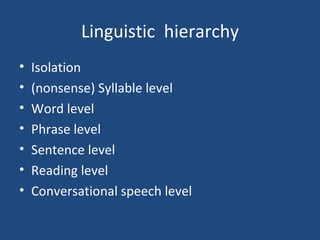
Linguistic  hierarchy Isolation (nonsense) Syllable level Word level Phrase level Sentence level Reading level Conversational speech level
Ways to help a child with an articulation disorder Be a good speech model. Be a knowledgeable referral source. Understand developmental  & cultural norms Make referral to SLP for evaluation & diagnosis Never tease/ridicule. Focus on the message, not the manner.
Reinforce accurate productions. Leave intervention to the SLP. Realize that treatment is a process. Takes time and skill. Many factors relate to speed at which goals are accomplished.

Csd 210 articulation disorders - fall 2010

  • 1.
    Articulation Development, Differencesand Disorders COMSDIS 210: Survey of Communication Disorders
  • 2.
    Articulation disorder Aspeech sound disorder resulting from difficulty with the physical production of one or more phonemes.
  • 3.
    Comparing and contrasting articulation and phonology Both are examples of “speech sound disorders”. Phonology: the sound system of a language and the rules that govern the sound combinations. (ASHA, 1993) Phonological disorders result from lack of awareness and/or use of the linguistic rules governing the use and combination of speech sounds.
  • 4.
    ASHA Definition of Articulation Disorder “ An articulation disorder is the atypical production of speech sounds characterized by substitutions, omissions, additions or distortions that may interfere with phonology.” (ASHA, 1993)
  • 5.
    Facts and figuresIncidence and prevalence Articulation disorders most commonly occurring communication disorder. May affect children and adults; can be result of congenital or acquired etiologies. 10-15% of preschoolers 6% of school-age children Almost 91% of speech-language pathologists in schools indicated that they served individuals with phonological/articulation disorders (ASHA, 2006)
  • 6.
    Types of articulationerrors Substitutions Omissions Distortions Additions
  • 7.
    Substitutions One phoneme(the target phoneme) is replaced with another. Common substitutions.
  • 8.
    Omissions A phonemewhich has an obligatory context is omitted/deleted. Examples
  • 9.
    Distortions Use ofa non-standard allophonic variation of a phoneme in replacement of the target phoneme. Diacritic symbols
  • 10.
    Additions A phonemeis added to a word for which no obligatory context exists. Examples
  • 11.
    Articulation development Whatis normative data ? How is it gathered? How is it used?
  • 12.
    Articulation normative dataVowels mastered before consonants. Vowels mastered by age 3 years. Normative data on mastery of consonants.
  • 13.
    Mastery of consonantsmay vary by word-position. Individual AND cultural differences exist.
  • 14.
    A note aboutarticulation differences Distinction between articulation disorder and articulation difference
  • 15.
    Causes of articulationdisorders (Etiologies) Structural impairments of the articulatory system Anatomical deviations (congenital or acquired) Craniofacial anomalies Dental/orthodontic issues
  • 16.
    Functional impairments ofthe articulatory system Neuromuscular impairments Weakness, paralysis, spasticity Oral motor impairments Oral motor discoordination
  • 17.
    Myofunctional disorders “Tongue thrust” (“reverse swallow”) Hearing impairment (transient and chronic) Perceptual/discrimination impairments Mental retardation/cognitive disabilities
  • 18.
    Unknown etiologies Functionaldisorders Residual errors
  • 19.
    Disorder-specific components ofthe articulation evaluation Assessment of articulation skills at the word level . Assessment of articulation skills in connected speech . Sentence level Reading level Conversational speech level
  • 20.
    Assessment of effectsof co-articulation/ facilitating contexts Contextual testing Assessment of stimulability Stimulability: the degree to which a client can modify their phoneme production given cues provided by the examiner
  • 21.
    Assessment of abilityto auditorily discriminate between accurate and inaccurate productions of the phoneme. Auditory discrimination
  • 22.
    Treatment of articulationdisorders A variety of treatment approaches available. “ Traditional Approach to Articulation Therapy” (Van Riper, 1939) continues to be widely used for clients exhibiting residual errors.
  • 23.
    Goal of TAAT: increase production accuracy of the target phoneme in various word positions across the “linguistic hierarchy”.
  • 24.
    Linguistic hierarchyIsolation (nonsense) Syllable level Word level Phrase level Sentence level Reading level Conversational speech level
  • 25.
    Ways to helpa child with an articulation disorder Be a good speech model. Be a knowledgeable referral source. Understand developmental & cultural norms Make referral to SLP for evaluation & diagnosis Never tease/ridicule. Focus on the message, not the manner.
  • 26.
    Reinforce accurate productions.Leave intervention to the SLP. Realize that treatment is a process. Takes time and skill. Many factors relate to speed at which goals are accomplished.

Editor's Notes

  • #12 How data is collected: tens of thousands
  • #17 Oral motor- movement of the muscles in the oral cavity Problems eating, drinkinking ) getting a seal around the cup)
  • #18 No bottle, passifier, no thumb past age 1
  • #19 Functional disorders – they exist with no known cause Resitdual – not able to reproduce
  • #26 Focus on the message, not the manner. Daddy I wove you! Oh, I Love you so much. I really Love you.