Chapter 4: The psychology of
Second Language Acquisition
Preview
1. Language and the brain
2. Learning process: SLA
3. Differences among learners
Language and the brain
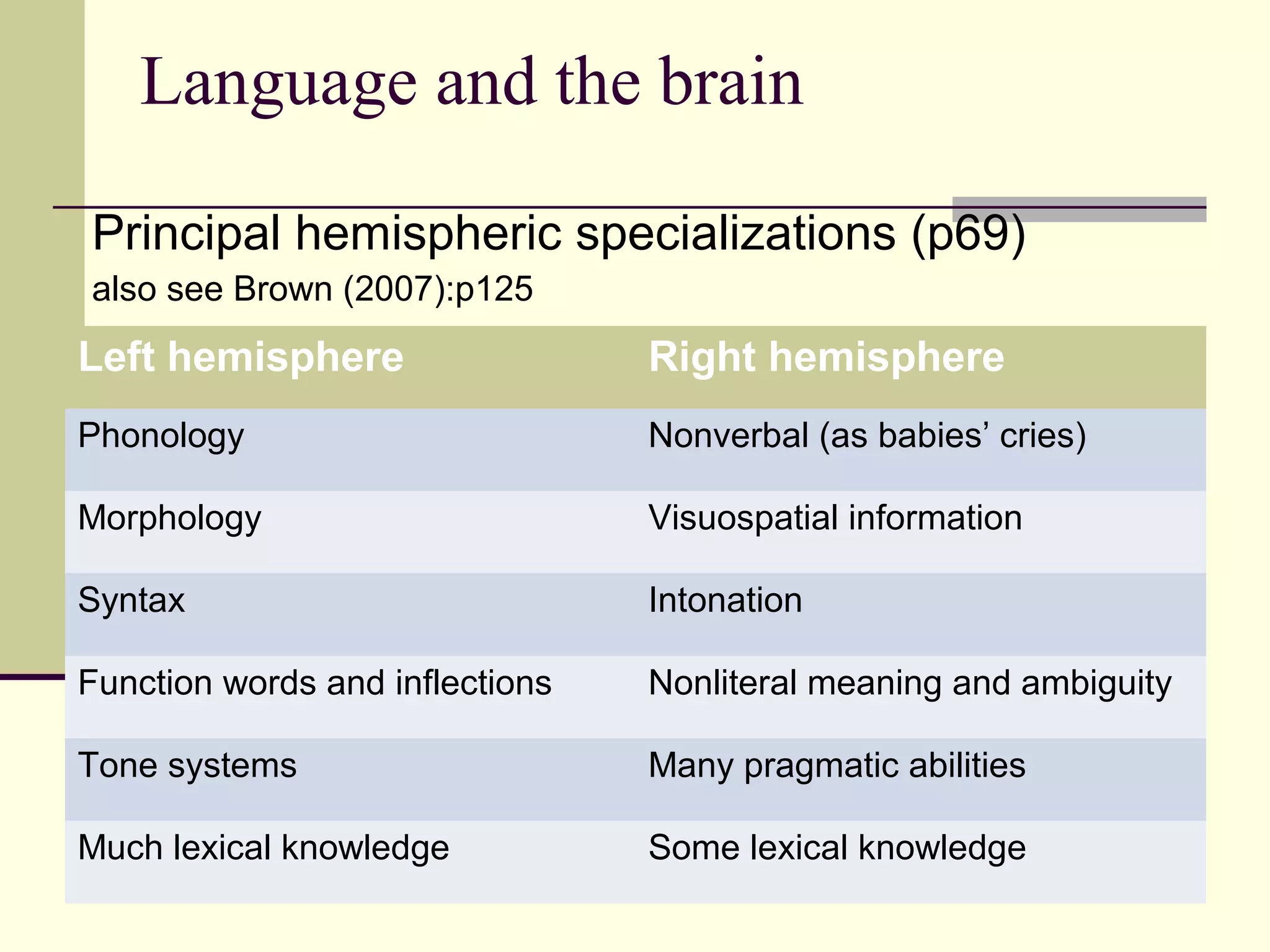
Left hemisphere Right hemisphere
Phonology Nonverbal (as babies’ cries)
Morphology Visuospatial information
Syntax Intonation
Function words and inflections Nonliteral meaning and ambiguity
Tone systems Many pragmatic abilities
Much lexical knowledge Some lexical knowledge
Principal hemispheric specializations (p69)
also see Brown (2007):p125
Language and the brain
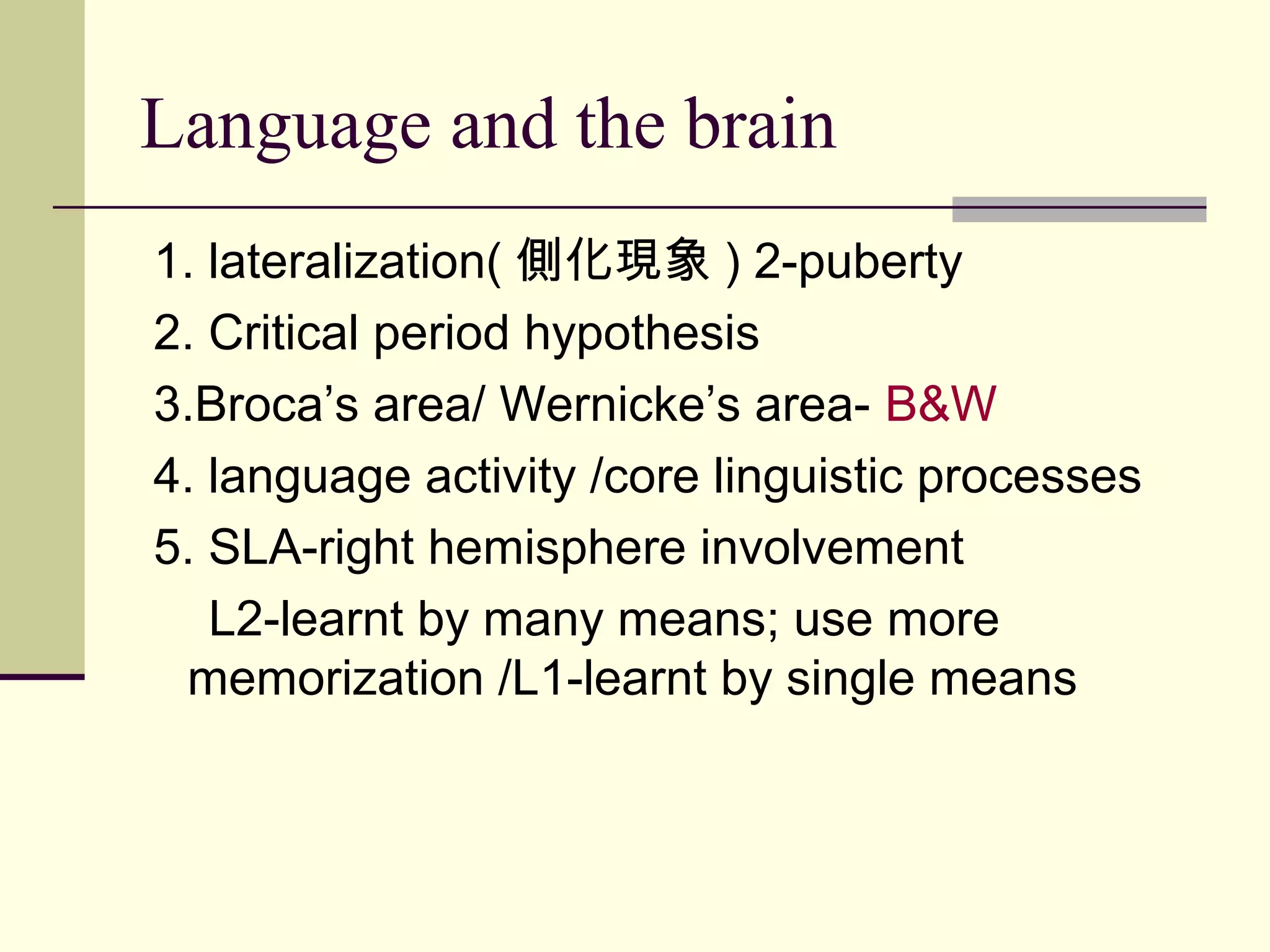
1. lateralization( 側化現象 ) 2-puberty
2. Critical period hypothesis
3.Broca’s area/ Wernicke’s area- B&W
4. language activity /core linguistic processes
5. SLA-right hemisphere involvement
L2-learnt by many means; use more
memorization /L1-learnt by single means
* Multilingual speakers
 Coordinate bilingualism
 Compound bilingualism
 Subordinate bilingualism
Q1:When there is differential
impairment or recovery in the brain,
which language loses first and
recovers first?
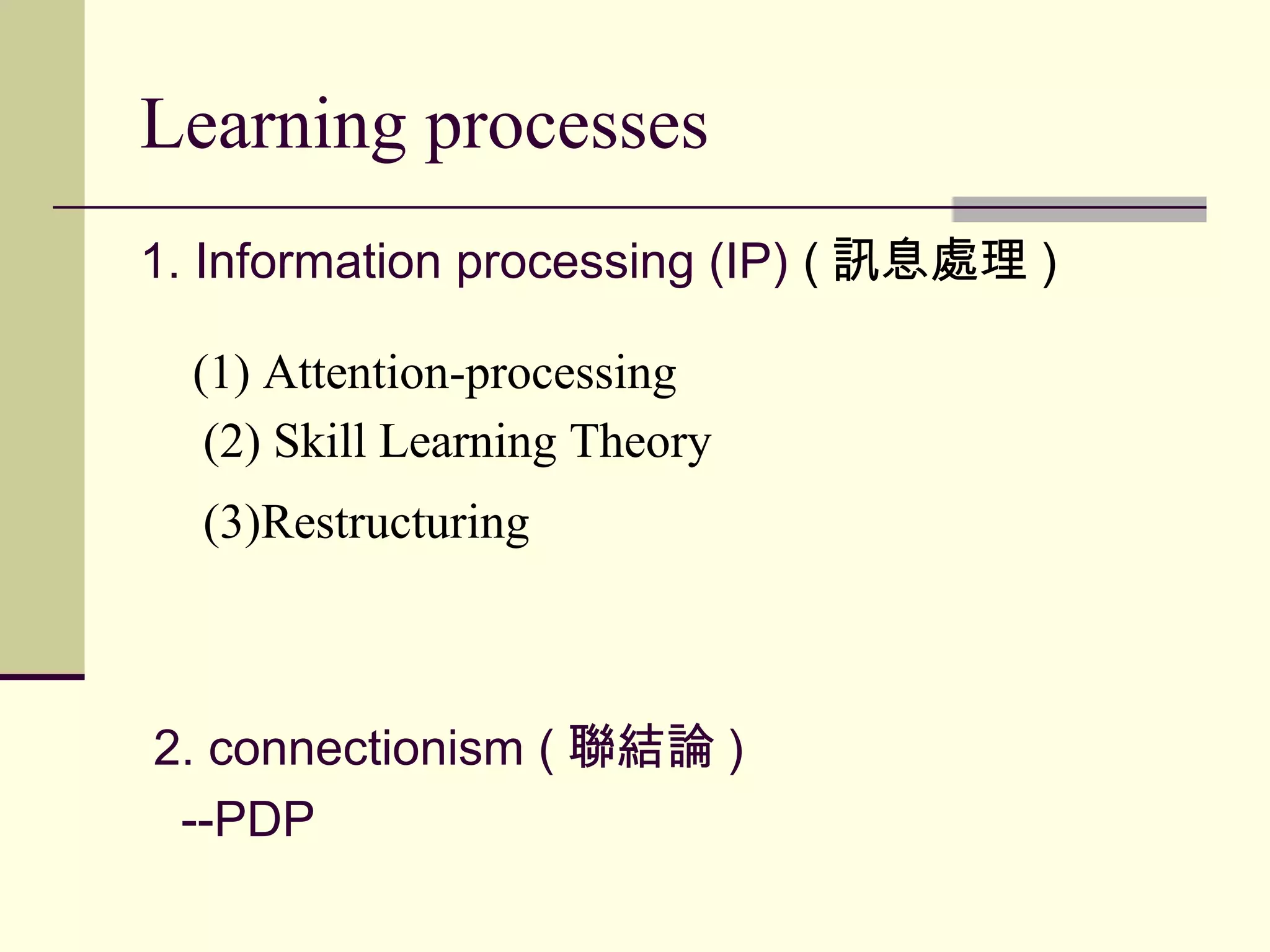
Learning processes
1. Information processing (IP) ( 訊息處理 )
(1) Attention-processing
(2) Skill Learning Theory
(3)Restructuring
2. connectionism ( 聯結論 )
--PDP
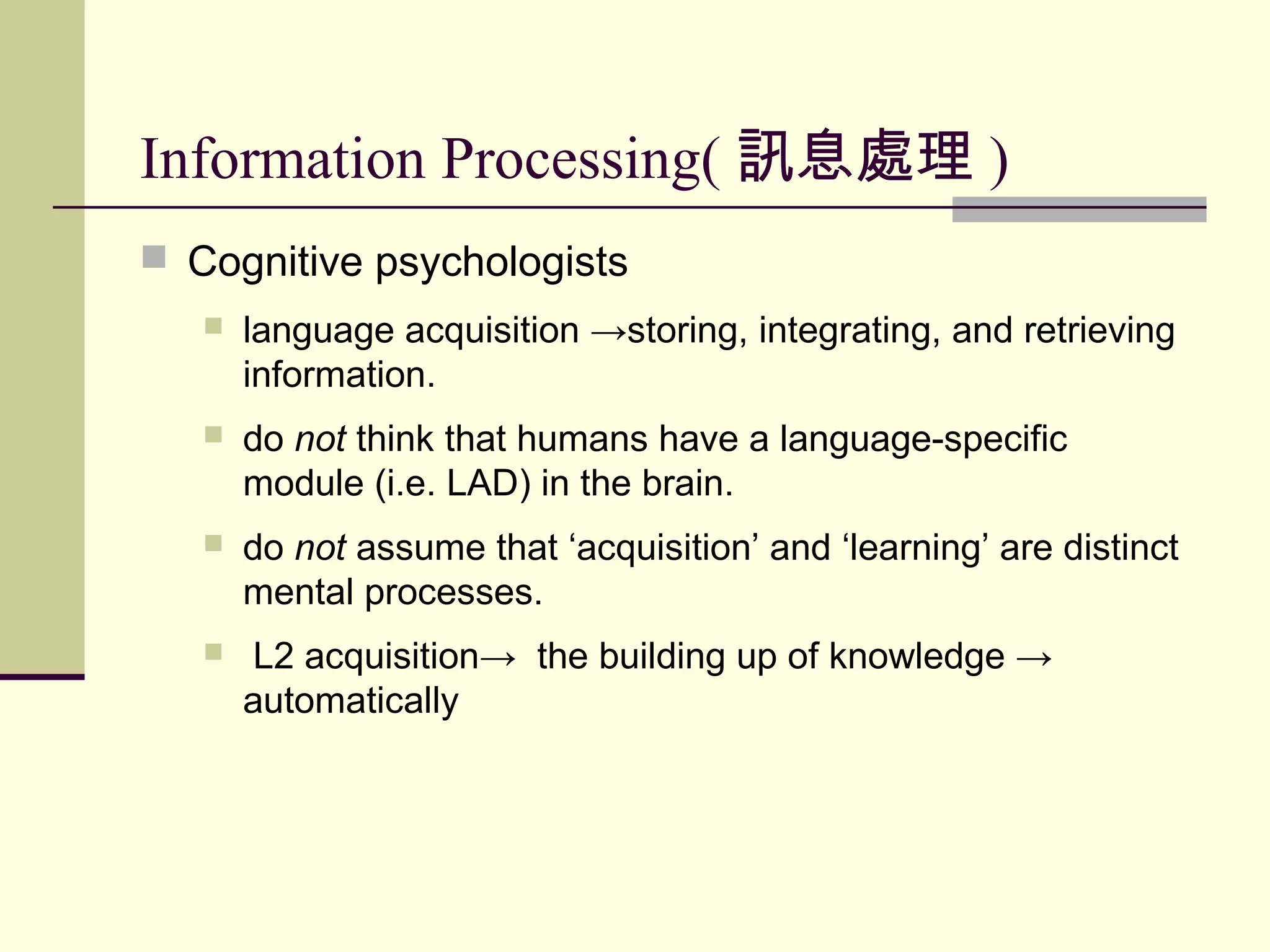
Information Processing( 訊息處理 )
 Cognitive psychologists
 language acquisition →storing, integrating, and retrieving
information.
 do not think that humans have a language-specific
module (i.e. LAD) in the brain.
 do not assume that ‘acquisition’ and ‘learning’ are distinct
mental processes.
 L2 acquisition→ the building up of knowledge →
automatically
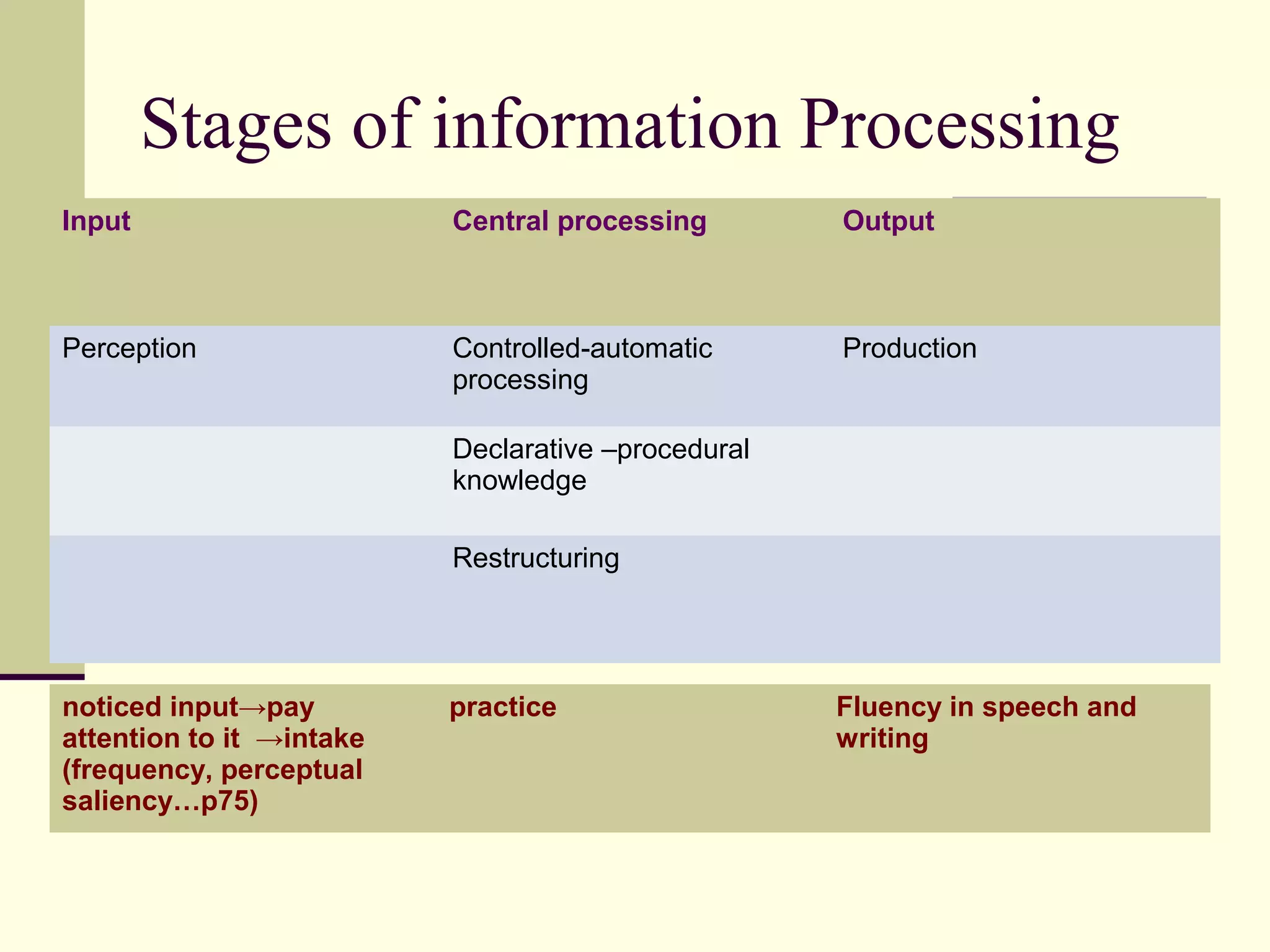
Stages of information Processing
Input Central processing Output
Perception Controlled-automatic
processing
Production
Declarative –procedural
knowledge
Restructuring
noticed input→pay
attention to it →intake
(frequency, perceptual
saliency…p75)
practice Fluency in speech and
writing
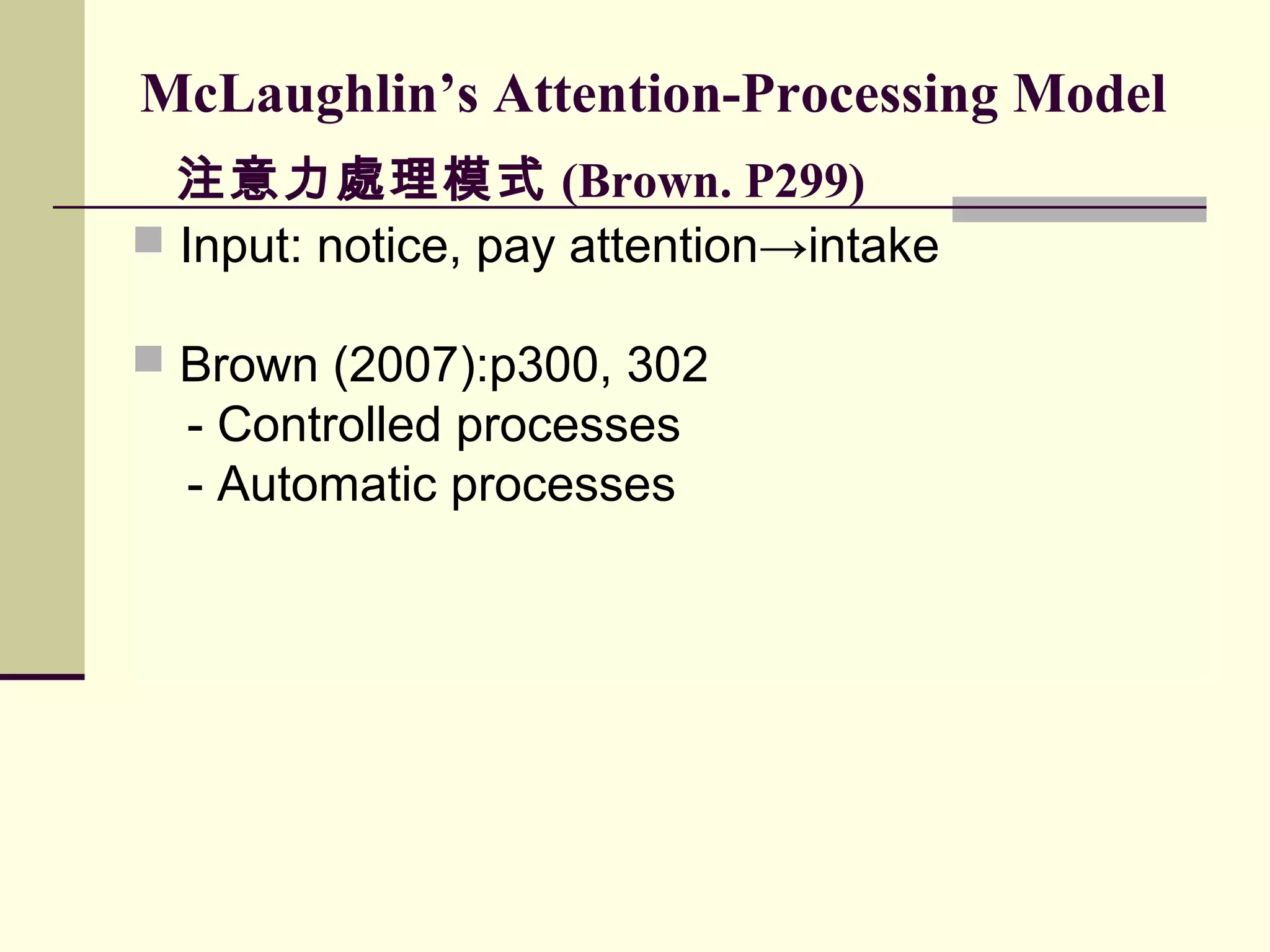
McLaughlin’s Attention-Processing Model
注意力處理模式 (Brown. P299)
 Input: notice, pay attention→intake
 Brown (2007):p300, 302
- Controlled processes
- Automatic processes
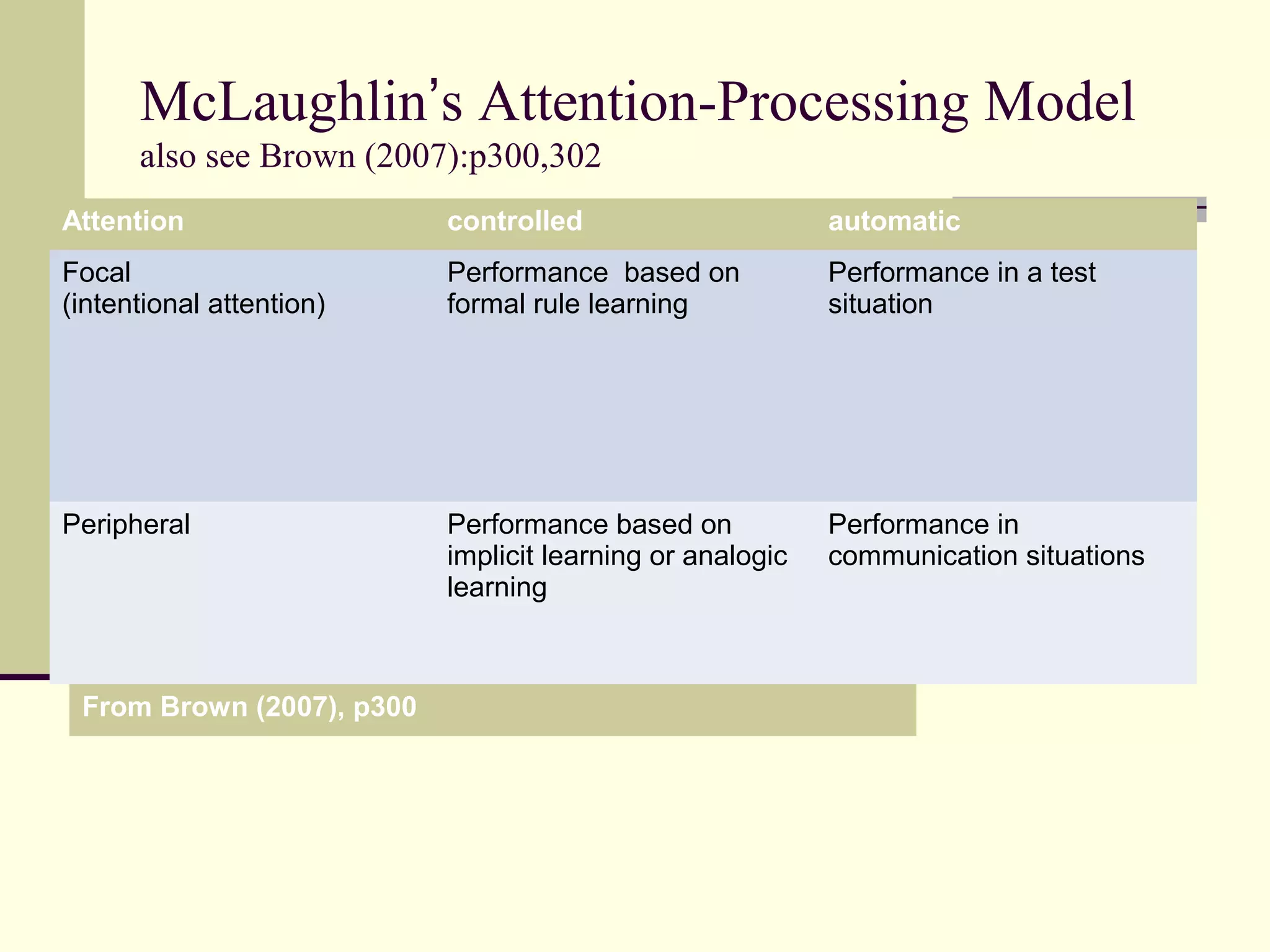
McLaughlin’s Attention-Processing Model
also see Brown (2007):p300,302
Attention controlled automatic
Focal
(intentional attention)
Performance based on
formal rule learning
Performance in a test
situation
Peripheral Performance based on
implicit learning or analogic
learning
Performance in
communication situations
From Brown (2007), p300
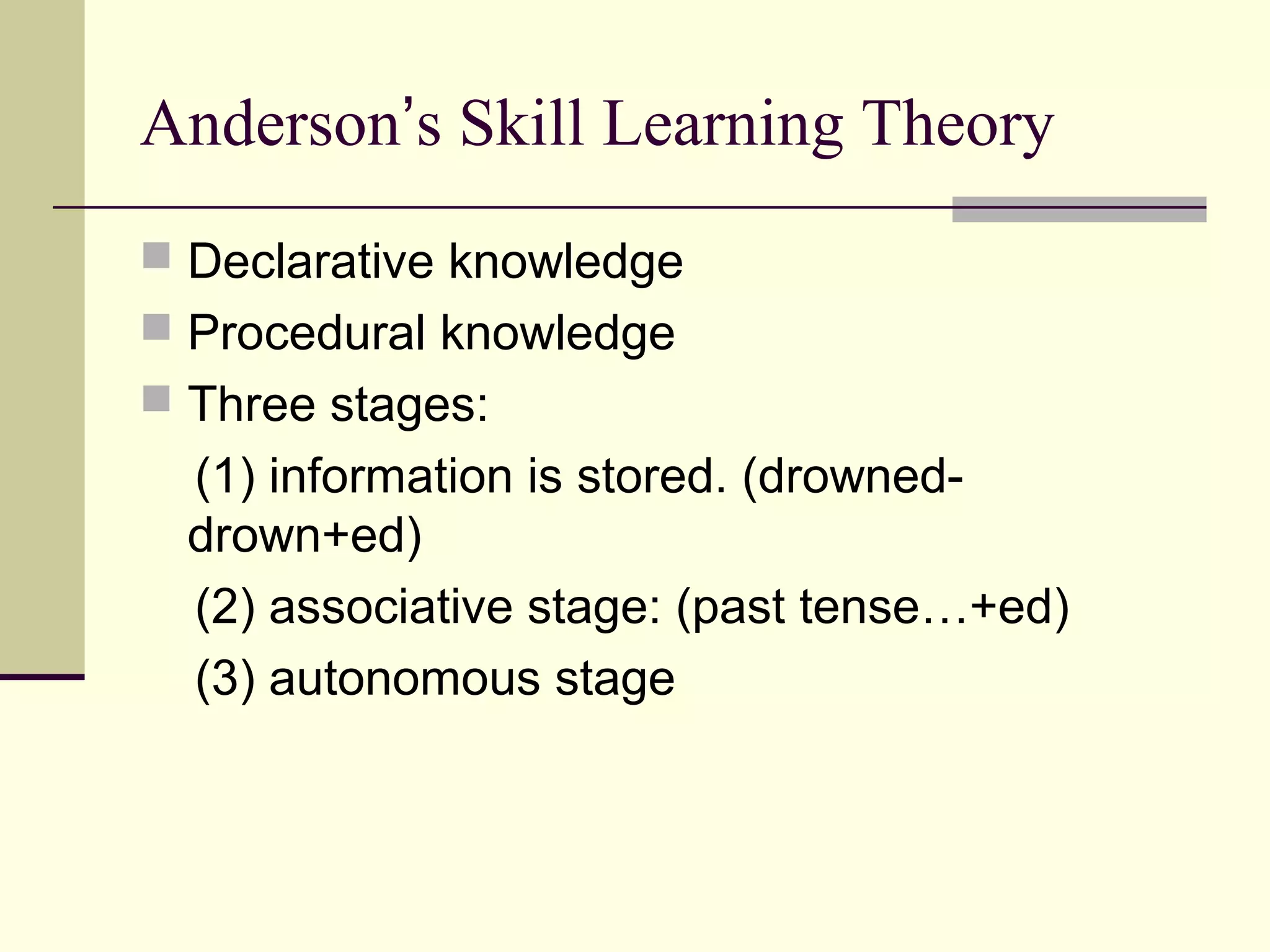
Anderson’s Skill Learning Theory
 Declarative knowledge
 Procedural knowledge
 Three stages:
(1) information is stored. (drowned-
drown+ed)
(2) associative stage: (past tense…+ed)
(3) autonomous stage
Question 2:
 Anderson thinks that L2 learners do not reach
full autonomy as L1 learners. What factors
may influence the process of achieving
autonomy in L2 acquisition?
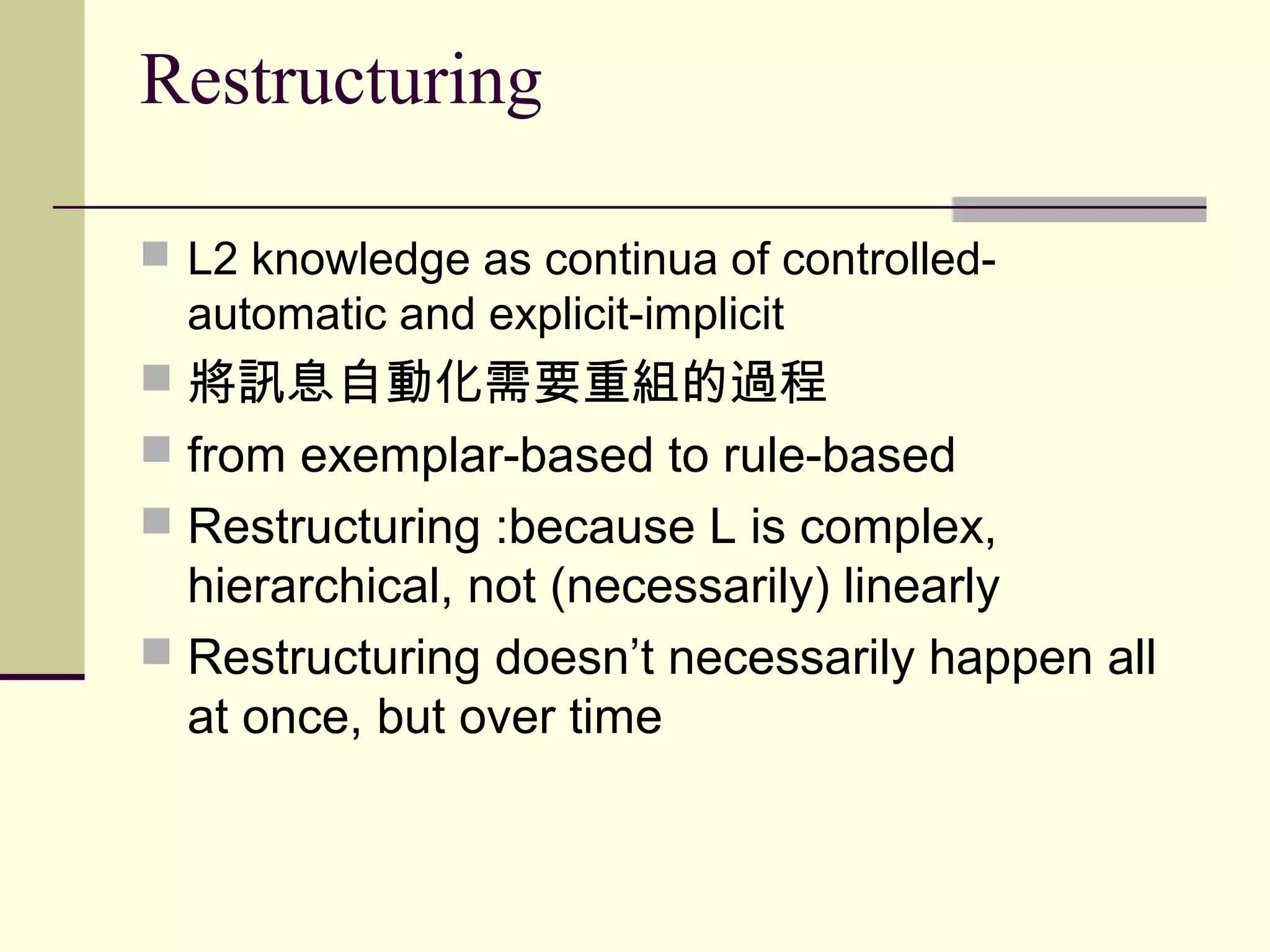
Restructuring
 L2 knowledge as continua of controlled-
automatic and explicit-implicit
 將訊息自動化需要重組的過程
 from exemplar-based to rule-based
 Restructuring :because L is complex,
hierarchical, not (necessarily) linearly
 Restructuring doesn’t necessarily happen all
at once, but over time
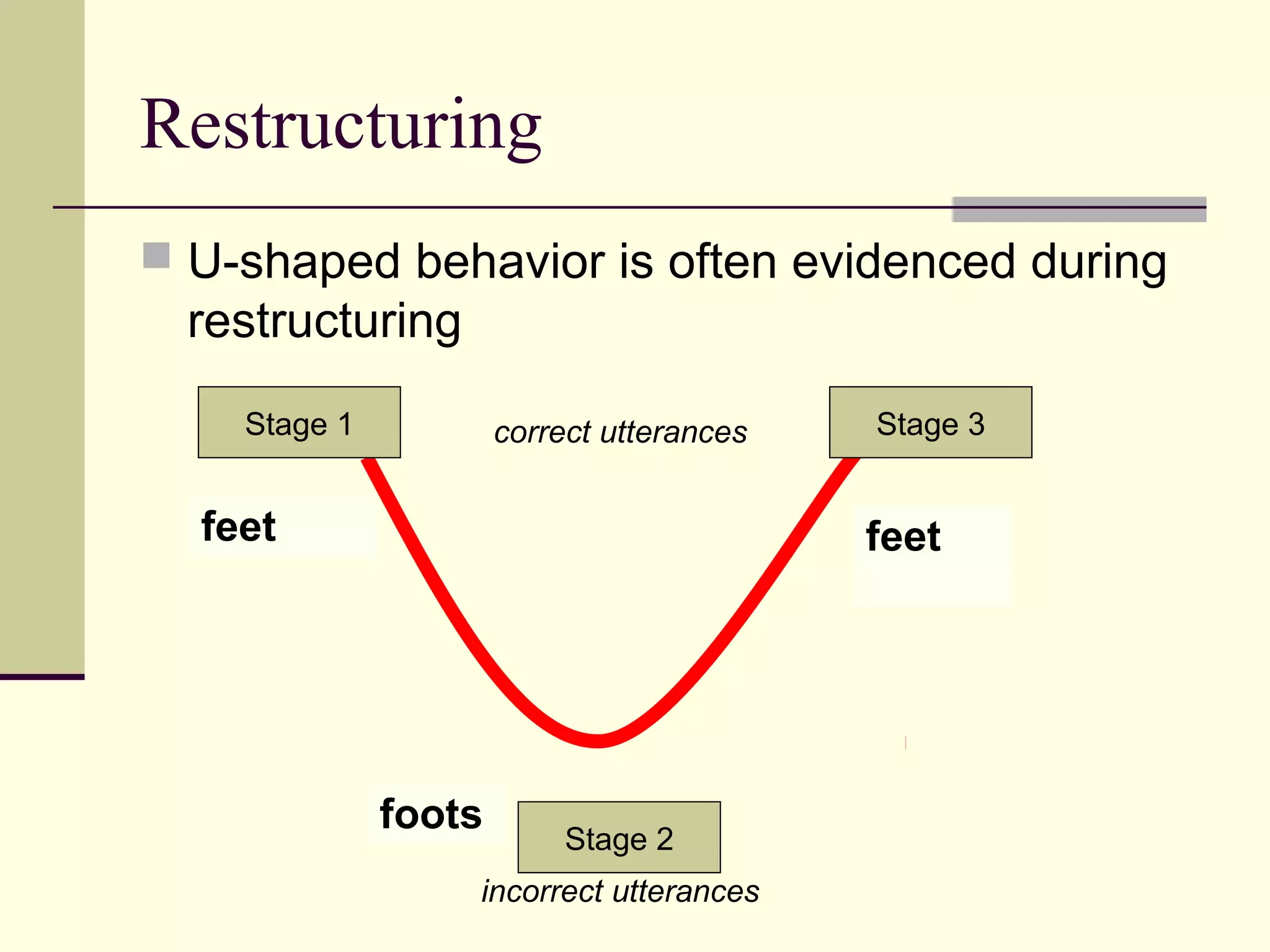
Restructuring
 U-shaped behavior is often evidenced during
restructuring
Stage 1 Stage 3
Stage 2
correct utterances
incorrect utterances
feet feet
foots
Three psychological approaches
 Multidimensional Model
 Processability Theory
 Competition Model
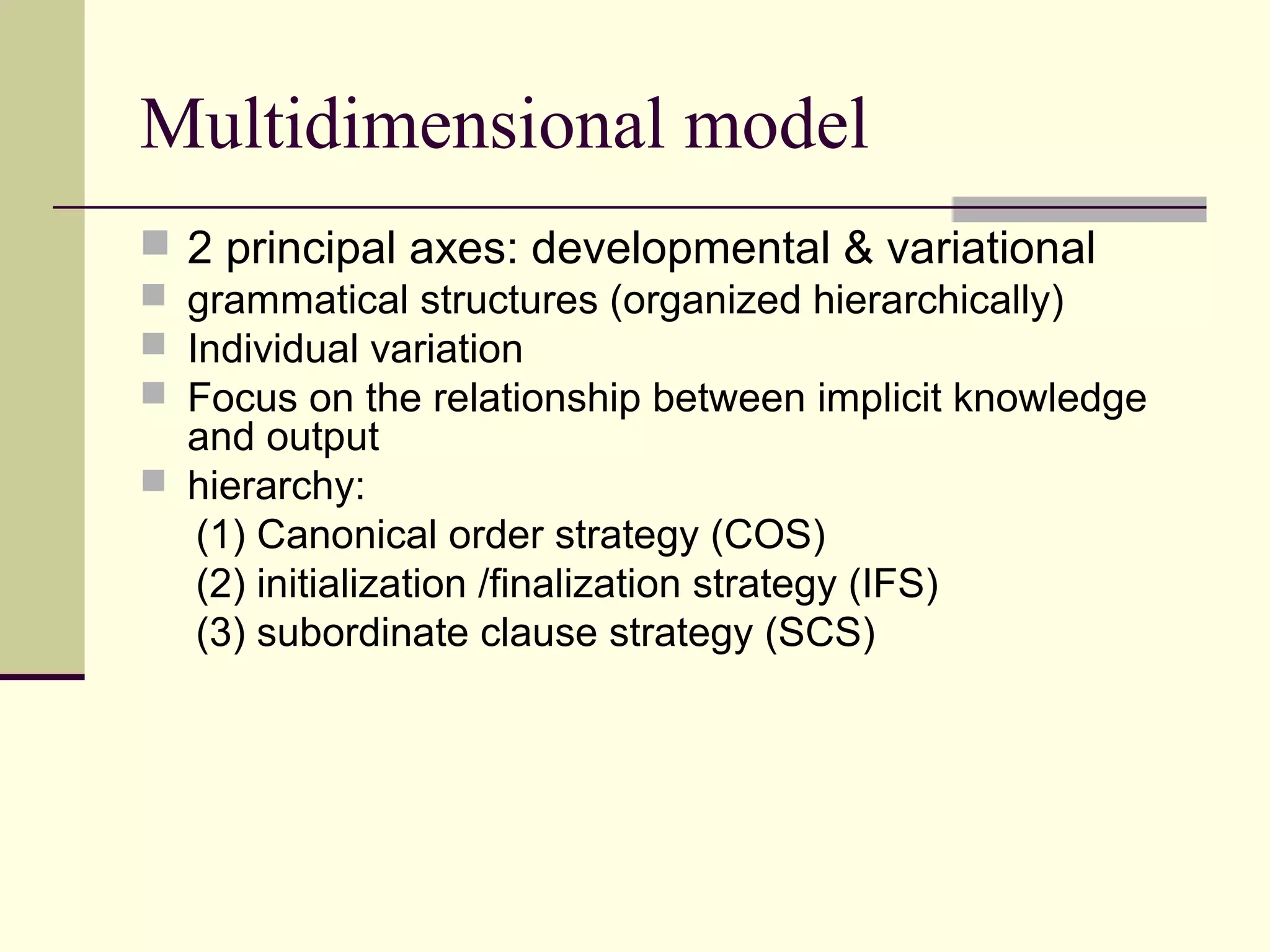
Multidimensional model
 2 principal axes: developmental & variational
 grammatical structures (organized hierarchically)
 Individual variation
 Focus on the relationship between implicit knowledge
and output
 hierarchy:
(1) Canonical order strategy (COS)
(2) initialization /finalization strategy (IFS)
(3) subordinate clause strategy (SCS)
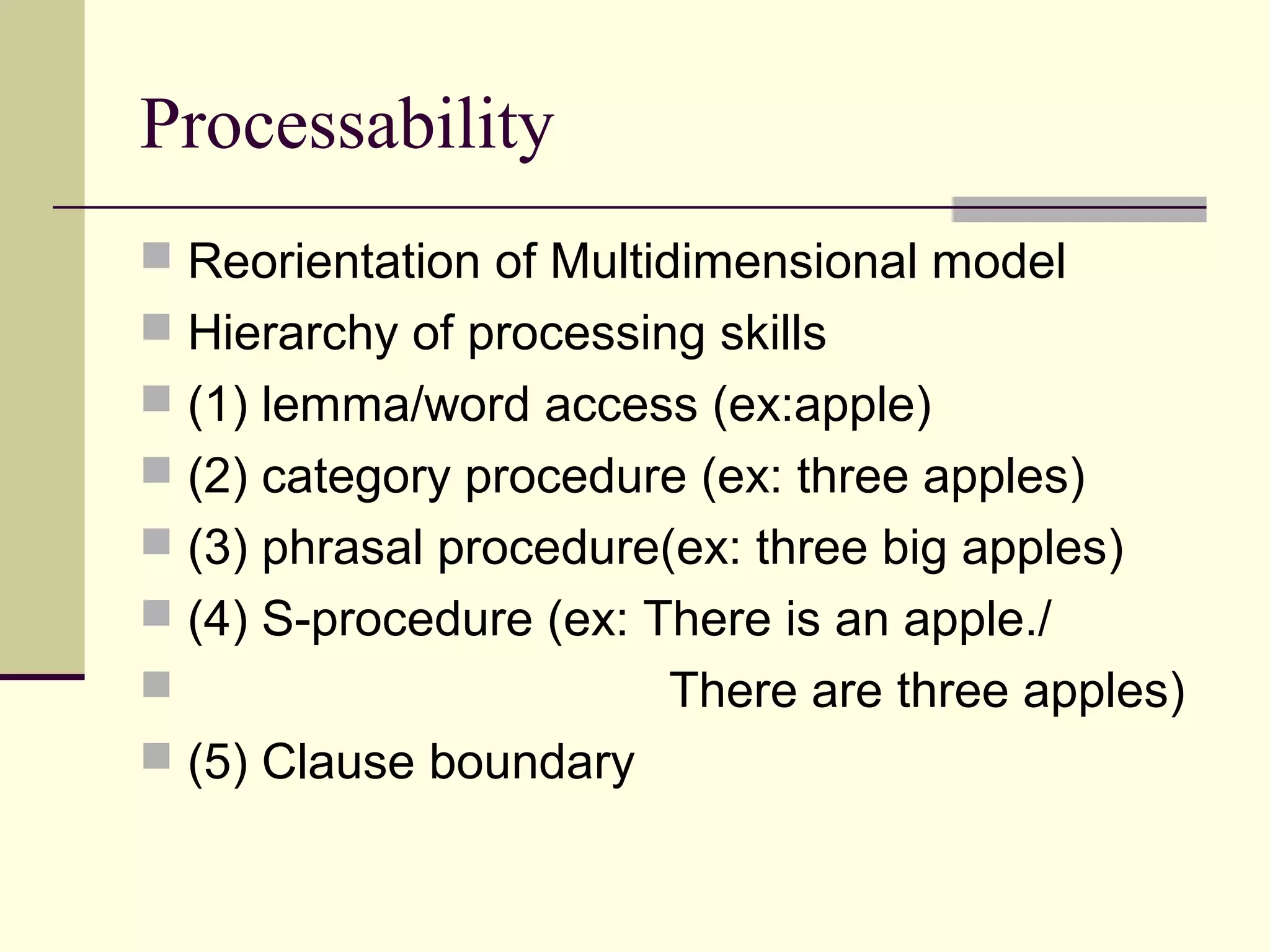
Processability
 Reorientation of Multidimensional model
 Hierarchy of processing skills
 (1) lemma/word access (ex:apple)
 (2) category procedure (ex: three apples)
 (3) phrasal procedure(ex: three big apples)
 (4) S-procedure (ex: There is an apple./
 There are three apples)
 (5) Clause boundary
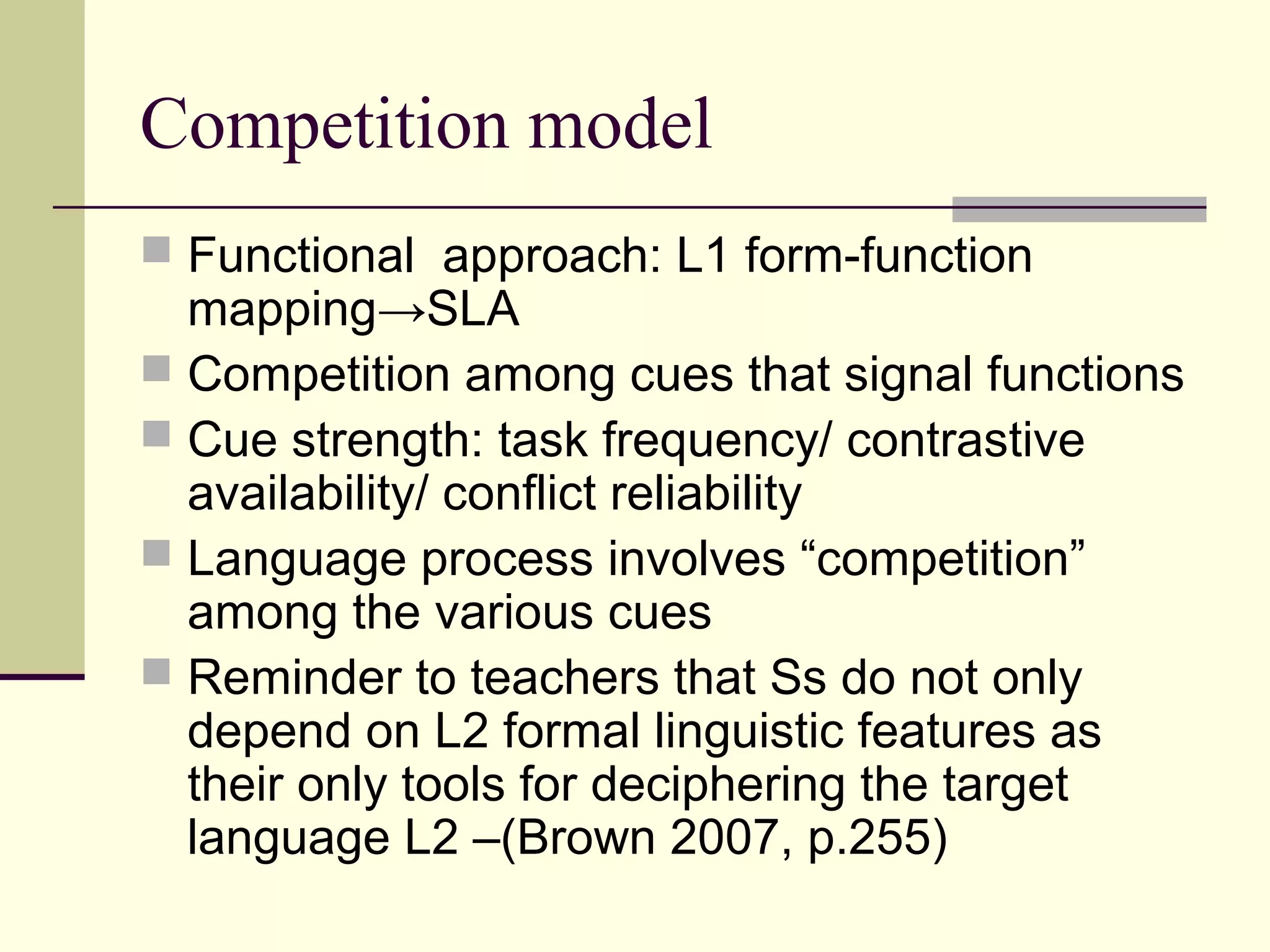
Competition model
 Functional approach: L1 form-function
mapping→SLA
 Competition among cues that signal functions
 Cue strength: task frequency/ contrastive
availability/ conflict reliability
 Language process involves “competition”
among the various cues
 Reminder to teachers that Ss do not only
depend on L2 formal linguistic features as
their only tools for deciphering the target
language L2 –(Brown 2007, p.255)
Competition model
(form-function mapping)
 1. horse
-form: sounds [hors]
-function: 4 legs/ hay eating animal
 2. Horses eat hay.
- Word order-form: horses + V + hay
- Function: “horses” is S.; “hay” is O.
- inflection- _s: form; function: more than one
horse
(p79)
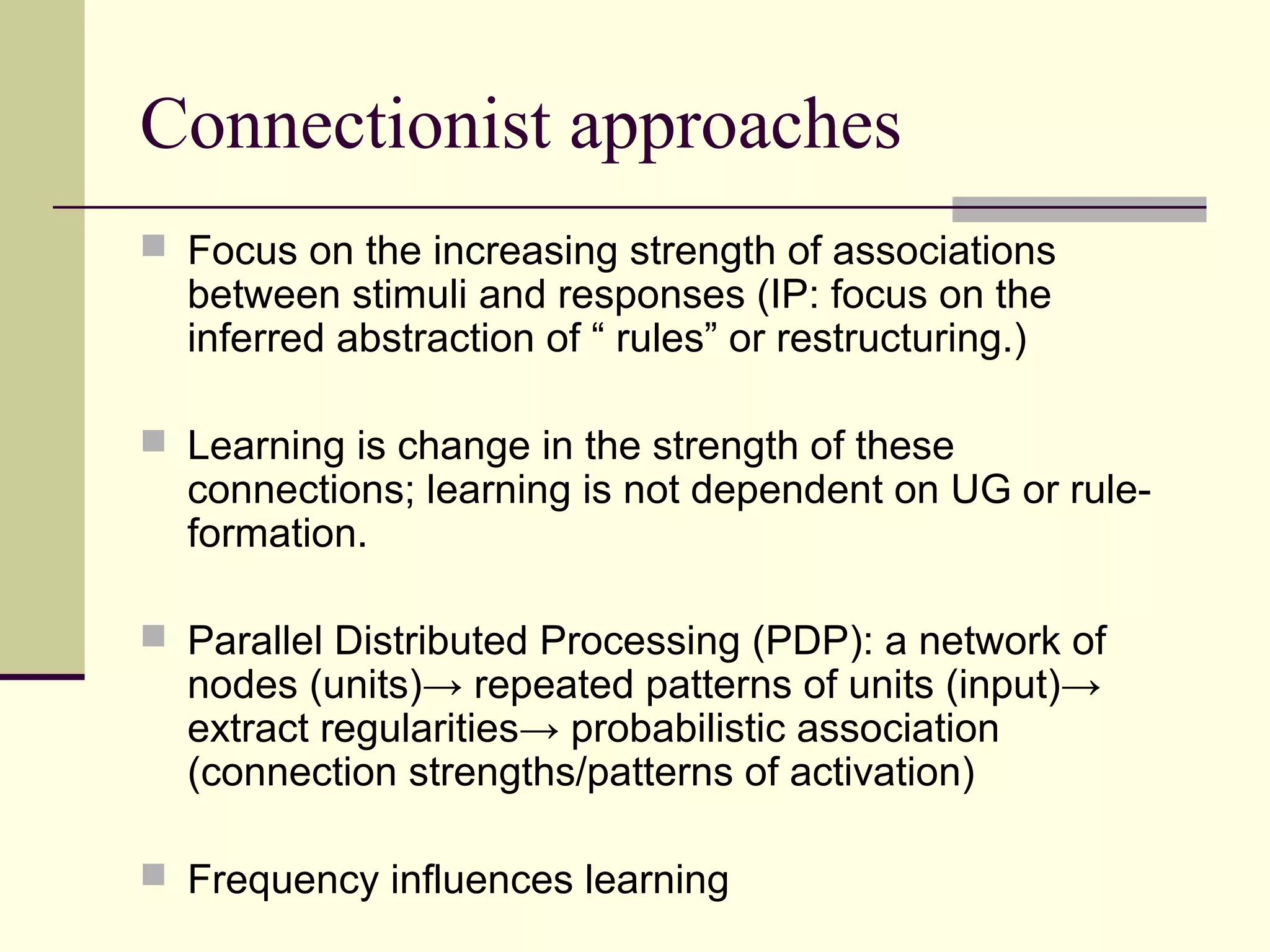
Connectionist approaches
 Focus on the increasing strength of associations
between stimuli and responses (IP: focus on the
inferred abstraction of “ rules” or restructuring.)
 Learning is change in the strength of these
connections; learning is not dependent on UG or rule-
formation.
 Parallel Distributed Processing (PDP): a network of
nodes (units)→ repeated patterns of units (input)→
extract regularities→ probabilistic association
(connection strengths/patterns of activation)
 Frequency influences learning
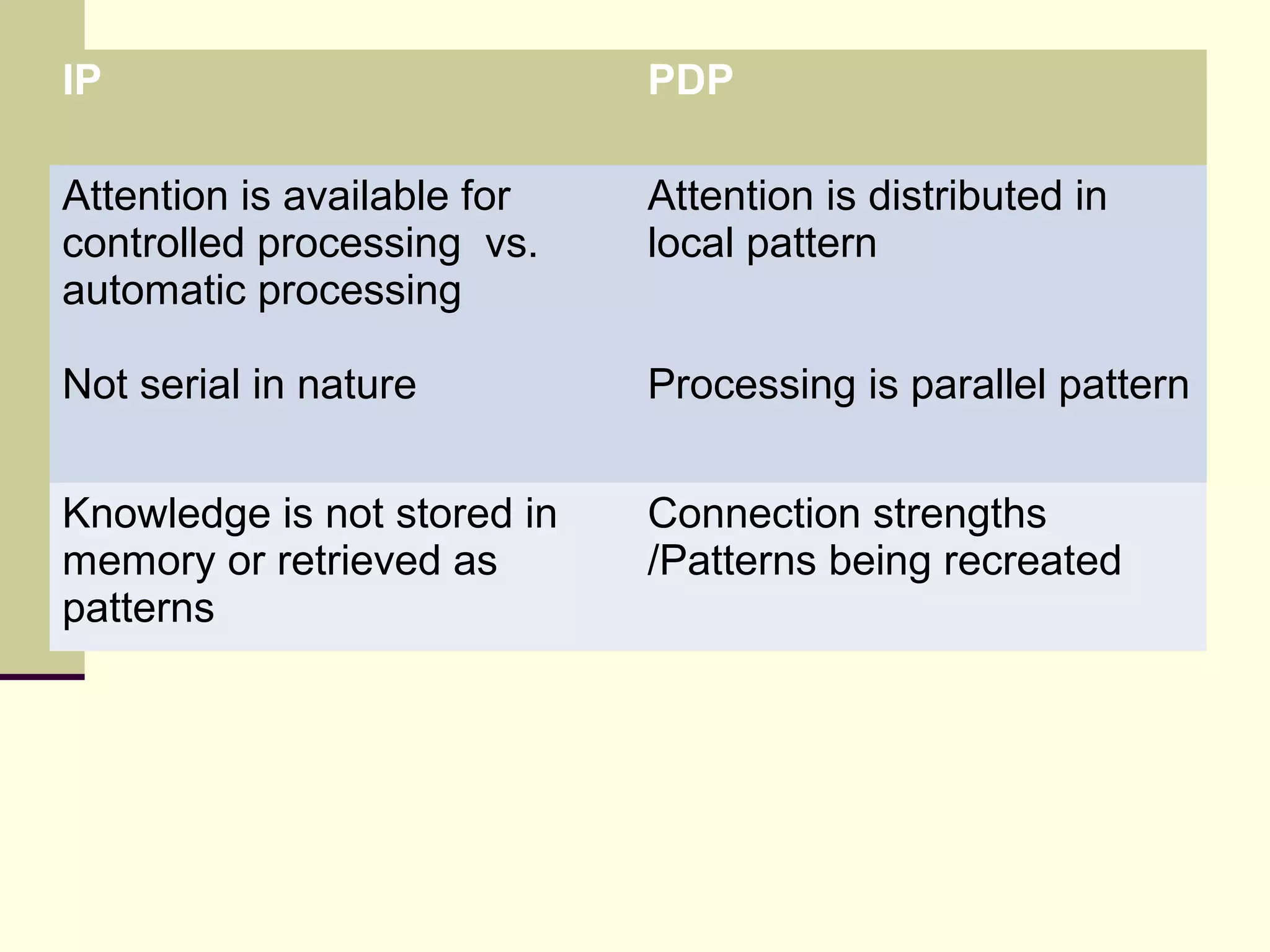
IP PDP
Attention is available for
controlled processing vs.
automatic processing
Not serial in nature
Attention is distributed in
local pattern
Processing is parallel pattern
Knowledge is not stored in
memory or retrieved as
patterns
Connection strengths
/Patterns being recreated
Question 3:
 Why are some L2 learners more successful
than others?
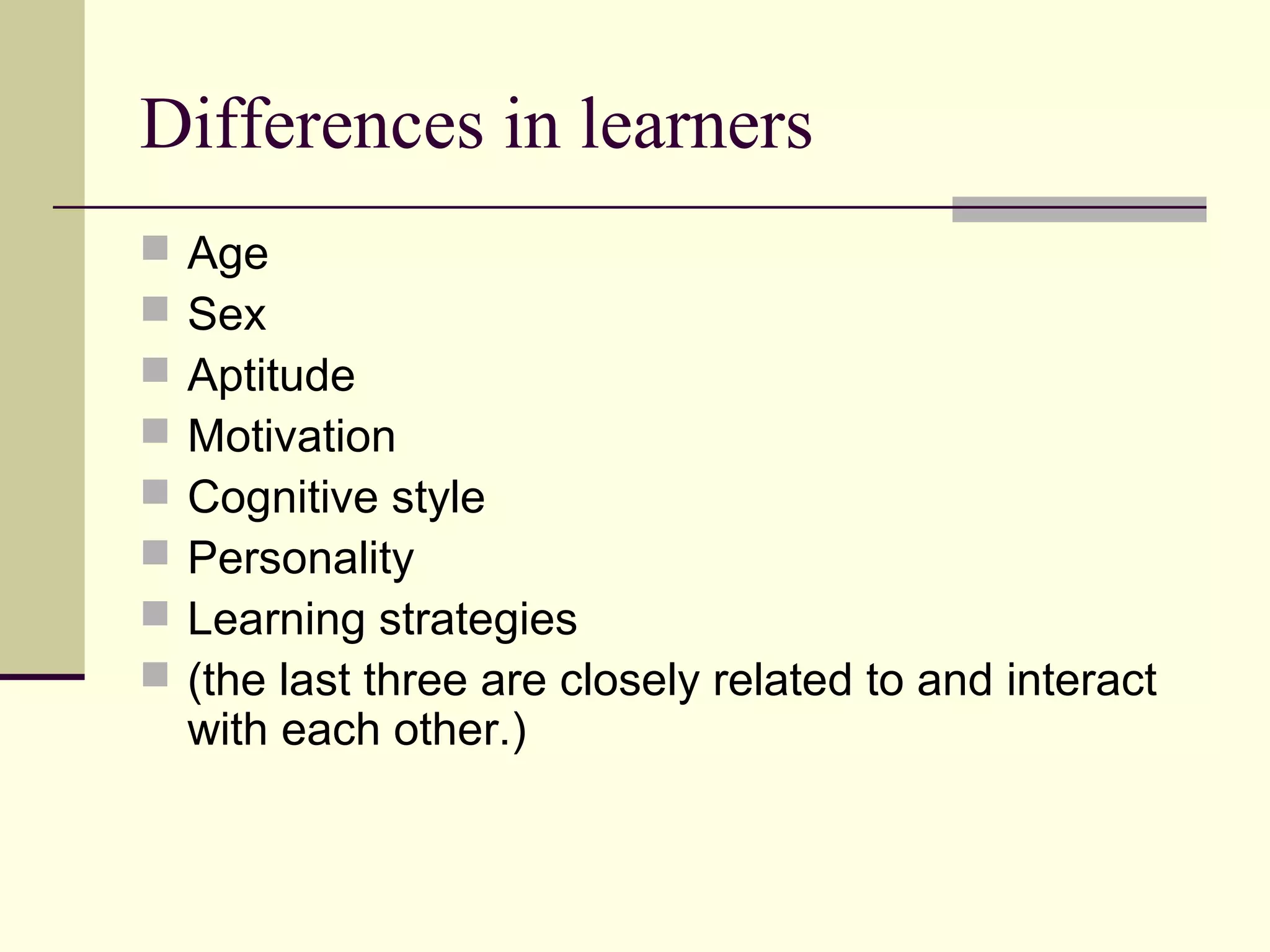
Differences in learners
 Age
 Sex
 Aptitude
 Motivation
 Cognitive style
 Personality
 Learning strategies
 (the last three are closely related to and interact
with each other.)
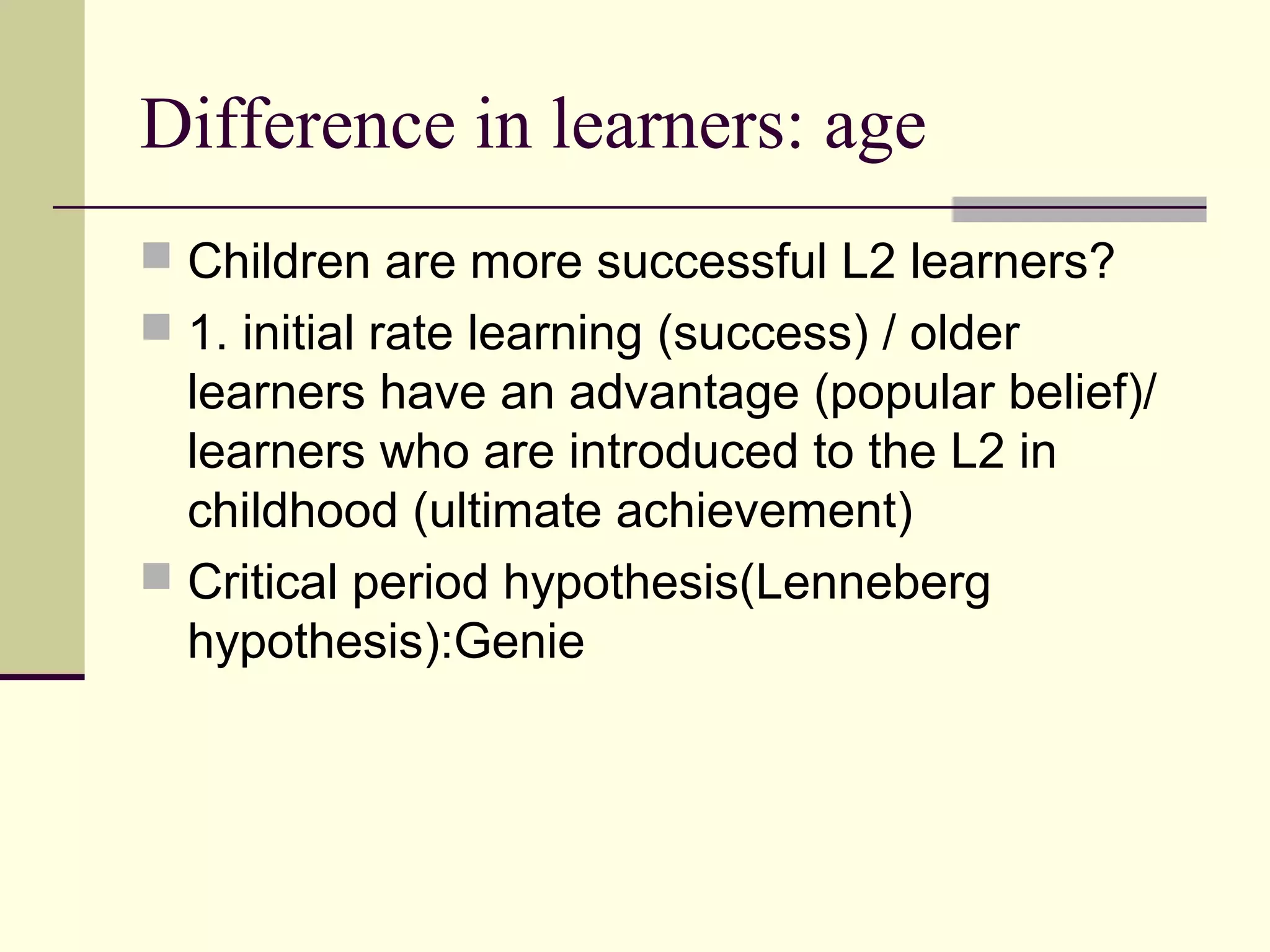
Difference in learners: age
 Children are more successful L2 learners?
 1. initial rate learning (success) / older
learners have an advantage (popular belief)/
learners who are introduced to the L2 in
childhood (ultimate achievement)
 Critical period hypothesis(Lenneberg
hypothesis):Genie
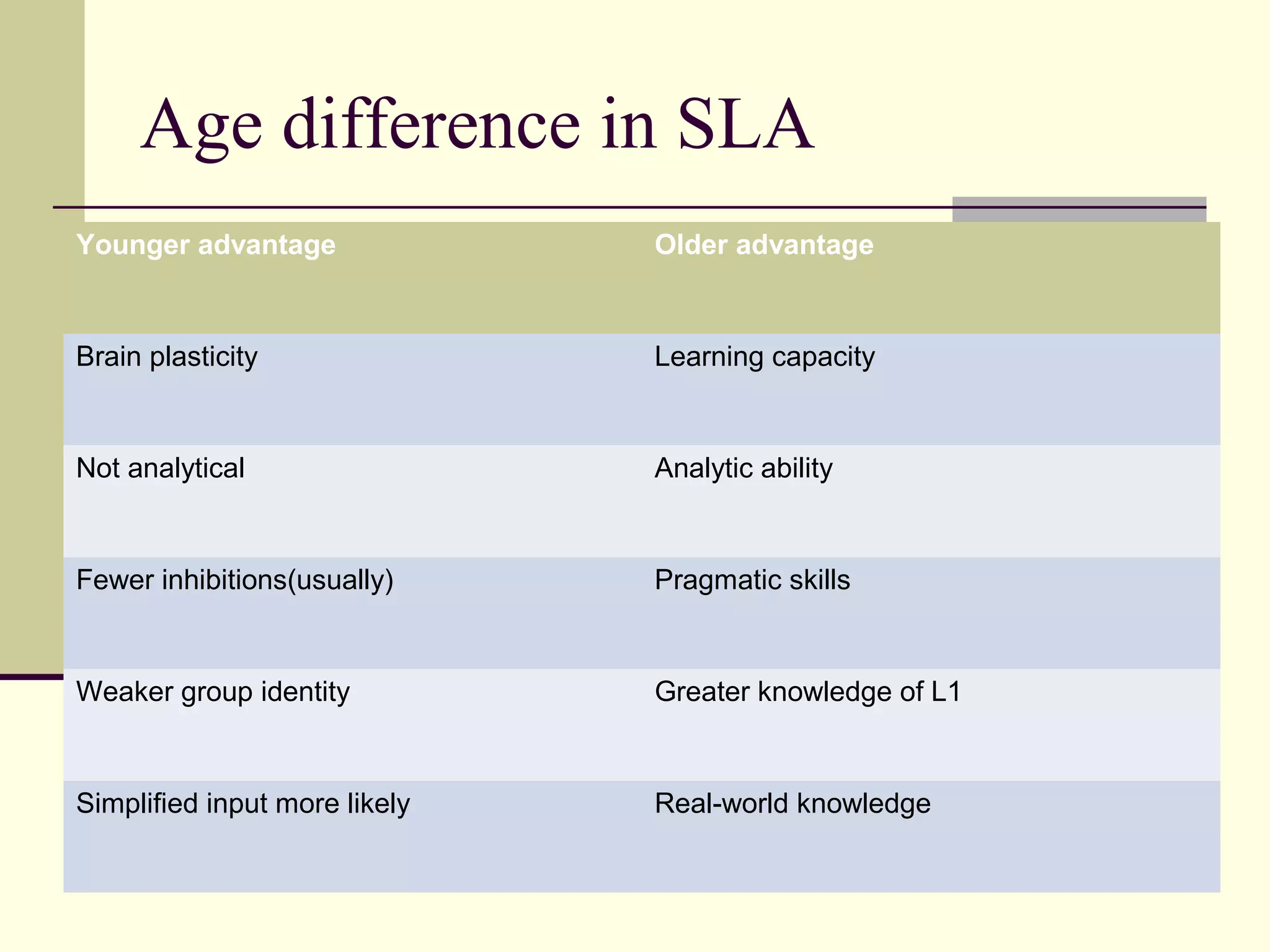
Age difference in SLA
Younger advantage Older advantage
Brain plasticity Learning capacity
Not analytical Analytic ability
Fewer inhibitions(usually) Pragmatic skills
Weaker group identity Greater knowledge of L1
Simplified input more likely Real-world knowledge
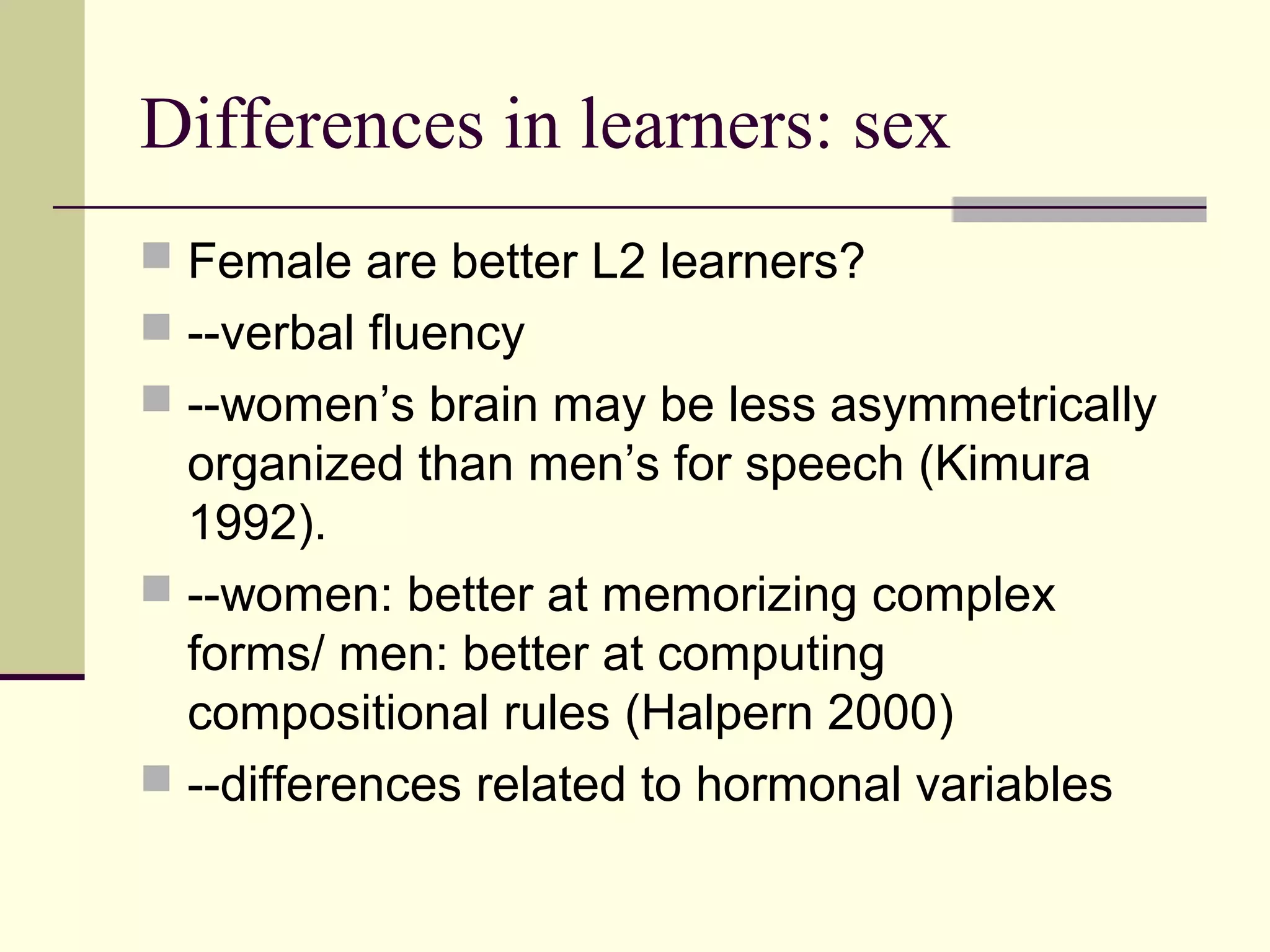
Differences in learners: sex
 Female are better L2 learners?
 --verbal fluency
 --women’s brain may be less asymmetrically
organized than men’s for speech (Kimura
1992).
 --women: better at memorizing complex
forms/ men: better at computing
compositional rules (Halpern 2000)
 --differences related to hormonal variables
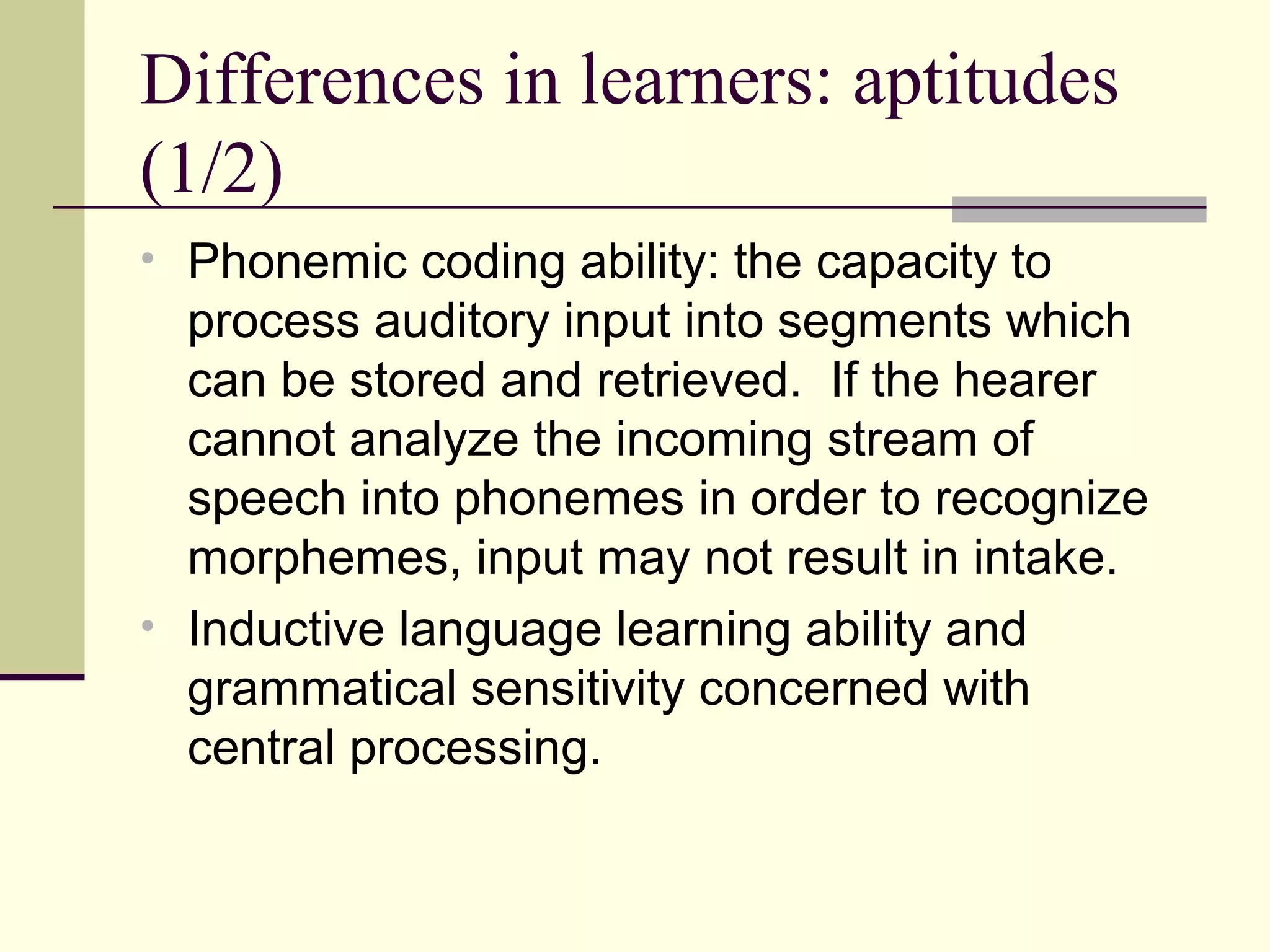
Differences in learners: aptitudes
(1/2)
• Phonemic coding ability: the capacity to
process auditory input into segments which
can be stored and retrieved. If the hearer
cannot analyze the incoming stream of
speech into phonemes in order to recognize
morphemes, input may not result in intake.
• Inductive language learning ability and
grammatical sensitivity concerned with
central processing.
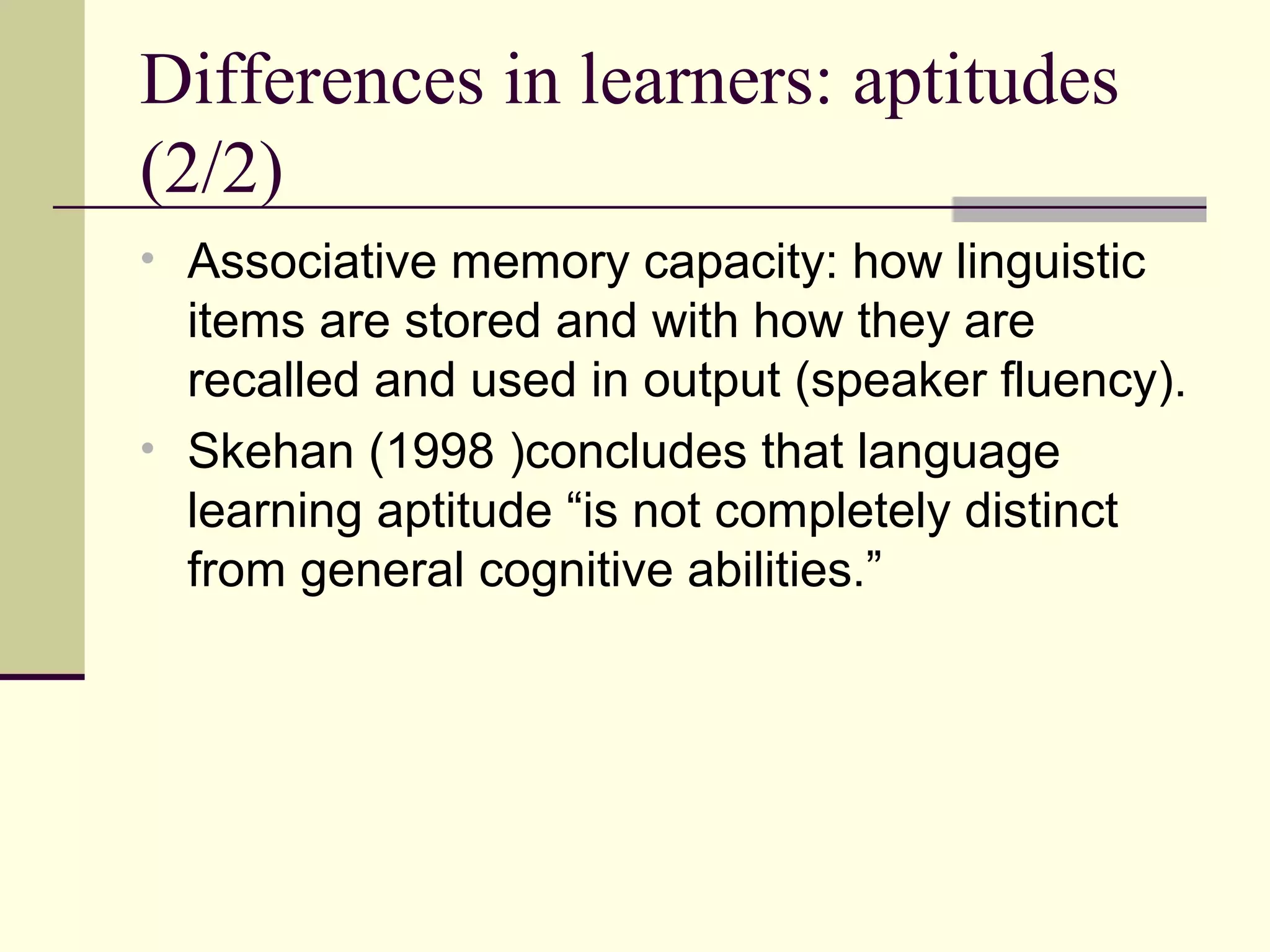
Differences in learners: aptitudes
(2/2)
• Associative memory capacity: how linguistic
items are stored and with how they are
recalled and used in output (speaker fluency).
• Skehan (1998 )concludes that language
learning aptitude “is not completely distinct
from general cognitive abilities.”
Differences in learners:
motivation(1/2)
• Significant goal or need/desire to attain the goal/
perception that learning L2 is relevant to fulfilling the
goal or meeting the need/belief in the likely success
or failure if learning L2/value of potential outcomes or
rewards
Differences in learners: motivation
(2/2)
• 2 type of motivation(Brown 2007, p175)
• --integrative motivation: based on interest in
learning L2; emotional or affective factors are
dominant (learning by a member of the
dominant group in a society)
• --instrumental motivation: involves perception
of purely practical value in learning L2
(learning by a subordinate group member)
Differences in learners: cognitive style
 Refers to individual’s preferred way of
processing: (perceiving, conceptualizing,
organizing and recalling information.)
 Brown (2007):p120
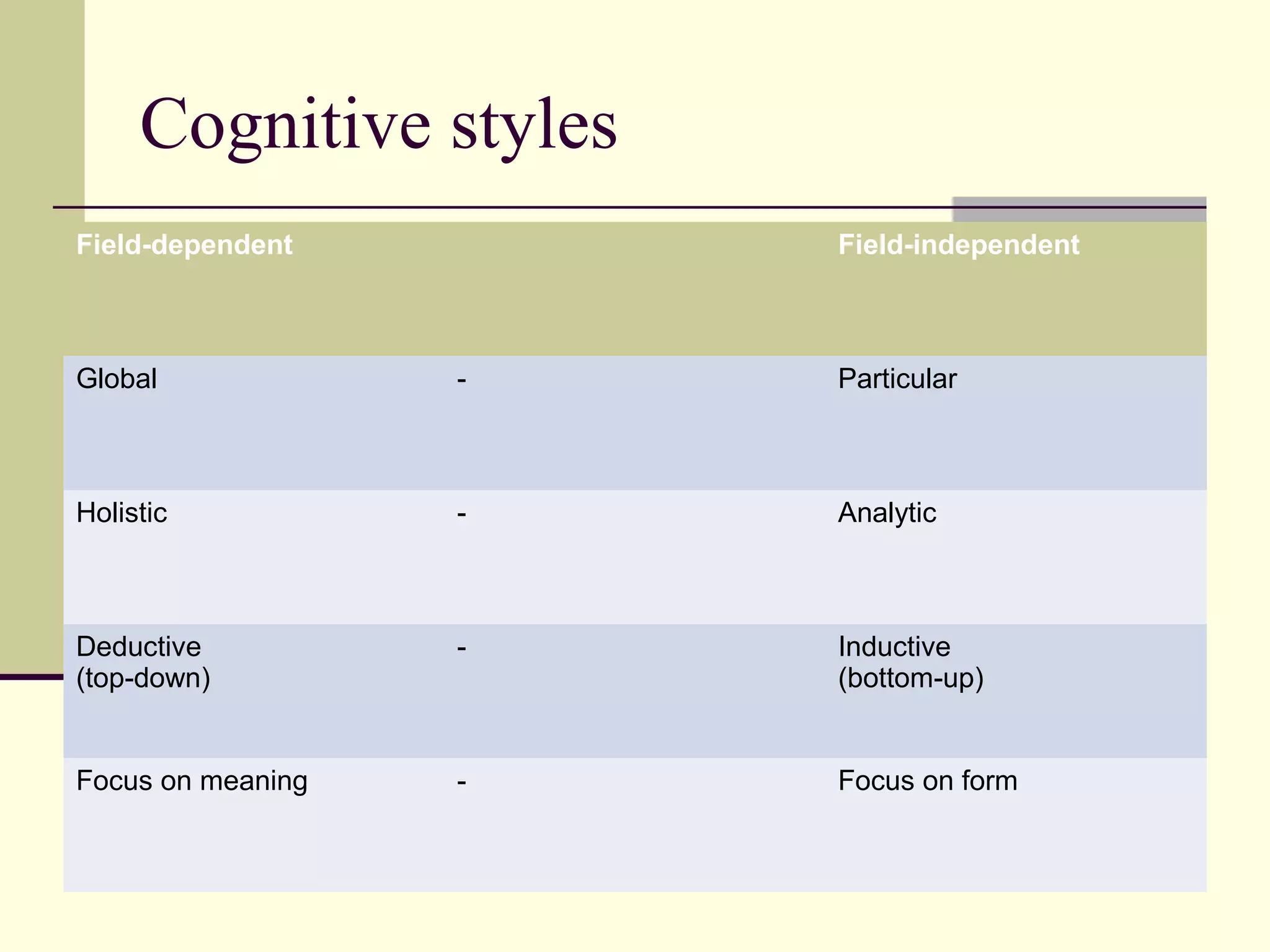
Cognitive styles
Field-dependent Field-independent
Global - Particular
Holistic - Analytic
Deductive
(top-down)
- Inductive
(bottom-up)
Focus on meaning - Focus on form
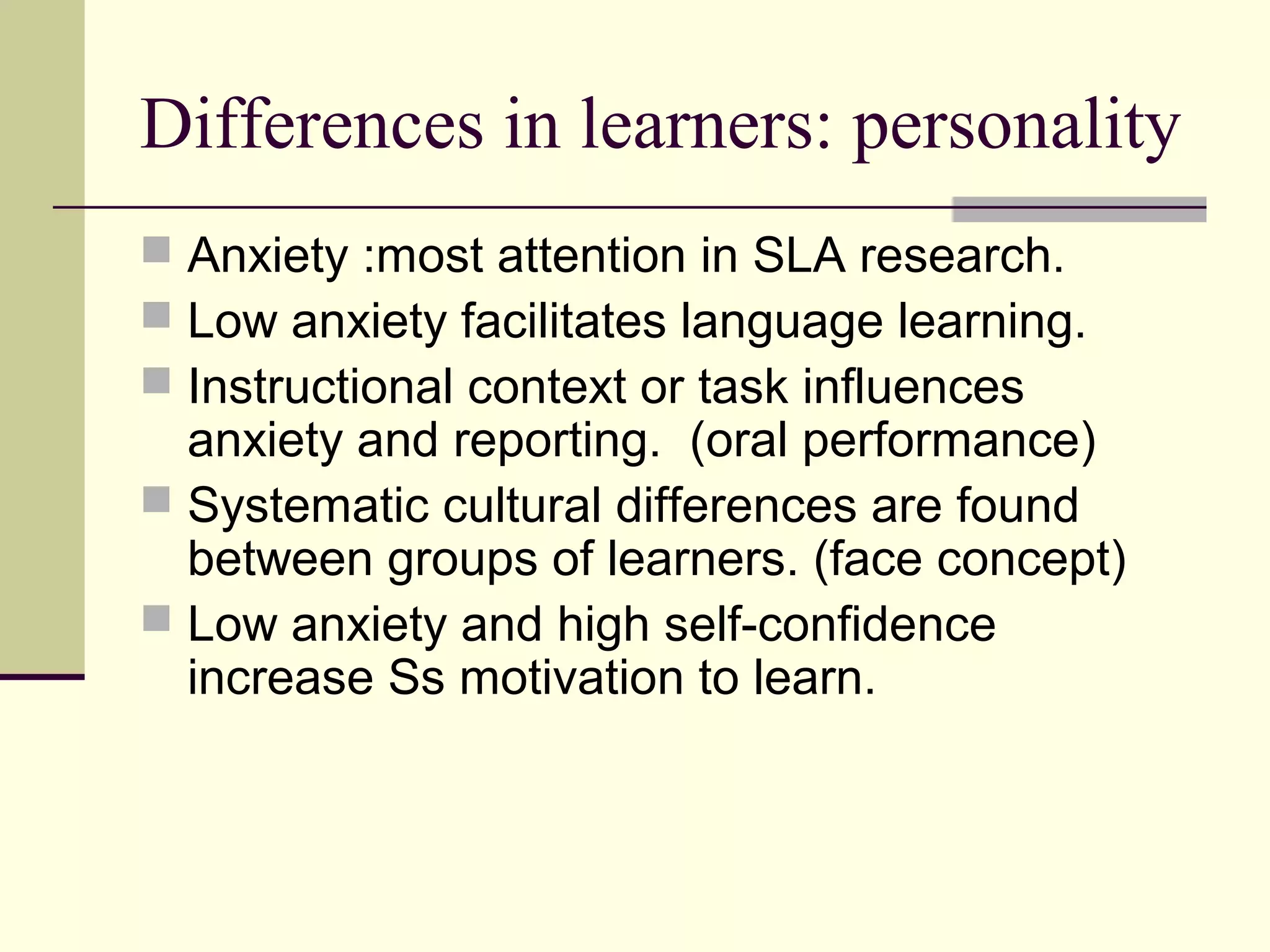
Differences in learners: personality
 Anxiety :most attention in SLA research.
 Low anxiety facilitates language learning.
 Instructional context or task influences
anxiety and reporting. (oral performance)
 Systematic cultural differences are found
between groups of learners. (face concept)
 Low anxiety and high self-confidence
increase Ss motivation to learn.
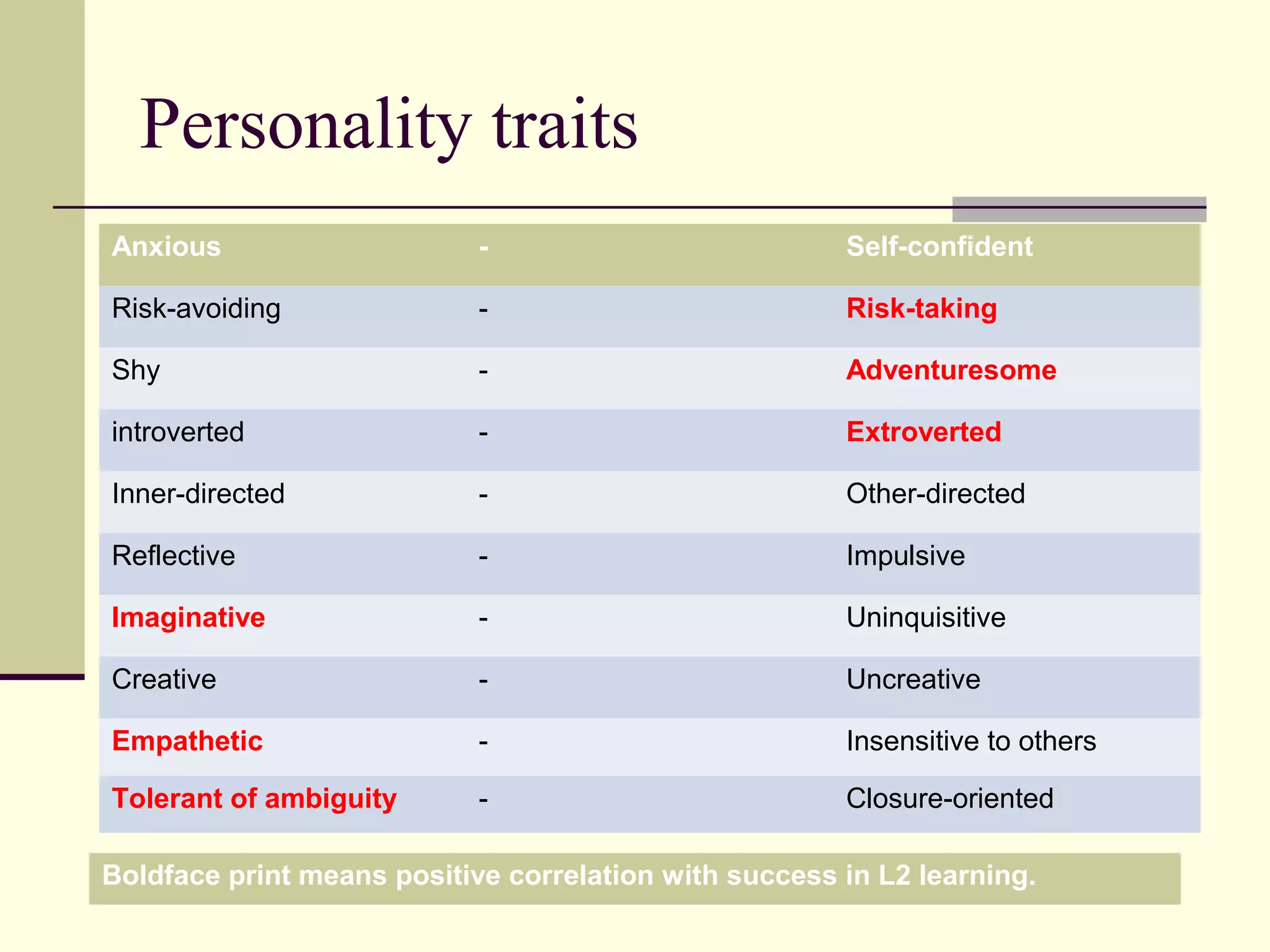
Personality traits
Anxious - Self-confident
Risk-avoiding - Risk-taking
Shy - Adventuresome
introverted - Extroverted
Inner-directed - Other-directed
Reflective - Impulsive
Imaginative - Uninquisitive
Creative - Uncreative
Empathetic - Insensitive to others
Tolerant of ambiguity - Closure-oriented
Boldface print means positive correlation with success in L2 learning.
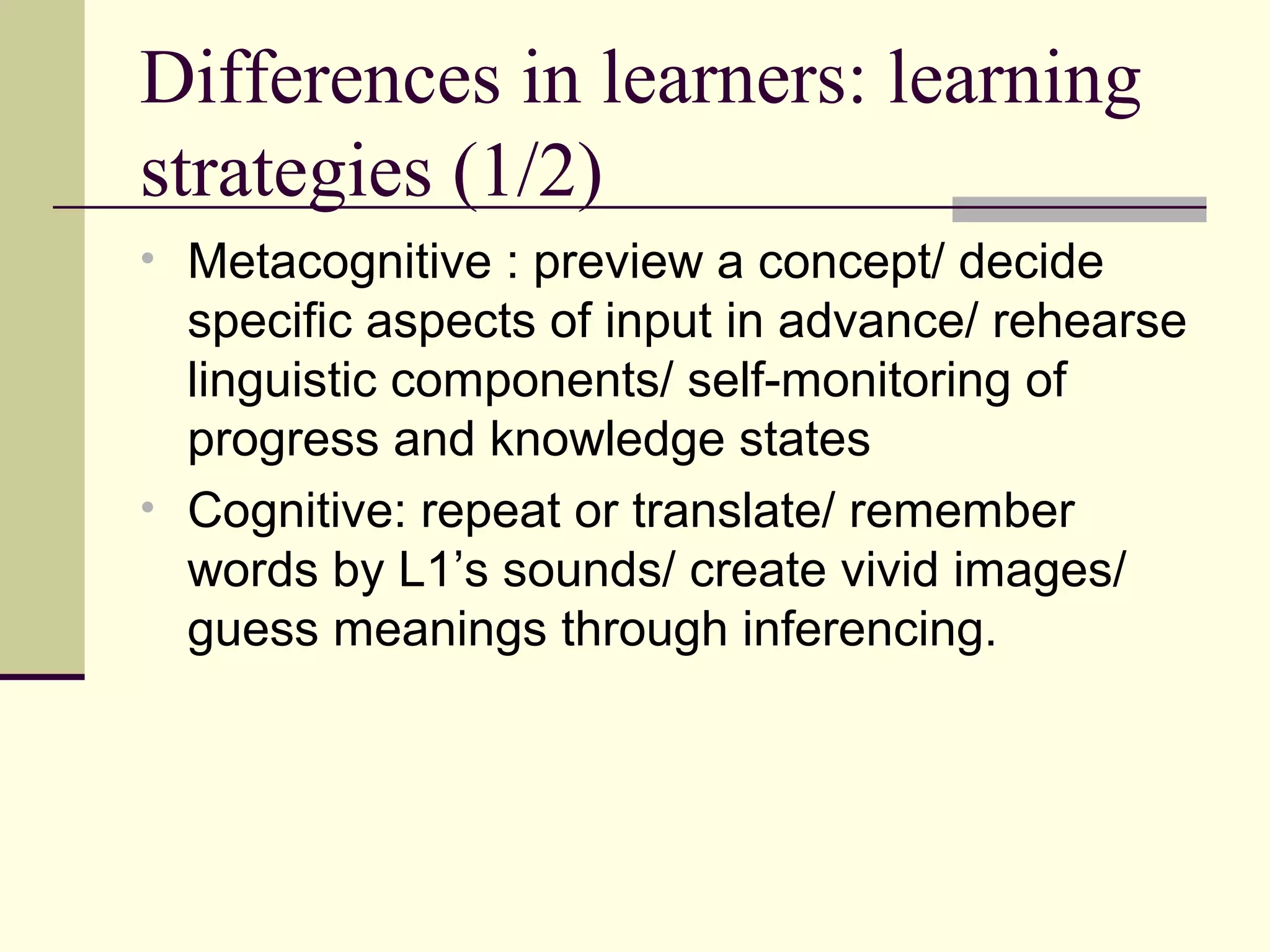
Differences in learners: learning
strategies (1/2)
• Metacognitive : preview a concept/ decide
specific aspects of input in advance/ rehearse
linguistic components/ self-monitoring of
progress and knowledge states
• Cognitive: repeat or translate/ remember
words by L1’s sounds/ create vivid images/
guess meanings through inferencing.
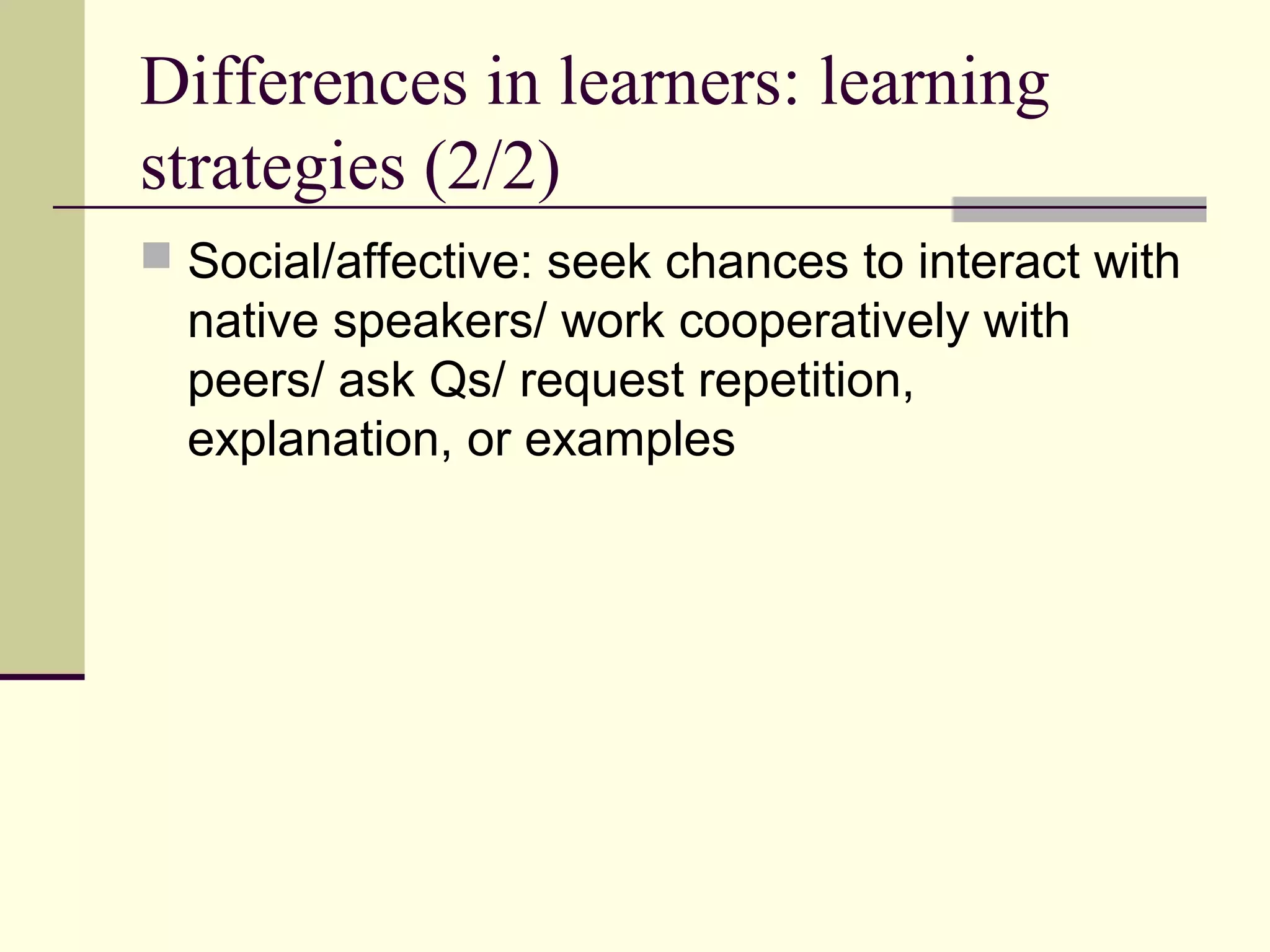
Differences in learners: learning
strategies (2/2)
 Social/affective: seek chances to interact with
native speakers/ work cooperatively with
peers/ ask Qs/ request repetition,
explanation, or examples
Good learners traits (Ellis 1994):
 Concern for language form (but also attention
to meaning)
 Concern for communication
 Active task approach
 Awareness of the learning process
 Capacity to use strategies flexibly in
accordance with task requirements
Question 4:
 How do you feel about multilingualism so far?
The effects of multilingualism (1/2)
 Positive effects:
1. foreign language study is good for “training the
mind.”
2. an essential characteristic of “educated” and
“cultured” members of society
3. on intellectual function based on “measures of
conceptual development, creativity, metalinguistic
awareness, semantic development, and analytic
skills” (p93)
The effects of multilingualism
(2/2)
 Negative effects:
1. negative impact on general intelligence
 2. capacity limitations for language
acquisition and maintenance, that
simultaneous bilingualism in childhood may
result in a narrower range of lexical
development in either language and that
intensive and continued use of L2 many
reduce accessibility of L1
Thank you for your attention!!

Psychology of language

  • 1.
    Chapter 4: Thepsychology of Second Language Acquisition
  • 2.
    Preview 1. Language andthe brain 2. Learning process: SLA 3. Differences among learners
  • 3.
    Language and thebrain Left hemisphere Right hemisphere Phonology Nonverbal (as babies’ cries) Morphology Visuospatial information Syntax Intonation Function words and inflections Nonliteral meaning and ambiguity Tone systems Many pragmatic abilities Much lexical knowledge Some lexical knowledge Principal hemispheric specializations (p69) also see Brown (2007):p125
  • 4.
    Language and thebrain 1. lateralization( 側化現象 ) 2-puberty 2. Critical period hypothesis 3.Broca’s area/ Wernicke’s area- B&W 4. language activity /core linguistic processes 5. SLA-right hemisphere involvement L2-learnt by many means; use more memorization /L1-learnt by single means
  • 5.
    * Multilingual speakers Coordinate bilingualism  Compound bilingualism  Subordinate bilingualism
  • 6.
    Q1:When there isdifferential impairment or recovery in the brain, which language loses first and recovers first?
  • 7.
    Learning processes 1. Informationprocessing (IP) ( 訊息處理 ) (1) Attention-processing (2) Skill Learning Theory (3)Restructuring 2. connectionism ( 聯結論 ) --PDP
  • 8.
    Information Processing( 訊息處理)  Cognitive psychologists  language acquisition →storing, integrating, and retrieving information.  do not think that humans have a language-specific module (i.e. LAD) in the brain.  do not assume that ‘acquisition’ and ‘learning’ are distinct mental processes.  L2 acquisition→ the building up of knowledge → automatically
  • 9.
    Stages of informationProcessing Input Central processing Output Perception Controlled-automatic processing Production Declarative –procedural knowledge Restructuring noticed input→pay attention to it →intake (frequency, perceptual saliency…p75) practice Fluency in speech and writing
  • 10.
    McLaughlin’s Attention-Processing Model 注意力處理模式(Brown. P299)  Input: notice, pay attention→intake  Brown (2007):p300, 302 - Controlled processes - Automatic processes
  • 11.
    McLaughlin’s Attention-Processing Model alsosee Brown (2007):p300,302 Attention controlled automatic Focal (intentional attention) Performance based on formal rule learning Performance in a test situation Peripheral Performance based on implicit learning or analogic learning Performance in communication situations From Brown (2007), p300
  • 12.
    Anderson’s Skill LearningTheory  Declarative knowledge  Procedural knowledge  Three stages: (1) information is stored. (drowned- drown+ed) (2) associative stage: (past tense…+ed) (3) autonomous stage
  • 13.
    Question 2:  Andersonthinks that L2 learners do not reach full autonomy as L1 learners. What factors may influence the process of achieving autonomy in L2 acquisition?
  • 14.
    Restructuring  L2 knowledgeas continua of controlled- automatic and explicit-implicit  將訊息自動化需要重組的過程  from exemplar-based to rule-based  Restructuring :because L is complex, hierarchical, not (necessarily) linearly  Restructuring doesn’t necessarily happen all at once, but over time
  • 15.
    Restructuring  U-shaped behavioris often evidenced during restructuring Stage 1 Stage 3 Stage 2 correct utterances incorrect utterances feet feet foots
  • 16.
    Three psychological approaches Multidimensional Model  Processability Theory  Competition Model
  • 17.
    Multidimensional model  2principal axes: developmental & variational  grammatical structures (organized hierarchically)  Individual variation  Focus on the relationship between implicit knowledge and output  hierarchy: (1) Canonical order strategy (COS) (2) initialization /finalization strategy (IFS) (3) subordinate clause strategy (SCS)
  • 18.
    Processability  Reorientation ofMultidimensional model  Hierarchy of processing skills  (1) lemma/word access (ex:apple)  (2) category procedure (ex: three apples)  (3) phrasal procedure(ex: three big apples)  (4) S-procedure (ex: There is an apple./  There are three apples)  (5) Clause boundary
  • 19.
    Competition model  Functionalapproach: L1 form-function mapping→SLA  Competition among cues that signal functions  Cue strength: task frequency/ contrastive availability/ conflict reliability  Language process involves “competition” among the various cues  Reminder to teachers that Ss do not only depend on L2 formal linguistic features as their only tools for deciphering the target language L2 –(Brown 2007, p.255)
  • 20.
    Competition model (form-function mapping) 1. horse -form: sounds [hors] -function: 4 legs/ hay eating animal  2. Horses eat hay. - Word order-form: horses + V + hay - Function: “horses” is S.; “hay” is O. - inflection- _s: form; function: more than one horse (p79)
  • 21.
    Connectionist approaches  Focuson the increasing strength of associations between stimuli and responses (IP: focus on the inferred abstraction of “ rules” or restructuring.)  Learning is change in the strength of these connections; learning is not dependent on UG or rule- formation.  Parallel Distributed Processing (PDP): a network of nodes (units)→ repeated patterns of units (input)→ extract regularities→ probabilistic association (connection strengths/patterns of activation)  Frequency influences learning
  • 22.
    IP PDP Attention isavailable for controlled processing vs. automatic processing Not serial in nature Attention is distributed in local pattern Processing is parallel pattern Knowledge is not stored in memory or retrieved as patterns Connection strengths /Patterns being recreated
  • 23.
    Question 3:  Whyare some L2 learners more successful than others?
  • 24.
    Differences in learners Age  Sex  Aptitude  Motivation  Cognitive style  Personality  Learning strategies  (the last three are closely related to and interact with each other.)
  • 25.
    Difference in learners:age  Children are more successful L2 learners?  1. initial rate learning (success) / older learners have an advantage (popular belief)/ learners who are introduced to the L2 in childhood (ultimate achievement)  Critical period hypothesis(Lenneberg hypothesis):Genie
  • 26.
    Age difference inSLA Younger advantage Older advantage Brain plasticity Learning capacity Not analytical Analytic ability Fewer inhibitions(usually) Pragmatic skills Weaker group identity Greater knowledge of L1 Simplified input more likely Real-world knowledge
  • 27.
    Differences in learners:sex  Female are better L2 learners?  --verbal fluency  --women’s brain may be less asymmetrically organized than men’s for speech (Kimura 1992).  --women: better at memorizing complex forms/ men: better at computing compositional rules (Halpern 2000)  --differences related to hormonal variables
  • 28.
    Differences in learners:aptitudes (1/2) • Phonemic coding ability: the capacity to process auditory input into segments which can be stored and retrieved. If the hearer cannot analyze the incoming stream of speech into phonemes in order to recognize morphemes, input may not result in intake. • Inductive language learning ability and grammatical sensitivity concerned with central processing.
  • 29.
    Differences in learners:aptitudes (2/2) • Associative memory capacity: how linguistic items are stored and with how they are recalled and used in output (speaker fluency). • Skehan (1998 )concludes that language learning aptitude “is not completely distinct from general cognitive abilities.”
  • 30.
    Differences in learners: motivation(1/2) •Significant goal or need/desire to attain the goal/ perception that learning L2 is relevant to fulfilling the goal or meeting the need/belief in the likely success or failure if learning L2/value of potential outcomes or rewards
  • 31.
    Differences in learners:motivation (2/2) • 2 type of motivation(Brown 2007, p175) • --integrative motivation: based on interest in learning L2; emotional or affective factors are dominant (learning by a member of the dominant group in a society) • --instrumental motivation: involves perception of purely practical value in learning L2 (learning by a subordinate group member)
  • 32.
    Differences in learners:cognitive style  Refers to individual’s preferred way of processing: (perceiving, conceptualizing, organizing and recalling information.)  Brown (2007):p120
  • 33.
    Cognitive styles Field-dependent Field-independent Global- Particular Holistic - Analytic Deductive (top-down) - Inductive (bottom-up) Focus on meaning - Focus on form
  • 34.
    Differences in learners:personality  Anxiety :most attention in SLA research.  Low anxiety facilitates language learning.  Instructional context or task influences anxiety and reporting. (oral performance)  Systematic cultural differences are found between groups of learners. (face concept)  Low anxiety and high self-confidence increase Ss motivation to learn.
  • 35.
    Personality traits Anxious -Self-confident Risk-avoiding - Risk-taking Shy - Adventuresome introverted - Extroverted Inner-directed - Other-directed Reflective - Impulsive Imaginative - Uninquisitive Creative - Uncreative Empathetic - Insensitive to others Tolerant of ambiguity - Closure-oriented Boldface print means positive correlation with success in L2 learning.
  • 36.
    Differences in learners:learning strategies (1/2) • Metacognitive : preview a concept/ decide specific aspects of input in advance/ rehearse linguistic components/ self-monitoring of progress and knowledge states • Cognitive: repeat or translate/ remember words by L1’s sounds/ create vivid images/ guess meanings through inferencing.
  • 37.
    Differences in learners:learning strategies (2/2)  Social/affective: seek chances to interact with native speakers/ work cooperatively with peers/ ask Qs/ request repetition, explanation, or examples
  • 38.
    Good learners traits(Ellis 1994):  Concern for language form (but also attention to meaning)  Concern for communication  Active task approach  Awareness of the learning process  Capacity to use strategies flexibly in accordance with task requirements
  • 39.
    Question 4:  Howdo you feel about multilingualism so far?
  • 40.
    The effects ofmultilingualism (1/2)  Positive effects: 1. foreign language study is good for “training the mind.” 2. an essential characteristic of “educated” and “cultured” members of society 3. on intellectual function based on “measures of conceptual development, creativity, metalinguistic awareness, semantic development, and analytic skills” (p93)
  • 41.
    The effects ofmultilingualism (2/2)  Negative effects: 1. negative impact on general intelligence  2. capacity limitations for language acquisition and maintenance, that simultaneous bilingualism in childhood may result in a narrower range of lexical development in either language and that intensive and continued use of L2 many reduce accessibility of L1
  • 42.
    Thank you foryour attention!!