PHYSICALLY ,MENTALLY
&SOCIALLY CHALLANGED
CHILDREN
HANDICAPPED CHILDREN
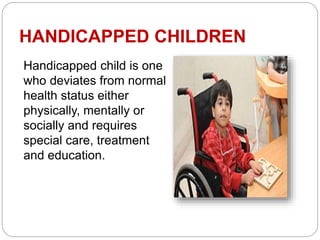
Handicapped child is one
who deviates from normal
health status either
physically, mentally or
socially and requires
special care, treatment
and education.
DEFINITION
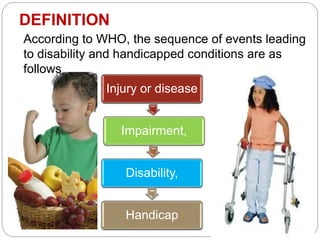
According to WHO, the sequence of events leading
to disability and handicapped conditions are as
follows
Injury or disease
Impairment,
Disability,
Handicap
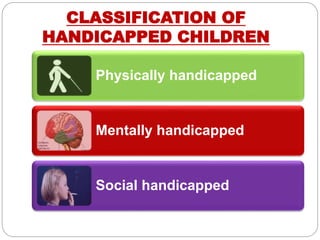
CLASSIFICATION OF
HANDICAPPED CHILDREN
Physically handicapped
Mentally handicapped
Social handicapped
PHYSICALLY
HANDICAPPED
CHILDREN
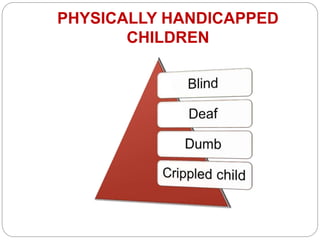
PHYSICALLY HANDICAPPED
CHILDREN
BLINDNESS
According to WHO the inability to count fingers in
day light from a distance of 3 meters is defined as
blindness.
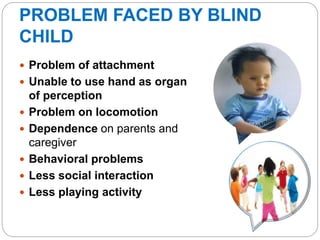
PROBLEM FACED BY BLIND
CHILD
 Problem of attachment
 Unable to use hand as organ
of perception
 Problem on locomotion
 Dependence on parents and
caregiver
 Behavioral problems
 Less social interaction
 Less playing activity
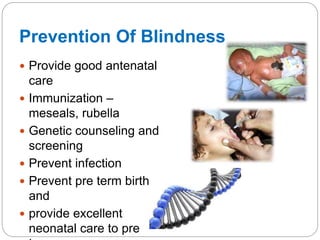
Prevention Of Blindness
 Provide good antenatal
care
 Immunization –
meseals, rubella
 Genetic counseling and
screening
 Prevent infection
 Prevent pre term birth
and
 provide excellent
neonatal care to pre
Cont….
 vitamin A supplement
 health education about eye
safety, personal hygiene
and nutrition for health
promotion
 Treatment of causes of
childhood blindness
 Retinopathy of
prematurity (ROP)
 Cataract
 Glaucoma
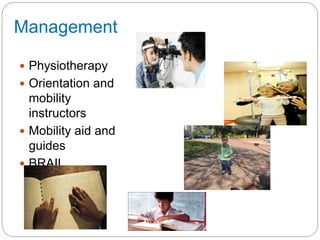
Management
 Physiotherapy
 Orientation and
mobility
instructors
 Mobility aid and
guides
 BRAIL
technology
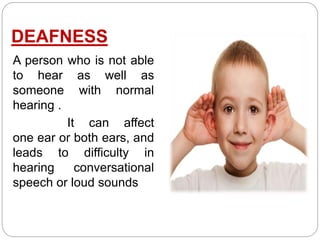
DEAFNESS
A person who is not able
to hear as well as
someone with normal
hearing .
It can affect
one ear or both ears, and
leads to difficulty in
hearing conversational
speech or loud sounds
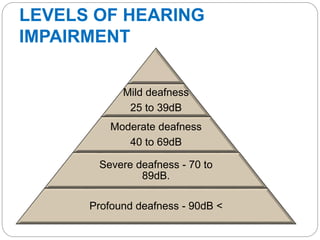
LEVELS OF HEARING
IMPAIRMENT
Mild deafness
25 to 39dB
Moderate deafness
40 to 69dB
Severe deafness - 70 to
89dB.
Profound deafness - 90dB <
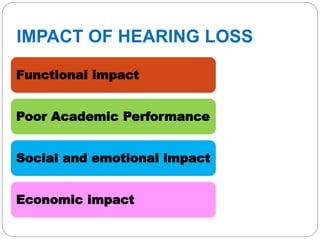
IMPACT OF HEARING LOSS
Functional impact
Poor Academic Performance
Social and emotional impact
Economic impact
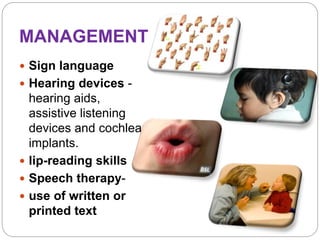
MANAGEMENT
 Sign language
 Hearing devices -
hearing aids,
assistive listening
devices and cochlear
implants.
 lip-reading skills
 Speech therapy-
 use of written or
printed text
SPEECH HANDICAPPED
 means an impairment of
speech or sound
production, fluency,
voice or language which
significantly affects a
child’s educational
performance or their
social, emotional or
vocational development.
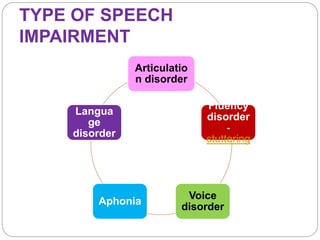
TYPE OF SPEECH
IMPAIRMENT
Articulatio
n disorder
Fluency
disorder
-
stuttering
Voice
disorder
Aphonia
Langua
ge
disorder
EMPACT OF SPEECH
IMPAIRMENT
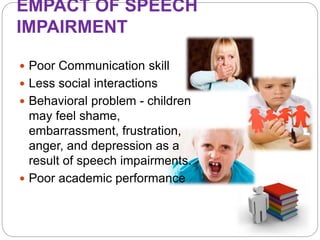
 Poor Communication skill
 Less social interactions
 Behavioral problem - children
may feel shame,
embarrassment, frustration,
anger, and depression as a
result of speech impairments.
 Poor academic performance
MANAGEMENT
 Early identification of speech
impairment
 Elimination of hearing impairment
 Medical and surgical intervention for
underlying causes
 Psychological counseling
 Avoid making fun of their voice or
speech
 Voice or Speech therapy
 Physical therapy
 Cognitive rehabilitation
ORTHOPEDICALLY
HANDICAPPED
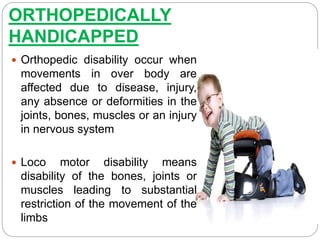
 Orthopedic disability occur when
movements in over body are
affected due to disease, injury,
any absence or deformities in the
joints, bones, muscles or an injury
in nervous system
 Loco motor disability means
disability of the bones, joints or
muscles leading to substantial
restriction of the movement of the
limbs
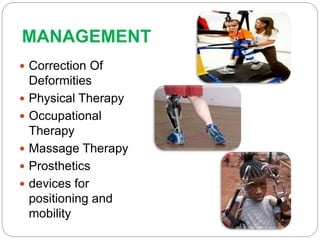
MANAGEMENT
 Correction Of
Deformities
 Physical Therapy
 Occupational
Therapy
 Massage Therapy
 Prosthetics
 devices for
positioning and
mobility
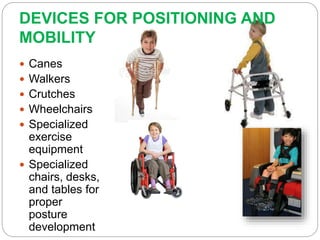
DEVICES FOR POSITIONING AND
MOBILITY
 Canes
 Walkers
 Crutches
 Wheelchairs
 Specialized
exercise
equipment
 Specialized
chairs, desks,
and tables for
proper
posture
development
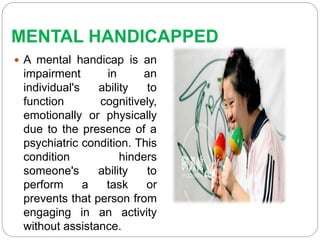
MENTAL HANDICAPPED
 A mental handicap is an
impairment in an
individual's ability to
function cognitively,
emotionally or physically
due to the presence of a
psychiatric condition. This
condition hinders
someone's ability to
perform a task or
prevents that person from
engaging in an activity
without assistance.
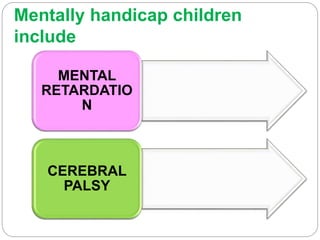
Mentally handicap children
include
MENTAL
RETARDATIO
N
CEREBRAL
PALSY
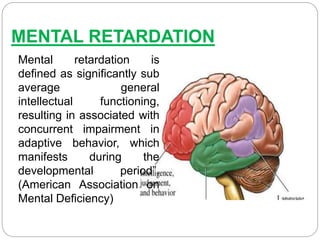
MENTAL RETARDATION
Mental retardation is
defined as significantly sub
average general
intellectual functioning,
resulting in associated with
concurrent impairment in
adaptive behavior, which
manifests during the
developmental period”.
(American Association on
Mental Deficiency)
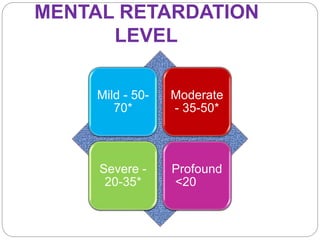
MENTAL RETARDATION
LEVEL
Mild - 50-
70*
Moderate
- 35-50*
Severe -
20-35*
Profound
<20
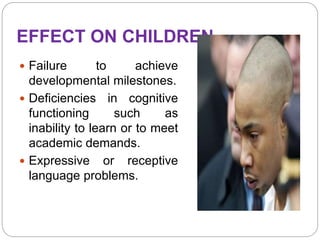
EFFECT ON CHILDREN
 Failure to achieve
developmental milestones.
 Deficiencies in cognitive
functioning such as
inability to learn or to meet
academic demands.
 Expressive or receptive
language problems.
Cont…
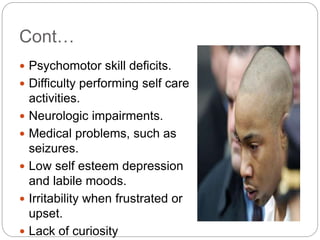
 Psychomotor skill deficits.
 Difficulty performing self care
activities.
 Neurologic impairments.
 Medical problems, such as
seizures.
 Low self esteem depression
and labile moods.
 Irritability when frustrated or
upset.
 Lack of curiosity
TREATMENT MODALITIES
 Behavior management.
 Environment supervision
 Monitoring the child’s developmental needs and
problems.
 Programs that maximum speech , language,
cognitive, psychomotor, social , self care, and
occupational skills.
 Family therapy
 Early intervention programs for children younger
than age 3 with mental retardation.
 Provide day schools to train the child in basic skills,
such as bathing and feeding.
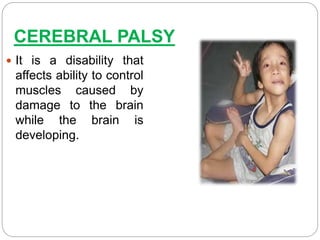
CEREBRAL PALSY
 It is a disability that
affects ability to control
muscles caused by
damage to the brain
while the brain is
developing.
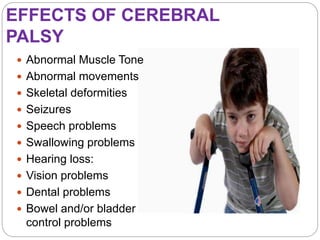
EFFECTS OF CEREBRAL
PALSY
 Abnormal Muscle Tone
 Abnormal movements
 Skeletal deformities
 Seizures
 Speech problems
 Swallowing problems
 Hearing loss:
 Vision problems
 Dental problems
 Bowel and/or bladder
control problems
SOCIALLY
CHALLENGED
CHILDREN€
SOCIALLY CHALLENGED
CHILDREN
 A Socially handicapped
children may be defined as
a child whose opportunity
for a healthy personality
development and full
unfolding of potentialities
are hampered certain
elements in his social
environment such as
parental inadequacy,
environmental deprivation,
(lack of learning
opportunity) and emotional
disturbance
CATEGORY OF SOCIALLY
HANDICAPPED CHILDREN
 Orphan
 Neglected
children
 Children of
divorce or step
parents
 Delinquent
children
ORPHAN
CHILDREN
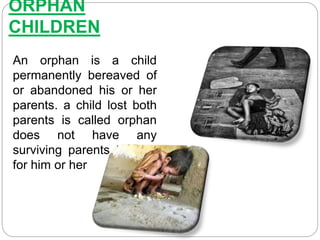
An orphan is a child
permanently bereaved of
or abandoned his or her
parents. a child lost both
parents is called orphan
does not have any
surviving parents to care
for him or her
PROBLEM ASSOCIATED WITH
ORPHANS
 Developmental
retardation
 Conduct and sleep
problem
 Personality problem
 Bed wetting
 Disturbance in eating
 Depression
During adulthood
 Antisocial problem
 Drug addiction
 Alcoholism
 Marital problem
CHILD NEGLECT
 Child neglect is an
ongoing failure to
provide the right care
and attention to a child's
needs, including food
and a safe environment,
or to a child's emotional
needs including warmth,
security and love. A lack
of these things are likely
to result in serious
damage to the child's
health or development.
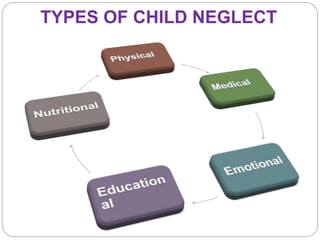
TYPES OF CHILD NEGLECT
 parental mental health
problems such as
depression
 Unstable and abusive
relationships between
parents
 parental history and learned
parental behavior
 lack of knowledge of
children's needs,
 an inability to plan, lack of
confidence about the future,
Cont…
 being a teenage
mother,
 Alcohol and drug
abuse in care-givers
 unemployment
 poverty
 a large number of
children,
 high levels of stress
 domestic violence
CONSEQUENCES OF NEGLECT
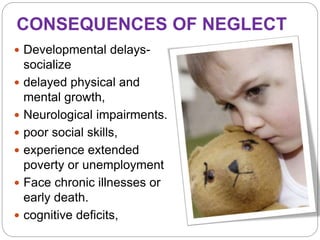
 Developmental delays-
socialize
 delayed physical and
mental growth,
 Neurological impairments.
 poor social skills,
 experience extended
poverty or unemployment
 Face chronic illnesses or
early death.
 cognitive deficits,
Cont…
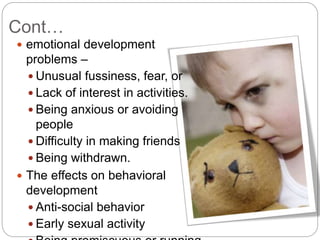
 emotional development
problems –
 Unusual fussiness, fear, or
 Lack of interest in activities.
 Being anxious or avoiding
people
 Difficulty in making friends
 Being withdrawn.
 The effects on behavioral
development
 Anti-social behavior
 Early sexual activity
Cont…
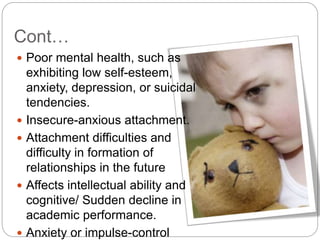
 Poor mental health, such as
exhibiting low self-esteem,
anxiety, depression, or suicidal
tendencies.
 Insecure-anxious attachment.
 Attachment difficulties and
difficulty in formation of
relationships in the future
 Affects intellectual ability and
cognitive/ Sudden decline in
academic performance.
 Anxiety or impulse-control
Cont….
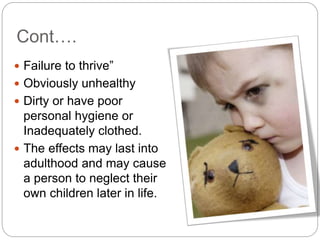
 Failure to thrive”
 Obviously unhealthy
 Dirty or have poor
personal hygiene or
Inadequately clothed.
 The effects may last into
adulthood and may cause
a person to neglect their
own children later in life.
Management
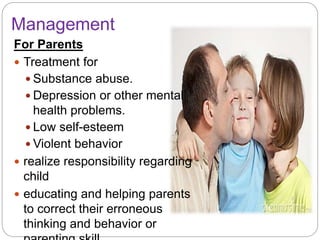
For Parents
 Treatment for
 Substance abuse.
 Depression or other mental
health problems.
 Low self-esteem
 Violent behavior
 realize responsibility regarding
child
 educating and helping parents
to correct their erroneous
thinking and behavior or
Cont….
For Child
 Child-centered interventions
include
 pediatric care, mentoring
 Behavioral and mental
health treatment.
 Provide stimulation
programme to emotionally
neglected child
 Develop timely and
comprehensive assessments
or placed in foster home
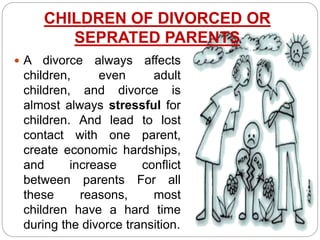
CHILDREN OF DIVORCED OR
SEPRATED PARENTS
 A divorce always affects
children, even adult
children, and divorce is
almost always stressful for
children. And lead to lost
contact with one parent,
create economic hardships,
and increase conflict
between parents For all
these reasons, most
children have a hard time
during the divorce transition.
EFFECTS OF DIVORCE OR
SEPERATION ON CHILDREN
Infants
 Loss of appetite.
 Upset stomach — may spit up more. More fretful or
anxious.
Toddlers
 More crying
 Sleeping Problem
 May feel anger
 May worry when parent is out of sight.
 May withdraw, bite or be irritable.
 Temper tantrums
Cont…
Preschoolers
 Feels uncertain about the future.
 May feel responsible.
 May hold anger inside.
 May become aggressive and angry
toward parent he/she lives with.
 May have more nightmares.
 Experiences feelings of grief because
of sudden absence of parent.
Cont….
Early elementary
 Feels unfaithful and feels a sense of
loss.
 Feels rejected by the parent who left.
 Ignores school and friendships.
 Worries about the future.
 Complains of headaches or
stomachaches.
 Experiences loss of appetite, sleep
problems, diarrhea, urinary
frequency.
 Learning problem in school
Cont….
Preteens and adolescents
 Feels angry and disillusioned.
 Feels abandoned, that parent is leaving
him/her not the other spouse.
 Shows extreme behavior (good and bad).
 Involved in high-risk behaviors (drugs,
shoplifting, skipping school).
 Anti social behavior
 Drug or alcohol abuse
 Problem in maintaining relationship.
 Worries about financial matters.
MANAGEMENT
 Not expose child to conflict
between parents
 Listen to child and provide
emotional support
 Child should be reared to
respect to both parents
 Child should taught that both
parents are nice people but are
separating because of they
have different views about life
PREVENTION
OF
HANDICAPPED
CONDITION IN
CHILDREN
PRIMARY PREVENTION
 Genetic counseling
 Genetic screening
 Reduction of
consanguineous marriage
 Pregnancy planning
 Rh incompablity
 Immunization of mother and
baby
 Vitamin A prophylaxis
 Improve nutritional status of
mother and child
Cont….
 Prevention of iodine and folic
acid deficiency
 Provide essential care in
prenatal, Intranatal, postnatal
period
 Prevent maternal and neonatal
infection
 Prevent birth injury, asphyxia,
hyperbilurubinemia
 Special care to high risk mother
–abortion, premature birth
 Encourage to kick bad habits
such as smoking or alcohol
abuse.
SECONDARY PREVENTION
 Careful history
 Regular medical supervision
and developmental
assessment
 Tereatment of particular
handicap condition
 Correction of deformity
 Physiotherapy and exercise
to improve physical
condition
 Occupational therapy
Cont…
 Speech therapy to
improve communication
ability
 Prosthetics
 Special care for mentally
handicapped children with
warmth , love , tolerance,
discipline, avoid criticism
 Counseling and guidance
 Referral for welfare
services
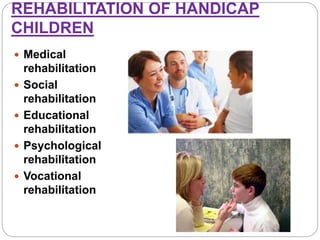
REHABILITATION OF HANDICAP
CHILDREN
 Medical
rehabilitation
 Social
rehabilitation
 Educational
rehabilitation
 Psychological
rehabilitation
 Vocational
rehabilitation
WELFARE OF
HANDICAPPED
CHILDREN
WELFARE OF HANDICAPPED
CHILDREN
 Persons with disabilities bill
(equal opportunity, protection of
right and full participation)-
1995,introduced by ministry of
welfare and Govt of India and it
deal with preventive and
promotional aspect of
rehabilitation
 Children Act 1960- provide for
the care protection, maintenance,
welfare, education, and
rehabilitation of socially
handicapped children.
Schemes for handicapped
children
 Deendhyal disabled rehabilitation scheme
 Assistance to disabled person to purchase or
fitting of aids and appliance
 National handicapped finance and development
cooperation
 Scheme for implementation of person with
disabilities act 1995(sipda)
 Scheme for incentive to employees in the private
sector for providing employment to person with
disabilities
National institute for handicapped
 National institute for orthopedically handicapped
Calcutta
 National institute for mentally handicapped
Hyderabad
 Ali yavar Jung National institute for hearing
handicapped Mumbai
 National institute for rehabilitation, training, and
research Calcutta
 National Institute for visually handicapped new
Delhi and Dehradun
NURSING MANAGEMENT OF
HANDICAPPED CHILDREN
 Ineffective family coping and
altered parenting related to
handicapped condition
 Anxiety of parents and family
members
 Altered nutrition less than body
requirement
 Potential for infection
 Self care deficient
 Communication impaired
 Physical mobility impaired
Cont…..
 Altered elimination pattern
 Activity intolerance
 Altered sleep pattern
 Sensory alteration, visual/
auditory
 Altered growth and
development
 Diversional activity deficit
 Knowledge deficit to
continued care of
handicapped children
Conclusion
 handicap develops as the consequence of the
disability. It is defined as a disadvantage for a
given individual resulting from impairment or a
disability that limits and prevents the fulfillment
of a role which is normal for that individual,
depending on age, sex, social and cultural
factors.
PHYSICALLY ,MENTALLY &SOCIALLY CHALLANGED CHILDREN

PHYSICALLY ,MENTALLY &SOCIALLY CHALLANGED CHILDREN

  • 1.
  • 2.
    HANDICAPPED CHILDREN Handicapped childis one who deviates from normal health status either physically, mentally or socially and requires special care, treatment and education.
  • 3.
    DEFINITION According to WHO,the sequence of events leading to disability and handicapped conditions are as follows Injury or disease Impairment, Disability, Handicap
  • 4.
    CLASSIFICATION OF HANDICAPPED CHILDREN Physicallyhandicapped Mentally handicapped Social handicapped
  • 5.
  • 6.
  • 7.
    BLINDNESS According to WHOthe inability to count fingers in day light from a distance of 3 meters is defined as blindness.
  • 8.
    PROBLEM FACED BYBLIND CHILD  Problem of attachment  Unable to use hand as organ of perception  Problem on locomotion  Dependence on parents and caregiver  Behavioral problems  Less social interaction  Less playing activity
  • 9.
    Prevention Of Blindness Provide good antenatal care  Immunization – meseals, rubella  Genetic counseling and screening  Prevent infection  Prevent pre term birth and  provide excellent neonatal care to pre
  • 10.
    Cont….  vitamin Asupplement  health education about eye safety, personal hygiene and nutrition for health promotion  Treatment of causes of childhood blindness  Retinopathy of prematurity (ROP)  Cataract  Glaucoma
  • 11.
    Management  Physiotherapy  Orientationand mobility instructors  Mobility aid and guides  BRAIL technology
  • 12.
    DEAFNESS A person whois not able to hear as well as someone with normal hearing . It can affect one ear or both ears, and leads to difficulty in hearing conversational speech or loud sounds
  • 13.
    LEVELS OF HEARING IMPAIRMENT Milddeafness 25 to 39dB Moderate deafness 40 to 69dB Severe deafness - 70 to 89dB. Profound deafness - 90dB <
  • 14.
    IMPACT OF HEARINGLOSS Functional impact Poor Academic Performance Social and emotional impact Economic impact
  • 15.
    MANAGEMENT  Sign language Hearing devices - hearing aids, assistive listening devices and cochlear implants.  lip-reading skills  Speech therapy-  use of written or printed text
  • 16.
    SPEECH HANDICAPPED  meansan impairment of speech or sound production, fluency, voice or language which significantly affects a child’s educational performance or their social, emotional or vocational development.
  • 17.
    TYPE OF SPEECH IMPAIRMENT Articulatio ndisorder Fluency disorder - stuttering Voice disorder Aphonia Langua ge disorder
  • 18.
    EMPACT OF SPEECH IMPAIRMENT Poor Communication skill  Less social interactions  Behavioral problem - children may feel shame, embarrassment, frustration, anger, and depression as a result of speech impairments.  Poor academic performance
  • 19.
    MANAGEMENT  Early identificationof speech impairment  Elimination of hearing impairment  Medical and surgical intervention for underlying causes  Psychological counseling  Avoid making fun of their voice or speech  Voice or Speech therapy  Physical therapy  Cognitive rehabilitation
  • 20.
    ORTHOPEDICALLY HANDICAPPED  Orthopedic disabilityoccur when movements in over body are affected due to disease, injury, any absence or deformities in the joints, bones, muscles or an injury in nervous system  Loco motor disability means disability of the bones, joints or muscles leading to substantial restriction of the movement of the limbs
  • 21.
    MANAGEMENT  Correction Of Deformities Physical Therapy  Occupational Therapy  Massage Therapy  Prosthetics  devices for positioning and mobility
  • 22.
    DEVICES FOR POSITIONINGAND MOBILITY  Canes  Walkers  Crutches  Wheelchairs  Specialized exercise equipment  Specialized chairs, desks, and tables for proper posture development
  • 24.
    MENTAL HANDICAPPED  Amental handicap is an impairment in an individual's ability to function cognitively, emotionally or physically due to the presence of a psychiatric condition. This condition hinders someone's ability to perform a task or prevents that person from engaging in an activity without assistance.
  • 25.
  • 26.
    MENTAL RETARDATION Mental retardationis defined as significantly sub average general intellectual functioning, resulting in associated with concurrent impairment in adaptive behavior, which manifests during the developmental period”. (American Association on Mental Deficiency)
  • 27.
    MENTAL RETARDATION LEVEL Mild -50- 70* Moderate - 35-50* Severe - 20-35* Profound <20
  • 28.
    EFFECT ON CHILDREN Failure to achieve developmental milestones.  Deficiencies in cognitive functioning such as inability to learn or to meet academic demands.  Expressive or receptive language problems.
  • 29.
    Cont…  Psychomotor skilldeficits.  Difficulty performing self care activities.  Neurologic impairments.  Medical problems, such as seizures.  Low self esteem depression and labile moods.  Irritability when frustrated or upset.  Lack of curiosity
  • 30.
    TREATMENT MODALITIES  Behaviormanagement.  Environment supervision  Monitoring the child’s developmental needs and problems.  Programs that maximum speech , language, cognitive, psychomotor, social , self care, and occupational skills.  Family therapy  Early intervention programs for children younger than age 3 with mental retardation.  Provide day schools to train the child in basic skills, such as bathing and feeding.
  • 31.
    CEREBRAL PALSY  Itis a disability that affects ability to control muscles caused by damage to the brain while the brain is developing.
  • 32.
    EFFECTS OF CEREBRAL PALSY Abnormal Muscle Tone  Abnormal movements  Skeletal deformities  Seizures  Speech problems  Swallowing problems  Hearing loss:  Vision problems  Dental problems  Bowel and/or bladder control problems
  • 33.
  • 34.
    SOCIALLY CHALLENGED CHILDREN  ASocially handicapped children may be defined as a child whose opportunity for a healthy personality development and full unfolding of potentialities are hampered certain elements in his social environment such as parental inadequacy, environmental deprivation, (lack of learning opportunity) and emotional disturbance
  • 35.
    CATEGORY OF SOCIALLY HANDICAPPEDCHILDREN  Orphan  Neglected children  Children of divorce or step parents  Delinquent children
  • 36.
    ORPHAN CHILDREN An orphan isa child permanently bereaved of or abandoned his or her parents. a child lost both parents is called orphan does not have any surviving parents to care for him or her
  • 37.
    PROBLEM ASSOCIATED WITH ORPHANS Developmental retardation  Conduct and sleep problem  Personality problem  Bed wetting  Disturbance in eating  Depression During adulthood  Antisocial problem  Drug addiction  Alcoholism  Marital problem
  • 38.
    CHILD NEGLECT  Childneglect is an ongoing failure to provide the right care and attention to a child's needs, including food and a safe environment, or to a child's emotional needs including warmth, security and love. A lack of these things are likely to result in serious damage to the child's health or development.
  • 39.
  • 40.
     parental mentalhealth problems such as depression  Unstable and abusive relationships between parents  parental history and learned parental behavior  lack of knowledge of children's needs,  an inability to plan, lack of confidence about the future,
  • 41.
    Cont…  being ateenage mother,  Alcohol and drug abuse in care-givers  unemployment  poverty  a large number of children,  high levels of stress  domestic violence
  • 42.
    CONSEQUENCES OF NEGLECT Developmental delays- socialize  delayed physical and mental growth,  Neurological impairments.  poor social skills,  experience extended poverty or unemployment  Face chronic illnesses or early death.  cognitive deficits,
  • 43.
    Cont…  emotional development problems–  Unusual fussiness, fear, or  Lack of interest in activities.  Being anxious or avoiding people  Difficulty in making friends  Being withdrawn.  The effects on behavioral development  Anti-social behavior  Early sexual activity
  • 44.
    Cont…  Poor mentalhealth, such as exhibiting low self-esteem, anxiety, depression, or suicidal tendencies.  Insecure-anxious attachment.  Attachment difficulties and difficulty in formation of relationships in the future  Affects intellectual ability and cognitive/ Sudden decline in academic performance.  Anxiety or impulse-control
  • 45.
    Cont….  Failure tothrive”  Obviously unhealthy  Dirty or have poor personal hygiene or Inadequately clothed.  The effects may last into adulthood and may cause a person to neglect their own children later in life.
  • 46.
    Management For Parents  Treatmentfor  Substance abuse.  Depression or other mental health problems.  Low self-esteem  Violent behavior  realize responsibility regarding child  educating and helping parents to correct their erroneous thinking and behavior or
  • 47.
    Cont…. For Child  Child-centeredinterventions include  pediatric care, mentoring  Behavioral and mental health treatment.  Provide stimulation programme to emotionally neglected child  Develop timely and comprehensive assessments or placed in foster home
  • 48.
    CHILDREN OF DIVORCEDOR SEPRATED PARENTS  A divorce always affects children, even adult children, and divorce is almost always stressful for children. And lead to lost contact with one parent, create economic hardships, and increase conflict between parents For all these reasons, most children have a hard time during the divorce transition.
  • 49.
    EFFECTS OF DIVORCEOR SEPERATION ON CHILDREN Infants  Loss of appetite.  Upset stomach — may spit up more. More fretful or anxious. Toddlers  More crying  Sleeping Problem  May feel anger  May worry when parent is out of sight.  May withdraw, bite or be irritable.  Temper tantrums
  • 50.
    Cont… Preschoolers  Feels uncertainabout the future.  May feel responsible.  May hold anger inside.  May become aggressive and angry toward parent he/she lives with.  May have more nightmares.  Experiences feelings of grief because of sudden absence of parent.
  • 51.
    Cont…. Early elementary  Feelsunfaithful and feels a sense of loss.  Feels rejected by the parent who left.  Ignores school and friendships.  Worries about the future.  Complains of headaches or stomachaches.  Experiences loss of appetite, sleep problems, diarrhea, urinary frequency.  Learning problem in school
  • 52.
    Cont…. Preteens and adolescents Feels angry and disillusioned.  Feels abandoned, that parent is leaving him/her not the other spouse.  Shows extreme behavior (good and bad).  Involved in high-risk behaviors (drugs, shoplifting, skipping school).  Anti social behavior  Drug or alcohol abuse  Problem in maintaining relationship.  Worries about financial matters.
  • 53.
    MANAGEMENT  Not exposechild to conflict between parents  Listen to child and provide emotional support  Child should be reared to respect to both parents  Child should taught that both parents are nice people but are separating because of they have different views about life
  • 54.
  • 55.
    PRIMARY PREVENTION  Geneticcounseling  Genetic screening  Reduction of consanguineous marriage  Pregnancy planning  Rh incompablity  Immunization of mother and baby  Vitamin A prophylaxis  Improve nutritional status of mother and child
  • 56.
    Cont….  Prevention ofiodine and folic acid deficiency  Provide essential care in prenatal, Intranatal, postnatal period  Prevent maternal and neonatal infection  Prevent birth injury, asphyxia, hyperbilurubinemia  Special care to high risk mother –abortion, premature birth  Encourage to kick bad habits such as smoking or alcohol abuse.
  • 57.
    SECONDARY PREVENTION  Carefulhistory  Regular medical supervision and developmental assessment  Tereatment of particular handicap condition  Correction of deformity  Physiotherapy and exercise to improve physical condition  Occupational therapy
  • 58.
    Cont…  Speech therapyto improve communication ability  Prosthetics  Special care for mentally handicapped children with warmth , love , tolerance, discipline, avoid criticism  Counseling and guidance  Referral for welfare services
  • 59.
    REHABILITATION OF HANDICAP CHILDREN Medical rehabilitation  Social rehabilitation  Educational rehabilitation  Psychological rehabilitation  Vocational rehabilitation
  • 60.
  • 61.
    WELFARE OF HANDICAPPED CHILDREN Persons with disabilities bill (equal opportunity, protection of right and full participation)- 1995,introduced by ministry of welfare and Govt of India and it deal with preventive and promotional aspect of rehabilitation  Children Act 1960- provide for the care protection, maintenance, welfare, education, and rehabilitation of socially handicapped children.
  • 62.
    Schemes for handicapped children Deendhyal disabled rehabilitation scheme  Assistance to disabled person to purchase or fitting of aids and appliance  National handicapped finance and development cooperation  Scheme for implementation of person with disabilities act 1995(sipda)  Scheme for incentive to employees in the private sector for providing employment to person with disabilities
  • 63.
    National institute forhandicapped  National institute for orthopedically handicapped Calcutta  National institute for mentally handicapped Hyderabad  Ali yavar Jung National institute for hearing handicapped Mumbai  National institute for rehabilitation, training, and research Calcutta  National Institute for visually handicapped new Delhi and Dehradun
  • 65.
    NURSING MANAGEMENT OF HANDICAPPEDCHILDREN  Ineffective family coping and altered parenting related to handicapped condition  Anxiety of parents and family members  Altered nutrition less than body requirement  Potential for infection  Self care deficient  Communication impaired  Physical mobility impaired
  • 66.
    Cont…..  Altered eliminationpattern  Activity intolerance  Altered sleep pattern  Sensory alteration, visual/ auditory  Altered growth and development  Diversional activity deficit  Knowledge deficit to continued care of handicapped children
  • 67.
    Conclusion  handicap developsas the consequence of the disability. It is defined as a disadvantage for a given individual resulting from impairment or a disability that limits and prevents the fulfillment of a role which is normal for that individual, depending on age, sex, social and cultural factors.