Approaches in educational
technology
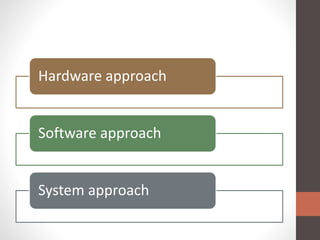
Hardware approach
Software approach
System approach
Hardware Approach
• Based on physical science and applied
engineering field approach
• The new mechanism of teaching-learning
with improved technology as its basis
• Suggesting innumerable new ways of
doing things to the class-room teachers
• The job and the duties of the teacher are
likely to have multifaceted changes as they
are to deal with many new gadgets for
teaching and learning now and in the
future
• A result of hardware technology = the
development of electro-mechanical
equipments for instructional purposes.
• E.g.,:microphones for making teachers’
voice fully audible to the learners.
• Radio, T.V., tape recorder, projector, closed
circuit television (C.C.T.V.), teaching
machines, and computers are used for
teaching the students.
• Silverman (1968), called this type of
educational technology 'Relative
Technology'.
• Educational technology deals with the
application of many fields of science to the
educational needs of the individual as well
as of society (Marilyn Nickson, 1971)
• Hardware approach also involves a
reduction of cost.
• the application of physical science to the
education enables teachers to deal with
more students, resulting in less cost and
economy in finances (Davis, 1971)
Software Approach
• In software approach, the basis of all
thinking and working is behavioural
science and psychology of learning.
• Software approach uses the principles of
psychology for the purpose of behaviour
modification.
• A teacher with added knowledge of
software approach can use the films, flash-
cards, tapes etc., for various purposes.
• There is not end to his thinking.
• A teacher can plan better teaching which
results into better learning.
• This view of educational technology is
closely associated with the modern
principles of programmed learning and is
characterised by task analysis, writing
precise objectives, selection of appropriate
learning strategies, reinforcement of
correct responses and constant education.
(Davis, 1971)
• Silverman (1968) termed this educational
technology as 'constructive educational
technology.'
• Both software and hardware approaches
are so interlinked that they cannot be
separated from each other. One without
the other is incomplete. It is software
approach which makes the hardware
approach function well.
System Approach
• A modern approach in educational
administration and organisation.
• It acts as a link between hardware and
software approach.
• Also known as 'Management Technology'.
• It has brought to educational management
a scientific approach for solving
educational administrative problems.
• System is a set of connected things or parts forming a
complex whole, in particular.
(http://oxforddictionaries.com/us/definition/american_english/system)
• Examples:
• A set of organs in the body with a common structure
or function: the digestive system
• The human or animal body as a whole: you need to get
the cholesterol out of your system
• Computing a group of related hardware units or
programs or both, especially when dedicated to a
single application.
• Education is regard as a system and system
approach is a systematic way of designing
an effective and economical educational
system
• the systems approach involved setting
goals and objectives, analyzing resources,
devising a plan of action and continuous
evaluation/modification of the program.
(Saettler, 1990)
setting goals
and objectives
analyzing
resources
continuous
evaluation/
modification of
the program
devising a plan
of action
System approach in education
Instructional Development
A system approach
that seeks to apply
scientifically derived
principles to the
planning
designing
creating
implementing
evaluating
of effective and
efficient instruction.
Instructional Development
Instructional
Development
Identification and
analysis of
instructional needs
Formulation of
specific objectives
Development and
testing of viable
alternatives
Revision and retesting
of alternatives
Evaluation of the
system as well as of
individual learners
Target students
Human resources
Technical resources
Financial resources
Information
Students whose
performance or
ideas have improved
in specific areas
Teaching -
Learning process
Instructional Development
STAGE I
DEFINE
• Function 1 – Identify problem
• Function 2 – Analyze setting
• Function 3 – Organize management
STAGE II
DEVELOP
• Function 4 – Identify objectives
• Function 5 – Specify methods
• Function 6 – Construct prototypes
STAGE III
EVALUATE
• Function 7 – Test prototypes
• Function 8 – Analyze results
• Function 9 – Implement/recycle
Stage 1- define
F1 : Identify
the problem
• Provides
structure that
enables us to
separate
symptoms, the
cause from the
actual problems
themselves.
• Focuses
attention upon
the status quo.
F2 : Analyze
the setting
• The data
gathering stage
• Assessment of
learner’s
characteristics or
the identified
problems
F3: Organize
management
• Decisions will
result in the
establishment,
planning and
procedures.
Stage 2 - develop
F4 : Identify
objectives
• Involves the
specification of
behavioural
objectives
• Translate broadly
stated problems into
precise statement
that describe
desired learner
behaviour
F5 : Specify
methods
• Methods and
materials are
outlined to aid the
attainment of the
specified
behaviours.
F6 : Construct
prototypes
• Opportunity to
review or design
strategies and
materials to
implement F4 and
F5
Stage 3 - evaluate
F7 : Test
prototypes
Prototypes must be
tested in the
appropriate educational
setting
Essential to evaluate
the prototype process
the evaluation data
F8 : Analyze
results
Determine the
relationships among
objectives, methods
and results
F9 :
Implement/
Recycle
Tying the theoretical
concepts of curriculum
management and
instructional
development

Approaches in educational technology

  • 1.
  • 2.
  • 3.
    Hardware Approach • Basedon physical science and applied engineering field approach • The new mechanism of teaching-learning with improved technology as its basis • Suggesting innumerable new ways of doing things to the class-room teachers
  • 4.
    • The joband the duties of the teacher are likely to have multifaceted changes as they are to deal with many new gadgets for teaching and learning now and in the future
  • 5.
    • A resultof hardware technology = the development of electro-mechanical equipments for instructional purposes. • E.g.,:microphones for making teachers’ voice fully audible to the learners. • Radio, T.V., tape recorder, projector, closed circuit television (C.C.T.V.), teaching machines, and computers are used for teaching the students.
  • 6.
    • Silverman (1968),called this type of educational technology 'Relative Technology'. • Educational technology deals with the application of many fields of science to the educational needs of the individual as well as of society (Marilyn Nickson, 1971)
  • 7.
    • Hardware approachalso involves a reduction of cost. • the application of physical science to the education enables teachers to deal with more students, resulting in less cost and economy in finances (Davis, 1971)
  • 8.
    Software Approach • Insoftware approach, the basis of all thinking and working is behavioural science and psychology of learning. • Software approach uses the principles of psychology for the purpose of behaviour modification.
  • 9.
    • A teacherwith added knowledge of software approach can use the films, flash- cards, tapes etc., for various purposes. • There is not end to his thinking. • A teacher can plan better teaching which results into better learning.
  • 10.
    • This viewof educational technology is closely associated with the modern principles of programmed learning and is characterised by task analysis, writing precise objectives, selection of appropriate learning strategies, reinforcement of correct responses and constant education. (Davis, 1971)
  • 11.
    • Silverman (1968)termed this educational technology as 'constructive educational technology.' • Both software and hardware approaches are so interlinked that they cannot be separated from each other. One without the other is incomplete. It is software approach which makes the hardware approach function well.
  • 12.
    System Approach • Amodern approach in educational administration and organisation. • It acts as a link between hardware and software approach. • Also known as 'Management Technology'. • It has brought to educational management a scientific approach for solving educational administrative problems.
  • 13.
    • System isa set of connected things or parts forming a complex whole, in particular. (http://oxforddictionaries.com/us/definition/american_english/system) • Examples: • A set of organs in the body with a common structure or function: the digestive system • The human or animal body as a whole: you need to get the cholesterol out of your system • Computing a group of related hardware units or programs or both, especially when dedicated to a single application.
  • 14.
    • Education isregard as a system and system approach is a systematic way of designing an effective and economical educational system • the systems approach involved setting goals and objectives, analyzing resources, devising a plan of action and continuous evaluation/modification of the program. (Saettler, 1990)
  • 15.
    setting goals and objectives analyzing resources continuous evaluation/ modificationof the program devising a plan of action System approach in education
  • 16.
    Instructional Development A systemapproach that seeks to apply scientifically derived principles to the planning designing creating implementing evaluating of effective and efficient instruction.
  • 17.
    Instructional Development Instructional Development Identification and analysisof instructional needs Formulation of specific objectives Development and testing of viable alternatives Revision and retesting of alternatives Evaluation of the system as well as of individual learners
  • 18.
    Target students Human resources Technicalresources Financial resources Information Students whose performance or ideas have improved in specific areas Teaching - Learning process
  • 19.
    Instructional Development STAGE I DEFINE •Function 1 – Identify problem • Function 2 – Analyze setting • Function 3 – Organize management STAGE II DEVELOP • Function 4 – Identify objectives • Function 5 – Specify methods • Function 6 – Construct prototypes STAGE III EVALUATE • Function 7 – Test prototypes • Function 8 – Analyze results • Function 9 – Implement/recycle
  • 20.
    Stage 1- define F1: Identify the problem • Provides structure that enables us to separate symptoms, the cause from the actual problems themselves. • Focuses attention upon the status quo. F2 : Analyze the setting • The data gathering stage • Assessment of learner’s characteristics or the identified problems F3: Organize management • Decisions will result in the establishment, planning and procedures.
  • 21.
    Stage 2 -develop F4 : Identify objectives • Involves the specification of behavioural objectives • Translate broadly stated problems into precise statement that describe desired learner behaviour F5 : Specify methods • Methods and materials are outlined to aid the attainment of the specified behaviours. F6 : Construct prototypes • Opportunity to review or design strategies and materials to implement F4 and F5
  • 22.
    Stage 3 -evaluate F7 : Test prototypes Prototypes must be tested in the appropriate educational setting Essential to evaluate the prototype process the evaluation data F8 : Analyze results Determine the relationships among objectives, methods and results F9 : Implement/ Recycle Tying the theoretical concepts of curriculum management and instructional development

Editor's Notes

  • #17 Also known as instructional technology, instructional design. Is defined as a system approach that seeks to apply scientifically derived principles to the planning, design, creation, implementation and evaluation of effective and efficient instruction.
  • #20 9 steps model designed to train key personnel in a system dealing with problems of curriculum and instruction