PERIPHERAL
NERVE DISORDER
Sanil Varghese
PERIPHERAL NEUROPATHIES
• Is defined as alteration in function and
structure of the motor, sensory or autonomic
components of a peripheral nerve.
CATEGORIES AND ETIOLOGIES OF
PERIPHERAL NEUROPATHIES
•
•
•
•
•
•
•
•
•
•

Metabolic or nutritional.
Drug induced.
Industrial or environmental toxins.
Connective tissue processes or vasculitis.
Infections or infectious processes.
Inflammatory processes.
Neoplasms.
Trauma or compressions.
Entrapment syndromes.
Heriditory disorders.
PATHOPHYSIOLOGY
•
•
•
•

Wallerian degeneration.
Axonal degeneration.
Primary neuronal degeneration.
Segmental demyelination.
DISTRIBUTION PATTERNS OF
PERIPHERAL NEUROPATHIES
• Mononeuropathy simplex or
mononeuropathy.
• Mononeuropathy multiplex.
• Polyneuropathy.
CLINICAL MANIFESTATIONS
• Pain, paresthesia, sensory loss, weakness, unstable
balance.
• Autonomic or trophic changes like cold, blue
extremities, cutaneous hair loss, brittle finger or
toenails.
• Decrease or a loss of light touch and pinprick
sensation.
• Tingling, numbness, paraesthesia and disesthesia.
• Neuropathic pain.
• Deep tendon reflexes absent or decreased in
affected muscels.
MONONEUROPATHY
Types
• Carpal tunnel syndrome
• Ulnar nerve palsy.
• Radial nerve palsy.
• Peroneal nerve palsy.
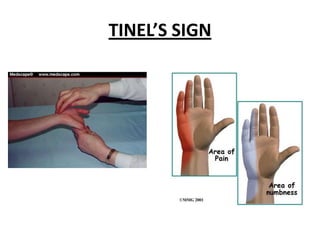
TINEL’S SIGN
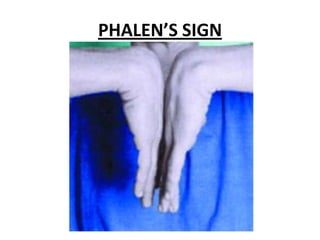
PHALEN’S SIGN
Ulnar nerve palsy
MULTIPLE MONONEUROPATHY
POLYNEUROPATHY
DIABETIC NEUROPATHY
Peripheral nerve disorders

Peripheral nerve disorders