Musculoskeletal Imaging –
The Basics
SANIL VARGHESE
Musculoskeletal Imaging
Technology

Advances in Imaging
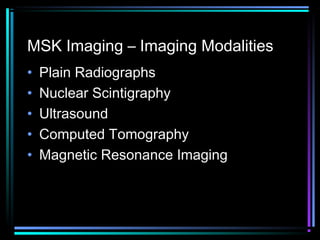
MSK Imaging – Imaging Modalities
•
•
•
•
•

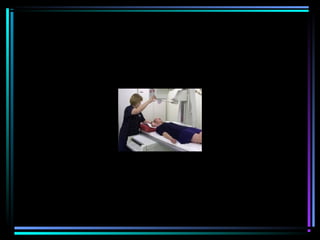
Plain Radiographs
Nuclear Scintigraphy
Ultrasound
Computed Tomography
Magnetic Resonance Imaging
Plain Radiographs
•
•
•
•
•

Widely available
Reproducible
Patient friendly
‘Inexpensive’
Usually the indicated primary imaging
modality
Plain Radiographs
• Standard protocols available
• Consider the pathology in question
– Image area of question, not the vicinity

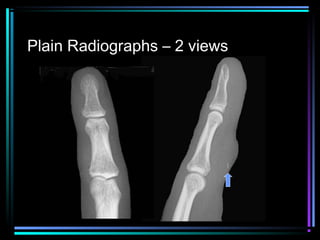
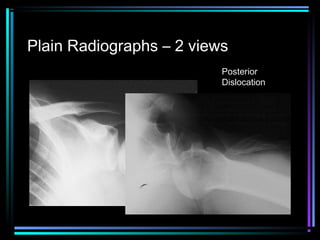
• “One view is No view”
• Supplemental views possible in most
locations
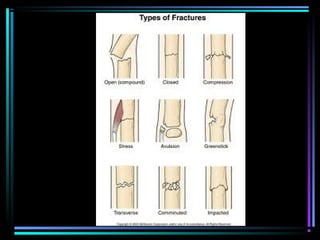
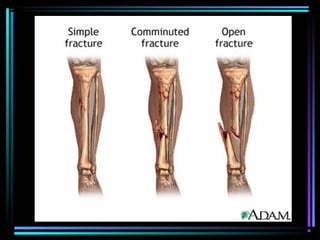
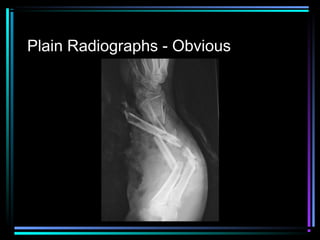
Plain Radiographs - Obvious
Plain Radiographs – 2 views
Posterior
Dislocation
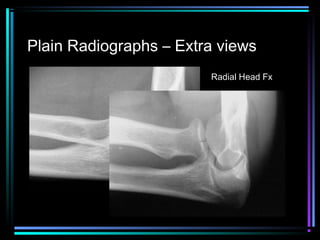
Plain Radiographs – Extra views
Radial Head Fx
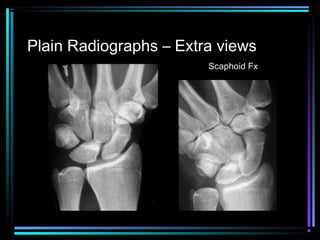
Plain Radiographs – Extra views
Scaphoid Fx
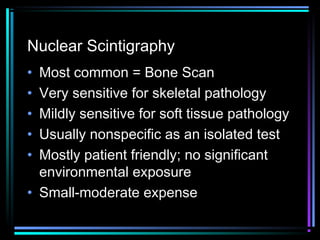
Nuclear Scintigraphy
•
•
•
•
•

Most common = Bone Scan
Very sensitive for skeletal pathology
Mildly sensitive for soft tissue pathology
Usually nonspecific as an isolated test
Mostly patient friendly; no significant
environmental exposure
• Small-moderate expense
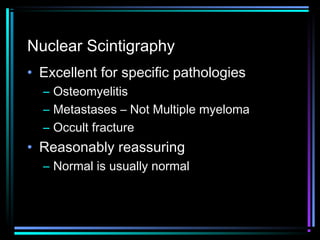
Nuclear Scintigraphy
• Excellent for specific pathologies
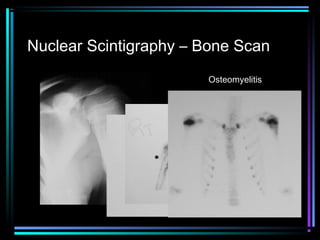
– Osteomyelitis
– Metastases – Not Multiple myeloma
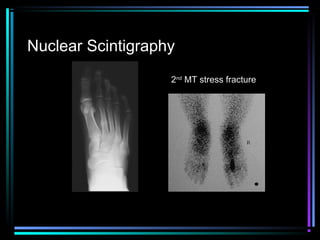
– Occult fracture

• Reasonably reassuring
– Normal is usually normal
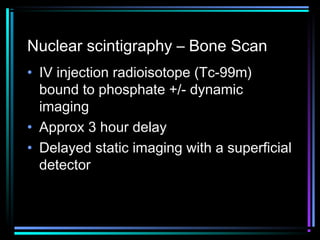
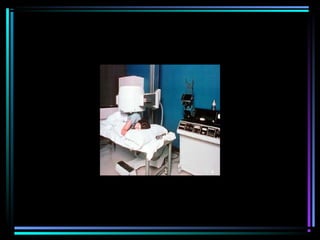
Nuclear scintigraphy – Bone Scan
• IV injection radioisotope (Tc-99m)
bound to phosphate +/- dynamic
imaging
• Approx 3 hour delay
• Delayed static imaging with a superficial
detector
Nuclear Scintigraphy – Bone Scan
Osteomyelitis
Nuclear Scintigraphy
2nd MT stress fracture
Ultrasound
• Not available at all institutions
• Reproducible in trained hands
• Excellent for superficial soft tissue
elements including tendons and muscle
• Patient friendly
• Small to moderate expense
Ultrasound
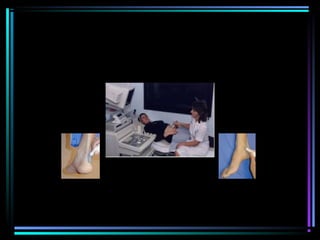
• Routine exam room equipped with
adequate imaging devices
• Superficial gel (standard or aseptic)
application with touch with transducer
• Usually static exam of architecture +/vascularity assessment
• Potential for dynamic imaging
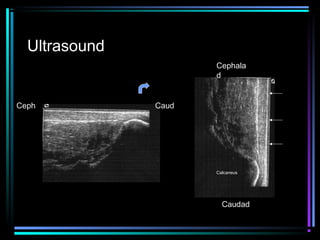
Ultrasound
Cephala
d
Ceph

Caud

Calcaneus

Caudad
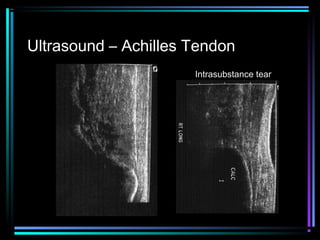
Ultrasound – Achilles Tendon
Intrasubstance tear
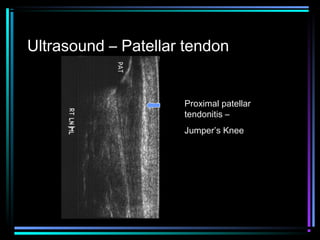
Ultrasound – Patellar tendon

Proximal patellar
tendonitis –
Jumper’s Knee
Computed Tomography (CT)
•
•
•
•

Widely available
Reproducible, although variety of techniques
Excellent bone assessment
Occasionally useful for soft tissue
assessment
• Patient friendly
• Moderate expense
• Interventional options
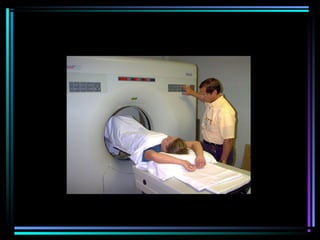
Computed Tomography
• Usually supine axial exam, with some
alternative positioning options
• Can develop reformatted images after
exam for alternative views
• Imaging time in seconds, rarely minutes
• Usually without IV or oral contrast
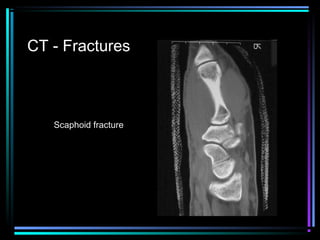
CT - Fractures

Scaphoid fracture
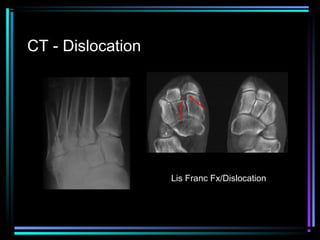
CT - Dislocation

Lis Franc Fx/Dislocation
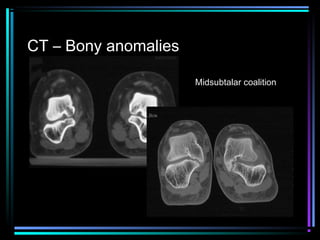
CT – Bony anomalies
Midsubtalar coalition
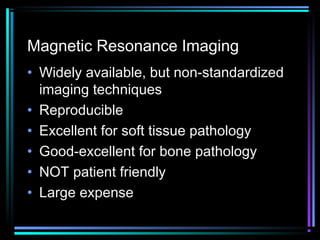
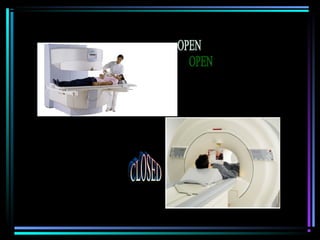
Magnetic Resonance Imaging
• Widely available, but non-standardized
imaging techniques
• Reproducible
• Excellent for soft tissue pathology
• Good-excellent for bone pathology
• NOT patient friendly
• Large expense
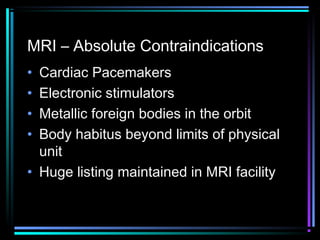
MRI – Absolute Contraindications
•
•
•
•

Cardiac Pacemakers
Electronic stimulators
Metallic foreign bodies in the orbit
Body habitus beyond limits of physical
unit
• Huge listing maintained in MRI facility
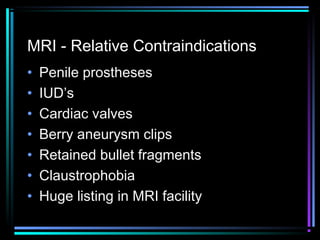
MRI - Relative Contraindications
•
•
•
•
•
•
•

Penile prostheses
IUD’s
Cardiac valves
Berry aneurysm clips
Retained bullet fragments
Claustrophobia
Huge listing in MRI facility
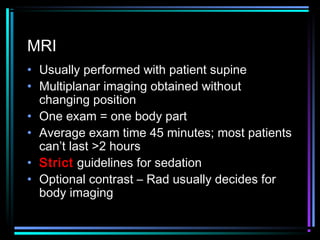
MRI
• Usually performed with patient supine
• Multiplanar imaging obtained without
changing position
• One exam = one body part
• Average exam time 45 minutes; most patients
can’t last >2 hours
• Strict guidelines for sedation
• Optional contrast – Rad usually decides for
body imaging
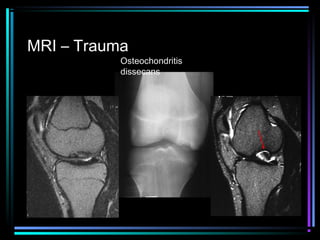
MRI – Trauma

Osteochondritis
dissecans
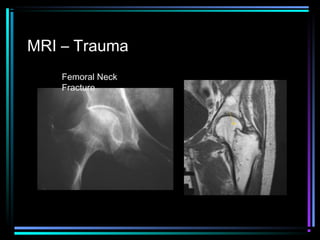
MRI – Trauma
Femoral Neck
Fracture
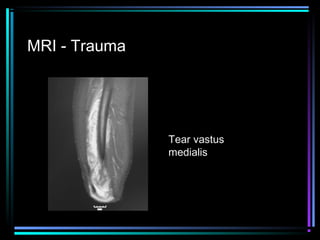
MRI - Trauma

Tear vastus
medialis
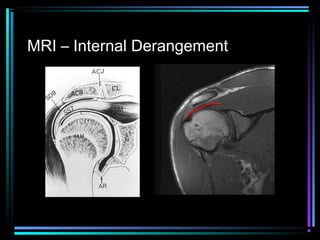
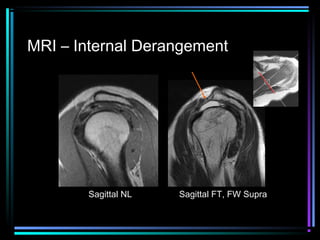
MRI – Internal Derangement
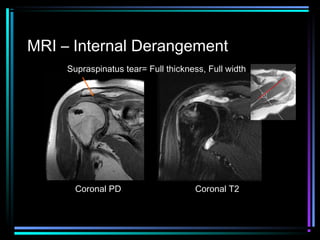
Supraspinatus tear= Full thickness, Full width

Coronal PD

Coronal T2
MRI – Internal Derangement

Sagittal NL

Sagittal FT, FW Supra
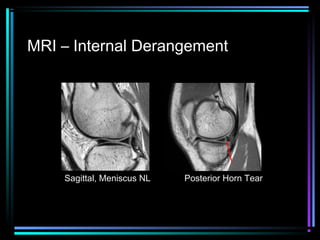
MRI – Internal Derangement

Sagittal, Meniscus NL

Posterior Horn Tear
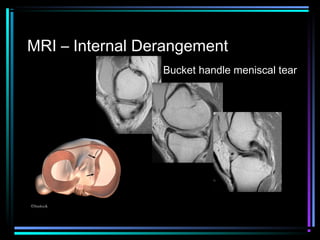
MRI – Internal Derangement
Bucket handle meniscal tear
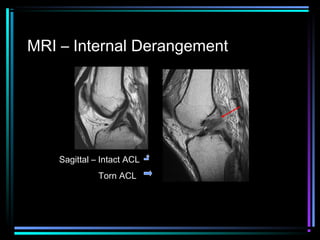
MRI – Internal Derangement

Sagittal – Intact ACL
Torn ACL
Imaging
• Plain radiographs are usually the starting
point
• Most x-ray protocols work for most situations;
Consider suppl. Views
• Secondary imaging techniques have specific
advantages and disadvantages
• A specific question is more likely to get you a
direct answer
• When in doubt, ask a Radiologist
THANK YOU

Sanil Varghese

Orthopedics radiography sanil