
SPECTACLES
Dr Saurabh Kushwaha
Resident (Ophthalmology)
SCOPE
 Introduction
 Eye glasses and Frame
 Unifocal, Bifocal and Trifocal
 Progressive lenses
 Hi Index lenses
 Photochromic lenses
 Polarazied lenses
 Polycarbonated lenses
 Anti refelective
SPECTACLE
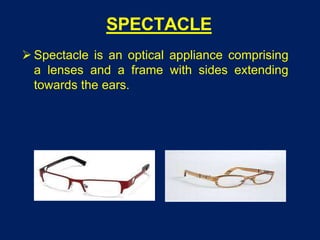
 Spectacle is an optical appliance comprising
a lenses and a frame with sides extending
towards the ears.
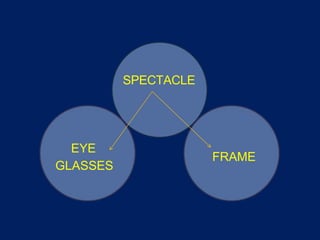
SPECTACLE
FRAME
EYE
GLASSES
EYE GLASSES
 These optical appliance comprising of lenses
and a frame having no side.
 Eye glasses were used in the past and have
replaced spectacle.
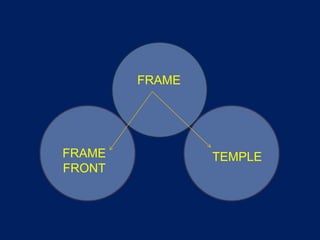
FRAME
 The portion of spectacle which holds the
lenses containing the ophthalmic prescription
in their proper position in front of the eyes.
 There are two part in a frame:
• Frame front
• Temples
FRAME
TEMPLE
FRAME
FRONT
SINGLE VISION OR UNIFOCAL
 This lens provides correction only for a given
distance. This means that the optical power is
the same at every point on the lens’s surface.
 Prescribed only for single vision:
• Myopia
• Hypermetropia
• Astigmatism
• Presbyopia
BIFOCAL LENSES
 Bifocal lenses combine vision correction for
near-sightedness and far-sightedness.
 The top of the lens is for distance vision and
the bottom half is for near vision.
 Usually prescribed for presbyopic patients
 There are several types of bifocal:
• Two pieces bifocal
• Fused bifocal
• One piece or solid bifocal
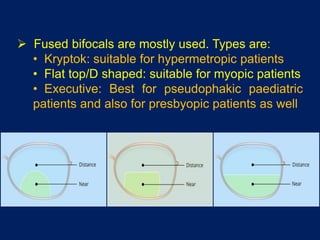
 Fused bifocals are mostly used. Types are:
• Kryptok: suitable for hypermetropic patients
• Flat top/D shaped: suitable for myopic patients
• Executive: Best for pseudophakic paediatric
patients and also for presbyopic patients as well
TRIFOCAL LENSES
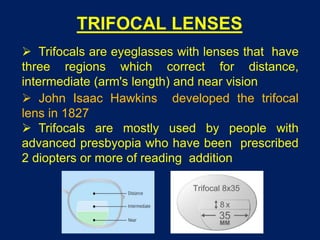
 Trifocals are eyeglasses with lenses that have
three regions which correct for distance,
intermediate (arm's length) and near vision
 John Isaac Hawkins developed the trifocal
lens in 1827
 Trifocals are mostly used by people with
advanced presbyopia who have been prescribed
2 diopters or more of reading addition
PROGRESSIVE LENSES
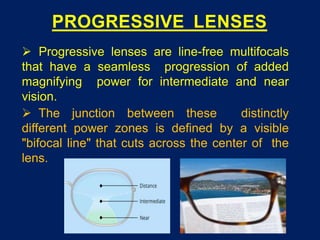
 Progressive lenses are line-free multifocals
that have a seamless progression of added
magnifying power for intermediate and near
vision.
 The junction between these distinctly
different power zones is defined by a visible
"bifocal line" that cuts across the center of the
lens.
HI-INDEX LENS
 Hi-index lens material reduces lens thickness,
making these lenses more comfortable and better
looking by minimizing the size of visible lens edges for
nearsighted wearers and reducing the magnified “bug
eye” appearance associated with farsighted wearers.
 Variety of hi-index 1.67 and 1.74 lenses that are
thinner and lighter than plastic. High Index 1.74 lenses
are the thinnest, flattest, and most cosmetically
appealing lens ever developed.
 These ultra thin lenses are nearly 50% thinner than
plastic and 5% thinner than 1.67 high index lenses,
offering you the ultimate in technology and cosmetics
HI-INDEX LENS
 Advantages of High-Index Lenses:
• Thinner: Because of their ability to bend light more
efficiently, high-index lenses for nearsightedness
have thinner edges than lenses with the same
prescription power that are made of conventional
plastic material.
• Lighter: Thinner edges require less lens material,
which reduces the overall weight of the lenses.
Lenses made of high-index plastic are lighter than
the same lenses made in conventional plastic, so
they're more comfortable to wear.
PHOTOCHROMIC LENSES
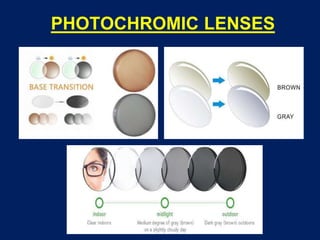
 Photochromic lenses are optical lenses that darken
on exposure to specific types of light of sufficient
intensity, most commonly ultraviolet (UV) radiation. In
the absence of activating light the lenses return to their
clear state. Photochromic lenses may be made of
glass, polycarbonate, or another plastic. They are
principally used in eyeglasses that are dark in bright
sunlight, but clear in low ambient light conditions. They
darken significantly within about a minute of exposure
to bright light, and take somewhat longer to clear. A
range of clear and dark transmittances are available.
 In one sort of technology, molecules of silver
chloride or another silver halide are embedded in
photochromatic lenses. They are transparent to
visible light without significant ultraviolet component,
which is normal for artificial lighting. In another sort
of technology, organic photochromic molecules, when
exposed to ultraviolet (UV) rays as in direct sunlight,
undergo a chemical process that causes them to
change shape and absorb a significant percentage
of the visible light, i.e., they darken. These processes
are reversible; once the lens is removed from strong
sources of UV rays the photochromic compounds
return to their transparent state.
PHOTOCHROMIC LENSES
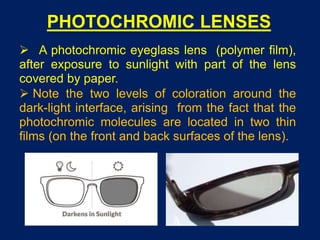
 A photochromic eyeglass lens (polymer film),
after exposure to sunlight with part of the lens
covered by paper.
 Note the two levels of coloration around the
dark-light interface, arising from the fact that the
photochromic molecules are located in two thin
films (on the front and back surfaces of the lens).
PHOTOCHROMIC LENSES
POLARIZED LENSES
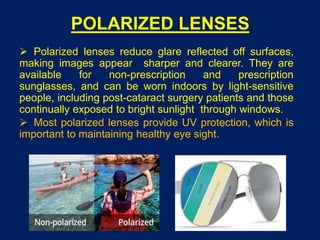
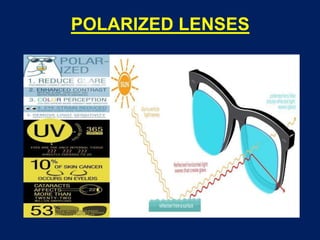
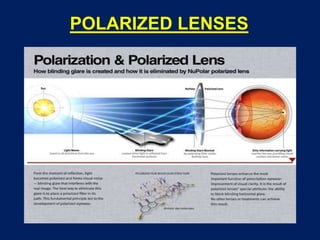
 Polarized lenses reduce glare reflected off surfaces,
making images appear sharper and clearer. They are
available for non-prescription and prescription
sunglasses, and can be worn indoors by light-sensitive
people, including post-cataract surgery patients and those
continually exposed to bright sunlight through windows.
 Most polarized lenses provide UV protection, which is
important to maintaining healthy eye sight.
POLARIZED LENSES
POLARIZED LENSES
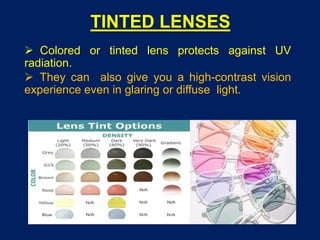
TINTED LENSES
 Colored or tinted lens protects against UV
radiation.
 They can also give you a high-contrast vision
experience even in glaring or diffuse light.
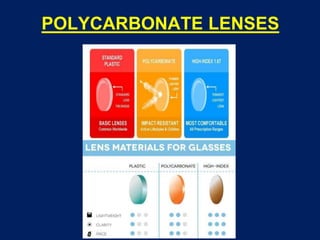
POLYCARBONATE LENSES
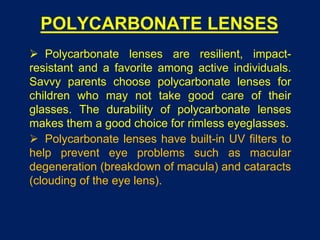
 Polycarbonate lenses are resilient, impact-
resistant and a favorite among active individuals.
Savvy parents choose polycarbonate lenses for
children who may not take good care of their
glasses. The durability of polycarbonate lenses
makes them a good choice for rimless eyeglasses.
 Polycarbonate lenses have built-in UV filters to
help prevent eye problems such as macular
degeneration (breakdown of macula) and cataracts
(clouding of the eye lens).
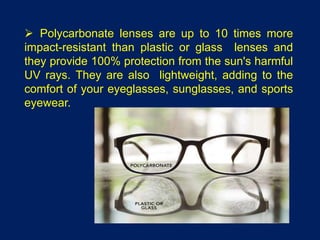
 Polycarbonate lenses are up to 10 times more
impact-resistant than plastic or glass lenses and
they provide 100% protection from the sun's harmful
UV rays. They are also lightweight, adding to the
comfort of your eyeglasses, sunglasses, and sports
eyewear.
POLYCARBONATE LENSES
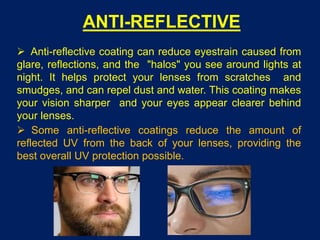
ANTI-REFLECTIVE
 Anti-reflective coating can reduce eyestrain caused from
glare, reflections, and the "halos" you see around lights at
night. It helps protect your lenses from scratches and
smudges, and can repel dust and water. This coating makes
your vision sharper and your eyes appear clearer behind
your lenses.
 Some anti-reflective coatings reduce the amount of
reflected UV from the back of your lenses, providing the
best overall UV protection possible.
THANK YOU

Spectacles

  • 1.
  • 2.
    SCOPE  Introduction  Eyeglasses and Frame  Unifocal, Bifocal and Trifocal  Progressive lenses  Hi Index lenses  Photochromic lenses  Polarazied lenses  Polycarbonated lenses  Anti refelective
  • 3.
    SPECTACLE  Spectacle isan optical appliance comprising a lenses and a frame with sides extending towards the ears.
  • 4.
  • 5.
    EYE GLASSES  Theseoptical appliance comprising of lenses and a frame having no side.  Eye glasses were used in the past and have replaced spectacle.
  • 6.
    FRAME  The portionof spectacle which holds the lenses containing the ophthalmic prescription in their proper position in front of the eyes.  There are two part in a frame: • Frame front • Temples
  • 7.
  • 8.
    SINGLE VISION ORUNIFOCAL  This lens provides correction only for a given distance. This means that the optical power is the same at every point on the lens’s surface.  Prescribed only for single vision: • Myopia • Hypermetropia • Astigmatism • Presbyopia
  • 9.
    BIFOCAL LENSES  Bifocallenses combine vision correction for near-sightedness and far-sightedness.  The top of the lens is for distance vision and the bottom half is for near vision.  Usually prescribed for presbyopic patients  There are several types of bifocal: • Two pieces bifocal • Fused bifocal • One piece or solid bifocal
  • 10.
     Fused bifocalsare mostly used. Types are: • Kryptok: suitable for hypermetropic patients • Flat top/D shaped: suitable for myopic patients • Executive: Best for pseudophakic paediatric patients and also for presbyopic patients as well
  • 11.
    TRIFOCAL LENSES  Trifocalsare eyeglasses with lenses that have three regions which correct for distance, intermediate (arm's length) and near vision  John Isaac Hawkins developed the trifocal lens in 1827  Trifocals are mostly used by people with advanced presbyopia who have been prescribed 2 diopters or more of reading addition
  • 12.
    PROGRESSIVE LENSES  Progressivelenses are line-free multifocals that have a seamless progression of added magnifying power for intermediate and near vision.  The junction between these distinctly different power zones is defined by a visible "bifocal line" that cuts across the center of the lens.
  • 13.
    HI-INDEX LENS  Hi-indexlens material reduces lens thickness, making these lenses more comfortable and better looking by minimizing the size of visible lens edges for nearsighted wearers and reducing the magnified “bug eye” appearance associated with farsighted wearers.  Variety of hi-index 1.67 and 1.74 lenses that are thinner and lighter than plastic. High Index 1.74 lenses are the thinnest, flattest, and most cosmetically appealing lens ever developed.  These ultra thin lenses are nearly 50% thinner than plastic and 5% thinner than 1.67 high index lenses, offering you the ultimate in technology and cosmetics
  • 14.
    HI-INDEX LENS  Advantagesof High-Index Lenses: • Thinner: Because of their ability to bend light more efficiently, high-index lenses for nearsightedness have thinner edges than lenses with the same prescription power that are made of conventional plastic material. • Lighter: Thinner edges require less lens material, which reduces the overall weight of the lenses. Lenses made of high-index plastic are lighter than the same lenses made in conventional plastic, so they're more comfortable to wear.
  • 15.
    PHOTOCHROMIC LENSES  Photochromiclenses are optical lenses that darken on exposure to specific types of light of sufficient intensity, most commonly ultraviolet (UV) radiation. In the absence of activating light the lenses return to their clear state. Photochromic lenses may be made of glass, polycarbonate, or another plastic. They are principally used in eyeglasses that are dark in bright sunlight, but clear in low ambient light conditions. They darken significantly within about a minute of exposure to bright light, and take somewhat longer to clear. A range of clear and dark transmittances are available.
  • 16.
     In onesort of technology, molecules of silver chloride or another silver halide are embedded in photochromatic lenses. They are transparent to visible light without significant ultraviolet component, which is normal for artificial lighting. In another sort of technology, organic photochromic molecules, when exposed to ultraviolet (UV) rays as in direct sunlight, undergo a chemical process that causes them to change shape and absorb a significant percentage of the visible light, i.e., they darken. These processes are reversible; once the lens is removed from strong sources of UV rays the photochromic compounds return to their transparent state.
  • 17.
    PHOTOCHROMIC LENSES  Aphotochromic eyeglass lens (polymer film), after exposure to sunlight with part of the lens covered by paper.  Note the two levels of coloration around the dark-light interface, arising from the fact that the photochromic molecules are located in two thin films (on the front and back surfaces of the lens).
  • 18.
  • 19.
    POLARIZED LENSES  Polarizedlenses reduce glare reflected off surfaces, making images appear sharper and clearer. They are available for non-prescription and prescription sunglasses, and can be worn indoors by light-sensitive people, including post-cataract surgery patients and those continually exposed to bright sunlight through windows.  Most polarized lenses provide UV protection, which is important to maintaining healthy eye sight.
  • 20.
  • 21.
  • 22.
    TINTED LENSES  Coloredor tinted lens protects against UV radiation.  They can also give you a high-contrast vision experience even in glaring or diffuse light.
  • 23.
    POLYCARBONATE LENSES  Polycarbonatelenses are resilient, impact- resistant and a favorite among active individuals. Savvy parents choose polycarbonate lenses for children who may not take good care of their glasses. The durability of polycarbonate lenses makes them a good choice for rimless eyeglasses.  Polycarbonate lenses have built-in UV filters to help prevent eye problems such as macular degeneration (breakdown of macula) and cataracts (clouding of the eye lens).
  • 24.
     Polycarbonate lensesare up to 10 times more impact-resistant than plastic or glass lenses and they provide 100% protection from the sun's harmful UV rays. They are also lightweight, adding to the comfort of your eyeglasses, sunglasses, and sports eyewear.
  • 25.
  • 26.
    ANTI-REFLECTIVE  Anti-reflective coatingcan reduce eyestrain caused from glare, reflections, and the "halos" you see around lights at night. It helps protect your lenses from scratches and smudges, and can repel dust and water. This coating makes your vision sharper and your eyes appear clearer behind your lenses.  Some anti-reflective coatings reduce the amount of reflected UV from the back of your lenses, providing the best overall UV protection possible.
  • 27.