Absorptive lenses
-BY OPTOM PRATIKSHA R. PATIL
M. OPTOM 1ST YEAR
1
contents
1. Phenomenon of Absorption
2. Need for Absorptive lenses
3. Electromagnetic Spectrum
4. Radiation effects
5. Concentration of Radiant energy by the eye
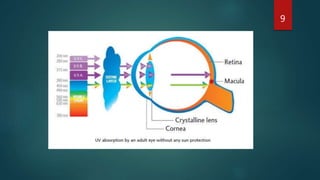
6. Absorption of Radiation by the Ocular tissues
7. Effects of UV
8. Effects of IR
9. Required amounts of Absorption
2
Cont.….
10. Absorptive lenses
11. Types of Absorptive lenses
12. Glare Control Lenses
13. Sunglasses
14. Specialty Absorptive lenses
15. Lens Coatings
3
Phenomenon of Absorption
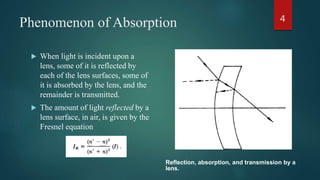
 When light is incident upon a
lens, some of it is reflected by
each of the lens surfaces, some of
it is absorbed by the lens, and the
remainder is transmitted.
 The amount of light reflected by a
lens surface, in air, is given by the
Fresnel equation
4
Reflection, absorption, and transmission by a
lens.
Cont.……
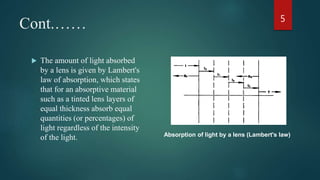
 The amount of light absorbed
by a lens is given by Lambert's
law of absorption, which states
that for an absorptive material
such as a tinted lens layers of
equal thickness absorb equal
quantities (or percentages) of
light regardless of the intensity
of the light.
5
Absorption of light by a lens (Lambert's law)
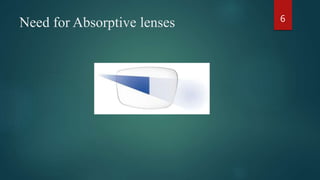
Need for Absorptive lenses 6
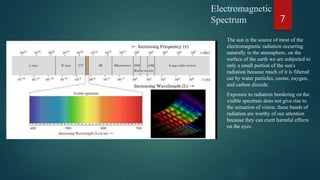
Electromagnetic
Spectrum
The sun is the source of most of the
electromagnetic radiation occurring
naturally in the atmosphere, on the
surface of the earth we are subjected to
only a small portion of the sun's
radiation because much of it is filtered
out by water particles, ozone, oxygen,
and carbon dioxide.
Exposure to radiation bordering on the
visible spectrum does not give rise to
the sensation of vision, these bands of
radiation are worthy of our attention
because they can exert harmful effects
on the eyes.
7
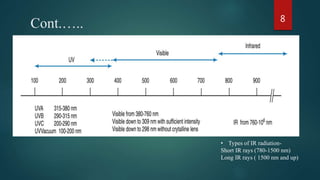
Cont.….. 8
• Types of IR radiation-
Short IR rays (780-1500 nm)
Long IR rays ( 1500 nm and up)
9
Radiation effects
 Draper’s law states that for radiation to have an effect on a
substance through which it travels, it must be absorbed by the
substance.
 Radiation has no effect (beneficial or deleterious) on a substance
through which is completely transmitted or by which it is
completely reflected.
 Radiation in the region of the visible spectrum causes the
sensation of vision because it is absorbed by the photopigments of
the retina.
 Ionizing radiation
 Non-ionizing radiation
10
Cont.….
IONIZING RADIATION
 Most ionizing radiation pass through the eye, but small amount is absorbed.
 The damage depends on the exposure time, concentration, and the type of
radiation.
 Ionizing radiation may have direct or indirect effect on ocular tissue.
 A direct effect may produce cellular anomalies or death.
 Indirect effect can result in damage to the blood vessels and thus restrict the
blood supply to the tissue.
11
Cont.….
NON-IONIZING RADIATION
 When radiation is absorbed by an ocular tissue, various effects are produced
by the transfer of radiant energy to the molecules and atoms of the absorbing
tissue.
 The absorbed energy can affect the visual apparatus in the following ways:
 The thermal effect
 The photochemical effect
 Photoluminescence (fluorescence)
12
Cont.….
 The thermal effect
 Heating effect
 Solar retinopathy, cause by looking directly at a solar eclipse.
 The photochemical effect
 In the visible spectrum, produces a chemical reaction in the retina
initiating the sensation of vision.
 Harmful photochemical effects can occur with other ocular tissues, such as
photokeratitis produced by excessive absorption of UV radiation by the
cornea.
 Photoluminescence (fluorescence)
 The lens is capable of visible flurescence when illuminated by UV light.
13
Concentration of radiant energy by the eye
 As radiant energy passes through the eye, it is attenuated in a number of ways:
 Absorption by the ocular media
 Scattering within the eye
 Reflection by the various optical interfaces
 Loss caused by the aberrations of the eye’s optical system
14
Cont.….
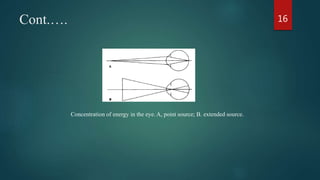
 Concentration of radiant energy is depends upon
1. size of source
2. intensity of source
3. pupil size
 For a point source of high intensity, refraction by the eye’s optical system
concentrates the energy of the retina (A) and cause tissue damage, but has little
effect on the cornea and the lens.
 Solar retinopathy: occur after exposure to a solar eclipse.
 A small source of low-intensity radiation is usually harmless to the retina, an
extended source of the same intensity may provide a dangerous concentration of
radiant energy in the lens. (B)
15
Cont.…. 16
Concentration of energy in the eye. A, point source; B. extended source.
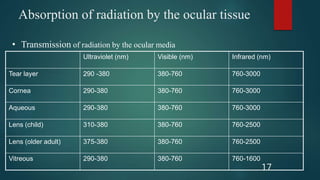
Absorption of radiation by the ocular tissue
Ultraviolet (nm) Visible (nm) Infrared (nm)
Tear layer 290 -380 380-760 760-3000
Cornea 290-380 380-760 760-3000
Aqueous 290-380 380-760 760-3000
Lens (child) 310-380 380-760 760-2500
Lens (older adult) 375-380 380-760 760-2500
Vitreous 290-380 380-760 760-1600
17
• Transmission of radiation by the ocular media
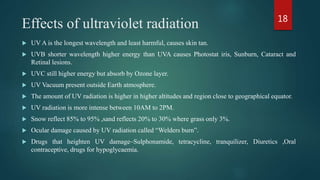
Effects of ultraviolet radiation
 UV A is the longest wavelength and least harmful, causes skin tan.
 UVB shorter wavelength higher energy than UVA causes Photostat iris, Sunburn, Cataract and
Retinal lesions.
 UVC still higher energy but absorb by Ozone layer.
 UV Vacuum present outside Earth atmosphere.
 The amount of UV radiation is higher in higher altitudes and region close to geographical equator.
 UV radiation is more intense between 10AM to 2PM.
 Snow reflect 85% to 95% ,sand reflects 20% to 30% where grass only 3%.
 Ocular damage caused by UV radiation called “Welders burn”.
 Drugs that heighten UV damage–Sulphonamide, tetracycline, tranquilizer, Diuretics ,Oral
contraceptive, drugs for hypoglycaemia.
18
cont…..
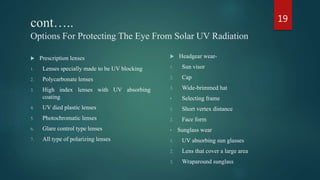
Options For Protecting The Eye From Solar UV Radiation
 Prescription lenses
1. Lenses specially made to be UV blocking
2. Polycarbonate lenses
3. High index lenses with UV absorbing
coating
4. UV died plastic lenses
5. Photochromatic lenses
6. Glare control type lenses
7. All type of polarizing lenses
 Headgear wear-
1. Sun visor
2. Cap
3. Wide-brimmed hat
• Selecting frame
1. Short vertex distance
2. Face form
• Sunglass wear
1. UV absorbing sun glasses
2. Lens that cover a large area
3. Wraparound sunglass
19
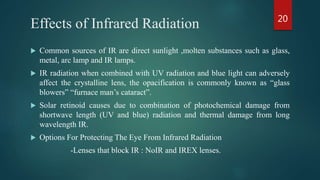
Effects of Infrared Radiation
 Common sources of IR are direct sunlight ,molten substances such as glass,
metal, arc lamp and IR lamps.
 IR radiation when combined with UV radiation and blue light can adversely
affect the crystalline lens, the opacification is commonly known as “glass
blowers” “furnace man’s cataract”.
 Solar retinoid causes due to combination of photochemical damage from
shortwave length (UV and blue) radiation and thermal damage from long
wavelength IR.
 Options For Protecting The Eye From Infrared Radiation
-Lenses that block IR : NoIR and IREX lenses.
20
Required amounts of absorption :
How Much Tint Is Enough?
 Normal transmission of sun glass is generally between 15%-30% (<15%
causes reflected glare from the back surface.)
 Sunglass used for driving shouldn’t darker than 8% (according to ANSI Z80.3
sunglass standard).
 Special purpose such as skiing , mountain climbing or beach transmission
may go as much as 3%.
 In daily exposure to sunlight for prolong period of time 15% or less
transmission of lenses required so that loss of dark adaptation can be
prevented.
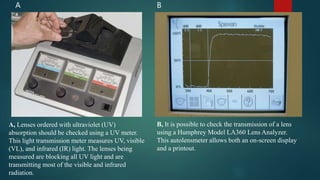
 Lens transmission checked with transmission meter and also using Humphrey
automated lensmeter.
21
22
A B
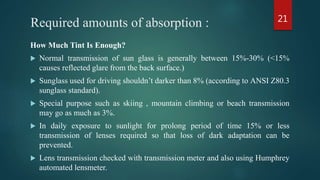
A, Lenses ordered with ultraviolet (UV)
absorption should be checked using a UV meter.
This light transmission meter measures UV, visible
(VL), and infrared (IR) light. The lenses being
measured are blocking all UV light and are
transmitting most of the visible and infrared
radiation.
B, It is possible to check the transmission of a lens
using a Humphrey Model LA360 Lens Analyzer.
This autolensmeter allows both an on-screen display
and a printout.
cont.…..The Hazards of Too Much Tint
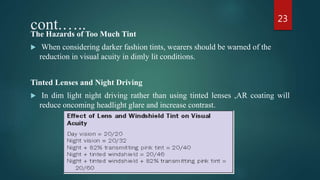
 When considering darker fashion tints, wearers should be warned of the
reduction in visual acuity in dimly lit conditions.
Tinted Lenses and Night Driving
 In dim light night driving rather than using tinted lenses ,AR coating will
reduce oncoming headlight glare and increase contrast.
23
ABSORPTIVE LENSES
 An absorptive lens is one which is used for the specific purpose of
reducing the amount of transmitted light or radiant energy, thus
acting as a filter.
 Absorptive lenses are sometimes referred to as tinted, or colored,
lenses, since they are not usually clear and colorless
 The absorption may be uniform (or neutral), absorbing visible light
of all wavelengths, or selective, absorbing some wavelengths more
than others.
24
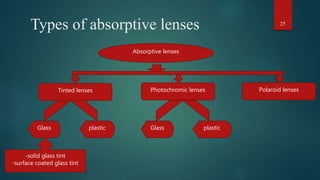
Types of absorptive lenses 25
Absorptive lenses
Tinted lenses Polaroid lensesPhotochromic lenses
Glass plastic Glass plastic
-solid glass tint
-surface coated glass tint
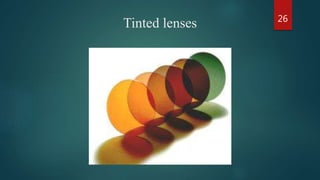
Tinted lenses 26
TYPES OF TINT
 COSMETIC TINTS- Cosmetic tints are those colors that are used for
enhancing the appearance of the eyewear.
 OCUPATIONAL TINTS-Occupational tints are those colors that are required
for a specific job task performed by the patient.
 RECREATIONAL TINTS -Recreational tints include colors such as true gray,
brown and green as well as colors that are formulated to absorb specific
wavelengths of light under specific conditions.
 THERAPEUTIC -Therapeutic tints are prescribed by some practitioners to
patients with glaucoma, diabetes, macular degeneration and retinitis
pigmentosa. As they are more sensitive to certain portions of the visible light
spectrum.
27
Methods of Manufacturing Absorptive
Lenses
1. GLASS TINT
a. Tinted Solid Glass Lenses( Integral Tint)
 This tint is achieved by adding the oxides in the basic batch at the start.
 The spectral transmission characteristics of the finished lens are controlled
by these metallic oxides.
 The concentration of the metals is less than 1% even for dense tint.
28
cont.…..
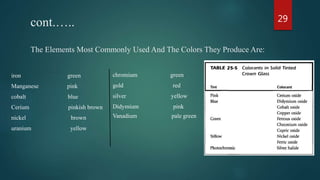
The Elements Most Commonly Used And The Colors They Produce Are:
iron green
Manganese pink
cobalt blue
Cerium pinkish brown
nickel brown
uranium yellow
chromium green
gold red
silver yellow
Didymium pink
Vanadium pale green
29
cont.…..
 ADVANTAGES
 Large number of blanks can be made.
 No surface reflections
 No special equipment needed.
 Not affected by surface qualities e.g. polishing or surfacing.
 Color wont fade.
 DISADVANTAGES
 Color varies with thickness of the lens from center to periphery.
 Permanent.so cant remove or change like surface tints.
30
cont.…..
b. Glass Lenses with Surface Coatings
 Lens is tinted by depositing a thin metallic oxide on the surface of the
lens.
 It is deposited by an evaporation process conducted under high vacuum at
high temperature.(200-300 c)
 The density depends on the thickness of the metallic coat applied.
 Usually on the back surface of the lens.
 Because the RI of the metallic oxide is higher than the under lying glass,
the amount of reflections increases.
 Hence an ARC has to be applied over the coat(magnesium fluoride).
31
cont.…..
 ADVANTAGES
 Uniform tint, which is independent of the power and thickness.
 Coating has high resistance to wear and to chemical interaction.
 Can be applied on a solid tint if the tint appears to be light than the
requirement.
 DISADVANTAGES
 If no arc, more surface reflections.
 Chances of peeling off.
 High temperature and vacuum needed.
 Cant be done on plastic lenses.
32
cont.…..
2. PLASTIC TINT (DYEING)
 This is done by dipping the lenses into a solution containing the
appropriate organic dye.
 The color depends on:
Duration of lens kept in the dye.
Concentration of the dye.
Type of dye.
Material of the lens.
33
cont.…..
 ADVANTAGES
 Plastic lenses can be tinted.
 Tint can be changed.(decolorize with bleach and re-dye).
 Independent of power and thickness.
 Can be graduated and double graduated.
 DISADVANTAGES
Unpredictable.
 High-index plastic lenses dye more slowly than CR-39 lenses and may require
special processing
 Cant be combined with any other coating e.g. ARC.
Dyes fade with time.
 Note it is very important to clean and pre-heat the lens before dyeing.
34
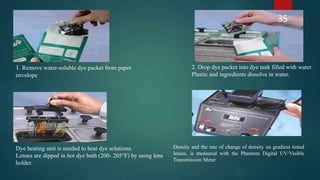
1. Remove water-soluble dye packet from paper
envelope
2. Drop dye packet into dye tank filled with water.
Plastic and ingredients dissolve in water.
Dye heating unit is needed to heat dye solutions.
Lenses are dipped in hot dye bath (200- 205°F) by using lens
holder.
Density and the rate of change of density on gradient tinted
lenses, is measured with the Phantom Digital UV/Visible
Transmission Meter
35
36
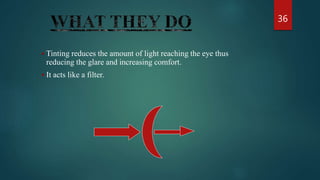
 Tinting reduces the amount of light reaching the eye thus
reducing the glare and increasing comfort.
 It acts like a filter.
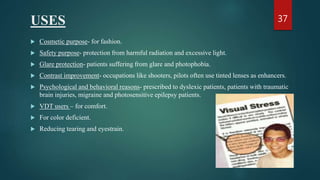
USES
 Cosmetic purpose- for fashion.
 Safety purpose- protection from harmful radiation and excessive light.
 Glare protection- patients suffering from glare and photophobia.
 Contrast improvement- occupations like shooters, pilots often use tinted lenses as enhancers.
 Psychological and behavioral reasons- prescribed to dyslexic patients, patients with traumatic
brain injuries, migraine and photosensitive epilepsy patients.
 VDT users – for comfort.
 For color deficient.
 Reducing tearing and eyestrain.
37
Colored Filter Lenses for Color Defectives
Factors Favoring the Use of Colored Filter Lenses for Color Defectives
 colored filters will allow a color-defective individual to use intensity cues to
discriminate between two otherwise indistinguishable colors
 Some spectacle lens color filters are placed in only one sector of a spectacle
lens so that a comparison of how the object appears can be made by moving
the head
Negative Effects of Using Colored Filter Lenses for Color Defectives
 One problem is that objects may appear to glisten.
 A second problem is that when there is a difference in intensity between the
two eyes, moving objects may appear to be wrongly located as to how far
away they appear.
38
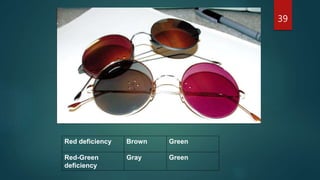
Red deficiency Brown Green
Red-Green
deficiency
Gray Green
39
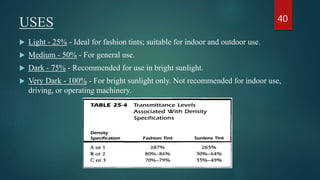
USES
 Light - 25% - Ideal for fashion tints; suitable for indoor and outdoor use.
 Medium - 50% - For general use.
 Dark - 75% - Recommended for use in bright sunlight.
 Very Dark - 100% - For bright sunlight only. Not recommended for indoor use,
driving, or operating machinery.
40
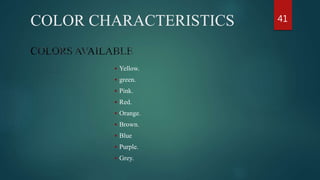
COLOR CHARACTERISTICS 41
 Yellow.
 green.
 Pink.
 Red.
 Orange.
 Brown.
 Blue
 Purple.
 Grey.
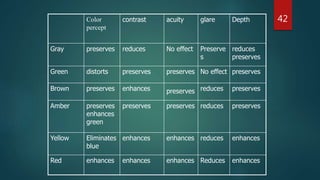
Color
percept
contrast acuity glare Depth
Gray preserves reduces No effect Preserve
s
reduces
preserves
Green distorts preserves preserves No effect preserves
Brown preserves enhances preserves reduces preserves
Amber preserves
enhances
green
preserves preserves reduces preserves
Yellow Eliminates
blue
enhances enhances reduces enhances
Red enhances enhances enhances Reduces enhances
42
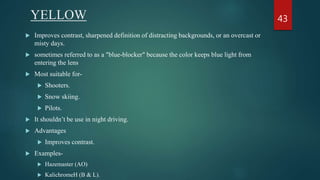
YELLOW
 Improves contrast, sharpened definition of distracting backgrounds, or an overcast or
misty days.
 sometimes referred to as a "blue-blocker" because the color keeps blue light from
entering the lens
 Most suitable for-
 Shooters.
 Snow skiing.
 Pilots.
 It shouldn’t be use in night driving.
 Advantages
 Improves contrast.
 Examples-
 Hazemaster (AO)
 KalichromeH (B & L).
43
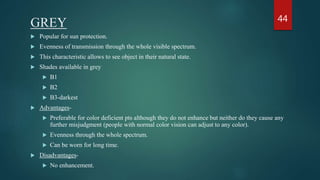
GREY
 Popular for sun protection.
 Evenness of transmission through the whole visible spectrum.
 This characteristic allows to see object in their natural state.
 Shades available in grey
 B1
 B2
 B3-darkest
 Advantages-
 Preferable for color deficient pts although they do not enhance but neither do they cause any
further misjudgment (people with normal color vision can adjust to any color).
 Evenness through the whole spectrum.
 Can be worn for long time.
 Disadvantages-
 No enhancement.
44
GREEN
 Green sun lenses have a transmission curve that closely approximates the color
sensitivity curve for the human eye.
 The most green lenses transmits the brilliant greens and yellows.
 Absorbs both IR and UV regions.
 The green tinted glass lens obtain it’s colour and characteristics transmission from
ferrous oxide .
 The plastic lens dyed green exhibit poor absorption in IR region than glass.
BROWN
 Brown lenses generally offer better contrast than green or grey.
 Have same characteristics as yellow lenses higher absorption of shorter visible
wavelength.
 Absorbs relatively more blue light which normally scattered by the atmosphere to
produce haze, better in hazy conditions.
45
PINK
 Have uniform transmission across the visible spectrum.
 Occasionally used for unfavourable indoor lighting situation.
 Reduce some amount of glare and reflection but better to use ARC and glare
control lenses.
 Indoor tint shouldn’t be less than 80% to worn in low light conditions.
46
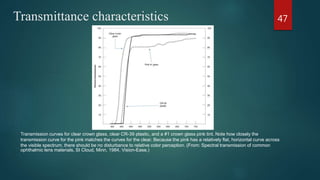
Transmittance characteristics 47
Transmission curves for clear crown glass, clear CR-39 plastic, and a #1 crown glass pink tint. Note how closely the
transmission curve for the pink matches the curves for the clear. Because the pink has a relatively flat, horizontal curve across
the visible spectrum, there should be no disturbance to relative color perception. (From: Spectral transmission of common
ophthalmic lens materials, St Cloud, Minn, 1984, Vision-Ease.)
48
Transmission curves for yellow and brown tints. Yellow has a characteristic sudden drop in transmission between 500 and 450 nm. Brown also
shows a drop, but that drop is spread over a larger part of the visible spectrum. Note how dyed plastic and polycarbonate lenses transmit the long
end of the spectrum, including the infrared. It is possible to use lens dyes that absorb in the infrared region of the spectrum, if desired. (Yellow
crown glass and tan #3 [brown] glass transmission curves are redrawn from: Spectral transmission of common ophthalmic lens materials, St Cloud,
Minn, 1984, Vision-Ease, pp 9, 10. Brown #3 CR-39 and polycarbonate transmission curves from Pitts DG and Kleinstein RN: Environmental
vision, Boston, 1993, Butterworth-Heinemann.)
49
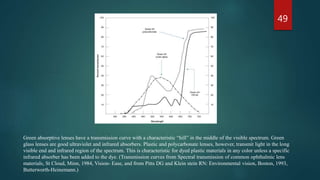
Green absorptive lenses have a transmission curve with a characteristic “hill” in the middle of the visible spectrum. Green
glass lenses are good ultraviolet and infrared absorbers. Plastic and polycarbonate lenses, however, transmit light in the long
visible end and infrared region of the spectrum. This is characteristic for dyed plastic materials in any color unless a specific
infrared absorber has been added to the dye. (Transmission curves from Spectral transmission of common ophthalmic lens
materials, St Cloud, Minn, 1984, Vision- Ease, and from Pitts DG and Klein stein RN: Environmental vision, Boston, 1993,
Butterworth-Heinemann.)
50
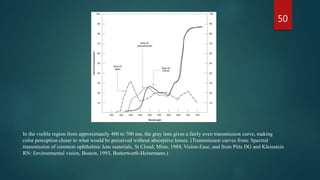
In the visible region from approximately 400 to 700 nm, the gray lens gives a fairly even transmission curve, making
color perception closer to what would be perceived without absorptive lenses. (Transmission curves from: Spectral
transmission of common ophthalmic lens materials, St Cloud, Minn, 1984, Vision-Ease, and from Pitts DG and Kleinstein
RN: Environmental vision, Boston, 1993, Butterworth-Heinemann.)
Categories of Absorptive Lenses and Specification of
Transmission
1. General-Wear Lenses Absorbing the Spectrum Evenly
2. Lenses That Selectively Absorb Ultraviolet Radiation While Transmitting the Visible
Spectrum in a Uniform Manner
3. Lenses That Selectively Absorb Both Ultraviolet and Infrared Radiation While Absorbing a
Substantial Amount of Visible Radiation in a Relatively Uniform Manner
4. Lenses That Selectively Absorb Portions of the Visible Spectrum
5. Absorptive Lenses Designed for Occupational Use
6. Miscellaneous Absorptive Lenses
7. Cosmetic Lenses
8. Photochromic Lenses
51
General-Wear Lenses Absorbing the Spectrum Evenly
 Lenses in this category are very lightly tinted, and absorb little or no more ultraviolet, visible, or
infrared radiation than clear ophthalmic glass
 known as "indoor" tints or as "cosmetic" tints
 Transmission across the spectrum is fairly uniform for these lenses
 color values of objects are changed very little
 Patients who frequently ask for light tints for general wear include the following:
 lightly pigmented individuals, including albinos;
 patients with high refractive errors, especially aphakics and myopes;
 patients who work under poorly designed artificial illumination conditions;
 patients who are not in good general health;
 patients who have neurasthenic or neurotic tendencies.
 Examples-
 American Optical Cruxite lens,
 Univis Mellolitethe Titmus Velvetlité,
 Vision-Ease Lablens
52
Lenses That Selectively Absorb Uv Radiation While Transmitting
the Visible Spectrum in a Uniform Manner
 Ocular protection from UV radiation can be provided by means of either absorptive or reflective filters
 CR-39 plastic lenses containing ultraviolet absorbers
 Optical Radiation UV-400
 Vision-Ease UV-Lite
 UVS lens by Silor Optical
 Varilux 2 UVX-Light lens by Multi-Optics
 Recreation Innovations NoIR lenses (#101,#102, #111, and #112)
 Glass lenses which transmit less than 5% of ultraviolet radiation
 American Optical Hazemaster
 Vision-Ease Striking Yellow
 Bausch and Lomb Kalichrome
 Spectra-Shield Human II
 Photochromic lenses from Corning Glas
53
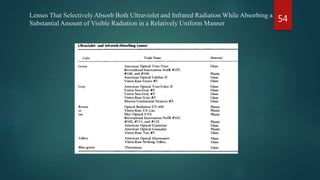
Lenses That Selectively Absorb Both Ultraviolet and Infrared Radiation While Absorbing a
Substantial Amount of Visible Radiation in a Relatively Uniform Manner
54
Lenses That Selectively Absorb Portions of the Visible
Spectrum
 Include both yellow and bluish-green lenses
 The yellow lenses
 American Optical Hazemaster ,
 Vision-Ease Striking Yellow ,
 Bausch and Lomb Kalichrome.
 The bluish-green lenses
 Therminon Corp. Therminon
 Titmus Optical Infra-Bar
 These lenses are claimed to be cool lenses
 Patients whose eyes are constantly exposed to highly reflective white surfaces, and for
cooks and others who must work in environments in which there is an excessive amount
of infrared radiation.
55
Absorptive Lenses Designed for Occupational Use
 Specially designed absorptive lenses are available for a number of occupations including
blast furnace operation, glass blowing, and welding.
 Must almost completely absorb both the ultraviolet and infrared radiation from harmful
sources.
 Welding lenses are available in two general categories:
 Class I welding lenses are general-purpose lenses,
 Class II welding lenses are used in operations producing high radiant flux at the
wavelengths of the sodium lines (589.3 nm)(contain didymium)
 Trade names for welding lenses
 Arc-Ban, Cescoweld ,
 Filterweld ,Willson-Weld.
56
Miscellaneous Absorptive Lenses
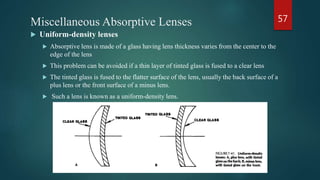
 Uniform-density lenses
 Absorptive lens is made of a glass having lens thickness varies from the center to the
edge of the lens
 This problem can be avoided if a thin layer of tinted glass is fused to a clear lens
 The tinted glass is fused to the flatter surface of the lens, usually the back surface of a
plus lens or the front surface of a minus lens.
 Such a lens is known as a uniform-density lens.
57
cont.…..
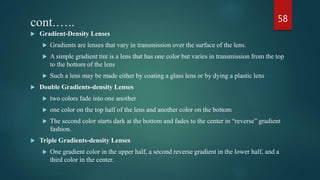
 Gradient-Density Lenses
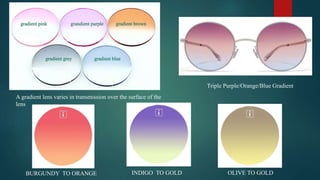
 Gradients are lenses that vary in transmission over the surface of the lens.
 A simple gradient tint is a lens that has one color but varies in transmission from the top
to the bottom of the lens
 Such a lens may be made either by coating a glass lens or by dying a plastic lens
 Double Gradients-density Lenses
 two colors fade into one another
 one color on the top half of the lens and another color on the bottom
 The second color starts dark at the bottom and fades to the center in “reverse” gradient
fashion.
 Triple Gradients-density Lenses
 One gradient color in the upper half, a second reverse gradient in the lower half, and a
third color in the center.
58
59
A gradient lens varies in transmission over the surface of the
lens
Triple Purple/Orange/Blue Gradient
BURGUNDY TO ORANGE INDIGO TO GOLD OLIVE TO GOLD
Cosmetic Lenses
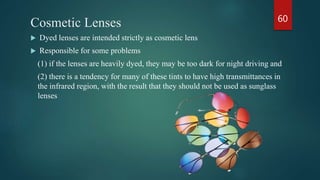
 Dyed lenses are intended strictly as cosmetic lens
 Responsible for some problems
(1) if the lenses are heavily dyed, they may be too dark for night driving and
(2) there is a tendency for many of these tints to have high transmittances in
the infrared region, with the result that they should not be used as sunglass
lenses
60
CLEANING
 Clean dust and lint from the lens with a soft cloth preferably micro
fiber cloth. Don’t use denim or wool.
 To remove smudges, oils, and/or finger prints use lens cleaner or
wash lens with mild soap and water. Dry with soft cloth.
 To prevent scratches don’t place lens upside down and don’t use
finger nails.
61
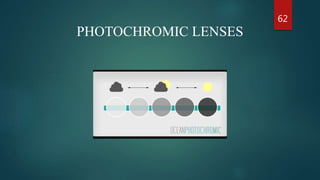
PHOTOCHROMIC LENSES
62
cont.…..
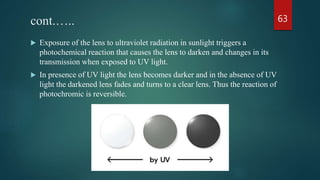
 Exposure of the lens to ultraviolet radiation in sunlight triggers a
photochemical reaction that causes the lens to darken and changes in its
transmission when exposed to UV light.
 In presence of UV light the lens becomes darker and in the absence of UV
light the darkened lens fades and turns to a clear lens. Thus the reaction of
photochromic is reversible.
63
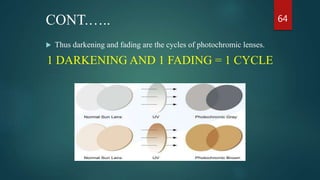
 Thus darkening and fading are the cycles of photochromic lenses.
1 DARKENING AND 1 FADING = 1 CYCLE
CONT.….. 64
HISTORY OF PHOTOCHROMICS
 A major breakthrough in the area of absorptive lenses took place in
1964 with the invention of corning’s photogray photochromic lens.
65
TYPES OF PHOTOCHROMIC LENSES
1) Mineral (glass) photochromic lenses
2) organic (Plastic) photochromic lenses
66
CONT.…..
MINERAL PHOTOCHROMIC LENSES
 Crown glass ( RI=1.523)
 Mineral (glass) photochromic lenses contain the silver halide crystals.
 The photochromic properties of these lenses is a function of the minute silver
halide crystals.
 MANUFACTURING
 The chemical composition determines the spectral sensitivity, hue, range and
speed of shade variation of the glass.
 Mineral (glass) photochromic lenses are made by introducing crystals of silver
halide of approximately 5mm diameter into the melt of borosilicate or
aluminum phosphate glass.
 Copper oxide is added to enhance the darkening process.
67
CONT.…..
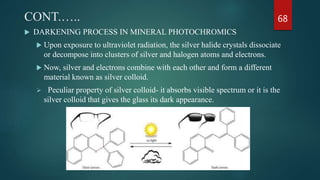
 DARKENING PROCESS IN MINERAL PHOTOCHROMICS
 Upon exposure to ultraviolet radiation, the silver halide crystals dissociate
or decompose into clusters of silver and halogen atoms and electrons.
 Now, silver and electrons combine with each other and form a different
material known as silver colloid.
 Peculiar property of silver colloid- it absorbs visible spectrum or it is the
silver colloid that gives the glass its dark appearance.
68
CONT.…..
 Then, the rigid matrix of the glass holds the silver and halogen in close
proximity and upon removal of the activating ultraviolet radiation the silver
and halogen atoms recombine into silver halide crystals with the result that
the lens becomes lighter.
 The photodissociation of the silver halide crystals occurs best under
conditions of high UV irradiance and low temperatures, which retard the
recombination of silver halides.
69
ORGANIC PHOTOCHROMIC LENSES
 Organic photochromic are available in a variety of brands and colors.
 Instead of using an organic material, such as the silver halide crystals used for glass
lenses, plastic photochromics use organic dyes.
 MANUFACTURING
 Organic (plastic) photochromic lenses are made by two techniques-
1) The lens blank is given the photochromic activity, then power (prescription) is generated
on the lens or power is grounded.
2) Power (prescription) is generated on the lens blank and then photochromic activity is
given to the lens. ( i.e dye is penetrated)
CONT.….. 70
 Unlike glass photochromic lenses, photochromic activation for plastic does not
work using silver halide crystals, but is based on a molecular group called
indolinospironaphthoxazine(ISN)
 When photons of UV light are absorbed by the ISN molecule, part of the bond to
the central atom is broken.
 After being broken, half of the ISN molecule rotates around the broken `hinge’ to
a new position and is able to absorb visible light.
 When UV light is no longer present, the molecule swings back to its original
position and stops absorbing visible light.
CONT.….. 71
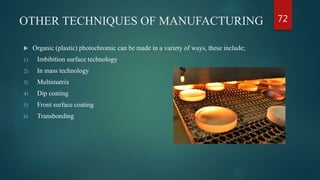
OTHER TECHNIQUES OF MANUFACTURING
 Organic (plastic) photochromic can be made in a variety of ways, these include;
1) Imbibition surface technology
2) In mass technology
3) Multimatrix
4) Dip coating
5) Front surface coating
6) Transbonding
72
IMBIBITION SURFACE TECHNOLOGY
 Lenses are made by starting with a clear plastic lens. It can be plastic material very
much like CR-39 or other organic lenses.
 Each lens manufacturer is responsible for making their own lens using compatible
lens materials.
 These lenses are then sent to a facility where with imbibition, the photochromic
compounds are driven 0.15mm into the front surface of the lens, becoming
permanently imbedded into the surface and part of the lens .This means the
photochromic material cannot be scratched.
73
IN MASS TECHNOLOGY
 In this technology, the photochromic dye is mixed into the liquid lens material
before the lens has been formed.
 Then the photochromic material is positioned near the surface of the lens.
 In mass technology points out that the organic dyes positioned near the surface of
the lens or the dye positioned superficially do not darken as fully, but the dye
penetrated slightly deeper in the lens is activated or fully darkened by the entering
UV rays.
 Thus the deeper dyes take over the darkening function in and all extending the
photochromic life of the lens.
74
DIP COATING
 The lens is coated by dipping it into a photochromic dye.
 The lens is then cured with a heat process.
FRONT SURFACE COATING
The front surface of the lens is coated with the photochromic material
or dye.
75
TRANSBONDING
 Transbonding is used with polycarbonate and high index lenses.
 In this process surface treatments are used in combination with a series of ophthalmic
grade layers
 This process applies proprietary surface treatments in layers, which provide
outstanding adhesion, scratch resistance, optical purity and photochromic
performance.
MULTIMATRIX
 The process begins with a clear lens.
 1mm layer of the photochromic dye is then bonded with the clear lens.
76
FACTORS INFLUENCING
PHOTOCHROMIC PERFORMANCE
 There are several variables that influence photochromic transmission and
darkening speed.
 Some factors affect only glass photochromic whereas other factors affect both
glass and plastic photochromic
1) Wavelength of exposed light (both glass and plastic)
2) Intensity of exposed light (both glass and plastic)
3) Temperature (both glass and plastic)
4) Exposure memory (only glass)
5) Lens thickness (only glass)
6) Heat tempering vs chemical tempering
77
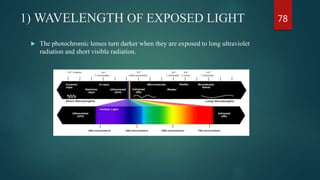
1) WAVELENGTH OF EXPOSED LIGHT
 The photochromic lenses turn darker when they are exposed to long ultraviolet
radiation and short visible radiation.
78
2) INTENSITY OF EXPOSED LIGHT
 Although exposure to UV and visible light is the condition that influences photochromic
lens transmission the most
 Several other factors contribute to lightening and darkening,
 At controlled temperatures the transmittance decreases as the intensity of the sunlight
increases.
 On over cast or cloudy days, the lenses will not be as dark as in full sunlight. The closer
the wavelength of incident radiation is to the optimum wavelength for activation, the
darker the lens becomes.
 The photochromic lenses do not darken when the sun is at less than 30⁰ of elevation,
because the UV irradiance is lower under these situations.
79
3) TEMPERATURE
 Photochromic lenses are temperature dependent or temperature sensitive
 The lenses will become darker in cool temperatures and lighter in warm
temperatures
 In winter, photochromic lenses darken to their greatest extent, gaining an
additional 20 to 30% in the cold, but they may not lighten to an acceptable level.
 On hot summer afternoons, the photochromic lens may not darken to the desired
level in the presence of ordinarily sufficient UVR.
 High temperature helps fading which is called as thermal bleaching heat will also
bleach the lens
80
4) EXPOSURE MEMORY
 Glass photochromic achieve their full changing photochromic activity and speed
of darkening depending on how many times they have been exposed or the times
they have been worn out.
 Thus glass photochromic have exposure memory, meaning they respond to light in
proportion to accumulated total recent exposures
 After each darkening and fading cycle the lens develops residual tint
 Residual tint- it reduces the time required for darkening. i.e darkens faster but also
takes more time for fading.
 Due multiple times exposure of the lens there is an increase in the residual tint,
which increases light absorption.
 This residual tint decreases transmission indoors.
81
CONT…..
To remove the residual tint,
we can expose the lens to thermal bleaching
1) The lens may be placed in boiling water for 1 hour to delete its exposure
memory.
OR
2) Keep the lens in an oven for at least an hour at a temperature of 212⁰F (100⁰C).
82
5) THICKNESS
 Photochromic activity and transmission of glass photochromic is also influenced
by lens thickness.
 In normal or moderate lenses , eg +2,-2,there will be no difference in the
darkening of the lens .i.e the lens will darken throughout.
 Whereas in high minus lenses there will be more darkening at the periphery and
in high plus lenses there will be more darkening at the center. This gives
cosmetically poor performance
 Thus glass photochromic are thickness dependent.
83
Chemical tempering vs Heat tempering
 The method used to temper glass lenses also affects the photochromic action.
 Chemical tempering produces a photochromic lens that has little color at
typical indoor illuminance levels but that darkens rapidly to a medium to
dark optical density on exposure to UV light.
 The photochromic action of a thermally hardened lens is neither as rapid nor
as dark as the chemically tempered lens and the lens appears more yellow in
the faded state.
 The thermally hardened photochromic lenses are significantly less impact-
resistant than chemically hardened lenses tested under ballistic testing.
 Hence photochromic glass lenses are best tempered in the chemical manner.
84
Coating a photochromic lens
 In the past AR coatings used to interfere with the performance of plastic
photochromic lenses.
 Now, with the changes in both coatings and lenses, this does not cause
the problem.
 AR coatings will not reduce the range of the photochromic cycles, be it
with any other lens, it will increase the transmission in both the lightened
and darkened states.
 In the lightened state, this may be significant but in the darkened state
because of the light absorbed going through the lens, the difference will
only amount in 1% decrease in the darkening and is hardly noticeable to
the wearer.
85
ADVANTAGES OF PHOTOCHROMICS
 Photochromics perform like a sun lens in their darkened state.
 Can be worn indoors as well as outdoors
 Since photochromic lenses use UV light in their activation process they are good
UV absorbers and furnish UV protection to the eyes.
 Photochromic lenses are available in single vision lenses, bifocal lenses and
progressive lenses.
86
DISADVANTAGES OF PHOTOCHROMICS
 A photochromic lens is unable to darken well behind the windshield
of a car.
 One lens cannot be replaced at a time.
 some photochromics fail to fully lighten in their faded state.
87
MINERAL VS ORGANIC
MINERAL(GLASS)
 Takes more time to fade
 Residual tint
 Thickness dependent
 Less costly
ORGANIC (PLASTIC)
 Fades quickly
 No residual tint
 Not thickness dependant
 More costly
88
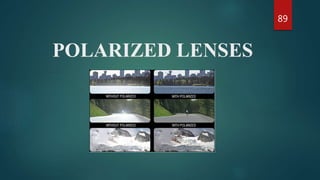
POLARIZED LENSES
89
Glare
 Is a term used to refer to the presence of one or more areas in the visual field that
are of sufficient brightness leading to
- an unpleasant sensation
- a temporary bluring of vision or
- a feeling of ocular fatigue
Cause
 It is caused,
when the illumination in a part of visual field is much greater than the level
of illumination in the background (for which the retina is adapted)
90
cont….
 To overcome glare ,the ratio between the highest level of illumination in the visual
field and the background illumination, must be reduced.
 Tinted lenses are of no help in controlling glare because they reduce the
transmittance evenly, thus keeping the ratio constant.
Types of Glares
Glares are mainly of two types
1. Discomfort Glare
2. Disability Glare
91
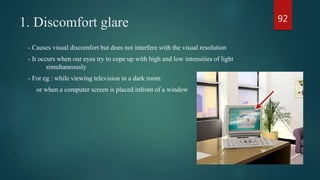
1. Discomfort glare
- Causes visual discomfort but does not interfere with the visual resolution
- It occurs when our eyes try to cope up with high and low intensities of light
simultaneously
- For eg : while viewing television in a dark room
or when a computer screen is placed infront of a window
92
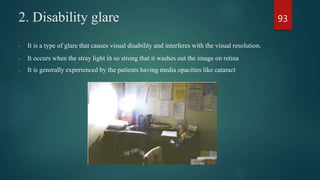
2. Disability glare
- It is a type of glare that causes visual disability and interferes with the visual resolution.
- It occurs when the stray light is so strong that it washes out the image on retina
- It is generally experienced by the patients having media opacities like cataract
93
Effects of glare on vison
- Reduces colour perception
- Reduces visual acuity
- Reduces texture perception
- Causes visual discomfort
94
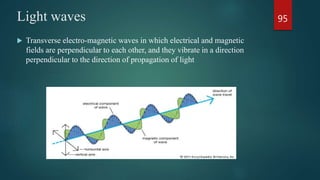
Light waves
 Transverse electro-magnetic waves in which electrical and magnetic
fields are perpendicular to each other, and they vibrate in a direction
perpendicular to the direction of propagation of light
95
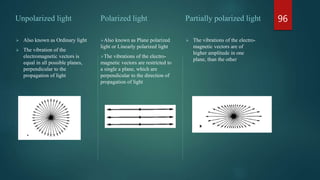
Unpolarized light
 Also known as Ordinary light
 The vibration of the
electromagnetic vectors is
equal in all possible planes,
perpendicular to the
propagation of light
Polarized light
Also known as Plane polarized
light or Linearly polarized light
The vibrations of the electro-
magnetic vectors are restricted to
a single a plane, which are
perpendicular to the direction of
propagation of light
Partially polarized light
 The vibrations of the electro-
magnetic vectors are of
higher amplitude in one
plane, than the other
96
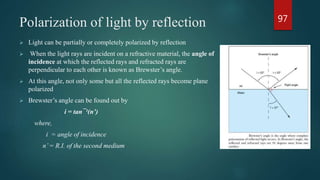
Polarization of light by reflection
 Light can be partially or completely polarized by reflection
 When the light rays are incident on a refractive material, the angle of
incidence at which the reflected rays and refracted rays are
perpendicular to each other is known as Brewster’s angle.
 At this angle, not only some but all the reflected rays become plane
polarized
 Brewster’s angle can be found out by
i = tan¯¹(n’)
where,
i = angle of incidence
n’= R.I. of the second medium
97
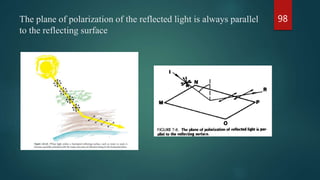
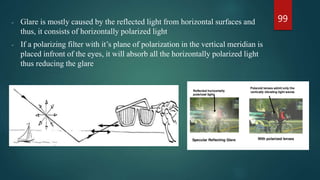
The plane of polarization of the reflected light is always parallel
to the reflecting surface
98
- Glare is mostly caused by the reflected light from horizontal surfaces and
thus, it consists of horizontally polarized light
- If a polarizing filter with it’s plane of polarization in the vertical meridian is
placed infront of the eyes, it will absorb all the horizontally polarized light
thus reducing the glare
99
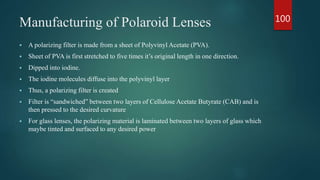
Manufacturing of Polaroid Lenses
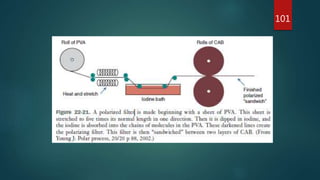
 A polarizing filter is made from a sheet of Polyvinyl Acetate (PVA).
 Sheet of PVA is first stretched to five times it’s original length in one direction.
 Dipped into iodine.
 The iodine molecules diffuse into the polyvinyl layer
 Thus, a polarizing filter is created
 Filter is “sandwiched” between two layers of Cellulose Acetate Butyrate (CAB) and is
then pressed to the desired curvature
 For glass lenses, the polarizing material is laminated between two layers of glass which
maybe tinted and surfaced to any desired power
100
101
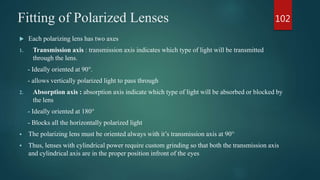
Fitting of Polarized Lenses
 Each polarizing lens has two axes
1. Transmission axis : transmission axis indicates which type of light will be transmitted
through the lens.
- Ideally oriented at 90°.
- allows vertically polarized light to pass through
2. Absorption axis : absorption axis indicate which type of light will be absorbed or blocked by
the lens
- Ideally oriented at 180°
- Blocks all the horizontally polarized light
 The polarizing lens must be oriented always with it’s transmission axis at 90°
 Thus, lenses with cylindrical power require custom grinding so that both the transmission axis
and cylindrical axis are in the proper position infront of the eyes
102
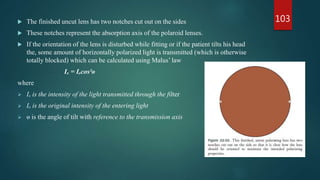
 The finished uncut lens has two notches cut out on the sides
 These notches represent the absorption axis of the polaroid lenses.
 If the orientation of the lens is disturbed while fitting or if the patient tilts his head
the, some amount of horizontally polarized light is transmitted (which is otherwise
totally blocked) which can be calculated using Malus’ law
Iₓ = Iₒcos²ɵ
where
 Iₓ is the intensity of the light transmitted through the filter
 Iₒ is the original intensity of the entering light
 ɵ is the angle of tilt with reference to the transmission axis
103
Advantages of Polarized Lenses
 Reduces Glare
 Reduces Transmission
 Reduces eye strain
 Increases colour perception
 Absorbs 100% UV radiations
 Improves contrast
 Improves visual acuity
 Tintable and coatable
104
Disadvantages of Polarized Lenses
 Difficulty in reading on LCDs
 Cannot be used at night
 Not possible to make these lenses truly clear
 Stress in heat-tempered glass is visible
105
Indications for Polarized Lenses
 Fishermen- Reflected light from water surface makes it difficult to see below the surface
-polarized lenses removes the glare and makes it easier to see below the surface
 Drivers – light reflected from Roads,Highways,and dashboard are very irritating and cause
ocular fatigue
-polarized lenses very efficiently reduce these glares
 Ship/Voyage-people who work on ships or those going on voyages, constantly come in contact
with the veiling glare by the water bodies which is reduced by polarized lenses
 Deserts-sand is an excellent source of polarized glare, thus polarized lenses are very useful in
deserts
 Beaches-glare from both water and sand is present in beaches thus polarized lenses come in
handy
 In Snowy areas- snow is highly reflective. Polarized lenses are very efficient in reducing this
blinding glare from the snow
106
Contraindications of Polarized Lenses
 Pilots – for 3 reasons
- windshields of aircraft are made up of polycarbonate which reveal stress
patterns when viewed from polarized lenses
-pilots have to monitor many instrument panels and some numbers or digits
may disappear when viewed from polarized lenses
- Makes it difficult to see an oncoming aircraft because light reflected from
the aircraft is mostly horizontally polarized
107
 Skiers – polarized lenses make snowy conditions harder to judge
- skiers tilt their head while turning and leaning which causes changes in
brightness
Hence it is contraindicated in all the sports in which players need to tilt their
heads, like
 Golf
 Shooting
 Skating
108continued
Availability of Polarized lenses
Polarized lenses have a wide
range of availability:
 Glass
 Plastic
 Polycarbonate
 High-index plastics
 Photochromics (Both in Glass
and Plastic)
 They are available in :
 Single vision lenses
 Bifocals
 Trifocals
 Multifocals
 Progressive addition lenses
109
Applications of polarized filters
 Spectacle Lenses
 Sunglasses
 Testing stereoscopic acuity
 Polarioscope/Colmascope
 3D goggles
 LCD Screens
 Glass windows in trains and aeroplanes
 Calculators, Watches
110
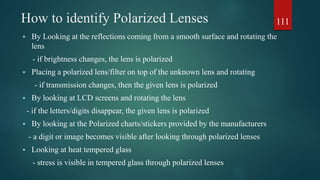
How to identify Polarized Lenses
 By Looking at the reflections coming from a smooth surface and rotating the
lens
- if brightness changes, the lens is polarized
 Placing a polarized lens/filter on top of the unknown lens and rotating
- if transmission changes, then the given lens is polarized
 By looking at LCD screens and rotating the lens
- if the letters/digits disappear, the given lens is polarized
 By looking at the Polarized charts/stickers provided by the manufacturers
- a digit or image becomes visible after looking through polarized lenses
 Looking at heat tempered glass
- stress is visible in tempered glass through polarized lenses
111
GLARE CONTROL LENSES
112
 Lenses Made to Block Short Wavelengths and Control Glare
 Glare Control CPF Lenses
 Glare Control Dyes
 Nonprescription Options for Controlling Glare
113
 Glare Control CPF Lenses
 Developed by Corning
 Series of photochromic lenses
 Acquired by and is sold through Winchester Optical.*
 Manufacturing process of CPF lenses begin with photochromic material that is
surfaced for the prescription and edged for the frame.
 Front layer is formed in hydrogen atmosphere thus reduces the silver halide crystal
near photochromatic lens to eliminate silver. Causing the photochromatic change
to be blocked.
 Back surface will remain unchanged with unique spectral absorbing property.
 None of these Glare Control lenses are to be worn for night driving.
114
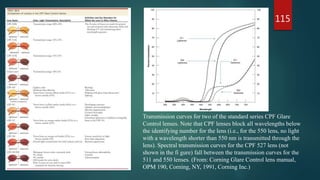
115
Transmission curves for two of the standard series CPF Glare
Control lenses. Note that CPF lenses block all wavelengths below
the identifying number for the lens (i.e., for the 550 lens, no light
with a wavelength shorter than 550 nm is transmitted through the
lens). Spectral transmission curves for the CPF 527 lens (not
shown in the fi gure) fall between the transmission curves for the
511 and 550 lenses. (From: Corning Glare Control lens manual,
OPM 190, Corning, NY, 1991, Corning Inc.)
Glare Control Dyes
 Manufactured With the help of glare control “colors” available in lens dyes
 Clear plastic lenses may be tinted to the desired absorptive characteristics
 The absorptive properties of the dyed lens should also fulfill the desired
transmission requirements.
116
Nonprescription Options for Controlling Glare
 Nonprescription filters available for controlling glare are available
from NoIR Medical Technologies.
 NoIRs vary in the amount of light absorbed, the selectivity of that
absorption across the spectrum, and the resulting physical color of
the lens.
117
Disadvantages of Glare Control-Type
Lenses
 Effect on color vision
 More of the visible spectrum that is absorbed by the lens, the greater
will be the effect on color vision
 Clinically, glare control lenses continue to enjoy popularity,
especially in practices specializing in low vision.
118
SPECIALTY ABSORPTIVE LENSES
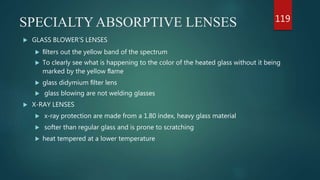
 GLASS BLOWER’S LENSES
 filters out the yellow band of the spectrum
 To clearly see what is happening to the color of the heated glass without it being
marked by the yellow flame
 glass didymium filter lens
 glass blowing are not welding glasses
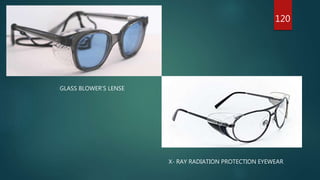
 X-RAY LENSES
 x-ray protection are made from a 1.80 index, heavy glass material
 softer than regular glass and is prone to scratching
 heat tempered at a lower temperature
119
120
GLASS BLOWER’S LENSE
X- RAY RADIATION PROTECTION EYEWEAR
121
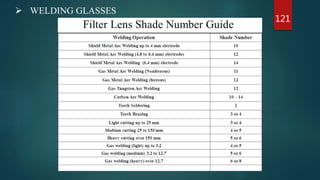
 WELDING GLASSES
SUNGLASSES
 Ideal pair of sunglasses should do the following:
1. Reduce intensity for optimum visual comfort and performance.
2. Eliminate parts of the optical spectrum that are not required for vision and are hazardous to
the eyes.
3. Provide enough protection while being worn during the day so that the wearer’s dark
adaptation and night vision are preserved at night.
4. Maintain normal color vision and allow the wearer to distinguish traffic signals quickly and
correctly.
5. Resist impact and scratching and only require a minimum of care.
 same impact-resistance requirements as any other spectacle lenses
 ANSI Z80.3-2001 sunglass and fashion eyewear standard
 “Not suitable for driving” and “Not suitable for persons with defective color vision.21”
122
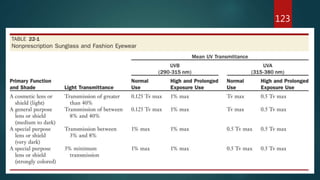
123
LENS COATINGS
 Antireflection Coatings
 Color Coatings
 Scratch-Resistant Coatings (SRCs)
 Antifog Coating
 Mirror Coating
 Edge Coating
 Hydrophobic coating
 Clear coat
124
REFERENCE
 System for ophthalmic dispensing (Clifford W. Brooks, Irvin M. Borish)
 Second and Third edition
 Clinical optics ( Troy E. Fannin, Theodore grosvenor)
 Borish’s clinical refraction ( william j. benjamin)
 Primary care optometry
 Geometric,Physical and Visual Optics -Michael P. Keating
 Optometry: Science, Techniques and Clinical Management-By Mark
Rosenfield, Nicola Logan, MCOptom, PhD
125
126
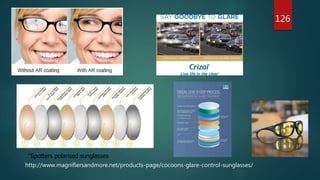
"Spotters polarised sunglasses
http://www.magnifiersandmore.net/products-page/cocoons-glare-control-sunglasses/
Thank you
127

Absorptive lenses

  • 1.
    Absorptive lenses -BY OPTOMPRATIKSHA R. PATIL M. OPTOM 1ST YEAR 1
  • 2.
    contents 1. Phenomenon ofAbsorption 2. Need for Absorptive lenses 3. Electromagnetic Spectrum 4. Radiation effects 5. Concentration of Radiant energy by the eye 6. Absorption of Radiation by the Ocular tissues 7. Effects of UV 8. Effects of IR 9. Required amounts of Absorption 2
  • 3.
    Cont.…. 10. Absorptive lenses 11.Types of Absorptive lenses 12. Glare Control Lenses 13. Sunglasses 14. Specialty Absorptive lenses 15. Lens Coatings 3
  • 4.
    Phenomenon of Absorption When light is incident upon a lens, some of it is reflected by each of the lens surfaces, some of it is absorbed by the lens, and the remainder is transmitted.  The amount of light reflected by a lens surface, in air, is given by the Fresnel equation 4 Reflection, absorption, and transmission by a lens.
  • 5.
    Cont.……  The amountof light absorbed by a lens is given by Lambert's law of absorption, which states that for an absorptive material such as a tinted lens layers of equal thickness absorb equal quantities (or percentages) of light regardless of the intensity of the light. 5 Absorption of light by a lens (Lambert's law)
  • 6.
  • 7.
    Electromagnetic Spectrum The sun isthe source of most of the electromagnetic radiation occurring naturally in the atmosphere, on the surface of the earth we are subjected to only a small portion of the sun's radiation because much of it is filtered out by water particles, ozone, oxygen, and carbon dioxide. Exposure to radiation bordering on the visible spectrum does not give rise to the sensation of vision, these bands of radiation are worthy of our attention because they can exert harmful effects on the eyes. 7
  • 8.
    Cont.….. 8 • Typesof IR radiation- Short IR rays (780-1500 nm) Long IR rays ( 1500 nm and up)
  • 9.
  • 10.
    Radiation effects  Draper’slaw states that for radiation to have an effect on a substance through which it travels, it must be absorbed by the substance.  Radiation has no effect (beneficial or deleterious) on a substance through which is completely transmitted or by which it is completely reflected.  Radiation in the region of the visible spectrum causes the sensation of vision because it is absorbed by the photopigments of the retina.  Ionizing radiation  Non-ionizing radiation 10
  • 11.
    Cont.…. IONIZING RADIATION  Mostionizing radiation pass through the eye, but small amount is absorbed.  The damage depends on the exposure time, concentration, and the type of radiation.  Ionizing radiation may have direct or indirect effect on ocular tissue.  A direct effect may produce cellular anomalies or death.  Indirect effect can result in damage to the blood vessels and thus restrict the blood supply to the tissue. 11
  • 12.
    Cont.…. NON-IONIZING RADIATION  Whenradiation is absorbed by an ocular tissue, various effects are produced by the transfer of radiant energy to the molecules and atoms of the absorbing tissue.  The absorbed energy can affect the visual apparatus in the following ways:  The thermal effect  The photochemical effect  Photoluminescence (fluorescence) 12
  • 13.
    Cont.….  The thermaleffect  Heating effect  Solar retinopathy, cause by looking directly at a solar eclipse.  The photochemical effect  In the visible spectrum, produces a chemical reaction in the retina initiating the sensation of vision.  Harmful photochemical effects can occur with other ocular tissues, such as photokeratitis produced by excessive absorption of UV radiation by the cornea.  Photoluminescence (fluorescence)  The lens is capable of visible flurescence when illuminated by UV light. 13
  • 14.
    Concentration of radiantenergy by the eye  As radiant energy passes through the eye, it is attenuated in a number of ways:  Absorption by the ocular media  Scattering within the eye  Reflection by the various optical interfaces  Loss caused by the aberrations of the eye’s optical system 14
  • 15.
    Cont.….  Concentration ofradiant energy is depends upon 1. size of source 2. intensity of source 3. pupil size  For a point source of high intensity, refraction by the eye’s optical system concentrates the energy of the retina (A) and cause tissue damage, but has little effect on the cornea and the lens.  Solar retinopathy: occur after exposure to a solar eclipse.  A small source of low-intensity radiation is usually harmless to the retina, an extended source of the same intensity may provide a dangerous concentration of radiant energy in the lens. (B) 15
  • 16.
    Cont.…. 16 Concentration ofenergy in the eye. A, point source; B. extended source.
  • 17.
    Absorption of radiationby the ocular tissue Ultraviolet (nm) Visible (nm) Infrared (nm) Tear layer 290 -380 380-760 760-3000 Cornea 290-380 380-760 760-3000 Aqueous 290-380 380-760 760-3000 Lens (child) 310-380 380-760 760-2500 Lens (older adult) 375-380 380-760 760-2500 Vitreous 290-380 380-760 760-1600 17 • Transmission of radiation by the ocular media
  • 18.
    Effects of ultravioletradiation  UV A is the longest wavelength and least harmful, causes skin tan.  UVB shorter wavelength higher energy than UVA causes Photostat iris, Sunburn, Cataract and Retinal lesions.  UVC still higher energy but absorb by Ozone layer.  UV Vacuum present outside Earth atmosphere.  The amount of UV radiation is higher in higher altitudes and region close to geographical equator.  UV radiation is more intense between 10AM to 2PM.  Snow reflect 85% to 95% ,sand reflects 20% to 30% where grass only 3%.  Ocular damage caused by UV radiation called “Welders burn”.  Drugs that heighten UV damage–Sulphonamide, tetracycline, tranquilizer, Diuretics ,Oral contraceptive, drugs for hypoglycaemia. 18
  • 19.
    cont….. Options For ProtectingThe Eye From Solar UV Radiation  Prescription lenses 1. Lenses specially made to be UV blocking 2. Polycarbonate lenses 3. High index lenses with UV absorbing coating 4. UV died plastic lenses 5. Photochromatic lenses 6. Glare control type lenses 7. All type of polarizing lenses  Headgear wear- 1. Sun visor 2. Cap 3. Wide-brimmed hat • Selecting frame 1. Short vertex distance 2. Face form • Sunglass wear 1. UV absorbing sun glasses 2. Lens that cover a large area 3. Wraparound sunglass 19
  • 20.
    Effects of InfraredRadiation  Common sources of IR are direct sunlight ,molten substances such as glass, metal, arc lamp and IR lamps.  IR radiation when combined with UV radiation and blue light can adversely affect the crystalline lens, the opacification is commonly known as “glass blowers” “furnace man’s cataract”.  Solar retinoid causes due to combination of photochemical damage from shortwave length (UV and blue) radiation and thermal damage from long wavelength IR.  Options For Protecting The Eye From Infrared Radiation -Lenses that block IR : NoIR and IREX lenses. 20
  • 21.
    Required amounts ofabsorption : How Much Tint Is Enough?  Normal transmission of sun glass is generally between 15%-30% (<15% causes reflected glare from the back surface.)  Sunglass used for driving shouldn’t darker than 8% (according to ANSI Z80.3 sunglass standard).  Special purpose such as skiing , mountain climbing or beach transmission may go as much as 3%.  In daily exposure to sunlight for prolong period of time 15% or less transmission of lenses required so that loss of dark adaptation can be prevented.  Lens transmission checked with transmission meter and also using Humphrey automated lensmeter. 21
  • 22.
    22 A B A, Lensesordered with ultraviolet (UV) absorption should be checked using a UV meter. This light transmission meter measures UV, visible (VL), and infrared (IR) light. The lenses being measured are blocking all UV light and are transmitting most of the visible and infrared radiation. B, It is possible to check the transmission of a lens using a Humphrey Model LA360 Lens Analyzer. This autolensmeter allows both an on-screen display and a printout.
  • 23.
    cont.…..The Hazards ofToo Much Tint  When considering darker fashion tints, wearers should be warned of the reduction in visual acuity in dimly lit conditions. Tinted Lenses and Night Driving  In dim light night driving rather than using tinted lenses ,AR coating will reduce oncoming headlight glare and increase contrast. 23
  • 24.
    ABSORPTIVE LENSES  Anabsorptive lens is one which is used for the specific purpose of reducing the amount of transmitted light or radiant energy, thus acting as a filter.  Absorptive lenses are sometimes referred to as tinted, or colored, lenses, since they are not usually clear and colorless  The absorption may be uniform (or neutral), absorbing visible light of all wavelengths, or selective, absorbing some wavelengths more than others. 24
  • 25.
    Types of absorptivelenses 25 Absorptive lenses Tinted lenses Polaroid lensesPhotochromic lenses Glass plastic Glass plastic -solid glass tint -surface coated glass tint
  • 26.
  • 27.
    TYPES OF TINT COSMETIC TINTS- Cosmetic tints are those colors that are used for enhancing the appearance of the eyewear.  OCUPATIONAL TINTS-Occupational tints are those colors that are required for a specific job task performed by the patient.  RECREATIONAL TINTS -Recreational tints include colors such as true gray, brown and green as well as colors that are formulated to absorb specific wavelengths of light under specific conditions.  THERAPEUTIC -Therapeutic tints are prescribed by some practitioners to patients with glaucoma, diabetes, macular degeneration and retinitis pigmentosa. As they are more sensitive to certain portions of the visible light spectrum. 27
  • 28.
    Methods of ManufacturingAbsorptive Lenses 1. GLASS TINT a. Tinted Solid Glass Lenses( Integral Tint)  This tint is achieved by adding the oxides in the basic batch at the start.  The spectral transmission characteristics of the finished lens are controlled by these metallic oxides.  The concentration of the metals is less than 1% even for dense tint. 28
  • 29.
    cont.….. The Elements MostCommonly Used And The Colors They Produce Are: iron green Manganese pink cobalt blue Cerium pinkish brown nickel brown uranium yellow chromium green gold red silver yellow Didymium pink Vanadium pale green 29
  • 30.
    cont.…..  ADVANTAGES  Largenumber of blanks can be made.  No surface reflections  No special equipment needed.  Not affected by surface qualities e.g. polishing or surfacing.  Color wont fade.  DISADVANTAGES  Color varies with thickness of the lens from center to periphery.  Permanent.so cant remove or change like surface tints. 30
  • 31.
    cont.….. b. Glass Lenseswith Surface Coatings  Lens is tinted by depositing a thin metallic oxide on the surface of the lens.  It is deposited by an evaporation process conducted under high vacuum at high temperature.(200-300 c)  The density depends on the thickness of the metallic coat applied.  Usually on the back surface of the lens.  Because the RI of the metallic oxide is higher than the under lying glass, the amount of reflections increases.  Hence an ARC has to be applied over the coat(magnesium fluoride). 31
  • 32.
    cont.…..  ADVANTAGES  Uniformtint, which is independent of the power and thickness.  Coating has high resistance to wear and to chemical interaction.  Can be applied on a solid tint if the tint appears to be light than the requirement.  DISADVANTAGES  If no arc, more surface reflections.  Chances of peeling off.  High temperature and vacuum needed.  Cant be done on plastic lenses. 32
  • 33.
    cont.….. 2. PLASTIC TINT(DYEING)  This is done by dipping the lenses into a solution containing the appropriate organic dye.  The color depends on: Duration of lens kept in the dye. Concentration of the dye. Type of dye. Material of the lens. 33
  • 34.
    cont.…..  ADVANTAGES  Plasticlenses can be tinted.  Tint can be changed.(decolorize with bleach and re-dye).  Independent of power and thickness.  Can be graduated and double graduated.  DISADVANTAGES Unpredictable.  High-index plastic lenses dye more slowly than CR-39 lenses and may require special processing  Cant be combined with any other coating e.g. ARC. Dyes fade with time.  Note it is very important to clean and pre-heat the lens before dyeing. 34
  • 35.
    1. Remove water-solubledye packet from paper envelope 2. Drop dye packet into dye tank filled with water. Plastic and ingredients dissolve in water. Dye heating unit is needed to heat dye solutions. Lenses are dipped in hot dye bath (200- 205°F) by using lens holder. Density and the rate of change of density on gradient tinted lenses, is measured with the Phantom Digital UV/Visible Transmission Meter 35
  • 36.
    36  Tinting reducesthe amount of light reaching the eye thus reducing the glare and increasing comfort.  It acts like a filter.
  • 37.
    USES  Cosmetic purpose-for fashion.  Safety purpose- protection from harmful radiation and excessive light.  Glare protection- patients suffering from glare and photophobia.  Contrast improvement- occupations like shooters, pilots often use tinted lenses as enhancers.  Psychological and behavioral reasons- prescribed to dyslexic patients, patients with traumatic brain injuries, migraine and photosensitive epilepsy patients.  VDT users – for comfort.  For color deficient.  Reducing tearing and eyestrain. 37
  • 38.
    Colored Filter Lensesfor Color Defectives Factors Favoring the Use of Colored Filter Lenses for Color Defectives  colored filters will allow a color-defective individual to use intensity cues to discriminate between two otherwise indistinguishable colors  Some spectacle lens color filters are placed in only one sector of a spectacle lens so that a comparison of how the object appears can be made by moving the head Negative Effects of Using Colored Filter Lenses for Color Defectives  One problem is that objects may appear to glisten.  A second problem is that when there is a difference in intensity between the two eyes, moving objects may appear to be wrongly located as to how far away they appear. 38
  • 39.
    Red deficiency BrownGreen Red-Green deficiency Gray Green 39
  • 40.
    USES  Light -25% - Ideal for fashion tints; suitable for indoor and outdoor use.  Medium - 50% - For general use.  Dark - 75% - Recommended for use in bright sunlight.  Very Dark - 100% - For bright sunlight only. Not recommended for indoor use, driving, or operating machinery. 40
  • 41.
    COLOR CHARACTERISTICS 41 Yellow.  green.  Pink.  Red.  Orange.  Brown.  Blue  Purple.  Grey.
  • 42.
    Color percept contrast acuity glareDepth Gray preserves reduces No effect Preserve s reduces preserves Green distorts preserves preserves No effect preserves Brown preserves enhances preserves reduces preserves Amber preserves enhances green preserves preserves reduces preserves Yellow Eliminates blue enhances enhances reduces enhances Red enhances enhances enhances Reduces enhances 42
  • 43.
    YELLOW  Improves contrast,sharpened definition of distracting backgrounds, or an overcast or misty days.  sometimes referred to as a "blue-blocker" because the color keeps blue light from entering the lens  Most suitable for-  Shooters.  Snow skiing.  Pilots.  It shouldn’t be use in night driving.  Advantages  Improves contrast.  Examples-  Hazemaster (AO)  KalichromeH (B & L). 43
  • 44.
    GREY  Popular forsun protection.  Evenness of transmission through the whole visible spectrum.  This characteristic allows to see object in their natural state.  Shades available in grey  B1  B2  B3-darkest  Advantages-  Preferable for color deficient pts although they do not enhance but neither do they cause any further misjudgment (people with normal color vision can adjust to any color).  Evenness through the whole spectrum.  Can be worn for long time.  Disadvantages-  No enhancement. 44
  • 45.
    GREEN  Green sunlenses have a transmission curve that closely approximates the color sensitivity curve for the human eye.  The most green lenses transmits the brilliant greens and yellows.  Absorbs both IR and UV regions.  The green tinted glass lens obtain it’s colour and characteristics transmission from ferrous oxide .  The plastic lens dyed green exhibit poor absorption in IR region than glass. BROWN  Brown lenses generally offer better contrast than green or grey.  Have same characteristics as yellow lenses higher absorption of shorter visible wavelength.  Absorbs relatively more blue light which normally scattered by the atmosphere to produce haze, better in hazy conditions. 45
  • 46.
    PINK  Have uniformtransmission across the visible spectrum.  Occasionally used for unfavourable indoor lighting situation.  Reduce some amount of glare and reflection but better to use ARC and glare control lenses.  Indoor tint shouldn’t be less than 80% to worn in low light conditions. 46
  • 47.
    Transmittance characteristics 47 Transmissioncurves for clear crown glass, clear CR-39 plastic, and a #1 crown glass pink tint. Note how closely the transmission curve for the pink matches the curves for the clear. Because the pink has a relatively flat, horizontal curve across the visible spectrum, there should be no disturbance to relative color perception. (From: Spectral transmission of common ophthalmic lens materials, St Cloud, Minn, 1984, Vision-Ease.)
  • 48.
    48 Transmission curves foryellow and brown tints. Yellow has a characteristic sudden drop in transmission between 500 and 450 nm. Brown also shows a drop, but that drop is spread over a larger part of the visible spectrum. Note how dyed plastic and polycarbonate lenses transmit the long end of the spectrum, including the infrared. It is possible to use lens dyes that absorb in the infrared region of the spectrum, if desired. (Yellow crown glass and tan #3 [brown] glass transmission curves are redrawn from: Spectral transmission of common ophthalmic lens materials, St Cloud, Minn, 1984, Vision-Ease, pp 9, 10. Brown #3 CR-39 and polycarbonate transmission curves from Pitts DG and Kleinstein RN: Environmental vision, Boston, 1993, Butterworth-Heinemann.)
  • 49.
    49 Green absorptive lenseshave a transmission curve with a characteristic “hill” in the middle of the visible spectrum. Green glass lenses are good ultraviolet and infrared absorbers. Plastic and polycarbonate lenses, however, transmit light in the long visible end and infrared region of the spectrum. This is characteristic for dyed plastic materials in any color unless a specific infrared absorber has been added to the dye. (Transmission curves from Spectral transmission of common ophthalmic lens materials, St Cloud, Minn, 1984, Vision- Ease, and from Pitts DG and Klein stein RN: Environmental vision, Boston, 1993, Butterworth-Heinemann.)
  • 50.
    50 In the visibleregion from approximately 400 to 700 nm, the gray lens gives a fairly even transmission curve, making color perception closer to what would be perceived without absorptive lenses. (Transmission curves from: Spectral transmission of common ophthalmic lens materials, St Cloud, Minn, 1984, Vision-Ease, and from Pitts DG and Kleinstein RN: Environmental vision, Boston, 1993, Butterworth-Heinemann.)
  • 51.
    Categories of AbsorptiveLenses and Specification of Transmission 1. General-Wear Lenses Absorbing the Spectrum Evenly 2. Lenses That Selectively Absorb Ultraviolet Radiation While Transmitting the Visible Spectrum in a Uniform Manner 3. Lenses That Selectively Absorb Both Ultraviolet and Infrared Radiation While Absorbing a Substantial Amount of Visible Radiation in a Relatively Uniform Manner 4. Lenses That Selectively Absorb Portions of the Visible Spectrum 5. Absorptive Lenses Designed for Occupational Use 6. Miscellaneous Absorptive Lenses 7. Cosmetic Lenses 8. Photochromic Lenses 51
  • 52.
    General-Wear Lenses Absorbingthe Spectrum Evenly  Lenses in this category are very lightly tinted, and absorb little or no more ultraviolet, visible, or infrared radiation than clear ophthalmic glass  known as "indoor" tints or as "cosmetic" tints  Transmission across the spectrum is fairly uniform for these lenses  color values of objects are changed very little  Patients who frequently ask for light tints for general wear include the following:  lightly pigmented individuals, including albinos;  patients with high refractive errors, especially aphakics and myopes;  patients who work under poorly designed artificial illumination conditions;  patients who are not in good general health;  patients who have neurasthenic or neurotic tendencies.  Examples-  American Optical Cruxite lens,  Univis Mellolitethe Titmus Velvetlité,  Vision-Ease Lablens 52
  • 53.
    Lenses That SelectivelyAbsorb Uv Radiation While Transmitting the Visible Spectrum in a Uniform Manner  Ocular protection from UV radiation can be provided by means of either absorptive or reflective filters  CR-39 plastic lenses containing ultraviolet absorbers  Optical Radiation UV-400  Vision-Ease UV-Lite  UVS lens by Silor Optical  Varilux 2 UVX-Light lens by Multi-Optics  Recreation Innovations NoIR lenses (#101,#102, #111, and #112)  Glass lenses which transmit less than 5% of ultraviolet radiation  American Optical Hazemaster  Vision-Ease Striking Yellow  Bausch and Lomb Kalichrome  Spectra-Shield Human II  Photochromic lenses from Corning Glas 53
  • 54.
    Lenses That SelectivelyAbsorb Both Ultraviolet and Infrared Radiation While Absorbing a Substantial Amount of Visible Radiation in a Relatively Uniform Manner 54
  • 55.
    Lenses That SelectivelyAbsorb Portions of the Visible Spectrum  Include both yellow and bluish-green lenses  The yellow lenses  American Optical Hazemaster ,  Vision-Ease Striking Yellow ,  Bausch and Lomb Kalichrome.  The bluish-green lenses  Therminon Corp. Therminon  Titmus Optical Infra-Bar  These lenses are claimed to be cool lenses  Patients whose eyes are constantly exposed to highly reflective white surfaces, and for cooks and others who must work in environments in which there is an excessive amount of infrared radiation. 55
  • 56.
    Absorptive Lenses Designedfor Occupational Use  Specially designed absorptive lenses are available for a number of occupations including blast furnace operation, glass blowing, and welding.  Must almost completely absorb both the ultraviolet and infrared radiation from harmful sources.  Welding lenses are available in two general categories:  Class I welding lenses are general-purpose lenses,  Class II welding lenses are used in operations producing high radiant flux at the wavelengths of the sodium lines (589.3 nm)(contain didymium)  Trade names for welding lenses  Arc-Ban, Cescoweld ,  Filterweld ,Willson-Weld. 56
  • 57.
    Miscellaneous Absorptive Lenses Uniform-density lenses  Absorptive lens is made of a glass having lens thickness varies from the center to the edge of the lens  This problem can be avoided if a thin layer of tinted glass is fused to a clear lens  The tinted glass is fused to the flatter surface of the lens, usually the back surface of a plus lens or the front surface of a minus lens.  Such a lens is known as a uniform-density lens. 57
  • 58.
    cont.…..  Gradient-Density Lenses Gradients are lenses that vary in transmission over the surface of the lens.  A simple gradient tint is a lens that has one color but varies in transmission from the top to the bottom of the lens  Such a lens may be made either by coating a glass lens or by dying a plastic lens  Double Gradients-density Lenses  two colors fade into one another  one color on the top half of the lens and another color on the bottom  The second color starts dark at the bottom and fades to the center in “reverse” gradient fashion.  Triple Gradients-density Lenses  One gradient color in the upper half, a second reverse gradient in the lower half, and a third color in the center. 58
  • 59.
    59 A gradient lensvaries in transmission over the surface of the lens Triple Purple/Orange/Blue Gradient BURGUNDY TO ORANGE INDIGO TO GOLD OLIVE TO GOLD
  • 60.
    Cosmetic Lenses  Dyedlenses are intended strictly as cosmetic lens  Responsible for some problems (1) if the lenses are heavily dyed, they may be too dark for night driving and (2) there is a tendency for many of these tints to have high transmittances in the infrared region, with the result that they should not be used as sunglass lenses 60
  • 61.
    CLEANING  Clean dustand lint from the lens with a soft cloth preferably micro fiber cloth. Don’t use denim or wool.  To remove smudges, oils, and/or finger prints use lens cleaner or wash lens with mild soap and water. Dry with soft cloth.  To prevent scratches don’t place lens upside down and don’t use finger nails. 61
  • 62.
  • 63.
    cont.…..  Exposure ofthe lens to ultraviolet radiation in sunlight triggers a photochemical reaction that causes the lens to darken and changes in its transmission when exposed to UV light.  In presence of UV light the lens becomes darker and in the absence of UV light the darkened lens fades and turns to a clear lens. Thus the reaction of photochromic is reversible. 63
  • 64.
     Thus darkeningand fading are the cycles of photochromic lenses. 1 DARKENING AND 1 FADING = 1 CYCLE CONT.….. 64
  • 65.
    HISTORY OF PHOTOCHROMICS A major breakthrough in the area of absorptive lenses took place in 1964 with the invention of corning’s photogray photochromic lens. 65
  • 66.
    TYPES OF PHOTOCHROMICLENSES 1) Mineral (glass) photochromic lenses 2) organic (Plastic) photochromic lenses 66
  • 67.
    CONT.….. MINERAL PHOTOCHROMIC LENSES Crown glass ( RI=1.523)  Mineral (glass) photochromic lenses contain the silver halide crystals.  The photochromic properties of these lenses is a function of the minute silver halide crystals.  MANUFACTURING  The chemical composition determines the spectral sensitivity, hue, range and speed of shade variation of the glass.  Mineral (glass) photochromic lenses are made by introducing crystals of silver halide of approximately 5mm diameter into the melt of borosilicate or aluminum phosphate glass.  Copper oxide is added to enhance the darkening process. 67
  • 68.
    CONT.…..  DARKENING PROCESSIN MINERAL PHOTOCHROMICS  Upon exposure to ultraviolet radiation, the silver halide crystals dissociate or decompose into clusters of silver and halogen atoms and electrons.  Now, silver and electrons combine with each other and form a different material known as silver colloid.  Peculiar property of silver colloid- it absorbs visible spectrum or it is the silver colloid that gives the glass its dark appearance. 68
  • 69.
    CONT.…..  Then, therigid matrix of the glass holds the silver and halogen in close proximity and upon removal of the activating ultraviolet radiation the silver and halogen atoms recombine into silver halide crystals with the result that the lens becomes lighter.  The photodissociation of the silver halide crystals occurs best under conditions of high UV irradiance and low temperatures, which retard the recombination of silver halides. 69
  • 70.
    ORGANIC PHOTOCHROMIC LENSES Organic photochromic are available in a variety of brands and colors.  Instead of using an organic material, such as the silver halide crystals used for glass lenses, plastic photochromics use organic dyes.  MANUFACTURING  Organic (plastic) photochromic lenses are made by two techniques- 1) The lens blank is given the photochromic activity, then power (prescription) is generated on the lens or power is grounded. 2) Power (prescription) is generated on the lens blank and then photochromic activity is given to the lens. ( i.e dye is penetrated) CONT.….. 70
  • 71.
     Unlike glassphotochromic lenses, photochromic activation for plastic does not work using silver halide crystals, but is based on a molecular group called indolinospironaphthoxazine(ISN)  When photons of UV light are absorbed by the ISN molecule, part of the bond to the central atom is broken.  After being broken, half of the ISN molecule rotates around the broken `hinge’ to a new position and is able to absorb visible light.  When UV light is no longer present, the molecule swings back to its original position and stops absorbing visible light. CONT.….. 71
  • 72.
    OTHER TECHNIQUES OFMANUFACTURING  Organic (plastic) photochromic can be made in a variety of ways, these include; 1) Imbibition surface technology 2) In mass technology 3) Multimatrix 4) Dip coating 5) Front surface coating 6) Transbonding 72
  • 73.
    IMBIBITION SURFACE TECHNOLOGY Lenses are made by starting with a clear plastic lens. It can be plastic material very much like CR-39 or other organic lenses.  Each lens manufacturer is responsible for making their own lens using compatible lens materials.  These lenses are then sent to a facility where with imbibition, the photochromic compounds are driven 0.15mm into the front surface of the lens, becoming permanently imbedded into the surface and part of the lens .This means the photochromic material cannot be scratched. 73
  • 74.
    IN MASS TECHNOLOGY In this technology, the photochromic dye is mixed into the liquid lens material before the lens has been formed.  Then the photochromic material is positioned near the surface of the lens.  In mass technology points out that the organic dyes positioned near the surface of the lens or the dye positioned superficially do not darken as fully, but the dye penetrated slightly deeper in the lens is activated or fully darkened by the entering UV rays.  Thus the deeper dyes take over the darkening function in and all extending the photochromic life of the lens. 74
  • 75.
    DIP COATING  Thelens is coated by dipping it into a photochromic dye.  The lens is then cured with a heat process. FRONT SURFACE COATING The front surface of the lens is coated with the photochromic material or dye. 75
  • 76.
    TRANSBONDING  Transbonding isused with polycarbonate and high index lenses.  In this process surface treatments are used in combination with a series of ophthalmic grade layers  This process applies proprietary surface treatments in layers, which provide outstanding adhesion, scratch resistance, optical purity and photochromic performance. MULTIMATRIX  The process begins with a clear lens.  1mm layer of the photochromic dye is then bonded with the clear lens. 76
  • 77.
    FACTORS INFLUENCING PHOTOCHROMIC PERFORMANCE There are several variables that influence photochromic transmission and darkening speed.  Some factors affect only glass photochromic whereas other factors affect both glass and plastic photochromic 1) Wavelength of exposed light (both glass and plastic) 2) Intensity of exposed light (both glass and plastic) 3) Temperature (both glass and plastic) 4) Exposure memory (only glass) 5) Lens thickness (only glass) 6) Heat tempering vs chemical tempering 77
  • 78.
    1) WAVELENGTH OFEXPOSED LIGHT  The photochromic lenses turn darker when they are exposed to long ultraviolet radiation and short visible radiation. 78
  • 79.
    2) INTENSITY OFEXPOSED LIGHT  Although exposure to UV and visible light is the condition that influences photochromic lens transmission the most  Several other factors contribute to lightening and darkening,  At controlled temperatures the transmittance decreases as the intensity of the sunlight increases.  On over cast or cloudy days, the lenses will not be as dark as in full sunlight. The closer the wavelength of incident radiation is to the optimum wavelength for activation, the darker the lens becomes.  The photochromic lenses do not darken when the sun is at less than 30⁰ of elevation, because the UV irradiance is lower under these situations. 79
  • 80.
    3) TEMPERATURE  Photochromiclenses are temperature dependent or temperature sensitive  The lenses will become darker in cool temperatures and lighter in warm temperatures  In winter, photochromic lenses darken to their greatest extent, gaining an additional 20 to 30% in the cold, but they may not lighten to an acceptable level.  On hot summer afternoons, the photochromic lens may not darken to the desired level in the presence of ordinarily sufficient UVR.  High temperature helps fading which is called as thermal bleaching heat will also bleach the lens 80
  • 81.
    4) EXPOSURE MEMORY Glass photochromic achieve their full changing photochromic activity and speed of darkening depending on how many times they have been exposed or the times they have been worn out.  Thus glass photochromic have exposure memory, meaning they respond to light in proportion to accumulated total recent exposures  After each darkening and fading cycle the lens develops residual tint  Residual tint- it reduces the time required for darkening. i.e darkens faster but also takes more time for fading.  Due multiple times exposure of the lens there is an increase in the residual tint, which increases light absorption.  This residual tint decreases transmission indoors. 81
  • 82.
    CONT….. To remove theresidual tint, we can expose the lens to thermal bleaching 1) The lens may be placed in boiling water for 1 hour to delete its exposure memory. OR 2) Keep the lens in an oven for at least an hour at a temperature of 212⁰F (100⁰C). 82
  • 83.
    5) THICKNESS  Photochromicactivity and transmission of glass photochromic is also influenced by lens thickness.  In normal or moderate lenses , eg +2,-2,there will be no difference in the darkening of the lens .i.e the lens will darken throughout.  Whereas in high minus lenses there will be more darkening at the periphery and in high plus lenses there will be more darkening at the center. This gives cosmetically poor performance  Thus glass photochromic are thickness dependent. 83
  • 84.
    Chemical tempering vsHeat tempering  The method used to temper glass lenses also affects the photochromic action.  Chemical tempering produces a photochromic lens that has little color at typical indoor illuminance levels but that darkens rapidly to a medium to dark optical density on exposure to UV light.  The photochromic action of a thermally hardened lens is neither as rapid nor as dark as the chemically tempered lens and the lens appears more yellow in the faded state.  The thermally hardened photochromic lenses are significantly less impact- resistant than chemically hardened lenses tested under ballistic testing.  Hence photochromic glass lenses are best tempered in the chemical manner. 84
  • 85.
    Coating a photochromiclens  In the past AR coatings used to interfere with the performance of plastic photochromic lenses.  Now, with the changes in both coatings and lenses, this does not cause the problem.  AR coatings will not reduce the range of the photochromic cycles, be it with any other lens, it will increase the transmission in both the lightened and darkened states.  In the lightened state, this may be significant but in the darkened state because of the light absorbed going through the lens, the difference will only amount in 1% decrease in the darkening and is hardly noticeable to the wearer. 85
  • 86.
    ADVANTAGES OF PHOTOCHROMICS Photochromics perform like a sun lens in their darkened state.  Can be worn indoors as well as outdoors  Since photochromic lenses use UV light in their activation process they are good UV absorbers and furnish UV protection to the eyes.  Photochromic lenses are available in single vision lenses, bifocal lenses and progressive lenses. 86
  • 87.
    DISADVANTAGES OF PHOTOCHROMICS A photochromic lens is unable to darken well behind the windshield of a car.  One lens cannot be replaced at a time.  some photochromics fail to fully lighten in their faded state. 87
  • 88.
    MINERAL VS ORGANIC MINERAL(GLASS) Takes more time to fade  Residual tint  Thickness dependent  Less costly ORGANIC (PLASTIC)  Fades quickly  No residual tint  Not thickness dependant  More costly 88
  • 89.
  • 90.
    Glare  Is aterm used to refer to the presence of one or more areas in the visual field that are of sufficient brightness leading to - an unpleasant sensation - a temporary bluring of vision or - a feeling of ocular fatigue Cause  It is caused, when the illumination in a part of visual field is much greater than the level of illumination in the background (for which the retina is adapted) 90
  • 91.
    cont….  To overcomeglare ,the ratio between the highest level of illumination in the visual field and the background illumination, must be reduced.  Tinted lenses are of no help in controlling glare because they reduce the transmittance evenly, thus keeping the ratio constant. Types of Glares Glares are mainly of two types 1. Discomfort Glare 2. Disability Glare 91
  • 92.
    1. Discomfort glare -Causes visual discomfort but does not interfere with the visual resolution - It occurs when our eyes try to cope up with high and low intensities of light simultaneously - For eg : while viewing television in a dark room or when a computer screen is placed infront of a window 92
  • 93.
    2. Disability glare -It is a type of glare that causes visual disability and interferes with the visual resolution. - It occurs when the stray light is so strong that it washes out the image on retina - It is generally experienced by the patients having media opacities like cataract 93
  • 94.
    Effects of glareon vison - Reduces colour perception - Reduces visual acuity - Reduces texture perception - Causes visual discomfort 94
  • 95.
    Light waves  Transverseelectro-magnetic waves in which electrical and magnetic fields are perpendicular to each other, and they vibrate in a direction perpendicular to the direction of propagation of light 95
  • 96.
    Unpolarized light  Alsoknown as Ordinary light  The vibration of the electromagnetic vectors is equal in all possible planes, perpendicular to the propagation of light Polarized light Also known as Plane polarized light or Linearly polarized light The vibrations of the electro- magnetic vectors are restricted to a single a plane, which are perpendicular to the direction of propagation of light Partially polarized light  The vibrations of the electro- magnetic vectors are of higher amplitude in one plane, than the other 96
  • 97.
    Polarization of lightby reflection  Light can be partially or completely polarized by reflection  When the light rays are incident on a refractive material, the angle of incidence at which the reflected rays and refracted rays are perpendicular to each other is known as Brewster’s angle.  At this angle, not only some but all the reflected rays become plane polarized  Brewster’s angle can be found out by i = tan¯¹(n’) where, i = angle of incidence n’= R.I. of the second medium 97
  • 98.
    The plane ofpolarization of the reflected light is always parallel to the reflecting surface 98
  • 99.
    - Glare ismostly caused by the reflected light from horizontal surfaces and thus, it consists of horizontally polarized light - If a polarizing filter with it’s plane of polarization in the vertical meridian is placed infront of the eyes, it will absorb all the horizontally polarized light thus reducing the glare 99
  • 100.
    Manufacturing of PolaroidLenses  A polarizing filter is made from a sheet of Polyvinyl Acetate (PVA).  Sheet of PVA is first stretched to five times it’s original length in one direction.  Dipped into iodine.  The iodine molecules diffuse into the polyvinyl layer  Thus, a polarizing filter is created  Filter is “sandwiched” between two layers of Cellulose Acetate Butyrate (CAB) and is then pressed to the desired curvature  For glass lenses, the polarizing material is laminated between two layers of glass which maybe tinted and surfaced to any desired power 100
  • 101.
  • 102.
    Fitting of PolarizedLenses  Each polarizing lens has two axes 1. Transmission axis : transmission axis indicates which type of light will be transmitted through the lens. - Ideally oriented at 90°. - allows vertically polarized light to pass through 2. Absorption axis : absorption axis indicate which type of light will be absorbed or blocked by the lens - Ideally oriented at 180° - Blocks all the horizontally polarized light  The polarizing lens must be oriented always with it’s transmission axis at 90°  Thus, lenses with cylindrical power require custom grinding so that both the transmission axis and cylindrical axis are in the proper position infront of the eyes 102
  • 103.
     The finisheduncut lens has two notches cut out on the sides  These notches represent the absorption axis of the polaroid lenses.  If the orientation of the lens is disturbed while fitting or if the patient tilts his head the, some amount of horizontally polarized light is transmitted (which is otherwise totally blocked) which can be calculated using Malus’ law Iₓ = Iₒcos²ɵ where  Iₓ is the intensity of the light transmitted through the filter  Iₒ is the original intensity of the entering light  ɵ is the angle of tilt with reference to the transmission axis 103
  • 104.
    Advantages of PolarizedLenses  Reduces Glare  Reduces Transmission  Reduces eye strain  Increases colour perception  Absorbs 100% UV radiations  Improves contrast  Improves visual acuity  Tintable and coatable 104
  • 105.
    Disadvantages of PolarizedLenses  Difficulty in reading on LCDs  Cannot be used at night  Not possible to make these lenses truly clear  Stress in heat-tempered glass is visible 105
  • 106.
    Indications for PolarizedLenses  Fishermen- Reflected light from water surface makes it difficult to see below the surface -polarized lenses removes the glare and makes it easier to see below the surface  Drivers – light reflected from Roads,Highways,and dashboard are very irritating and cause ocular fatigue -polarized lenses very efficiently reduce these glares  Ship/Voyage-people who work on ships or those going on voyages, constantly come in contact with the veiling glare by the water bodies which is reduced by polarized lenses  Deserts-sand is an excellent source of polarized glare, thus polarized lenses are very useful in deserts  Beaches-glare from both water and sand is present in beaches thus polarized lenses come in handy  In Snowy areas- snow is highly reflective. Polarized lenses are very efficient in reducing this blinding glare from the snow 106
  • 107.
    Contraindications of PolarizedLenses  Pilots – for 3 reasons - windshields of aircraft are made up of polycarbonate which reveal stress patterns when viewed from polarized lenses -pilots have to monitor many instrument panels and some numbers or digits may disappear when viewed from polarized lenses - Makes it difficult to see an oncoming aircraft because light reflected from the aircraft is mostly horizontally polarized 107
  • 108.
     Skiers –polarized lenses make snowy conditions harder to judge - skiers tilt their head while turning and leaning which causes changes in brightness Hence it is contraindicated in all the sports in which players need to tilt their heads, like  Golf  Shooting  Skating 108continued
  • 109.
    Availability of Polarizedlenses Polarized lenses have a wide range of availability:  Glass  Plastic  Polycarbonate  High-index plastics  Photochromics (Both in Glass and Plastic)  They are available in :  Single vision lenses  Bifocals  Trifocals  Multifocals  Progressive addition lenses 109
  • 110.
    Applications of polarizedfilters  Spectacle Lenses  Sunglasses  Testing stereoscopic acuity  Polarioscope/Colmascope  3D goggles  LCD Screens  Glass windows in trains and aeroplanes  Calculators, Watches 110
  • 111.
    How to identifyPolarized Lenses  By Looking at the reflections coming from a smooth surface and rotating the lens - if brightness changes, the lens is polarized  Placing a polarized lens/filter on top of the unknown lens and rotating - if transmission changes, then the given lens is polarized  By looking at LCD screens and rotating the lens - if the letters/digits disappear, the given lens is polarized  By looking at the Polarized charts/stickers provided by the manufacturers - a digit or image becomes visible after looking through polarized lenses  Looking at heat tempered glass - stress is visible in tempered glass through polarized lenses 111
  • 112.
  • 113.
     Lenses Madeto Block Short Wavelengths and Control Glare  Glare Control CPF Lenses  Glare Control Dyes  Nonprescription Options for Controlling Glare 113
  • 114.
     Glare ControlCPF Lenses  Developed by Corning  Series of photochromic lenses  Acquired by and is sold through Winchester Optical.*  Manufacturing process of CPF lenses begin with photochromic material that is surfaced for the prescription and edged for the frame.  Front layer is formed in hydrogen atmosphere thus reduces the silver halide crystal near photochromatic lens to eliminate silver. Causing the photochromatic change to be blocked.  Back surface will remain unchanged with unique spectral absorbing property.  None of these Glare Control lenses are to be worn for night driving. 114
  • 115.
    115 Transmission curves fortwo of the standard series CPF Glare Control lenses. Note that CPF lenses block all wavelengths below the identifying number for the lens (i.e., for the 550 lens, no light with a wavelength shorter than 550 nm is transmitted through the lens). Spectral transmission curves for the CPF 527 lens (not shown in the fi gure) fall between the transmission curves for the 511 and 550 lenses. (From: Corning Glare Control lens manual, OPM 190, Corning, NY, 1991, Corning Inc.)
  • 116.
    Glare Control Dyes Manufactured With the help of glare control “colors” available in lens dyes  Clear plastic lenses may be tinted to the desired absorptive characteristics  The absorptive properties of the dyed lens should also fulfill the desired transmission requirements. 116
  • 117.
    Nonprescription Options forControlling Glare  Nonprescription filters available for controlling glare are available from NoIR Medical Technologies.  NoIRs vary in the amount of light absorbed, the selectivity of that absorption across the spectrum, and the resulting physical color of the lens. 117
  • 118.
    Disadvantages of GlareControl-Type Lenses  Effect on color vision  More of the visible spectrum that is absorbed by the lens, the greater will be the effect on color vision  Clinically, glare control lenses continue to enjoy popularity, especially in practices specializing in low vision. 118
  • 119.
    SPECIALTY ABSORPTIVE LENSES GLASS BLOWER’S LENSES  filters out the yellow band of the spectrum  To clearly see what is happening to the color of the heated glass without it being marked by the yellow flame  glass didymium filter lens  glass blowing are not welding glasses  X-RAY LENSES  x-ray protection are made from a 1.80 index, heavy glass material  softer than regular glass and is prone to scratching  heat tempered at a lower temperature 119
  • 120.
    120 GLASS BLOWER’S LENSE X-RAY RADIATION PROTECTION EYEWEAR
  • 121.
  • 122.
    SUNGLASSES  Ideal pairof sunglasses should do the following: 1. Reduce intensity for optimum visual comfort and performance. 2. Eliminate parts of the optical spectrum that are not required for vision and are hazardous to the eyes. 3. Provide enough protection while being worn during the day so that the wearer’s dark adaptation and night vision are preserved at night. 4. Maintain normal color vision and allow the wearer to distinguish traffic signals quickly and correctly. 5. Resist impact and scratching and only require a minimum of care.  same impact-resistance requirements as any other spectacle lenses  ANSI Z80.3-2001 sunglass and fashion eyewear standard  “Not suitable for driving” and “Not suitable for persons with defective color vision.21” 122
  • 123.
  • 124.
    LENS COATINGS  AntireflectionCoatings  Color Coatings  Scratch-Resistant Coatings (SRCs)  Antifog Coating  Mirror Coating  Edge Coating  Hydrophobic coating  Clear coat 124
  • 125.
    REFERENCE  System forophthalmic dispensing (Clifford W. Brooks, Irvin M. Borish)  Second and Third edition  Clinical optics ( Troy E. Fannin, Theodore grosvenor)  Borish’s clinical refraction ( william j. benjamin)  Primary care optometry  Geometric,Physical and Visual Optics -Michael P. Keating  Optometry: Science, Techniques and Clinical Management-By Mark Rosenfield, Nicola Logan, MCOptom, PhD 125
  • 126.
  • 127.