CORNEAL TOPOGRAPHY
Dr Saurabh Kushwaha
Resident Ophthalmology
SCOPE
 Introduction
 Topography techniques
 Keratoscopy
 Computer topography systems
 Colour coded topographic maps
 Clinical Applications
 Variations in corneal topographic patterns
INTRODUCTION
 topos : place
 graphō : write
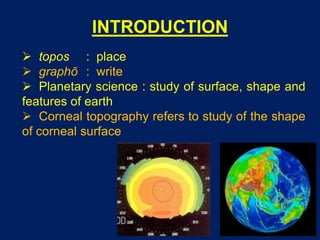
 Planetary science : study of surface, shape and
features of earth
 Corneal topography refers to study of the shape
of corneal surface
TOPOGRAPHY TECHNIQUES
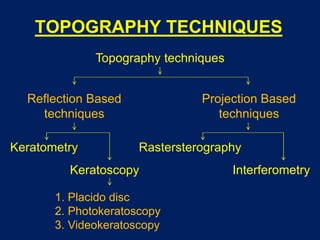
Topography techniques
Keratometry
Keratoscopy
1. Placido disc
2. Photokeratoscopy
3. Videokeratoscopy
Rastersterography
Interferometry
Reflection Based
techniques
Projection Based
techniques
KERATOSCOPY
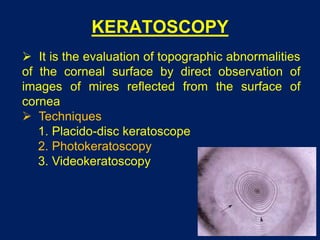
 It is the evaluation of topographic abnormalities
of the corneal surface by direct observation of
images of mires reflected from the surface of
cornea
 Techniques
1. Placido-disc keratoscope
2. Photokeratoscopy
3. Videokeratoscopy
PLACIDO-DISC KERATOSCOPE
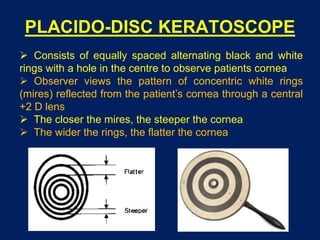
 Consists of equally spaced alternating black and white
rings with a hole in the centre to observe patients cornea
 Observer views the pattern of concentric white rings
(mires) reflected from the patient’s cornea through a central
+2 D lens
 The closer the mires, the steeper the cornea
 The wider the rings, the flatter the cornea
PLACIDO-DISC KERATOSCOPE
 Disadvantages
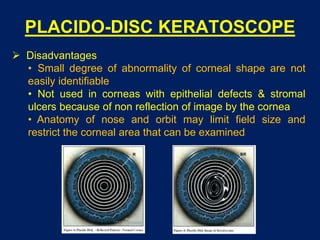
• Small degree of abnormality of corneal shape are not
easily identifiable
• Not used in corneas with epithelial defects & stromal
ulcers because of non reflection of image by the cornea
• Anatomy of nose and orbit may limit field size and
restrict the corneal area that can be examined
PHOTOKERATOSCOPY
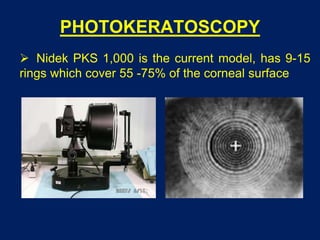
 When a photographic film camera is attached to a
keratoscope, it functions as a photokeratoscope
 In the technique, the keratoscopic image is
photographed wherein the size of the images on the
photographic film can be changed to change the size
of the corneal image
 The image of most photokeratoscope rings covers
the paracentral zone, overlapping into the central and
peripheral zones but leaving the optically important
central 2-3 mm as well as the peripheral cornea
PHOTOKERATOSCOPY
 Nidek PKS 1,000 is the current model, has 9-15
rings which cover 55 -75% of the corneal surface
VIDEOKERATOSCOPY
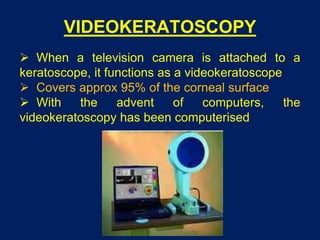
 When a television camera is attached to a
keratoscope, it functions as a videokeratoscope
 Covers approx 95% of the corneal surface
 With the advent of computers, the
videokeratoscopy has been computerised
RASTEREROGRAPHY
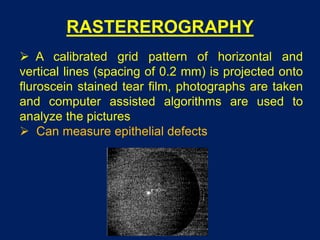
 A calibrated grid pattern of horizontal and
vertical lines (spacing of 0.2 mm) is projected onto
fluroscein stained tear film, photographs are taken
and computer assisted algorithms are used to
analyze the pictures
 Can measure epithelial defects
INTERFEROMETRY
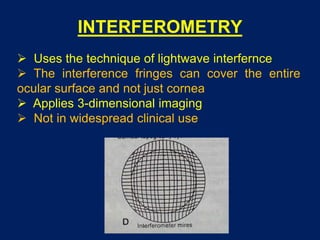
 Uses the technique of lightwave interfernce
 The interference fringes can cover the entire
ocular surface and not just cornea
 Applies 3-dimensional imaging
 Not in widespread clinical use
COMPUTER TOPOGRAPHY
SYSTEMS
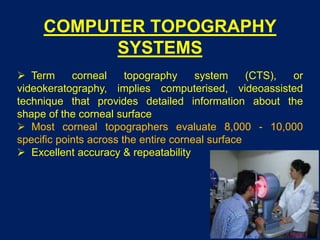
 Term corneal topography system (CTS), or
videokeratography, implies computerised, videoassisted
technique that provides detailed information about the
shape of the corneal surface
 Most corneal topographers evaluate 8,000 - 10,000
specific points across the entire corneal surface
 Excellent accuracy & repeatability
COMPUTER TOPOGRAPHY
SYSTEMS
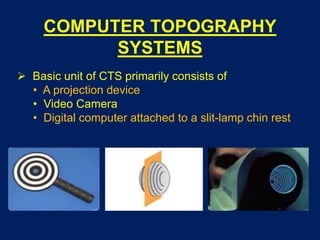
 Basic unit of CTS primarily consists of
• A projection device
• Video Camera
• Digital computer attached to a slit-lamp chin rest
COMPUTER TOPOGRAPHY
SYSTEMS
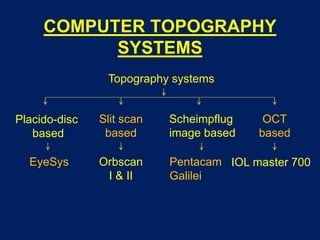
Topography systems
EyeSys Orbscan
I & II
IOL master 700
Scheimpflug
image based
OCT
based
Placido-disc
based
Slit scan
based
Pentacam
Galilei
COLOUR CODED
TOPOGRAPHIC MAP
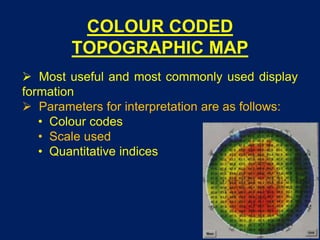
 Most useful and most commonly used display
formation
 Parameters for interpretation are as follows:
• Colour codes
• Scale used
• Quantitative indices
COLOUR CODES
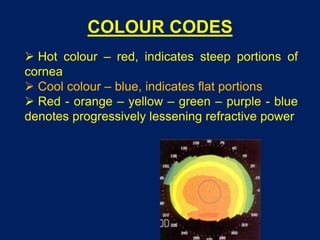
 Hot colour – red, indicates steep portions of
cornea
 Cool colour – blue, indicates flat portions
 Red - orange – yellow – green – purple - blue
denotes progressively lessening refractive power
SCALES
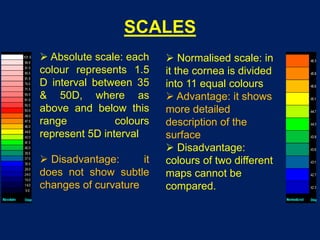
 Absolute scale: each
colour represents 1.5
D interval between 35
& 50D, where as
above and below this
range colours
represent 5D interval
 Disadvantage: it
does not show subtle
changes of curvature
 Normalised scale: in
it the cornea is divided
into 11 equal colours
 Advantage: it shows
more detailed
description of the
surface
 Disadvantage:
colours of two different
maps cannot be
compared.
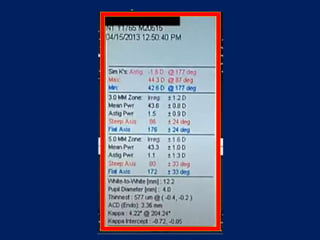
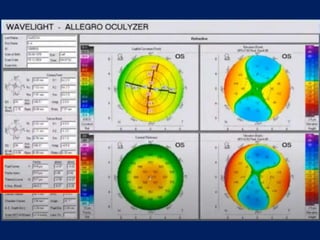
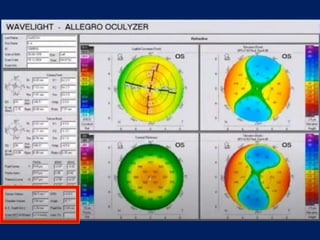
QUANTITATIVE INDICES
ORBSCAN
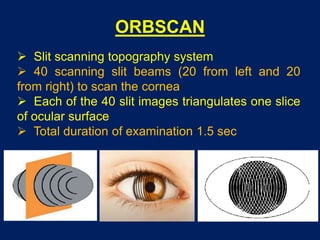
 Slit scanning topography system
 40 scanning slit beams (20 from left and 20
from right) to scan the cornea
 Each of the 40 slit images triangulates one slice
of ocular surface
 Total duration of examination 1.5 sec
ORBSCAN II
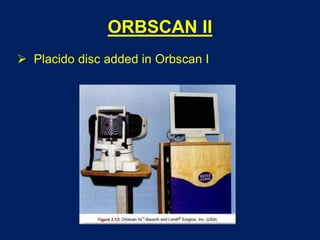
 Placido disc added in Orbscan I
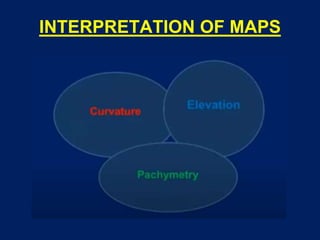
INTERPRETATION OF MAPS
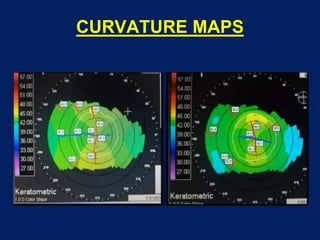
CURVATURE MAPS
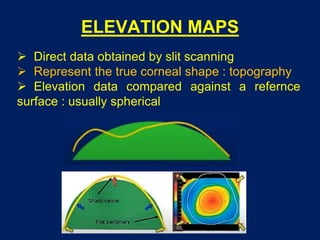
ELEVATION MAPS
 Direct data obtained by slit scanning
 Represent the true corneal shape : topography
 Elevation data compared against a refernce
surface : usually spherical
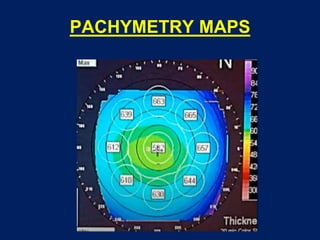
PACHYMETRY MAPS
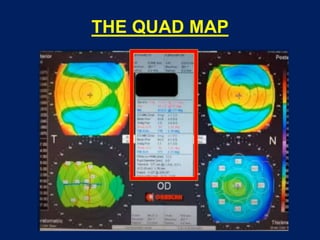
THE QUAD MAP
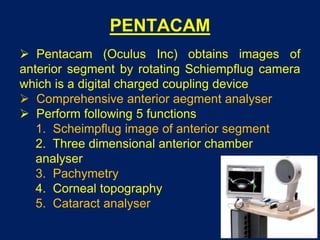
PENTACAM
 Pentacam (Oculus Inc) obtains images of
anterior segment by rotating Schiempflug camera
which is a digital charged coupling device
 Comprehensive anterior aegment analyser
 Perform following 5 functions
1. Scheimpflug image of anterior segment
2. Three dimensional anterior chamber
analyser
3. Pachymetry
4. Corneal topography
5. Cataract analyser
 Advantages of pentacam
• Takes 50 meridonial sections through centre of
cornea which allows the system to realign the
central thinnest point of each section before it
reconstructs the corneal image. Thus it
eliminates any eye movement occurring during
the examination
• Enables measurement of cornea with severe
irregularities such as keratoconus that may not
be possible with placido disc imaging
• Enables calculation of pachymetry from limbus
to limbus
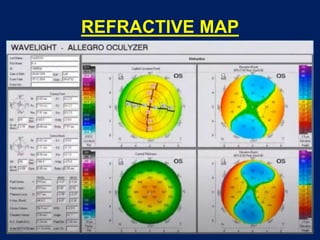
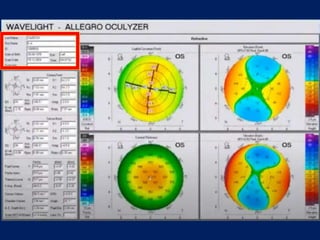
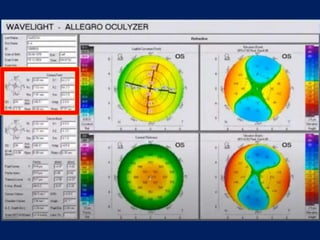
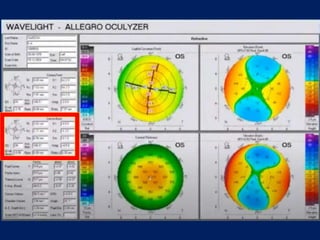
REFRACTIVE MAP
CLINICAL APPLICATIONS
 Preoperative and postoperative assessment of the
refractive patient
 Preoperative and postoperative assessment of
penetrating keratoplasty
 Irregular astigmatism
 Corneal distrophies, bullous keratopathy
 Keratoconus (diagnostic and follow-up)
 Follow-up of corneal ulceration or abscess
 Post-traumatic corneal scarring
 Contact lens fitting
 IOL power calculation
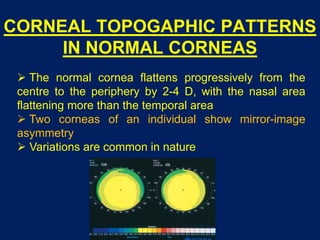
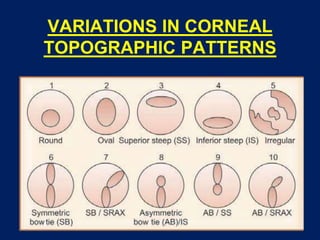
CORNEAL TOPOGAPHIC PATTERNS
IN NORMAL CORNEAS
 The normal cornea flattens progressively from the
centre to the periphery by 2-4 D, with the nasal area
flattening more than the temporal area
 Two corneas of an individual show mirror-image
asymmetry
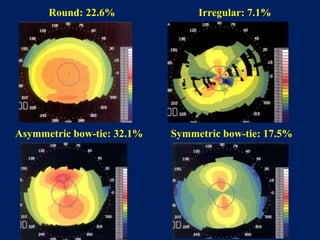
 Variations are common in nature
VARIATIONS IN CORNEAL
TOPOGRAPHIC PATTERNS
Round: 22.6%
Symmetric bow-tie: 17.5%Asymmetric bow-tie: 32.1%
Irregular: 7.1%
KERATOCONUS
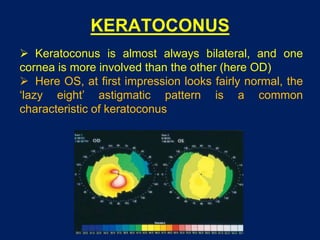
 Keratoconus is almost always bilateral, and one
cornea is more involved than the other (here OD)
 Here OS, at first impression looks fairly normal, the
‘lazy eight’ astigmatic pattern is a common
characteristic of keratoconus
PELLUCID MARGINAL
DEGENERATION
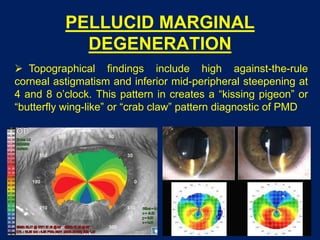
 Topographical findings include high against-the-rule
corneal astigmatism and inferior mid-peripheral steepening at
4 and 8 o’clock. This pattern in creates a “kissing pigeon” or
“butterfly wing-like” or “crab claw” pattern diagnostic of PMD
TERRIENS DEGENERATION
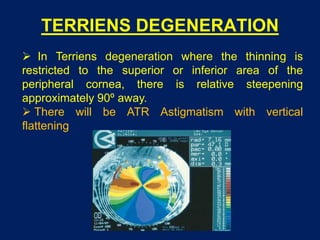
 In Terriens degeneration where the thinning is
restricted to the superior or inferior area of the
peripheral cornea, there is relative steepening
approximately 90º away.
 There will be ATR Astigmatism with vertical
flattening
PTERYGIUM
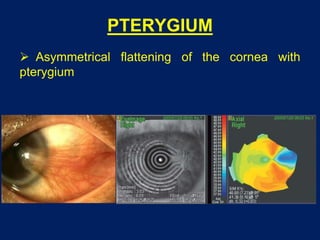
 Asymmetrical flattening of the cornea with
pterygium
THANK YOU

Corneal topography

  • 1.
    CORNEAL TOPOGRAPHY Dr SaurabhKushwaha Resident Ophthalmology
  • 2.
    SCOPE  Introduction  Topographytechniques  Keratoscopy  Computer topography systems  Colour coded topographic maps  Clinical Applications  Variations in corneal topographic patterns
  • 3.
    INTRODUCTION  topos :place  graphō : write  Planetary science : study of surface, shape and features of earth  Corneal topography refers to study of the shape of corneal surface
  • 4.
    TOPOGRAPHY TECHNIQUES Topography techniques Keratometry Keratoscopy 1.Placido disc 2. Photokeratoscopy 3. Videokeratoscopy Rastersterography Interferometry Reflection Based techniques Projection Based techniques
  • 5.
    KERATOSCOPY  It isthe evaluation of topographic abnormalities of the corneal surface by direct observation of images of mires reflected from the surface of cornea  Techniques 1. Placido-disc keratoscope 2. Photokeratoscopy 3. Videokeratoscopy
  • 6.
    PLACIDO-DISC KERATOSCOPE  Consistsof equally spaced alternating black and white rings with a hole in the centre to observe patients cornea  Observer views the pattern of concentric white rings (mires) reflected from the patient’s cornea through a central +2 D lens  The closer the mires, the steeper the cornea  The wider the rings, the flatter the cornea
  • 7.
    PLACIDO-DISC KERATOSCOPE  Disadvantages •Small degree of abnormality of corneal shape are not easily identifiable • Not used in corneas with epithelial defects & stromal ulcers because of non reflection of image by the cornea • Anatomy of nose and orbit may limit field size and restrict the corneal area that can be examined
  • 8.
    PHOTOKERATOSCOPY  When aphotographic film camera is attached to a keratoscope, it functions as a photokeratoscope  In the technique, the keratoscopic image is photographed wherein the size of the images on the photographic film can be changed to change the size of the corneal image  The image of most photokeratoscope rings covers the paracentral zone, overlapping into the central and peripheral zones but leaving the optically important central 2-3 mm as well as the peripheral cornea
  • 9.
    PHOTOKERATOSCOPY  Nidek PKS1,000 is the current model, has 9-15 rings which cover 55 -75% of the corneal surface
  • 10.
    VIDEOKERATOSCOPY  When atelevision camera is attached to a keratoscope, it functions as a videokeratoscope  Covers approx 95% of the corneal surface  With the advent of computers, the videokeratoscopy has been computerised
  • 11.
    RASTEREROGRAPHY  A calibratedgrid pattern of horizontal and vertical lines (spacing of 0.2 mm) is projected onto fluroscein stained tear film, photographs are taken and computer assisted algorithms are used to analyze the pictures  Can measure epithelial defects
  • 12.
    INTERFEROMETRY  Uses thetechnique of lightwave interfernce  The interference fringes can cover the entire ocular surface and not just cornea  Applies 3-dimensional imaging  Not in widespread clinical use
  • 13.
    COMPUTER TOPOGRAPHY SYSTEMS  Termcorneal topography system (CTS), or videokeratography, implies computerised, videoassisted technique that provides detailed information about the shape of the corneal surface  Most corneal topographers evaluate 8,000 - 10,000 specific points across the entire corneal surface  Excellent accuracy & repeatability
  • 14.
    COMPUTER TOPOGRAPHY SYSTEMS  Basicunit of CTS primarily consists of • A projection device • Video Camera • Digital computer attached to a slit-lamp chin rest
  • 15.
    COMPUTER TOPOGRAPHY SYSTEMS Topography systems EyeSysOrbscan I & II IOL master 700 Scheimpflug image based OCT based Placido-disc based Slit scan based Pentacam Galilei
  • 16.
    COLOUR CODED TOPOGRAPHIC MAP Most useful and most commonly used display formation  Parameters for interpretation are as follows: • Colour codes • Scale used • Quantitative indices
  • 17.
    COLOUR CODES  Hotcolour – red, indicates steep portions of cornea  Cool colour – blue, indicates flat portions  Red - orange – yellow – green – purple - blue denotes progressively lessening refractive power
  • 18.
    SCALES  Absolute scale:each colour represents 1.5 D interval between 35 & 50D, where as above and below this range colours represent 5D interval  Disadvantage: it does not show subtle changes of curvature  Normalised scale: in it the cornea is divided into 11 equal colours  Advantage: it shows more detailed description of the surface  Disadvantage: colours of two different maps cannot be compared.
  • 19.
  • 20.
    ORBSCAN  Slit scanningtopography system  40 scanning slit beams (20 from left and 20 from right) to scan the cornea  Each of the 40 slit images triangulates one slice of ocular surface  Total duration of examination 1.5 sec
  • 21.
    ORBSCAN II  Placidodisc added in Orbscan I
  • 22.
  • 23.
  • 24.
    ELEVATION MAPS  Directdata obtained by slit scanning  Represent the true corneal shape : topography  Elevation data compared against a refernce surface : usually spherical
  • 25.
  • 26.
  • 28.
    PENTACAM  Pentacam (OculusInc) obtains images of anterior segment by rotating Schiempflug camera which is a digital charged coupling device  Comprehensive anterior aegment analyser  Perform following 5 functions 1. Scheimpflug image of anterior segment 2. Three dimensional anterior chamber analyser 3. Pachymetry 4. Corneal topography 5. Cataract analyser
  • 29.
     Advantages ofpentacam • Takes 50 meridonial sections through centre of cornea which allows the system to realign the central thinnest point of each section before it reconstructs the corneal image. Thus it eliminates any eye movement occurring during the examination • Enables measurement of cornea with severe irregularities such as keratoconus that may not be possible with placido disc imaging • Enables calculation of pachymetry from limbus to limbus
  • 30.
  • 36.
    CLINICAL APPLICATIONS  Preoperativeand postoperative assessment of the refractive patient  Preoperative and postoperative assessment of penetrating keratoplasty  Irregular astigmatism  Corneal distrophies, bullous keratopathy  Keratoconus (diagnostic and follow-up)  Follow-up of corneal ulceration or abscess  Post-traumatic corneal scarring  Contact lens fitting  IOL power calculation
  • 37.
    CORNEAL TOPOGAPHIC PATTERNS INNORMAL CORNEAS  The normal cornea flattens progressively from the centre to the periphery by 2-4 D, with the nasal area flattening more than the temporal area  Two corneas of an individual show mirror-image asymmetry  Variations are common in nature
  • 38.
  • 39.
    Round: 22.6% Symmetric bow-tie:17.5%Asymmetric bow-tie: 32.1% Irregular: 7.1%
  • 40.
    KERATOCONUS  Keratoconus isalmost always bilateral, and one cornea is more involved than the other (here OD)  Here OS, at first impression looks fairly normal, the ‘lazy eight’ astigmatic pattern is a common characteristic of keratoconus
  • 41.
    PELLUCID MARGINAL DEGENERATION  Topographicalfindings include high against-the-rule corneal astigmatism and inferior mid-peripheral steepening at 4 and 8 o’clock. This pattern in creates a “kissing pigeon” or “butterfly wing-like” or “crab claw” pattern diagnostic of PMD
  • 42.
    TERRIENS DEGENERATION  InTerriens degeneration where the thinning is restricted to the superior or inferior area of the peripheral cornea, there is relative steepening approximately 90º away.  There will be ATR Astigmatism with vertical flattening
  • 43.
    PTERYGIUM  Asymmetrical flatteningof the cornea with pterygium
  • 44.