MADE BY : SWATI PANARA
FROM : BHARTIMAIYA COLLEGE OF
OPTOMETRY
2nd YEAR 3rd SEMESTER
1
•
2
INTRODUCTION
• Polarized lenses are transparent pieces of material, usually glass or
plastic, that block certain types of light waves.
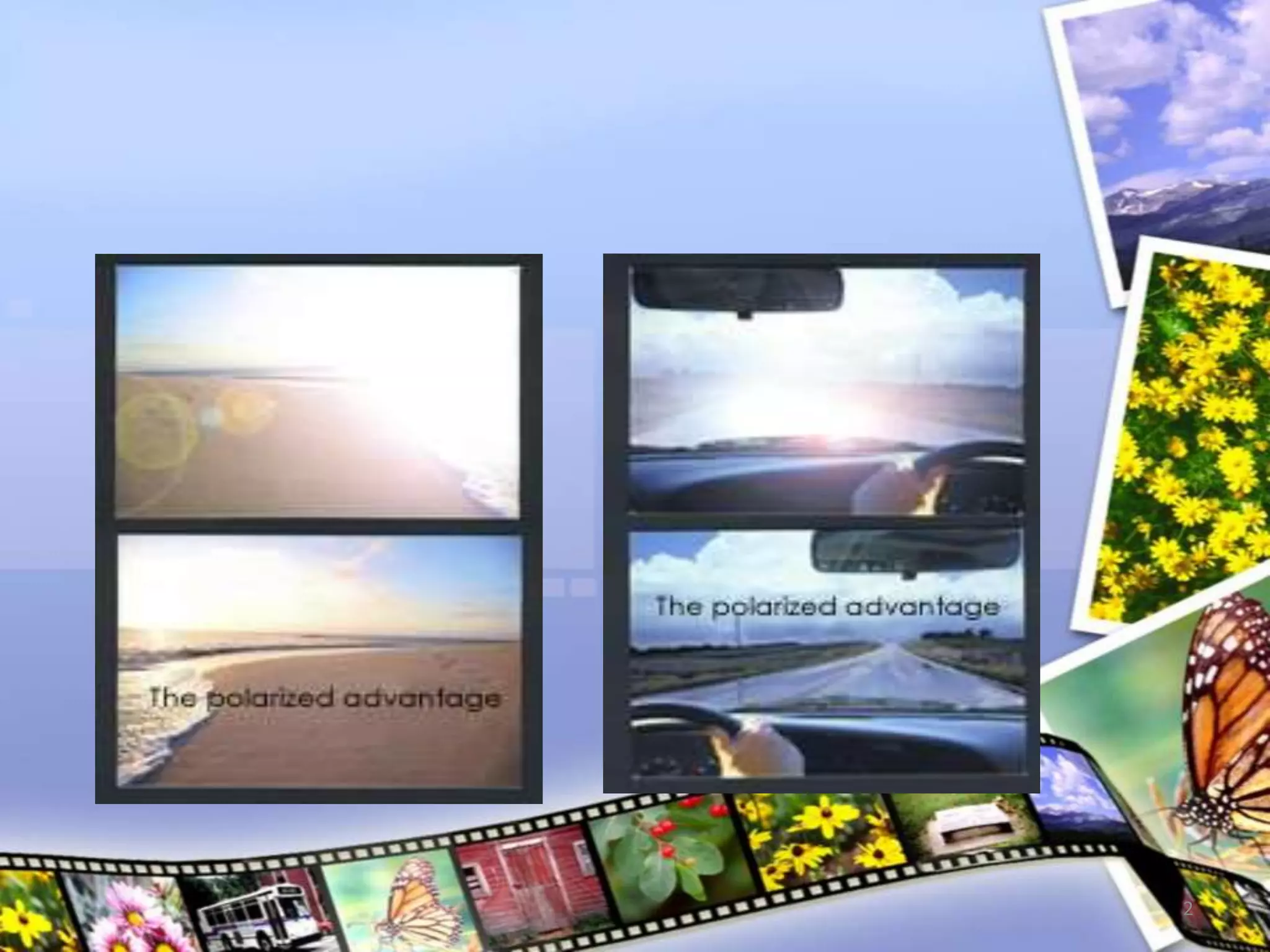
• Polaroid polarized lenses block out virtually 100% of glare.
3
OTHER NAME
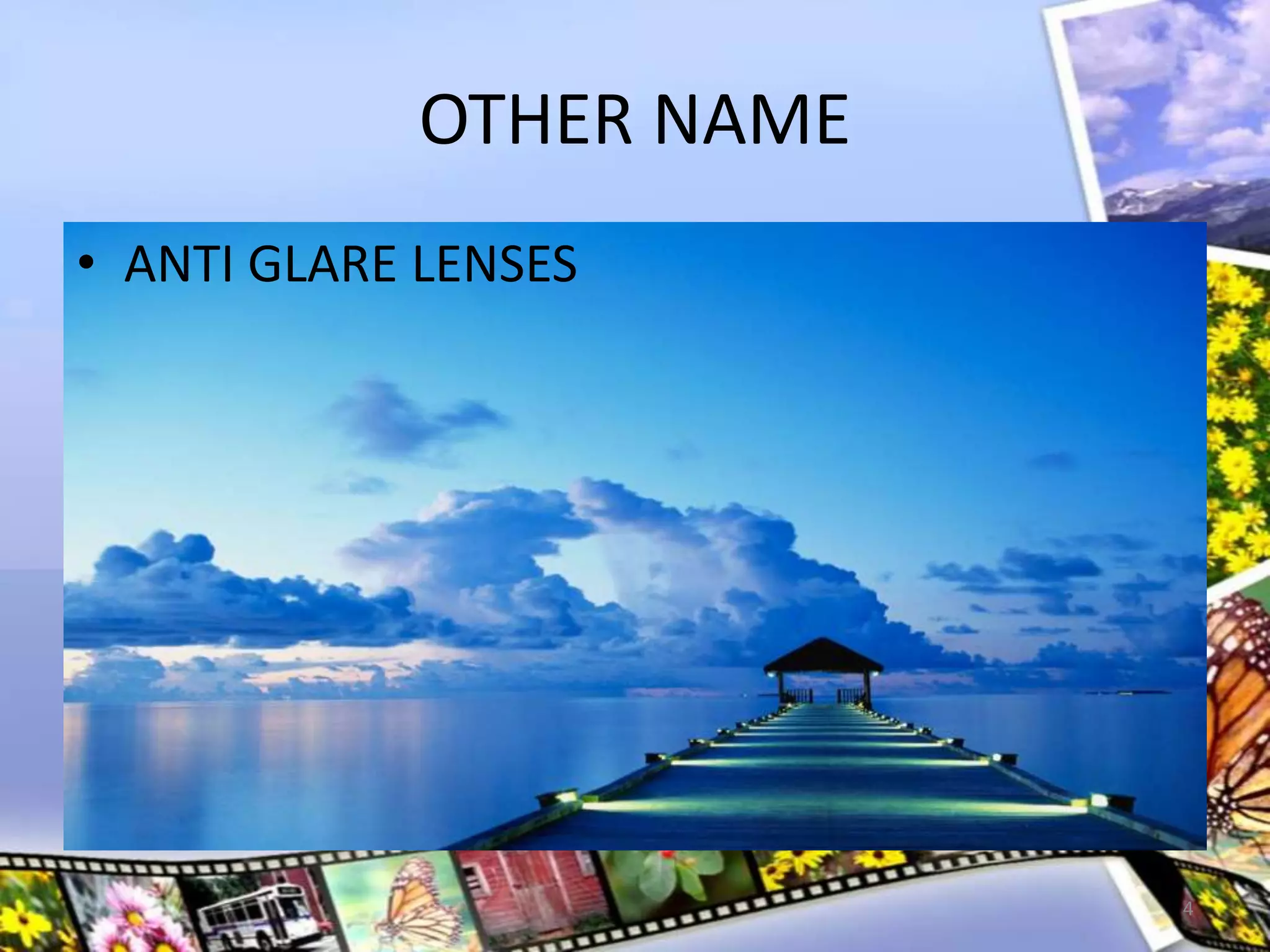
• ANTI GLARE LENSES
4
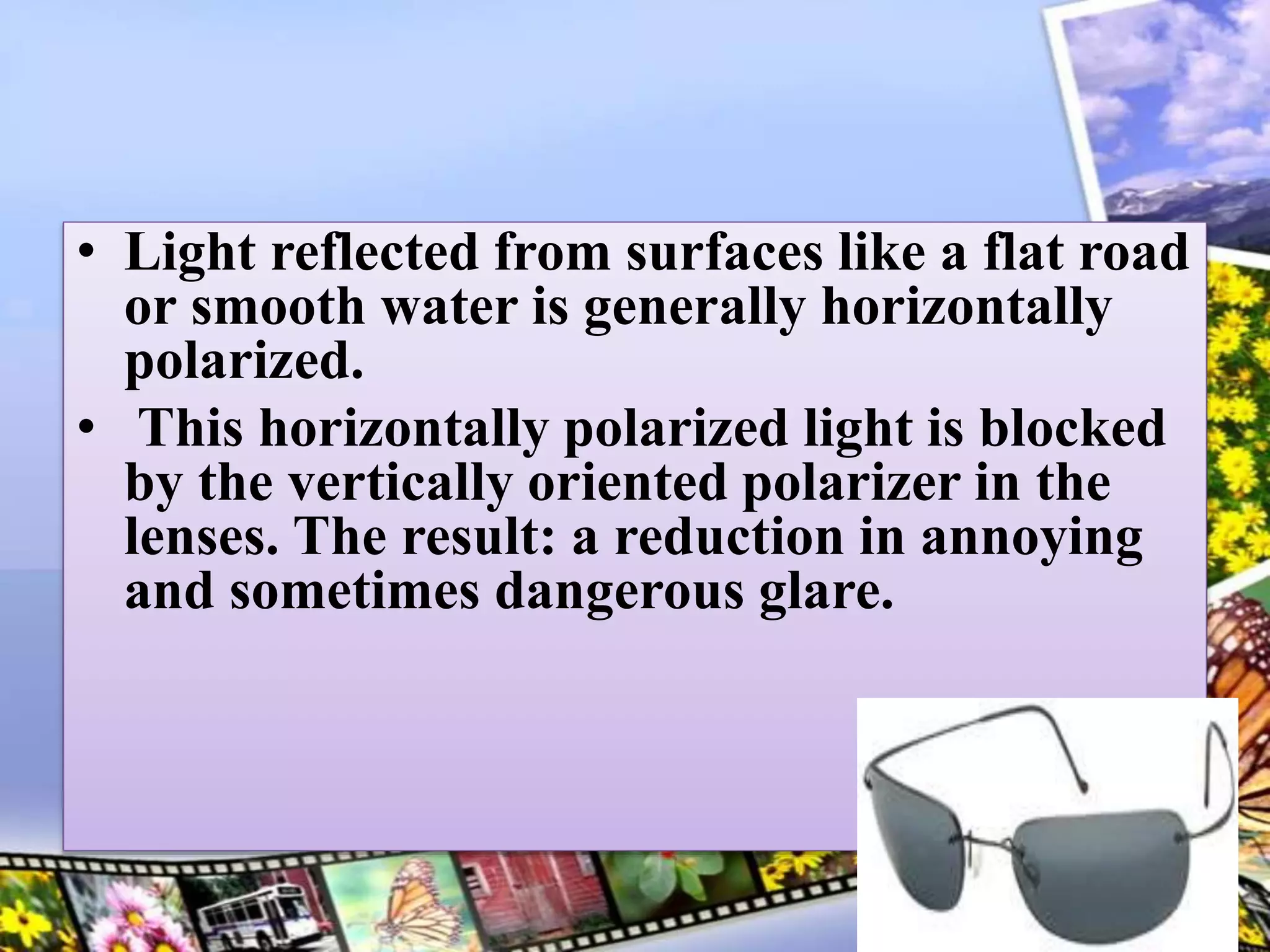
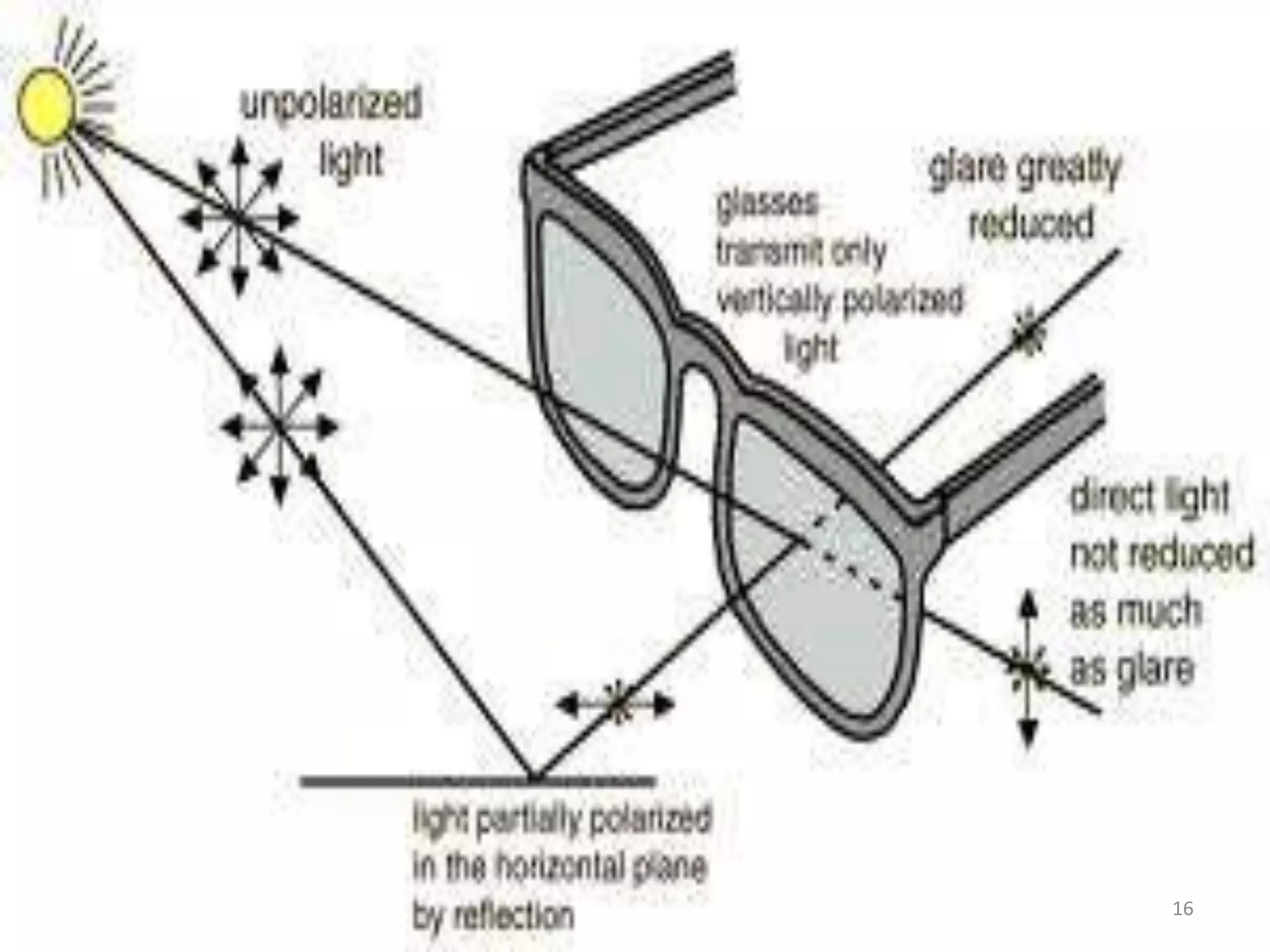
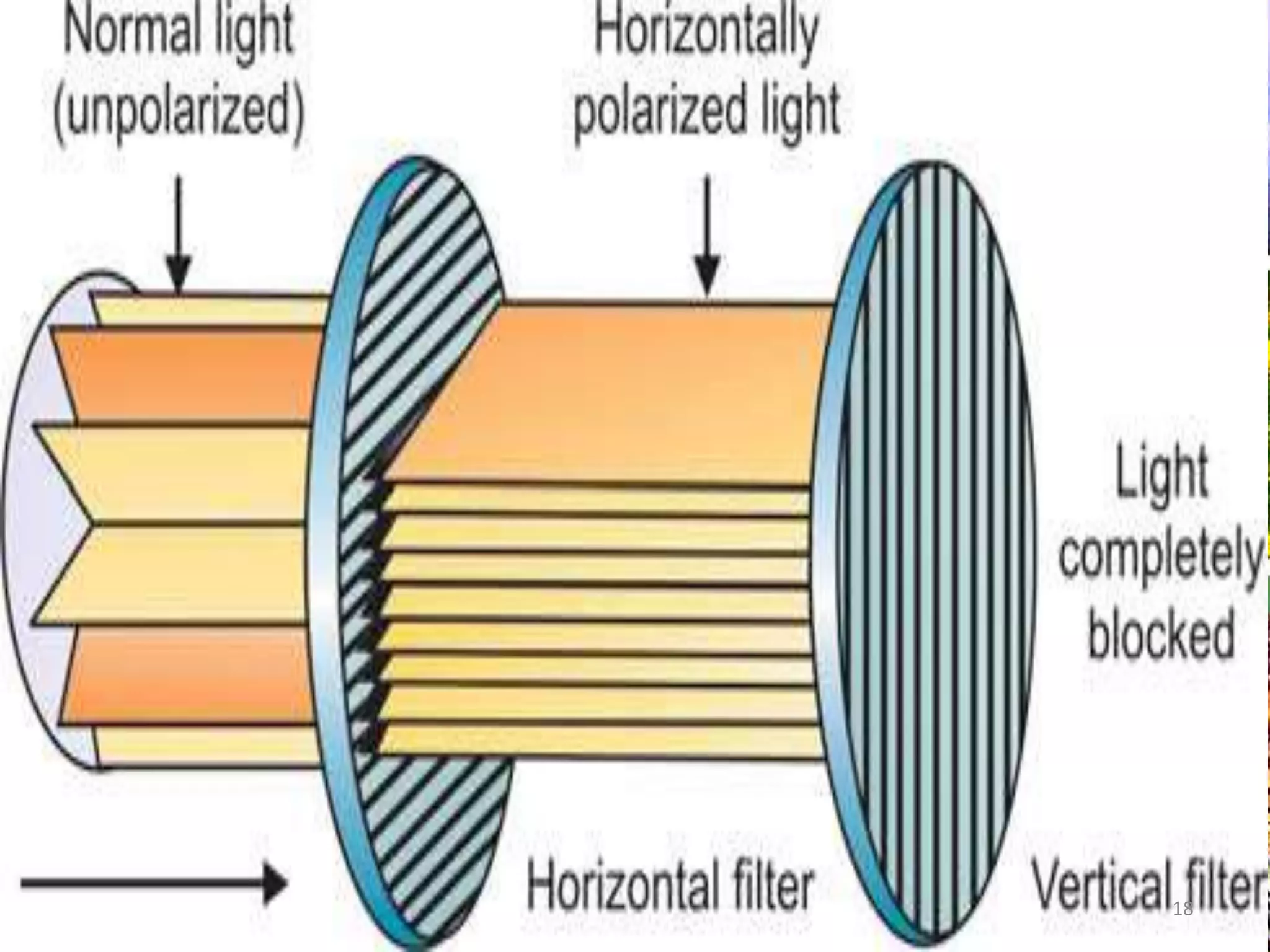
• Light reflected from surfaces like a flat road
or smooth water is generally horizontally
polarized.
• This horizontally polarized light is blocked
by the vertically oriented polarizer in the
lenses. The result: a reduction in annoying
and sometimes dangerous glare.
5
• WHEN DIRECT SUNLIGHT OR ARTIFICIAL
LOGHT HIT A SMOOTH SURFACE AT A GIVEN
ANGLE , IT REFLECT OFF THE SMOOTH
SURFACE AND TRAVELS IN THE SAME
DIRECTION , INTENSIFYING THEIR EFFECT ON
THE EYES.
• THIS PHENOMENON PRODUCE GLARE.
6
GLARE-
• TWO TYPES-
DISCOMFORT GLARE
DISABLILTY GLARE
7
DISABILITY GLARE-
• The most dangerous form of glare is disability glare. This is the type of glare that
causes the patient to instinctively avert his or her eyes.
• Reflection off the roads, water, ice, hoods of vehicles and sand are the main causes
of this glare type.
• Further, it is disability glare that most concerns the eye care professional when
providing the patient with the appropriate sunwear.
• Disability glare poses a hazard to the patient if not treated properly, due to safety
risks that averting the eye can cause during activities such as driving and water
sports .
8
DISCOMFORT GLARE-
• Discomfort glare is a very subtle form of glare.
• It causes the visual system to over exert itself resulting in eye strain,
headaches, and physical fatigue.
• Common causes of this glare type are light that is reflected off
spectacle lenses, computer screens, windshields; as well as light color
surfaces such as paper and walls.
9
Brewster’s Angle
• This occurs when the tangent of the angle of
incidence is equal to the index of refraction of
the medium to which the light is incident ,
that is Tan i = n
• The plane of polarization of the reflected
light is parallel to the reflecting surface or
perpendicular to the plane of the incident
light.
10
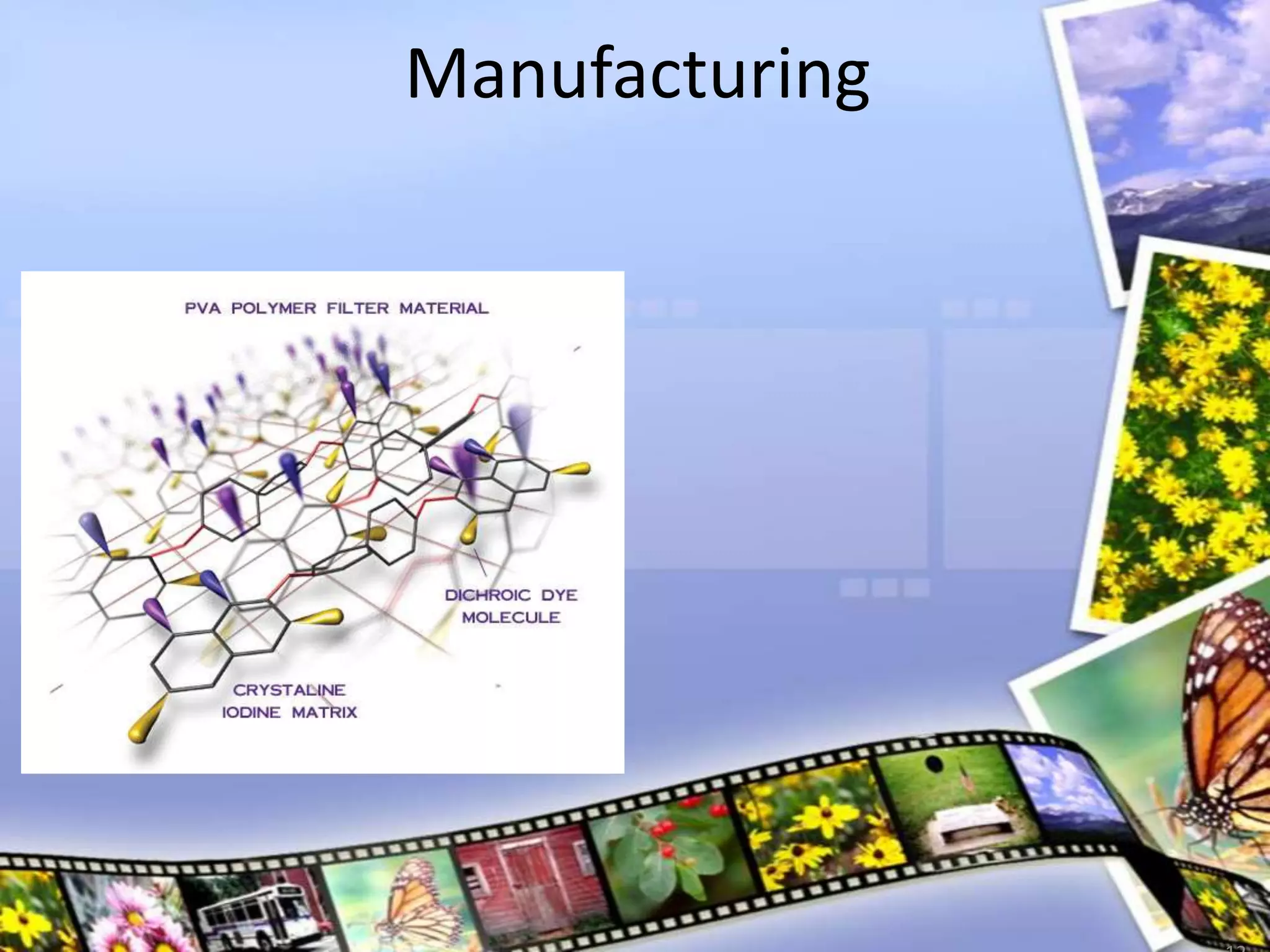
Manufacturing
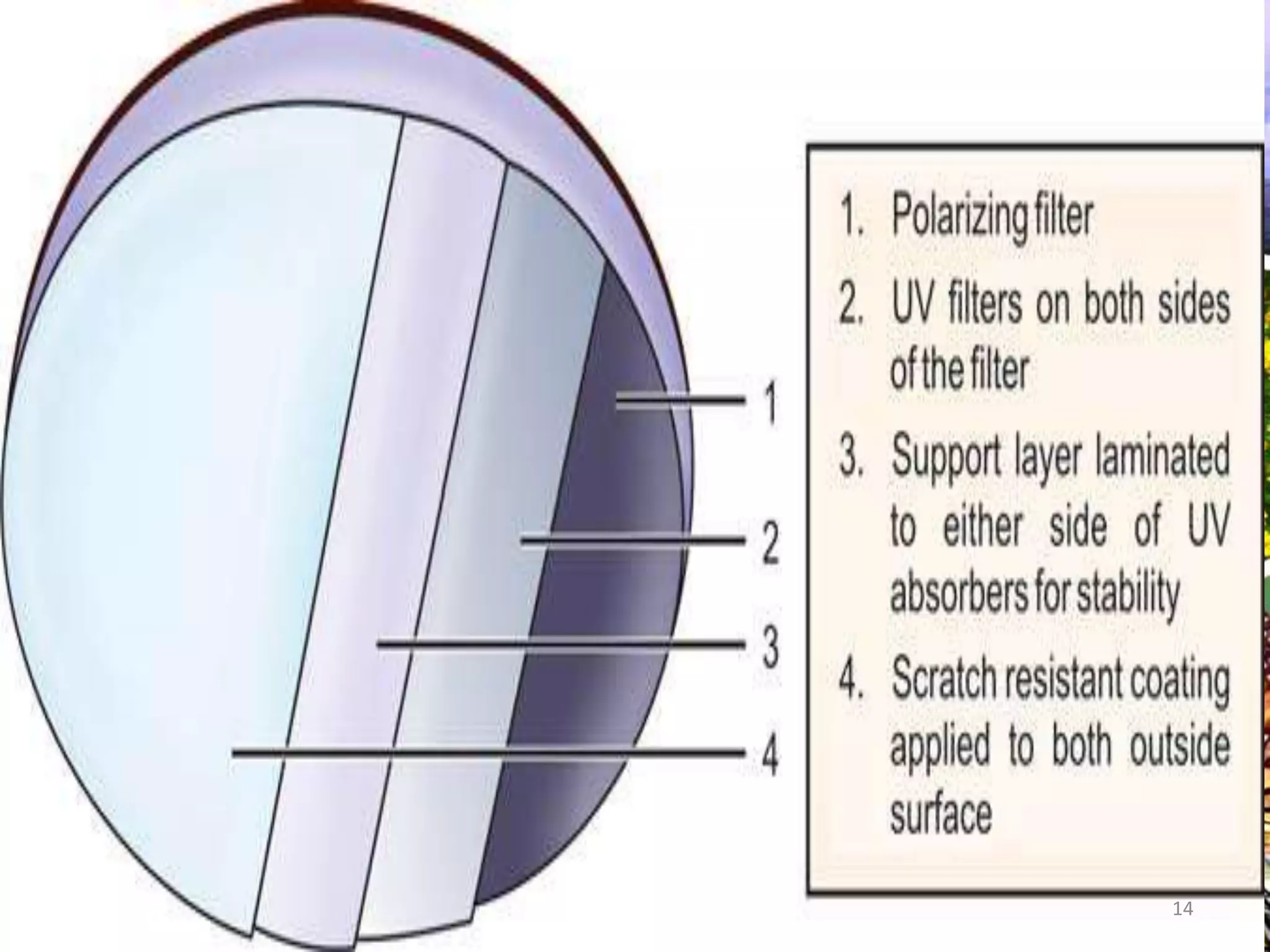
• Polarizing filters are created by stretching sheets
of polyvinyl alcohol (PVA) so its molecules align
in long directional chains. The PVA is then
passed through an iodine solution where the
light absorbing iodine molecules attach to the
molecular chains forming the microscopic blinds.
The film is then incorporated into the lens blank
as it is poured, creating polarized lenses
11
Manufacturing
Manufacturing
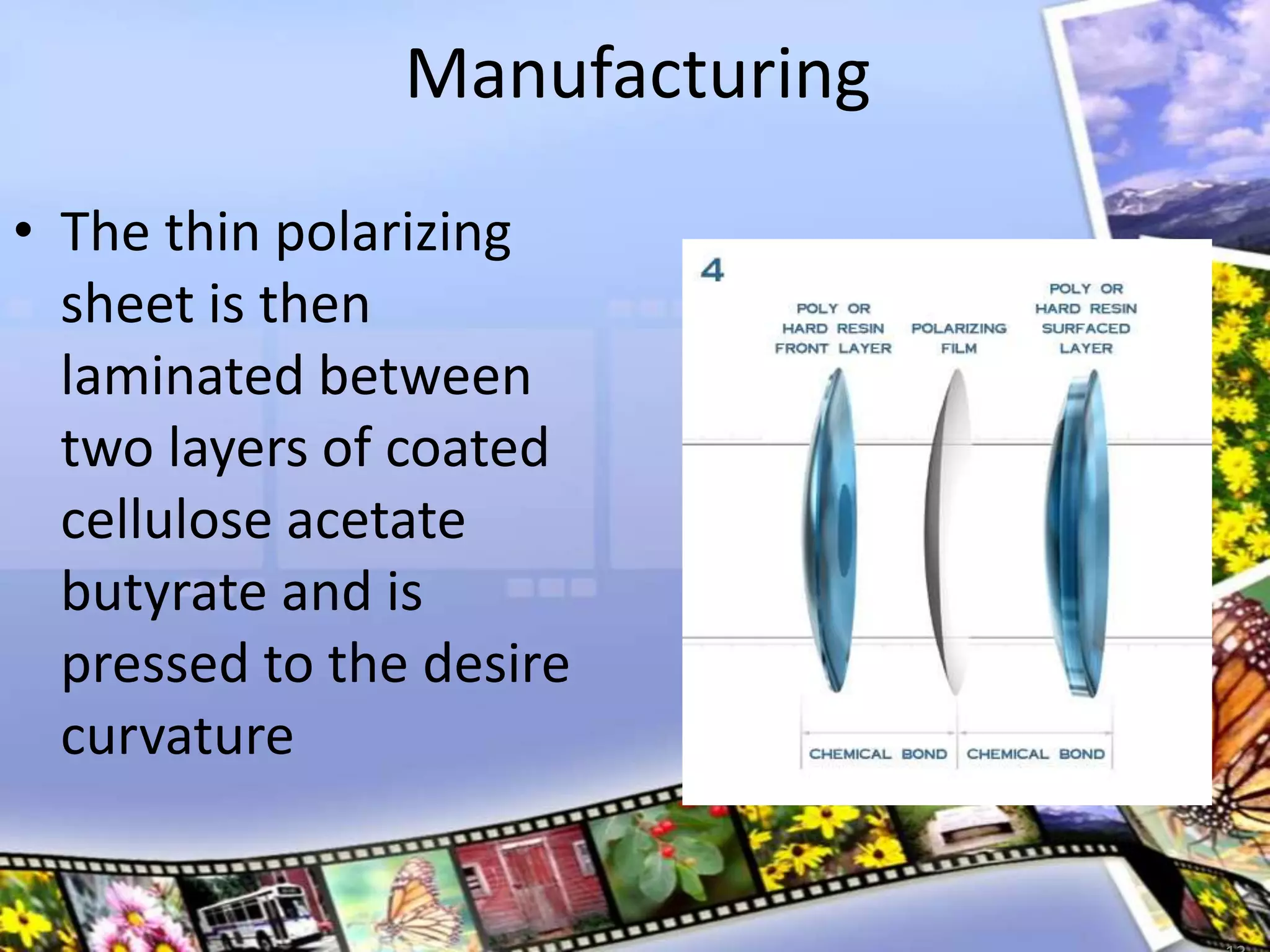
• The thin polarizing
sheet is then
laminated between
two layers of coated
cellulose acetate
butyrate and is
pressed to the desire
curvature
14
POLARIZATION
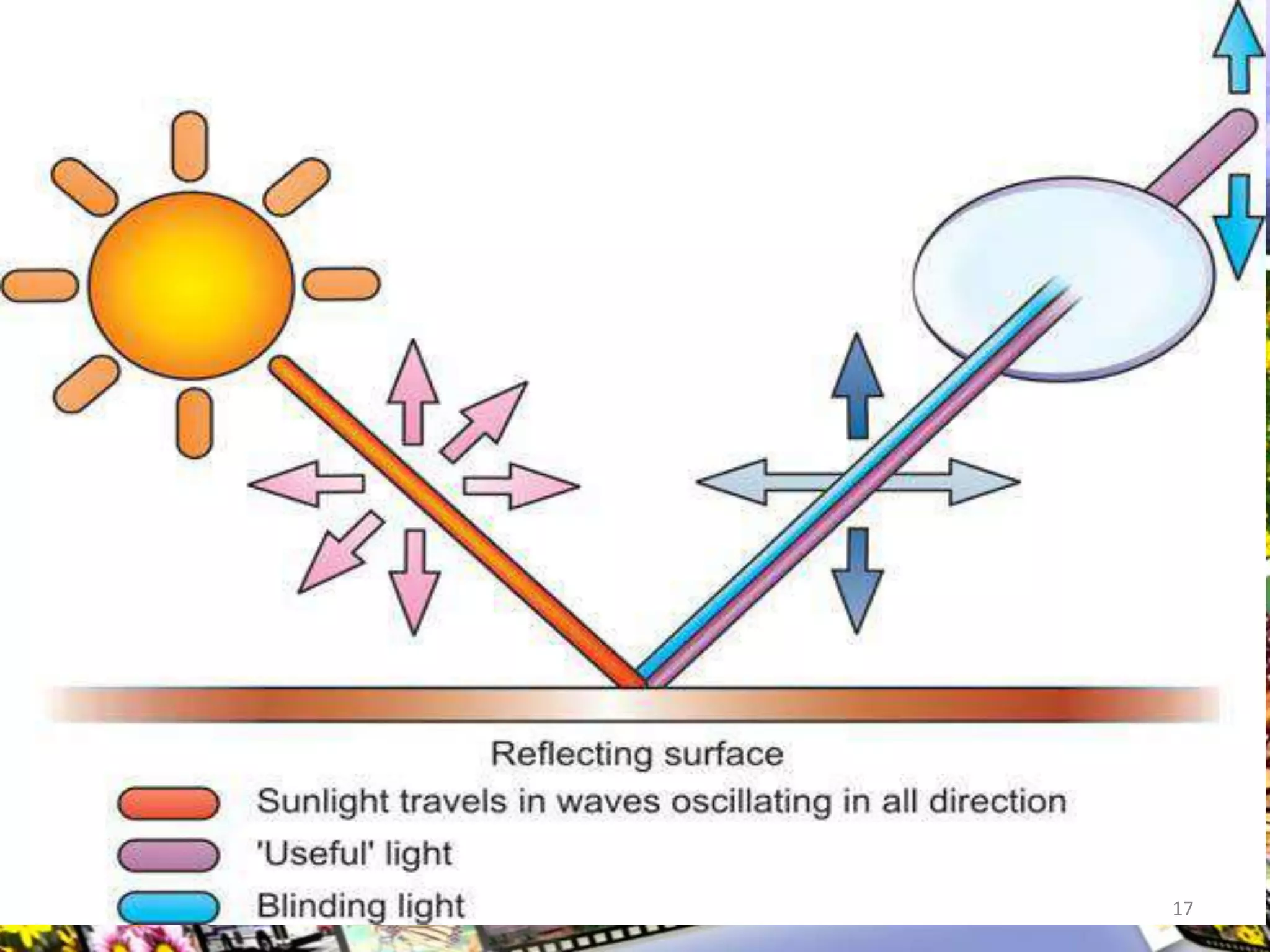
• Polarization is the breaking down of a light wave that travels in all directions, into
rays that travel in two directions.
• Although the direct light coming from the sun in not polarized, when the light
hits a highly reflective surface, it is broken down into horizontal and vertical
polarized beams.
• Since most reflective surfaces are on a horizontal plane, such as water or the hood
of a car, the polarized beams that cause the most disability glare is the horizontal
polarized light.
• Therefore, to eliminate the horizontal polarized light from reaching the eye, a filter
is fixed at an angle that only allows vertical polarized light to enter the eye .
15
16
17
18
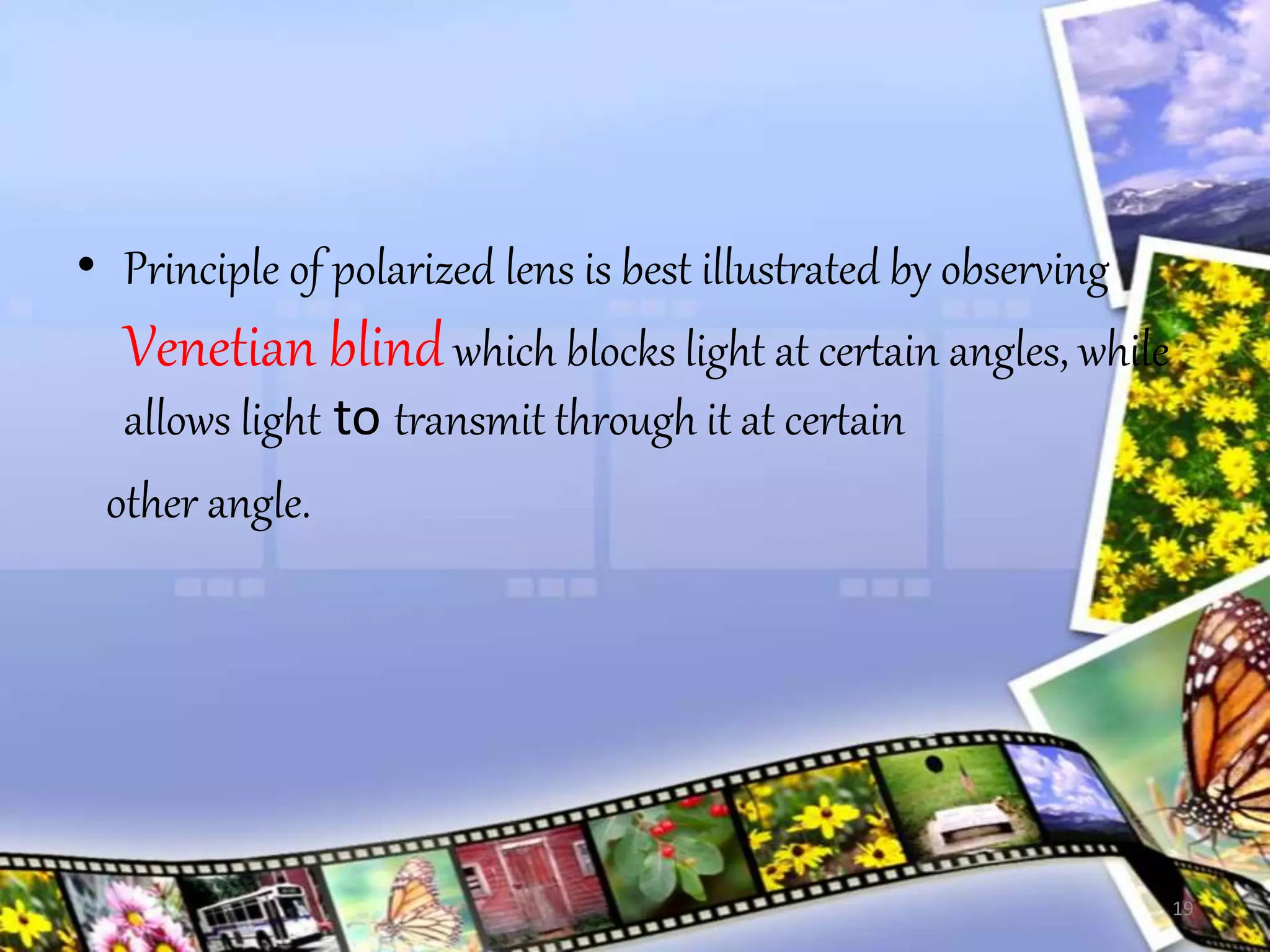
• Principle of polarized lens is best illustrated by observing
Venetian blindwhich blocks light at certain angles, while
allows light to transmit through it at certain
other angle.
19
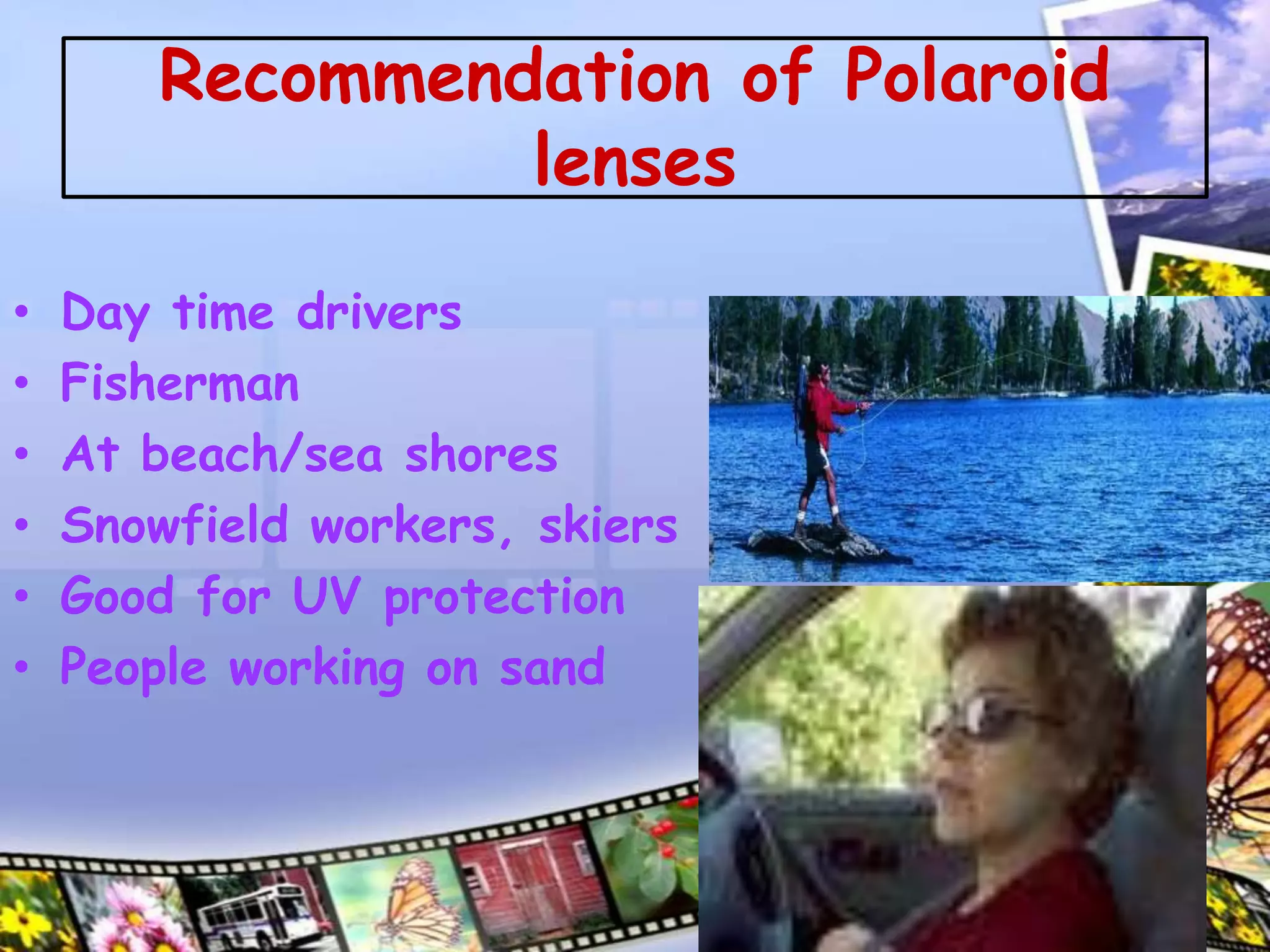
Recommendation of Polaroid
lenses
• Day time drivers
• Fisherman
• At beach/sea shores
• Snowfield workers, skiers
• Good for UV protection
• People working on sand
20
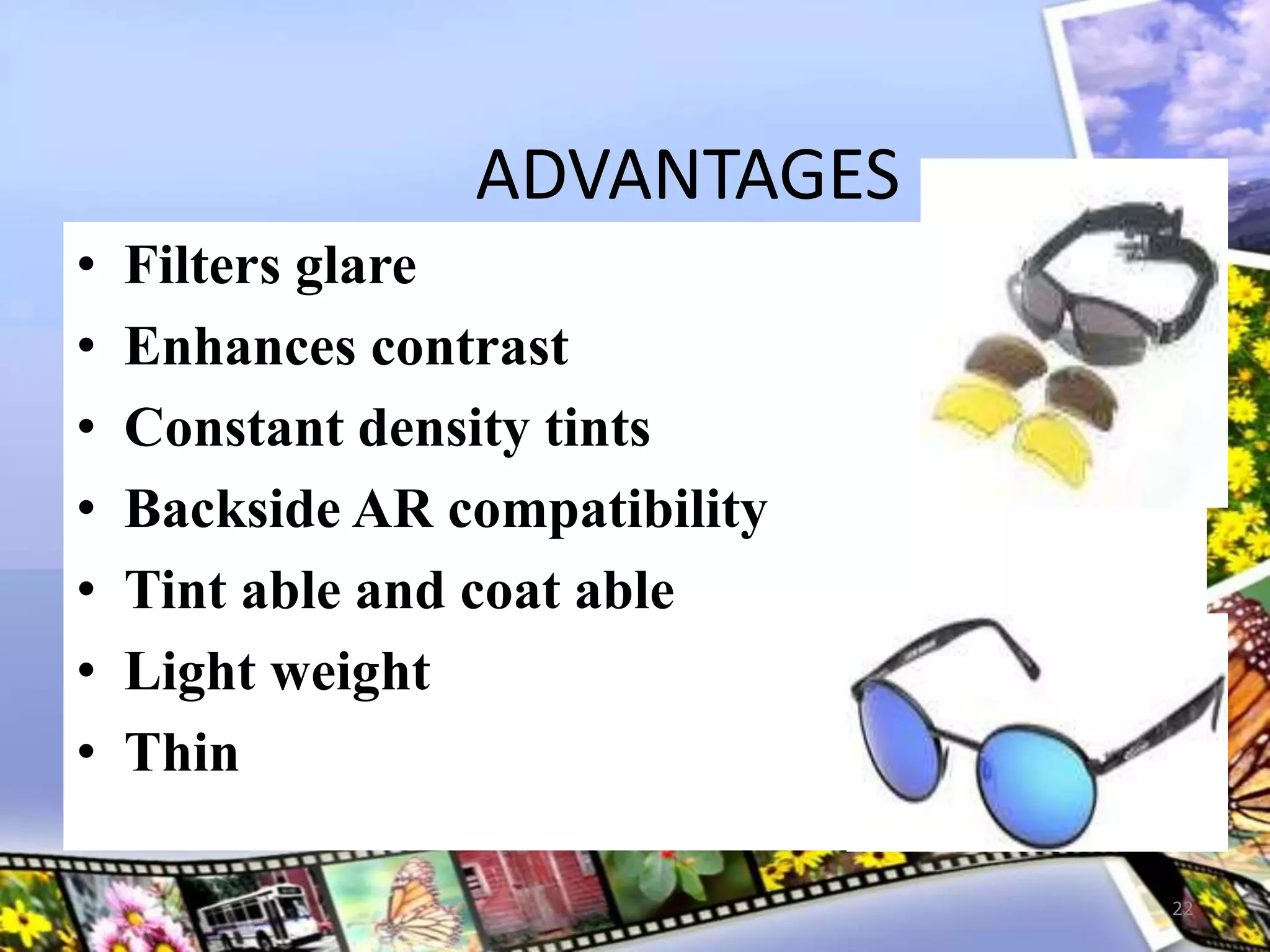
AVAIBELITY
• SINGLE VISION LENSES
• MULTIFOCAL
• THEY ARE AVAILABLE IN GLASS PLASTIC ,
POLY CARBONATE , HI INDEX.
• NOW , POLAROID LENSES ARE AVAILABLE IN
PHOTO CHROMIC LENS.
• TINT LENS IS AVAOLABLE.
21
ADVANTAGES
• Filters glare
• Enhances contrast
• Constant density tints
• Backside AR compatibility
• Tint able and coat able
• Light weight
• Thin
22
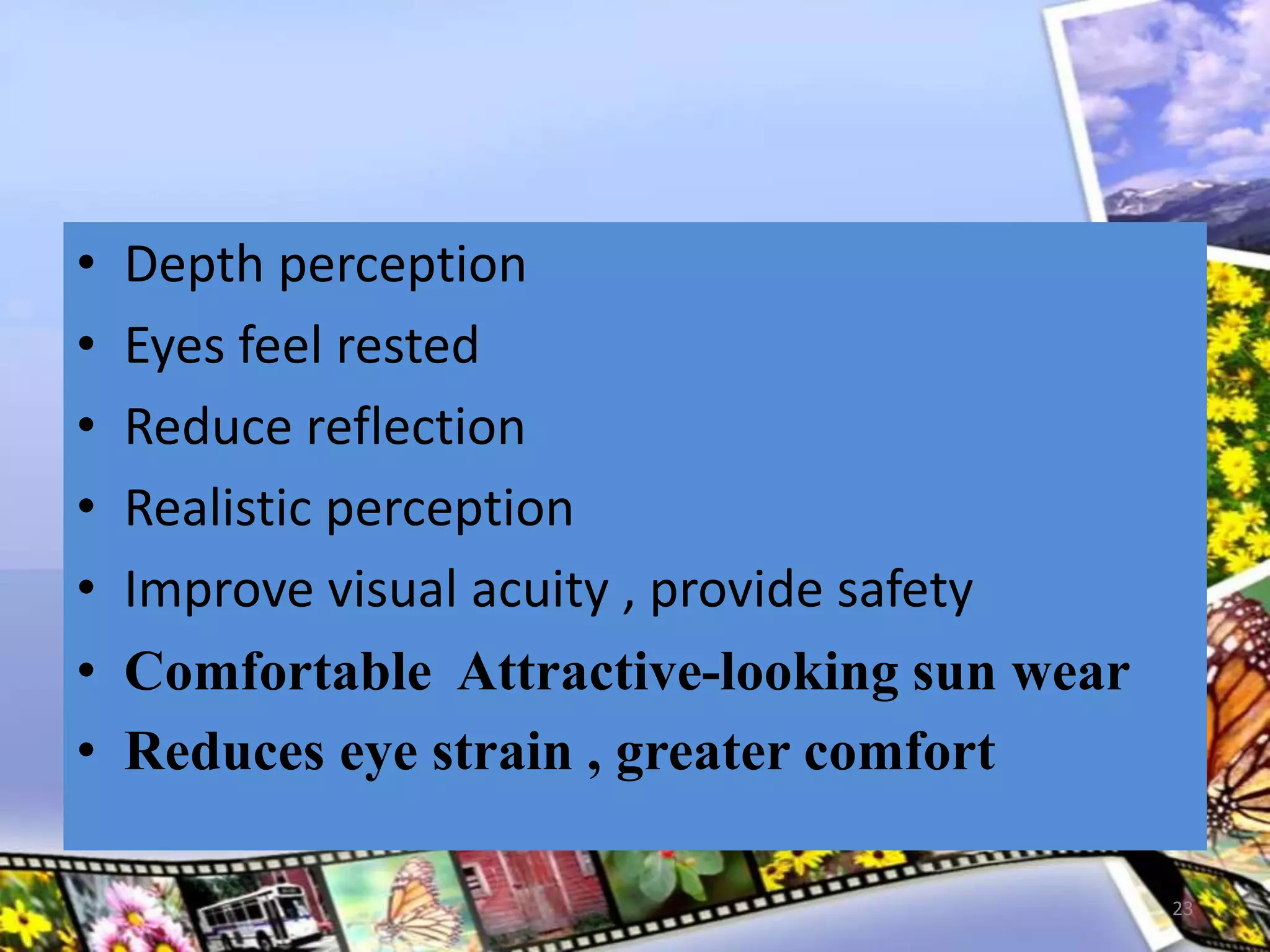
• Depth perception
• Eyes feel rested
• Reduce reflection
• Realistic perception
• Improve visual acuity , provide safety
• Comfortable Attractive-looking sun wear
• Reduces eye strain , greater comfort
23
24
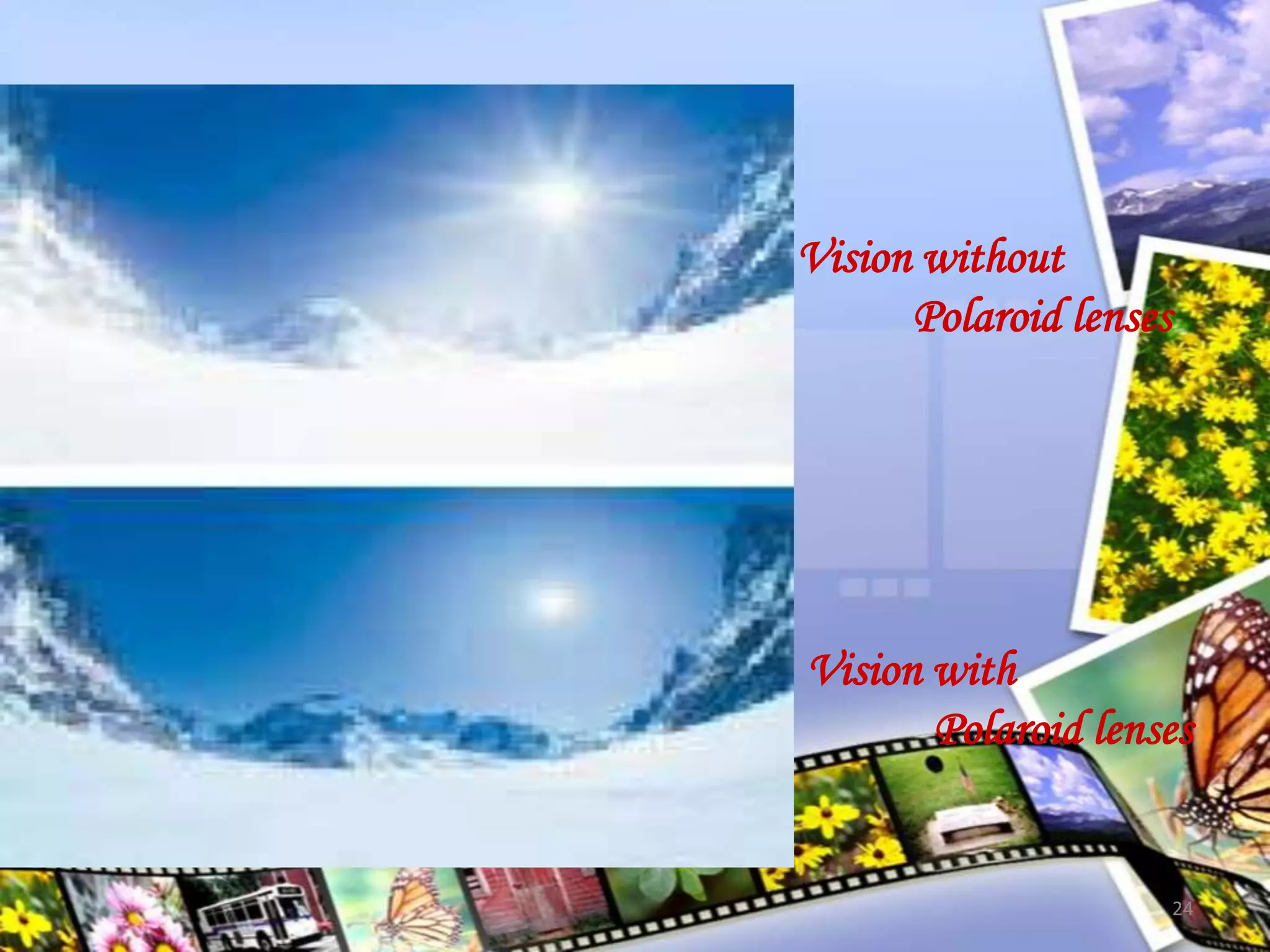
Vision without
Polaroid lenses
Vision with
Polaroid lenses
COLOUR
• Gray: The most popular color for sunglasses in the U.S., gray
transmits all colors evenly. It makes a good everyday or all-
purpose choice of sunglasses. It is recommended for ocean
fishing, where the water tends to be blue. "Classic gray" is a
color that provides near-natural vision and true color
perception
25
• All purpose sun wear
• Driving
• Sport activities
• Water activities
26
• Brown: Because brown improves contrast and depth perception, it is
best for driving and shallow-water fishing. Light brown is a good color
for overcast days and is recommended for skiers and golfers. Brown is
another popular color, especially among the fashion-conscious,
because many fashion authorities believe that brown is flattering to the
face.
27
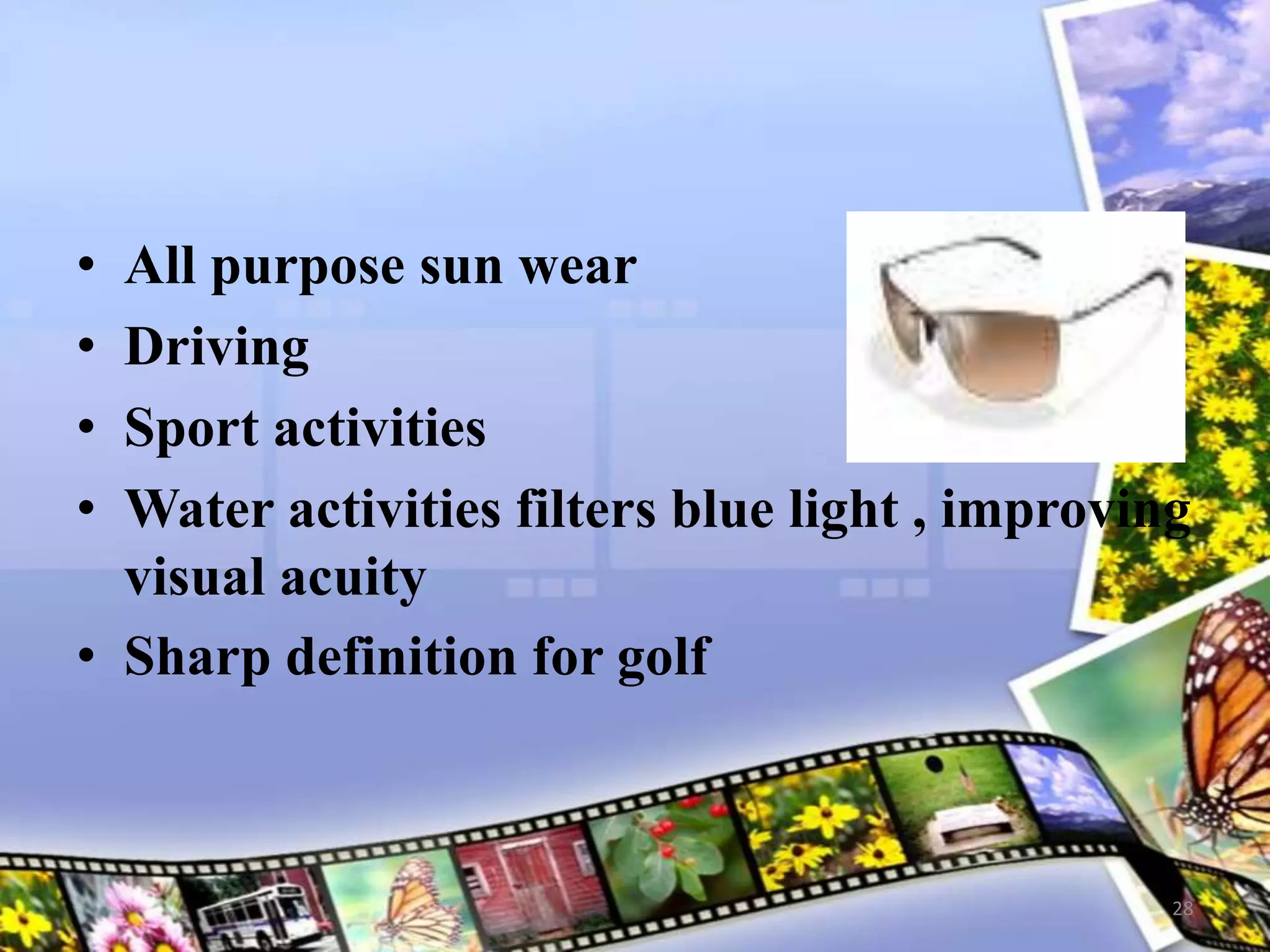
• All purpose sun wear
• Driving
• Sport activities
• Water activities filters blue light , improving
visual acuity
• Sharp definition for golf
28
• Blue: Blue allows the most blue light to filter through, so it is
good in partly cloudy weather. Blue is a popular lens color
among tennis players and golfers.
29
• Green: Green improves contrast slightly, and keeps a good
balance among the colors of light. It is a popular color for
tennis, golf, or driving
30
• Yellow: This color filters out blue light. Because it provides the
highest level of contrast, it is perfect for cloudy-day driving.
31
• Violet: Violet causes green to fade and enhances orange,
green, and black. It is good for shooting under average
conditions.
32
• Red: Red is primarily used by sportsmen working in bright,
sunny places.
33
• Copper: Copper provides maximum contrast and is best for
any activity in which good vision is important .
34
USES
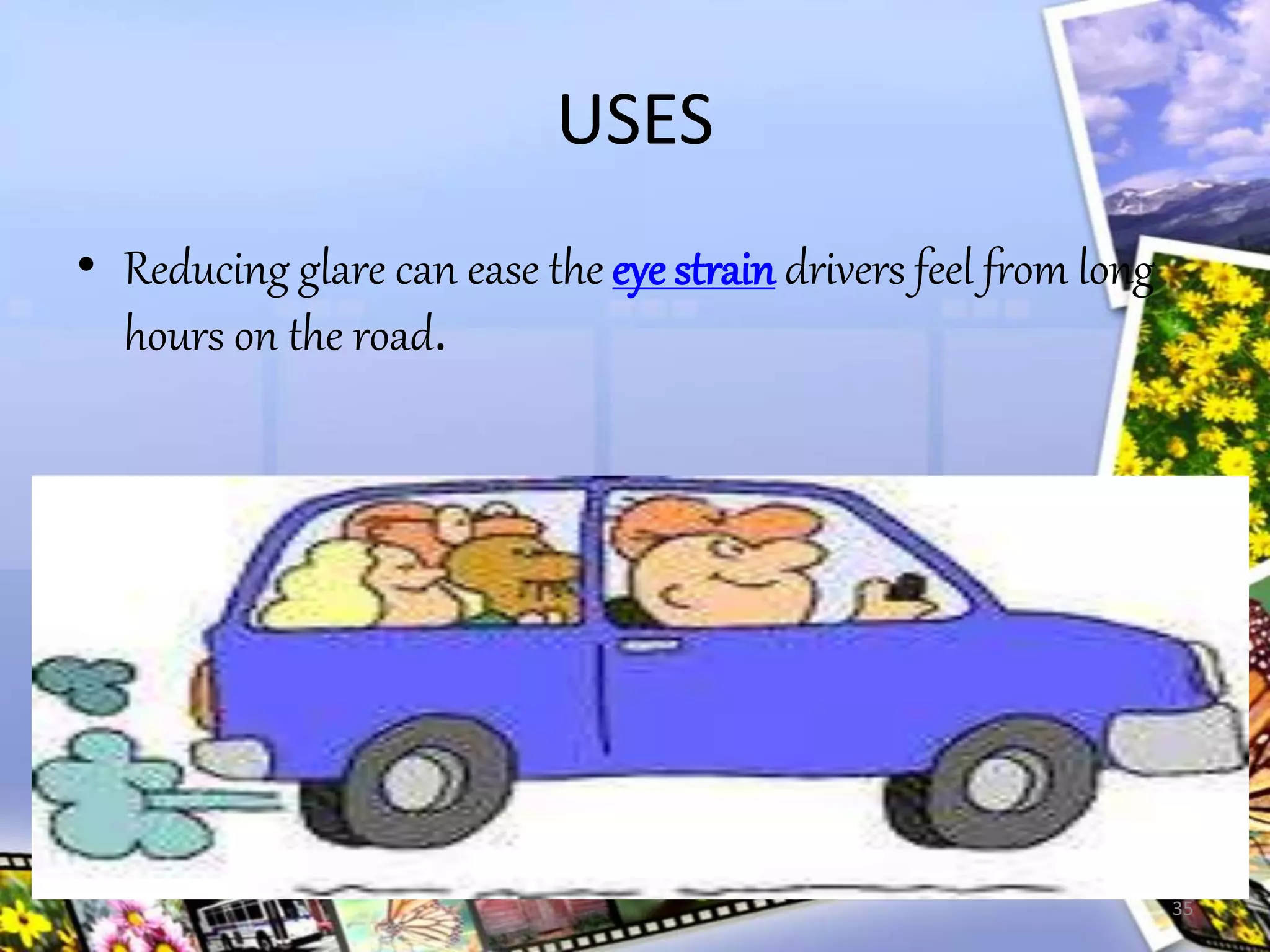
• Reducing glare can ease the eye strain drivers feel from long
hours on the road.
35
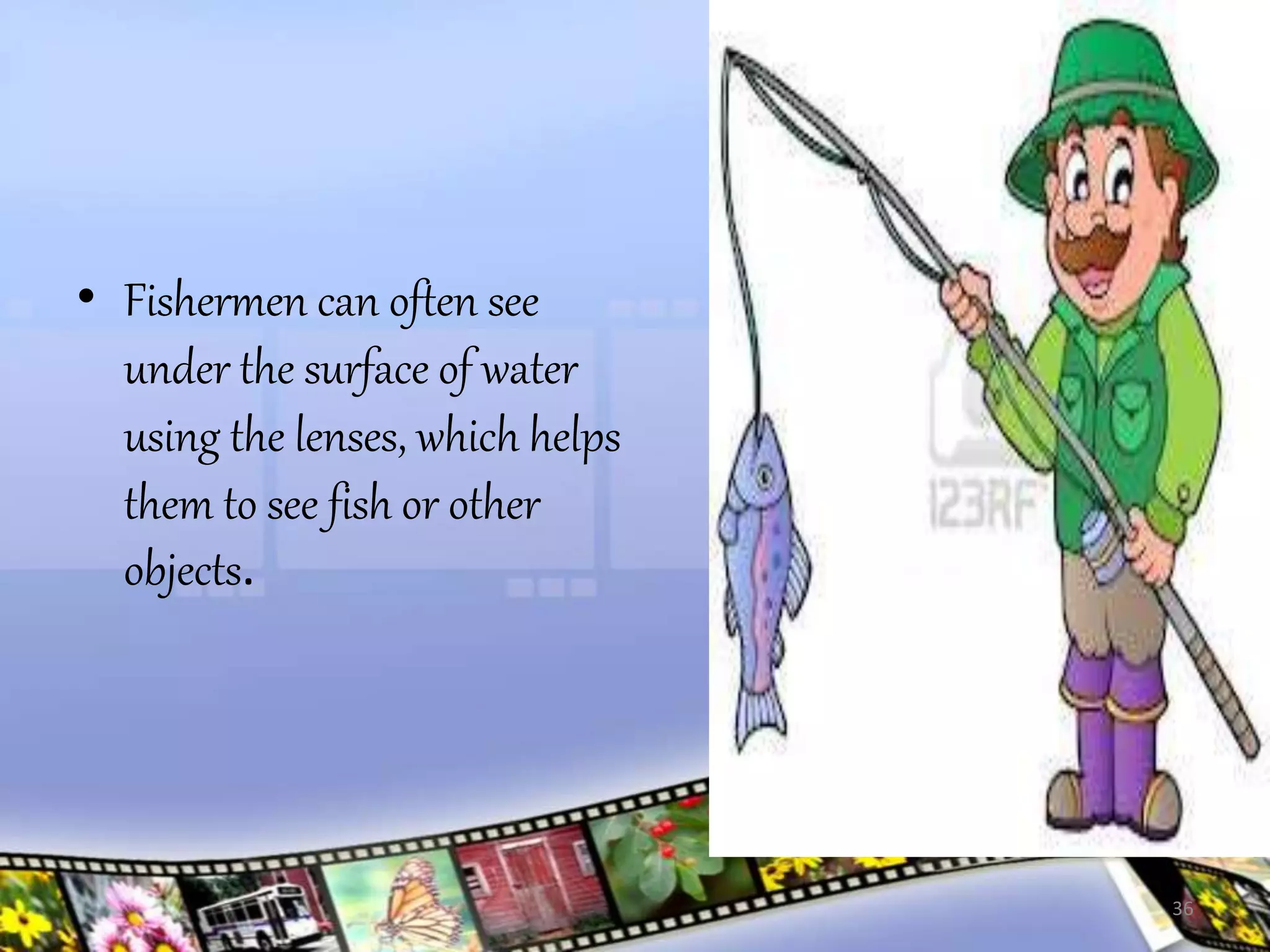
• Fishermen can often see
under the surface of water
using the lenses, which helps
them to see fish or other
objects.
36
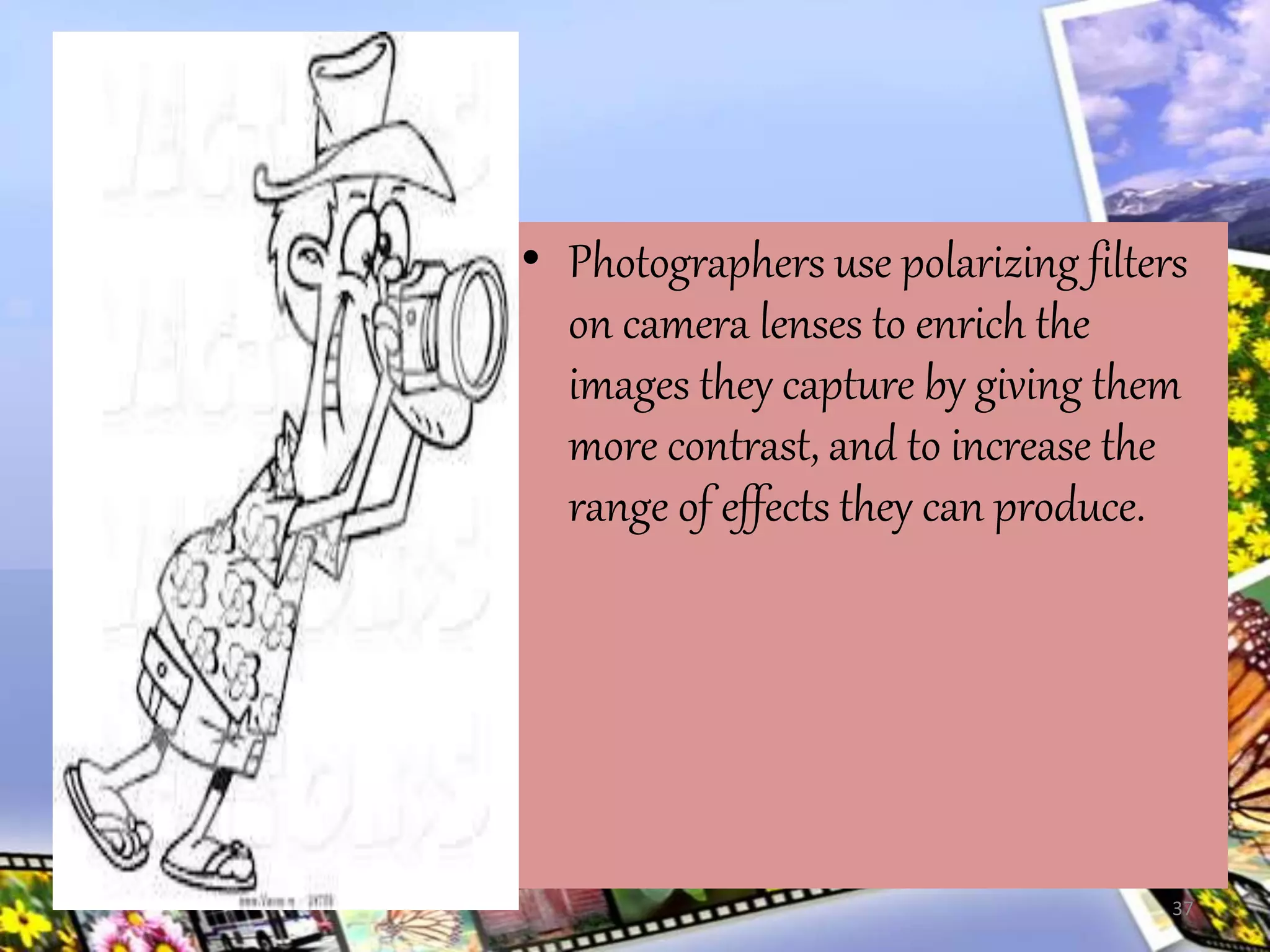
• Photographers use polarizing filters
on camera lenses to enrich the
images they capture by giving them
more contrast, and to increase the
range of effects they can produce.
37
• Using horizontally and vertically polarized
lenses together makes one type of three-
dimensional (3-D) movies possible. Two
images are projected onto a 3-D movie screen:
one is polarized vertically and one
horizontally.
38
Disadvantage
• It includes additional cost and time limited
tint color choices , and fact that many
patients and dispensers misunderstand the
uses of polarized lenses.
39
LIMITATIONS.
• Polarized glasses do not provide universal protection from glare.
• If the wearer tilts his or her head past 45° or so, more of the horizontal light can
enter and cause bright spots.
• In addition, these lenses do not usually work with snow glare because snow tends
to reflect light equally in all directions, rather than the mostly horizontal reflection
off of liquid water.
• It is strongly recommended that downhill skiers in particular not wear polarized
sunglasses; ice does reflect horizontally, and these glasses can make dangerous icy
spots less visible.
40
• Because the polarizing stripes reduce the amount of light entering the eye, these
lenses should not be used at night or in other situations where clear lenses are
required.
• It is not possible to make such lenses truly clear; even those with low levels of
polarization have a slightly gray hue. Some people find that looking through the
lenses for too long a period of time can cause headaches and eye strain.
41
• Polarized lenses can cause distortions in the way wearers see liquid crystal displays
(LCDs), rendering some cell phone screens, clocks, and other displays unreadable.
• The texture of laminated or heat-treated glass, like a windshield, can be made
more prominent by looking at it through a polarized lens, making the glass
difficult to see through. Pilots should not use polarized glasses because they can
make flight instruments difficult to read and other objects in the sky— including
other airplanes — less visible.
42
DISPENSING TIPS
• PLEASE,DO NOT TEMPER POLARIZED GLASS !
• Remember, polarized glass is already
tempered. Attempting to do so again will
crack your lenses.
43
44
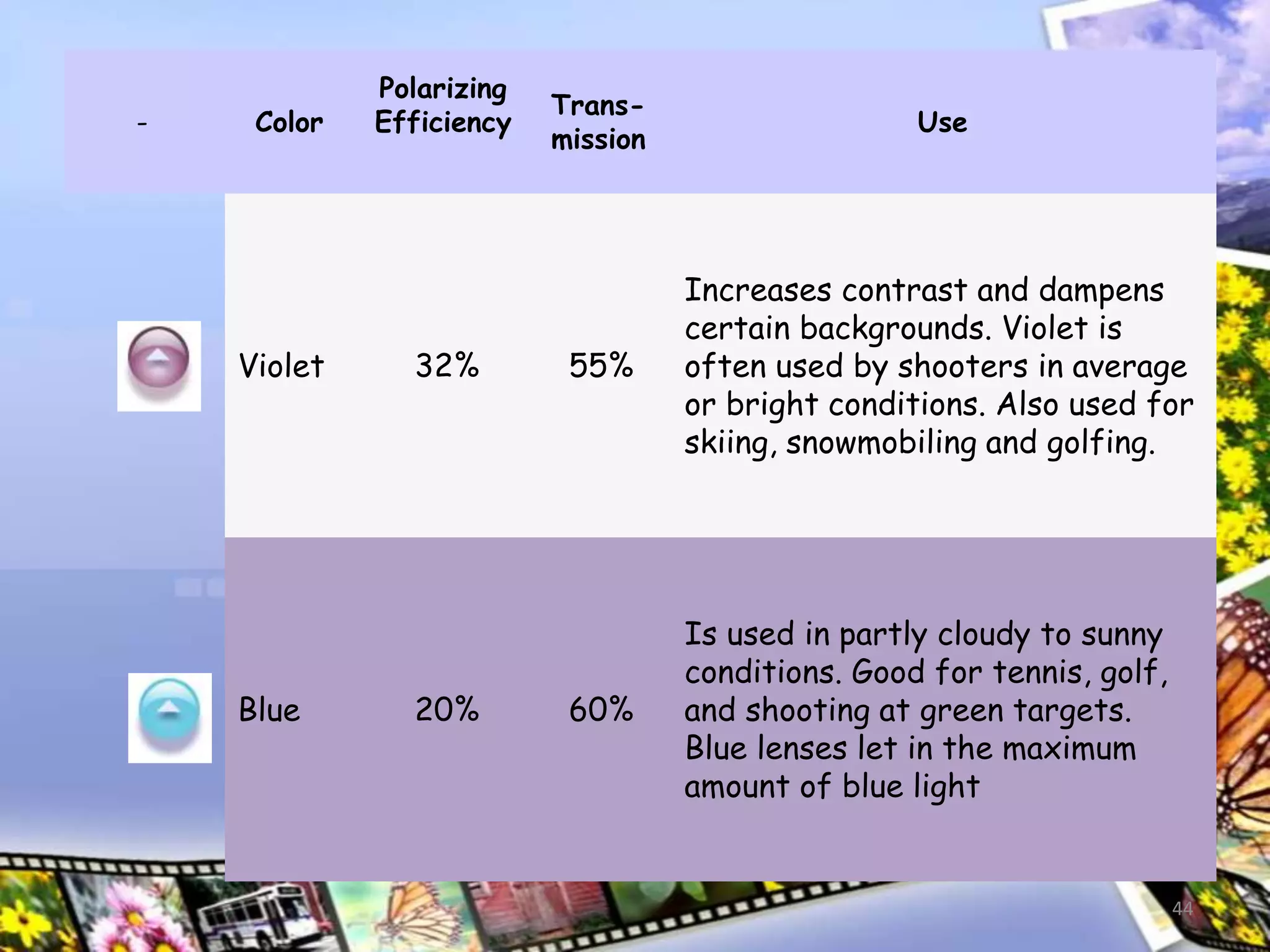
Violet 32% 55%
Increases contrast and dampens
certain backgrounds. Violet is
often used by shooters in average
or bright conditions. Also used for
skiing, snowmobiling and golfing.
Blue 20% 60%
Is used in partly cloudy to sunny
conditions. Good for tennis, golf,
and shooting at green targets.
Blue lenses let in the maximum
amount of blue light
- Color
Polarizing
Efficiency
Trans-
mission
Use
45
- Color
Polarizing
Efficiency
Trans-
mission
Use
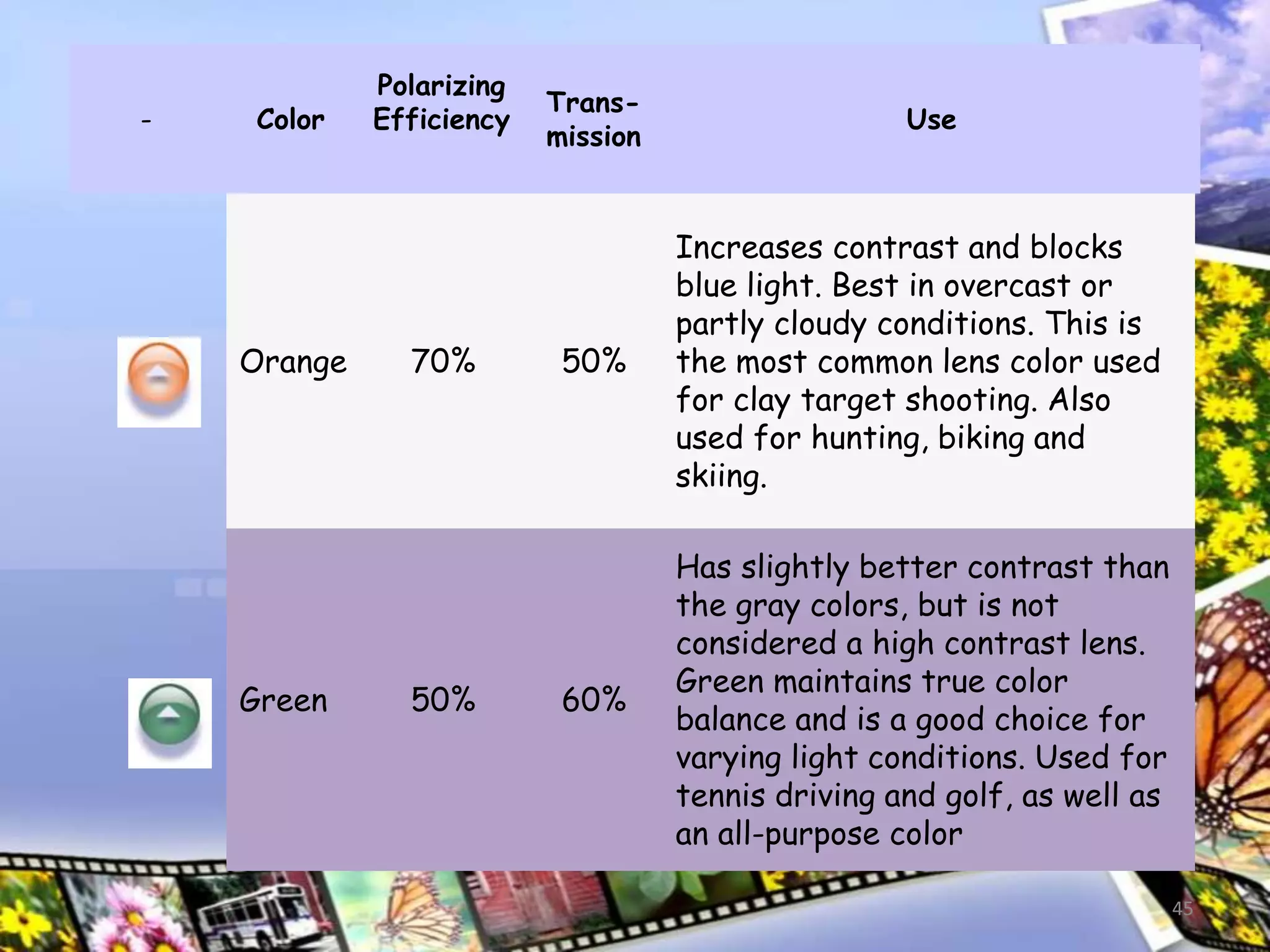
Orange 70% 50%
Increases contrast and blocks
blue light. Best in overcast or
partly cloudy conditions. This is
the most common lens color used
for clay target shooting. Also
used for hunting, biking and
skiing.
Green 50% 60%
Has slightly better contrast than
the gray colors, but is not
considered a high contrast lens.
Green maintains true color
balance and is a good choice for
varying light conditions. Used for
tennis driving and golf, as well as
an all-purpose color
46
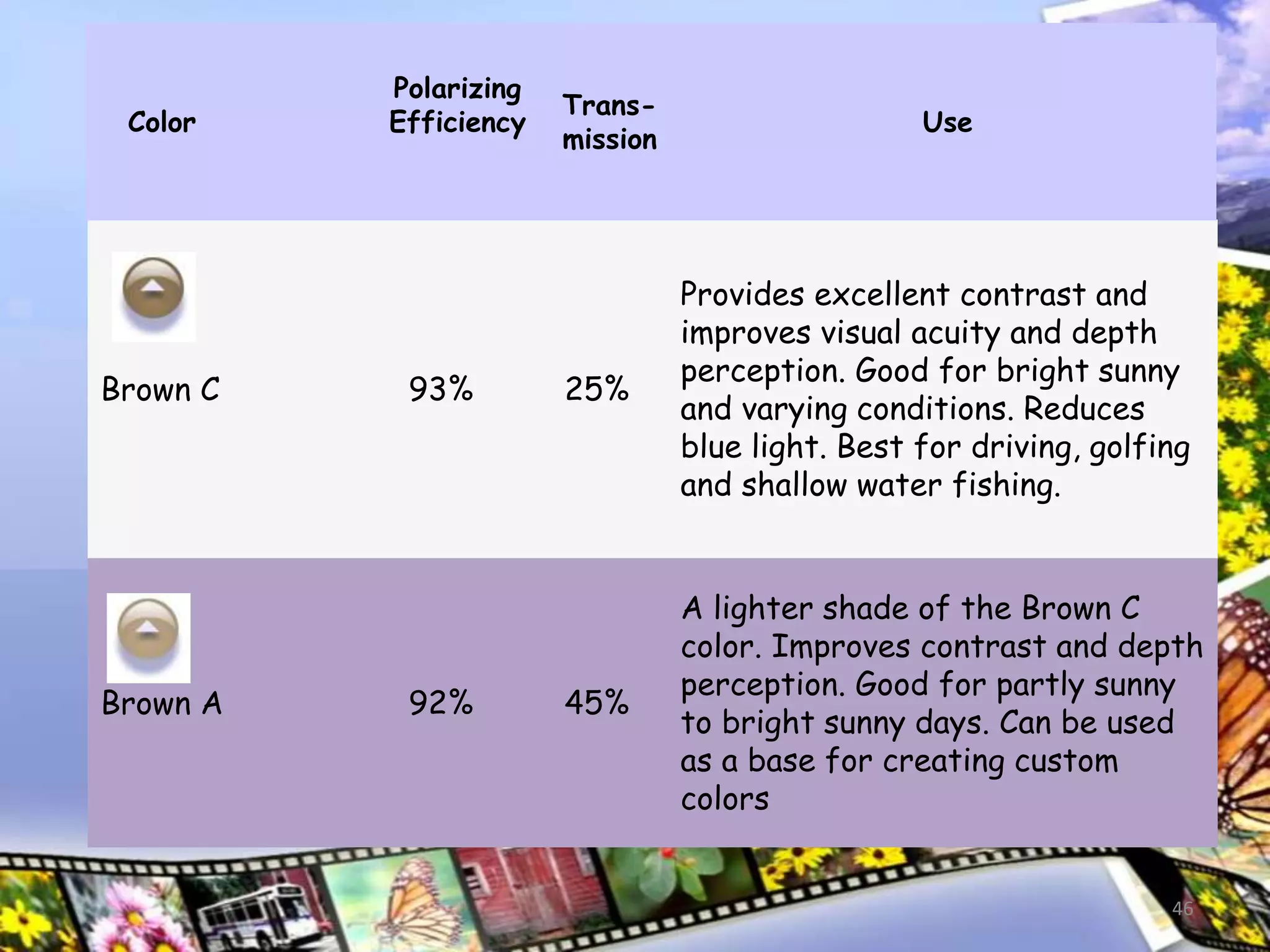
Brown C 93% 25%
Provides excellent contrast and
improves visual acuity and depth
perception. Good for bright sunny
and varying conditions. Reduces
blue light. Best for driving, golfing
and shallow water fishing.
Brown A 92% 45%
A lighter shade of the Brown C
color. Improves contrast and depth
perception. Good for partly sunny
to bright sunny days. Can be used
as a base for creating custom
colors
Color
Polarizing
Efficiency
Trans-
mission
Use
47
-
Color
Polarizing
Efficienc
y
Trans-
mission
Use
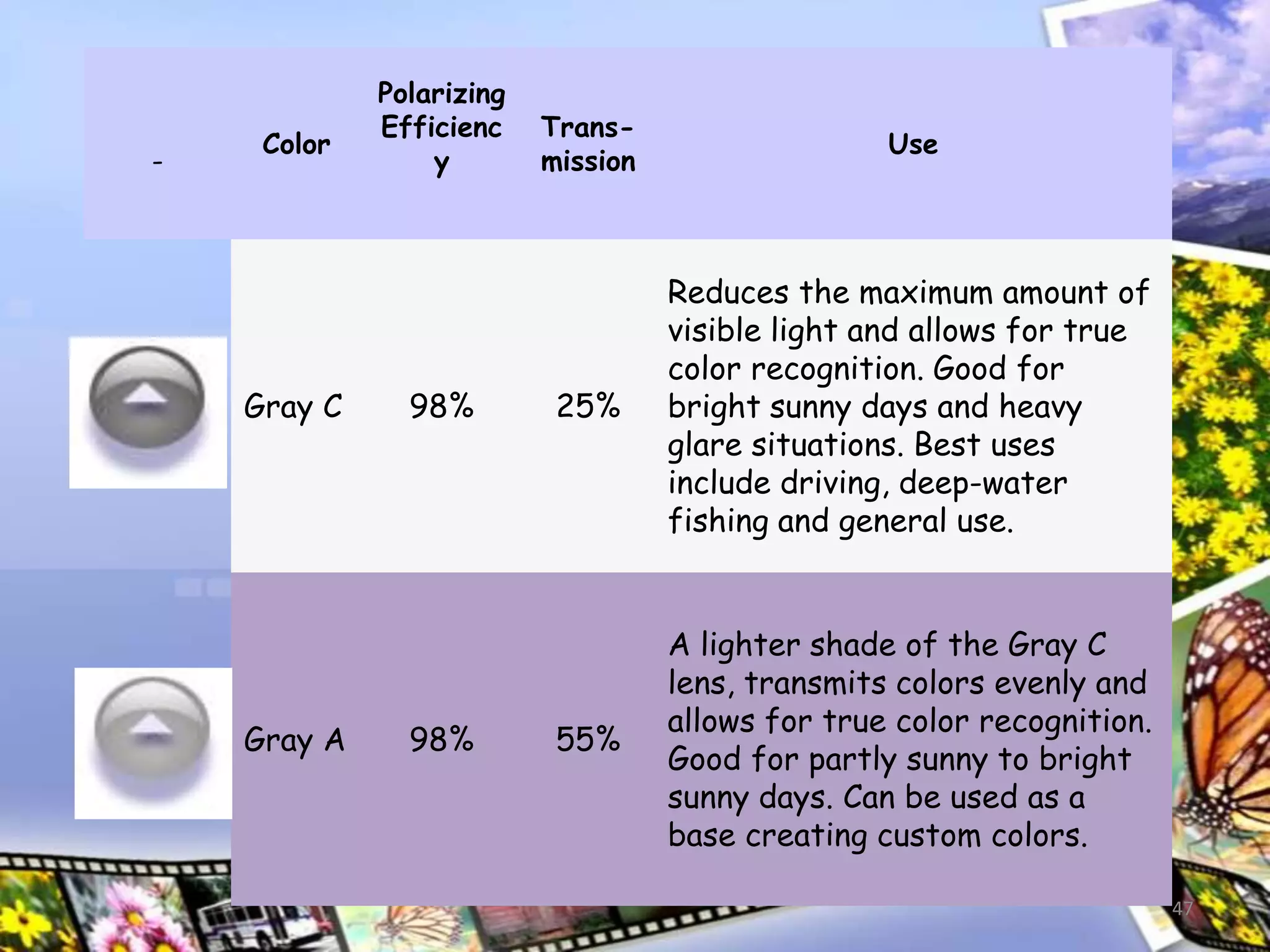
Gray C 98% 25%
Reduces the maximum amount of
visible light and allows for true
color recognition. Good for
bright sunny days and heavy
glare situations. Best uses
include driving, deep-water
fishing and general use.
Gray A 98% 55%
A lighter shade of the Gray C
lens, transmits colors evenly and
allows for true color recognition.
Good for partly sunny to bright
sunny days. Can be used as a
base creating custom colors.
48
- Color
Polarizing
Efficienc
y
Trans-
mission
Use
Melani
n
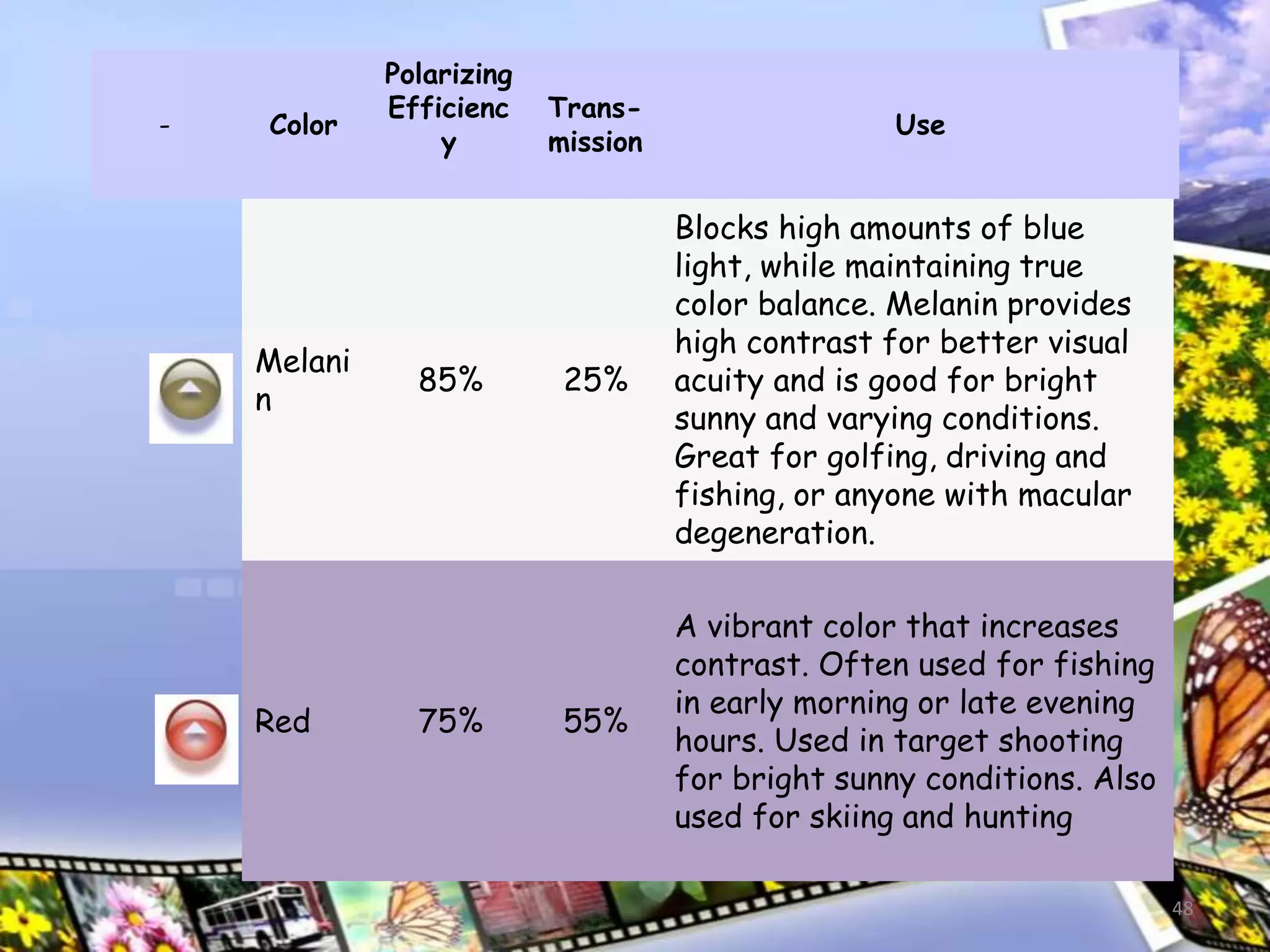
85% 25%
Blocks high amounts of blue
light, while maintaining true
color balance. Melanin provides
high contrast for better visual
acuity and is good for bright
sunny and varying conditions.
Great for golfing, driving and
fishing, or anyone with macular
degeneration.
Red 75% 55%
A vibrant color that increases
contrast. Often used for fishing
in early morning or late evening
hours. Used in target shooting
for bright sunny conditions. Also
used for skiing and hunting
49
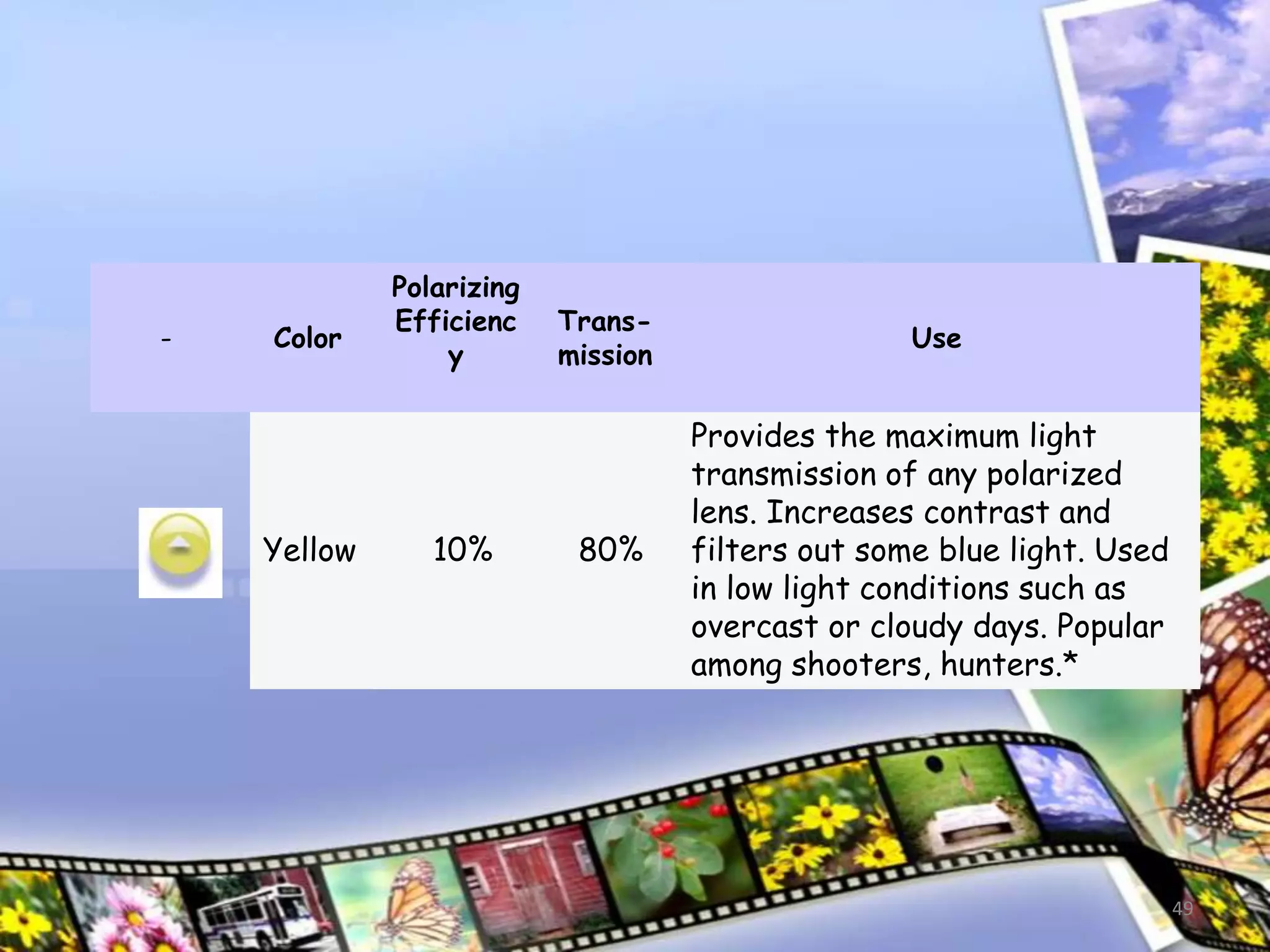
Yellow 10% 80%
Provides the maximum light
transmission of any polarized
lens. Increases contrast and
filters out some blue light. Used
in low light conditions such as
overcast or cloudy days. Popular
among shooters, hunters.*
- Color
Polarizing
Efficienc
y
Trans-
mission
Use
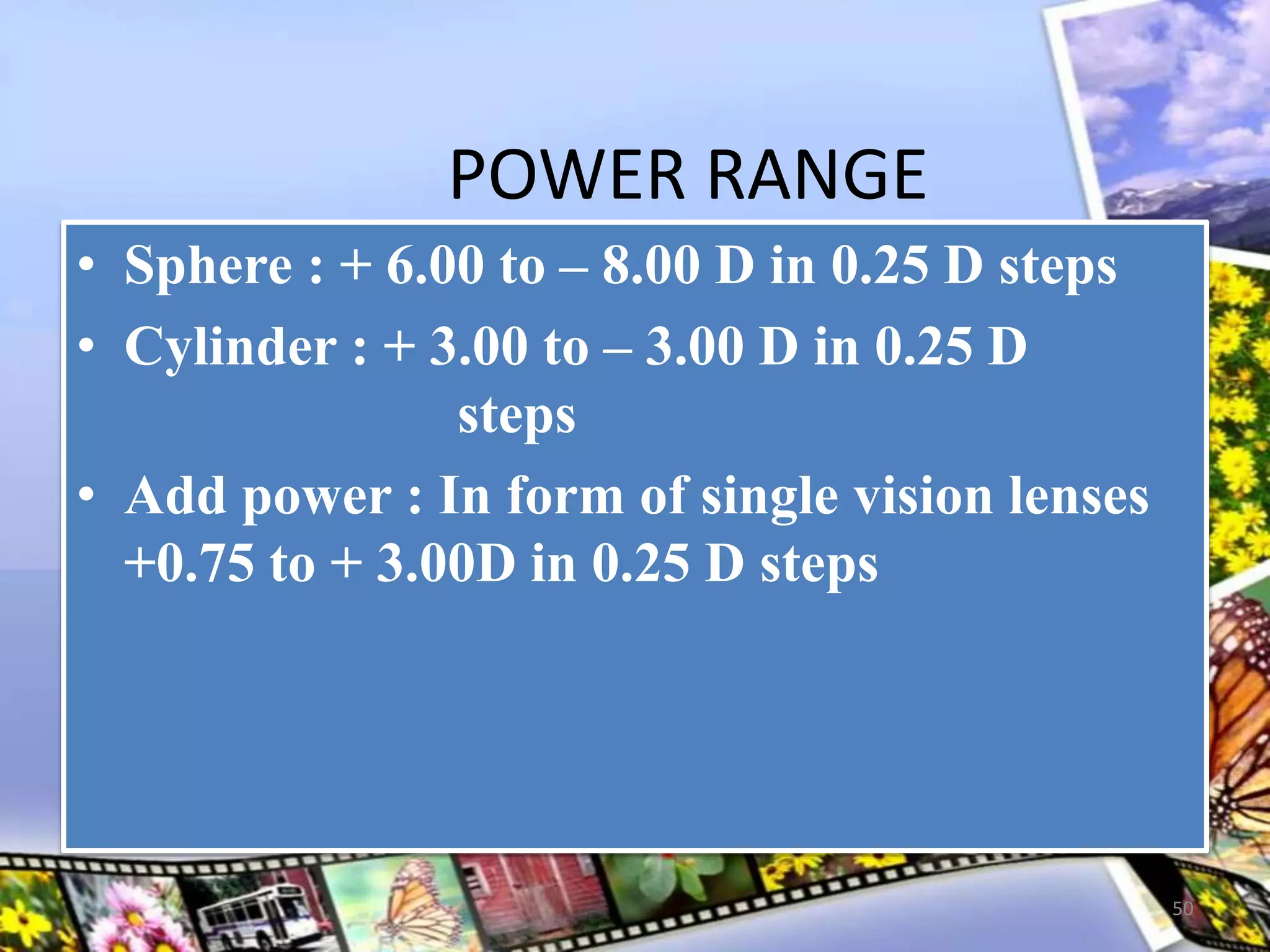
POWER RANGE
• Sphere : + 6.00 to – 8.00 D in 0.25 D steps
• Cylinder : + 3.00 to – 3.00 D in 0.25 D
steps
• Add power : In form of single vision lenses
+0.75 to + 3.00D in 0.25 D steps
50
51

Polaroid lenses

  • 1.
    MADE BY :SWATI PANARA FROM : BHARTIMAIYA COLLEGE OF OPTOMETRY 2nd YEAR 3rd SEMESTER 1
  • 2.
  • 3.
    INTRODUCTION • Polarized lensesare transparent pieces of material, usually glass or plastic, that block certain types of light waves. • Polaroid polarized lenses block out virtually 100% of glare. 3
  • 4.
    OTHER NAME • ANTIGLARE LENSES 4
  • 5.
    • Light reflectedfrom surfaces like a flat road or smooth water is generally horizontally polarized. • This horizontally polarized light is blocked by the vertically oriented polarizer in the lenses. The result: a reduction in annoying and sometimes dangerous glare. 5
  • 6.
    • WHEN DIRECTSUNLIGHT OR ARTIFICIAL LOGHT HIT A SMOOTH SURFACE AT A GIVEN ANGLE , IT REFLECT OFF THE SMOOTH SURFACE AND TRAVELS IN THE SAME DIRECTION , INTENSIFYING THEIR EFFECT ON THE EYES. • THIS PHENOMENON PRODUCE GLARE. 6
  • 7.
    GLARE- • TWO TYPES- DISCOMFORTGLARE DISABLILTY GLARE 7
  • 8.
    DISABILITY GLARE- • Themost dangerous form of glare is disability glare. This is the type of glare that causes the patient to instinctively avert his or her eyes. • Reflection off the roads, water, ice, hoods of vehicles and sand are the main causes of this glare type. • Further, it is disability glare that most concerns the eye care professional when providing the patient with the appropriate sunwear. • Disability glare poses a hazard to the patient if not treated properly, due to safety risks that averting the eye can cause during activities such as driving and water sports . 8
  • 9.
    DISCOMFORT GLARE- • Discomfortglare is a very subtle form of glare. • It causes the visual system to over exert itself resulting in eye strain, headaches, and physical fatigue. • Common causes of this glare type are light that is reflected off spectacle lenses, computer screens, windshields; as well as light color surfaces such as paper and walls. 9
  • 10.
    Brewster’s Angle • Thisoccurs when the tangent of the angle of incidence is equal to the index of refraction of the medium to which the light is incident , that is Tan i = n • The plane of polarization of the reflected light is parallel to the reflecting surface or perpendicular to the plane of the incident light. 10
  • 11.
    Manufacturing • Polarizing filtersare created by stretching sheets of polyvinyl alcohol (PVA) so its molecules align in long directional chains. The PVA is then passed through an iodine solution where the light absorbing iodine molecules attach to the molecular chains forming the microscopic blinds. The film is then incorporated into the lens blank as it is poured, creating polarized lenses 11
  • 12.
  • 13.
    Manufacturing • The thinpolarizing sheet is then laminated between two layers of coated cellulose acetate butyrate and is pressed to the desire curvature
  • 14.
  • 15.
    POLARIZATION • Polarization isthe breaking down of a light wave that travels in all directions, into rays that travel in two directions. • Although the direct light coming from the sun in not polarized, when the light hits a highly reflective surface, it is broken down into horizontal and vertical polarized beams. • Since most reflective surfaces are on a horizontal plane, such as water or the hood of a car, the polarized beams that cause the most disability glare is the horizontal polarized light. • Therefore, to eliminate the horizontal polarized light from reaching the eye, a filter is fixed at an angle that only allows vertical polarized light to enter the eye . 15
  • 16.
  • 17.
  • 18.
  • 19.
    • Principle ofpolarized lens is best illustrated by observing Venetian blindwhich blocks light at certain angles, while allows light to transmit through it at certain other angle. 19
  • 20.
    Recommendation of Polaroid lenses •Day time drivers • Fisherman • At beach/sea shores • Snowfield workers, skiers • Good for UV protection • People working on sand 20
  • 21.
    AVAIBELITY • SINGLE VISIONLENSES • MULTIFOCAL • THEY ARE AVAILABLE IN GLASS PLASTIC , POLY CARBONATE , HI INDEX. • NOW , POLAROID LENSES ARE AVAILABLE IN PHOTO CHROMIC LENS. • TINT LENS IS AVAOLABLE. 21
  • 22.
    ADVANTAGES • Filters glare •Enhances contrast • Constant density tints • Backside AR compatibility • Tint able and coat able • Light weight • Thin 22
  • 23.
    • Depth perception •Eyes feel rested • Reduce reflection • Realistic perception • Improve visual acuity , provide safety • Comfortable Attractive-looking sun wear • Reduces eye strain , greater comfort 23
  • 24.
  • 25.
    COLOUR • Gray: Themost popular color for sunglasses in the U.S., gray transmits all colors evenly. It makes a good everyday or all- purpose choice of sunglasses. It is recommended for ocean fishing, where the water tends to be blue. "Classic gray" is a color that provides near-natural vision and true color perception 25
  • 26.
    • All purposesun wear • Driving • Sport activities • Water activities 26
  • 27.
    • Brown: Becausebrown improves contrast and depth perception, it is best for driving and shallow-water fishing. Light brown is a good color for overcast days and is recommended for skiers and golfers. Brown is another popular color, especially among the fashion-conscious, because many fashion authorities believe that brown is flattering to the face. 27
  • 28.
    • All purposesun wear • Driving • Sport activities • Water activities filters blue light , improving visual acuity • Sharp definition for golf 28
  • 29.
    • Blue: Blueallows the most blue light to filter through, so it is good in partly cloudy weather. Blue is a popular lens color among tennis players and golfers. 29
  • 30.
    • Green: Greenimproves contrast slightly, and keeps a good balance among the colors of light. It is a popular color for tennis, golf, or driving 30
  • 31.
    • Yellow: Thiscolor filters out blue light. Because it provides the highest level of contrast, it is perfect for cloudy-day driving. 31
  • 32.
    • Violet: Violetcauses green to fade and enhances orange, green, and black. It is good for shooting under average conditions. 32
  • 33.
    • Red: Redis primarily used by sportsmen working in bright, sunny places. 33
  • 34.
    • Copper: Copperprovides maximum contrast and is best for any activity in which good vision is important . 34
  • 35.
    USES • Reducing glarecan ease the eye strain drivers feel from long hours on the road. 35
  • 36.
    • Fishermen canoften see under the surface of water using the lenses, which helps them to see fish or other objects. 36
  • 37.
    • Photographers usepolarizing filters on camera lenses to enrich the images they capture by giving them more contrast, and to increase the range of effects they can produce. 37
  • 38.
    • Using horizontallyand vertically polarized lenses together makes one type of three- dimensional (3-D) movies possible. Two images are projected onto a 3-D movie screen: one is polarized vertically and one horizontally. 38
  • 39.
    Disadvantage • It includesadditional cost and time limited tint color choices , and fact that many patients and dispensers misunderstand the uses of polarized lenses. 39
  • 40.
    LIMITATIONS. • Polarized glassesdo not provide universal protection from glare. • If the wearer tilts his or her head past 45° or so, more of the horizontal light can enter and cause bright spots. • In addition, these lenses do not usually work with snow glare because snow tends to reflect light equally in all directions, rather than the mostly horizontal reflection off of liquid water. • It is strongly recommended that downhill skiers in particular not wear polarized sunglasses; ice does reflect horizontally, and these glasses can make dangerous icy spots less visible. 40
  • 41.
    • Because thepolarizing stripes reduce the amount of light entering the eye, these lenses should not be used at night or in other situations where clear lenses are required. • It is not possible to make such lenses truly clear; even those with low levels of polarization have a slightly gray hue. Some people find that looking through the lenses for too long a period of time can cause headaches and eye strain. 41
  • 42.
    • Polarized lensescan cause distortions in the way wearers see liquid crystal displays (LCDs), rendering some cell phone screens, clocks, and other displays unreadable. • The texture of laminated or heat-treated glass, like a windshield, can be made more prominent by looking at it through a polarized lens, making the glass difficult to see through. Pilots should not use polarized glasses because they can make flight instruments difficult to read and other objects in the sky— including other airplanes — less visible. 42
  • 43.
    DISPENSING TIPS • PLEASE,DONOT TEMPER POLARIZED GLASS ! • Remember, polarized glass is already tempered. Attempting to do so again will crack your lenses. 43
  • 44.
    44 Violet 32% 55% Increasescontrast and dampens certain backgrounds. Violet is often used by shooters in average or bright conditions. Also used for skiing, snowmobiling and golfing. Blue 20% 60% Is used in partly cloudy to sunny conditions. Good for tennis, golf, and shooting at green targets. Blue lenses let in the maximum amount of blue light - Color Polarizing Efficiency Trans- mission Use
  • 45.
    45 - Color Polarizing Efficiency Trans- mission Use Orange 70%50% Increases contrast and blocks blue light. Best in overcast or partly cloudy conditions. This is the most common lens color used for clay target shooting. Also used for hunting, biking and skiing. Green 50% 60% Has slightly better contrast than the gray colors, but is not considered a high contrast lens. Green maintains true color balance and is a good choice for varying light conditions. Used for tennis driving and golf, as well as an all-purpose color
  • 46.
    46 Brown C 93%25% Provides excellent contrast and improves visual acuity and depth perception. Good for bright sunny and varying conditions. Reduces blue light. Best for driving, golfing and shallow water fishing. Brown A 92% 45% A lighter shade of the Brown C color. Improves contrast and depth perception. Good for partly sunny to bright sunny days. Can be used as a base for creating custom colors Color Polarizing Efficiency Trans- mission Use
  • 47.
    47 - Color Polarizing Efficienc y Trans- mission Use Gray C 98%25% Reduces the maximum amount of visible light and allows for true color recognition. Good for bright sunny days and heavy glare situations. Best uses include driving, deep-water fishing and general use. Gray A 98% 55% A lighter shade of the Gray C lens, transmits colors evenly and allows for true color recognition. Good for partly sunny to bright sunny days. Can be used as a base creating custom colors.
  • 48.
    48 - Color Polarizing Efficienc y Trans- mission Use Melani n 85% 25% Blockshigh amounts of blue light, while maintaining true color balance. Melanin provides high contrast for better visual acuity and is good for bright sunny and varying conditions. Great for golfing, driving and fishing, or anyone with macular degeneration. Red 75% 55% A vibrant color that increases contrast. Often used for fishing in early morning or late evening hours. Used in target shooting for bright sunny conditions. Also used for skiing and hunting
  • 49.
    49 Yellow 10% 80% Providesthe maximum light transmission of any polarized lens. Increases contrast and filters out some blue light. Used in low light conditions such as overcast or cloudy days. Popular among shooters, hunters.* - Color Polarizing Efficienc y Trans- mission Use
  • 50.
    POWER RANGE • Sphere: + 6.00 to – 8.00 D in 0.25 D steps • Cylinder : + 3.00 to – 3.00 D in 0.25 D steps • Add power : In form of single vision lenses +0.75 to + 3.00D in 0.25 D steps 50
  • 51.