SPECTACLES
 Spectacle is an optical appliance comprising
a lenses and a frame with sides extending
towards the ears.
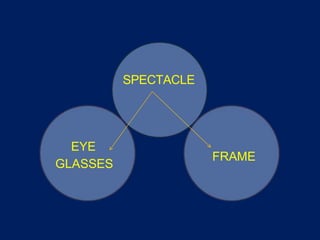
SPECTACLE
FRAME
EYE
GLASSES
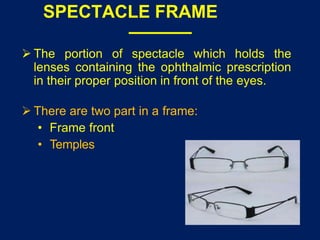
SPECTACLE FRAME
 The portion of spectacle which holds the
lenses containing the ophthalmic prescription
in their proper position in front of the eyes.
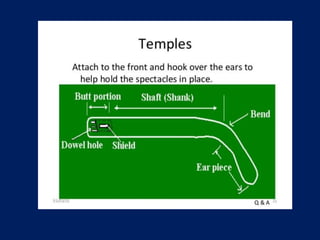
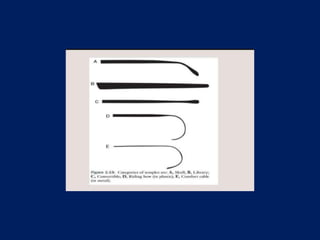
 There are two part in a frame:
• Frame front
• Temples
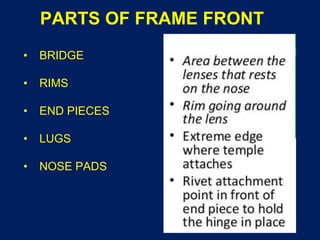
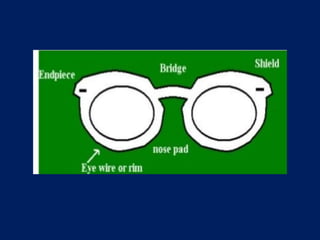
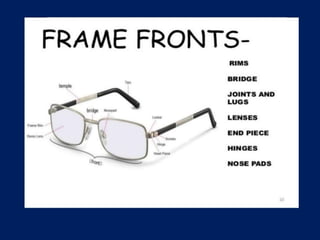
• BRIDGE
• RIMS
• END PIECES
• LUGS
• NOSE PADS
PARTS OF FRAME FRONT
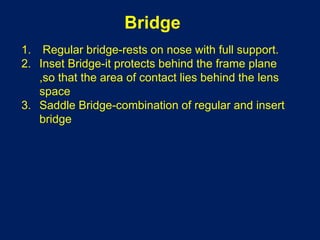
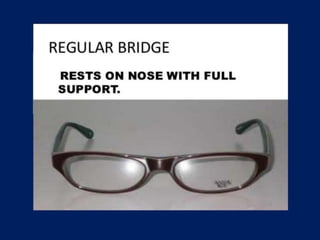
Bridge
1. Regular bridge-rests on nose with full support.
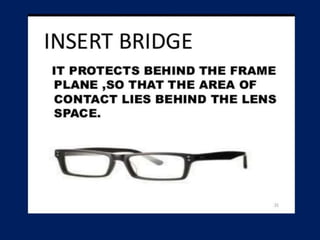
2. Inset Bridge-it protects behind the frame plane
,so that the area of contact lies behind the lens
space
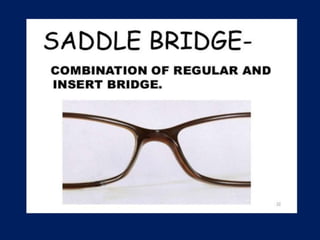
3. Saddle Bridge-combination of regular and insert
bridge
FRAME MATERIALS
• NATURAL MATERIAL (TORTOISE-SHELL
FRAMES)
• PLASTIC FRAMES-1.CELLULOSE NITRATE
2. CELLULOSE ACETATE
3. CELLULOSE PROPIONATE
4. PERSPEX
5. EPOXY RESINS
• NYLON SUPRA FRAMES
• METAL FRAMES-
• 1.STAINLESS STEEL
• 2.MONEL METAL
• 3.TITANIUM
• 4. FLEXON
• 5. TICKLE
• 6.BERYLLIUM
• 7.RUTHENIUM
• 8. NICKLE SILVER
• 9.ANODIZED ALUMINIUM
• 10. GOLD
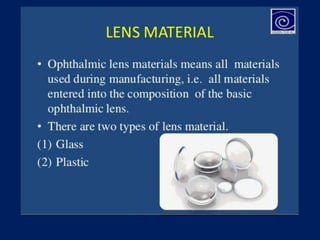
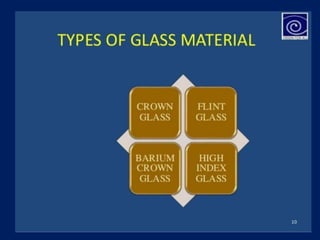
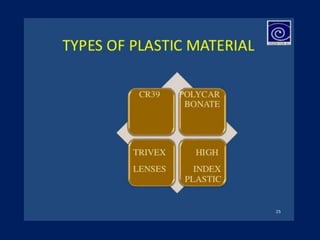
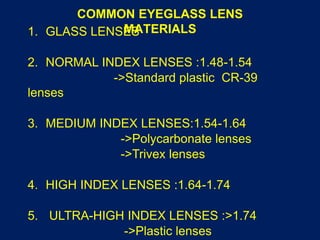
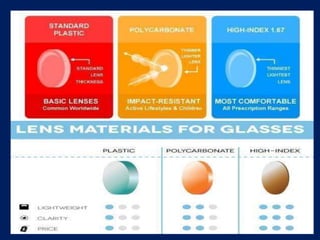
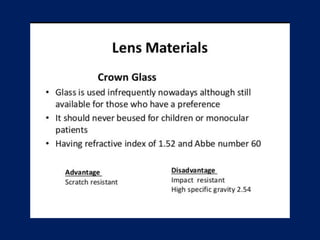
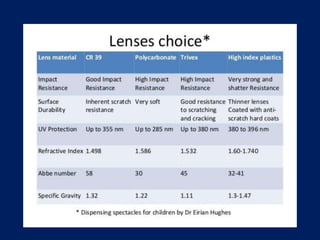
1. GLASS LENSES
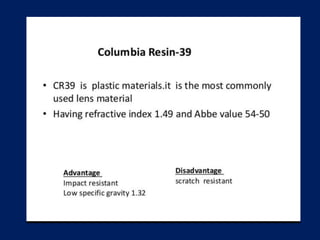
2. NORMAL INDEX LENSES :1.48-1.54
->Standard plastic CR-39
lenses
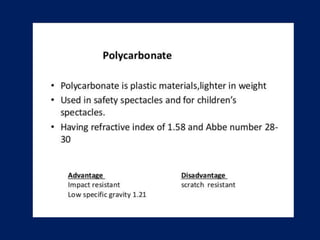
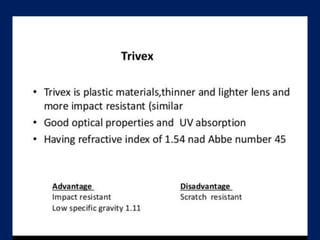
3. MEDIUM INDEX LENSES:1.54-1.64
->Polycarbonate lenses
->Trivex lenses
4. HIGH INDEX LENSES :1.64-1.74
5. ULTRA-HIGH INDEX LENSES :>1.74
->Plastic lenses
COMMON EYEGLASS LENS
MATERIALS
Lens forms
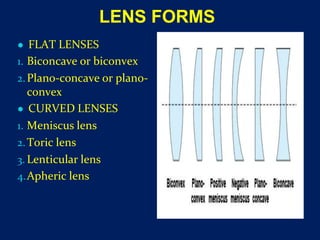
LENS FORMS
● FLAT LENSES
1. Biconcave or biconvex
2.Plano-concave or plano-
convex
● CURVED LENSES
1. Meniscus lens
2.Toric lens
3. Lenticular lens
4.Apheric lens
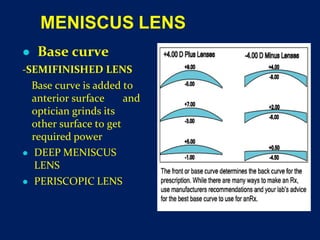
MENISCUS LENS
● Base curve
-SEMIFINISHED LENS
Base curve is added to
anterior surface and
optician grinds its
other surface to get
required power
● DEEP MENISCUS
LENS
● PERISCOPIC LENS
TORIC LENS
• Where one surface is spherical and other
surface is toroidal.
• What is toroidal surface?
if we visualise a cylinder its one axis is curved while
other is straight which is the axis of cylinder-> now
straight axis is also curved then surface will become
toroidal.
• Spherical lens is ground on anterior surface
and posterior surface is made toroidal
• Base curve used 6D
• Difference between base curve and curvature of
toric surface equals the cylindrical power
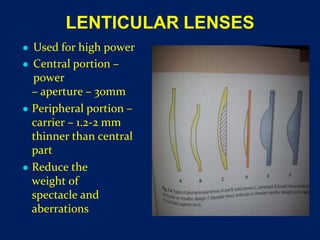
LENTICULAR LENSES
● Used for high power
● Central portion –
power
– aperture – 30mm
● Peripheral portion –
carrier – 1.2-2 mm
thinner than central
part
● Reduce the
weight of
spectacle and
aberrations
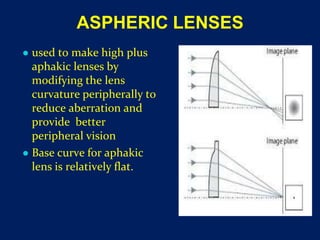
ASPHERIC LENSES
● used to make high plus
aphakic lenses by
modifying the lens
curvature peripherally to
reduce aberration and
provide better
peripheral vision
● Base curve for aphakic
lens is relatively flat.
Types of spectacles
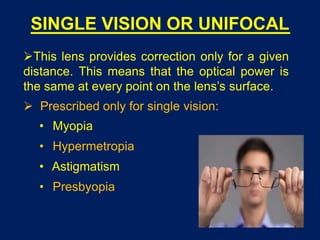
SINGLE VISION OR UNIFOCAL
This lens provides correction only for a given
distance. This means that the optical power is
the same at every point on the lens’s surface.
 Prescribed only for single vision:
• Myopia
• Hypermetropia
• Astigmatism
• Presbyopia
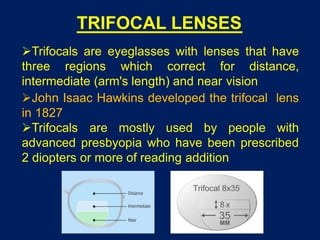
TRIFOCAL LENSES
Trifocals are eyeglasses with lenses that have
three regions which correct for distance,
intermediate (arm's length) and near vision
John Isaac Hawkins developed the trifocal lens
in 1827
Trifocals are mostly used by people with
advanced presbyopia who have been prescribed
2 diopters or more of reading addition
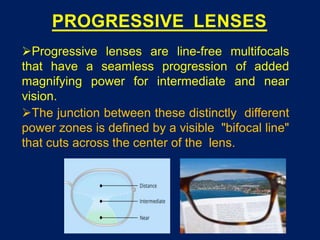
PROGRESSIVE LENSES
Progressive lenses are line-free multifocals
that have a seamless progression of added
magnifying power for intermediate and near
vision.
The junction between these distinctly different
power zones is defined by a visible "bifocal line"
that cuts across the center of the lens.
Other types of spectacles
• Sports spectacles
• Fishing spectacles
• Recumbent spectacles
• Hemianopic spectacles
• Shielded spectacles
• Divers spectacles
• Crutch spectacles
• Protective glasses
SPECTACLE LENS COATING
● Anti reflective coating lens
● Scratch- Resistant coating
● UV Coating
● Photochromatic lens
● Anti-fog coating
● Tinted lens
● Mirror coating
● Polarised lens
● Yellow filter
ANTI-REFLECTIVE COATING
Anti-reflective coating can reduce eyestrain caused from
glare, reflections, and the "halos" you see around lights at
night. It helps protect your lenses from scratches and
smudges, and can repel dust and water. This coating makes
your vision sharper and your eyes appear clearer behind
your lenses.
Some anti-reflective coatings reduce the amount of
reflected UV from the back of your lenses, providing the
best overall UV protection possible.
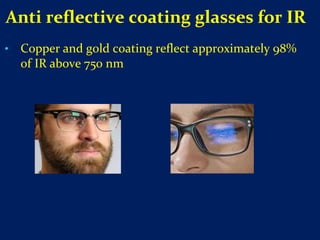
• Copper and gold coating reflect approximately 98%
of IR above 750 nm
Anti reflective coating glasses for IR
SCRATCH- RESISTANT COATING
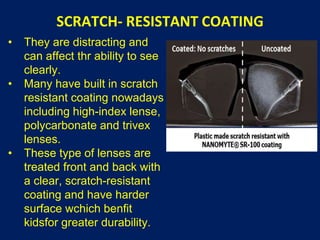
• They are distracting and
can affect thr ability to see
clearly.
• Many have built in scratch
resistant coating nowadays
including high-index lense,
polycarbonate and trivex
lenses.
• These type of lenses are
treated front and back with
a clear, scratch-resistant
coating and have harder
surface wchich benfit
kidsfor greater durability.
UV COATING
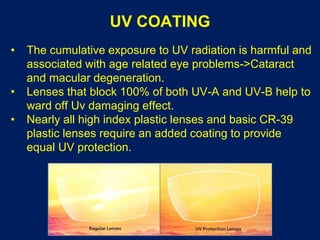
• The cumulative exposure to UV radiation is harmful and
associated with age related eye problems->Cataract
and macular degeneration.
• Lenses that block 100% of both UV-A and UV-B help to
ward off Uv damaging effect.
• Nearly all high index plastic lenses and basic CR-39
plastic lenses require an added coating to provide
equal UV protection.
PHOTOCHROMIC LENSES
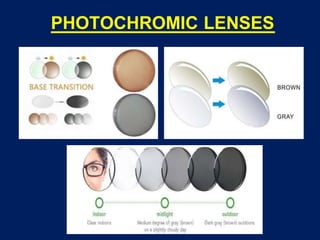
Photochromic lenses are optical lenses that darken on
exposure to specific types of light of sufficient intensity,
most commonly ultraviolet (UV) radiation. In the
absence of activating light the lenses return to their
clear state. Photochromic lenses may be made of
glass, polycarbonate, or another plastic. They are
principally used in eyeglasses that are dark in bright
sunlight, but clear in low ambient light conditions. They
darken significantly within about a minute of exposure
to bright light, and take somewhat longer to clear. A
range of clear and dark transmittances are available.
 In one sort of technology, molecules of silver
chloride or another silver halide are embedded in
photochromatic lenses. They are transparent to
visible light without significant ultraviolet component,
which is normal for artificial lighting. In another sort of
technology, organic photochromic molecules, when
exposed to ultraviolet (UV) rays as in direct sunlight,
undergo a chemical process that causes them to
change shape and absorb a significant percentage of
the visible light, i.e., they darken. These processes
are reversible; once the lens is removed from strong
sources of UV rays the photochromic compounds
return to their transparent state.
PHOTOCHROMIC LENSES
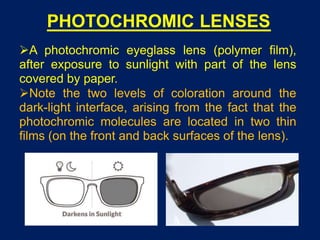
A photochromic eyeglass lens (polymer film),
after exposure to sunlight with part of the lens
covered by paper.
Note the two levels of coloration around the
dark-light interface, arising from the fact that the
photochromic molecules are located in two thin
films (on the front and back surfaces of the lens).
PHOTOCHROMIC LENSES
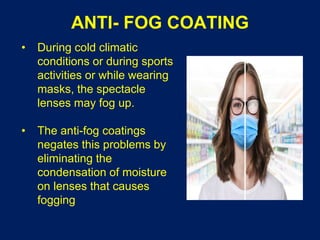
ANTI- FOG COATING
• During cold climatic
conditions or during sports
activities or while wearing
masks, the spectacle
lenses may fog up.
• The anti-fog coatings
negates this problems by
eliminating the
condensation of moisture
on lenses that causes
fogging
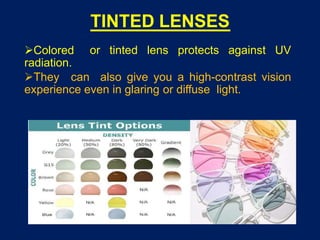
TINTED LENSES
or tinted lens protects against UV
Colored
radiation.
They can also give you a high-contrast vision
experience even in glaring or diffuse light.
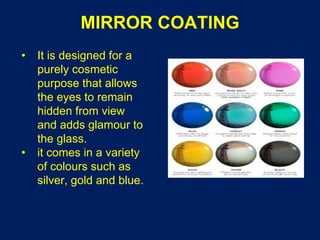
MIRROR COATING
• It is designed for a
purely cosmetic
purpose that allows
the eyes to remain
hidden from view
and adds glamour to
the glass.
• it comes in a variety
of colours such as
silver, gold and blue.
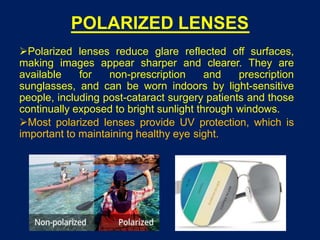
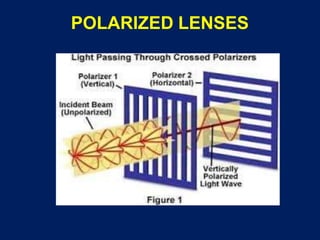
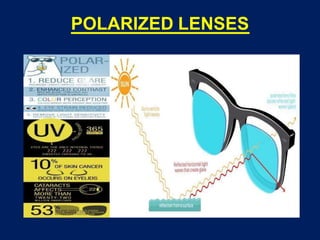
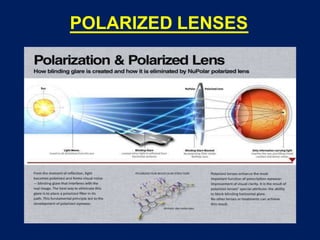
POLARIZED LENSES
Polarized lenses reduce glare reflected off surfaces,
making images appear sharper and clearer. They are
available for non-prescription and prescription
sunglasses, and can be worn indoors by light-sensitive
people, including post-cataract surgery patients and those
continually exposed to bright sunlight through windows.
Most polarized lenses provide UV protection, which is
important to maintaining healthy eye sight.
POLARIZED LENSES
POLARIZED LENSES
POLARIZED LENSES
YELLOW FILTERS
• Shooter’s glasses
It increases contrast for longer wavelength objects
viewed against shorter wavelength background
THANK YOU

spectacles.pptx

  • 1.
    SPECTACLES  Spectacle isan optical appliance comprising a lenses and a frame with sides extending towards the ears.
  • 2.
  • 3.
    SPECTACLE FRAME  Theportion of spectacle which holds the lenses containing the ophthalmic prescription in their proper position in front of the eyes.  There are two part in a frame: • Frame front • Temples
  • 4.
    • BRIDGE • RIMS •END PIECES • LUGS • NOSE PADS PARTS OF FRAME FRONT
  • 10.
    Bridge 1. Regular bridge-restson nose with full support. 2. Inset Bridge-it protects behind the frame plane ,so that the area of contact lies behind the lens space 3. Saddle Bridge-combination of regular and insert bridge
  • 17.
    FRAME MATERIALS • NATURALMATERIAL (TORTOISE-SHELL FRAMES) • PLASTIC FRAMES-1.CELLULOSE NITRATE 2. CELLULOSE ACETATE 3. CELLULOSE PROPIONATE 4. PERSPEX 5. EPOXY RESINS • NYLON SUPRA FRAMES • METAL FRAMES- • 1.STAINLESS STEEL • 2.MONEL METAL • 3.TITANIUM • 4. FLEXON • 5. TICKLE • 6.BERYLLIUM • 7.RUTHENIUM • 8. NICKLE SILVER • 9.ANODIZED ALUMINIUM • 10. GOLD
  • 21.
    1. GLASS LENSES 2.NORMAL INDEX LENSES :1.48-1.54 ->Standard plastic CR-39 lenses 3. MEDIUM INDEX LENSES:1.54-1.64 ->Polycarbonate lenses ->Trivex lenses 4. HIGH INDEX LENSES :1.64-1.74 5. ULTRA-HIGH INDEX LENSES :>1.74 ->Plastic lenses COMMON EYEGLASS LENS MATERIALS
  • 28.
  • 29.
    LENS FORMS ● FLATLENSES 1. Biconcave or biconvex 2.Plano-concave or plano- convex ● CURVED LENSES 1. Meniscus lens 2.Toric lens 3. Lenticular lens 4.Apheric lens
  • 30.
    MENISCUS LENS ● Basecurve -SEMIFINISHED LENS Base curve is added to anterior surface and optician grinds its other surface to get required power ● DEEP MENISCUS LENS ● PERISCOPIC LENS
  • 31.
    TORIC LENS • Whereone surface is spherical and other surface is toroidal. • What is toroidal surface? if we visualise a cylinder its one axis is curved while other is straight which is the axis of cylinder-> now straight axis is also curved then surface will become toroidal. • Spherical lens is ground on anterior surface and posterior surface is made toroidal • Base curve used 6D • Difference between base curve and curvature of toric surface equals the cylindrical power
  • 32.
    LENTICULAR LENSES ● Usedfor high power ● Central portion – power – aperture – 30mm ● Peripheral portion – carrier – 1.2-2 mm thinner than central part ● Reduce the weight of spectacle and aberrations
  • 33.
    ASPHERIC LENSES ● usedto make high plus aphakic lenses by modifying the lens curvature peripherally to reduce aberration and provide better peripheral vision ● Base curve for aphakic lens is relatively flat.
  • 34.
  • 35.
    SINGLE VISION ORUNIFOCAL This lens provides correction only for a given distance. This means that the optical power is the same at every point on the lens’s surface.  Prescribed only for single vision: • Myopia • Hypermetropia • Astigmatism • Presbyopia
  • 40.
    TRIFOCAL LENSES Trifocals areeyeglasses with lenses that have three regions which correct for distance, intermediate (arm's length) and near vision John Isaac Hawkins developed the trifocal lens in 1827 Trifocals are mostly used by people with advanced presbyopia who have been prescribed 2 diopters or more of reading addition
  • 41.
    PROGRESSIVE LENSES Progressive lensesare line-free multifocals that have a seamless progression of added magnifying power for intermediate and near vision. The junction between these distinctly different power zones is defined by a visible "bifocal line" that cuts across the center of the lens.
  • 42.
    Other types ofspectacles
  • 43.
    • Sports spectacles •Fishing spectacles • Recumbent spectacles • Hemianopic spectacles • Shielded spectacles • Divers spectacles • Crutch spectacles • Protective glasses
  • 44.
    SPECTACLE LENS COATING ●Anti reflective coating lens ● Scratch- Resistant coating ● UV Coating ● Photochromatic lens ● Anti-fog coating ● Tinted lens ● Mirror coating ● Polarised lens ● Yellow filter
  • 45.
    ANTI-REFLECTIVE COATING Anti-reflective coatingcan reduce eyestrain caused from glare, reflections, and the "halos" you see around lights at night. It helps protect your lenses from scratches and smudges, and can repel dust and water. This coating makes your vision sharper and your eyes appear clearer behind your lenses. Some anti-reflective coatings reduce the amount of reflected UV from the back of your lenses, providing the best overall UV protection possible.
  • 46.
    • Copper andgold coating reflect approximately 98% of IR above 750 nm Anti reflective coating glasses for IR
  • 47.
    SCRATCH- RESISTANT COATING •They are distracting and can affect thr ability to see clearly. • Many have built in scratch resistant coating nowadays including high-index lense, polycarbonate and trivex lenses. • These type of lenses are treated front and back with a clear, scratch-resistant coating and have harder surface wchich benfit kidsfor greater durability.
  • 48.
    UV COATING • Thecumulative exposure to UV radiation is harmful and associated with age related eye problems->Cataract and macular degeneration. • Lenses that block 100% of both UV-A and UV-B help to ward off Uv damaging effect. • Nearly all high index plastic lenses and basic CR-39 plastic lenses require an added coating to provide equal UV protection.
  • 49.
    PHOTOCHROMIC LENSES Photochromic lensesare optical lenses that darken on exposure to specific types of light of sufficient intensity, most commonly ultraviolet (UV) radiation. In the absence of activating light the lenses return to their clear state. Photochromic lenses may be made of glass, polycarbonate, or another plastic. They are principally used in eyeglasses that are dark in bright sunlight, but clear in low ambient light conditions. They darken significantly within about a minute of exposure to bright light, and take somewhat longer to clear. A range of clear and dark transmittances are available.
  • 50.
     In onesort of technology, molecules of silver chloride or another silver halide are embedded in photochromatic lenses. They are transparent to visible light without significant ultraviolet component, which is normal for artificial lighting. In another sort of technology, organic photochromic molecules, when exposed to ultraviolet (UV) rays as in direct sunlight, undergo a chemical process that causes them to change shape and absorb a significant percentage of the visible light, i.e., they darken. These processes are reversible; once the lens is removed from strong sources of UV rays the photochromic compounds return to their transparent state.
  • 51.
    PHOTOCHROMIC LENSES A photochromiceyeglass lens (polymer film), after exposure to sunlight with part of the lens covered by paper. Note the two levels of coloration around the dark-light interface, arising from the fact that the photochromic molecules are located in two thin films (on the front and back surfaces of the lens).
  • 52.
  • 53.
    ANTI- FOG COATING •During cold climatic conditions or during sports activities or while wearing masks, the spectacle lenses may fog up. • The anti-fog coatings negates this problems by eliminating the condensation of moisture on lenses that causes fogging
  • 54.
    TINTED LENSES or tintedlens protects against UV Colored radiation. They can also give you a high-contrast vision experience even in glaring or diffuse light.
  • 55.
    MIRROR COATING • Itis designed for a purely cosmetic purpose that allows the eyes to remain hidden from view and adds glamour to the glass. • it comes in a variety of colours such as silver, gold and blue.
  • 56.
    POLARIZED LENSES Polarized lensesreduce glare reflected off surfaces, making images appear sharper and clearer. They are available for non-prescription and prescription sunglasses, and can be worn indoors by light-sensitive people, including post-cataract surgery patients and those continually exposed to bright sunlight through windows. Most polarized lenses provide UV protection, which is important to maintaining healthy eye sight.
  • 57.
  • 58.
  • 59.
  • 60.
    YELLOW FILTERS • Shooter’sglasses It increases contrast for longer wavelength objects viewed against shorter wavelength background
  • 61.