The Future and The Conditional

            E. Siler
A New Tense: The Future
• Less used than most tenses in academic
  Spanish.
• Like English there are multiple ways of
  expressing the future.
English
• There is no real future “tense” in English . . .
• But there are multiple ways of expressing the
  future.
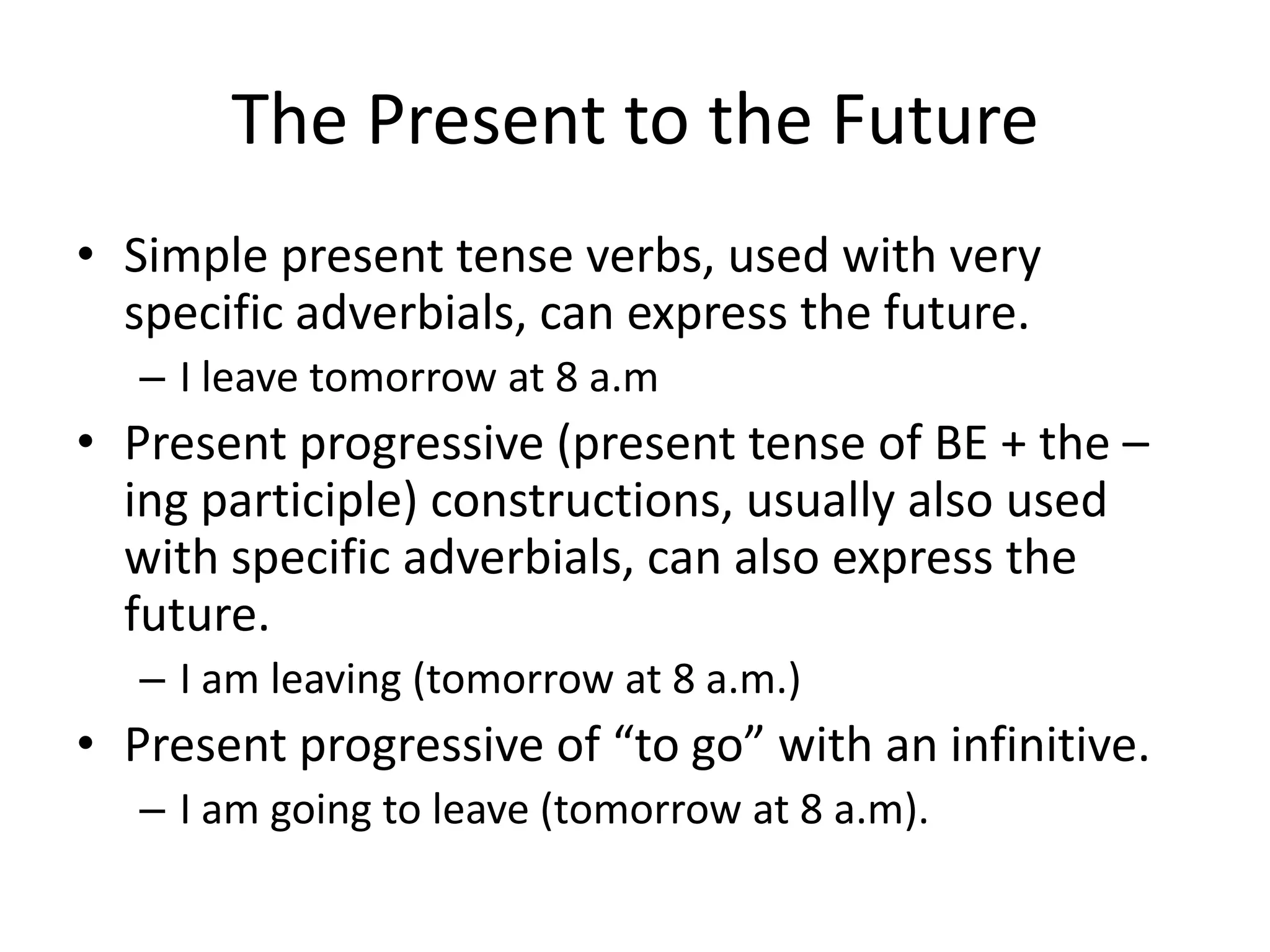
The Present to the Future
• Simple present tense verbs, used with very
  specific adverbials, can express the future.
   – I leave tomorrow at 8 a.m
• Present progressive (present tense of BE + the –
  ing participle) constructions, usually also used
  with specific adverbials, can also express the
  future.
   – I am leaving (tomorrow at 8 a.m.)
• Present progressive of “to go” with an infinitive.
   – I am going to leave (tomorrow at 8 a.m).
The Future with a Modal
• English has a category of fixed verbs called
  modals.
• These never change for number.
• Many of them, used with a simple verb, can
  express the future.
• Examples of modals: can/could; will/shall;
  may/might . .
• The most common future expressing modal is
  will.
Examples
•   I may leave (tomorrow).
•   I will leave (tomorrow).
•   I should leave (tomorrow).
•   I can leave (tomorrow).
•   I could leave (to morrow).
The Future in Spanish
• There are also many ways to express the
  future in Spanish.
• Many of these parallel ways expressed in
  English.
The Present to the Future
• Simple present tense used with an adverbial.
  – Salgomañana a lasocho. (I leave tomorrow at 8).
• A simple present tense version of “ir” (to go)
  followed by the preposition “a” and an
  infinitive.
      Person       Singular             Plural

      First        Yovoy a hablar       Nosotros/vamos a
                                        hablar
      Second       Tú vas a hablar/     Ustedes van a
                   Ustedva a hablar     hablar
      Third        Él/Ellava a hablar   Ellos/Ellas van a
                                        hablar
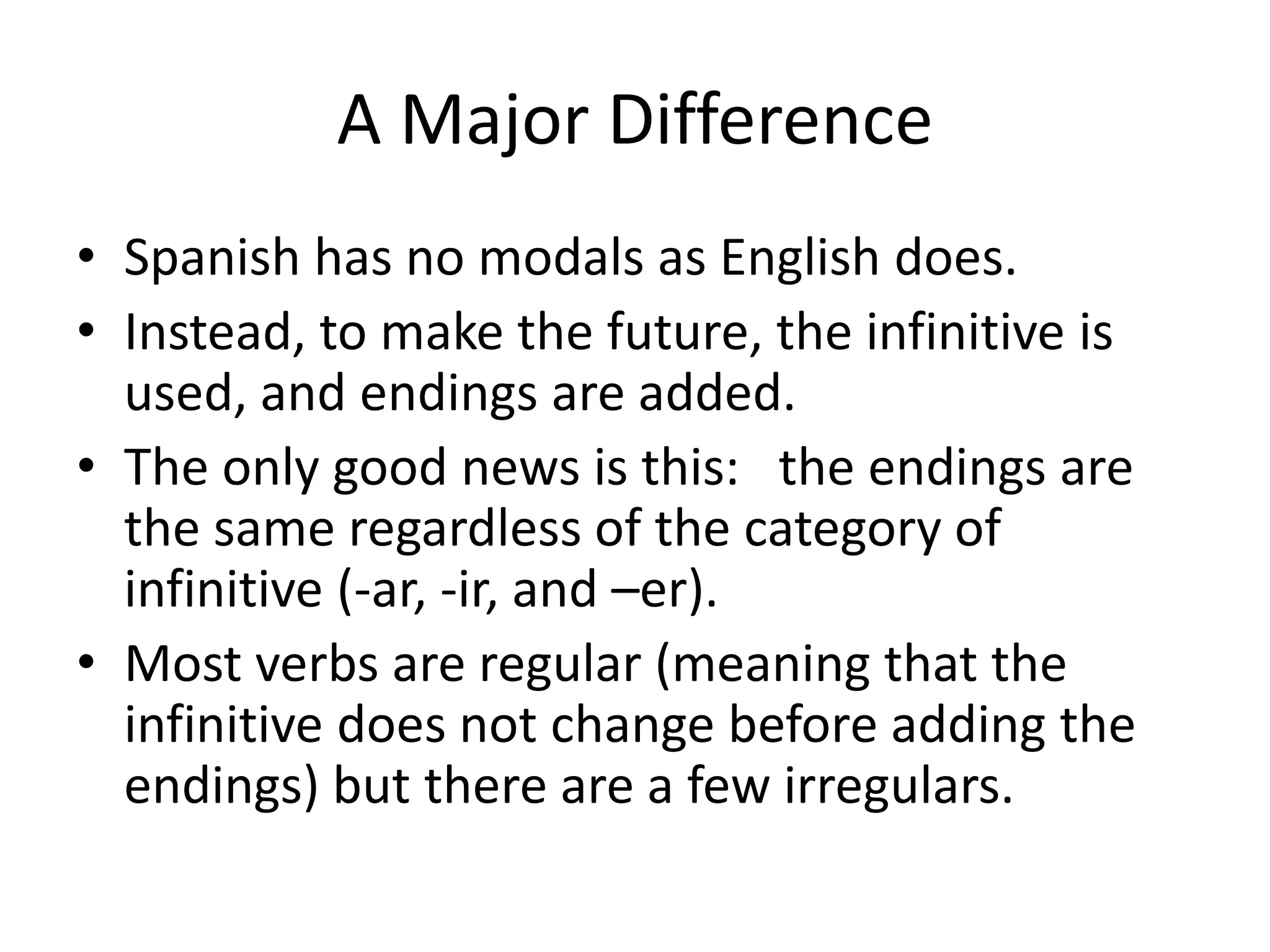
A Major Difference
• Spanish has no modals as English does.
• Instead, to make the future, the infinitive is
  used, and endings are added.
• The only good news is this: the endings are
  the same regardless of the category of
  infinitive (-ar, -ir, and –er).
• Most verbs are regular (meaning that the
  infinitive does not change before adding the
  endings) but there are a few irregulars.
The endings

• Any Infinitive + These endings (NOTE
  ACCENTS!!!)

      Person      Singular            Plural
      First       Yohablaré           Nosotros/nosotras
                                      hablaremos
      Second      Tuhablarás/Ustedh   Ustedeshablarán
                  ablará
      Third       Él/Ella hablará     Ellos/ellashablarán
The irregulars
• There are a few infinitives that change slightly
  before adding the future endings.
• These are listed on p. 75 of the grammar.
• Sadly, most of them are the high frequency
  verbs.
• So they need to be learned cold.
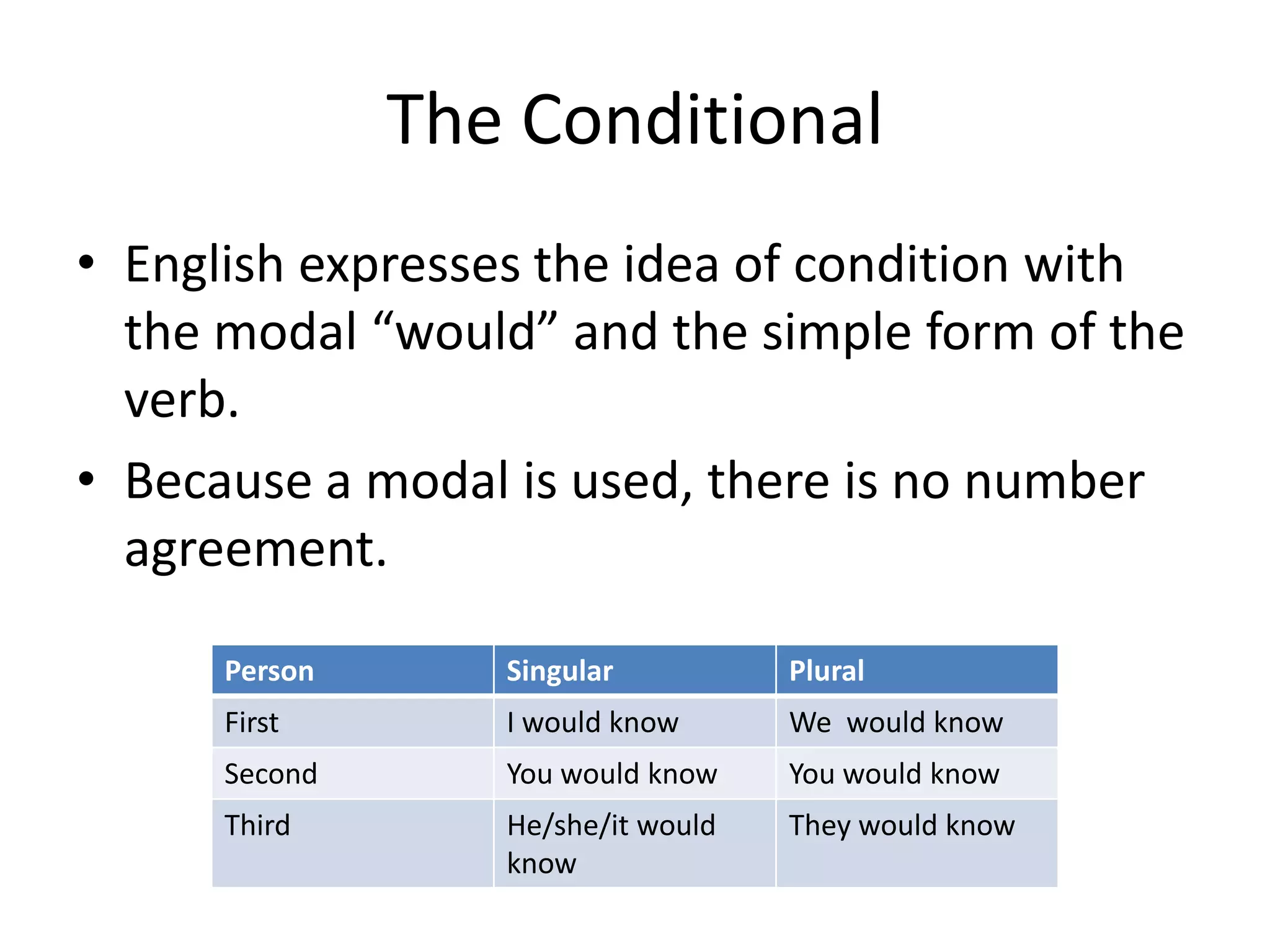
The Conditional
• English expresses the idea of condition with
  the modal “would” and the simple form of the
  verb.
• Because a modal is used, there is no number
  agreement.

      Person      Singular          Plural
      First       I would know      We would know
      Second      You would know    You would know
      Third       He/she/it would   They would know
                  know
Spanish
• The conditional in Spanish is formed by a set
  of regular endings added to the infinitive.
• The basic formation pattern is the same as the
  future --- it’s just that the endings are
  different.
Example
• Infinitive + These Endings (NOTE ACCENTS!!!)
      Person      Singular          Plural

      First       Yohablaría        Nosotros/nosotras
                                    hablaríamos
      Second      Túhablarías/      Ustedeshablarían
                  Ustedhablaría
      Third       Él/ellahablaría   Ellos/Ellashablarían
Important Notes
• Note that the actual conditional ENDINGS are
  practically identical to the –er/ir endings of
  the imperfect.
• But the imperfect is formed by DROPPING the
  –er/ar/ir ending and adding endings.
• The conditional is formed by keeping the
  infinitive intact and ADDING the endings.
CONTRAST
•   Yocomía/ yocomería
•   I was eating/ I would eat
•   Juan vivía/ Juan viviría
•   Juan was living/ Juan would live. . .
Another Note
• The basic formation pattern of the conditional
  and the future are the same --- but the
  endings are different.
• The conditional also has a few irregular
  infinitive bases.
• The irregular bases are the same in the
  conditional and the future. See p. 75/76 of
  the grammar for more on this.
Perfects – A Review
• Perfects in English (as previously studied) are
  formed by a form of “have” and the past
  participle.
• Depending on the tense of “have” the present
  perfect or the past perfect are formed.
  – I have studied Spanish for ten years.
  – I had studied Spanish for ten years.
Spanish
• As previously studied, Spanish can form the
  present and past perfects with a form of
  “haber” and an past participle that ends in
  (usually) –ado/ido.
  – Yo he hablado
  – Yohabíahablado
Perfects in the Future
• In English: Will + have + past participle.
• Example: I will have studied for ten years.
• In Spanish: Future of “haber” + past
  participle. Note: the infinitive root of “haber”
  is irregular.
      Person        Singular            Plural
      First         Yohabréhablado      Nosotros/ashabrem
                                        oshablado
      Second        Túhabráshablado/u   Ustedeshabránhabl
                    stedhabráhablado    ado


      Third         Él/Ella             Ellos/Ellashabránha
Perfects with the Conditional
• In English: Would have + past participle
• Example: I would have bought that book.
• In Spanish: Conditional of “haber” + past
  participle.
      Person      Singular          Plural

      First       Yohabríacomprado. Nosotros/ashabría
                  .                 moscomprado


      Second      Túhabríascomprado Ustedeshabríanco
                  /Ustedhabríacompr mprado
                  ado
      Third       Él/Ella           Ellos/Ellashabríanc

Spanish9

  • 1.
    The Future andThe Conditional E. Siler
  • 2.
    A New Tense:The Future • Less used than most tenses in academic Spanish. • Like English there are multiple ways of expressing the future.
  • 3.
    English • There isno real future “tense” in English . . . • But there are multiple ways of expressing the future.
  • 4.
    The Present tothe Future • Simple present tense verbs, used with very specific adverbials, can express the future. – I leave tomorrow at 8 a.m • Present progressive (present tense of BE + the – ing participle) constructions, usually also used with specific adverbials, can also express the future. – I am leaving (tomorrow at 8 a.m.) • Present progressive of “to go” with an infinitive. – I am going to leave (tomorrow at 8 a.m).
  • 5.
    The Future witha Modal • English has a category of fixed verbs called modals. • These never change for number. • Many of them, used with a simple verb, can express the future. • Examples of modals: can/could; will/shall; may/might . . • The most common future expressing modal is will.
  • 6.
    Examples • I may leave (tomorrow). • I will leave (tomorrow). • I should leave (tomorrow). • I can leave (tomorrow). • I could leave (to morrow).
  • 7.
    The Future inSpanish • There are also many ways to express the future in Spanish. • Many of these parallel ways expressed in English.
  • 8.
    The Present tothe Future • Simple present tense used with an adverbial. – Salgomañana a lasocho. (I leave tomorrow at 8). • A simple present tense version of “ir” (to go) followed by the preposition “a” and an infinitive. Person Singular Plural First Yovoy a hablar Nosotros/vamos a hablar Second Tú vas a hablar/ Ustedes van a Ustedva a hablar hablar Third Él/Ellava a hablar Ellos/Ellas van a hablar
  • 9.
    A Major Difference •Spanish has no modals as English does. • Instead, to make the future, the infinitive is used, and endings are added. • The only good news is this: the endings are the same regardless of the category of infinitive (-ar, -ir, and –er). • Most verbs are regular (meaning that the infinitive does not change before adding the endings) but there are a few irregulars.
  • 10.
    The endings • AnyInfinitive + These endings (NOTE ACCENTS!!!) Person Singular Plural First Yohablaré Nosotros/nosotras hablaremos Second Tuhablarás/Ustedh Ustedeshablarán ablará Third Él/Ella hablará Ellos/ellashablarán
  • 11.
    The irregulars • Thereare a few infinitives that change slightly before adding the future endings. • These are listed on p. 75 of the grammar. • Sadly, most of them are the high frequency verbs. • So they need to be learned cold.
  • 12.
    The Conditional • Englishexpresses the idea of condition with the modal “would” and the simple form of the verb. • Because a modal is used, there is no number agreement. Person Singular Plural First I would know We would know Second You would know You would know Third He/she/it would They would know know
  • 13.
    Spanish • The conditionalin Spanish is formed by a set of regular endings added to the infinitive. • The basic formation pattern is the same as the future --- it’s just that the endings are different.
  • 14.
    Example • Infinitive +These Endings (NOTE ACCENTS!!!) Person Singular Plural First Yohablaría Nosotros/nosotras hablaríamos Second Túhablarías/ Ustedeshablarían Ustedhablaría Third Él/ellahablaría Ellos/Ellashablarían
  • 15.
    Important Notes • Notethat the actual conditional ENDINGS are practically identical to the –er/ir endings of the imperfect. • But the imperfect is formed by DROPPING the –er/ar/ir ending and adding endings. • The conditional is formed by keeping the infinitive intact and ADDING the endings.
  • 16.
    CONTRAST • Yocomía/ yocomería • I was eating/ I would eat • Juan vivía/ Juan viviría • Juan was living/ Juan would live. . .
  • 17.
    Another Note • Thebasic formation pattern of the conditional and the future are the same --- but the endings are different. • The conditional also has a few irregular infinitive bases. • The irregular bases are the same in the conditional and the future. See p. 75/76 of the grammar for more on this.
  • 18.
    Perfects – AReview • Perfects in English (as previously studied) are formed by a form of “have” and the past participle. • Depending on the tense of “have” the present perfect or the past perfect are formed. – I have studied Spanish for ten years. – I had studied Spanish for ten years.
  • 19.
    Spanish • As previouslystudied, Spanish can form the present and past perfects with a form of “haber” and an past participle that ends in (usually) –ado/ido. – Yo he hablado – Yohabíahablado
  • 20.
    Perfects in theFuture • In English: Will + have + past participle. • Example: I will have studied for ten years. • In Spanish: Future of “haber” + past participle. Note: the infinitive root of “haber” is irregular. Person Singular Plural First Yohabréhablado Nosotros/ashabrem oshablado Second Túhabráshablado/u Ustedeshabránhabl stedhabráhablado ado Third Él/Ella Ellos/Ellashabránha
  • 21.
    Perfects with theConditional • In English: Would have + past participle • Example: I would have bought that book. • In Spanish: Conditional of “haber” + past participle. Person Singular Plural First Yohabríacomprado. Nosotros/ashabría . moscomprado Second Túhabríascomprado Ustedeshabríanco /Ustedhabríacompr mprado ado Third Él/Ella Ellos/Ellashabríanc