Verbs 9: Aspect: An
Important Inflection on Verbs
Materials by Liz Siler
Definition
• Aspect is another type of inflection
(change) that adds some extra meaning
to the verb phrase.
More on Aspect
• English has four aspects:
– simple,
– progressive,
– perfect, and
– perfect progressive.

• We will now examine how each works.
1: The simple
• The simple aspect is unmarked.
• That means that no primary auxiliaries
are needed to express this aspect.
Look for
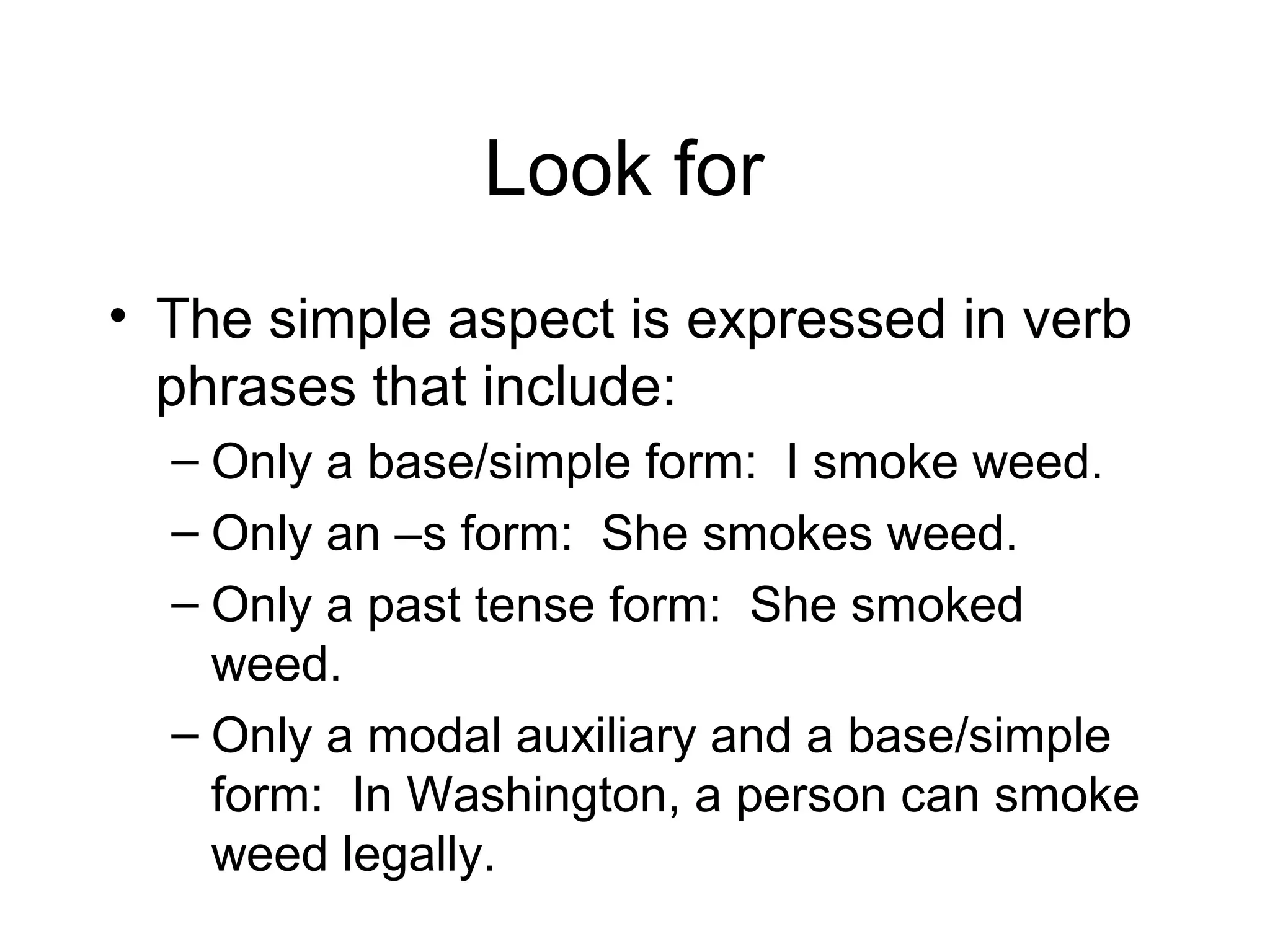
• The simple aspect is expressed in verb
phrases that include:
– Only a base/simple form: I smoke weed.
– Only an –s form: She smokes weed.
– Only a past tense form: She smoked
weed.
– Only a modal auxiliary and a base/simple
form: In Washington, a person can smoke
weed legally.
Present tense simple aspect:
• My family eats a lot of lentils.
• We support the legalization of marijuana.
• The birds in my backyard are grateful for
extra food in the winter season.
• Labradors can make excellent search and
rescue dogs.
Past tense simple aspect:
• My Labrador retriever chased a rabbit
yesterday.
• I signed a petition in support of the
legalization of marijuana.
• The birds in my backyard were particularly
noisy this morning.
• Fishermen in Newfoundland would breed
Labradors as assistants for cold-water fishing
vessels.
2. The
progressive/continuous
• The progressive is formed with a form
of the verb TO BE used as an auxiliary
and the lexical verb in the form of the
-ing participle
Look for
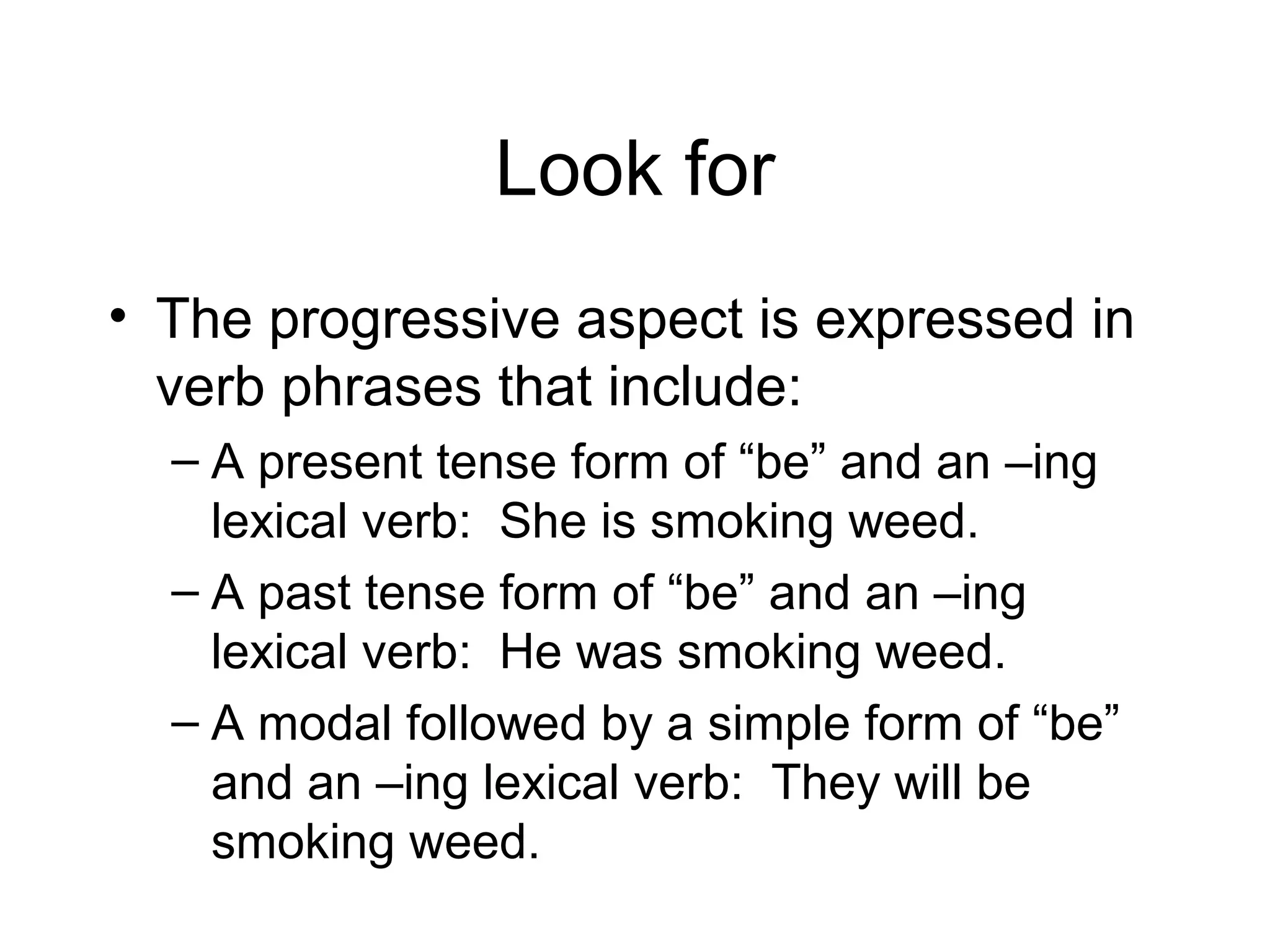
• The progressive aspect is expressed in
verb phrases that include:
– A present tense form of “be” and an –ing
lexical verb: She is smoking weed.
– A past tense form of “be” and an –ing
lexical verb: He was smoking weed.
– A modal followed by a simple form of “be”
and an –ing lexical verb: They will be
smoking weed.
Present tense progressive
aspect:
• My family is eating some lentils.
• Legislators are debating a possible
legalization of marijuana in other states.
• Those birds are chirping loudly!
• My Labrador must be splashing water
everywhere.
Past tense progressive
aspect:

• My Labrador retriever was chasing a rabbit
yesterday.
• He was smoking weed at the time of the bust.
• The birds were scattering seed everywhere.
• The dog could be barking at something in the
back yard.
3: The perfect
• The perfect is formed with a form of the
verb “have” used as an auxiliary and the
use of the past participle for the lexical
verb.
Look for
• The perfect aspect is expressed in verb phrases that
include:
• A present tense form of “have” and a lexical verb in
the past participle form: He has smoked weed for
two years.
• A past tense form of “have” and a lexical verb in the
past participle form: He had smoked weed for years
at the time of his imprisonment.
• A modal followed by “have” followed by a lexical verb
in the past participle form. She may have smoked
some weed.
Present tense perfect aspect:
• My family has eaten a lot of lentils in the last
few years.
• My husband and I have signed a lot of promarijuana petitions.
• The birds may have flown south for the
winter.
• The Labrador has flunked out of puppy
school.
Past tense perfect aspect:
• My Labrador retriever had chased a rabbit
down a hole.
• The police had arrived before his arrest.
• The birds might have gone south for the
winter.
• The dog had gone to puppy school with
several other dogs.
4: The perfect progressive
• The perfect progressive is formed with a form of the
verb “have” used as an auxiliary, followed by the past
participle of “be” -- been -- (that’s the perfect part),
followed by the lexical verb in the -ing participle form
(that’s the progressive part).
Look for
•
•

•

•

The perfect progressive aspect is expressed in verb phrases
that include:
A present tense form of “have” followed by the past participle of
“be” (been) followed by a lexical verb in the –ing form: She has
been smoking weed.
A past tense form of “have” (had) followed by the past participle
of “be” (been) followed by a lexical verb in the –ing form: She
had been smoking weed.
A modal followed by the simple form of “have” (have) followed
by the past participle of “be” (been) followed by a lexical verb in
the –ing form: She should have been smoking weed.
Present tense perfect progressive
aspect
• My family has been eating lentils for the last
several nights.
• I have been thinking about what to say for ten
minutes.
• The birds may have been picking at the corn
cob.
• The dog has been sniffing suspiciously at the
front door.
Past tense perfect progressive
aspect
• My Labrador retriever had been chasing a
rabbit for two hours.
• She had been trying to quit the stuff.
• The birds might have been playing in the
water.
• The dog had been learning a new command.
Some Cautionary Notes
• Remember there are only two tenses in
English.
• Often, however, you will hear English
teachers say (for example), “Present Perfect
Progressive Tense.”
• This is wrong.
• The tense is the present, but the aspect is the
perfect progressive.
• Get in the habit of saying, “Present Tense
Perfect Progressive Aspect.”

Verbs9

  • 1.
    Verbs 9: Aspect:An Important Inflection on Verbs Materials by Liz Siler
  • 2.
    Definition • Aspect isanother type of inflection (change) that adds some extra meaning to the verb phrase.
  • 3.
    More on Aspect •English has four aspects: – simple, – progressive, – perfect, and – perfect progressive. • We will now examine how each works.
  • 4.
    1: The simple •The simple aspect is unmarked. • That means that no primary auxiliaries are needed to express this aspect.
  • 5.
    Look for • Thesimple aspect is expressed in verb phrases that include: – Only a base/simple form: I smoke weed. – Only an –s form: She smokes weed. – Only a past tense form: She smoked weed. – Only a modal auxiliary and a base/simple form: In Washington, a person can smoke weed legally.
  • 6.
    Present tense simpleaspect: • My family eats a lot of lentils. • We support the legalization of marijuana. • The birds in my backyard are grateful for extra food in the winter season. • Labradors can make excellent search and rescue dogs.
  • 7.
    Past tense simpleaspect: • My Labrador retriever chased a rabbit yesterday. • I signed a petition in support of the legalization of marijuana. • The birds in my backyard were particularly noisy this morning. • Fishermen in Newfoundland would breed Labradors as assistants for cold-water fishing vessels.
  • 8.
    2. The progressive/continuous • Theprogressive is formed with a form of the verb TO BE used as an auxiliary and the lexical verb in the form of the -ing participle
  • 9.
    Look for • Theprogressive aspect is expressed in verb phrases that include: – A present tense form of “be” and an –ing lexical verb: She is smoking weed. – A past tense form of “be” and an –ing lexical verb: He was smoking weed. – A modal followed by a simple form of “be” and an –ing lexical verb: They will be smoking weed.
  • 10.
    Present tense progressive aspect: •My family is eating some lentils. • Legislators are debating a possible legalization of marijuana in other states. • Those birds are chirping loudly! • My Labrador must be splashing water everywhere.
  • 11.
    Past tense progressive aspect: •My Labrador retriever was chasing a rabbit yesterday. • He was smoking weed at the time of the bust. • The birds were scattering seed everywhere. • The dog could be barking at something in the back yard.
  • 12.
    3: The perfect •The perfect is formed with a form of the verb “have” used as an auxiliary and the use of the past participle for the lexical verb.
  • 13.
    Look for • Theperfect aspect is expressed in verb phrases that include: • A present tense form of “have” and a lexical verb in the past participle form: He has smoked weed for two years. • A past tense form of “have” and a lexical verb in the past participle form: He had smoked weed for years at the time of his imprisonment. • A modal followed by “have” followed by a lexical verb in the past participle form. She may have smoked some weed.
  • 14.
    Present tense perfectaspect: • My family has eaten a lot of lentils in the last few years. • My husband and I have signed a lot of promarijuana petitions. • The birds may have flown south for the winter. • The Labrador has flunked out of puppy school.
  • 15.
    Past tense perfectaspect: • My Labrador retriever had chased a rabbit down a hole. • The police had arrived before his arrest. • The birds might have gone south for the winter. • The dog had gone to puppy school with several other dogs.
  • 16.
    4: The perfectprogressive • The perfect progressive is formed with a form of the verb “have” used as an auxiliary, followed by the past participle of “be” -- been -- (that’s the perfect part), followed by the lexical verb in the -ing participle form (that’s the progressive part).
  • 17.
    Look for • • • • The perfectprogressive aspect is expressed in verb phrases that include: A present tense form of “have” followed by the past participle of “be” (been) followed by a lexical verb in the –ing form: She has been smoking weed. A past tense form of “have” (had) followed by the past participle of “be” (been) followed by a lexical verb in the –ing form: She had been smoking weed. A modal followed by the simple form of “have” (have) followed by the past participle of “be” (been) followed by a lexical verb in the –ing form: She should have been smoking weed.
  • 18.
    Present tense perfectprogressive aspect • My family has been eating lentils for the last several nights. • I have been thinking about what to say for ten minutes. • The birds may have been picking at the corn cob. • The dog has been sniffing suspiciously at the front door.
  • 19.
    Past tense perfectprogressive aspect • My Labrador retriever had been chasing a rabbit for two hours. • She had been trying to quit the stuff. • The birds might have been playing in the water. • The dog had been learning a new command.
  • 20.
    Some Cautionary Notes •Remember there are only two tenses in English. • Often, however, you will hear English teachers say (for example), “Present Perfect Progressive Tense.” • This is wrong. • The tense is the present, but the aspect is the perfect progressive. • Get in the habit of saying, “Present Tense Perfect Progressive Aspect.”